November/December 2025, January 2026 – belonging and rejoicing
I accidentally learned about another nonprofit in Walla Walla: Entrust Community Services (ECS), when a community support specialist from ECS emailed me, asking if she could bring one of her clients to our writing group. In particular she wanted to know if this individual’s limited ability to participate would be okay for the group. Neither of us knew how the individual would respond to the group, and vice versa, so of course we opted to give it a try. The staff member arrived at our meeting last week with her client, who sat in a wheelchair. As they settled in at the table, two long-time attenders sensed the communication difficulties and leaned in to take the young man’s hand and introduce themselves. I watched this warm welcome with gratitude that our little gathering has a big heart.
I thought that would be my moment of wonder for the day, but another surprise was coming. We had over a dozen people around the table, forcing a bit of a “back row,” which I don’t love. In addition to the community support specialist and her client, a young woman who wants to reignite her passion for writing joined us for the first time. Then, nearly halfway through our time together, a man wearing dark glasses and carrying a long white cane appeared in our corner. He’d been invited (in a chance encounter on the street) by someone who regularly attended the group some months ago. New to the Walla Walla area, he joined the conversation easily, and although his limited vision didn’t allow him to write with pen and paper, he “wrote” in his head and verbally responded to the second writing prompt with a story that sounded as if it had actually been written—no tangents or starting over or stuttering.
All told, 15 people came to write that day. The man in the wheelchair who lives with blindness and an inability to speak stood the most risk of feeling like an outsider. Then, by the hand of God or the wisdom of the universe, a second individual with blindness came on the same day. I can’t speak to what it was like for these individuals, but I like to think they experienced belonging, not only from storytelling and the open arms of our group members, but because each of them was not the only person there who couldn’t see. I’m reminded of the time I went to yoga class at the Senior Center. Everyone else in the room was at least 30 years my senior, and I felt out of place, until a woman arrived with her granddaughter. Never mind that she was 30 years my junior; I was no longer alone as the young person in the room.
As I run into folks from our writing group around town, hear the excitement of submitting for publication, listen to the laughter around the table, and feel us struggle together through the vulnerability of writing and, for some, the exhaustion of publishing, I rejoice. There’s just no better word for it than rejoicing. When one of our college-age participants shares that they wrote in response to a prompt at home with their mom, I feel warm inside. When two folks in the group request that we take measures to keep things on track, I am grateful for their eyes on the group dynamic and willingness to speak up and support. When we publish our own zine (I barely knew what a zine was), I am humbled by the time everyone puts in, their creativity, and their willingness to work together. This week, Thursday February 5, will mark one year since the first day I showed up at the library with water bottles, snacks, and notebooks, wondering what might come of my dream.
Additional highlights from the last three months:
- Received my volunteer badge, and participated in BPC meetings at Washington State Penitentiary almost a dozen times
- Wrote with staff at Akin in November, and am now scheduled to write with them once a month as an ongoing self-care event for staff. Thank you Shawniene for this opportunity. (I also had coffee recently with Megan from Akin, and thoroughly enjoyed making her acquaintance)
- Attended an open house for Hope Heals on November 19 at their new-to-them building, where a food pantry, clothing, and counseling services are available, among other things
- Enjoyed an all-day online storytelling workshop by The Hearth
- Watched Come See Me in the Good Light documentary with my sister at Powerhouse Theatre
- Attended Together 26, an annual community art event highlighting healing and recovery, at the Reid Center on the campus of Whitman College
“Salvation happens every time someone with a key uses it to open a door he could lock instead.”
–Barbara Brown Taylor, from her book Leaving Church
September/October 2025 – elementary school, penitentiary, library, COMMUNITY
We’re in the middle of Red Ribbon Week as I write this. On Monday morning, Becky Turner from Community Resilience Initiative gave an interactive presentation on drugs, resilience, and healthy choices. Tuesday, Craig Bonson brought the MX Powerteam trailer and motorcycle. There are half a dozen opportunities to win prizes throughout the week, and a friend of mine who lived through overdose will share her story with us on Friday. It has been a lot of work, a delight to work with so many community partners (all prizes were donated by local businesses), and fun to see the kids engaging with questions, conversation, and participation in dress-up days and contests. My goal is to let the “just say no” message be a small part of the narrative, and to highlight what builds resilience and how resilience happens in community.
Writing at the Walla Walla Public Library is going strong. One individual self-published a book. Several others are also working on books, while some of us, myself included, write short pieces in response to the writing prompts. One of our more recent regulars expressed gratitude for the healing that takes place as we write and as we listen, affirming again that this group is a catalyst for both creativity and healing (which may be one and the same) in our community.
These past couple months, I attended half a dozen incredible events. To see pictures from the overdose awareness event, look me up on Instagram @jesusmyfavorite subject. (OR, if you’re a newsletter subscriber, I shared pictures via email last month.)
– Sept 3 – End The Stigma: Overdose Awareness
– Sept 9 – “Talk Saves Lives” webinar about suicide prevention, hosted by ITIC
– Sept 9 – “Trauma-Informed Writing” webinar with JoLanda Rogers, hosted by Writing for Your Life
– Sept 10 – Sabbath Queen movie, hosted by Powerhouse Theatre (Wow! I recommend seeing this film if you have the opportunity.)
– Sept 20 – Concrete Mama Community Celebration, a fundraiser for the hit podcast, Concrete Mama, recorded inside the Washington State Penitentiary here in Walla Walla
– Oct 7 – “Positive and Negative Uses of Social Media in Adolescents” webinar, hosted by ITIC
I’m BEYOND excited that volunteering inside the Washington State Penitentiary (WSP), through the Black Prisoners Caucus (BPC), is moving forward. On September 29, I attended a BPC Reentry meeting at WSP. I wore a pair of mail-order slip-on shoes for the first time, assuming they would be comfortable, but they rubbed blisters on the backs of my ankles. I’m told the walk from the security entrance to the unit where the meetings are held is about a half mile. We saw only a few guards leaving work as we traversed the wide concrete walkway segmented by a series of locked gates that were opened as we approached by staff in guard towers.
The meeting took place in a small room that serves as a library and meeting room for incarcerated individuals (II’s), and is also used for Department of Corrections (DOC) meetings. My husband went with me – both of us on guest passes. More than a dozen II’s, dressed in a combination of white, gray, or tan pants and t-shirts, and half a dozen volunteers, gathered around a couple of long tables set up end to end. One of the BPC leaders, an II with a slight southern accent, started the meeting with a group story-writing icebreaker—each person contributed a word, one at a time, around and around the table, until we had written a few paragraphs of questionable prose. Hearty laughter punctuated this group improv.
Then II’s and volunteers gave updates—on BPC classes, community partnerships, etc. After that we broke into smaller groups so the folks coordinating specific aspects of BPC or the programs they offer could plan and discuss. My husband and I had an informal welcome and orientation with the same II who led the group icebreaker. Then we chatted with an II who has been working toward offering a writing and philosophy group, a place I may get involved because of my passion for writing.
We shook hands with many of the II’s as they came in for the meeting, and again as they left, two and a half hours later. Some introduced themselves with nicknames, and some with their given first name. One individual had contributed artwork to a fundraiser I attended, so I checked when I got home and it turns out I had purchased multiple paintings by him. There’s an element of excitement to meeting some of these people I’ve heard of through the Concrete Mama podcast and local art and fundraising events. I’ve been exposed to their work, and since most people have no way to contact them, it feels slightly thrilling to meet them in real life on the inside.
A few of the nuts-and-bolts of getting to this point: being recommended by other BPC volunteers, emailing those volunteers as well as multiple DOC employees, filling out a dozen pages of various forms (background check, confidentiality agreement, volunteer application, etc), taking those forms to WSP, meeting in person on the outside with other volunteers, completing an in-person volunteer orientation process with the Community Partnership Program Coordinator at WSP, reading a handful of online courses and signing certificates of completion.
I’m still waiting for my volunteer badge, which will allow me to attend BPC events without going through the guest clearance process. I’m having conversations with my family about how many volunteer hours are practical, since they all fall on weekends and evenings, the same times kids are home. I’m also getting emails about new volunteer rules—two in the last few weeks already: volunteers must use a clear bag for any items they bring in (water bottles, books and notepads seem to be acceptable, as long as we’re not leaving anything with the II’s), and II’s may no longer use golf pencils or #2 pencils (however, volunteers may, so long as we don’t share them with II’s). I must admit, I am nervous about breaking a rule (oops, you needed a pencil and I handed it you without thinking), wearing the wrong thing, saying the wrong thing. While the environment does not feel especially controlled or stifling to me when I’m there, those hundreds and hundreds of rules, directives, guidelines and laws seems to lurk, waiting for me to make a misstep.
But mostly I don’t worry about the rules. I find the II’s contagiously full of life, and am honored to be a small part of what they are working hard to provide for themselves and fellow II’s. Time will tell what my involvement will look like. In addition to the reentry meeting, I was able to attend their monthly BPC general meeting in October on a guest pass. It was not unlike the reentry meeting, in that a generous portion of time was committed to an icebreaker question, and folks had the opportunity for individual discussion after the meeting was over. It’s fascinating to see what collaboration looks like without texting, phone calls, or email!
This update has grown long, so that’s it for now. Look for the next update in a month or two.
“I often walk with a spring in my step along the barbed wire.”
–Etty Hillesum, from Etty Hillesum: Essential Writings, Selected with an Introduction by Annemarie S. Kidder
June/July/August 2025 – opportunities and connections
Summer. Everything crammed. Meetings and courses and writing groups squeezed between swimming lessons, drama camp, travel, and playdates for my daughters, now 11 and 12 years old. As school begins again, I hope for more space. Then I realize that hope is not enough. I will have to plan for more space, by saying “no.” This is not easy for me, especially because the opportunities coming my way are deliciously aligned with my passions. I’ll be coordinating Red Ribbon Week for the small private school my daughters attend, and I’m SUPER excited. Two years ago, I had only the tentative beginnings of the body of knowledge and connections I will draw on as I put together information and activities for each classroom and for the whole student body.
Below are some of the trauma-informed learning and opportunities I benefited from over the summer, and a short update on our writing group at the WW Public Library.
Events:
SAND film screening of The Eternal Song
– Janelle Hardy’s “Stories From the Body Writing Challenge,” a free yearly event. It took place July 6-11 this year.
– Powerhouse theatre – Your Fat Friend film screening, June 25
– Powerhouse theatre – Red Badge Project reading, July 10. My third time attending this annual event. (scroll down to the “2014-2023 – the birth of an idea” and “July 2024 – a small circle” entries to hear how Red Badge has influenced my writing)
Training:
-Two thoughtfully-paced, research-based and engaging opportunities from the Community Resilience Initiative: the self-paced, online “Trauma-Supportive Certification,” and “Moving from Trauma-Informed Care to Healing-Centered Practices,” which I attended live online with Teresa Posakony on June 2 and 9.
Opportunities:
-Turned in paperwork to volunteer with the Black Prisoners’ Caucus – more on this another time. (This film is one way to learn more about BPC)
-Applied to participate in the Austin Story Project, a training on transformational storytelling.
-Working with the WW Community Change Team to put together a book containing 10-ish stories of local individuals who have struggled with substance use. I’m thrilled to be a part of this project, and will share more as things develop.
“It’s a good problem to have.” More than one person says this about our growing writing group at the library. And I suppose if I had to choose between growing and shrinking I’d choose growing… But in order to allow time for both writing and reading, it’s sometimes necessary to divide the group, which makes me feel out of control, and selfishly I want to hear what everyone writes. So I struggle to make the call on when to split into smaller groups. Over the summer we averaged 7-10 people, with more than a dozen one day, and only one another day. Twice I was out of town and a volunteer led the group.
About a quarter of regular attenders are gender expansive. As they share their preferred names and pronouns with the group, I am again aware of the sacred space we create for each other, and the importance of that safety. And selfishly, I am delighted. My everyday acquaintances are gender conforming, so when I engage with gender-expansive individuals I feel prone to mistakes and misunderstanding, using wrong terminology, offending someone. The best way to get over this is real interactions in real life. I am grateful for this opportunity.
“Our listening creates sanctuary for the homeless parts within the other person.”
–Rachel Naomi Remen, from her book Kitchen Table Wisdom: Stories That Heal
May 2025 – light in the darkness
“I have crawled out of a dark place since I have started and am most grateful.” I sat at my desk reading emails, including this one from a woman who’d been attending our writing group at the library. When I shared this sentence of gratitude with my husband, his response was most insightful. “That’s what you wanted,” he said.
Yes. That’s what I wanted. And what I still want. I bought a t-shirt this year that’s black with white lettering, “Write your way out of the dark.”
I am mesmerized by the healing power of writing, of story, of small groups. And every Thursday morning these things come together. They arrive in the farmer, the retired professor, the stay-at-home dad, the almost-monk. Together we write, we listen, we sit in each other’s presence.
I am initially surprised by how eager many participants are to read aloud what they’ve just written. Reading aloud is always optional, and I thought timidity would prevail. But often someone has their hand up to read before I’ve finished the invitation. It is human nature, I think, to bask in being heard. When this writing group is a safe place to be heard, reading aloud becomes sacred and desirable, a gift to both the listener and the speaker. There is no one alive who doesn’t want to be heard.
In May, our fourth month of weekly meetings at the library, those who attend regularly begin to let me know when they won’t be here. Since there is no requirement or expectation to participate, I take this spontaneous communication as a sign of belonging. I don’t need to know when a regular attender will be gone, but they want me to know—and I want to know. They want the group to know—and the group wants to know.
What we create together matters, and it is our presence with each other that begins to stitch our lives together. It’s not the snacks I bring, or the water bottles and writing prompts I provide that pull folks to return. It is the experience of seeing and being seen. We see each other seeing each other. We write imperfectly. We accept and bear witness to each of our innate creativity. We laugh and groan and cry and sigh. We risk revealing what is inside our shells, and we honor the miracle of seeing what is inside the shell of another.
After some weeks of 3-6 participants, our numbers increased to about 10 for the second half of May. Last week, our time included lively discussion of the positive-response guidelines for verbal feedback, as well as suggestions for what will keep our group safe. This arose spontaneously, and I’m delighted that we’ve moved beyond the phase where I lead and everyone follows. This is not my group; it is ours. When I travel later in June, leadership will pass to willing volunteers. This group is now bigger than me, in purpose and in spirit. It is alive and—to borrow Christian lingo—it is light in the darkness.
“We live storied lives. We organize experience into stories… The stories we hear fuel our empathic connections. They change our brains.”
–Lewis Mehl-Madrona, as quoted by Judy Atkinson during SAND’s The Eternal Song film online premiere, June 2025
April 2025 – are we in the flow?
This is a short update, as I haven’t done much outside of leading writing groups. As I wrote on my Facebook page, I’m getting to know some of the frequent attenders at the library group, and what a funny, creative, inspiring group they are! I am amazed every week by their writing. One prompt in particular that brought out imagination and laughter involved describing an object as if you are an alien seeing it for the first time, and relating its features to another alien. I provided each of us with a red onion for this exercise, and the fresh and juicy writing matched the spicy onions.
I continue to learn about local nonprofits, often by attending their fundraising events. In March I attended the Friends of Children of Walla Walla breakfast, and in April the YWCA luncheon. Both were held in the large ballroom at Whitman Hotel and Conference Center in downtown Walla Walla. Both highlighted the courage and determination of individuals who truly see people, and create organizations that allow that act of seeing and being seen to be repeated, a beautiful ripple effect.
I returned to the STAR Project on April 12 and wrote with two individuals, both of whom wrote better than I did. In May I’ll lead a third group with STAR and then evaluate whether to continue. I returned to Hope Street on a Wednesday morning in April to write with the residents there.
As summer approaches, I’ll ask for volunteers in the writing group at the library to keep it going on the Thursdays I’m out of town, as camping trips already dot our summer calendar.
“Ignorance breeds fear breeds avoidance breeds misunderstanding breeds stereotypes breeds prejudice breeds hatred breeds violence. Stop the cycle.”
-Patti Digh, from her book life is a verb
March 2025 – success and stretching
Nine women gathered for our first meeting at the library in February. The first meeting in March, there are four men, and me. As the weeks go on, the group settles to about four to seven each week, of mixed genders. Writing prompts include a spread of photographs—choose one and write what comes to mind; write a letter; write a poem of instruction. I always bring snacks and provide water bottles. After several weeks carrying a tote heavy with water bottles and journals, I get permission to store some of my supplies at the library.
Most everyone reads their writing aloud during the optional reading time after each writing session. As weeks pass, I notice there is less shyness and more eagerness. We want our words to be heard. Before each time of reading aloud, I remind us of four guidelines, outlined this way in my notes (adapted from Pat Schneider’s guidelines in Writing Alone and With Others):
We’ll provide each other positive verbal feedback after each reading. Specifically:
- Assume all written work to be fictional. It may help to speak about “the child,” “the father,” “the woman,” etc. as a way to keep your comments focused on the story and not the author.
- Say what you like, what stays with you. We won’t ask questions, make interpretations, or offer suggestions.
- Uphold confidentiality. Our stories are sacred, and ours alone to share.
- Welcome diversity.
Here is where I begin to notice my awkward discomfort when it’s necessary to give reminders about these guidelines. The ways we stray always seem small—one bit of advice, a personal anecdote, a question—and I tell myself if everyone is safe and happy I don’t need to intervene. But a wiser part of me knows two things. First, that I am uncharacteristically afraid of intervening, and the only way to get over this is to practice. Second, it will be easier to give small reminders about clear guidelines than wait until something “big” happens and have to start over again by admitting I’ve let things slide.
I realize I may be over-thinking this, but I also know I want to practice a skill I have never understood—how to enforce guidelines or rules without judgement, punishment, awkwardness, disconnection. In my experience, correction comes with piles of extra baggage that basically equate to shame. But I have watched people “enforce” rules in a way that is infused with connection, and not at all shaming. In fact, holding a group accountable for each others’ safety can be affirming. All my life I have felt small when someone corrects me. I oscillate between apologizing and defending. “I’m SO sorry!” or “I didn’t mean THAT.”
Reading Gregory Boyle and Becky Kennedy gives me glimpses of what it might look like to have boundaries that are not segues to disconnection. While I explore these new possibilities, I am grateful for the kindness of the folks who gather to write. I assume they are all more skilled at connected boundary-holding than I am, but they are gracious and generous with me. I give an awkward reminder here and there, with too many caveats. But I am determined to keep at this.
After nearly a year of waiting to hear back from the STAR (Successful Transition and Reentry) project about next steps for writing with their clients inside and out of the state penitentiary, I received an email from one of their staff. We set a time to meet, rescheduled because my kids were sick, and finally met on a Tuesday in mid-February. A delightful and informative conversation led to three Saturday writing groups on my calendar—in March, April, and May. Two hours each, they would take place at the STAR project office in Walla Walla, a small building that looks more like a house than an office, a bit shabby, with many small spaces connected by small hallways. The room we write in faces East and spring light sloshes in through large windows.
The first time I come to write, the two-hour session is half over before anyone arrives. Several STAR staff are tucked in offices at different corners of the building. A petite staff member, probably in her twenties, joins me at the tables we’ve set up for writing. We chat (and she educates me on grant writing) until three women arrive to write. A man and another woman come in a few minutes later, and the five of us write together in response to a prompt about “firsts”—first job, first time driving, seeing the ocean for the first time. There’s a different energy here than at the library. It will take me a while to find words to describe it.
“There’s nothing more valuable than learning to find our goodness under our struggles, because this leads to an increased capacity to reflect and change. All good decisions start with feeling secure in ourselves and in our environment, and nothing feels more secure than being recognized for the good people we truly are.”
-Dr. Becky Kennedy, from her book Good Inside
February 2025 – library group takes off
Nine women around a table. How many movements have begun in this way, with women who are unafraid to gather, to feel, to think, to write, to speak? Only God knows. “A movement,” I suppose, is a grandiose representation of this writing group, gathered in the large-print corner of the public library, a calm retreat from the below-freezing temperatures and snow of February.
It’s the year 2025, and I am facilitating the first meeting of a writing group I’ve been dreaming for more than 18 months. “We’re going to jump right in,” I say. “Since this is a writing group, we’ll introduce ourselves in writing. I’ll give you three sentences to complete, and after we take a few minutes to do that, we’ll read around the circle. The sentences are: ‘I am . . . ‘, which is a great place to tell us your name, and anything else you want to add; ‘I like . . . ‘; and ‘Once I ate . . . ‘” I repeat these instructions and soon we’re all writing.
For two hours we write and read, listen and respond, eat pumpkin-spice pretzels and laugh. We cry, too, and since I didn’t think to bring tissues, I’m grateful for the box already on the table.
As the weeks go by, it’s clear this group is filling a need. Some people who come are greiving. Some are excited to revive a passion that lay dormant, squeezed out by other seasons of life. Some are writing books. Others come from film-making or theater and bring their artistry to a new medium of writing. Not everyone returns after one session, but the majority do. The second week, three men diversify our group, and with a dozen of us writing together, I ask a friend to take half the group to another corner of the library for the reading-aloud portion of our time together.
Over the course of the month, three participants turn in a response form I’ve provided, which involves completing three sentences: “I like . . . “, “I wish . . . “, and “I need . . . ” (shout-out to Becky Turner and CRI, who introduced me to this format). Respondents like the writing prompts, the safety of the group, and they indicate they want to keep coming and to tell their friends. I send their responses to Josh at the library and he e-mails back: “I’ll be putting this on the calendar indefinitely.”
Two or three participants are especially excited that the group will continue beyond what we originally advertised (two months). Their gratitude fuels my own. I get to do this. None of us are required to be here—by law, by God, by academics, by parents—yet we are here at my invitation, our lives intersecting for two hours each Thursday, for the love of words.
My community, local and beyond, continues to provide opportunities to connect and learn. In February these included:
- Powerhouse Theatre showed My Own Normal—you can learn more about the film here: https://myownnormalmovie.com/.
- The Walla Walla Community Change Team hosted their annual “Together 25” art show, which highlights “addiction, recovery, and resilience!” Currently (March 11, 2025), their web site shows details for a new event, “High Schools Together for Change,” happening this weekend.
- Trilogy Recovery Community held their first-ever fundraising luncheon, with keynote speaker Matt Beisner.
- Monthly discussion group hosted by Writing For Your Life. This month’s topic—presented by author and artist Roger Hutchison—”Speaking Your Writing into Being,” covered writing a book with a dictation app, and embracing unconventional ways of writing and creating.
“Safety is not just a lack of danger; it’s a kind of connection.”
-Betsy Polatin
January 2025 – collaboration feels like belonging
So much and so little happened in January. I didn’t attend any trauma-informed-care trainings, although I did dive back into Pat Schneider’s book, Writing Alone and with Others. Pat’s book provides the framework for these writing groups, as well as the majority of writing prompts. Although the title, Writing Alone and with Others, sounds rather dry, I’ve enjoyed every page—even the 65 pages of “Additional Exercises” at the end of the book. Pat’s wisdom, honesty, and decades of experience hold my hand as I venture into the space of facilitating writing groups.
And speaking of facilitating, it’s happening! Here’s the low-down on a new trauma-informed writing group at our local public library, facilitated by yours truly:
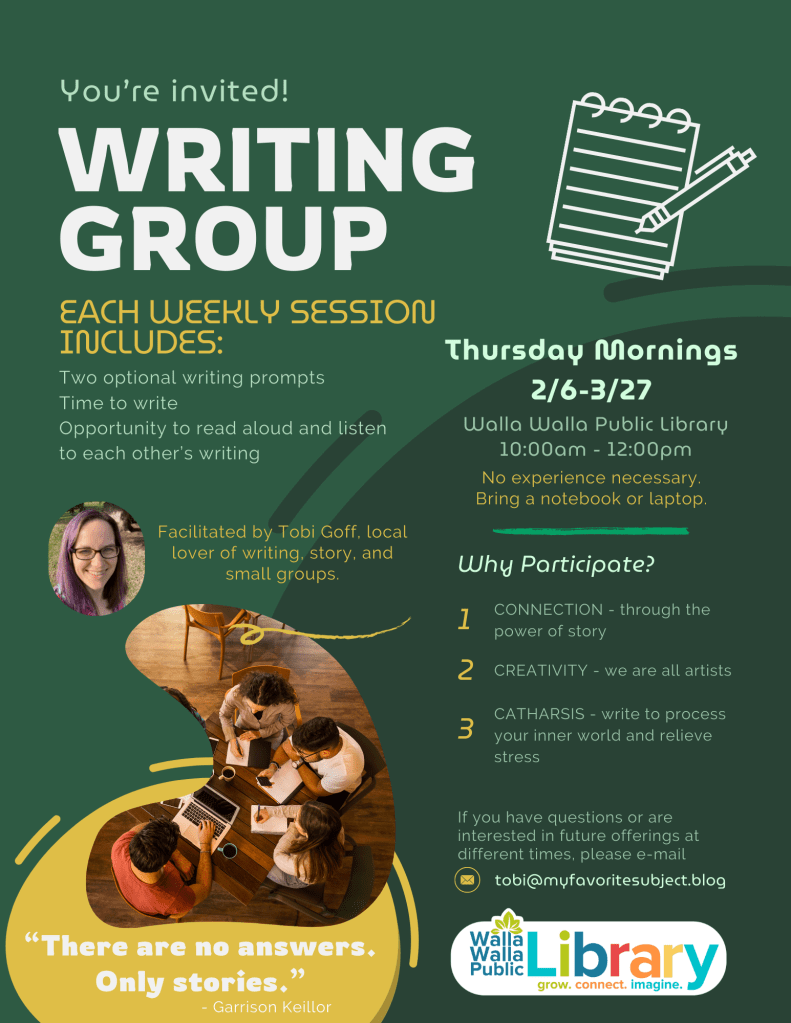
I continue to be surprised by people’s willingness to help me get this endeavor off the ground. Maybe the folks I’ve known a long time are willing to do me a favor because, well, they’ve just known me so long. But many I’ve met in the last year are diving in with their support and skills. One new friend donated $25 to buy journals, and hung posters up around town; another friend I met last summer designed the flier, and sat down with me to learn the format we use for group sharing so that if our group ballooned in size she could step in as a second facilitator; a generous acquaintance at a local nonprofit promoted the event through her organization’s email newsletter, Instagram, and LinkedIn.
Perhaps due to my avoidant tendency in terms of relational attachment, I find it truly surprising when someone offers their help—no codependency, no fishing for validation or a favor in return. As I experience the joy of collaboration over and over, it gives me profound moments of optimism about the good in humanity, and a first-hand understanding of the power of positive support for pursuit of a dream.
So, thank you to the dozens of friends, acquaintances, and strangers who have encouraged me during the past 18 months. And a special thanks to these businesses who are displaying posters about the writing group:
FVC Gallery
Sonbridge Community Center
Christian Aid Center
Walla Walla Alliance for the Homeless
Trilogy Recovery Community
Valley Vision
Milton Stateline Adventist School
Bright’s Candies
Thrive! Integrative Health and Physical Therapy
Dayton Public Library
Walla Walla YMCA
Walla Walla YWCA
Super 1 Foods
Grocery Outlet (employee break room)
Andy’s Market
Now that the flurry is over—delivering posters, printing writing prompts, editing group guidelines, going over details with the library—all that remains is just a bit of nerves and whole lot of excitement and gratitude. I am well-supported, and I get to create a space for others to receive the wonder and belonging of community support through the acts of writing, reading, and listening.
“We are all connected to one another and to the mystery at the heart of the universe through our strange and marvelous ability to create words. When we write, we create, and when we offer our creation to one another, we close the wound of loneliness and may participate in healing the broken world. Our words, our truth, our imagining, our dreaming, may be the best gifts we have to give.”
-Pat Schneider, from the Introduction to her book Writing Alone and with Others
December 2024 – so. much. learning.
I’ve been soaking up information about trauma-informed care for a year and a half. And I want more! Can I say again how lucky I am to spend time learning about a subject that interests and energizes me? I am grateful/thankful/blessed—all those #hashtag things people say.
In December I completed Community Resilience Initiative’s “Course One: Trauma-Informed Certification.” The information isn’t earth-shattering, yet it is profound. Lead trainer Rick Griffin says, “All behavior is communicating something. If we could look beyond the behavior to what it’s trying to communicate, we would be far more effective in working with human beings.” This concept, backed by the latest brain science, makes way for a paradigm shift in how we view ourselves and others. On some level it’s about mindfulness—staying present with ourselves, so we can be present with others. As a side note, I’ve been practicing 4-7-8 breathing (if you’re not familiar, Google it) since it was recommended in the course material, and of the handful of breathing exercises I’ve tried, it’s my favorite.
I’ve taken four courses recently from the Institute For Trauma Informed Care:
- Trauma-Informed Care for Youth Impacted by Domestic Violence and Abuse
- Adverse Childhood Experiences
- Discovering We Are Resilient
- Emotional Awareness and Its Impact on Our Mental Well-Being and Success
Several weeks ago, I joined the College Place Prevention Coalition. I’m still learning what exactly this group is about, but near as I can tell, it’s a community coalition committed to teen substance use prevention. They hosted an event in November to educate adults about drug and alcohol paraphernalia and use, and provided information on mental health and other risk factors for teens (blog post about this coming soon). In December, the coalition participated in a strategic planning meeting with the Southeast Prevention Network Coalition leaders from the Benton Franklin Health District (that’s a mouthful!). I especially enjoyed listening to the disagreements in the room.
My primary reason for joining the group (I’ve committed to one year) is to meet people who are working with local youth—and of course keep my eye open for opportunities to facilitate writing groups. If anything I do contributes to individual or community wholeness and the reduction of trauma, that will be a bonus!
I continue to attend Community Change Team meetings, as well as Becky Turner’s monthly Community of Practice for trauma-informed care. I also attended my first Member Meeting with Common Roots Housing Trust, our local community land trust organization. They are in the early stages of providing more sustainably affordable housing in our community. Woohoo! And, as a bonus, I met in person a lovely woman I had previously met only in online meetings (we are in two or three community groups together).
I’ll close with two exciting updates.
First, I’m working on defining trauma-informed writing. Here’s the current draft:
Trauma-informed (TI) creative writing invites us to (re)discover our personal voice. When we do this, we become aware of the value of our experiences – both inner and outer – and realize that every one of us is an artist.
In TI creative writing groups, a workshop facilitator provides writing prompts followed by periods of quiet individual writing, and participates with the group in reading aloud, listening, and responding to each other’s writing.
As we write together and read our stories aloud (always optional), we (re)connect to ourselves, and to our community.
Second exciting update – I met with Josh Armstrong, the Youth and Adult Services Librarian at our local Walla Walla Public Library. I’d been at the library on December 7 at the invitation of Scott Kasenga, Executive Director of our local student mentoring program, Friends of Children of Walla Walla. Mentors from Whitman College came to decorate Christmas ornaments, enjoy hot cocoa and cookies, and participate in other fun activities with the kids, including a writing craft I created (a positive-identity acrostic). While I was there, I gave my card to the librarian at the help desk and asked if I might be able to facilitate a trauma-informed writing group at the library. She connected me with Josh, which started an email conversation. Soon after, I stopped at the library and together we looked at a few spaces that might serve well for a writing group. I’m now in the process of recruiting friends to attend and help me get the group off the ground, and creating marketing materials. With any luck, I’ll launch an ongoing community creative writing group in February!
“There are no answers. Only stories.”
-Garrison Keillor
October-November 2024 – emerging themes, and the healing power of writing
I’m beginning to find themes in the conversations, classes, and books about trauma-informed care. I’m hearing the same things on repeat. Far from being boring, this is actually exciting. I can tell I’m getting closer to a point where I’ve internalized the basics and can share them with others, and apply them to what I do and write.
Two of these repeating themes come to mind at the moment. First, the ways we can engage with each other that promote emotional safety. While this conversation is often focused on individuals who have experienced significant trauma, all of us share the need for safety and have some level of trauma. Practices that support safety include predictability and stability, curiosity, inclusion in decision-making, empowerment, finding voice, introducing calming practices, and giving options to support a sense of agency. These elements are valuable in our internal world—interactions with ourselves—as well as our external experiences.
The second theme I’m noticing is the science of our brains and bodies. From the basics of fight-or-flight, to the complexities of epigenetics, our brains and bodies work hard on our behalf, mostly without asking us first. While this is important for our functioning, we can become stuck in painful patterns. Understanding this provides an opportunity to reframe our thinking toward what the Community Resilience Initiative (CRI) calls “safety predictions” instead of “threat predictions.” CRI’s framework for understanding trauma suggests that human brains are not constantly reacting, so much as they are constantly predicting—What is likely to happen next?
From the predictive-brain viewpoint, emotional triggers are seen as “the brain’s attempt to make meaning out of past experiences by issuing a threat prediction. … It is statistical patterning based on each person’s unique history, culture and experience.” Predicting a threat then results in dysregulation, which in turn “leads to defensive or offensive behavior.” (I’m quoting here from CRI’s “Course One: Trauma-Informed Certification,” a rich body of knowledge, delivered in bite-size pieces in a variety of formats (reading, video, interactive), with references to many additional resources.) Brain science is a powerful tool for reducing shame and stigmatization. It helps make sense of what has often felt scary or unapproachable—in ourselves and others.
It’s a bonus that the trauma-informed training and information I devour often serves as personal therapy. In Oct/Nov I completed SAND’s “Pathways to Wholeness” course by Gabor Maté and Betsy Polatin. I took the course to expand my understanding of trauma and healing. At several points I was surprised by my own tears as Gabor spoke to emotional pain and its sources. I’m learning to be compassionate with myself, which is—whether I like it or not—a precursor to true compassion toward others.
In my last update, I mentioned three books on my TBR list—G-Dog and the Homeboys, Trauma Stewardship, and Between the Listening and the Telling. I’m three chapters into Trauma Stewardship (by Laura van Dernoot Lipsky, with Connie Burk), which begins with repeated reminders of the importance of engaging with my own self before I engage with others. The authors write, “… our capacity to help others and the environment is greatest when we are willing, able, and even determined to be helped ourselves.” (pg. 16) This is equally exciting and intimidating. I get to be fully engaged, body, mind, and soul, in this pursuit of healing, AND I don’t get the option of disconnecting, putting my head down, and just plowing through. To be present to others, I have to present to myself.
I devoured G-Dog and the Homeboys, and felt a joy and kinship with one particular story, in the introduction, that relates the healing power of writing. The author, Celeste Fremon, attended a poetry reading by a group of homeboys and homegirls, the culmination of four months in a poetry-writing workshop. Near the end of more than two hours of poetry readings, a young man named Joseph Holguin stood up to read. Fremon writes, “Before he began to read, he told the audience a story about how [the poem] came into being. Late the night before, Joseph said, he had learned that his brother-in-law had been beaten nearly to death in some kind of fight. The brother-in-law was in intensive care, still alive, but his prognosis was uncertain. ‘This man raised me like a father, so when I heard a part of me wanted to go out and get revenge.’ In previous days, he said, that’s exactly what he would have done. ‘But instead, I took all those feelings … and I wrote a poem.’” (pg. 14)
Fremon goes on to talk about “meeting complexity with complexity” by employing a broad array of approaches to gang intervention. My personal favorite, of course, relates to writing: “… the embryonic belief that one’s voice is of consequence, and that the wounds of one’s body and psyche need no longer be liabilities, but can be transformed into poems and stories capable of healing.” (pg. 15)
Yes and Amen.
“If we put aside our fears and simply observe what is in front of us, there is something in every moment to honor.”
-from “Trauma Stewardship,” by Laura van Dernoot Lipsky with Connie Burk
August-September 2024 – loving what i do
I’m sitting on our porch this afternoon, facing the plentiful greenery that is our side-yard: trees, bushes, lawn. It’s a lukewarm day, and I mean that as a compliment. There’s a light breeze and it is neither hot nor cold. It’s one of those rare times when I feel like I belong outdoors. The kids have been in school for six weeks, and I’m finding my stride as I spend more time at my desk—Monday is email day, Tuesday to-do list, Wednesday blog post, Thursday is project day, and on Friday I submit writing for publication.
I’m continuing to educate myself on trauma-informed care, and toward that end I participated in several events during August and September:
- ITIC classes:
- Understanding, Supporting and De-Stigmatizing Trauma when Treating Substance Use Disorder
- Introduction to Trauma-Informed Care
- Implementing TIC Principles
- Writing Trauma That Heals, with Kate Owen Kennedy – a Writing for Your Life “Second Tuesday Discussion Group”
- Trauma-Informed Community of Practice meetings, hosted by Becky Turner
- Gabor Maté’s 3-hour presentation on his new book The Myth of Normal: Trauma, Illness, & Healing in a Toxic Culture, live from Copenhagen
- Collective Healing Conference – 8 days of free talks about trauma, healing, mindfulness, and many other topics, hosted by Thomas Hübl and his team
All of these events were on Zoom, YouTube, WebEx, etc—platforms that allow me to access much more wisdom and information than I would be exposed to in an internet-less world. In addition, I treasured—as always—personal connections. I had a wonderful conversation with Katheryn Witherington over matcha lattes in my back yard. Kathryn is the executive director of Common Roots Housing Trust, a local non-profit dedicated to creating “permanently affordable homes.” Kathryn explained it to me, but I can’t repeat the info with any semblance of clarity, so if you’re interested, watch this video.
I met Kathryn this summer when our kids became besties during a summer theater day-camp. She asked interesting questions and encouraged me in my pursuit of writing, and she—along with my writing-critique group—challenged me to create a definition of trauma-informed writing. Maybe next month I’ll have that ready to share!
Toward the end of September I wrote again with the women at Hope Street. (You can read in detail about the first time I wrote with them under the July heading below). I also attended Akin’s event, “Connect for a Cause,” hosted at their Walla Walla location. Every staff and board member I’ve met there over the years is a wonderful person, kind, capable, passionate and compassionate. I’d recommend any of their events if for no other reason than to soak up the caring vibes.
In a moment of post-summer reflection, I’ve thought back on a few books I read that broadened my understanding of trauma, through personal story. These women are exceptional writers, candid in ways that are both artful and deeply real.
What My Bones Know, by Stephanie Foo
I Know Why the Caged Bird Sings, by Maya Angelou.
Surviving the White Gaze, by Rebecca Carroll
I’m not loving any of the books piled on my nightstand at the moment, but I have a TBR list that keeps growing, and some of the titles I’m looking forward to will expand my education on trauma and storytelling:
G-Dog and the Homeboys, by Celeste Fremon
Trauma Stewardship, by Laura van Dernoot Lipsky with Connie Burk
Between the Listening and the Telling, by Mark Yaconelli
Two years ago I had no idea I would be diving deeper into both writing and trauma-informed care. Every class, book, and conversation confirms that these topics—and their intersection—appeal to me. It’s an honor to be “doing what I love, and loving what I do” (as a country song puts it).
“Trauma is not what happens to you; it is what happens inside you as a result of what happened to you.”
-Gabor Maté
July 2024 – a small circle
It’s a few minutes before 10 AM on July 3 when I pull up in front of a quiet, fenced, red-brick home in downtown Walla Walla. The smell of warm brownies has kept me company across town, and I lift the shallow box containing towel-wrapped goodies and an assortment of papers from the passenger seat. Karen Carmen, founder of Hope Street, meets me at the front door and invites me inside with her usual friendliness and practicality.
I don’t realize it yet, but today marks exactly one year since I began my inquiry into trauma-informed writing groups. This will be my first time leading a group, and I focus my attention on setting out snacks and organizing papers. I have one hour with the five women seated around the living room, where small talk centers on a dead-mouse smell that mysteriously snuck into the house that morning. No one can tell quite where it’s coming from.
Alicia, who works here at Hope Street, passes out notebooks and pens. Then we begin with a writing prompt that will serve as personal introductions. “Finish these three sentences,” I instruct, “and then we’ll go around the circle and read what we’ve written. First sentence: I am… Second sentence: Once I bought… Third sentence: I wish…”
After a minute or two, the sounds of writing stop and we take turns reading our answers. “Once I bought…” sentences bring a few chuckles, and “I wish…” statements are trailed by affirming mmm’s and hmmm’s. Then I introduce the writing prompt that will take most of our time—a reflection on a moment with someone important to us. I set a timer on my phone for 15 minutes.
When there are two minutes left, I invite everyone to bring their writing to a conclusion, and hastily do the same with mine. I unwrap the brownies and we’re drawn in by the smell. We hold the sugary chocolate squares—and healthy apple slices—on napkins, and fall into conversation.
After our break, it’s time to read aloud what we’ve written. The women urge me to read first, so I do—I wrote about my grandma, and how she looked sitting on the back-porch swing at her home in Texas. Alicia reads next, and most of the women read aloud. They live here together, so they know each other. I am the stranger in the room and I’m honored by their trust.
We give each other feedback as I have instructed: positive comments on what you like, what stays with you, what you remember. I am surprised and delighted by the quality of writing. Each writer has used wonderfully descriptive words, and—even better—conveyed emotion. I am also surprised that we finish reading aloud and commenting on each other’s writing a few minutes before 11:00, which feels like a stroke of luck rather than a credit to my time management (running late is my cardio).
Already I like these women, and I’m thrilled when they compliment my writing and leadership and respond positively to my offer to come again. I plop my stuff back in the box, and Alicia walks me to the front door. I didn’t expect this to be so smooth, so fun, so… easy. Energized and feeling slightly inflated, I drive home, high on the joy of connection, the excitement of future possibilities, and the smell of brownies, which lingers in the warm car.
Eight hours later, I arrive at a tall brick building on the other side of downtown Walla Walla. Powerhouse Theatre is hosting a Red Badge Project reading—nearly three hours of veterans reading aloud their stories of war and life and healing. As I drove here, it dawned on me that one year ago today I attended this same event. It’s what first inspired me to spread the healing power of trauma-informed writing. I feel a moment of completeness as I settle into a seat near the front of the theater. I have returned to the place where my dream began. One small circle is complete.
I imagine that coming years will add circle upon circle, ripples of words and connection and healing. In the meantime, I continue to open my schedule, my brain, my emotions to a wider understanding of what trauma-informed means, a broader experience in writing, and a growing network of personal connections. In addition to leading the group at Hope Street and attending the Red Badge Project event, favorite moments of learning and connection in July include:
- Attending a Trauma-Informed Community of Practice meeting, hosted by Becky Turner
- Chatting with Matt Lopez at FVC Gallery, and enjoying the art displays and exquisite coffee
- Talking to my aunt Pam on the phone about writing, healing, kids, and all the things
- Participating in Janelle Hardy’s five-day, online “Stories From the Body Writing Challenge”
- Attending ITIC’s “Unlocking Human Connection: The Power of Person-Centered Thinking,” training event with Robert Peaden
- Visiting with Mindy Salyers of Counseltation about the possibility of a writing group with some of her clients (she is a therapist for elementary schools and high schools)
- Meeting Warren Etheredge after the Red Badge Project reading. Warren emceed the program both last year and this year. He is a founding faculty member and writing coach for Red Badge.
Life may not be a box of chocolates, but whatever it serves up deserves to be written down, perhaps in the safety of a living room, around a plate of brownies.
One of the women at Hope Street used the words “laughter” and “loneliness” together in her writing—a pleasant alliteration, but an unlikely pairing. I noted the way it stood out to me, paused me. And that evening at Powerhouse Theatre, as a slightly-bent older man read from the podium, the very same words came out of his mouth, one after the other: laughter and loneliness. These two words carry human experience, the feeling in our spirit of connection or estrangement, belonging or realizing we are untethered. This is why I want to write with people—so we can notice our laughter and loneliness, we can read it—speak it—aloud, we can know we are not alone.
“When so many are lonely as seem to be lonely, it would be inexcusably selfish to be lonely alone.”
-Tennessee Williams
May-June 2024 – noticing my thirst
I am discovering a profound thirst for information and experiences, and the commensurate reward of drinking deep. This summer I’ve been quenching my thirst through Webex and Zoom, documentaries, small groups, and many conversations. I’ve taken notes, shared tidbits with my husband and friends, journaled about new things, and am now drowning in e-mails because I subscribed to too many new learning platforms and resources.
Here are three classes I feasted on during May and June:
- Community Resilience Initiative’s (CRI) “Course 1: Trauma-Informed“
- Institute for Trauma-Informed Care’s (ITIC) live class “Trauma and the Transgender Community: Creating Welcoming Spaces”
- Science and Nonduality’s (SAND) “Pathways to Wholeness: An 8-Part Exploration into Healing Trauma” with Gabor Maté and Betsy Polatin (I also watched SAND’s documentary “Where Olive Trees Weep,” which deepened my understanding of the Israeli-Palestinian conflict and the before-during-after landscape of ongoing trauma)
If there’s anything more fun than classes, it’s connecting on a more personal level. In light of this, my last couple of months were greatly improved by:
- Becky Turner, who connected me with CRI’s online courses and the Community Change Team, where I’ve had the privilege of playing a tiny part in surveying local agencies—an early step toward improved addiction and recovery support services in our local community.
- Jessica, who spent a morning at my dining table patiently helping me discover what I wanted for a particular webpage, and wading through the jungle that is WordPress web-editing.
- Karen and Alicia, who welcomed me to Hope Street and were at least as interested in serving me as in understanding how I could serve them. Their invitation landed a real, live, trauma-informed writing group on my calendar, for July 3. (I also had a terrific time at their fundraiser, where my children munched on the abundant snacks. Meanwhile, I feasted my eyes on beautiful artwork, furniture, and plants, and scored a Hope Street t-shirt).
- Sarah Kelnhofer, who welcomed me sight-unseen to her counseling office, listened with interest to my wispy dreams and half-formed ideas, shared resources, and expressed a willingness to maybe lead a writing group with me in the future. She also got me thinking about movement and the role of somatic experiences in healing.
While much of my time in early summer involved taking things in, my very small output was an exciting one: I prepared to lead an in-person trauma-informed writing group. I created one page of notes, including reminders to myself (“Keep a quiet spirit.”), writing prompts (“I once bought…”), and safe practices for sharing our work aloud together (“Say what you remember and what you like.”).
Five generous friends gathered at my house on a Friday morning for a trial run. I cleaned house, baked brownies, penned an estimated timeline, and bought gluten- and dairy-free snacks for my allergy-laden college roommate. We started at the dining room table, and ended up in the living room as we wrapped up an hour-and-a-half later. I could write a whole page about this, but I’ll wait and give you a full writing-group rundown when I get to share about the real deal in July. Briefly, my two favorite parts about this pilot group were: laughing with my friends and witnessing their emotions, and starting a list of feedback that will help me in future groups. (Two bits of feedback that stood out: 1) remind writers there is no right answer, the experience is the process, write whatever comes to mind, and 2) if someone expresses a need (for example, “I’m having trouble hearing”), become their advocate and work with the group to adapt the environment to meet their needs if possible.)
P.S. Best decision I made for mental health this summer: I spent the first week of summer break camping with friends. My kids played every day until dark, slept like logs, and woke the next morning ready to do it again. I sat by the river, laughed and cried with the moms, gave out bandaids, and cooked on a heavy old Coleman stove. If you share the privileged (but often trying) situation of staying home with your kiddos even as they approach middle school, I recommend a week-days summer camping trip with friends.
“Here’s a theory: Maybe I had not really been broken this whole time. Maybe I had been a human—flawed and still growing but full of light nonetheless.”
-Stephanie Foo
January-April 2024 – connecting and learning
“The wind blows wherever it pleases. You hear its sound, but you cannot tell where it comes from or where it is going. So it is with everyone born of the Spirit.” (John 3:8, NIV)
Perhaps for the first time in my life, I’m traveling like a leaf on the wind—lightly, erratically, artfully. I began the year diving deep into creative recovery with a few friends and Julia Cameron’s book, The Artist’s Way. Julia’s approach provides a breeze upon which to sail, and artistic permissions that most of us have not previously received. It was through her encouragement to pay attention to who believes in me that I began conversing with an aunt in San Diego about our shared passion for incarcerated individuals, and, as it turned out, other common interests.
Early this year, when my trajectory was toward starting a non-profit, my sister connected me with Sherwood Trust. Their training event, “The Science and Practice of Inclusion,” furthered my connections to our community nonprofits and gifted me a meeting with Becky Turner of the Community Resilience Initiative, who encouraged my trauma informed writing-group dream, and connected me with Karen Carmen, founder of Hope Street.
In March I attended Together24, a trauma informed community art event, hosted by the Walla Walla Community Change Team.
I don’t remember how I learned about The Listeners Project, but just at the time when I wanted to interview Ramon Zamora of Rock Stead Boxing ZAP Walla Walla, I discovered the availability of interview kits at our public library. Three conversations with Ramon ensued, which I’m now in the process of transferring to written material. I’m not much for small-talk, so having permission to dive deep as an interviewer suited me well, and Ramon’s energy and passion made for delightful conversations.
The more I learn about the nonprofit scene in Walla Walla, the more astounded I am by the quantity and quality of organizations and individuals working for the wholeness of our community. I’ve been aware of the STAR (Successful Transition and Re-entry) Project for nearly a decade, donating here and there in money or items toward their services to formerly incarcerate people. This winter I attended an info session and learned they are doing more work inside our local penitentiary. At the same event, I connected with a staff member from Lincoln High (of Paper Tigers fame). Those conversations led to shadowing a couple of English classes at Lincoln High. In late April, I connected with Linda Scott (STAR Project director) and Devon Player (Community Advocacy Coordinator for the Community Council, and volunteer with the Black Prisoners’ Caucus) for a conversation about the potential of trauma informed writing groups with incarcerated and formerly incarcerated individuals. The rubber is getting closer to the road!
It’s odd how much I feel this whole process in my body and in my spirit. I’m excited but peaceful, energized but not in a rush. Two things in particular have surprised me. First, I don’t have to know what I’m doing right now. People are willing to have conversations, to let me observe and learn and talk about what I’m imagining. Second, it’s a slow process. One connection may take months to lead to the next. And that’s okay. I’m grateful, curious, and ready to see where the Wind blows this leaf next.
“… love is wild territory. It’s where people who don’t have control go and linger.”
-Patricia Raybon
2014-2023 – the birth of an idea
There’s no knowing when this desire really began. Maybe it was on the streets of Santa Barbara at the age of seven, when I wanted to build a safe place for all the homeless people. Perhaps it started with the deconstruction of my faith and mental health in 2016. Or maybe it began when I watched Paper Tigers, a documentary about Lincoln High, the alternative public high school in my hometown of Walla Walla, WA.
Gesa Power House Theatre played a part. It hosted showings of Since I Been Down, which introduced me to the Black Prisoners Caucus (BPC), and Grapefruit, which gave me a glimpse into Substance Use Disorder (SUD).
Many books over the years undoubtedly join the narrative that is now propelling me into using writing as a means of healing. Gregory Boyle’s books provided a new framework through which to see myself and my human family. Other influential reads include Just Mercy (by Bryan Stevenson), In the Realm of Hungry Ghosts (Gabor Maté), Traveling Mercies (by Anne Lamott), and The Face of Addiction (by Joshua Lawson).
In 2023, Warren Etheredge, director of film programming at Gesa Power House Theatre, emceed two-plus hours of readings by participants in the Red Badge Project, a nonprofit that empowers veterans to write their stories. That event, I think, became the launchpad for a year of exploration. I observed the healing power of writing—of storytelling—and I knew I wanted to be a part of it.
Over the next year, conversations at random points with seemingly random people—the parent of one of my daughter’s classmates, a taco-night friend who happens to be a penitentiary official, the managers of a local trust fund—turned into a constellation of conversations that began to take form.
 My Favorite Subject