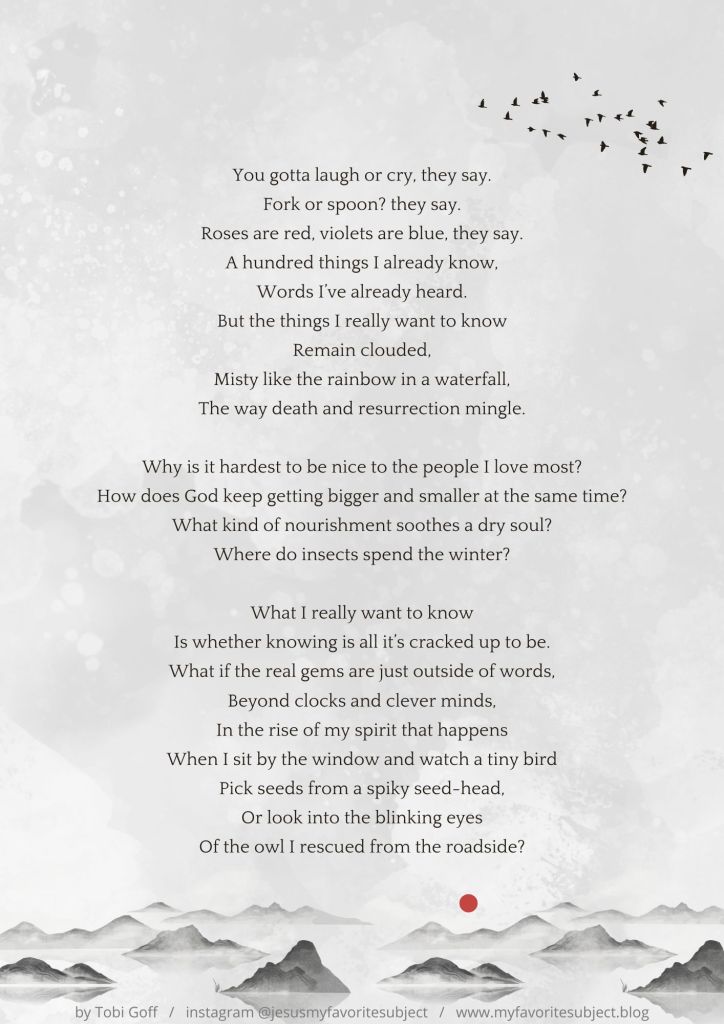
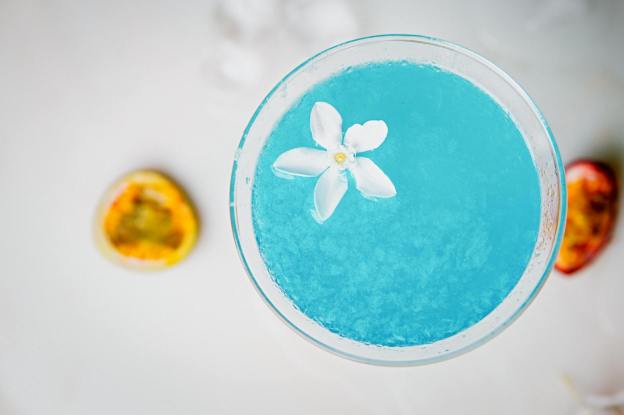
My friend E started drinking first, and together we made plans for my debut with alcohol. Piña coladas on my 40thbirthday. But then I decided to try a drink first with my husband—the primary witness to my life. The night was cold in every way. My turn to plan date night, and I reserved an “igloo” at Marcy’s downtown. These plastic domes appeared over several of their outdoor tables in late fall, purportedly to extend the viability of outdoor eating.
We drove to Marcy’s in silence, as we’d recently stopped speaking to each other unless absolutely necessary (a car ride did not qualify). It’s hard to say if silent date night indicated our stubbornness, a dark desire to marinate in our melancholy, or a hope that we might break things loose. If I’d had any ideas that alcohol might aid us, those hopes were soon dashed.
Our igloo struggled against the 30-degree weather, and I kept my coat on. A space heater ran full blast, and staff provided blankets. Too bad we didn’t feel like snuggling. Our waiter unzipped the igloo and stepped in, quickly zipped it behind him, and stood prepared to take our drink order. He provided a brief verbal tour of the alcoholic beverage options, none of which were warm. Unable to abide the thought of a cold drink, I asked if they had anything warm with alcohol. Yes, there were a few options. Having zero idea what most of the components were, I chose one that included coffee—something familiar. Michael ordered a cold mocktail.
As we waited for our drinks, I connected my phone to the provided bluetooth speaker and started our love-song playlist. The romantic songs did nothing to lift the chill, but they did slightly reduce the awkwardness of the silence between us.
My drink came in a glass with a handle, piled high with whipped cream. First sip—tolerable. By the third sip I wished I’d ordered the same fruity mocktail as Michael. After that I kept trying tiny sips, but mostly ate the whipped cream off the top and felt bad for wasting money. Since I found nothing pleasurable in the flavor, I hoped to at least drink enough to feel something—a “buzz”?—or to get just a wee bit tipsy, or loose enough to throw myself at Michael when we got home and have makeup sex. But I couldn’t do it. The drink was just plain gross, and I didn’t care for the “warm” sensation as I swallowed. I tried to convince Michael he wanted to try it, but he most certainly did not.
Our pitiful meal came to end, we paid, unzipped our igloo, and returned home colder than we had arrived.
A month or two later, I sat on the couch at E’s house, working on a puzzle on her coffee table. Her husband offered me a glass of red wine as he poured some for each of them. “Don’t give her too much, she probably won’t drink it,” E said. It hit me just about the same as the drink at Marcy’s—gross with a side of unwanted “heat.” I would regale you with nuanced descriptions of flavor and texture, but my palate-related language is pedestrian at best.
In April I drove to Bellingham, Washington, for a soul-filling weekend with my OG ladies group. My friend Andi ordered me a shot of Baileys. “It’s really sweet. If you don’t like it you probably won’t like any alcohol.” It tasted like caramel mixed with isopropyl alcohol. She finished it for me.
Some weeks after my 40th birthday in May, and months after the frigid date at Marcy’s, E and I met downtown at a Mexican restaurant for piña coladas. Virgin piña coladas are one of my favorite drinks—in fact, we had them at our wedding reception. Not wanting to ruin the drink entirely, but still hoping for a new experience—relaxation, anger, stomach upset, anything really—I asked the waiter to cut the alcohol in half. E ordered chicken and scanned the restaurant for teetotalers who could jeopardize her career by reporting a drink to her religious employer.
Our piña coladas came. I took a small sip, then several long pulls at the straw, trying to determine how the flavor differed from a virgin drink. Not much. I drank the whole glass, but didn’t get any of those bodily changes I hoped for. Although it was my most successful drinking experiment yet in terms of volume, I decided I prefer virgin piña coladas.
Further attempts at drinking have failed to produce anything more exciting. My friend Gela and I had a lovely moms-afternoon-out at a cellar offering wine slushies—flavors in a row in large plastic tubs with turning paddles, just like gas station slushies. We sat on a fancy armless couch, and I drank my entire glass, but it wasn’t worth the $14. Until my drinking experiments, I’d had no idea alcohol sucked up even more money than designer coffee.
At the farmer’s market I tasted three (free!) wine samples, drinking barely enough for a semblance of politeness before I discreetly tossed most of the final serving away with the small plastic cup.
Alcohol and I have not become friends. She is expensive and sharp. I remain curious, and may try a can of beer, hard cider at a local winery, or the mead my cousin makes, but I’ve given up on the possibility of actual enjoyment, and am unlikely to gag down enough of anything to get tipsy. For anyone who worried I’d become a raging alcoholic, I’m sorry to disappoint*. I’ve gained some fun experiences with friends, and lost the ability to say I’ve never had alcohol (well, other than in vanilla extract). I prefer a good mocktail to drinks with alcohol, but I like an Italian soda, blended mocha, or London fog even better.
Honestly, I thought something about alcohol would appeal to me—after all, how can the masses be so enamored? So financially invested? I don’t understand drinking for pleasure, nor can I imagine swallowing enough to get drunk. I’ll drown my troubles with a good 12-hour night of sleep, followed by a morning nap, and an afternoon one too if it’s a sad Saturday, and leave the hop juice for someone else.
*This is not intended as a slight to my many friends and family who choose not to drink, nor do I intend to make light of the damage alcohol causes to individuals, families, and society. Rather, I am making fun of the over-moralized fear-based decision making that was for many years my reason for not drinking alcohol.
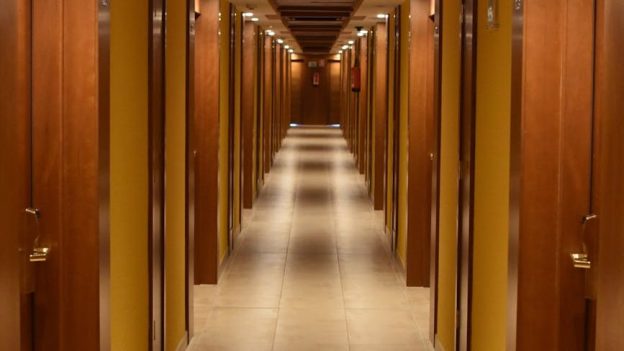
I’m dabbling in fiction again, which of course is influenced by my actual life, wherein my mother’s health is failing. This piece came from a writing prompt to begin with, “The hospital corridor was dimly lit…”
The hospital corridor was dimly lit, but only because the fluorescent lights on one side of the ceiling emitted partial light, accompanied by a buzzing sound. I wished someone would turn the lights off. One o’clock a.m. was never meant to be lit at all. Sinking to the floor, I checked the exact time on my watch, 1:17.
My mother slept. She’d been sleeping much of the day and night for some five years. Sleeping suited her phlegmatic personality and neurodegenerative disease. Sleeping was familiar.
But tonight, sleep could wander into death at any moment. And so we kept vigil—my brother and I—taking turns at her bedside, watching the face of each nurse who came in to check her vital signs. Did their expression show any hint of surprise or concern? Anything to indicate an imminent ending?
I’d never been this close to death before, and my feelings warred with my philosophies. It’s one thing to say death is natural, a passage as much as an ending, a new experience just like every other milestone in life. But there’s something heavy about a last milestone.
As I stared at the wall, unseeing, questions caught traction in my mind. This grief, is it about loss of the mother I have, or loss of the mother I wish I had? Or is it fear of what will happen to my brother and me when Mom isn’t here? Or am I feeling anger that I have to be here, to witness this, to hold it and see it and feel it and live it—that this dying person not only consumes my time when I’m at the hospital, but consumes my emotions and thoughts when I’m driving, eating, washing dishes? Who gave her permission to be woven into me in this way?
And what does the unweaving look like? Is it a severing, like a guillotine? Is it a careful unstitching, or an impassioned disassembly, tossing parts and pieces here and there? Or will my dead mother remain inside me, and will I like her better that way? What memories will make me smile? How much time will it take for me to internalize a narrative that holds us both gently?—a narrative that’s peaceful, not buzzing and half-lit like this damn hallway.
It’s wet paint
It’s an artifact at the science and history museum
It’s frosted birthday cupcakes
A piece of candy on the floor
A dead mouse
A hot pan
Rows of glass on the dishware shelf at Target
Electric fence
Sand art
Don’t touch that!
It’s a fight about money
It’s a friend’s anger at God
It’s a memory that twists my stomach
A mother’s embarrassment
A father’s shame
A hospital bill
God as feminine
Donald Trump
LGBTQIA+
Don’t touch that!
It’s a papery hornet nest
It’s a snake sunning on a rock
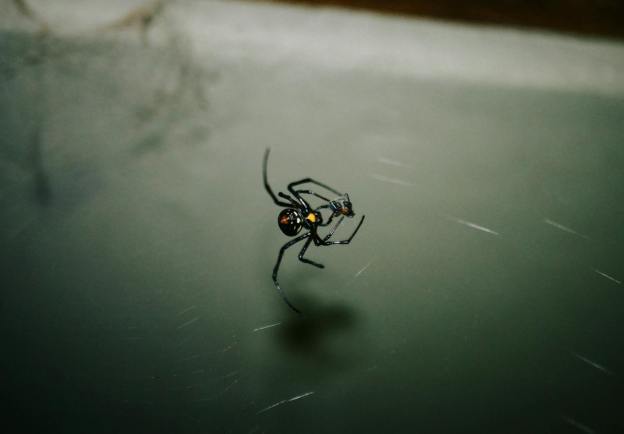
It’s a spiderweb
A cup overflowing
A polished concert grand piano
A fragile seedling
Perfect place setting, with folded-napkin swan
“Emergency Call” button in the elevator
Picnic leftover, buzzing flies
Don’t touch that!
It’s weight gain
It’s addiction
It’s a black eye
A cousin in jail
A protruding (pregnant?) belly
A brother-in-law in rehab, again
Extramarital affair
Ex-girlfriend
Was grandma “saved” or did she die an atheist?
Don’t touch.

Dear God,
Do you receive enough letters every year to bury planet earth a mile deep in stamped and postmarked comments to the divine? Is there a team who helps you read them? Do you throw out letters that are too pious—or too irreverent? If a parcel comes to you “postage due”, do you pay the balance or return to sender? How many angels do you deploy every year in response to mail from earth? Do you keep statistics on what subjects are trending? Do letters from different parts of the earth have a distinct smell? Well, enough about that. I actually have a purpose for this letter.
I’m annoyed that using your name is so complicated. If I say I believe in you—whatever that means—I want to tell my story, not get coopted into someone else’s story. I’m scared of their assumptions and experiences. Does belief in God mean an agenda of fighting atheism? Evangelizing 3rd-world countries? Pro-life marches? Does belief in God mean you made the world, or that you died for our sins, or that you’re making some sort of “new heaven”?
Next time someone tells me they’re a Christian, does it mean they go to church but don’t pray? Or that they pray but don’t go to church? Does it mean they think you cause human pain, or relieve human pain, or both? Are you male or female? Do you live in humans or in heaven? How are you deciding when and how to make the earth new? Are you many, or one, or three-in-one? Is your love soft or hard? Do you ever feel afraid?
I guess my point is that, for my own comfort, I want you to be small. I don’t appreciate the need to explain what kind of Christian I am—if I say I’m a Christian—or that I have to explain what mysticism is if I say I’m a mystic, or that my swearing puts some people at ease and sets others on edge. And both responses to swearing feel somehow related to you—like we’re all basing our lives on you, whether we mean to or not, and we’re all uncomfortable with the fact that you remain shrouded in mystery. I’ve ceased to believe you have an agenda, but for some, an agenda is inherent in the word “Christian.”
Truthfully, I don’t want you to do anything about this. I just need to vent. Do you see how annoying the situation can be? The way you draw people together in a singular way and also divide folks violently? The way you bring us to peace with ourselves and offer us the most startling awareness of our love-less parts? Do you see how I experience you differently than the person next to me, and sometimes we admire each others’ representations of you, and sometimes despise them?
I find myself trying to assure some folks I’m not “that” right-wing Christian, and trying to assure other folks I’m not “that” far-left kind of Christian. I want people’s favor and I want yours and it’s all terribly messy and I blame you.
But, in conclusion, I admit it’s best for you to be slippery, mysterious, and surprising. Thank you for connecting with each of us in your own way without a thought of being consistent, following the rules, or managing outcomes. Your flagrant freedom in relationship to humans reminds me that I, too, have the freedom to look a little different to every person who knows me. Like you, we humans can be slippery, mysterious and surprising, and we need permission to embrace these traits in our relationships.
I’ll let you get back to that mountain of letters. And I don’t have the patience for snail-mail, so if you want to answer me, please send a text message.
Cordially,
Tobi
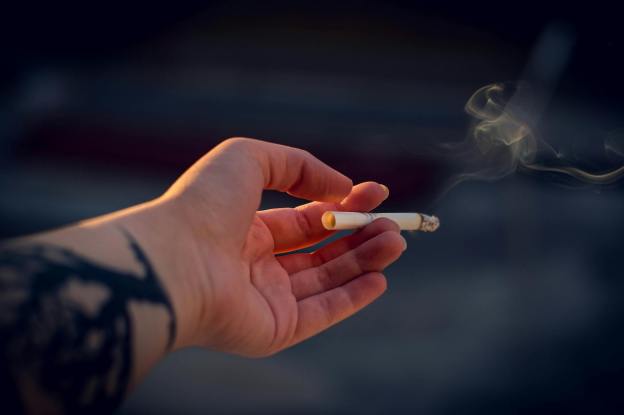
I know next to nothing about substance use. Other than tales of “the alcoholic” family members I never met, the “sinners” in the prodigal-returns books the church fed me, and the guy who beat the tar out of a piñata at his daughter’s birthday party, I live in a substance-use-free bubble. Although, I was offered a drink last week by two guys about my age who came upon me at a local park, where I had stationed myself to watch for beaver activity. I hoped to catch the crepuscular creatures near one end of their habitat, where they had recently felled a large tree.
It became apparent these two fellows had been drinking when they repeatedly complimented my purple outfit, introduced themselves, offered to move my chair for me, asked me to show them the beaver lodge, and kept up a constant stream of friendly banter. Sober people walk by silently and you’re lucky to get a nod.
“If you’re gonna take beer from a stranger, we’re the right people to take it from,” the talkative fellow offered. He went on to explain the virtues of the beer he had in the cooler bag over his shoulder, but it all went over my head. IPA and other alcohol-related terms are Greek to me.
As a child, I was taught to fear alcohol, with the admonition that because alcohol addiction runs in our family, I could become addicted with a single drink. Is there truth to that? I don’t know. Now that I’m an adult it seems beside the point.
Last November, I attended a community education event—“Hidden In Plain Sight,” or HIPS. This event multiplied my slight knowledge of substances by at least ten times. For example, I thought “doing pot” 40 years ago was essentially the same as “doing pot” today. I was wrong. But before I get to that … The whole experience hit me odd—attending a 1.5-hour community event in which I felt the main takeaway was “just say no” (although those words were not used). I thought people who didn’t rely on religious/moral reasons for abstinence just didn’t abstain. Or at the very least, didn’t tell others to abstain. But apparently, given data on brain development and facts about the effects of drugs and alcohol, a whole slough of people agree that—at least for kids and teens—“no” is the appropriate attitude toward substances. And this isn’t about illegal drugs; it’s about nicotine, marijuana, and alcohol.
When I talk to my kids about alcohol and drug use, I notice they are acutely—vehemently—aware that it is “bad”—so much so that it’s easy for them to assume a person who uses is not a “good” person. For that reason, my conversations with them, more often than not, focus on the aspect of numbing pain. I tell them people drink because it makes them feel better. It’s relief from anxiety, loneliness, trauma, and intense emotional pain. And isn’t every human being worthy of relief from pain?
I didn’t know what to expect going to the HIPS event—other than free pizza and a lesson on the paraphernalia of risky teen behavior. But when I left after the event I had a distinct feeling that something was missing—we didn’t talk about the pain these kids are trying to numb. Or the pain their parents are trying to numb. And parental influence means—like it or not—when we as parents use substances to numb our pain, it’s hard to tell our kids not to, and even harder for them to respect and respond to us.
In the state of Washington, where I live, it is legal for a parent to give alcohol to their child at any age, in their home1. And although it’s illegal to give tobacco or marijuana products to your own children, the data in our local community indicates that parents are supplying these items to their children in middle school and high school2—or at least turning a blind eye. Additionally, many websites that sell vapes and other nicotine products simply have a textbox to type in one’s age, making it easier to buy substances than it is to log into your bank account.
Products that were originally marketed as smoking cessation products, such as vapes,3 may deliver more nicotine to users than cigarettes, depending on the product and frequency of use. They’re also cheaper. A carton of cigarettes is $120, and the roughly-equivalent 7,000-puff rechargeable fume vape—which comes in more than a dozen flavors and fits easily in a closed hand—costs only $15. It also conveniently flies under the radar of the Clean Indoor Air Act, since the nicotine is delivered without a cloud of smoke. As you might imagine, these changes rewrite the landscape of nicotine use.
And alcohol is not exempt from the changing landscape. With a disposable water bottle, a wine cork, and a bike pump, a curious teen can vaporize alcohol, conveniently bypassing their digestive system and taking the full impact of a shot of hard liquor directly to their bloodstream.4
Now back to the changes around “doing pot”. Before the turn of the century, marijuana products delivered about 4% THC, or tetrahydrocannabinol, the psychoactive compound found in cannabis. In the 2010s, that number jumped to nearly 20% with the medicalization of marijuana. Today there are products containing up to 90% THC5. This ain’t your grandpa’s weed. Yet in Walla Walla County the Healthy Youth Survey in 2023 reported that 56% of 10th-grade respondents thought trying cannabis/marijuana held no risk or low risk, and 30% thought regular use had little or no risk.6 Are these students thinking of grandpa’s weed, or the expanding menu of available products? There’s rosin, crumble, distillate, bubble hash, dry sift, crystalline, and the list goes on.7
Youth who experiment with substance use are often unaware—now more than ever—of the actual amount of alcohol, nicotine, or THC they are taking in through various products or processes, resulting in an uptake of accidental overdoses.8 Parents seem to be checked out of their kids’ lives, and capitalism is taking advantage of the changing topography of products that deliver substances.
20% of 10th graders reported using marijuana at least once in their life.
50.9% of 10th graders reported using alcohol at least once in their life.
16% of 8th graders had ridden, during the previous 30 days, in a vehicle driven by someone who had been drinking alcohol.
2.7% of 6th graders (my 12-year-old daughter’s grade) reported alcohol use in the past 30 days, as did 3.9% of 8th graders and 13.1% of 10th graders.
19.5% of 8th graders and 33.6% of 10th graders indicated it would be “sort of or very easy” to get marijuana.
In case you got lost in the grade numbers,
all of these statistics are for youth approximately 11-15 years of age.
Not long after attending the HIPS events, my husband Michael and I walked by a smoke shop as we were finishing a pizza-and-ice-cream date night. “Ooh,” I said spontaneously, “let’s go in!” Michael didn’t share my enthusiasm, but he followed me inside the shop. The young man behind the counter welcomed us in and asked if we were after anything particular. I volunteered that neither of us had ever had anything. “If there’s something you want to try, let me know,” he offered.
To the left, behind a long counter, packaged products lined the wall. To the right, blown-glass paraphernalia caught my eye. I didn’t know what any of it was called. “Pipe” and “bong” seemed like terms that probably applied to some of the stuff, but I wasn’t sure. It reminded me of visiting the glass-blowing shops in Oregon’s coastal towns. Rows of shelves showcased the beautiful colors and shapes, and at the back of the store two more large displays highlighted artful drug paraphernalia.
The shop also had knives, samurai swords, rings for body-piercings, incense, an impressive display of fancy cigars, sex paraphernalia, and—based on my newly-acquired knowledge—several items I assumed were for hiding drugs. Michael and I circled the store a few times, commenting quietly to each other. Wanting to be a good customer, I bought a small vaping device.
Just kidding. I bought a pair of cheap earrings.
“Drugs and alcohol” are not the static story I imagined. And my interpretations are one tiny perspective on an issue that is complex beyond any one person’s understanding. Advertising, social influences9, the complex science of the over-400 components of cannabis10, the biology of addiction, stigma, family structure, mental health, and countless other factors impact our youth and their decisions around substances.
Mental health professionals and others, including the renowned Brené Brown, say it isn’t possible to selectively numb emotion. If we numb pain, anxiety, and sadness, we also numb joy, contentment, and gratitude. How will a generation unable to feel things—let alone name those feelings—live whole lives, experience belonging, and effectively walk through the tragedy and triumph of life?
And how will they teach resilience to the next generation?
I am left with more questions than answers. Why did I know nothing of the breadth and depth of new and evolving products and packaging around substance use? Why did only about 20 people attend this HIPS event that was marketed across the Walla Walla Valley? Why does it seem like social workers and law enforcement are the only people looking at this data?
About 10% of 8th graders and 14% of 10th graders surveyed had considered suicide. Over a third indicated a struggle with depression.11 Why are our children in so much pain? And how are we offering relief?
Endnotes:
1 RCW 66.44.270, subsection (4), viewed here.
2 The Healthy Youth Survey fact sheet for Walla Walla County in 2023 reports that 29% of youth in 8th and 12th grades, and 27% of youth in 10th grade reported getting alcohol from home, with permission, in the past 30 days. Additionally, only 5% of youth drink alcohol if their parents think it’s wrong, while 28% drink if their parents don’t think it’s wrong. This data is from a fact sheet created here.
3 https://pmc.ncbi.nlm.nih.gov/articles/PMC10880776/
4 https://www.vumc.org/poison-control/toxicology-question-week/jan-29-2020-alcohol-vaping-friend-or-foe
3 https://medicine.yale.edu/news-article/not-your-grandmothers-marijuana-rising-thc-concentrations-in-cannabis-can-pose-devastating-health-risks/
6 This data is from a fact sheet created here.
7 https://vivosun.com/growing_guide/what-is-crumble-crystalline-sugar/
8 This was covered in the live presentation. I’m still looking for a data source to cite here.
9 https://www.cdc.gov/tobacco/e-cigarettes/why-youth-vape.html
10 https://pmc.ncbi.nlm.nih.gov/articles/PMC4188645/
11 This data is from a fact sheet created here.

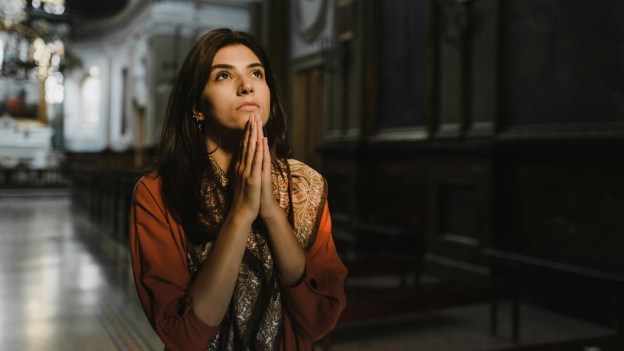
This morning I wanted to pray for friends, but instead I circled unsettling questions—questions I’ve returned to many times.
Why would I ask God to do something She’s already doing (i.e. Please be with this suffering person)?
Why does the Bible say Jesus will do anything we ask in His name?
Why should I have a say in God’s agenda for today? Especially when I’m pretty sure God doesn’t even have an agenda.
I want to pray for my friends—the text messages of prayer requests are waiting—but every way I know feels like useless chatter. I know countless book have been written and sermons preached to “answer” these questions, but I don’t really want answers. I want to acknowledge the awkwardness of prayer.
Talking to God about my frustrations—like this frustration with prayer—feels natural. She’s not offended when I call Her a liar for saying I’ll receive anything I ask in Jesus’ name. But today I’m annoyed because I don’t know how to bridge the gap between sharing my inner world with God and talking/asking/supplicating/mentioning my friends and their lives.
Our two tiger-striped cats sit at the window, attending to squirrels and whatever else moves outside the glass.
The sky lights slowly, cool gray clouds warming to creamy white.
I think about God and I sitting on the couch in His house, an image I return to often, always an invitation to relax into the overlap between us—His breath, my body. And it occurs to me that I could invite my friends to this couch.
I scoot over and invite Anna to the open spot between us. Her mother is dying in another country and she doesn’t know if she’ll make it in time to say goodbye. As she sits between us, something flows from her body, releasing her, and the three of us witness it together.
Next I think of Jen and her heaviness, hovering just under the surface of her pleasant and positive demeanor. Sitting with her creates space for the heaviness to stay or to go.
Then the couch shapes into a large, comfortable circle to make room for the family of a young man who passed away suddenly. His wife and children, his brothers and their families, all squeeze in to witness the grief in silent togetherness. Who knew coziness and pain could hold hands like this?
So God and I stand witness (or rather, sit witness) to each of my friends and family who come to the couch. No words are exchanged, no requests made, no answers given. We honor God with our presence as She honors us with Hers. We remember we are not alone. We see the depravity of our circumstances and the beauty of love, together.
When I finish praying, I know I will do this again. And I am touched and awed by the ease with which God converses with me in Her living room, whether in words or silence—the ease with which He engages my frustration and discomfort, and invites me to forego awkward requests in favor of sitting together.
Thank You, Papa.

I may be impeding the second coming of the Messiah.
Let me explain.
As I embrace spiritual uncertainty, my Christian denomination is included in that uncertainty. My faith group of origin—and current community—is Seventh-Day Adventist (SDA), but I refer to myself as “badventist” to portray the distance I feel from the doctrines I signed my name to uphold more than 30 years ago.
The name “Seventh-Day Adventist” incorporates two of the church’s most precious truths: we rest and worship on the seventh day of the week, and we believe in the soon second coming, or “advent,” of Jesus Christ. According to SDA’s, biblical interpretation of Scripture predicts a worldwide decline before Jesus descends from “heaven” and carries away the saints—including those who resurrect upon His arrival. After that we sit around for 1,000 years, Earth incinerates, then gets made new, and we move back in. (Disclaimer: this is what my brain recalls of our church’s teaching. The well-studied may find errors.)
This pre-second-coming world decline involves an increase in “knowledge,” natural disasters, merrymaking, Antichrist, and moral decline. Many SDA’s also believe that every person in the world must hear the gospel of Jesus Christ before the second coming—hence, a focus on evangelism. Missionaries travel all over the world to tell people about Jesus and undertake projects like translating the Bible into local language.
In this worldview of planet-decline-followed-by-destruction, it can be considered wasteful to invest too much in taking care of the planet—I remember a sermon titled, “It’s All Gonna Burn.” Wouldn’t it also be wasteful, then, to care for people without telling them about Jesus? If they’re happy and healthy but don’t know about Jesus, they’ll go to hell happy and healthy. Not much “eternal value” there. (Although SDA’s don’t ascribe to an eternally burning hell, just a quick fiery death.)
At the time of this writing, I find myself on a quest to help people without telling them about Jesus, and it looks like this: I believe writing is healing, speaking and hearing our stories is healing, and in marrying those two healing forces, my desire is to guide small groups in writing together and reading aloud our writing. The goal is to create space for marginalized people (which is all of us, at times) to have a voice, to own our stories, and to find wholeness in the process. The goal is not to introduce people to Jesus. So, am I delaying the second coming, heaven, and the world made new?
When I was a kid, we had neighbors up the road who believed in God, but—I was shocked to find out—believed the world would gradually get better and better, instead of worse and worse. A google search informs me their belief may be called postmillennialism, in which Jesus essentially will return to a saved earth. This almost makes more sense to me.
It sounds like the SDA view is suggesting that the more people who know Jesus, the worse off the world becomes. Doesn’t that seem odd? Spread the gospel everywhere, and once everyone has heard about Jesus the Earth will be in the worst shape it’s ever been. Jesus will then swoop in to save the righteous few and burn up the rest. I’m having doubts about how all this will go down.
For the time being, I mostly leave the destiny of the world in God’s hands—surprise me. I don’t need to know. Anyway, humans have a pathetic track record when it comes to predicting the future—even from intensive study of Scripture.
Having said all that, I still experience a nagging feeling that it’s “wrong” to help people without telling them about Jesus. Am I delaying the glorious new earth by helping people get healthier and not introducing them to Jesus? Shouldn’t I introduce them while they’re acutely aware of their need of a Savior? Once they get healthy they might be less motivated to “convert.”
In all honesty, I’m not firmly settled on the question—or the answer. But I am sure about setting this aside, for now. God partners with me—or I partner with Her—to relieve suffering. If I’ve missed the mark by excluding overtly religious material from my writing group curriculum, I have complete confidence in God to point me in a new direction.
Who knows, maybe we’re all invited to make this world a better place in order to set the stage for the return of our Beloved.
Last fall I (shockingly) found something on Facebook I don’t agree with. As I scrolled through the first dozen posts on my feed, this graphic appeared at least three times.
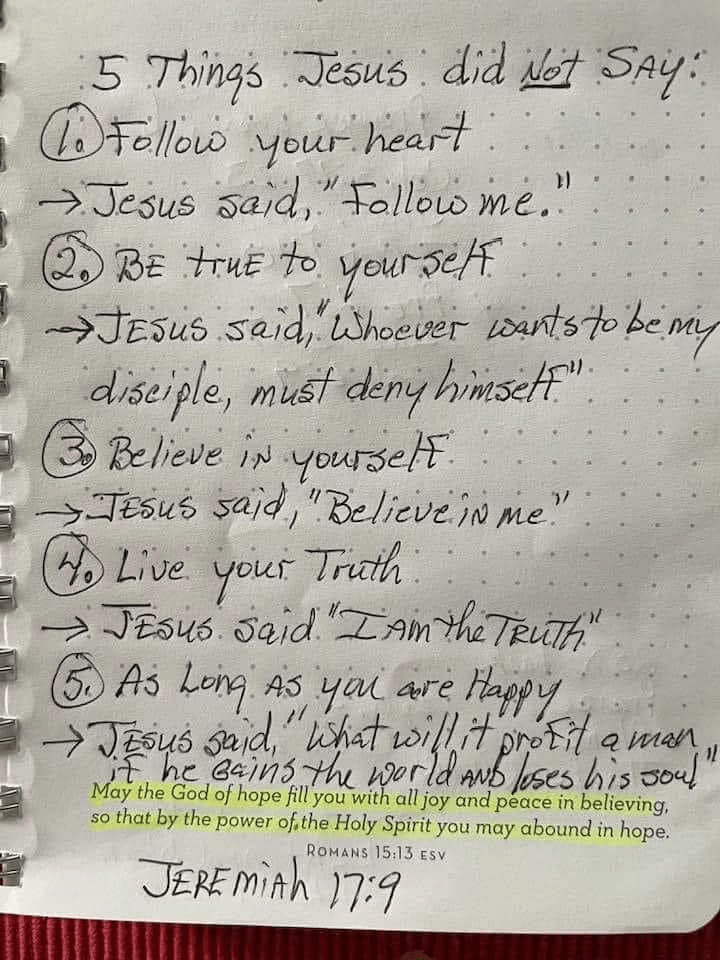
Obviously it resonated with many of my friends and family. But, when I read it, I felt small, mute, powerless. I felt called to misery as my spiritual inheritance. I felt afraid of myself.
Then I thought, two can play at this game. You throw Bible verses at me, I’ll throw some back at you. (Side note: I’m working on being less defensive.)
#1) Jesus didn’t say, “Follow your heart.”
No, but He made my heart, and He likes to spend time there. My heart is where the physical and the spiritual meet—like the exchange of oxygen in my lungs, passing from air to blood, life-giving mystery. If I try to separate from myself, I end up separating from God. He is the substance of which I am made.
Jesus said to His Father, “I do not pray for these alone, but also for those who will believe in Me through their word; that they all may be one, as You, Father, are in Me, and I in You; that they also may be one in Us.” (John 17:20-21a, NKJV, emphasis added)
#2) Jesus didn’t say, “Be true to yourself.”
No, but He did say, “Every kingdom divided against itself is brought to desolation, and every city or house divided against itself will not stand.” (Matthew 12:25b, NKJV)
#3) Jesus didn’t say, “Believe in yourself.”
No, but He did tell this parable: “Suppose a woman has ten silver coins and loses one. Doesn’t she light a lamp, sweep the house and search carefully until she finds it? And when she finds it, she calls her friends and neighbors together and says, ‘Rejoice with me; I have found my lost coin.’” (Luke 15:8-9, NIV)
This is a woman who believes in herself. She doesn’t blame the kids for losing her coin, or berate herself. She takes action. She lights a lamp, sweeps the house, and looks carefully until she finds the coin. When she finds it, she doesn’t breathe a sigh of relief that no one found out how irresponsible she was to lose it. On the contrary, it appears she’s okay with mistakes and disappointments. When she finds the coin, she calls her friends and neighbors to rejoice. She knows that she belongs and that her triumphs are worth celebrating—not because she has done something extraordinary, but because she has showed up for the ordinary.
#4) Jesus didn’t say, “Live your truth.”
No, but He did make me different from everyone else. JJ Heller sings, “Maybe the best thing I can be is me.” I’m not Jesus, or Paul, or Ruth. I’m not the foster-mom, or the guy who evangelizes with fresh-baked bread. I’m not the one who remembers everyone’s name and their mother-in-law’s name. My home isn’t a clean and peaceful space people flock to. But I do create safe spaces for people to talk and grapple and say life is shitty. I do text friends when I’m thinking of them, and sporadically send cards in the mail. I ask questions and deliver coffee and buy birthday gifts.
I write bravely, and sometimes the person who reads feels seen. My truth is the truth I know because I’ve lived it and it’s deep in my bones. It is these deepest parts of me that touch the divine.
Jesus said, “For God so loved the world that He gave His only begotten Son, that whoever believes in Him should not perish but have everlasting life. For God did not send His Son into the world to condemn the world, but that the world through Him might be saved.” (John 3:16-17, NKJV)
God didn’t come into the world to overshadow me or indict me, but to preserve and liberate me.
#5) Jesus didn’t say, “As long as you are happy…”
No, but He did say, “I have come that [my sheep] may have life, and that they may have it more abundantly. I am the good shepherd. The good shepherd gives His life for the sheep.” (John 10:10b-11, NKJV)
Jesus didn’t suggest that we sacrifice everything on the altar of happiness, but neither did He suggest that we pursue misery. He made us with taste buds and penises and clitorises, and He made a world bursting with taste and touch and life. He metes it out neither according to merit nor in submission to scarcity, but in wild abundance.
“Happy are the people whose God is the Lord!” (Psalm 144:15b, NKJV)
My journal takes me back in time. September 25, 2015. Thirty years old. Married ten years. Two daughters—Kyli two months past her first birthday, and Kayt a month shy of her third. That means on the day I wrote this prayer I had a one-year-old and a two-year-old. No surprise that “broken,” “scared,” “no match,” and “tired” feature in this heart-cry, penned during a rare stolen moment. My heart bled out through the ink of my pen. I turned to the page and to my heavenly parent, because together they were the safest place I knew.
April 17, 2024. Thirty-eight years old. Married 18 years. Kyli and Kayt are now 9 and 11. We’re deeply settled into the house we were in the process of purchasing in 2015. And I’m writing, which I now realize is not only a safe place for me, but also a creative passion.
Today I’ll respond to myself in this prayer. A spiritual journey is a both/and experience, dense with contrast and contradiction. And so today maybe I disagree with my thirty-year-old self, but my experience and beliefs then were as valid as my experience and beliefs now.
Truthfully, I haven’t been writing spiritual content much recently. I’m weary of cultural Christian ideas, the sin-and-salvation language, the beliefs that tied my hands behind my back. But set all that aside, and there is a friendship. Prayer is a celebration of friendship.
Good morning, Lord.
I am in a place I know You do not intend for me to be. I’m literally sick with worry. I can’t stop my head from spinning and my heart from panicking. Please speak truth to my heart and save me from myself.
You can be in this place. It’s okay to not be okay. You won’t feel this way forever. And yes, keep believing there are better things ahead. You are held.
I believe the solution is walking with You, but I can’t even do that. I am so broken, so scared, so selfish. Please do it for me, Lord. Take my heart, take my marriage, take my parenting, take my responsibilities at church and book group and other places, take the move to the new house, take meal planning and grocery shopping, take the lies that cripple me. Take my heart of stone and replace it with a heart of flesh.
What does it look like to “walk with God”? You are beautiful and your life is beautiful. You are worn out. Ask for help. Take medication. Drink coffee. Watch TV shows. Cry. Plan a day for yourself—that is not selfish. Your heart of flesh is already there. And this grieving might be just the thing to help you find it.
I confess my selfishness, my desire for control, my fears, my misbeliefs. They are sin and they do not honor You. Please take them from me. Please fight this fight for me. I am no match for sin, no match for the devil, no match for life.
Overwhelmed, flooded, depressed, alone, trapped. You feel these things deeply. You are stronger than you think, and not as strong as you think. You might have to let get of what you’re holding tight, and holder tighter to the things you’ve been letting go. Don’t know what that means? Don’t fret. God really does have your back, and She’s not the least bit disappointed.
I can do nothing … but isn’t that a good thing? For Your strength is made perfect in weakness [2 Corinthians 12:9]. Please hedge me behind and before and lay your hand upon me [Psalm 139:5]. Please take away my addiction to negative emotions. Teach me to rejoice in Your victory in my life, to give You the glory, to have a heart of thanksgiving.
These things you dream of will happen. You will learn to enjoy feeling happy, to like yourself, to feel gratitude and joy.
Lord, I am lonely. I am broken. I am too self-centered to see the beauty of You and the many good gifts You are showering on me daily. I surrender to You, Lord. Please save me from myself, Lord.
God will save you from yourself by introducing you to your true self. It’s okay to be lonely and broken. You are also brave and kind and capable.
I need time with You daily in prayer and in the Bible but I feel helpless to make that time. Please do it for me.
God loves to spend time with you. She hears you.
Thank You that You see me as I am and love me. I am so tired of myself. I am so grateful that You are not overwhelmed by my brokenness. Thank You that You use brokenness for Your glory. Give me a testimony that will draw others to You. Lord, if I need a mentor, please provide.
Keep speaking these truths. And when you’re too tired to speak them, the Spirit will speak them for you. You don’t need a testimony; you are a testimony. And you always will be.
I am terrified of the day ahead of me. Take this from me, Lord. Give me eyes of faith. Remind my heart to lay everything at Your feet and let You do the heavy lifting. I want to take Your yoke upon me and learn of You, and accept the rest You promise [Matthew 11:29]. I want to be Your servant and friend so that others will be drawn to You.
Oh dear one, these days are so long and so hard. I see you. You can do hard things. And God is teaching you to rest, even now.
Thank You for my brokenness, thank You for trials and difficult times. Thank You that You are enough and everything else is a cherry on top. I choose by the power of Your Spirit to abide in You. Please let me be a branch today. [John 15:4, 5]
Way to go! You are receiving with open hands. But you know, “everything else” is the stuff life is made of, and it’s okay to want it to feel lighter. You are a branch. You are a badass. Many good things are coming for you, and one day you will feel excited about what the day holds. In the meantime, go get some coffee.
 My Favorite Subject