Category Archives: On Being Alive

Get To Know the Couple

November 20 marked 30 years since Pastor Bryson baptized me at the Milo Adventist Academy Seventh-Day Adventist Church—my home church. I attended that church, beginning in utero, until I moved away for college at the age of 18. An evangelistic series in the school gymnasium pulled me to baptism in an emotional rush. Less emotional were the pre-baptismal Bible lessons. On a cold day in November, my older sister and I donned baptismal robes and took the plunge in a warm baptistry.

I’ve never looked back. Although today I’m less certain about the words on the baptismal certificate I signed, I’m more certain about the relationship.

To celebrate thirty years with a little fun, I’ve compiled questions from “Get To Know the Couple” games and answered them for God and myself.

Where did they work when they met?
Tobi was a full-time child and God was a full-time lover

How long have they been together?
Pretty much forever

Where did they get engaged?
In the Milo Adventist Academy gymnasium

What did they do on their first date?
Go to church (sorry it’s not more glamorous)

Are they cat or dog people?
Tobi is a cat person, God can’t decide

Who said “I love you” first?
God

What is something they have in common?
A desire to create safe spaces where people can share their inner world, their stories

Who is more high maintenance?
Tobi

Are they morning people or night people?
Morning people, although they can have a good time at night too

Who is the most patient?
God

What is the bride’s middle name?
Danielle

What is the groom’s middle name?
He has too many to list. One of the bride’s favorites is El Roi

What is their favorite type of food?
Fruit

What are their pet names for each other?
Tobi’s current pet name for God is Love, and his current pet name for her is Meadow.

What is their favorite place?
Anywhere still and quiet—especially a chair by the window

How old is the groom?
Nobody really knows, but he still looks good

What is their favorite thing to do together?
Write

Who is the better cook?
Tobi

Who is more stubborn?
Tobi, she hates changing direction

Who takes longer to get ready?
God, he has no idea how to hurry

Who spends more money?
God

Where was the bride born?
Canyonville, Oregon

What does the groom do for work?
Still a full-time lover.

What was their wedding date?
November 20, 1993

What is one thing they want to do together in the next 30 years?
Start a nonprofit writing group

As I mentioned, God has lots of names. Also—and this may seem weird—he doesn’t always look the same. So if you see me out with someone you don’t recognize, or hear me talking about a guy with a different name, text me before you freak out. It’s probably God in one of his other bodies or using one of his other names. He’s a dynamic fellow. I’m honored to be his bride of 30 years.

November

I’m trying a different poem style this week. It’s challenging to rhyme after writing so much free verse poetry! It’s a different kind of week, kids home from school, extra time in the kitchen, gatherings with extended family. I’m grateful for each of you in the @jesusmyfavoritesubject family. Thank you for seeing me, and allowing me to see you.

November

In this month of gratitude
I struggle with a bad-itude.
I do not love this ugly mood
Or how my heart feels misconstrued.

My kids are not a quiet brood.
Today their antics light my fuse.
My inner peace they now intrude
Until I beg for solitude.

I am allowed disquietude,
But I’m not victim of my mood.
It’s likely this month will include
Both thoughtless acts and moments shrewd.

So I will eat Thanksgiving food,
Refrain from being trite or rude;
When we give thanks I will include
Some words of sincere gratitude.

Grace is not a platitude
And Love is wide in magnitude.
Here I belong, so I conclude
There’s latitude for attitude.

A Finger to My Lips

What pulls at me today, daring to suggest my calm and holy center is not where I belong? Emotions roll like a ball in one of those handheld mazes, frozen in place as I s-l-o-w-l-y tip the maze, then a lightning-quick roll to the far corner before I can steady my hand.

So, what is pulling today?

Fear of disappointing my husband.

Heaviness from the impenetrable docket of housekeeping chores.

Despair over how my daughters have been treating each other.

Anxiety that I am a split second away from disappointing myself or someone else.

Terror because I am not in control of my inner world, or my outer world.

Is speeding up is the answer? More lists, more timekeeping, more discipline? No, because speed propels me out of my center, into the fears and despair.

The call is to slow down. Slowness requires trust—of myself, God, the people around me. Trust of time and the universe. What precedes trust? Willingness to accept a variety of outcomes, and to receive that I am well-loved in all of them.

Beginning at the end of myself, I find my way back to the beginning, receive the wideness of love, prevalent as air. As I breathe in love, I trust the intrinsic goodness of myself and others. I give up trust in outcomes and good behavior.

I choose slowness as an embodied reflection of my still and holy center. This is different than the stubborn slowness I use to distance myself from the needs of others, or the sullen slowness meant to display my tired and long-suffering soul.

With a playful but firm finger to my fretting lips, God intervenes. My churning heart stills once again in the embrace of grace and abundance. I am called to “unforced rhythms of grace,” where the daily cadence of faithfulness takes place within the finished song of grace.


~Scripture quote in the final paragraph is from Matthew 11:28-30 MSG: “Are you tired? Worn out? Burned out on religion? Come to me. Get away with me and you’ll recover your life. I’ll show you how to take a real rest. Walk with me and work with me—watch how I do it. Learn the unforced rhythms of grace. I won’t lay anything heavy or ill-fitting on you. Keep company with me and you’ll learn to live freely and lightly.”

I Will Change, I Will Not Change

I fear Christian belief will have no real impact on my life. I’m aware that addiction, divorce, and abuse in the home wreak havoc among Christians as well as non-Christians. And the things we do to feel better about ourselves happen among Christians as well—keeping our stories and our houses as clean as possible, consuming coffee and sugar at alarming rates, moving from one place (or church) to another to escape the consequences of a damaging lifestyle or broken relationship.

Until recently, I spent little time considering the opposite fear—that God will influence, transform or otherwise impact me and my life. Carl McColman, author and fellow blogger, suggests, “Our deepest fear is not that there is no God. Our deepest fear is that God does exist and wants to become an intimate part of our lives, changing us forever.”1 I want to argue with him, but I can’t. I do fear God’s influence in my life. Chances are, He has a different list (does God have lists?) of priorities than I do, and His presence will affect change. I cannot sit with Him and expect to remain the same. This is unnerving at best, terrifying at worst, but also the thing I want more than anything else.

I hold both fears at once—that I will be changed, and that I will not be changed. McColman puts it in relational terms—the fear of loneliness/abandonment, or the fear of being engulfed. I want to keep God, and my dearest human companions, in a safe little space between those two realities. In this space, I will experience a controlled situation in which I am neither left nor overwhelmed.

There is no such space in intimate relationship. It’s not that God is in the business of leaving or overwhelming people. Rather, relationship is consent to be influenced. I am changed by the people I spend time with, and I, in turn, affect those same people. Is this also true in divine relationship? The Apostle Paul wrote, “And we all, with unveiled face, beholding the glory of the Lord, are being transformed into the same image from one degree of glory to another. For this comes from the Lord who is the Spirit.” (2 Corinthians 3:18 ESV)

I’m not sure I want to be unveiled with God. Isn’t that dangerous? Maybe we can work something out where I get to wear a veil. I’ll submit my list of prayer requests without approaching God. No need to bother Him; I know He’ll take care of things. Also, if His activity in my life is based on me doing a good job, I don’t need to spend time with Him. I can focus on being a kind and productive person, and He’ll take it from there. There are countless ways to avoid the influence of relationship. Keep it professional. Make rules. Perform. Retreat.

I suppose “influence” would be a good word to describe what happens when two people spend time together. Where does that leave control? “To have control is to have the power to run something in an orderly way.”2 Does God have this power? Is the universe orderly? Yes, it is, and no, it isn’t.

Influence is “the power to change or affect someone or something—especially the power to cause changes without directly forcing those changes to happen.”3 If I say God has influence but not control, have I emasculated Him in my view, or am I getting closer to freedom?

In a previous post I wrote, “Perhaps love is the pain of not being in control.” At the time of that writing, I explored what this means in terms of fearing my own feelings. Feelings often run free of logic and control, and therefore, I have tended to avoid them. Now, as I consider this statement in terms of relationship with God, it occurs to me this is a two-way street. God relinquishes control of me, and I relinquish control of Him. I believe this is painful for both of us.

At the same time, it is comforting. I approach God without the intent to control Him, knowing that likewise, He will not control me. I do not consent to be engulfed; I consent to be influenced. I do not consent to abandonment; I consent to a life that is not well-controlled, which is messy because love and free will are messy. Proximity includes vulnerability.

It is here that I may begin to love God. Also here is the shocking possibility that God allows me to influence Him. I don’t know how to love the Lord my God with all my heart. The best I’ve come up with in the past involved being respectful to Him, and nice to the person in front of me. There’s nothing wrong with that. But is it relationship?

I find no tidy conclusion, but I’ve stumbled upon a desire for consensual relationship with God. And so, I consent to be influenced. I consent to the pain of love, which is the pain of not having control. I accept that knowing God will change me, and it will not change me. I receive the fear of being an average human, the terror of becoming more, and all that it means to love because He first loved me.

Endnotes:
1McColman, Carl. The Big Book of Christian Mysticism, page 204.
2https://www.vocabulary.com/dictionary/control#:~:text=To%20have%20control%20is%20to,remote%20control%20for%20a%20television
3https://www.merriam-webster.com/dictionary/influence#:~:text=In%20modern%20use%2C%20the%20noun,something%20in%20an%20important%20way

Cone of Shame

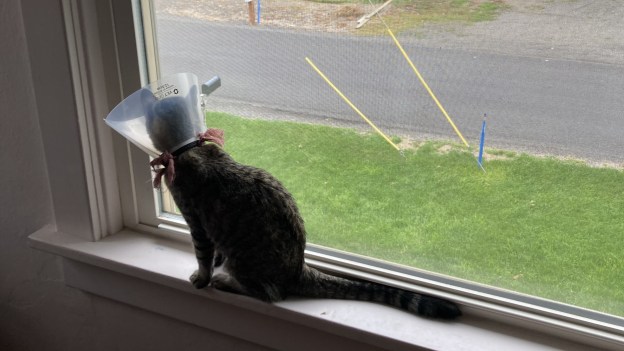
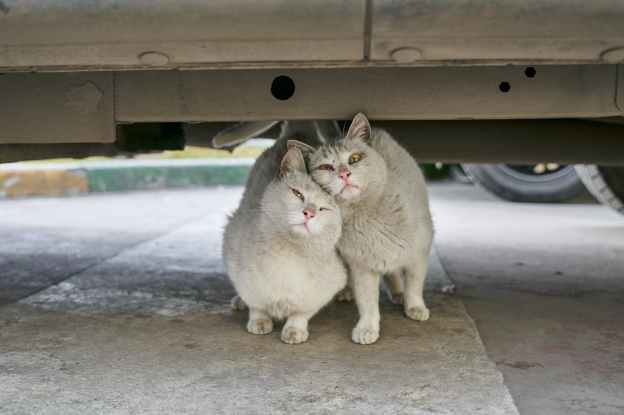
The youngest member of our family is sporting a cone of shame. She’s our six-month-old shorthair female cat, Phiona, and last week she had an overnight stay at the veterinary office to get spayed. We picked her up Wednesday morning, with a page of post-op instructions and a bag of syringes pre-filled with kitten-sized doses of pain medication. The vet assistant who discharged her instructed us to keep her as calm as possible for the next ten days, so we moved her food and litter into my office and there she convalesces.

Half of Phiona’s belly is shaved, with a one-and-a-half inch incision in the center, neatly sewn up. She wears a small cone on her small head, though it must seem large to her, and tremendously inconvenient. She can’t eat or drink without a person there to hold the dish still. Noises seem to come at her from strange directions, funneled through the cone. She licks the cone instead of her fur, and when her ear itches, the hind foot that pops up scratches at smooth plastic. There is no curling up to rest, no itching, and no bathing. Poop sometimes gets on the cone when she uses the litter box. Playing is a difficult proposition, as she can’t quite see her paws, nor coordinate them with her mouth to bite what she grabs, as kittens do.

Phiona doesn’t know the cone will come off after 10-14 days. As far as she knows, this may be her new normal—cooped up in one room of the house, wearing a constricting cone, unable to eat or drink until she has a visitor. If I were she, I would find this unbearable, and my attitude and behavior would follow suit. I’ve been watching her and imagining the deprivation of cat pleasures—a luxurious licking bath; a nap, curled up with nose tucked under tail; or a fierce romp, attacking string or toy with body, mouth, and all four appendages.

Phiona wears a cone of shame—or “Elizabethan collar” as it is called on the vet’s invoice—but she has no concept of shame. She doesn’t hide or hang her head. She purrs and plays and eats and drinks, and takes her medicine without complaint. How does she do this? I have watched her in amazement for a week, and I have no answer, only an increased awareness of how quick I am to sink into despair, to become angry when things aren’t how I want them to be, and to receive shame as my rightful state of mind. Phiona’s disposition is a compelling suggestion that there may be another way. Perhaps my humanity is not as volatile as I think, and the essentials of being human are more dependable than I realize. When I am limited, inconvenienced, slowed down, I do not lose my identity as a human being. I belong and I am invited to pleasure and peace as surely as when things are going my way.

I don’t have to always be well, productive, respectable, functional. I can rest when I am unwell. I can slow down when I am tired. I can enjoy the company of friends when I feel un-respectable. I can be waited on when I am not functional. I have permission to be human, and being human carries dignity with it through any circumstance. Whether buried in dept, or addiction, or depression, weighed down by sorrow and loss, or suffocating under secrets, each person is dignified. Whether disappointed in myself as a mom, humiliated by misunderstanding, or fearful of fallout after a mistake, I am dignified.

Thank you, Phiona, for teaching me that dignity is not complicated. You have modeled it through pain and confusion and the cone of shame, and have taught me again that my value is not in performance and my happiness is not in circumstances. But, I look forward to taking that cone off and watching you run and bathe and eat and drink, unrestricted.

When I See God Glowing

“It would be a good sign of our spiritual well-being if, when asked to describe a moment we felt close to God, we said, ‘When I loved another.’”
– Philip Gulley, Unlearning God: How Unbelieving Helped Me Believe

“Assuredly, I say to you, inasmuch as you did it to one of the least of these My brethren, you did it to Me.”
– the King, speaking to the sheep, as told by Jesus in Matthew 25:40

Intimacy with human beings is intimacy with God. When I interact with the “least,” I connect with God. This is humbling. This is not light beaming from heaven, or a pipe organ in a cathedral, or gallant green trees, or even my favorite books. Yes, God is in those things. But He makes a point to tell me He is in the least.

Who are my “least”?

My bickering, balking, button-pushing children.

Friends I avoid because they are “too Christian.”

The folks I pay money to—cashiers, wait staff, contractors, plumbers, produce stand vendors.

People asking for money at the entrance to the Walmart parking lot or sleeping in shop doorways downtown.

I’m good at hiding—behind a smile, a book, “safe” sharing. When I tap my credit card, I don’t have to see the person behind the counter. When I’m on a phone call—to the bank, dentist, tax office—I hide behind the professional relationship. I scurry down the soup aisle at the grocery store to avoid greeting an acquaintance. My kids get the short end of the stick as I shield myself with anger and control at home. I give money to charities because it’s easier than being charitable.

Then again, I keep bags, packed with snacks, water, and toiletries, in my car, and hand them to folks on street corners. I give a stranger a ride home. I pray with the cashier at the grocery story. I forgive my children before they ask.

I don’t know if I’m a nice person. I lean in; I pull away. Does this mean sometimes I have time for Jesus and sometimes I don’t?

Are there tally marks in the Book of Life?

Does it matter?

Human tally marks are about control, about externals. If there are tally marks on the cosmic whiteboard, they’re a kind I’ve never seen before. If God is measuring, let Him measure. I wouldn’t know what to measure anyway.

How well am I loving Jesus in the flesh and bones before me, wearing leggings and sweat and weariness? I do not think God is worrying about this. He is busy inhabiting arrogant leaders and polarizing politicians; beggars and cheaters and liars and beaters; starving children and sex slaves; and that guy who drives too fast down my street at 10pm most evenings. God is holding hands with humble pastors and hardworking husbands, earthquake victims and suicidal teenagers, relief workers and therapists, and mothers worn so thin you can see the light through them.

I rest assured that I will find Jesus today—at lunch with girlfriends, at school pickup, in text messages and emails, at the dinner table, and while the kids brush their teeth before bed. Intimacy with God is built into my existence. Intimacy with God is the breath of life in my own warm body.

The world is pulsing with light—a heat map of warm bodies—in the layers of houses I can see from my front window, the drivers of cars, the shoppers and walkers, glowing. Everywhere, God is glowing.

For 18 Years

For 18 Years

Blessed are You
Lord our God
King of the Universe
for 18 years of marriage,
of love—
bitter / sweet
comforting / unsettling
lonely / intimate
full

Blessed are You,
for I have seen You
in Michael’s face
in his words
his steadfastness
forgiveness

Blessed are You
Lord our God
King of the Universe
for duck pond dates
pillow talk and pillow tears
Ted Lasso
role reversals
one-liners
friendship

Blessed are You
for we have loved and endured
each other
and each other’s families.
We have learned by participation
what hurts and what heals.
Seeing, seeing
seeing each other
and then again
forever

Naked, Sacred Spirits

Friendship drama. I feel it in my body. I watch my daughters ride the waves of acceptance and rejection in the classroom or at play dates. I listen to adult friends struggling with relational tension. I talk about my own social anxiety and parasitic desire to look good and be right. I try to help my children understand their own and others’ behaviors, to see with a heart of grace. But when there’s nothing left to do or say, tension lingers in my body. Why?

Relationships are tenuous and fragile. I don’t like that. The clock ticks, lies are believed, trust breaks, narratives are written into the brain, and suddenly I am aware that I still question my value, my belonging, my place. Maybe I was skating by on trusting that everyone, including myself, would behave maturely. Then a moment of triggering or misunderstanding cracks me open, revealing a child who is still asking if she belongs here. Is she worthy of love?

Seeing through the crack to another person’s inner child is as frightening and vulnerable as being seen through my own cracks. I don’t feel authorized to talk to another person’s inner child. I sense the import of this mutual seeing—my inner child gazing at hers through our cracks—and I freeze. The stakes are high. I know that even if she is gracious to me, I may hide in fear; and even if I reach a gentle hand toward her, she may perceive a monster, commissioned to hurt her or keep her in her place.

How will our spirits see and feel and hear each other? I have no control over this. Maybe our faces and our words will look like friendship, but our spirits will henceforth sleep with one eye open when the other person is in the room. Maybe our spirits will come out of hiding, hold hands.

Her naked spirit and my naked spirit are sacred. They live in the company of the Great Spirit, God who shaped and breathed and spoke them to life. The connections I make to prove myself, or break to save myself—God imparts holiness to each one.

The overused analogy about how we’re all God’s children may be useful here. We squabble. We finagle to divide God’s affections or allegiance, but He is unaffected. “You are my favorite,” He says. “You are my favorite,”—to a sibling who took the lion’s share of ice cream, or lied about what I did, or made a face at me when He wasn’t looking, or apologized in a sour tone. Ugh.

God is 100% on my side. God is 100% on her side. I will lean in to this challenge. I will say Namaste—the divine in me greets the divine in you.

Hopeful Loyalty

God suggested that I love Her with loyalty, and it didn’t take long for fear of myself to surface. Offering my loyalty to God is essentially agreeing to fail. I will not be perfectly loyal. My loyalty will ebb and flow as it rides the waves of selfishness, embarrassment, and fear. Memories of rejection, and the possibility of future rejection, will poke holes in it. Rejection lends credence to my spectral but faithful companion, shame, who points a judging finger at me, and with her other hand beckons crowds to gawk at my failures, to know I am a fraud. Rejection turns her back on me, not to walk away, but to stay, as a reminder that a back is what I deserve. No face has time for me.

Perhaps loyalty to God involves agreeing there is a face with time for me. It involves looking at His face when I would rather serve time for my crime before I show my face.

Loyalty means I show up in our relationship even when my own divinity seems tarnished beyond the redemptive powers of a polishing cloth, or love.

Loyalty means I give up being the poster child for God so I can be the friend of God.

Loyalty means I will stick with the relationship when I fail, and when God appears to fail.

Loyalty means I will practice allowing myself to be seen, and I might stop to see God, stop when everyone else is running.

Yes, fear of loyalty is fear of myself. But it is fear of God, too. Fear that I will show up at our meeting place and She will not be there. Fear that He is easily distracted, easily frustrated. Fear of misunderstandings and loneliness. Fear that She is greedy and I will never be able to satisfy Her demands. Fear that He’ll like me better when I’m not the way I am right now.

Loyalty involves accepting these fears and allowing them to be in the story, to swirl around my divine center and say their piece. Loving God with loyalty is knowing that She is not the fears or the feelings, the knowing or the not-knowing, the intimacy or rejection. God is the floors and the walls and the roof. She is the foundation holding it all steady. She is the home where our story takes place. Her loyalty begets mine, because these walls see failure, ego, and embarrassment, and they remain standing. These walls also witness joy, inclusion, and peace. They are walls of hope.

And hope is fuel for the next moment of loyalty to God.

Morning Pages

Writing and prayer are, for me, inextricably linked. Pat Schneider said it well: “When I begin to write, I open myself and wait. And when I turn toward an inner spiritual awareness, I open myself and wait.”

In the course of living, I often disconnect from myself. I disconnect to stay operative, and it can be difficult to coax my spirit out of hiding. If I feel, will I still be able to function?

I’m reading two of Julia Cameron’s honest and encouraging books on the creative pursuit, and have been initiated to Morning Pages. Julia swears by them—three pages of longhand, stream-of-consciousness writing every morning, for the rest of your life. This practice puts you in touch with yourself, clears the racket in your head, lets you listen to the Spirit and to your own heart. “As we write,” Julia says, “we come know to ourselves, and increased tenderness to the self we are discovering is the reward.”

I’ve not made Morning Pages a daily habit, but when I do them, I find they deliver the promised effects.

My Morning Pages on June 2 were a ramble about ducklings and the kids’ last day of school. I wrote one page, then got scared: “How do I feel inside? Time to go shower …”

The next morning, it was time to come out of hiding.

June 3, 2023
I guess I’ll start today where I left off yesterday. With my heart. “Go ahead and come out, heart. This is a safe place.” Did some fear send my heart packing? When? How? It seems sudden that I have lost access to myself. But I know it can’t be. Am I running from heaviness? How does one keep a practical balance within one’s heart? Listen and feel, but not descend into the heaviness, never to rise? Maybe I’ve forgotten about my center. Is there really a still place in the middle of all this drama? A place to rest without shutting everything down or solving anything? “The present is safe,” Spirit says. My head is trying to protect my heart. My heart is trying to be small so I can get things done and look functional. But I am not lost in this stormy sea. The girls came downstairs so I moved upstairs. I sat down in my “prayer chair.” I turned my chair to look out a different window. I’m fantasizing about the marriage book I’m going to write. I’m listening to the ducklings and thinking they need their water refilled soon. I’m staring at nothing. I’m listening to the ceiling fan. I’m closing my eyes. I hear the mourning dove and think of the nest we had this spring. K is calling me from downstairs. Now she has come to ask if she can watch PJ Masks with her sister. She’s dressed only in underwear, and in their pretend game she has just hatched from an egg. She holds her hands under her chin in a chipmunk-like pose and speaks adorable gibberish, until I decipher “watch” and “PJ Masks.” It’s before 8am on a Saturday and I’d have to give special permission on Kayt’s iPad, so I say no. I’m starting to thaw here a little bit. I am safe with myself, my journal, God, Michael, and ultimately, with everyone and everything. K’s caterpillars are getting fat. I think God saved their lives. I guess (know) it’s safe to be me, and this day is very doable. Just show up, and then again.

Morning Pages are wonderful, rambling therapy. They are the healing experience of being seen. They are a permission slip to be human. Writing is a gentle and whimsical pathway to the inner self, which I once thought to access with a hammer and chisel, but which actually comes forward like a squirrel—shyly, with worried chirps and false starts. I must sit still. When the squirrel’s tiny paws rest on my fingertips, I feel a sense of wonder. I—brute that I am—receive the trust of another creature. So it is with my own spirit. I cannot use force to gain passage; I must sit quietly and observe with rapture that I am alive. And when I see myself alive, feel the pulse in my own fingertips, I know I will probably be okay.

~ Quotes are from Pat Schneider’s book, “How the Light Gets In,” and Julia Cameron’s book, “Write for Life.”