Category Archives: Unshakeable Identity

Simple Jesus

I want to like Jesus because the grown-ups in my life told me He is good, and they were right. 

I want to be innocently happy that God is good. 

I want to go back to painting “JESUS FREAK” in huge letters on a baggy cotton T-shirt, soaking up Sabbath School lessons with gusto, back to the credibility God had when I was 14.

Simple Jesus—does He still exist? Or can He at least be mysteriously complex and Kindergarten-simple at the same time? 

Is there a reality—no-strings-attached—in which Jesus just loves me and knows my name?

A few weeks ago I attended a spiritual retreat at Camp MiVoden, as a sponsor for the girls in the 7th/8th-grade class. During the worship services I remembered something, a feeling of belonging and certainty from my past. I knew some of the songs the praise band led, and I sang with my arms raised. No one expected anything—hardly anyone knew me—and the featured speaker said simple and good things, about who I am and who God is, and I cried, and I remembered a time when I belonged wholly, and sermons weren’t pocked with ideas that distract me from goodness and wholeness.

I want a plain friendship, one I don’t have to defend or explain, one in which I don’t need Jesus to make me look good, and Jesus doesn’t need me to make Him look good; Jesus with a reputation as simple as Mary who had a little lamb, not the notoriety of an activist. 

I don’t need answers for all the questions and discrepancies. I’m looking for that place where they are absent, where I don’t have to explain why I don’t believe in a punitive gospel, or why I’m part of a faith tradition (Christianity) that has inspired violence for thousands of years. I don’t want to explain why I use feminine pronouns for God, or why I say Adventism is my community but not my religion. I don’t want anyone to raise their eyebrows at me, nor me at them. I want to be in love—inside love. I want to feel safe because I am safe. 

Maybe what I really want to know is this: does a simple Jesus exist for adults too? Does He go for coffee with millennials—with me? Does He wear jeans and send 132 text messages every day? Does He understand carpools and playdates and a family calendar on the kitchen wall and how all the spoons are dirty if I miss one day running the dishwasher? Does He peruse my TBR shelf and ask me about my writing? Does He know I’m still a little girl inside, intimidated by the disciples who turn me away because I am small and simple?

Is Jesus here now, and does He remember me? Does He look through my photo albums and murmur memories? Has He been here for it all? Can we laugh together about singing “Sinnerman” and “We Are Soldiers”—the laugh of a shared memory—those lyrics humorous like the frizzy perms of the 80’s?* Is He still the cleft in the rock, the hiding place, the blessed assurance the hymns offered? 

What if we’ve shared a life more than a belief system, and our love is built on mutual adventure and admiration?

Maybe He has never needed me to pull Him apart and stitch Him back together, to understand how He is a triune being, or even to put our companionship into words. Perhaps I was mistaken in thinking that farther, bigger, and deeper are better. 

Jesus is here. In the essentials He hasn’t changed a bit. He’s still the great guy I knew in primary Sabbath School; the one who stood with me in the church baptistry, invisible yet deliciously simple; the father I wrote to in a dozen journals full of prayers; the soil from which I grow. Most of all, He’s still my friend.


*I sang these songs countless times. Although the lyrics of “Sinnerman” I sang were not as heinous as what I just found by googling it, I think it’s safe to say it’s inappropriate to mock sinners running from God (and what even is a “sinner”? Aren’t we all?). And don’t even get me started on “We Are Soldiers” and “I’m in the Lord’s Army.” Who decided it was a good idea for seven-year-olds to sing about blood-stained banners and artillery? So yes, I think Jesus and I can have a good laugh about it.

Disrupt the System, Applaud Early

Applause: public approval or praise expressed by clapping hands together.

Some fifteen years ago, I stood while applauding after a Distinguished Faculty Lecture at my alma mater. Is it a standing ovation if only one person stands? I stood, exuberant about the depth of understanding and connection I experienced during the lecture. But as my peripheral vision told me that no one else stood, self-consciousness bubbled up. Why am I the only one deeply affected? Does everyone else already have a depth of experience such that the lecture was run-of-the-mill for them? My pulse quickened and I lowered into my seat, certain everyone must be giving me the side-eye, judging my way of being in the world.

Looking back, I am proud of that moment. I know now that many of us who speak or write or reveal ourselves in some way, need only one person to stand. Only one person to send a note letting us know our words created connection.

Late last July, I attended “heART on display,” an event featuring artwork by incarcerated or formerly incarcerated individuals. Cedar Rain Spirits, a distillery and BBQ in downtown Walla Walla, hosted the event, curated by Devon Player, whom I met through the Walla Walla Community Change Team. Outside the narrow storefront, a sandwich board on the sidewalk announced the event. Inside, people mingled, music blared, and art lined much of the two long walls that extended to the back of the venue.

For the next hour, I perused art, snacked on free hors d’oeuvres, asked a few questions, and flattened myself into tables and walls to avoid bumping into fellow guests. As I chose art to purchase—proceeds to benefit Running Waters Equity Fund and the Black Prisoners Caucus—Devon took the mic and introduced a guest speaker, Anthony Covert. We all quieted where we sat or stood, and turned to listen.

Anthony was sentenced to 432 months (36 years) in prison at the age of 18. He served 16 of those, and walked free on June 10, 2024. As he talked about sitting in prison, alone with himself, I stumbled into sudden affinity with him. We “outside” (unincarcerated) folks have so much available to distract ourselves; it is a rare and excruciating experience to be alone with ourselves. “ But when you’re sitting in that prison cell and all you got is those four walls—sometimes with a celly, sometimes not—you have to sit with yourself.” And, he says, you have to ask yourself questions, about how you came to be in this place, and what your purpose is now that you’re here. 

My own season of being alone with myself and asking hard questions transpired during stay-at-home momming. I recognized that singular agony of sitting with oneself, and the subsequent decision to engage with tricky, heavy questions. As an incarcerated, black young man, Anthony felt it in the isolation of prison. As a middle class, white mother of an infant and toddler, I felt it in the isolation of motherhood. Although our experiences differed, Anthony’s words connected intimately with my inner world as a stay-at-home mom. Because he exposed his pain, I felt seen in mine. Our stories held hands for a just a moment. 

I wanted to applaud, but other listeners were intent, soaking up the story, not ready to respond. Anthony continued, and when he shared the completion of a college degree, while incarcerated, with a 3.98 GPA, everyone applauded, including me. Later, when he talked about his clemency hearing and the unanimous vote to grant him clemency, we applauded again. It was then that I noticed my moments of connection were not the same as the moments of applause. Before Anthony’s clemency hearing, when anxiety was high, Anthony’s friend Demar told him, “Go in there and show them who you are.” That moment connected. That moment I wanted to clap or sigh, or give the man a hug. Show them who you are.

Why the dissonance between my moments of kinship with the speaker, and our collective moments of applause? Could it be that as a society we are quick to applaud measurable achievement, but not moments of quiet strength? What about times of agonizing surrender—to our brokenness, and simultaneously to our wholeness? 

Anthony described us on the “outside” as an invisible army that stands with those on the “inside.” Because our worlds are disconnected, there is a wall isolating our compassion and assistance from the insiders’ knowledge, and/or response. Knowing this, may we be courageous to continue engaging—despite the lack of testimonials, catchy postcards, and fundraising galas that feed the selfish side of our generosity. 

“ There’s no fixing the system. It is what it is,” Anthony said. “But what you can do is disrupt it in certain areas, right? To give people opportunities to come home.”

What if applause—public approval or praise—happened earlier in the story, and it served to recognize nothing more than our humanity, the intrinsic dignity of our existence? What if clapping said, “you got this,” more than, “you did something big and measurable”? Better yet, what if approval and praise showed up in the process and in the conclusion? What if it gave people opportunities to come home—to themselves, to their families, to their communities? I need this. I suspect we all do.

I want to applaud early—for my children, my spouse, my friends, my community. A healer is “someone who can see the movement toward wholeness in you more clearly than you can at any given moment,” wrote Rachel Naomi Remen. Let’s open our eyes to see. Put your hands together for humanity. 

Let’s applaud smallness. Clap for the courage it takes to engage with our own selves and our messy stories. Cheer at the thin places in our stories, where pain and intention form a bond and point us in a new direction. Celebrate wholeness even as it lingers in the wings. Disrupt the narrative in ways that invite belonging. 

Before the Meeting: A Story About Inner Voices

Once upon a time, in the midst of a large wood, there stood a smallish cluster of trees hiding a secret meeting place. From the outside, these trees appeared just as the rest of the forest. But underneath the canopy of intertwined branches that formed a roof over the meeting place, a mild summer climate prevailed. The temperature was always pleasantly warm, the leaves bright and shiny, the floor spongy and warm, but never damp. The light inside felt like sunlight, although it did not come from the sun and never changed with the seasons.

Near the center of this cozy clearing stood a tremendously broad tree stump, weathered and gray. There was enough room around the stump for seven or eight chairs, but the only seat was a large stone with a comfortable-looking, moss-lined depression, where Found Girl always sat. Although no one was ever quite certain if Found Girl really did sit, because it looked like she flowed, as if someone had plucked up a small section of a stream and fashioned it into something like a person. Her appendages were more suggestion than reality, and you could almost hear the gurgle of a creek when you came near. Despite her ambiguity of form, she had a most attractive face, with eyes that sparkled like sun glinting off stones in a mountain stream, and a mouth which gave order to her face and conveyed her gentle nature. The others came and went, but Found Girl always stayed on her stone chair, content and natural.

On this particular day, Levee and Bound arrived at the clearing together, though they didn’t look at all as if they belonged together. Levee, a thin, straight-lipped woman dressed like a schoolmarm, carried a ruler. Her hair was pulled back so tightly into a bun that her face looked just a bit stretched. No one can say I’m late, she pondered with pride, and with any luck, my exemplary responsibility will guilt the others into behaving themselves.

Bound was small in stature, the size of a boy ten or eleven, though clearly a grown man. He had short, black hair and wore brass knuckles on both hands. But one hardly noticed his appearance because he was always shouting, and all that uproarious noise was the main thing anyone remembered about him. He carried himself with the foreboding of a lit fuse nearing its explosive target, and a few strides into the clearing, he broke into a series of lunges and air-punches. Truth be told, the noise he generated on the outside was only a fraction of the roaring and explosions happening inside. Stupid. Unthinking. Can’t get their act together long enough to solve some problems, he thought, anticipating a tedious meeting. I can’t stand myself and I can’t stand them! Words stayed inside, as futility spilled out in growls.

Levee laid a legal pad and pencil on the stump and scrutinized the forest floor and canopy. Lost Boy circled the clearing, his large shoulders hunched over. No one had seen him arrive, and even he seemed a little unsure of his presence as he slunk in circles. I don’t think this is going to be okay. I can’t possibly speak in front of Levee and Bound. Nothing makes sense. What can I do. This was a statement, not a question, and his torso rocked forward and back with each repetition. What can I do. What can … What … His thoughts morphed into panic, disguised by his plodding feet.

A few moments passed as Found Girl flowed in her stone chair, Levee took stock with a critical eye, Bound threw punches, and Lost Boy bit his fingernails and wandered.

Fragrant—whom everyone called Fray—a woman of average stature with a fairy-like appearance and delightfully scented hair, entered through a cascade of willow branches on the east side of the clearing and stood beside Levee at the stump, where they waited for Broad. I’m lucky to belong here, thought Fray. This is a lovely group in a lovely place.

Broad soon arrived, looking especially round, his very large and expressive face—almost triangular in shape—resting directly on his shoulders. No one could say for sure if he had a neck, and no one wanted to get close enough to see, because Broad often broke into unrestrained displays of emotion, and his aura oozed despair in such a way that it seemed very likely to get all over whoever might come near. I’ll just stay here at the edge of the clearing. There’s too much energy at the stump, Broad decided. Too tired to stand, he melted onto a bed of thick moss near the base of a crooked evergreen.

The moment Broad arrived, Levee called the meeting to order with a few loud raps of her ruler on the stump. That is, she tried to call the meeting to order. This had no effect on Lost Boy, who continued his distracted circling, but it did throw Bound into a tizzy. “You two get over here!!” he shouted at Broad and Lost Boy. He kicked the stump as he repeated this command. Broad collapsed even further into a fat heap and cried.

At this point, Levee’s thin-lipped smile became so thin it almost disappeared. “We must stand around the stump and be quiet.” Her voice was coated with frustration and disdain, and she glared at Bound. Meanwhile, Fray fell in beside Lost Boy. “Come to the stump,” she invited in her always-pleasant voice. But Lost Boy didn’t reply, only continued in aimless circles, and Fray thought, Poor soul. If only he knew it’s okay to not be okay. She returned alone to the stump.

Levee, hell-bent on a productive meeting and desperate for order, strode over to Broad and dragged him toward the stump. This required no small amount of effort, and a few hairs popped out of her bun. After several exhausting moments, Broad was in a sad, fat heap, closer to the stump. Suddenly, Lost Boy noticed he was the only one still at large and would be Levee’s next target. Just as he moved to hide behind a tree at the edge of the clearing, Found Girl spoke.

This startled everyone, as they had forgotten she was there. Her voice, like her appearance, flowed, yet carried unmistakable strength. It drew Bound’s attention first; he immediately stopped kicking the stump and shouting. Before she finished a sentence, everyone in the clearing was focused on her, curiously enthralled by her flowing body and voice, their individual angst forgotten for a moment.

This is what she said. “Friends, each one of us belongs here. This is our clearing, our stump, our meeting. Levee may bring an agenda and take notes, but she is no more important—or in charge—than anyone else.” At this, Levee’s schoolmarm face relaxed somewhat, though her relief seemed tinged with doubt. I can’t imagine how Found Girl thinks she’s going to bring things to order.

Found Girl continued, “Lost Boy doesn’t have to speak his fears, and Bound doesn’t have to quiet his anger. Fray and Broad can attend to their own thoughts and feelings, which are their gifts in this meeting. We’re in this together. Look around at each other. Smell Fray’s fragrant hair. Admire Bound’s latest brass knuckles, and maybe look for Broad’s neck.” Everyone chuckled at this, except Lost Boy, who had commenced his circling.

Found Girl, having given everyone permission to be themselves, closed her captivating mouth and motioned to Levee. Then the meeting began.

What Version of Me Belongs?

I have chosen between attachment and authenticity a thousand times at least.

What do I mean by this?

I’ll loosely define attachment as a healthy sense of relational connection and belonging. And let’s think of authenticity as the ability to know ourselves and show up in the fullness of who we are, including the little quirks and details.

The choice between attachment and authenticity occurs when we must—or perceive we must—choose one of the two. For example, let’s say you’ve made a new acquaintance and you’re arriving at her house for the first time, with a plan to chat over a cup of tea. You might feel a little anxious, not knowing whether this will be awkward, and wondering about the future of your friendship. When you step in the door, your friend offers to take your coat. You’d rather leave it on until you warm up a bit, but instead you take it off and she whisks it away to a side room. Then she offers you scones, which are obviously hot from the oven and smell delicious. You accept and then notice there are raisins in them. You don’t like raisins. But rather than pick them out, you decide to eat them. In these moments, you are choosing attachment over authenticity. Sharing your preferences feels risky for the relationship, so you keep them to yourself.

Often, as in the above examples, we base our decision not on reality (you have no idea whether your friend would be offended by you picking out the raisins), but on a perception of what would best maintain your attachment—your relational connection—in the moment.

Let’s think about scenarios where the stakes are higher. A teen might have to choose between the authenticity of letting their parents know they’re transgender, or preserving attachment by not sharing that information. A pastor may have to choose between authentically and vulnerably requesting help for an addiction, or maintaining his position and his church relationships—his connection and belonging—because he knows he cannot have both. A person may choose to have sex with their partner because it’s easier to do what they don’t really want to do than it is to say the vulnerable truth and deal with the possible fallout of disconnection.

As children, and even as infants, when presented with a choice between authenticity and attachment, we choose attachment. Our survival depends on it. As we become adults, our circle of resources widens, and our options become more diverse. We don’t have to choose attachment over authenticity every time. Still, there is an element of risk to authenticity, and we weigh this consciously or subconsciously every day.

One of the most challenging environments to navigate this dynamic is religious circles—which in my case extend to my children’s private education, friends past and present, my readers, and even neighbors. Church seems a strange place to make a choice between belonging or being myself, yet I have felt it often there. Christians say, “Come as you are.” But I don’t think we meant it. Or, we mean it with a tag-on—“Come as you are, when you’re ready to change that to be like us.”

I have believed I can’t be me, because whatever improved version of me God has in mind is better than the current version of me—“sinful and selfish” me. Somehow being myself means heresy. I can’t be true to myself and to God at the same time. You know, something about “a house divided,” or how man’s thoughts are “evil continually.”

These days, I’m not sure I belong in church. But it doesn’t matter like it used to. I belong in myself, and that is sweet relief. I belong in the living room of God, who has become both mother and father to me. I am bonded spiritually, and it’s the safest place I’ve found yet to excavate and inhabit my authentic self.

God doesn’t ask Her children to choose between attachment and authenticity. Belonging is a foregone conclusion, and God’s favorite pastime might be holding your hand as you get acquainted with your authentic self. I think God emits joy-sparkles when He gets to witness you noticing yourself and connecting with the fun, complex, messed up, whole and holy person that you are.

Wherever attachment and authenticity occur together is sacred. These holy spaces may be inside us, in marriage or friendship, in nature or a good book. I’ve discovered that in settling into my own self, I can hold the paradox that I am okay and I am not okay. And it turns out God is way bigger than they said She was.


My understanding of these concepts leans heavily on Gabor Maté and Krispin Mayfield. Many thanks to them both for acquainting me with my own inner safety.


P.S. I posted an update today about trauma-informed writing groups. Check it out here.

Come Wanderer

Come, come, whoever you are.
Wanderer, worshipper, lover of leaving.
It doesn’t matter.
Ours is not a caravan of despair.
Come, even if you have broken your vow
a hundred times.
Come, yet again, come, come.

-Rumi

“Come … wanderer,” God invites.

In what ways have I wandered?

The wilderness of parenting.

The jungle of marriage.

The labyrinth of religion.

Is wandering about being lost?

Or is it about looking for something new? Something about which I can’t say, “Oh, I knew that.”

Wandering leaves me wondering if I fit in, if I am still invited in.

You invite me in. “Come,” You say, “come wanderer.”

Yes, I am invited. Yes, I belong. Yes, there is a place for me, even—maybe especially—when I don’t fit in to the containers I used to fit in—the labeled Tupperware, the organized totes.

Now the pieces of me are less organized, but still You say, “Come,” and all of me comes even though I thought maybe the pieces were too scattered.

They are not. All of them respond to Your voice.

It is not my job to organize myself. Or to stop wandering. Everywhere I go, You meet me there.

If wandering has taught me anything, it is that You are everywhere.

“Come,” You say, and I am surprised to find You are standing right next to me. You are not calling from a great distance. “Come,” You say, “let us wander together. Show me something you’ve found here. And I’ll show you some things too.”

Wandering and loneliness are intertwined, and You and I, we are familiar with both.

“Come,” You say, and I know that You know this place, that You are no stranger to wilderness or jungle or labyrinth. These are Your kitchen, your garden, your cathedral.

“Come,” You say, and I know that I have always been home. For You are home to wanderers.

Gained in Translation

“Thanks to you I have the goal of being someone good in this world.” So concludes the final letter from Alejandro*, and his words stop me.

I’ve been told I have influence—or rather, warned that I have influence. Better use it for good, they say. Watch yourself. Or, as the church-school song goes, “Oh be careful little tongue what you say… for the Father up above is looking down in love…” And I have been careful, which mostly feels like fear, anxiety, and judgement.

I’ve been told I have influence—but Alejandro’s words shocked me. It hadn’t occurred to me that I could inspire anyone to want to be good, and certainly not someone I’d never met in person.


In 2009, I was a few years married and worked full time at the Christian college from which I had recently graduated. That spring the student association hosted a concert by the Christian rock band, Superchick. It took place in the big dome at a neighboring college. While true fans moshed it up, I wished for earplugs from my seat on the bleachers. Somewhere in the course of the evening, the band made an appeal for child sponsors, and in the post-concert din and jostling, we managed to buy a CD and sponsor a child—Alejandro, from Bolivia.

For 14 years we exchanged letters with Alejandro, as he grew from a preschooler to a working man and graduated from Compassion International’s child sponsorship program at age 20. Early letters were written by Alejandro’s brother or his tutor. A letter in 2011 included this endearing anecdote: “It was a happy week for my family too because my brother was born and my mom was delicate so we couldn’t do anything for her birthday. She is better now and we are going to buy a cake for her. Alejandro helps me to wash the dishes because my mom is still delicate.” -signed by older brother Emilio.

Over the years we prayed for each other and shared favorite foods and the antics of our pets. One letter informed us that Alejandro’s pet goose had laid five eggs and was taking good care of them, and included an update on turkeys that had hatched some months before: “My mom likes them very much, she feeds them every moment.” Occasionally we’d make an extra monetary gift through the Compassion project, and a few months later we’d receive a picture showing what Alejandro bought with the money—clothing and shoes, “rubber dinosaurs,” a dresser for his clothes.

At first our letters traveled snail-mail between Bolivia and Washington state. Later, online letter-writing became available, but still it was a slow correspondence. I worried about asking the same questions or sharing the same information because I forgot what we covered in previous letters. I probably did forget things and repeat myself, but Alejandro responded to every letter with only the kindest words, and patiently answered our questions.

In 2023, Alejandro aged out of Compassion International’s sponsorship program and we each wrote a letter of farewell. His letter begins, “My dear friends Michael, Tobi, Kyli and Kayt, let me greet you, I am so grateful for all the time you were my friends and I was blessed with your sponsorship. Truly God touched your lives and through you He touched mine and my family’s. I am so grateful. You were really an unconditional support for so long, words would not be enough to show you how much I love and appreciate you.”

I am immediately touched, and simultaneously aware that these kind words register on a grand scale almost foreign to my daily narrative—God reaching through me to touch another, the elusive desire of every God-lover. “Unconditional” is not a word I would use to describe myself, but there it is. I choose to receive it.

Alejandro goes on to describe how the Compassion project helped him and his family, concluding “but above all, I received the word of God in my life, I was able to know Jesus, and I was able to understand that my life was better if I held His hand.” One sentence, profound gospel. My life was better if I held His hand.

Alejandro requested our continued prayers for guidance and for his family, and promised to pray for us: “I will pray that God will always bless you, that God will grant you the desires of your heart, that God will guide you well in everything you do, that God will keep you from all evil, and that you will now be able to continue blessing more lives as you did with me during all this time.”

Then he concluded, “Now, with a happy heart, for having completed the Compassion program, but also a little sad because I will no longer be in touch with you, I really feel you as part of my family, I will always have you in my heart my dear friends. Thanks to you I have the goal of being someone good in this world. God bless you always, your friend forever, Alejandro.”

It has been said some things are lost in translation, but, if anything, I’d say translation lent this final letter a beautiful simplicity. Alejandro’s translated words rank among the best prose I’ve read. They are high praise yet totally devoid of flattery. His gentle and grateful heart reminds me who I am—a daughter of God who does’t have to worry or hustle. I am blessed and I am a blessing—this is the sum of my existence. Alejandro, thanks to you I have the goal of being someone good in this world. I want to live up to your estimation of me. God bless you always.


*Not his real name.

A Finger to My Lips

What pulls at me today, daring to suggest my calm and holy center is not where I belong? Emotions roll like a ball in one of those handheld mazes, frozen in place as I s-l-o-w-l-y tip the maze, then a lightning-quick roll to the far corner before I can steady my hand.

So, what is pulling today?

Fear of disappointing my husband.

Heaviness from the impenetrable docket of housekeeping chores.

Despair over how my daughters have been treating each other.

Anxiety that I am a split second away from disappointing myself or someone else.

Terror because I am not in control of my inner world, or my outer world.

Is speeding up is the answer? More lists, more timekeeping, more discipline? No, because speed propels me out of my center, into the fears and despair.

The call is to slow down. Slowness requires trust—of myself, God, the people around me. Trust of time and the universe. What precedes trust? Willingness to accept a variety of outcomes, and to receive that I am well-loved in all of them.

Beginning at the end of myself, I find my way back to the beginning, receive the wideness of love, prevalent as air. As I breathe in love, I trust the intrinsic goodness of myself and others. I give up trust in outcomes and good behavior.

I choose slowness as an embodied reflection of my still and holy center. This is different than the stubborn slowness I use to distance myself from the needs of others, or the sullen slowness meant to display my tired and long-suffering soul.

With a playful but firm finger to my fretting lips, God intervenes. My churning heart stills once again in the embrace of grace and abundance. I am called to “unforced rhythms of grace,” where the daily cadence of faithfulness takes place within the finished song of grace.


~Scripture quote in the final paragraph is from Matthew 11:28-30 MSG: “Are you tired? Worn out? Burned out on religion? Come to me. Get away with me and you’ll recover your life. I’ll show you how to take a real rest. Walk with me and work with me—watch how I do it. Learn the unforced rhythms of grace. I won’t lay anything heavy or ill-fitting on you. Keep company with me and you’ll learn to live freely and lightly.”

Cone of Shame

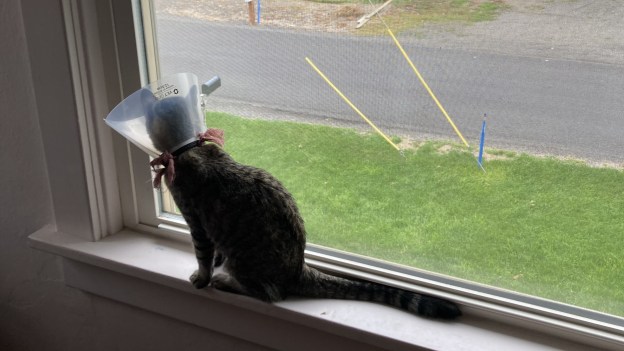
The youngest member of our family is sporting a cone of shame. She’s our six-month-old shorthair female cat, Phiona, and last week she had an overnight stay at the veterinary office to get spayed. We picked her up Wednesday morning, with a page of post-op instructions and a bag of syringes pre-filled with kitten-sized doses of pain medication. The vet assistant who discharged her instructed us to keep her as calm as possible for the next ten days, so we moved her food and litter into my office and there she convalesces.

Half of Phiona’s belly is shaved, with a one-and-a-half inch incision in the center, neatly sewn up. She wears a small cone on her small head, though it must seem large to her, and tremendously inconvenient. She can’t eat or drink without a person there to hold the dish still. Noises seem to come at her from strange directions, funneled through the cone. She licks the cone instead of her fur, and when her ear itches, the hind foot that pops up scratches at smooth plastic. There is no curling up to rest, no itching, and no bathing. Poop sometimes gets on the cone when she uses the litter box. Playing is a difficult proposition, as she can’t quite see her paws, nor coordinate them with her mouth to bite what she grabs, as kittens do.

Phiona doesn’t know the cone will come off after 10-14 days. As far as she knows, this may be her new normal—cooped up in one room of the house, wearing a constricting cone, unable to eat or drink until she has a visitor. If I were she, I would find this unbearable, and my attitude and behavior would follow suit. I’ve been watching her and imagining the deprivation of cat pleasures—a luxurious licking bath; a nap, curled up with nose tucked under tail; or a fierce romp, attacking string or toy with body, mouth, and all four appendages.

Phiona wears a cone of shame—or “Elizabethan collar” as it is called on the vet’s invoice—but she has no concept of shame. She doesn’t hide or hang her head. She purrs and plays and eats and drinks, and takes her medicine without complaint. How does she do this? I have watched her in amazement for a week, and I have no answer, only an increased awareness of how quick I am to sink into despair, to become angry when things aren’t how I want them to be, and to receive shame as my rightful state of mind. Phiona’s disposition is a compelling suggestion that there may be another way. Perhaps my humanity is not as volatile as I think, and the essentials of being human are more dependable than I realize. When I am limited, inconvenienced, slowed down, I do not lose my identity as a human being. I belong and I am invited to pleasure and peace as surely as when things are going my way.

I don’t have to always be well, productive, respectable, functional. I can rest when I am unwell. I can slow down when I am tired. I can enjoy the company of friends when I feel un-respectable. I can be waited on when I am not functional. I have permission to be human, and being human carries dignity with it through any circumstance. Whether buried in dept, or addiction, or depression, weighed down by sorrow and loss, or suffocating under secrets, each person is dignified. Whether disappointed in myself as a mom, humiliated by misunderstanding, or fearful of fallout after a mistake, I am dignified.

Thank you, Phiona, for teaching me that dignity is not complicated. You have modeled it through pain and confusion and the cone of shame, and have taught me again that my value is not in performance and my happiness is not in circumstances. But, I look forward to taking that cone off and watching you run and bathe and eat and drink, unrestricted.

Naked, Sacred Spirits

Friendship drama. I feel it in my body. I watch my daughters ride the waves of acceptance and rejection in the classroom or at play dates. I listen to adult friends struggling with relational tension. I talk about my own social anxiety and parasitic desire to look good and be right. I try to help my children understand their own and others’ behaviors, to see with a heart of grace. But when there’s nothing left to do or say, tension lingers in my body. Why?

Relationships are tenuous and fragile. I don’t like that. The clock ticks, lies are believed, trust breaks, narratives are written into the brain, and suddenly I am aware that I still question my value, my belonging, my place. Maybe I was skating by on trusting that everyone, including myself, would behave maturely. Then a moment of triggering or misunderstanding cracks me open, revealing a child who is still asking if she belongs here. Is she worthy of love?

Seeing through the crack to another person’s inner child is as frightening and vulnerable as being seen through my own cracks. I don’t feel authorized to talk to another person’s inner child. I sense the import of this mutual seeing—my inner child gazing at hers through our cracks—and I freeze. The stakes are high. I know that even if she is gracious to me, I may hide in fear; and even if I reach a gentle hand toward her, she may perceive a monster, commissioned to hurt her or keep her in her place.

How will our spirits see and feel and hear each other? I have no control over this. Maybe our faces and our words will look like friendship, but our spirits will henceforth sleep with one eye open when the other person is in the room. Maybe our spirits will come out of hiding, hold hands.

Her naked spirit and my naked spirit are sacred. They live in the company of the Great Spirit, God who shaped and breathed and spoke them to life. The connections I make to prove myself, or break to save myself—God imparts holiness to each one.

The overused analogy about how we’re all God’s children may be useful here. We squabble. We finagle to divide God’s affections or allegiance, but He is unaffected. “You are my favorite,” He says. “You are my favorite,”—to a sibling who took the lion’s share of ice cream, or lied about what I did, or made a face at me when He wasn’t looking, or apologized in a sour tone. Ugh.

God is 100% on my side. God is 100% on her side. I will lean in to this challenge. I will say Namaste—the divine in me greets the divine in you.

Hopeful Loyalty

God suggested that I love Her with loyalty, and it didn’t take long for fear of myself to surface. Offering my loyalty to God is essentially agreeing to fail. I will not be perfectly loyal. My loyalty will ebb and flow as it rides the waves of selfishness, embarrassment, and fear. Memories of rejection, and the possibility of future rejection, will poke holes in it. Rejection lends credence to my spectral but faithful companion, shame, who points a judging finger at me, and with her other hand beckons crowds to gawk at my failures, to know I am a fraud. Rejection turns her back on me, not to walk away, but to stay, as a reminder that a back is what I deserve. No face has time for me.

Perhaps loyalty to God involves agreeing there is a face with time for me. It involves looking at His face when I would rather serve time for my crime before I show my face.

Loyalty means I show up in our relationship even when my own divinity seems tarnished beyond the redemptive powers of a polishing cloth, or love.

Loyalty means I give up being the poster child for God so I can be the friend of God.

Loyalty means I will stick with the relationship when I fail, and when God appears to fail.

Loyalty means I will practice allowing myself to be seen, and I might stop to see God, stop when everyone else is running.

Yes, fear of loyalty is fear of myself. But it is fear of God, too. Fear that I will show up at our meeting place and She will not be there. Fear that He is easily distracted, easily frustrated. Fear of misunderstandings and loneliness. Fear that She is greedy and I will never be able to satisfy Her demands. Fear that He’ll like me better when I’m not the way I am right now.

Loyalty involves accepting these fears and allowing them to be in the story, to swirl around my divine center and say their piece. Loving God with loyalty is knowing that She is not the fears or the feelings, the knowing or the not-knowing, the intimacy or rejection. God is the floors and the walls and the roof. She is the foundation holding it all steady. She is the home where our story takes place. Her loyalty begets mine, because these walls see failure, ego, and embarrassment, and they remain standing. These walls also witness joy, inclusion, and peace. They are walls of hope.

And hope is fuel for the next moment of loyalty to God.