Category Archives: Books and Media

Tobi’s 2025 Book Awards

It’s that time where I look back over the books I read the previous year. I’m giving out five awards of my own making, followed by a list of five additional favorite reads. At the end of the post you’ll see the complete list of 27 books I finished, plus a few that I read parts of.

The Favorite New Author award goes to Rachel Naomi Remen. Her book, Kitchen Table Wisdom: Stories That Heal, surprised me with its depth. (Free printable quotes available here and here). I couldn’t quite put a finger on why I kept wanting to turn the pages and read more, but I did. Her stories are powerful in their simplicity, beautifully painting a picture of human healing and wholeness. I’m now halfway through another of her books, My Grandfather’s Blessings, and find it equally satisfying.

The Most Underlined Book award goes to Good Inside, by Dr. Becky Kennedy. Never has a complete stranger seemingly looked into my soul and given words to my experience in the way that Dr. Becky did, particularly in the first half of this book on parenting. I experienced it as a get-your-hands-dirty guide through story work, attachment, belonging, and how we communicate those things to our children. Her clarity of thought and wisdom are fitting of a person decades older. 

The Most Fun Read award goes to Big Magic, by Elizabeth Gilbert. Captivating, pithy, funny, challenging. (Free printable quotes available here and here). I cut out the excerpt on the back of the dust jacket and it hangs on the door of my office:

“Creativity is sacred,
and it is not sacred.
What we make matters enormously,
and it doesn’t matter at all.
We toil alone, and we are
accompanied by spirits.
We are terrified, and we are brave.
Art is a crushing chore and
a wonderful privilege.
The work wants to be made, and
it wants to be made through you.”

The Practical and Impactful award goes to Writing Alone and With Others, by Pat Schneider. This was my guidebook for leading creative writing groups, an incredibly rewarding endeavor that took flight in 2025.

The final award, Best Story, goes to The Boys in the Boat, by Daniel James Brown. Brown skillfully weaves together the stories of the men who made up the University of Washington rowing team that would win the 1936 Summer Olympics in Nazi Germany. It schooled me in rowing, the Great Depression, and Nazi Germany—a worthwhile education on all counts. Most of all, it’s a story of deep and lasting kinship. 

Five additional favorites:
The Tao of Pooh, by Benjamin Hoff, which I read for the second (or third?) time (Free printable quotes here)
The Yellow Leaves: A Miscellany, by Frederick Buechner
The Art of Memoir, by Mary Karr
Circle of Grace, a book of poetry by Jan Richardson
Grandma Gatewood’s Walk: The Inspiring Story of the Woman Who Saved the Appalachian Trail, by Ben Montgomery

I read for much the same reason that I go on coffee dates and volunteer in the community. I want to see and I want to be seen. And the more I see and am seen, the more I am aware of our interconnected universe, the more I am challenged to hold both joy and pain, and the more gentle I become. For my fellow readers, may you be fed and fueled by the words you read this year, and may you become fiercely kind.


COMPLETE 2025 BOOK LIST

STORIES

Puck Farkinsons: A Parkinson’s Memoir, Mike Justak, 91
14:19:22 audio book, The Boys in the Boat, Daniel James Brown
Grandma Gatewood’s Walk, Ben Montgomery, 268
Parkinson’s Humor, Beverly Ribaudo, 212
Four Against the Wilderness, Elmo Wortman, 210

FICTION

The Netanyahus: An Account of a Minor and Ultimately Even Negligible Episode in the History of a Very Famous Family, Joshua Cohen, 237
On The Brink, Michael E. Cafferky, 320

SPIRITUAL/CREATIVE

Help, Thanks, Wow: The Three Essential Prayers, Anne Lamott, 102
The Tao of Pooh, Benjamin Hoff, 158
Wake Up Laughing: A Spiritual Autobiography, Pat Schneider, 197
Writing Alone and With Others, Pat Schneider, 361
Etty Hillesum: Essential Writings, Selected with an Introduction by Annemarie S. Kidder, 157
Big Magic, Elizabeth Gilbert, 272
The Cloister Walk, Kathleen Norris, 382
The Yellow Leaves: A Miscellany, Frederick Buechner, 123
Invitations to Rest Right Where You Are, Alicia Worley Palacios, 125
Kitchen Table Wisdom: Stories That Heal, Rachel Naomi Remen, M.D., 333
Loving the Present: Sufism, Mindfulness, & Recovery from Addiction & Mental Illness, Sarah Huxtable Mohr, 152
Write for Life, Julia Cameron, 181
The Art of Memoir, Mary Karr, 218

POETRY

Given: Poems, Wendell Berry, 147
Circle of Grace, Jan Richardson, 180
Same, Hannah Rosenberg, 215
Prayer Poems From a Reluctant Disciple, Anthony Pfannenstiel, 73

OTHER

Gulp: Adventures on the Alimentary Canal, Mary Roach, 327
Good Inside, Dr. Becky Kennedy, 303
Trauma Stewardship: An Everyday Guide to Caring for Self While Caring for Others, Laura van Dernoot Lipsky with Connie Burk, 246

PARTIAL READS

The Second Brain: Your Gut Has a Mind of Its Own, Michael D. Gershon, M.D., read over 200 pages
How We Love: Discover Your Love Style, Enhance Your Marriage, Milan and Kay Yerkovich, read sections as assigned by our marriage counselor, probably about half the book
Mistress Pat, L.M. Montgomery, read less than two chapters
Books I Read In 2024

I read 26 books last year. Let’s look at the boring category first: SELF HELP. (I won’t tell if you skip down the page)

Two of these books were suggested by friends, who read them with me. I’ve copied a favorite quote from each book.

“People who don’t know what they find satisfying generally struggle to know who they really are. Our identity and our passions are intimately connected.” (page 168)
The 4 Habits of Joy-Filled People, Marcus Warner and Chris M. Coursey, 179

“… if we are to stay connected with our soul, we will need to have the capacity to sometimes be dreadful, objectionable, or offensive.” (pages 64-65)
The Vital Spark: Reclaim Your Outlaw Energies and Find Your Feminine Fire, Lisa Marchiano, LCSW, 249

“Other people’s frustrations won’t kill you. Their opinions can’t take you out. You can indeed choose a new yes, or a continued yes. You can keep at the thing you love, even if it isn’t producing results yet. You can say yes to what you want to say yes to. … Are you just into it? That is reason enough.” (page 129)
Fierce, Free, and Full of Fire: The Guide to Being Glorious You, Jen Hatmaker, 221

“There is a season between deliverance and dominion that is called dependence.” (page 193)
She Is Free: Learning the Truth About the Lies That Hold You Captive, Andi Andrew, 203


FICTION. In 2023 I read only one work of fiction—I edited it for a friend. I determined to read more fiction in 2024, and I did! I enjoyed, but didn’t love, these reads. Maybe 2025 will be the year I find a fiction book to love.

The Innocents at Home: Children of the 1940’s, Mary Stone, 241

Facing the Dawn, Cynthia Ruchti, 310

Love, Jacaranda, Alex Flinn, 356

All Other Nights, Dara Horn, 363

One Corpse Too Many, Ellis Peters, 275

The Minister’s Restoration, George MacDonald, edited by Michael R. Phillips, 207


POETRY. I had the privilege of joining the book launch team for Marla Taviano’s book whole: poems on reclaiming the pieces of ourselves and creating something new (268 pp.). It’s a quick, fun read, and Marla’s authenticity creates space for a whole range of questions and “questionable thoughts” about Christianity/religion.

Made of Rivers by Emory Hall (68 pp.) is fabulous. It was recently re-released with thirty additional poems. Go buy it.

OR, if you can only buy one book of poetry today, you might consider All Along You Were Blooming: Thoughts for Boundless Living, by Morgan Harper Nichols (182 pp.). My dream as a writer is to create spaces with my words that allow folks to breathe, allow their souls to sit down in peace. This collection of poems did those exact things for me. It’s a wonderful read for a quiet hour on the weekend, or a way to rest your spirit when you climb in bed at night.


CREATIVITY AND WRITING. I’ve read some pretty amazing books by writers, about writing. Lots of people write about things they know about, and the books are good, but reading the words of a skilled writer is always more fun. Maybe I’m biased, but I think the best how-to books are about writing, because writers wrote them. Am I making any sense?

Julia Cameron’s book, The Artist’s Way: A Spiritual Path to Higher Creativity (235 pp.), would fall in the category of excellent-book-about-writing, written by an excellent writer. And if you like The Artist’s Way, she has perhaps a dozen more books with related content. Take a deep dive.

The Artist’s Rule: Nurturing Your Creative Soul With Monastic Wisdom, by Christine Valters Paintner (162 pp.), is an invitation to embrace the intersection of the spiritual and the creative—or, in her words, your inner monk and inner artist. I loved every page, had a lot of fun with the writing prompts, and tried some new things, like wabi-sabi photography.

Mark Yaconelli’s book, Between the Listening and the Telling: How Stories Can Save Us (183 pp.), is a compelling showcase for the power of story. It reignited my passion for storytelling and story-listening as community activities.


STORIES. All good. Of course the one about Gregory Boyle (G-dog) was a favorite, along with What My Bones Know. My daughter picked up The Invisible Thread at a used book fair. It’s the memoir of a young second-generation Japanese American who lived in a U.S. concentration camp during World War II. I read it because I knew nothing about the experience of Japanese Americans during the war, and to see if it was appropriate for an 11-year-old to read (in my opinion, it is).

G-Dog and the Homeboys: Father Greg Boyle and the Gangs of East Los Angeles, Celeste Fremon, 314

Happy Trails: The Story of Roy Rogers and Dale Evans, with Carlton Stowers, 207

I Know Why the Caged Bird Sings, Maya Angelou, 289

Surviving the White Gaze: A Memoir, Rebecca Carroll, 318

A Beautiful Mind: The Life of Mathematical Genius and Nobel Laureate John Nash, Sylvia Nasar, 390

What My Bones Know: A Memoir of Healing from Complex Trauma, Stephanie Foo, 321

The Invisible Thread, Yoshiko Uchida, 133


SOUL FOOD, my favorite! The books in the CREATIVITY AND WRITING category would fit here as well.

Eat, Pray, Love, by Elizabeth Gilbert (331 pp.)—it’s popular for a reason. The blend of delectable writing with deep insight and the permission to be human made it a special occasion each time I sat down to read. I celebrated these good feelings by taking the book to a coffee shop a few times, to revel in the experience.

Here’s a favorite passage from Somehow: Thoughts on Love, by Anne Lamott (191 pp.). I don’t know how I got by with reading only one Lamott book in 2024, and I plan to partake of at least a few this year.
“When we screw up … it is never the final word. The fact that this happens to all of us allows us to have a tenderness about the broken places. … hope is believing this one thing, that love is bigger than any grim, bleak shit anyone can throw at us. And I believe. Also, my experience is that grace bats last.” (pages 85-86)

And, without planning it, the first book I read in 2024 is last on the list: Running to the Mountain: A Midlife Adventure, by Jon Katz (242 pp). Here’s a quote.
“Spirituality is usually presented in terms of the Big Payoff—Merton finds faith sitting in a church one day. I’d expected something similarly dramatic. It took me weeks to grasp that this was going to be painstaking and meticulous work, hand-to-hand combat of the most intensely personal sort—with myself. Day by day, chore by chore, I’d know more in six months or a year—if I were lucky—than I did now.” (page 83)

And that concludes my reading for last year.

Martina and “Reckless”

This summer I’m bingeing country artist Martina McBride. She’ll be right here in Walla Walla for our county fair at the end of August and I. Can’t. Help. Myself. Michael and I have tickets on “Floor A”—the center of the arena, between the bandstand and the stage. I’m gonna belt every song I know, and I’m hoping I know every song. Hence, the bingeing—time to explore her music, especially any hits I don’t know, and hopefully find new favorites. But first I return to the song that connected me with Martina 25 years ago.

Remember the CD mail-order marketing of the late ‘90s? For me, a teen reaching a few timid fingers out of my homeschooled-on-a-farm cocoon, an offer of a dozen free compact discs was too good to pass up.

The ‘90s and early 2000s were my puritan years—no dating, no secular music. I lived those moral convictions with great gusto. My collection of CDs, which by high school graduation filled two disc storage albums, consisted almost entirely of Contemporary Christian music (Michael W. Smith, every Jaci Valasquez album, Kathy Troccoli), along with a compilation of Elvis Presley’s gospel songs, and a few “pagan” discs from my musician father—Peter, Paul and Mary; Roger Miller; Cat Stevens. The Cat Stevens album included “Two Fine People,” with a scandalous lyric about breast kissing—that was a new thought.

The summer after my 15th birthday I worked at a small orchard in a neighboring town, thinning and picking peaches and nectarines. The self-assigned orchard crew leader, a tough woman named Dawn, kept the portable stereo in the orchard tuned to country radio, shifting it down the rows as we moved our ladders and picked only ripe fruit—the best I’ve ever tasted. By the end of that summer I knew most of the country hits of the year 2000. That same summer, my sister worked as a lifeguard at the city pool in the next one-horse-town down the line from where I picked fruit. Country music was the backdrop there, too, and we both finished out high school with the stereos in our matching white Chevy Corsicas tuned to the country station.

On the radio I heard Martina McBride sing “There You Are,” a slow song full of metaphor about the omnipresence of a lover. I immediately adopted it as a Christian song about the ever-presence of God. This adoption allowed it into my stringent collection of music. I wanted to buy the album with that song, but didn’t know which album to buy. It took me a couple of tries, and that is how I came to possess Martina McBride’s albums Evolution and Emotion—the latter includes the song “There You Are.”

Popular music, along with all Disney movies, and most fiction books, were absent from my childhood home. As a Junior in high school—the first year I didn’t homeschool—I became best friends with Terah, who listened to popular music. I picked up a song here and there. She gave me the Shrek soundtrack and introduced me to Billy Gillman, who sang country that was pop enough she could handle it. At first I felt a bit sneaky adding those Martina McBride albums to my Christian-curated collection, but my loyalty was sealed when I read online that Martina sidelined her touring so her children could have a normal upbringing, with her in it. I mean, doesn’t that speak for her music?

Evolution and Emotion are cherished albums 25 years later, and Martina continues to be my favorite country artist, although I haven’t kept up with her later releases. Her Christmas albums play in our house every December, and I learned the chords for “This Uncivil War” so I could sing and play it on my guitar.

In preparation for the concert at the county fair, I’ve been listening to all 14 of Martina’s albums. There’s some good classic country stuff in there, like the song about crying on the shoulder of the road. Her first three albums lean toward “whiny country” (or, if you prefer, “classic country”) and I’m finding I don’t enjoy them as much as her country-pop sound. But one album, released 17 years after Emotion, quickly became a new favorite from beginning to end. I can sing parts of every song now. And—once again—the song that captivated me most, reminds me of God. The album is Reckless, and the title song is about, well, being reckless, rushing headlong into everything. The rash person in the song makes a rash statement about her lover, new words for my standing conviction that God is crazy: “For loving me the way you do / I know I’m reckless / But you must be reckless, too.”

I don’t suppose God is reckless in a traditional sense (“reckless” is generally defined as a lack of concern for consequences), careless about the consequences of His decisions—given all that omniscience and “outside of time” stuff. But, unlike humans, perhaps God doesn’t make decisions based on consequences. Maybe He doesn’t even base decisions on “outcomes”—the sophisticated version of consequences. What if it’s all about creativity, the making of us; and presence, seeing us? What if it’s about doing a whole lot of reckless things for people who will never return the favor, the affection?

I’m looking forward to a reunion on August 28—a return to age 15 and nectarines, to the memory of CD clubs and having my own car (a Garth Brooks CD was in the player when I bought the car), and a do-over of the time I missed hearing Martina at the 2019 Ventura County Fair. I’m looking forward to singing in a sea of strangers, watching the moon rise above the stage, everything sounding muted on the way home. And I’m looking forward to celebrating the God who loves me through my puritan phases, arrogance, anger, and disbelief. He has sent love notes to me in country music, TV shows, and irreverent books. He has taken me on dates to therapy offices, quiet campgrounds, and Bible studies. I know I’m reckless (believe me, perfectionism is its own version of recklessness), but He must be reckless, too.

Blessed Books

Blessed Books

Blessed are You,
Lord our God,
King of the Universe,
for books of all shapes and sizes.
My Bible concordance weighs 4.6 pounds,
a giant next to the tiny hardcover
book of proper etiquette, 2.2 ounces.

Blessed are You for books—strangers,
who may become friends as I turn the pages,
or allies, or acquaintances,
or enemies who confine me,
mentors who challenge me,
or therapists who help me find myself.
Books have saved me, expanded me, held me.

Blessed are You,
Lord our God,
King of the Universe,
for the pleasure of reading in bed
with a comforter and pillows
and a cat curled at my feet;
for the companionship
of books that fit in purses or pockets
and travel with me on an airplane,
or to a chair in the back yard.
Each is a gift in some way:
friendship, adventure, humor, mystery, wit and wisdom;
and every story is a sacred portrait of those made in Your image.

Julia, It’s either You or Me

Julia Cameron possesses the rare talent of crafting an instructional book that is a treat to read, an invitation to be seen, and a storehouse of insight and wisdom. But I’m not happy with her right now. With some friends, I’m going through her book, The Artist’s Way. And it’s fun—the reading, our group dynamic, the exercises. Under her tutelage I’m learning to date my inner artist, a practice designed to fill my creative well.

I’m not mad at Julia about these Artist Dates. Or about the fact that I seem to have less creative flow since starting The Artist’s Way coursework. It’s probably hormones or the time of year or the other things on my calendar. Or maybe I’m just too contented to write. I like most of what’s on my schedule, and since I don’t fight against myself all the time any more, the emotional atmosphere in my life is pretty calm. In any case, I can’t put Julia on the hook for my stagnant writing.

It’s Morning Pages I’m mad about—three pages of stream-of-consciousness writing every morning. Julia swears they will change your life. Morning Pages—along with Artist Dates—are Julia’s favorite tools for recovering creativity. They are “a loving witness to our growth process,” a form of meditation, a journey inside. “We find our own quiet center,” she writes, “the place where we hear the still, small voice that is at once our creator’s and our own.” I think I know exactly what she’s talking about. I’ve been journaling with God for decades. I found my quiet center. I love to sit with my Creator and a pen and see what happens, or to hash out on paper a nagging question, perplexing circumstance, or angry diatribe. On the page, in communion with the Spirit, I have found myself and have discovered with some surprise that I like myself.

Julia takes care to point out that many people have resistance to Morning Pages, but two months ago I just knew that would not be me. What could be better than starting the day with three pages of stream-of-consciousness writing? Well, after nearly two months of writing (almost) daily, I can think of at least three things: snuggling in bed with my warm husband a little longer, sitting with God and watching the sunrise, or spending time with whichever daughter awakens early.

As is often the case, the thing I thought would be hard (Artist Dates) slipped into my life like a new and delightful friend, and what I thought would be easy (Morning Pages) is causing considerable discomfort. I try to wrestle it into submission by reminding myself that it is a perfect fit for me. I totally look great in this outfit. But after weeks of early-morning writing in which I have discovered next to nothing about myself, except that I’m chafing at this requirement, I must admit Morning Pages are not a perfect fit. I don’t want to record random thoughts. I want to finish a thought. I don’t want to write fragments and ramblings. I don’t want to lose valuable insights in pages of jibber-jabber.

Besides, my “consciousness” seems to be a bit of a worrier. Following it around for three pages is more stressful than sitting in silence, practicing gratitude, or praying for friends. Perhaps those things are allowable for Morning Pages and I’m just getting this all wrong. But stream-of-conscious, to me, doesn’t sound like directed thoughts and meditations. And I’m not supposed to pause. Keep writing, bypass the left brain, or some crap like that.

I don’t like to admit it, but I don’t like being told what to do. The rule-follower in me really wants to cross every “t” and dot every “i,” so doing what I’m told can be excruciating. It takes a lot of energy to get things right. If you’re going to tell me what to do, you better know what you’re talking about and the payoff better be good, because I’m not self-actualized enough to put in a proper (balanced) amount of effort. And once I over-blow my efforts, I expect an equally overblown result. I’m not about to spend hours every week writing a bunch of gibberish because you, Julia, say it’s the best thing since sliced bread.

Take that.

I’m not very good at agency yet, so I make up for it by pushing back on everyone who wants something from me. I live in the tension of hoarding my time and emotions out of fear, and giving them too freely, also out of fear. This is not Julia’s fault. She has simply made a request and I can’t handle requests. Isn’t every request an obligation? And if it’s not—if this whole course is actually about helpful tools and creative recovery—then how do I know whether to force myself to do Morning Pages? Do I choose them because my resistance needs to be seen but not given charge? Or do I choose not to do them because I gave it an honest try and found I already have practices in place that work better for me? Is that prideful? Rebellious? Naive? How could I know more than Julia Cameron?

I’m stuck. And stuck makes me angry. And anger makes me want a “bad guy,” which in this case is either me or Julia. Who’s it gonna be?

Sigh.

There is no bad guy.

There is no right answer.

Morning Pages could be helpful today or next year or never. It could be unhelpful in winter or while I’m content in life, or forever. I hate that. How does ambiguity manage to be such heart-wrenching torture, and simultaneously an elegant freedom? I am free to choose. I can decide to write Morning Pages when I don’t feel like it. Or I can not write them at all. Or I can try one page, or evening pages, or weekend pages. Who decided to give me this much power?

Some say it’s God, the only One crazy enough to hand out freedom-of-choice like candy. The rest of us know that some amount of control is the only thing keeping us humans washing our hands before we eat, and stopping us from eating each other alive. But maybe I’ll go with God on this one. I don’t have to fight with Julia, or Morning Pages, or even with myself. I can decide. Then I can change my mind and try something else next week. There’s not much at stake here. Maybe the best part of Morning Pages is learning that life is not graded, but lived.

Books I Read in 2023

I read over 30 books in 2023. I’d like to think I choose what I read. But, as with many facets of life, the people I know—and whatever version of fate I ascribe to—play a large part. Last year I picked up nine books at a Writing For Your Life conference—none of which I would have read otherwise. Several were written by authors at the conference, others lay piled on a “free” table in the foyer, and another—Grace Notes—was a not-yet-published manuscript. The author and fellow conference attendee, Cheyenne Wilbur, agreed to let me try my copyediting skills on his book. Grace Notes was the only work of fiction I read last year. With no forethought or planning, I gravitated toward nonfiction.

In 2023 I read at least ten books recommended by friends and family—ranging from depression-era stories to books on writing. I selected books for a dozen reasons I know, and probably a score more subconscious reasons. I chose because of the author’s name—Richard Rohr, Rachel Held Evans, Anne Lamott; or because of the title—Intersexion: A Story of Faith, Identity, and Authenticity; or because I wanted to learn more about mysticism—The Big book of Christian Mysticism, and Wild Mercy. Some books, unread on my shelf since high school, had to be read or sent to the thrift store, making room for more recent acquisitions.


Eleven books by authors I know, or have connected with in some way, appear on my reading list. I treasure each of these connections, and find myself astonished by the quantity of people who write bravely, skillfully, and often while also attending to other full-time commitments.

A nurse and author of several books, Susan L. Schoenbeck, introduced herself to me on LinkedIn because of a mutual connection. Her experience—both personally and professionally—with near-death experiences piqued my interest and I purchased her self-published book Heaven and Angels.

My friend and cousin-in-law, Clair Gabriel, embraced her creative-writing skills and published a book on Amazon: Pregnancy, Birth, and Oh, Baby! It’s a quick and encouraging read, both important traits for a target audience of young mothers.

At the year’s end, I absorbed one last book, written by the former pastor of my childhood home church, Carl Wilkens. The book is titled I’m not leaving., with this singular statement on the cover: “Rwanda through the eyes of the only American to remain in the country through the 1994 genocide.” It was a thought-provoking read, ripe with unanswerable questions and the traits that empower a person to navigate such answerless queries and harrowing circumstances: love and connection.

Books by authors I met at the Writing For Your Life conference:

  • The Hundred Story Home: A Memoir About Finding Faith in Ourselves and Something Bigger, by Kathy Izard
  • Grace Notes, by John Cheyenne Wilbur
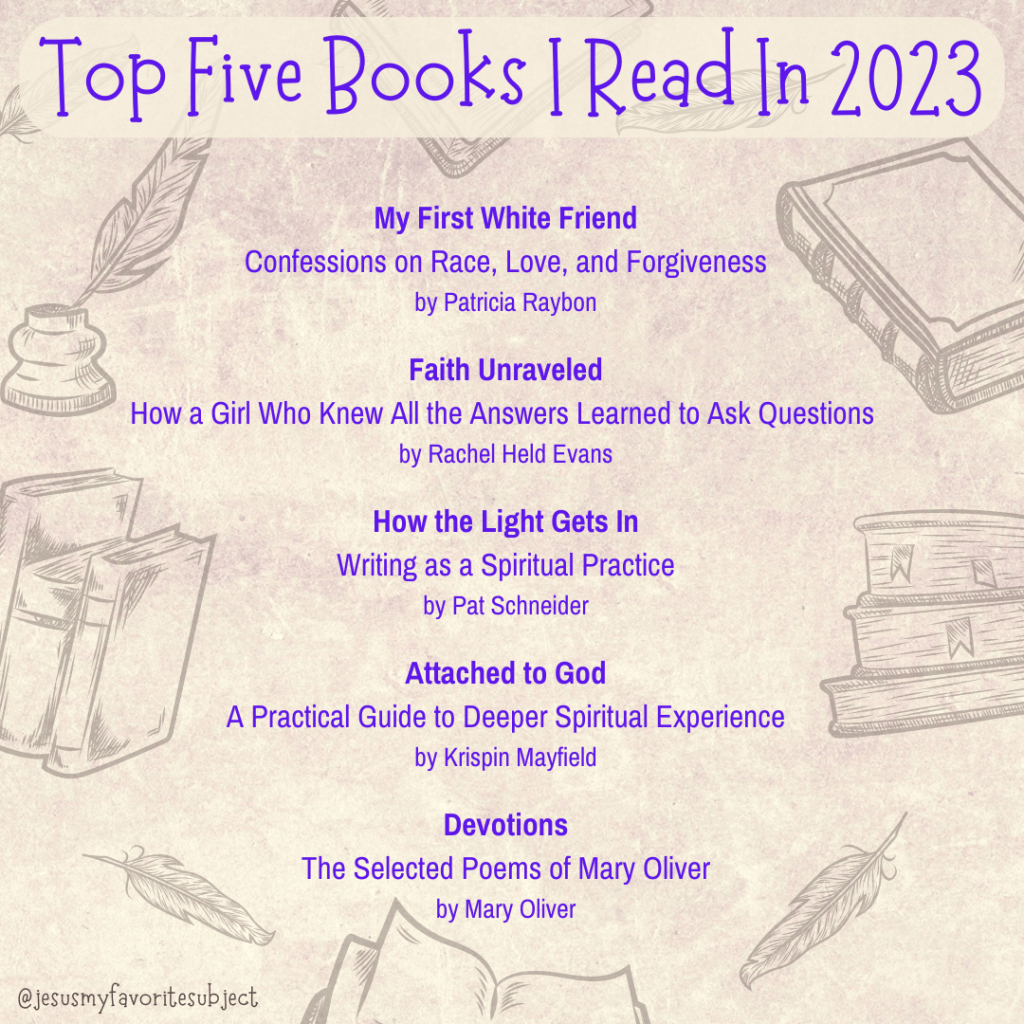
  • My First White Friend: Confessions on Race, Love, and Forgiveness, by Patricia Raybon
  • The Big Book of Christian Mysticism: The Essential Guide to Contemplative Spirituality, by Carl McColman
  • unbelieve: poems on the journey to becoming a heretic, by Marla Taviano

Books by authors in the Christian writing critique group I attend:

  • Surviving the Sand: My Family’s Struggle to Farm the Pasco Desert, by Helen Lingscheit Heavirland
  • Life Aboard a Sinking Ship: Mishaps and Mayhem on a Navy Tugboat, by Lee Yates as told to Blanche Yates
  • Building the Columbia River Highway: They Said It Couldn’t Be Done, by Peg Willis

Until last year, children’s books comprised nearly all my reading of poetry. Think Dr. Seuss and Shel Silverstein. When I started writing poems, I knew I needed to overcome my fear of poetry that isn’t illustrated and in large print. My sister helped by recommending several poets, and I read five books of poetry—including a compilation containing three of my poems, and the above-mentioned book by Marlia Taviano.

  • Swallow’s Nest: Poetry Journal, Fourth Annual Issue—December 2022, compiled by Linda L. Kruschke for Oregon Christian Writers
  • To Bless the Space Between Us: A Book of Blessings, by John O’Donohue
  • Stripped, by Cara Alwill Leyba
  • Devotions: The Selected Poems of Mary Oliver, by Mary Oliver

My reading last year included only one or two books from the self-help genre. I’d like to think this is because my mental and emotional health are improving. Or maybe I have that backward, and my mental and emotional health are improving because I’m not reading so many self-help books. Instead, I read more stories. There must be a technical term other than “story”—I’m sure “memoir” would apply to some—but to me these books are lovely because they are stories. The authors don’t tell me what to think. Rather, they invite me into their experiences. A good story is an offer of intimacy, a passageway to the inner workings of another human being and the wildness of their story. In addition to half a dozen of the above-listed books by authors I know, here are the stories I read last year.

  • Julie & Julia, by Julie Powell
  • Growing Up, by Russell Baker
  • Once Upon an Island: The Adventures of a Young Couple Who Did Buy Their Dream Island, by David Conover
  • I Went to the Woods: The Adventures of a Bird Photographer, by Ronald Austing
  • Faith Unraveled: How a Girl Who Knew All the Answers Learned to Ask Questions, by Rachel Held Evans
  • Intersexion: A Story of Faith, Identity, and Authenticity, by Cynthia Vacca Davis
  • The Face of Addiction: Stories of Loss and Recovery, by Joshua Lawson
  • Sealed: An Unexpected Journey Into the Heart of Grace, by Katie Langston
  • Love Warrior: A Memoir, by Glennon Doyle
  • Birding Against All Odds, by Joan Easton Lentz

Every one of the spiritual books I read felt like friendship. These books saw my heart and spoke both things I knew and things I didn’t yet know. They pushed me to try new things, think new thoughts, ask new questions. God and spirituality captivate me in a way nothing else does. I underline, write down page numbers, read aloud to my husband, and text paragraphs to friends. Although this happens with other books as well, it is spiritual books that most often invite me home, to a profound sense of belonging.

  • How the Light Gets In: Writing as a Spiritual Practice, by Pat Schneider
  • Attached to God: A Practical Guide to Deeper Spiritual Experience, by Krispin Mayfield
  • Small Victories: Spotting Improbable Moments of Grace, by Anne Lamott
  • The Tao of Pooh: The Principles of Taoism Demonstrated by Winnie the Pooh, by Benjamin Hoff
  • False Intimacy: Understanding the Struggle of Sexual Addiction, by Dr. Harry W. Schaumburg
  • Wild Mercy: Living the Fierce and Tender Wisdom of the Women Mystics, by Mirabai Starr
  • Forgive Everyone Everything, by Gregory Boyle, art by Fabian Debora
  • Seeking the Triune Image of God in You: A Glimpse Through a Keyhole, by Jeffrey D. Hill
  • Breathing Under Water: Spirituality and the Twelve Steps, by Richard Rohr

Re-reads. Finally, I read these three books a second time, because, in my humble opinion, they are just that good.

  • The Whole Language: The Power of Extravagant Tenderness, by Gregory Boyle
  • Bird by Bird: Some Instructions on Writing and Life, by Anne Lamott
  • Present Over Perfect: Leaving Behind Frantic for a Simple, More Soulful Way of Living, by Shauna Niequist

Thirty-seven books, and probably a few more I forgot to write down. It is a still-infant privilege, this copious access to written material. And yet, having grown up in America late in the 21st century, I can’t imagine anything else. Shelves of books are the backdrop to my office, my small groups, and my mental and emotional spaces. I am profoundly thankful for each author who puts their words into public spaces, and for the privilege of having time to pick up those words and hang out with them.

What did you read in 2023? Leave a comment and maybe I’ll add your recommendation to the list of books I want to read.

Alexander and Me

When Michael and I were newlyweds, our town welcomed a Hastings, in a large new building on Ninth Street by the auto parts store. We signed up for a membership and frequented the store—an inviting combination of books, coffee shop, and rows upon rows of DVDs to rent or buy. One evening we casually browsed books—I especially remember the prominent cookbook section with its bright colors—and wandered into the children’s book area.

“Hey, it’s Alexander and the Terrible, Horrible, No Good, Very Bad Day,” Michael said, pulling out a thin, blue book. “My high school English teacher read this to us.”

I took the book and opened to the first page, where a black-and-white illustration shows a small boy in pajamas, resignation on his face. I read aloud:

“I went to sleep with gum in my mouth and now there’s gum in my hair and when I got out of bed this morning I tripped on the skateboard and by mistake I dropped my sweater in the sink while the water was running and I could tell it was going to be a terrible, horrible, no good, very bad day.”

“That’s awful!” I said, as I turned the page and silently read on. The story continued in similar style, as Alexander suffered through the day. His teacher said he left out sixteen at counting time, the dentist found a cavity in his teeth but not in his two brothers’ teeth, there were lima beans for dinner, and during his too-hot bath he got soap in his eye and his marble went down the drain. Each page featured run-on sentences detailing the disappointments of childhood.

“Wow,” I said, handing the book back to Michael. “I don’t like it at all. Why would someone write a book like that?”

Michael looked slightly amused by my passionate reaction.

“Doesn’t it bother you?” I asked.

“I don’t know. It doesn’t seem to hit me the same way it hits you.”


Fast forward nearly 20 years. Alexander and the Terrible, Horrible, No Good, Very Bad Day is one of my favorite children’s books. This change illustrates the undoing and remaking of my inner landscape, especially after becoming a mother 11 years ago. Newlywed Me believed the world was a happy place and sadness was fixable. Late-30s Me prefers Glennon Doyle’s word “brutiful” to describe the world, and has mostly given up on trying to fix sadness. Newlywed Me thought children’s books should have color pictures, cheerful stories, and favorable endings. Late-30’s Me appreciates pencil and ink illustrations, stories of struggle, and inconclusive endings. Newlywed Me didn’t want to believe any day could be bad from start to finish. Late-30’s Me agrees with Alexander’s mother, that “some days are like that. Even in Australia.” Newlywed Me felt a sense of injustice when Alexander’s best friend rejected him, and when he got in trouble for being muddy after one brother made him fall in the mud and the other brother called him a crybaby. Late-30’s Me knows that friendship is fragile, and sometimes you get scolded for things that aren’t your fault.

Alexander suffered through his day. I suffered through the drudgery of stay-at-home-momming. Throughout the book, as Alexander voices his desires and frustrations, no one listens, and no one answers. Throughout the early years of parenting, I felt unseen and unheard.

On a piece of old electrical wiring sticking out of the wall in my unfinished home office hangs a “medal,” swag from a 5k I walked/ran with friends in 2021. It features a glittering butterfly above the words, “It’s okay to not be okay.” I first saw those words in traffic, painted on a car window at the intersection of Ninth and Rose. They gave me a permission I had needed for a long time: permission to not be okay, to be unable to fix my mind or my marriage or the bathroom formica that is partially detached from the countertop. I think it was Anne Lamott who wrote, “Everything is so not okay.” I agree.

Sometimes I get to fix things, and I like that. Most of the time I don’t, and I’m learning that a bleeding world feels much friendlier when I know “some days are like that,” some relationships are like that, some religions are like that, and one load of laundry containing the entire wardrobe of a baby can take an hour to fold.

Alexander was not happy when he went to bed that evening. The day ended much as it began:

“When I went to bed Nick took back the pillow he said I could keep and the Mickey Mouse night light burned out and I bit my tongue. The cat wants to sleep with Anthony, not with me. It has been a terrible, horrible, no good, very bad day.”

I am moved to laughter and tears, and most of all, relief. Some things in life simply call for a negative, bleak, too-long, awful sad list of adjectives.

If you’re not familiar with the Alexander books, this youtube video is a lovely read-aloud of Judith Viorst’s book that inspired today’s blog post.

Alexander, Who Used to Be Rich Last Sunday is another favorite.

Special thanks to my husband, Michael, for the idea to write on this topic.