Tag Archives: Bible

Simple Jesus

I want to like Jesus because the grown-ups in my life told me He is good, and they were right. 

I want to be innocently happy that God is good. 

I want to go back to painting “JESUS FREAK” in huge letters on a baggy cotton T-shirt, soaking up Sabbath School lessons with gusto, back to the credibility God had when I was 14.

Simple Jesus—does He still exist? Or can He at least be mysteriously complex and Kindergarten-simple at the same time? 

Is there a reality—no-strings-attached—in which Jesus just loves me and knows my name?

A few weeks ago I attended a spiritual retreat at Camp MiVoden, as a sponsor for the girls in the 7th/8th-grade class. During the worship services I remembered something, a feeling of belonging and certainty from my past. I knew some of the songs the praise band led, and I sang with my arms raised. No one expected anything—hardly anyone knew me—and the featured speaker said simple and good things, about who I am and who God is, and I cried, and I remembered a time when I belonged wholly, and sermons weren’t pocked with ideas that distract me from goodness and wholeness.

I want a plain friendship, one I don’t have to defend or explain, one in which I don’t need Jesus to make me look good, and Jesus doesn’t need me to make Him look good; Jesus with a reputation as simple as Mary who had a little lamb, not the notoriety of an activist. 

I don’t need answers for all the questions and discrepancies. I’m looking for that place where they are absent, where I don’t have to explain why I don’t believe in a punitive gospel, or why I’m part of a faith tradition (Christianity) that has inspired violence for thousands of years. I don’t want to explain why I use feminine pronouns for God, or why I say Adventism is my community but not my religion. I don’t want anyone to raise their eyebrows at me, nor me at them. I want to be in love—inside love. I want to feel safe because I am safe. 

Maybe what I really want to know is this: does a simple Jesus exist for adults too? Does He go for coffee with millennials—with me? Does He wear jeans and send 132 text messages every day? Does He understand carpools and playdates and a family calendar on the kitchen wall and how all the spoons are dirty if I miss one day running the dishwasher? Does He peruse my TBR shelf and ask me about my writing? Does He know I’m still a little girl inside, intimidated by the disciples who turn me away because I am small and simple?

Is Jesus here now, and does He remember me? Does He look through my photo albums and murmur memories? Has He been here for it all? Can we laugh together about singing “Sinnerman” and “We Are Soldiers”—the laugh of a shared memory—those lyrics humorous like the frizzy perms of the 80’s?* Is He still the cleft in the rock, the hiding place, the blessed assurance the hymns offered? 

What if we’ve shared a life more than a belief system, and our love is built on mutual adventure and admiration?

Maybe He has never needed me to pull Him apart and stitch Him back together, to understand how He is a triune being, or even to put our companionship into words. Perhaps I was mistaken in thinking that farther, bigger, and deeper are better. 

Jesus is here. In the essentials He hasn’t changed a bit. He’s still the great guy I knew in primary Sabbath School; the one who stood with me in the church baptistry, invisible yet deliciously simple; the father I wrote to in a dozen journals full of prayers; the soil from which I grow. Most of all, He’s still my friend.


*I sang these songs countless times. Although the lyrics of “Sinnerman” I sang were not as heinous as what I just found by googling it, I think it’s safe to say it’s inappropriate to mock sinners running from God (and what even is a “sinner”? Aren’t we all?). And don’t even get me started on “We Are Soldiers” and “I’m in the Lord’s Army.” Who decided it was a good idea for seven-year-olds to sing about blood-stained banners and artillery? So yes, I think Jesus and I can have a good laugh about it.

Am I Delaying Jesus’ Coming?

I may be impeding the second coming of the Messiah.

Let me explain.

As I embrace spiritual uncertainty, my Christian denomination is included in that uncertainty. My faith group of origin—and current community—is Seventh-Day Adventist (SDA), but I refer to myself as “badventist” to portray the distance I feel from the doctrines I signed my name to uphold more than 30 years ago.

The name “Seventh-Day Adventist” incorporates two of the church’s most precious truths: we rest and worship on the seventh day of the week, and we believe in the soon second coming, or “advent,” of Jesus Christ. According to SDA’s, biblical interpretation of Scripture predicts a worldwide decline before Jesus descends from “heaven” and carries away the saints—including those who resurrect upon His arrival. After that we sit around for 1,000 years, Earth incinerates, then gets made new, and we move back in. (Disclaimer: this is what my brain recalls of our church’s teaching. The well-studied may find errors.)

This pre-second-coming world decline involves an increase in “knowledge,” natural disasters, merrymaking, Antichrist, and moral decline. Many SDA’s also believe that every person in the world must hear the gospel of Jesus Christ before the second coming—hence, a focus on evangelism. Missionaries travel all over the world to tell people about Jesus and undertake projects like translating the Bible into local language.

In this worldview of planet-decline-followed-by-destruction, it can be considered wasteful to invest too much in taking care of the planet—I remember a sermon titled, “It’s All Gonna Burn.” Wouldn’t it also be wasteful, then, to care for people without telling them about Jesus? If they’re happy and healthy but don’t know about Jesus, they’ll go to hell happy and healthy. Not much “eternal value” there. (Although SDA’s don’t ascribe to an eternally burning hell, just a quick fiery death.)

At the time of this writing, I find myself on a quest to help people without telling them about Jesus, and it looks like this: I believe writing is healing, speaking and hearing our stories is healing, and in marrying those two healing forces, my desire is to guide small groups in writing together and reading aloud our writing. The goal is to create space for marginalized people (which is all of us, at times) to have a voice, to own our stories, and to find wholeness in the process. The goal is not to introduce people to Jesus. So, am I delaying the second coming, heaven, and the world made new?

When I was a kid, we had neighbors up the road who believed in God, but—I was shocked to find out—believed the world would gradually get better and better, instead of worse and worse. A google search informs me their belief may be called postmillennialism, in which Jesus essentially will return to a saved earth. This almost makes more sense to me.

It sounds like the SDA view is suggesting that the more people who know Jesus, the worse off the world becomes. Doesn’t that seem odd? Spread the gospel everywhere, and once everyone has heard about Jesus the Earth will be in the worst shape it’s ever been. Jesus will then swoop in to save the righteous few and burn up the rest. I’m having doubts about how all this will go down.

For the time being, I mostly leave the destiny of the world in God’s hands—surprise me. I don’t need to know. Anyway, humans have a pathetic track record when it comes to predicting the future—even from intensive study of Scripture.

Having said all that, I still experience a nagging feeling that it’s “wrong” to help people without telling them about Jesus. Am I delaying the glorious new earth by helping people get healthier and not introducing them to Jesus? Shouldn’t I introduce them while they’re acutely aware of their need of a Savior? Once they get healthy they might be less motivated to “convert.”

In all honesty, I’m not firmly settled on the question—or the answer. But I am sure about setting this aside, for now. God partners with me—or I partner with Her—to relieve suffering. If I’ve missed the mark by excluding overtly religious material from my writing group curriculum, I have complete confidence in God to point me in a new direction.

Who knows, maybe we’re all invited to make this world a better place in order to set the stage for the return of our Beloved.

But Jesus Said

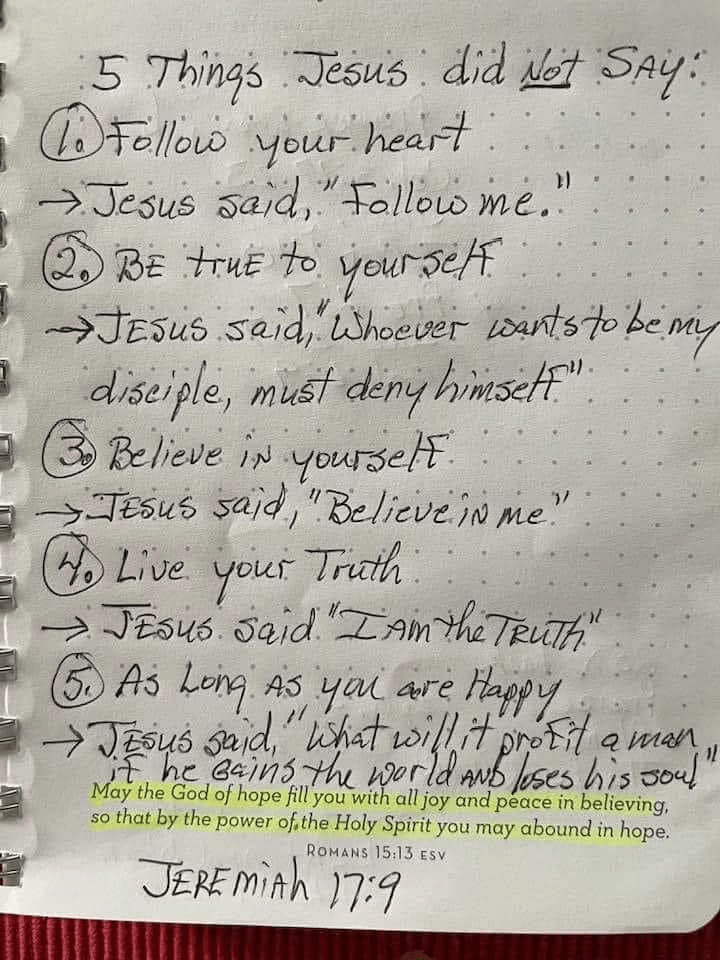
Last fall I (shockingly) found something on Facebook I don’t agree with. As I scrolled through the first dozen posts on my feed, this graphic appeared at least three times.

Obviously it resonated with many of my friends and family. But, when I read it, I felt small, mute, powerless. I felt called to misery as my spiritual inheritance. I felt afraid of myself.

Then I thought, two can play at this game. You throw Bible verses at me, I’ll throw some back at you. (Side note: I’m working on being less defensive.)

#1) Jesus didn’t say, “Follow your heart.”

No, but He made my heart, and He likes to spend time there. My heart is where the physical and the spiritual meet—like the exchange of oxygen in my lungs, passing from air to blood, life-giving mystery. If I try to separate from myself, I end up separating from God. He is the substance of which I am made.

Jesus said to His Father, “I do not pray for these alone, but also for those who will believe in Me through their word; that they all may be one, as You, Father, are in Me, and I in You; that they also may be one in Us.” (John 17:20-21a, NKJV, emphasis added)

#2) Jesus didn’t say, “Be true to yourself.”

No, but He did say, “Every kingdom divided against itself is brought to desolation, and every city or house divided against itself will not stand.” (Matthew 12:25b, NKJV)

#3) Jesus didn’t say, “Believe in yourself.”

No, but He did tell this parable: “Suppose a woman has ten silver coins and loses one. Doesn’t she light a lamp, sweep the house and search carefully until she finds it? And when she finds it, she calls her friends and neighbors together and says, ‘Rejoice with me; I have found my lost coin.’” (Luke 15:8-9, NIV)

This is a woman who believes in herself. She doesn’t blame the kids for losing her coin, or berate herself. She takes action. She lights a lamp, sweeps the house, and looks carefully until she finds the coin. When she finds it, she doesn’t breathe a sigh of relief that no one found out how irresponsible she was to lose it. On the contrary, it appears she’s okay with mistakes and disappointments. When she finds the coin, she calls her friends and neighbors to rejoice. She knows that she belongs and that her triumphs are worth celebrating—not because she has done something extraordinary, but because she has showed up for the ordinary.

#4) Jesus didn’t say, “Live your truth.”

No, but He did make me different from everyone else. JJ Heller sings, “Maybe the best thing I can be is me.” I’m not Jesus, or Paul, or Ruth. I’m not the foster-mom, or the guy who evangelizes with fresh-baked bread. I’m not the one who remembers everyone’s name and their mother-in-law’s name. My home isn’t a clean and peaceful space people flock to. But I do create safe spaces for people to talk and grapple and say life is shitty. I do text friends when I’m thinking of them, and sporadically send cards in the mail. I ask questions and deliver coffee and buy birthday gifts.

I write bravely, and sometimes the person who reads feels seen. My truth is the truth I know because I’ve lived it and it’s deep in my bones. It is these deepest parts of me that touch the divine.

Jesus said, “For God so loved the world that He gave His only begotten Son, that whoever believes in Him should not perish but have everlasting life. For God did not send His Son into the world to condemn the world, but that the world through Him might be saved.” (John 3:16-17, NKJV)

God didn’t come into the world to overshadow me or indict me, but to preserve and liberate me.

#5) Jesus didn’t say, “As long as you are happy…”

No, but He did say, “I have come that [my sheep] may have life, and that they may have it more abundantly. I am the good shepherd. The good shepherd gives His life for the sheep.” (John 10:10b-11, NKJV)

Jesus didn’t suggest that we sacrifice everything on the altar of happiness, but neither did He suggest that we pursue misery. He made us with taste buds and penises and clitorises, and He made a world bursting with taste and touch and life. He metes it out neither according to merit nor in submission to scarcity, but in wild abundance.

“Happy are the people whose God is the Lord!” (Psalm 144:15b, NKJV)

The Bible Is Bananas

A wise man once said there is a time for everything. I used to interpret that as a statement about seasons—one thing in one season, another thing in another season. But maybe it’s also a statement about concurrency, about different things at the same time. In stead of either/or, I find myself more often thinking both/and. I am both connected to people and separate from them. I am both anxious and at peace. The world is breathtakingly beautiful and excruciatingly broken. Family is an asset and a pain in the ass. Love is ultimate safety and ultimate risk. God is male and female and non-gender.

But now and then I wonder if I’m being too permissive. My conservative evangelical upbringing tells me there are definite wrongs and rights, and one typically excludes the other. The church also told me the Bible makes sense. Read it “right” and you can reconcile what is confusing, and even package it all up nicely in bullet points on illustrated pamphlets. So if I don’t believe in one right answer any more, do I still believe in the Bible?

I don’t open my Bible much these days, but today I do. I read Lamentations chapter 3, and find it to be a lovely example of both/and thinking. (Or an example of irreconcilable contradiction. Take your pick.) Lamentations 3 contains 66 verses of despair, hope, and vengeance, penned by the prophet Jeremiah. As I begin to read, I feel a growing sense of contrast between these verses and the scriptures I see stenciled on wall art at Hobby Lobby, or screen-printed on church youth group t-shirts. I certainly didn’t memorize these verses in Sabbath School.

v. 2 He has led me and made me walk in darkness and not in light.

v. 3 Surely He has turned His hand against me time and time again throughout the day.

v. 7 He has hedged me in so that I cannot get out; He has made my chain heavy.

v. 11 He has turned aside my ways and torn me in pieces; He has made me desolate.

v. 16 He has also broken my teeth with gravel, and covered me with ashes.

I’m not even gonna try to wrap those up with a nice bow. Not only are these sentiments a dark portrayal of God, they stand in open disagreement with texts elsewhere in the Bible. For example:

v. 2 He has led me and made me walk in darkness and not in light.
AND Your word is a lamp for my feet, a light on my path. Psalm 119:105

v. 3 Surely He has turned His hand against me time and time again throughout the day.
AND I will strengthen you and help you; I will uphold you with my righteous right hand. Isaiah 41:10b

v. 7 He has hedged me in so that I cannot get out; He has made my chain heavy.
AND “My yoke is easy and my burden is light.” Matthew 11:30

v. 8 Even when I cry and shout, He shuts out my prayer.
AND The righteous cry out, and the Lord hears, and delivers them out of all their troubles. Psalm 34:17

v. 9 He has blocked my ways with hewn stone; He has made my paths crooked.
AND I will go before you, and make the crooked places straight. Isaiah 45:2a

v. 16 He has also broken my teeth with gravel, and covered me with ashes.
AND The Spirit of the Lord God is upon Me, to give them beauty for ashes, the oil of joy for mourning, the garment of praise for the spirit of heaviness. Psalm 61:1a, 3b

v. 17 You have moved my soul far from peace; I have forgotten good.
AND “My peace I give to you.” John 14:27
AND He leads me beside the still waters. He restores my soul. Psalm 23:2b, 3a

As it turns out, I don’t need to look in other books of the Bible to find opposing sentiments. This one chapter of Lamentations contains a fullness of expression from one extreme to the other:

v. 11 He has turned aside my ways and torn me in pieces; He has made me desolate.
AND The Lord is good to those who wait for Him, to the soul who seeks Him. v. 25

v. 42 We have transgressed and rebelled; You have not pardoned.
AND Oh Lord, You have pleaded the case for my soul; You have redeemed my life. v. 58

v. 43 You have covered Yourself with anger and pursued us; You have slain and not pitied.
AND Through the Lord’s mercies we are not consumed, because His compassions fail not. They are new every morning; great is Your faithfulness. v. 22, 23 (Here’s the Hobby Lobby verse I was looking for!)

v. 44 You have covered Yourself with a cloud, that prayer should not pass through.
AND You drew near on the day I called on You, and said, “Do not fear!” v. 57

At this point I’m either thoroughly confused (I am), or my both/and thinking is expanding exponentially (it’s trying). The more I read, the more oddities I find. Is this a portrait of grief, not meant to make “sense”? Certainly an either/or mindset would require a diagnosis here, probably something along the lines of, “These are just feelings. Of course God doesn’t actually break our teeth, remove us from peace, or make our chains heavy. This passage is an upset person blowing off steam, exaggerating to express their angst.”

But couldn’t you say the same about the verses that extol God? What if the reality is that God turns His face away from us and punishes us, but sometimes we feel like He is listening to us and redeeming us?

Maybe it’s all of the above. We feel all kinds of feelings that aren’t about what God is actually doing or not doing. We also receive Her work in our life through our feelings. And maybe God is both punishing us and redeeming us. That’s hard for me to even write, as I have completely abandoned the idea of a God who punishes. But what if it’s both? And what if sometimes salvation happens in a sheep-and-goats sort of way, and other times in an all-shall-be-saved sort of way?

Jeremiah writes, “Is it not from the mouth of the Most High that woe and well-being proceed?” (v. 38) I love that it’s a question and not a statement. It’s an invitation to conversation, and invitation to keep wondering, keep talking, keep paying attention to what is there and what isn’t there.

Could it be comforting that the Bible is basically bananas? Imagine if everything matched up nicely and could be distilled to a handful of logical statements. No need for 66 books full of words that paint God (and Her creation) in every light imaginable. Let’s have one painting of God, at dusk, when the light is most complimentary and the air is calm. Let’s keep this one painting in a vault and burn all other paintings, and the people who paint them.

But no, the Bible will not allow this. Its vivid portraits of God and humans are all bound together. For my part, I’m done pretending the Holy Spirit is going to match it all up for me. Bring on the paradoxes, contradictions, violence and patriarchy, and the portrait of a God whose love is so inclusive and profligate it’s ridiculous. Both/and.


Special thanks to Marla Taviano (@marlataviano, @whitegirllearning) for the phrase “the Bible is basically bananas.” Go preorder her newest book of passionately beautiful deconstruction poetry, titled whole. (And while you’re at it, order her other books of poetry, unbelieve and jaded.)

From Pink Leather to Diversity

I cannot imagine the “Urgent need for Bibles” depicted on my social media feed and in letters from charities. I don’t know the hunger for Scripture that thousands have felt in prison, in remote villages, in countries hostile to Christianity. I have more Bibles than I want, and only need visit a book store or sit in a church pew to access even more.

Over the years, I’ve accumulated seven or eight Bibles, including a small pink New Testament with Psalms, a Seminars Unlimited Edition KJV (free for everyone who attended a Revelation Seminar series—hallmark of the Seventh-Day-Adventist Church), and the bright, almost-holographic NIV children’s Bible I earned by memorizing the books of the Bible. I’m still proud that I can recite the minor prophets in order.

During my high school years I bought a metal-covered NLT Bible with a magnetic clasp, and a Spanish/English NIV. In Senior Bible class, each student chose a new-to-us style or version of the Bible. I picked the Serendipity Bible, designed with questions and study helps in the margins for group discussion. Lover of small groups that I am, I thought—and still think—it’s brilliant. But I’ve hardly used it.

The only Bible I truly loved came to me in its pink leather cover on my ninth birthday. As I wrote in last week’s post, I read it all the way through that year, and over the next ten years it became like a fifth appendage. When I flip through it now, I find a quarter-sheet of paper with notes for a worship talk to the student body at my high school, and another with multiple-choice options, showing a checkmark beside the statement, “I rededicate my life to Christ today.”

I still get a feeling of companionship when I turn the pages of my pink Bible, but it’s connected to life before I moved away from home. I must have taken that Bible to church during my college years, but memories are vague. Did I have morning “quiet time”? I can’t remember. By the time I graduated from college, the focus of my small groups had moved away from Bible study and toward facilitating safe spaces for personal growth. The women in my life wanted to be heard, and so did I.

Two years after I graduated from college—and fifteen years after my parents gave me the pink Bible—my college-boyfriend-turned-husband gave me a burgundy NKJV Remnant Study Bible with my married name embossed on the front, in silver. Pink Bible retired to the Bible shelf, safe in a pleather case. But I never really moved in to my new Bible. Only a handful of verses are highlighted or underlined and no papers are tucked between the thin pages.

I can’t help but wonder if I loved the Bible as a book in its own right, or if I only loved that Bible. The pink Bible meant purpose, connection, expertise. Perhaps it filled the role of a cup of coffee or alcohol—to buffer social spaces. During my 20’s, as the years filled with grown-up responsibilities, the Bible settled down along with the rest of my life. The excitement of spiritual leadership, learning to drive, falling in love, and working a dozen different student jobs during my late teens and early 20’s turned into the predictability of a dual-income home. I rose at 5:40am for quiet time, and prayed through Stormie Omartian’s The Power of a Praying Wife at least twice. I read the Bible and journaled and expected life to continue in much the same way. The Bible was habit—was that all?

By the time I turned thirty, we’d added two babies to the family. Prayer journaling ceased during the years of babies and young children, and at the same time my confidence in God and Scripture took a beating. As I fought for sleep and struggled to maintain a shred of self-worth, my youthful confidence gave in to confusion, anger—and curiosity. I wrestled with God and mostly left the Bible out of it. An aching emptiness took hold of me, and the Bible’s companionship didn’t comfort. I read other books and prayed and went to counseling. Half a dozen agonizing years later I emerged with a different confidence and a different companion. My confidence resembled the flowing water of a mountain stream more than the steadfast rocks at its bottom. My new companion emerged as a sense of spiritual belonging and safety with myself and with the divine.

My “faith,” or whatever you want to name the relationship I have with myself and with the divine, is safe, flexible, curious, gentle. I have little interest in church doctrine, and equally slight interest in church pews. The occasional sermon I’m obliged to hear tends to raise my hackles. But I may be closer than I’ve ever been to possessing something I want to share. And it’s not a Bible study.

These days I’m timid with the Bible. When I want to find a verse, it’s faster to google a key phrase than open my Strong’s Exhaustive Concordance of the Bible, or—if I know the reference—I type it in BibleGateway and select the version I like best. My burgundy Bible sits on my writing desk more as a prop than a friend, and my pink Bible remains in the bookshelf.

Rachel Held Evans, in her book Faith Unraveled, takes readers along with her on the journey promised in the subtitle: How a Girl Who Knew All the Answers Learned to Ask Questions. Her Bible, like mine, absorbed a nontrivial portion of her time and energy as a teen. Unlike me, she started to ask questions, and learned that all questions do not have clean, three-point answers. Over time she found a different way to approach the Bible:

“As much as I struggle with the things I don’t like about the Bible—the apparent contradictions, the competing interpretations, the troubling passages—I’m beginning to think that God allows these tensions to exist for a reason. Perhaps our love for the Bible should be measured not by how valiantly we fight to convince others of our interpretations but by how diligently we work to preserve a diversity of opinion.”

Faith Unraveled, pg. 194

Diversity of opinion sounds terribly healthy. Am I that healthy? How comfortable am I, listening to another person share—from the Bible—a theological view different from mine? Will I allow them the certainty that irks me? On the other hand, am I able to hear doubts and questions without offering a solution? Can I experience spiritual intimacy with the people I disagree with, or only with those who have the same interpretations and “aha” moments that I do?

I’ve avoided the Bible for years now because when I pick it up and begin to read, I’m often thrown back into black-and-white thinking. Scripture is not a place of curiosity for me, but a textbook with answers. It’s hard to come back to a text I poured my life into as a teen, with a different view of myself and the world. We don’t fit together like we used to. But Rachel Held Evans gives me permission to try a more nuanced, messy relationship with my Bible. I haven’t picked it up yet, but I might. When I do, I want to look for diversity and contradiction, and practice making friends with the parts that are uncomfortable. I would like the Bible to be an irritating friend—by turns funny, exasperating, wise, sometimes a gentle companion and other times giver of good advice I’d rather not hear. I want it to remind me there are more questions than answers, and that what we write about God is as oddly erratic as what we write about humans. Maybe, in a year or ten, I will again be friends with a Bible. I don’t know what color the cover will be, but the inside won’t be black and white. It will be grey and rainbow.

Bible Sidekick

When I was eight years old, I signed a baptismal certificate, and Pastor Bryson baptized me into the Seventh-Day Adventist Church. I remember practicing how to hold his arm while he held the dry washcloth over my face, so I could go under without breathing in water.

Six months later, for my ninth birthday, my parents purchased a Bible from the Christian book store, where they had my name embossed on the cover. They let me choose the embossing color—rainbow shimmer—but they kept the Bible out of sight. I used to wish I had chosen plain silver embossing, to please the adults and to match my tastes as I grew older. But at eight-going-on-nine, I wanted rainbow shimmer.

I was allowed to invite one family to our home for my birthday celebration each year, and for my ninth birthday I invited Laura and Eric. They were the only people I knew in their early 20’s, and I admired them as only a nine-year-old can. Laura had dark brown hair with one curly spot in the back where her previously-straight hair grew back in a curl after a diving accident. She had a petite frame, and a lovely accent from spending a year in Latvia. Eric was tall, with long everything—legs, arms, torso—and a wide, impish-yet-innocent smile.

I don’t remember much about my ninth birthday. Pictures remind me that I dressed up in elegant old skirts from our dress-up stash. Laura and Eric gave me a miniature rose plant, and my parents gave me the Bible—a red letter edition NKJV with a pink, bonded-leather cover.

I read the Bible cover to cover that year. I read about creation and Abraham and Moses, the cut-up concubine, prostitution and murder, lying and rape, greed and gratuitous violence. I read about Ruth and Esther, the Song of Songs, and somehow made it through Lamentations and the major and minor prophets. I read the shocking story of Jesus’ beginnings and the shocking story of His death, and through the exhortations of the apostles, all the way to the “Amen” at the end of Revelation chapter 22, verse 21.

I don’t recall having any questions, registering any shock at the violence, or finding any difference between the God portrayed in the Old Testament and the God portrayed in the New Testament. It was the Bible. I assumed it was all okay to read, and unnecessary to question.

By the time I completed 8th grade, I could find any Scripture reference in 30 seconds or less. My pink Bible accompanied me for the livestream of Dwight Nelson’s Net ‘98 evangelistic series, and Mark Finley’s Net ‘99 evangelistic series, both projected on the big screen in my home church. I began a lifelong habit of morning prayer-journaling after Net ‘98, the year I turned 13. In the front of my Bible I glued a handwritten copy of Robert Frost’s poem, “The Road Not Taken,” and a variety of Bible “study helps” I never used. With The Marked Word study guide as my starting point, and armed with half a dozen pastel-colored gel pens, I underlined more than 30 chain studies.

After homeschooling basically forever, I attended Milo Adventist Academy (MAA) for 11th and 12th grades. Our family lived in the small southern-Oregon community where MAA occupies a slope beside the South Umpqua River, so as a high school student I attended the same church I’d been attending since I was born. As a student at MAA I served in almost every spiritual leadership position available. I was a group facilitator at a youth Bible conference, Spiritual Disciplines small-group leader, Junior Class Spiritual Vice President, and Student Association Spiritual Vice President. For a school talent show, I memorized and recited Psalm 139 and won a cash prize.

The summers I was 16 and 17 years old, I spent away from home, selling religious books and vegetarian cookbooks door to door with a Seventh-Day Adventist group called Oregon Youth Challenge. We led church services on weekends and Bible studies some weeknights, and my pink Bible and I took a tour of the SDA churches around Gresham, Oregon and Vancouver, Washington, while book sales helped fund my private school tuition.

Wherever I went, throughout my teen years that well-marked Bible was like a fifth appendage. When the youth leader said, “Hold up your swords!” my “sword” was always handy. I was well-prepared to fight with that sword, but I never did.

I don’t recall interacting with anyone who was interested in the Bible from a curious, unknowing space. Everyone I knew was either a “nominal Christian,” bumping along in apathy, or they were doing the same things I was, memorizing and marking Bible studies and verses that reinforced Adventist doctrine. Books I read and pastors I met told stories about meeting someone who was “hungry for the truth,” but I didn’t see or experience this firsthand.

Despite swallowing the Bible hook-line-and-sinker, even in high school I couldn’t imagine sharing the “plan of salvation,” telling someone they’re a sinner in need of saving. Although I soaked in Scripture and prayer, I didn’t feel any urgency to share my experience as a Christian. I sat squarely in the middle of an us-vs-them mindset, but the act of inviting a “them” to join “us” was far from my desire and far from my experience.

The Bible, I think, was something for me to be good at. I “knew” my Bible. I could find any verse in a few blinks of the eye, ask thoughtful questions (within accepted norms), and share my observations and opinions. I can’t imagine not having the Bible at that time in my life. I read it, marked it, loved it.

When I packed my room and drove eight hours to move into a college dormitory, I had no idea what was ahead for me and my Bible.


Read the next part of the story on February 7.

Home and Healing

I get confused about Healing and Home, in a chicken-or-egg sort of way.

By Healing, I mean what Christians often call sanctification—the sacred pathway of becoming.

By Home I mean, “It is finished.” (see John 19:30) Christ accomplished all, and all is mine and His, and we are one. (The Christian ideas of justification and glorification may both be included here).

Which comes first, Healing or Home? Home leads to Healing because it tells me the truth about who I am, but Healing brings me Home because it enables me to believe the truth about who I am.

Wondering which one follows the other may be a distraction from the miracle that both are forever true. Home stands complete, perfect, sure and strong as granite. Healing takes the journey, bearing witness to growth and death and life—transformation on repeat. Healing leads me Home … but Home permits me to Heal.

The Bible—which at this time is an enigma to me—says much about Home and Healing. It speaks about what we have now, and what we are moving toward; about how things are, were, and will be. It’s all mixed up together. Take the first chapter of Ephesians, for example.

I pray that your hearts will be flooded with light so that you can understand the confident hope He has given to those He called—His holy people who are His rich and glorious inheritance. I also pray that you will understand the incredible greatness of God’s power for us who believe Him. This is the same mighty power that raised Christ from the dead and seated him in the place of honor at God’s right hand in the heavenly realms. Now He is far above any ruler or authority or power or leader or anything else—not only in this world but also in the world to come. God has put all things under the authority of Christ and has made Him head over all things for the benefit of the church. And the church is His body; it is made full and complete by Christ, who fills all things everywhere with Himself.

Ephesians 1:18-23 NLT

I feel a bit woozy after I read this passage. Past, present, future—it’s all there. And what a lineup of shocking statements. I am part of God’s inheritance (why does He have an inheritance?). God’s power for me is the power that resurrected Jesus. Jesus has authority over all authorities, “not only in this world, but also in the world to come.” The church is Christ’s body (say what?). “All things everywhere” are filled with Christ (really? All and everywhere are VERY inclusive words).

But I’m gonna roll with it. God my Father placed Christ above all things, and He placed me in Christ. He is “far above” because He is bigger and more alive than power and dominion and rules and authority.

I am in Him. By His stripes I am healed from control, because He is above control, and I am in Him. (see Isaiah 53:5) His authority supersedes the illusion of human control (the illusion that I can control myself or another person, or that I can be controlled by another person).

Even the apostle Paul seems astonished by (yet very confident about) this craziness.

What shall we say about such wonderful things as these? If God is for us, who can ever be against us? Since He did not spare even His own Son but gave Him up for us all, won’t He also give us everything else? Who dares accuse us whom God has chosen for His own? No one—for God Himself has given us right standing with Himself. Who then will condemn us? No one—for Christ Jesus died for us and was raised to life for us, and He is sitting in the place of honor at God’s right hand, pleading for us. Can anything ever separate us from Christ’s love? Does it mean He no longer loves us if we have trouble or calamity, or are persecuted, or hungry, or destitute, or in danger, or threatened with death? No, despite all these things, overwhelming victory is ours through Christ, who loved us. And I am convinced that nothing can ever separate us from God’s love. Neither death nor life, neither angels nor demons, neither our fears for today nor our worries about tomorrow—not even the powers of hell can separate us from God’s love. No power in the sky above or in the earth below—indeed, nothing in all creation will ever be able to separate us from the love of God that is revealed in Christ Jesus our Lord.

Romans 8:31-35, 37-39 NLT

As I consider what little I can grasp from this shocking passage, I am surprised by this comfort: I belong. This is a relief.

I belong in (inside) Christ. I don’t need to worry, because I’m Home. I have arrived.

Sometimes I may feel lost—as if trying to read a map through tears. Or frozen still, breathing shallow, as shape-shifting shadows approach.

Yet nothing can separate me from the love of Jesus. I am always Home. I am always in His heart, His thoughts, His body. Whether I am thriving or dying, grieving or joyful, begging or praising, suffering or sitting pretty, married or divorced, addicted or sober, giving or taking …

I am Home, which is an invitation to Healing.

I am Healing, which is my invitation Home. The door is always open.