Tag Archives: emotions

Everything Is Well but Not Okay

On Sunday morning I lay in bed with my back against my husband’s chest, and the cat propped against me with her hindquarters on the bed and the rest of her body relaxed against my belly. As she purred, Michael and I groggily checked in with each other about last night’s sleep and the coming day’s hopes. In that moment I knew I was the luckiest woman in the world.

Also, too many people I know are in agony. It’s the usual culprits—death, divorce, disease. Add to that a whole lot of problems that haven’t been named or categorized. I know people who are feeling the brokenness in their minds and bodies, whether it has a name or not.

We’re veeerrryy close to the beginning of a remodel project that will add a master bath to our home. I can’t wait for the first day of real work, when the contractor comes in and lays that heavy duty cardboard down to protect the floors, and they start demolishing walls. I’m giddy with excitement about the next few weeks of packing up my bookshelves and moving things around to accommodate the remodel. Don’t ask me to explain this joy, but by golly I’m going to revel in it whether I can explain it or not.

I’ve been crying more lately, which is oddly comforting. I haven’t cried much the last year and a half since I’ve been taking anti-depressants. Whatever curbs my depression and anger also curbs tears, and I’ve missed crying. Last night I cried at the end of the Disney movie, Elemental. I teared up recently during a dolphin show at Sea Life Park. And this morning I cried when I shared a heavy heart with friends and their response came back immediate and full of love.

Yesterday I met with the school counselor at our local alternative high school. I’m slowly making connections in the community with the goal of learning about trauma-informed education and someday facilitating writing groups that empower incarcerated and underprivileged people to tell their stories. I want to give them room to be seen and heard. Writing is one path toward wholeness, and wholeness matters. Two books near the top of my TBR pile will help me with this—Between the Listening and the Telling, by Mike Yaconelli, and Writing Alone and With Others, by Pat Schneider. Just looking at those books gives me a tiny burst of energy, and if I let myself imagine a future in which I write with others toward healing, I break into a smile. Hand me the tools and let me get started!

If someone is living a better life than me, I don’t know who it is. Of course it wouldn’t take long to write down a dozen things that could be improved—but why bother? Today is my day to live, as me. I have what I need. I am enough. God is big and bigger and biggest.

When I feel the tension, I often return to these quotes, best when read together:

“Everything is so not okay.” -Anne Lamott*

“All shall be well, and all shall be well, and all manner of things shall be well.” -Julian of Norwich

Yes.

*Okay, the truth is I’m pretty sure I read this in an Anne Lamott book, but I can’t find it again. If you know, send me the book title and page number.
Now What?

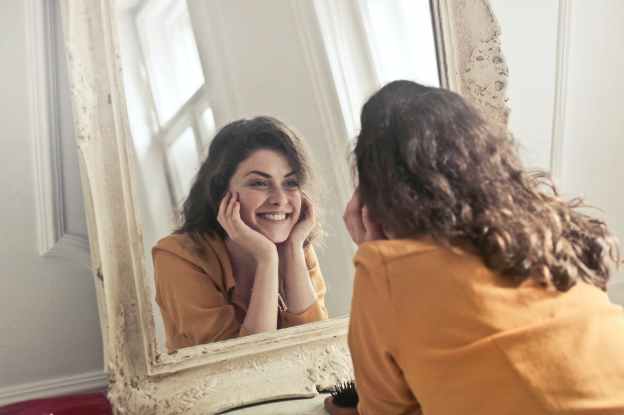
In a few days, 2024 will unfurl. I’m curious what the year will be like, for one reason I never expected: joy. I’m happy, content, grateful. After years of feeling heavy, taking life seriously, and forming relationships around mutual brokenness, happy is a little scary. My inner child tells me cheerful is good, but not happy. Happy is too … emotional. Cheerful is a choice. Happy is a feeling. God forbid I feel anything.

Boldness rises. I will step away from the heavy hand of survival to the wide open spaces of abundance. I will feel joy. And I will enjoy that joy. I will laugh and smile and say I’m doing great. It will be scary, but worth it.

Scary, because I’ve primarily related to God as therapist for so long. What will we do together if we’re not bonding over my anger, fear, and dislike of myself and my life?

Scary, because I’ve thrived on connecting with friends through a shared journey of personal growth. When I don’t have a problem to employ as a means to vulnerability, how will I connect deeply?

Scary, because I’ve believed that happy is irritating and naive. If I love my life, what will people think of me? What will I write about?

Yes, I’m afraid.

I’m also excited, tantalized by the potential of a tea-sipping life—warm, slow, fragrant. I’ve been dodging bullets and putting out fires, sleeping to avoid the chaos in my mind. What will it be like to enjoy wakefulness?

Here’s to 2023 for being ripe with friendship and love, catalysts for joy.

And here’s to 2024 for its potential to be well-lived rather than well-controlled.

An Unusual Homecoming

It has been ten weeks since I last posted. I was in a rhythm of writing, Bible study, small groups, and daily responsibilities. Then one of the kids was home sick most of one week, the other kid the next week, and the first kid again the following week. I got Covid and the girls were promptly and unceremoniously sent home from school. Two days later I received a voicemail saying they could come back to school wearing masks.

Ten days after I tested positive, Michael and the girls followed suit, so the kids were home for an entire week. I cleared my schedule. I felt good about the increased flexibility I noticed in myself, which allowed me to be available to the kids. At the same time though, I’d been distant with Michael all month, and wondered why he hadn’t complained. Should I accept this lack of stress in our relationship with gratitude, or worry that something is brewing?

It has been a long two months, unexpected in so many ways—in my heart, my schedule, my relationships. I feel fragile. I feel courageous. I wonder if I am growing up. I wonder at the beautiful people God has placed around me.

I missed (both meanings of the word) prayer group and Bible study because I was sick; then again because the kids were sick; and now we’ve adjourned for summer. Why is it that the loveliness of spring is often painted in the uncomfortable hues of transition and farewell?

Amongst the sickness and schedule upheaval, I took a wild ride in regard to my identity in Christ, shedding some things, feeling in turn brave, naked, empowered, confused. I wondered how all those feelings fit in gospel freedom. I went into a state of near panic trying to receive freedom in Christ. Then I realized in all the trying I had forgotten to sit down, to enjoy the presence of Jesus in me.

One morning I cried tears of gratitude for a deep sense of hope. A lot of mornings I slept in. Am I struggling with depression? Why did I suddenly stop writing? I noticed I didn’t feel the need to plan anything big for my birthday this year. I wasn’t sure if this apparently casual attitude was a sign of grace or depression. Do grace and depression sometimes look the same?

I have sung, cried, read, prayed, hoped, been held up by friends, and gone on a lot of coffee dates. I enjoyed hours of tender care from Nurse Nature while I had Covid, lying in bed listening to the rain and wind, Mother’s Day weekend. When I ventured out of bed I enjoyed the window shelf full of cards and flowers and treats I received for my birthday and Mother’s Day. Evidence that I married up, and also that I friended up.

If the illness and emotions weren’t enough turmoil for me—ever the avoider of change—I also fasted and prayed for three days, and we stepped down from home-church leadership after six years. That was emotional and difficult, but good. Does change cause discomfort, or discomfort cause change? I suspect it’s both.

As I flounder, I reach for certainty, forgetting that it has been a life-threatening taskmistress. But my body and my soul have not forgotten, and they recoil. They panic; I hold on tighter. Until I become acutely aware of this: the apparent safety of certainty is available only if I am willing to hold still and breathe shallow. About the time I get lightheaded, I decide I’d rather breathe deep, even if it requires that I consider alternatives to certainty—curiosity, rest and unrest, a sojourn in the wilderness.

When I become aware that comfort and discomfort are both acceptable experiences—when I allow myself to receive the wilderness—perhaps then belonging finds me. Fixating on comfort has estranged me from belonging. But there was a time I belonged, a time I remember in feelings rather than facts, before I knew that life is hard and before I reached for control to make it better. Today I cannot pretend any longer that control is serving me well, and I allow myself to remember that long-ago place of belonging, the set-your-bags-down feeling of arriving home.

It’s an unusual homecoming; an arrival initially unapparent to anyone, even me. But I remember as a child the feeling of coming home; remember where the spare key was hidden, in the garage, in the glass jar filled with nuts and bolts and little metal pieces that someone found and didn’t want to throw away in case they belonged to something important. I remember the smell of the garage—cardboard boxes and tires. Funny how even the memory of that smell takes me back to what it felt like to belong. To be a child.

I’d like to return there now, find the jar of metal bits and pieces, and carefully extricate the house key. I would let myself in, grateful the house is empty. When no one is home the feeling of belonging is unmarred by expectations. The emptiness is a quiet invitation to sit in whichever room I choose, or to stare out the window for an unacceptably long time. Being alone in a place of belonging is better than any company in a place of performance.

If I unexpectedly slipped from belonging to performance those many years ago as a child, could I unexpectedly slip back now? Could I close the door on all the houses filled with people and noise and endless expectations? I have been accepted in those houses, but so tired. My childhood house of quiet, softened by the hum of the refrigerator, invites me to return. Yet while I relish this memory of belonging, I know I cannot slip back to it.

I will never again be a little child, unconcerned for my safety and unashamed of who I am. But if my childhood won the award for simplicity, my adulthood wins for being brave enough to grow from a seed to a sapling, to risk sun and rain and wind, when they are gentle and when they are terrifying. God’s Spirit was my soil as a child, and it remains my soil. I am okay; I am never alone; I always belong. I belong in comfort and discomfort, known and unknown, well-worn pews or wilderness.

Photo by César Coni from Pexels