Tag Archives: jesus

Simple Jesus

I want to like Jesus because the grown-ups in my life told me He is good, and they were right. 

I want to be innocently happy that God is good. 

I want to go back to painting “JESUS FREAK” in huge letters on a baggy cotton T-shirt, soaking up Sabbath School lessons with gusto, back to the credibility God had when I was 14.

Simple Jesus—does He still exist? Or can He at least be mysteriously complex and Kindergarten-simple at the same time? 

Is there a reality—no-strings-attached—in which Jesus just loves me and knows my name?

A few weeks ago I attended a spiritual retreat at Camp MiVoden, as a sponsor for the girls in the 7th/8th-grade class. During the worship services I remembered something, a feeling of belonging and certainty from my past. I knew some of the songs the praise band led, and I sang with my arms raised. No one expected anything—hardly anyone knew me—and the featured speaker said simple and good things, about who I am and who God is, and I cried, and I remembered a time when I belonged wholly, and sermons weren’t pocked with ideas that distract me from goodness and wholeness.

I want a plain friendship, one I don’t have to defend or explain, one in which I don’t need Jesus to make me look good, and Jesus doesn’t need me to make Him look good; Jesus with a reputation as simple as Mary who had a little lamb, not the notoriety of an activist. 

I don’t need answers for all the questions and discrepancies. I’m looking for that place where they are absent, where I don’t have to explain why I don’t believe in a punitive gospel, or why I’m part of a faith tradition (Christianity) that has inspired violence for thousands of years. I don’t want to explain why I use feminine pronouns for God, or why I say Adventism is my community but not my religion. I don’t want anyone to raise their eyebrows at me, nor me at them. I want to be in love—inside love. I want to feel safe because I am safe. 

Maybe what I really want to know is this: does a simple Jesus exist for adults too? Does He go for coffee with millennials—with me? Does He wear jeans and send 132 text messages every day? Does He understand carpools and playdates and a family calendar on the kitchen wall and how all the spoons are dirty if I miss one day running the dishwasher? Does He peruse my TBR shelf and ask me about my writing? Does He know I’m still a little girl inside, intimidated by the disciples who turn me away because I am small and simple?

Is Jesus here now, and does He remember me? Does He look through my photo albums and murmur memories? Has He been here for it all? Can we laugh together about singing “Sinnerman” and “We Are Soldiers”—the laugh of a shared memory—those lyrics humorous like the frizzy perms of the 80’s?* Is He still the cleft in the rock, the hiding place, the blessed assurance the hymns offered? 

What if we’ve shared a life more than a belief system, and our love is built on mutual adventure and admiration?

Maybe He has never needed me to pull Him apart and stitch Him back together, to understand how He is a triune being, or even to put our companionship into words. Perhaps I was mistaken in thinking that farther, bigger, and deeper are better. 

Jesus is here. In the essentials He hasn’t changed a bit. He’s still the great guy I knew in primary Sabbath School; the one who stood with me in the church baptistry, invisible yet deliciously simple; the father I wrote to in a dozen journals full of prayers; the soil from which I grow. Most of all, He’s still my friend.


*I sang these songs countless times. Although the lyrics of “Sinnerman” I sang were not as heinous as what I just found by googling it, I think it’s safe to say it’s inappropriate to mock sinners running from God (and what even is a “sinner”? Aren’t we all?). And don’t even get me started on “We Are Soldiers” and “I’m in the Lord’s Army.” Who decided it was a good idea for seven-year-olds to sing about blood-stained banners and artillery? So yes, I think Jesus and I can have a good laugh about it.

Weird but Not Worried

Weird but Not Worried

Blessed are You
Lord Jesus,
King of the Universe,
for sending Your disciples to preach—
even Judas—
before they grasped
what You were all about.

Blessed are You
for letting thousands of people
get hungry on a hillside,
for letting demons
run a fortune of bacon
over a cliff to drown,
for letting a woman use her hair
as a washcloth, on You.

Blessed are You
Lord Jesus,
King of the Universe,
for never being much of one to worry
about Your next meal
or Your fickle followers
or that you sounded crazy
or preached too long.
You saw the person in front of You
like they’d never been seen before
and didn’t worry about the rest.

Blessing My Small Self

Lord, wash me not of my imperfections, but of the ways I try to hide them.

Four-days-unwashed hair.

Running late, always running, always late.

Hoping no one finds out how infrequently I launder the bedsheets.

I never before thought of blessing these things. Now I see them in need of blessing, of integration.

The voices of emotion.

The voice of smallness.

The voice of vulnerability.

The voice of longing.

Christine Valters Paintner writes, “Sometimes we need to welcome our ‘small selves’—the poor, meek, humble parts of ourselves—to allow our big radiant selves to be in service to them … Perhaps there is something even more profound than all of the amazing things we are doing in the world. It is this simple unadorned self that is blessed. The smaller selves are blessed.” (The Artist’s Rule, pg. 87)

The wisdom of these smaller selves is the wisdom of being human, of being malleable, of being unpolished and beautiful.

I want to make peace with my shadow side, my imperfections. I feel in conflict with myself, like half of me is inside a fortress, and half of me is huddled against the outside walls—like all of me is afraid.

Interior freedom feels like being present with myself, like saying “not today” to crappy thoughts. It feels literally spacious, permission to take up more room with my body and breath. Is there room to make mistakes? I feel small when I think about making mistakes.

In Celtic spirituality, “thin places” refers to locations or times where the veil between the physical and spiritual realms seems thin, where a closer connection to the divine arrives, perhaps unexpected. It is possible that no one else wants my small self, but God does. He meets me in the moments when I am aware of a limitation, a failing, a smallness. Maybe these moments are another “thin place.”

I notice that my sense of self is rigid, even brittle. Can I reimagine myself? Fleshy, muscular, vulnerable, more cottage than castle, more field than fortress.

I am meadow. No meadow has walls. No meadow tries to look the same every day. A meadow doesn’t look at its thin patches with embarrassment.

My whole heart longs for grace and mercy. I want to mete out mercy, because it is the right thing to do. But I’m not sure mercy can be “meted.” It is given out not so much in measure as in waves. It is oceanic, much bigger than I realize.

I am meadow, and in meadows deer graze, butterflies drink, shy rabbits and tiny mice feel at home. “Welcome home to myself,” I say.

My big self sets the table for my small self, and together we dine in the meadow.

Dear God, I’m Annoyed

Dear God,

Do you receive enough letters every year to bury planet earth a mile deep in stamped and postmarked comments to the divine? Is there a team who helps you read them? Do you throw out letters that are too pious—or too irreverent? If a parcel comes to you “postage due”, do you pay the balance or return to sender? How many angels do you deploy every year in response to mail from earth? Do you keep statistics on what subjects are trending? Do letters from different parts of the earth have a distinct smell? Well, enough about that. I actually have a purpose for this letter.

I’m annoyed that using your name is so complicated. If I say I believe in you—whatever that means—I want to tell my story, not get coopted into someone else’s story. I’m scared of their assumptions and experiences. Does belief in God mean an agenda of fighting atheism? Evangelizing 3rd-world countries? Pro-life marches? Does belief in God mean you made the world, or that you died for our sins, or that you’re making some sort of “new heaven”?

Next time someone tells me they’re a Christian, does it mean they go to church but don’t pray? Or that they pray but don’t go to church? Does it mean they think you cause human pain, or relieve human pain, or both? Are you male or female? Do you live in humans or in heaven? How are you deciding when and how to make the earth new? Are you many, or one, or three-in-one? Is your love soft or hard? Do you ever feel afraid?

I guess my point is that, for my own comfort, I want you to be small. I don’t appreciate the need to explain what kind of Christian I am—if I say I’m a Christian—or that I have to explain what mysticism is if I say I’m a mystic, or that my swearing puts some people at ease and sets others on edge. And both responses to swearing feel somehow related to you—like we’re all basing our lives on you, whether we mean to or not, and we’re all uncomfortable with the fact that you remain shrouded in mystery. I’ve ceased to believe you have an agenda, but for some, an agenda is inherent in the word “Christian.”

Truthfully, I don’t want you to do anything about this. I just need to vent. Do you see how annoying the situation can be? The way you draw people together in a singular way and also divide folks violently? The way you bring us to peace with ourselves and offer us the most startling awareness of our love-less parts? Do you see how I experience you differently than the person next to me, and sometimes we admire each others’ representations of you, and sometimes despise them?

I find myself trying to assure some folks I’m not “that” right-wing Christian, and trying to assure other folks I’m not “that” far-left kind of Christian. I want people’s favor and I want yours and it’s all terribly messy and I blame you.

But, in conclusion, I admit it’s best for you to be slippery, mysterious, and surprising. Thank you for connecting with each of us in your own way without a thought of being consistent, following the rules, or managing outcomes. Your flagrant freedom in relationship to humans reminds me that I, too, have the freedom to look a little different to every person who knows me. Like you, we humans can be slippery, mysterious and surprising, and we need permission to embrace these traits in our relationships.

I’ll let you get back to that mountain of letters. And I don’t have the patience for snail-mail, so if you want to answer me, please send a text message.

Cordially,

Tobi

What Version of Me Belongs?

I have chosen between attachment and authenticity a thousand times at least.

What do I mean by this?

I’ll loosely define attachment as a healthy sense of relational connection and belonging. And let’s think of authenticity as the ability to know ourselves and show up in the fullness of who we are, including the little quirks and details.

The choice between attachment and authenticity occurs when we must—or perceive we must—choose one of the two. For example, let’s say you’ve made a new acquaintance and you’re arriving at her house for the first time, with a plan to chat over a cup of tea. You might feel a little anxious, not knowing whether this will be awkward, and wondering about the future of your friendship. When you step in the door, your friend offers to take your coat. You’d rather leave it on until you warm up a bit, but instead you take it off and she whisks it away to a side room. Then she offers you scones, which are obviously hot from the oven and smell delicious. You accept and then notice there are raisins in them. You don’t like raisins. But rather than pick them out, you decide to eat them. In these moments, you are choosing attachment over authenticity. Sharing your preferences feels risky for the relationship, so you keep them to yourself.

Often, as in the above examples, we base our decision not on reality (you have no idea whether your friend would be offended by you picking out the raisins), but on a perception of what would best maintain your attachment—your relational connection—in the moment.

Let’s think about scenarios where the stakes are higher. A teen might have to choose between the authenticity of letting their parents know they’re transgender, or preserving attachment by not sharing that information. A pastor may have to choose between authentically and vulnerably requesting help for an addiction, or maintaining his position and his church relationships—his connection and belonging—because he knows he cannot have both. A person may choose to have sex with their partner because it’s easier to do what they don’t really want to do than it is to say the vulnerable truth and deal with the possible fallout of disconnection.

As children, and even as infants, when presented with a choice between authenticity and attachment, we choose attachment. Our survival depends on it. As we become adults, our circle of resources widens, and our options become more diverse. We don’t have to choose attachment over authenticity every time. Still, there is an element of risk to authenticity, and we weigh this consciously or subconsciously every day.

One of the most challenging environments to navigate this dynamic is religious circles—which in my case extend to my children’s private education, friends past and present, my readers, and even neighbors. Church seems a strange place to make a choice between belonging or being myself, yet I have felt it often there. Christians say, “Come as you are.” But I don’t think we meant it. Or, we mean it with a tag-on—“Come as you are, when you’re ready to change that to be like us.”

I have believed I can’t be me, because whatever improved version of me God has in mind is better than the current version of me—“sinful and selfish” me. Somehow being myself means heresy. I can’t be true to myself and to God at the same time. You know, something about “a house divided,” or how man’s thoughts are “evil continually.”

These days, I’m not sure I belong in church. But it doesn’t matter like it used to. I belong in myself, and that is sweet relief. I belong in the living room of God, who has become both mother and father to me. I am bonded spiritually, and it’s the safest place I’ve found yet to excavate and inhabit my authentic self.

God doesn’t ask Her children to choose between attachment and authenticity. Belonging is a foregone conclusion, and God’s favorite pastime might be holding your hand as you get acquainted with your authentic self. I think God emits joy-sparkles when He gets to witness you noticing yourself and connecting with the fun, complex, messed up, whole and holy person that you are.

Wherever attachment and authenticity occur together is sacred. These holy spaces may be inside us, in marriage or friendship, in nature or a good book. I’ve discovered that in settling into my own self, I can hold the paradox that I am okay and I am not okay. And it turns out God is way bigger than they said She was.


My understanding of these concepts leans heavily on Gabor Maté and Krispin Mayfield. Many thanks to them both for acquainting me with my own inner safety.


P.S. I posted an update today about trauma-informed writing groups. Check it out here.

Am I Delaying Jesus’ Coming?

I may be impeding the second coming of the Messiah.

Let me explain.

As I embrace spiritual uncertainty, my Christian denomination is included in that uncertainty. My faith group of origin—and current community—is Seventh-Day Adventist (SDA), but I refer to myself as “badventist” to portray the distance I feel from the doctrines I signed my name to uphold more than 30 years ago.

The name “Seventh-Day Adventist” incorporates two of the church’s most precious truths: we rest and worship on the seventh day of the week, and we believe in the soon second coming, or “advent,” of Jesus Christ. According to SDA’s, biblical interpretation of Scripture predicts a worldwide decline before Jesus descends from “heaven” and carries away the saints—including those who resurrect upon His arrival. After that we sit around for 1,000 years, Earth incinerates, then gets made new, and we move back in. (Disclaimer: this is what my brain recalls of our church’s teaching. The well-studied may find errors.)

This pre-second-coming world decline involves an increase in “knowledge,” natural disasters, merrymaking, Antichrist, and moral decline. Many SDA’s also believe that every person in the world must hear the gospel of Jesus Christ before the second coming—hence, a focus on evangelism. Missionaries travel all over the world to tell people about Jesus and undertake projects like translating the Bible into local language.

In this worldview of planet-decline-followed-by-destruction, it can be considered wasteful to invest too much in taking care of the planet—I remember a sermon titled, “It’s All Gonna Burn.” Wouldn’t it also be wasteful, then, to care for people without telling them about Jesus? If they’re happy and healthy but don’t know about Jesus, they’ll go to hell happy and healthy. Not much “eternal value” there. (Although SDA’s don’t ascribe to an eternally burning hell, just a quick fiery death.)

At the time of this writing, I find myself on a quest to help people without telling them about Jesus, and it looks like this: I believe writing is healing, speaking and hearing our stories is healing, and in marrying those two healing forces, my desire is to guide small groups in writing together and reading aloud our writing. The goal is to create space for marginalized people (which is all of us, at times) to have a voice, to own our stories, and to find wholeness in the process. The goal is not to introduce people to Jesus. So, am I delaying the second coming, heaven, and the world made new?

When I was a kid, we had neighbors up the road who believed in God, but—I was shocked to find out—believed the world would gradually get better and better, instead of worse and worse. A google search informs me their belief may be called postmillennialism, in which Jesus essentially will return to a saved earth. This almost makes more sense to me.

It sounds like the SDA view is suggesting that the more people who know Jesus, the worse off the world becomes. Doesn’t that seem odd? Spread the gospel everywhere, and once everyone has heard about Jesus the Earth will be in the worst shape it’s ever been. Jesus will then swoop in to save the righteous few and burn up the rest. I’m having doubts about how all this will go down.

For the time being, I mostly leave the destiny of the world in God’s hands—surprise me. I don’t need to know. Anyway, humans have a pathetic track record when it comes to predicting the future—even from intensive study of Scripture.

Having said all that, I still experience a nagging feeling that it’s “wrong” to help people without telling them about Jesus. Am I delaying the glorious new earth by helping people get healthier and not introducing them to Jesus? Shouldn’t I introduce them while they’re acutely aware of their need of a Savior? Once they get healthy they might be less motivated to “convert.”

In all honesty, I’m not firmly settled on the question—or the answer. But I am sure about setting this aside, for now. God partners with me—or I partner with Her—to relieve suffering. If I’ve missed the mark by excluding overtly religious material from my writing group curriculum, I have complete confidence in God to point me in a new direction.

Who knows, maybe we’re all invited to make this world a better place in order to set the stage for the return of our Beloved.

But Jesus Said

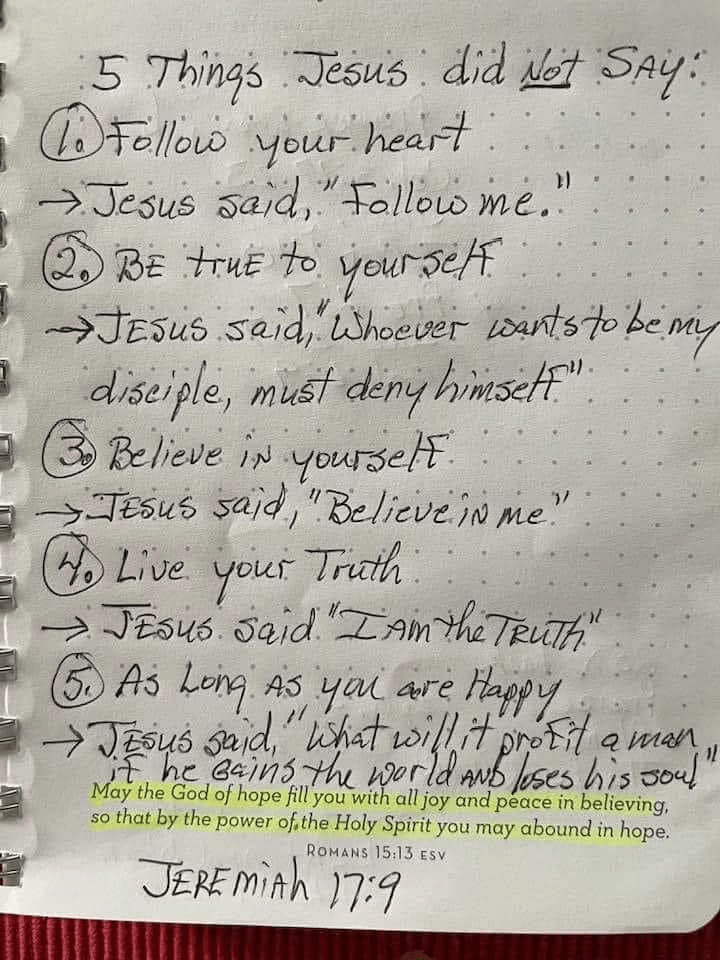
Last fall I (shockingly) found something on Facebook I don’t agree with. As I scrolled through the first dozen posts on my feed, this graphic appeared at least three times.

Obviously it resonated with many of my friends and family. But, when I read it, I felt small, mute, powerless. I felt called to misery as my spiritual inheritance. I felt afraid of myself.

Then I thought, two can play at this game. You throw Bible verses at me, I’ll throw some back at you. (Side note: I’m working on being less defensive.)

#1) Jesus didn’t say, “Follow your heart.”

No, but He made my heart, and He likes to spend time there. My heart is where the physical and the spiritual meet—like the exchange of oxygen in my lungs, passing from air to blood, life-giving mystery. If I try to separate from myself, I end up separating from God. He is the substance of which I am made.

Jesus said to His Father, “I do not pray for these alone, but also for those who will believe in Me through their word; that they all may be one, as You, Father, are in Me, and I in You; that they also may be one in Us.” (John 17:20-21a, NKJV, emphasis added)

#2) Jesus didn’t say, “Be true to yourself.”

No, but He did say, “Every kingdom divided against itself is brought to desolation, and every city or house divided against itself will not stand.” (Matthew 12:25b, NKJV)

#3) Jesus didn’t say, “Believe in yourself.”

No, but He did tell this parable: “Suppose a woman has ten silver coins and loses one. Doesn’t she light a lamp, sweep the house and search carefully until she finds it? And when she finds it, she calls her friends and neighbors together and says, ‘Rejoice with me; I have found my lost coin.’” (Luke 15:8-9, NIV)

This is a woman who believes in herself. She doesn’t blame the kids for losing her coin, or berate herself. She takes action. She lights a lamp, sweeps the house, and looks carefully until she finds the coin. When she finds it, she doesn’t breathe a sigh of relief that no one found out how irresponsible she was to lose it. On the contrary, it appears she’s okay with mistakes and disappointments. When she finds the coin, she calls her friends and neighbors to rejoice. She knows that she belongs and that her triumphs are worth celebrating—not because she has done something extraordinary, but because she has showed up for the ordinary.

#4) Jesus didn’t say, “Live your truth.”

No, but He did make me different from everyone else. JJ Heller sings, “Maybe the best thing I can be is me.” I’m not Jesus, or Paul, or Ruth. I’m not the foster-mom, or the guy who evangelizes with fresh-baked bread. I’m not the one who remembers everyone’s name and their mother-in-law’s name. My home isn’t a clean and peaceful space people flock to. But I do create safe spaces for people to talk and grapple and say life is shitty. I do text friends when I’m thinking of them, and sporadically send cards in the mail. I ask questions and deliver coffee and buy birthday gifts.

I write bravely, and sometimes the person who reads feels seen. My truth is the truth I know because I’ve lived it and it’s deep in my bones. It is these deepest parts of me that touch the divine.

Jesus said, “For God so loved the world that He gave His only begotten Son, that whoever believes in Him should not perish but have everlasting life. For God did not send His Son into the world to condemn the world, but that the world through Him might be saved.” (John 3:16-17, NKJV)

God didn’t come into the world to overshadow me or indict me, but to preserve and liberate me.

#5) Jesus didn’t say, “As long as you are happy…”

No, but He did say, “I have come that [my sheep] may have life, and that they may have it more abundantly. I am the good shepherd. The good shepherd gives His life for the sheep.” (John 10:10b-11, NKJV)

Jesus didn’t suggest that we sacrifice everything on the altar of happiness, but neither did He suggest that we pursue misery. He made us with taste buds and penises and clitorises, and He made a world bursting with taste and touch and life. He metes it out neither according to merit nor in submission to scarcity, but in wild abundance.

“Happy are the people whose God is the Lord!” (Psalm 144:15b, NKJV)

God Coming Out

God Coming Out

Blessed are You,
Lord our God,
King of the Universe,
for coming out, in ministry
at the age of 33,
knowing full well you’d be
not the man they wanted to see,
indeed, they grieved
and seethed,
could not accept your offer to be free.

Blessed are You
for revealing
truth, and healing,
teaching them that kneeling
is not the same as feeling,
they found your love appealing
but your words left them reeling,
they steeled against the sealing
you promised.

Blessed are You,
Lord our God,
King of the Universe,
you came out of the womb,
made the world your classroom,
told them: watch the flowers bloom,
you wove love upon your loom,
promised yourself to us as groom,
led the way out of the tomb,
boom! He’s out!

Gained in Translation

“Thanks to you I have the goal of being someone good in this world.” So concludes the final letter from Alejandro*, and his words stop me.

I’ve been told I have influence—or rather, warned that I have influence. Better use it for good, they say. Watch yourself. Or, as the church-school song goes, “Oh be careful little tongue what you say… for the Father up above is looking down in love…” And I have been careful, which mostly feels like fear, anxiety, and judgement.

I’ve been told I have influence—but Alejandro’s words shocked me. It hadn’t occurred to me that I could inspire anyone to want to be good, and certainly not someone I’d never met in person.


In 2009, I was a few years married and worked full time at the Christian college from which I had recently graduated. That spring the student association hosted a concert by the Christian rock band, Superchick. It took place in the big dome at a neighboring college. While true fans moshed it up, I wished for earplugs from my seat on the bleachers. Somewhere in the course of the evening, the band made an appeal for child sponsors, and in the post-concert din and jostling, we managed to buy a CD and sponsor a child—Alejandro, from Bolivia.

For 14 years we exchanged letters with Alejandro, as he grew from a preschooler to a working man and graduated from Compassion International’s child sponsorship program at age 20. Early letters were written by Alejandro’s brother or his tutor. A letter in 2011 included this endearing anecdote: “It was a happy week for my family too because my brother was born and my mom was delicate so we couldn’t do anything for her birthday. She is better now and we are going to buy a cake for her. Alejandro helps me to wash the dishes because my mom is still delicate.” -signed by older brother Emilio.

Over the years we prayed for each other and shared favorite foods and the antics of our pets. One letter informed us that Alejandro’s pet goose had laid five eggs and was taking good care of them, and included an update on turkeys that had hatched some months before: “My mom likes them very much, she feeds them every moment.” Occasionally we’d make an extra monetary gift through the Compassion project, and a few months later we’d receive a picture showing what Alejandro bought with the money—clothing and shoes, “rubber dinosaurs,” a dresser for his clothes.

At first our letters traveled snail-mail between Bolivia and Washington state. Later, online letter-writing became available, but still it was a slow correspondence. I worried about asking the same questions or sharing the same information because I forgot what we covered in previous letters. I probably did forget things and repeat myself, but Alejandro responded to every letter with only the kindest words, and patiently answered our questions.

In 2023, Alejandro aged out of Compassion International’s sponsorship program and we each wrote a letter of farewell. His letter begins, “My dear friends Michael, Tobi, Kyli and Kayt, let me greet you, I am so grateful for all the time you were my friends and I was blessed with your sponsorship. Truly God touched your lives and through you He touched mine and my family’s. I am so grateful. You were really an unconditional support for so long, words would not be enough to show you how much I love and appreciate you.”

I am immediately touched, and simultaneously aware that these kind words register on a grand scale almost foreign to my daily narrative—God reaching through me to touch another, the elusive desire of every God-lover. “Unconditional” is not a word I would use to describe myself, but there it is. I choose to receive it.

Alejandro goes on to describe how the Compassion project helped him and his family, concluding “but above all, I received the word of God in my life, I was able to know Jesus, and I was able to understand that my life was better if I held His hand.” One sentence, profound gospel. My life was better if I held His hand.

Alejandro requested our continued prayers for guidance and for his family, and promised to pray for us: “I will pray that God will always bless you, that God will grant you the desires of your heart, that God will guide you well in everything you do, that God will keep you from all evil, and that you will now be able to continue blessing more lives as you did with me during all this time.”

Then he concluded, “Now, with a happy heart, for having completed the Compassion program, but also a little sad because I will no longer be in touch with you, I really feel you as part of my family, I will always have you in my heart my dear friends. Thanks to you I have the goal of being someone good in this world. God bless you always, your friend forever, Alejandro.”

It has been said some things are lost in translation, but, if anything, I’d say translation lent this final letter a beautiful simplicity. Alejandro’s translated words rank among the best prose I’ve read. They are high praise yet totally devoid of flattery. His gentle and grateful heart reminds me who I am—a daughter of God who does’t have to worry or hustle. I am blessed and I am a blessing—this is the sum of my existence. Alejandro, thanks to you I have the goal of being someone good in this world. I want to live up to your estimation of me. God bless you always.


*Not his real name.

Savior Lullaby

Birth

A babe in womb,
And His name shall be called Emmanuel:
God with us.
News and light to shepherds on a hill.

They found the Light swaddled tight,
In a cradle full of hay.
They left their sheep, to watch Him sleep,
Miracle and mess all mingled there.

What was the Father God feeling on that night?
How did Holy Spirit fill a newborn life?
Where did Mary find the strength to birth a God?
And did Joseph tire of the whispers: “Isn’t it odd?”

Born at night like billions of babies.
And born to be a light like none had seen.
He cried and nursed like ordinary babies,
While the angels sang a Savior lullaby.

Death

God poured out,
Blood and water streaming from His side,
As it turns out,
The babe-in-hay’s destiny’s to die.

Up all night, questioned, tried,
The subject of contempt,
He was alone, weary to the bone,
Love was bleeding, not retreating scared.

What was the Father God feeling on that night?
How did Holy Spirit fill an ebbing life?
Where did Mary find the strength to watch Him cry?
Forsaken, Jesus shouted, “Why, God? Why?”

He held His arms wide open, not by choice.
He let his soul be overcome by love.
Widows wept while evil men rejoiced,
And the angels sang a Savior lullaby.


Note: this can be sung to the tune of Brad Paisley’s song, “Whiskey Lullaby”