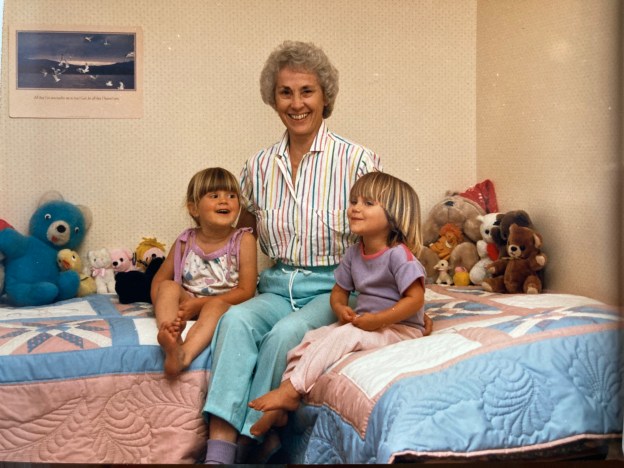
A year ago today—on March 9, 2021—my Grandma Foster passed away. She was 97 years old. Her name was Ruth Vernelle Foster, but everyone called her Vernelle, and I called her Grandma. Visits to my grandparents were rare, as they lived in Texas and my family lived in Oregon. We saw them once a year or less, which left our relationship perhaps less intimate, but also unvarnished by the inevitable friction that comes with living in close proximity.
Although my Grandma Foster—and Grandpa—lived in California when I was born, my only memories of our visits are at their retirement home on Lake Texoma. My sister and I would follow Grandpa along the lake shore, clambering over the large sand-colored rocks that bordered the water, and watch him fish. If he caught something worth cooking up, Grandma would bread it in cornflakes and bake it to perfection. Then we’d all enjoy it around the large dining table right inside the front door, next to the hat rack overflowing with Grandpa’s trucker hats (to him they were fishing hats). The hats were a motley bunch, as they had all joined his collection by washing up on the lake shore, lost treasures of boaters on a windy day.
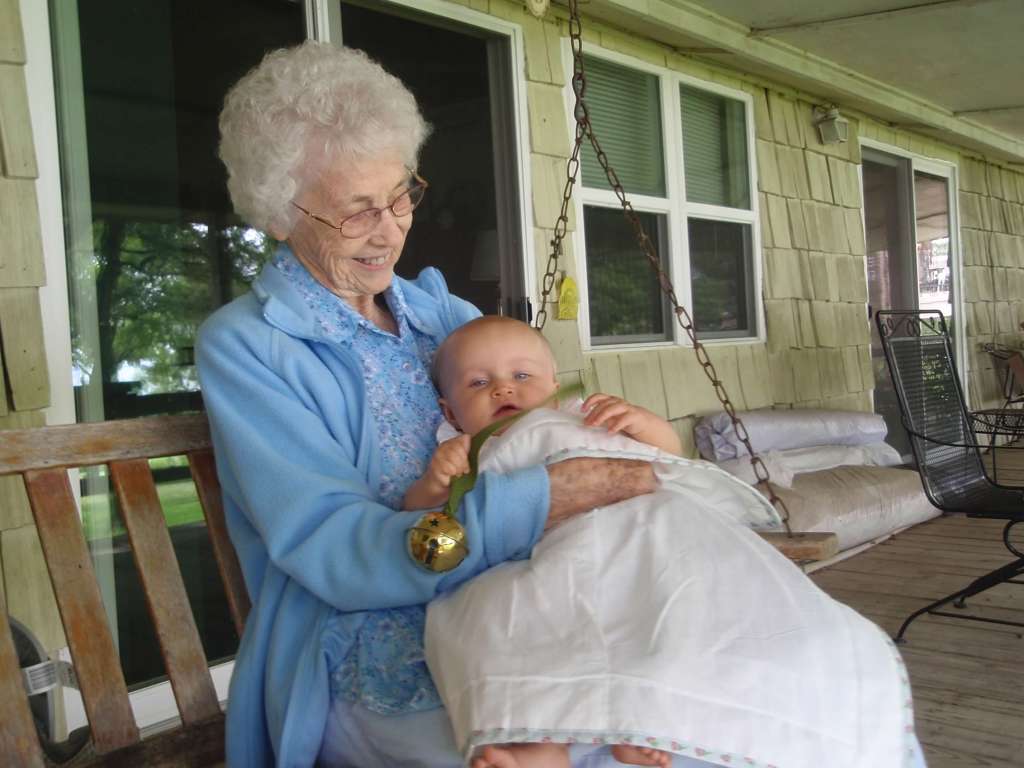
The layout of Grandma and Grandpa’s home was ahead of its time, with an open floor plan and high ceiling. The dining area, large living room, and kitchen, were all one open space, with a sliding glass door at the back, leading to a large deck with two porch swings facing the lake. A lot of swinging went on at Grandpa and Grandma’s house. If it wasn’t in the porch swings, it was in the backyard hammock or the kid swing. Grandma was a great swinging companion. She was content to be quiet or to talk, and never had an agenda.
The lake view was peaceful, with fishing boats and colorful sailboats often passing by, and the Oklahoma shore in the far distance. There was often animal activity on the front porch at the bird feeders, which were really squirrel feeders. It was a delight to watch the squirrels scampering around or enjoying an easy meal. There was one bird we saw at regular intervals, but it wasn’t on the front porch. It was in the house, inside the beautifully carved wooden cuckoo clock. My sister and I tried to see that bird every hour when it came out. We’d rush pell-mell from anywhere in the house to stand under the clock and watch the tiny bird poke its head out. Twelve o’clock was the best showing, with twelve “cuckoos” ringing out before the bird ducked back inside.
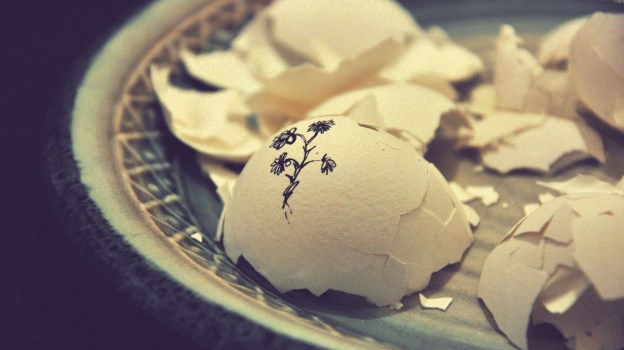
It was generally quiet at Grandpa and Grandma’s house, but things would liven up when our cousins came over—two boys just younger than my sister and me. The school bus dropped them off at Grandma and Grandpa’s every afternoon. Probably my favorite, and one of my clearest, memories with the cousins was decorating Easter eggs. Grandma hard-boiled dozens of eggs and had all the trappings to dye them. She set us four cousins up at the table and we went to work coloring those eggs. Then we hid them in the yard, found them, and hid and found them, over and over until the eggs fell apart. I must have been quite young—6 years old perhaps—and that was a wondrous Easter for me. We didn’t celebrate Easter at home, and I had never done anything like that.
One year Grandma let us keep a Box turtle we found. She provided a cardboard box for it to live in, and kitchen scraps to feed it, and we surely enjoyed that turtle! Sometimes we passed time by watching the Andy Griffith Show on the little TV in the living room, or following Grandpa around, or reading the kids books in the guest room. Since our home was a bastion of only true stories, Grandma’s house is where I read nursery rhymes, stories about Winnie the Pooh, and other children’s fiction.
Grandma and Grandpa’s neighborhood was quiet and open—I don’t recall very many fences. It was off the main road, so the folks who lived there were the primary “traffic.” My parents and sister and I often took walks around the neighborhood. There was a small cemetery at the corner where the main road ran perpendicular to their little peninsula, and a camp which we sometimes wandered through. Four houses down, and also on the lakefront, lived my Great-Aunt Jean, Grandma’s sister. She had the most wonderful southern accent and the softest old lady skin. We always visited her rather formally: our family of four would walk to her house, sit together in the living room, and have a visit. After our visits we would chuckle about how her “yeahs” trailed off with a southern echo: yeah-eah-eah.
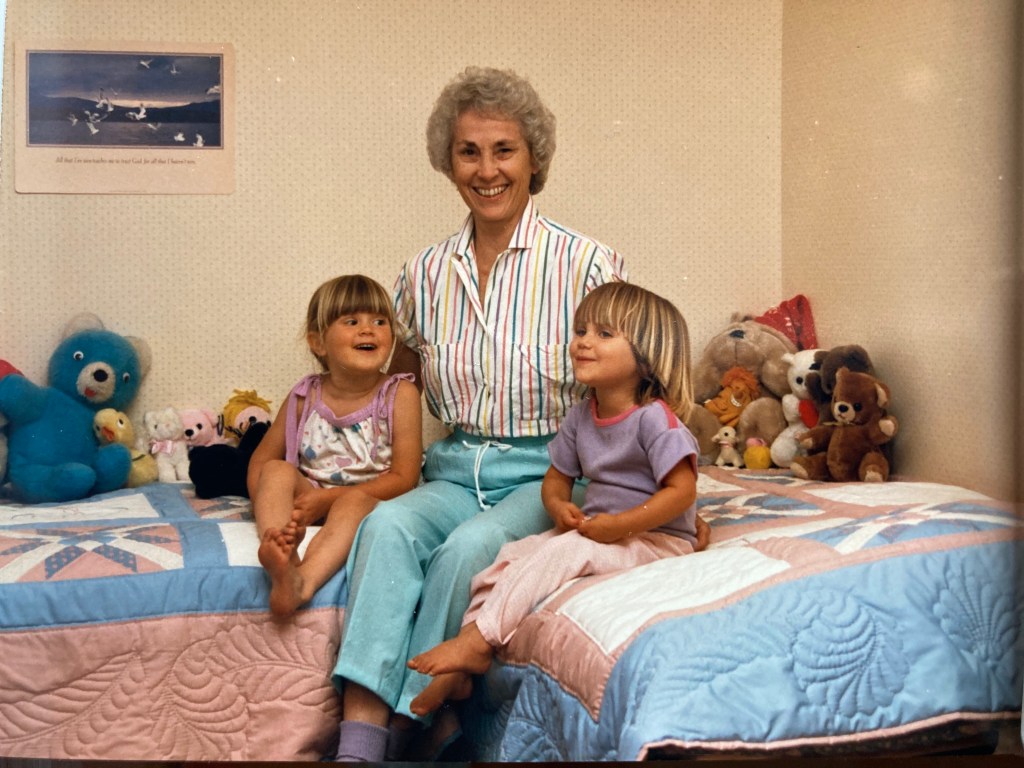
Grandma and Grandpa always sent birthday cards with $20. They would both write in the card—Grandma in cursive, and Grandpa in all uppercase letters. Grandma was a thoughtful gift-giver. Gifts were rare but always quality and meaningful. When my mom built us a three-story dollhouse, Grandma purchased some very elegant dining furniture and other pieces to furnish it. When I was three years old, Grandpa and Grandma came to our house for a visit. I don’t remember anything about it except what is in pictures: beautiful pastel pink and blue quilts, handmade and quilted for my sister and me, with each of our names embroidered on them. I slept under that quilt for many years, and now my kids use it, for blanket forts or an afternoon snack in the back yard. Later Grandma hand-stitched a pillow case with my initials on it, which I used in my college dorm room.
Fifteen years after that visit, Grandpa and Grandma came to Oregon for my high school graduation. It was their first time traveling by air, and I felt pretty special that they wanted to be there to celebrate with me. Two years later Grandma came north again, this time to Washington for my wedding. She was always a quiet presence. I don’t remember her ever being controlling, although she had a very matter-of-fact way of speaking and wasn’t shy about her opinions. But she always ended with a chuckle that seemed to say “what will be will be.” Her laugh was probably the most-mentioned attribute at her memorial service, which we attended on Facebook Live last March. She laughed often, laughed till she cried, and could laugh and talk at the same time.
Grandma and Grandpa were married 78 years, of which I am very proud—easy for me to say since I didn’t have to do any of the hard work to keep a marriage alive for that long. Grandpa could be bossy at times, and he had quirky habits like unplugging kitchen appliances before leaving the house. One time we came to visit and there was chicken wire all along the front of the garage. We found out he had installed it there after Grandma had an accidental bump into the garage door with the car.
Grandma spent countless hours making memory books for her kids and grandkids. I have two large photo albums with photos, memories, newspaper clippings, and letters, going back to my great-great-great-grandparents. She included all the artwork, letters and cards I sent her over the years, as well as letters from my parents that talked about how I was learning and growing as an infant and child. Grandma had a methodical way of putting together these memories, always including dates and other details that would help orient anyone who had not been present to the events. Along with being well-versed in family history, Grandma also had an eye on the future. Her son—my father—who is a classical guitarist, received a letter from her containing a list of songs she wanted him to play at her funeral, 20 years before she passed away. And when she did finally breath her last, her funeral was already planned, by her.
It may be that my penchant for planning, my big smile, and my loud laugh, journeyed from Grandma’s DNA to mine. And one day I hope to be a grandma who can sit on a porch swing without an agenda, adopt a wild animal as a pet for my grandchildren, and laugh about almost anything. Thank you, Grandma, for showing me how to do the things humans were made for: creating things, and loving fellow humans.

 My Favorite Subject