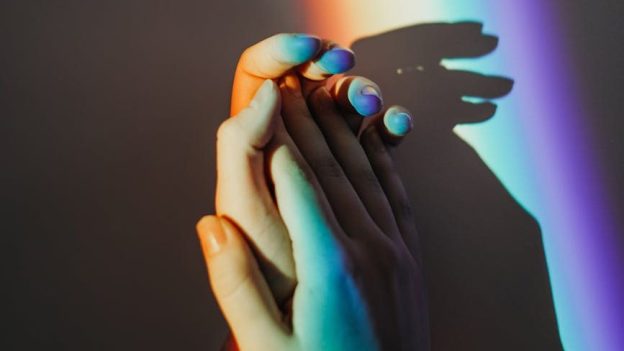
Applause: public approval or praise expressed by clapping hands together.
Some fifteen years ago, I stood while applauding after a Distinguished Faculty Lecture at my alma mater. Is it a standing ovation if only one person stands? I stood, exuberant about the depth of understanding and connection I experienced during the lecture. But as my peripheral vision told me that no one else stood, self-consciousness bubbled up. Why am I the only one deeply affected? Does everyone else already have a depth of experience such that the lecture was run-of-the-mill for them? My pulse quickened and I lowered into my seat, certain everyone must be giving me the side-eye, judging my way of being in the world.
Looking back, I am proud of that moment. I know now that many of us who speak or write or reveal ourselves in some way, need only one person to stand. Only one person to send a note letting us know our words created connection.
Late last July, I attended “heART on display,” an event featuring artwork by incarcerated or formerly incarcerated individuals. Cedar Rain Spirits, a distillery and BBQ in downtown Walla Walla, hosted the event, curated by Devon Player, whom I met through the Walla Walla Community Change Team. Outside the narrow storefront, a sandwich board on the sidewalk announced the event. Inside, people mingled, music blared, and art lined much of the two long walls that extended to the back of the venue.
For the next hour, I perused art, snacked on free hors d’oeuvres, asked a few questions, and flattened myself into tables and walls to avoid bumping into fellow guests. As I chose art to purchase—proceeds to benefit Running Waters Equity Fund and the Black Prisoners Caucus—Devon took the mic and introduced a guest speaker, Anthony Covert. We all quieted where we sat or stood, and turned to listen.
Anthony was sentenced to 432 months (36 years) in prison at the age of 18. He served 16 of those, and walked free on June 10, 2024. As he talked about sitting in prison, alone with himself, I stumbled into sudden affinity with him. We “outside” (unincarcerated) folks have so much available to distract ourselves; it is a rare and excruciating experience to be alone with ourselves. “ But when you’re sitting in that prison cell and all you got is those four walls—sometimes with a celly, sometimes not—you have to sit with yourself.” And, he says, you have to ask yourself questions, about how you came to be in this place, and what your purpose is now that you’re here.
My own season of being alone with myself and asking hard questions transpired during stay-at-home momming. I recognized that singular agony of sitting with oneself, and the subsequent decision to engage with tricky, heavy questions. As an incarcerated, black young man, Anthony felt it in the isolation of prison. As a middle class, white mother of an infant and toddler, I felt it in the isolation of motherhood. Although our experiences differed, Anthony’s words connected intimately with my inner world as a stay-at-home mom. Because he exposed his pain, I felt seen in mine. Our stories held hands for a just a moment.
I wanted to applaud, but other listeners were intent, soaking up the story, not ready to respond. Anthony continued, and when he shared the completion of a college degree, while incarcerated, with a 3.98 GPA, everyone applauded, including me. Later, when he talked about his clemency hearing and the unanimous vote to grant him clemency, we applauded again. It was then that I noticed my moments of connection were not the same as the moments of applause. Before Anthony’s clemency hearing, when anxiety was high, Anthony’s friend Demar told him, “Go in there and show them who you are.” That moment connected. That moment I wanted to clap or sigh, or give the man a hug. Show them who you are.
Why the dissonance between my moments of kinship with the speaker, and our collective moments of applause? Could it be that as a society we are quick to applaud measurable achievement, but not moments of quiet strength? What about times of agonizing surrender—to our brokenness, and simultaneously to our wholeness?
Anthony described us on the “outside” as an invisible army that stands with those on the “inside.” Because our worlds are disconnected, there is a wall isolating our compassion and assistance from the insiders’ knowledge, and/or response. Knowing this, may we be courageous to continue engaging—despite the lack of testimonials, catchy postcards, and fundraising galas that feed the selfish side of our generosity.
“ There’s no fixing the system. It is what it is,” Anthony said. “But what you can do is disrupt it in certain areas, right? To give people opportunities to come home.”
What if applause—public approval or praise—happened earlier in the story, and it served to recognize nothing more than our humanity, the intrinsic dignity of our existence? What if clapping said, “you got this,” more than, “you did something big and measurable”? Better yet, what if approval and praise showed up in the process and in the conclusion? What if it gave people opportunities to come home—to themselves, to their families, to their communities? I need this. I suspect we all do.
I want to applaud early—for my children, my spouse, my friends, my community. A healer is “someone who can see the movement toward wholeness in you more clearly than you can at any given moment,” wrote Rachel Naomi Remen. Let’s open our eyes to see. Put your hands together for humanity.
Let’s applaud smallness. Clap for the courage it takes to engage with our own selves and our messy stories. Cheer at the thin places in our stories, where pain and intention form a bond and point us in a new direction. Celebrate wholeness even as it lingers in the wings. Disrupt the narrative in ways that invite belonging.
 My Favorite Subject