Tag Archives: questions

Damn Hospital Corridors and Mothers

I’m dabbling in fiction again, which of course is influenced by my actual life, wherein my mother’s health is failing. This piece came from a writing prompt to begin with, “The hospital corridor was dimly lit…”

The hospital corridor was dimly lit, but only because the fluorescent lights on one side of the ceiling emitted partial light, accompanied by a buzzing sound. I wished someone would turn the lights off. One o’clock a.m. was never meant to be lit at all. Sinking to the floor, I checked the exact time on my watch, 1:17.

My mother slept. She’d been sleeping much of the day and night for some five years. Sleeping suited her phlegmatic personality and neurodegenerative disease. Sleeping was familiar.

But tonight, sleep could wander into death at any moment. And so we kept vigil—my brother and I—taking turns at her bedside, watching the face of each nurse who came in to check her vital signs. Did their expression show any hint of surprise or concern? Anything to indicate an imminent ending?

I’d never been this close to death before, and my feelings warred with my philosophies. It’s one thing to say death is natural, a passage as much as an ending, a new experience just like every other milestone in life. But there’s something heavy about a last milestone.

As I stared at the wall, unseeing, questions caught traction in my mind. This grief, is it about loss of the mother I have, or loss of the mother I wish I had? Or is it fear of what will happen to my brother and me when Mom isn’t here? Or am I feeling anger that I have to be here, to witness this, to hold it and see it and feel it and live it—that this dying person not only consumes my time when I’m at the hospital, but consumes my emotions and thoughts when I’m driving, eating, washing dishes? Who gave her permission to be woven into me in this way?

And what does the unweaving look like? Is it a severing, like a guillotine? Is it a careful unstitching, or an impassioned disassembly, tossing parts and pieces here and there? Or will my dead mother remain inside me, and will I like her better that way? What memories will make me smile? How much time will it take for me to internalize a narrative that holds us both gently?—a narrative that’s peaceful, not buzzing and half-lit like this damn hallway.

Dear God, I’m Annoyed

Dear God,

Do you receive enough letters every year to bury planet earth a mile deep in stamped and postmarked comments to the divine? Is there a team who helps you read them? Do you throw out letters that are too pious—or too irreverent? If a parcel comes to you “postage due”, do you pay the balance or return to sender? How many angels do you deploy every year in response to mail from earth? Do you keep statistics on what subjects are trending? Do letters from different parts of the earth have a distinct smell? Well, enough about that. I actually have a purpose for this letter.

I’m annoyed that using your name is so complicated. If I say I believe in you—whatever that means—I want to tell my story, not get coopted into someone else’s story. I’m scared of their assumptions and experiences. Does belief in God mean an agenda of fighting atheism? Evangelizing 3rd-world countries? Pro-life marches? Does belief in God mean you made the world, or that you died for our sins, or that you’re making some sort of “new heaven”?

Next time someone tells me they’re a Christian, does it mean they go to church but don’t pray? Or that they pray but don’t go to church? Does it mean they think you cause human pain, or relieve human pain, or both? Are you male or female? Do you live in humans or in heaven? How are you deciding when and how to make the earth new? Are you many, or one, or three-in-one? Is your love soft or hard? Do you ever feel afraid?

I guess my point is that, for my own comfort, I want you to be small. I don’t appreciate the need to explain what kind of Christian I am—if I say I’m a Christian—or that I have to explain what mysticism is if I say I’m a mystic, or that my swearing puts some people at ease and sets others on edge. And both responses to swearing feel somehow related to you—like we’re all basing our lives on you, whether we mean to or not, and we’re all uncomfortable with the fact that you remain shrouded in mystery. I’ve ceased to believe you have an agenda, but for some, an agenda is inherent in the word “Christian.”

Truthfully, I don’t want you to do anything about this. I just need to vent. Do you see how annoying the situation can be? The way you draw people together in a singular way and also divide folks violently? The way you bring us to peace with ourselves and offer us the most startling awareness of our love-less parts? Do you see how I experience you differently than the person next to me, and sometimes we admire each others’ representations of you, and sometimes despise them?

I find myself trying to assure some folks I’m not “that” right-wing Christian, and trying to assure other folks I’m not “that” far-left kind of Christian. I want people’s favor and I want yours and it’s all terribly messy and I blame you.

But, in conclusion, I admit it’s best for you to be slippery, mysterious, and surprising. Thank you for connecting with each of us in your own way without a thought of being consistent, following the rules, or managing outcomes. Your flagrant freedom in relationship to humans reminds me that I, too, have the freedom to look a little different to every person who knows me. Like you, we humans can be slippery, mysterious and surprising, and we need permission to embrace these traits in our relationships.

I’ll let you get back to that mountain of letters. And I don’t have the patience for snail-mail, so if you want to answer me, please send a text message.

Cordially,

Tobi

But Jesus Said

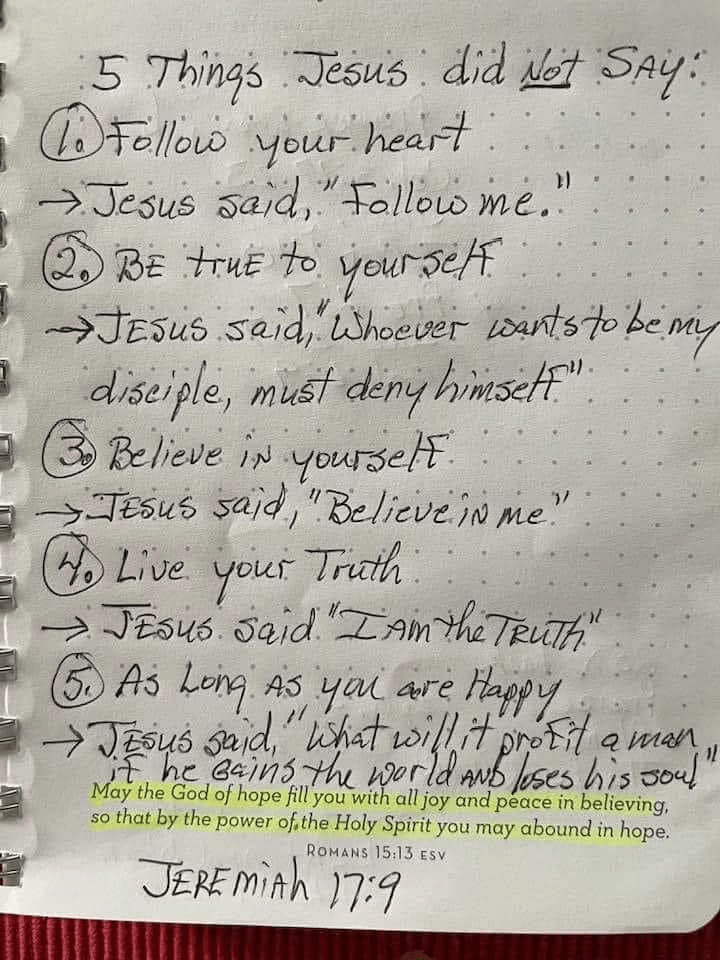
Last fall I (shockingly) found something on Facebook I don’t agree with. As I scrolled through the first dozen posts on my feed, this graphic appeared at least three times.

Obviously it resonated with many of my friends and family. But, when I read it, I felt small, mute, powerless. I felt called to misery as my spiritual inheritance. I felt afraid of myself.

Then I thought, two can play at this game. You throw Bible verses at me, I’ll throw some back at you. (Side note: I’m working on being less defensive.)

#1) Jesus didn’t say, “Follow your heart.”

No, but He made my heart, and He likes to spend time there. My heart is where the physical and the spiritual meet—like the exchange of oxygen in my lungs, passing from air to blood, life-giving mystery. If I try to separate from myself, I end up separating from God. He is the substance of which I am made.

Jesus said to His Father, “I do not pray for these alone, but also for those who will believe in Me through their word; that they all may be one, as You, Father, are in Me, and I in You; that they also may be one in Us.” (John 17:20-21a, NKJV, emphasis added)

#2) Jesus didn’t say, “Be true to yourself.”

No, but He did say, “Every kingdom divided against itself is brought to desolation, and every city or house divided against itself will not stand.” (Matthew 12:25b, NKJV)

#3) Jesus didn’t say, “Believe in yourself.”

No, but He did tell this parable: “Suppose a woman has ten silver coins and loses one. Doesn’t she light a lamp, sweep the house and search carefully until she finds it? And when she finds it, she calls her friends and neighbors together and says, ‘Rejoice with me; I have found my lost coin.’” (Luke 15:8-9, NIV)

This is a woman who believes in herself. She doesn’t blame the kids for losing her coin, or berate herself. She takes action. She lights a lamp, sweeps the house, and looks carefully until she finds the coin. When she finds it, she doesn’t breathe a sigh of relief that no one found out how irresponsible she was to lose it. On the contrary, it appears she’s okay with mistakes and disappointments. When she finds the coin, she calls her friends and neighbors to rejoice. She knows that she belongs and that her triumphs are worth celebrating—not because she has done something extraordinary, but because she has showed up for the ordinary.

#4) Jesus didn’t say, “Live your truth.”

No, but He did make me different from everyone else. JJ Heller sings, “Maybe the best thing I can be is me.” I’m not Jesus, or Paul, or Ruth. I’m not the foster-mom, or the guy who evangelizes with fresh-baked bread. I’m not the one who remembers everyone’s name and their mother-in-law’s name. My home isn’t a clean and peaceful space people flock to. But I do create safe spaces for people to talk and grapple and say life is shitty. I do text friends when I’m thinking of them, and sporadically send cards in the mail. I ask questions and deliver coffee and buy birthday gifts.

I write bravely, and sometimes the person who reads feels seen. My truth is the truth I know because I’ve lived it and it’s deep in my bones. It is these deepest parts of me that touch the divine.

Jesus said, “For God so loved the world that He gave His only begotten Son, that whoever believes in Him should not perish but have everlasting life. For God did not send His Son into the world to condemn the world, but that the world through Him might be saved.” (John 3:16-17, NKJV)

God didn’t come into the world to overshadow me or indict me, but to preserve and liberate me.

#5) Jesus didn’t say, “As long as you are happy…”

No, but He did say, “I have come that [my sheep] may have life, and that they may have it more abundantly. I am the good shepherd. The good shepherd gives His life for the sheep.” (John 10:10b-11, NKJV)

Jesus didn’t suggest that we sacrifice everything on the altar of happiness, but neither did He suggest that we pursue misery. He made us with taste buds and penises and clitorises, and He made a world bursting with taste and touch and life. He metes it out neither according to merit nor in submission to scarcity, but in wild abundance.

“Happy are the people whose God is the Lord!” (Psalm 144:15b, NKJV)

From Pink Leather to Diversity

I cannot imagine the “Urgent need for Bibles” depicted on my social media feed and in letters from charities. I don’t know the hunger for Scripture that thousands have felt in prison, in remote villages, in countries hostile to Christianity. I have more Bibles than I want, and only need visit a book store or sit in a church pew to access even more.

Over the years, I’ve accumulated seven or eight Bibles, including a small pink New Testament with Psalms, a Seminars Unlimited Edition KJV (free for everyone who attended a Revelation Seminar series—hallmark of the Seventh-Day-Adventist Church), and the bright, almost-holographic NIV children’s Bible I earned by memorizing the books of the Bible. I’m still proud that I can recite the minor prophets in order.

During my high school years I bought a metal-covered NLT Bible with a magnetic clasp, and a Spanish/English NIV. In Senior Bible class, each student chose a new-to-us style or version of the Bible. I picked the Serendipity Bible, designed with questions and study helps in the margins for group discussion. Lover of small groups that I am, I thought—and still think—it’s brilliant. But I’ve hardly used it.

The only Bible I truly loved came to me in its pink leather cover on my ninth birthday. As I wrote in last week’s post, I read it all the way through that year, and over the next ten years it became like a fifth appendage. When I flip through it now, I find a quarter-sheet of paper with notes for a worship talk to the student body at my high school, and another with multiple-choice options, showing a checkmark beside the statement, “I rededicate my life to Christ today.”

I still get a feeling of companionship when I turn the pages of my pink Bible, but it’s connected to life before I moved away from home. I must have taken that Bible to church during my college years, but memories are vague. Did I have morning “quiet time”? I can’t remember. By the time I graduated from college, the focus of my small groups had moved away from Bible study and toward facilitating safe spaces for personal growth. The women in my life wanted to be heard, and so did I.

Two years after I graduated from college—and fifteen years after my parents gave me the pink Bible—my college-boyfriend-turned-husband gave me a burgundy NKJV Remnant Study Bible with my married name embossed on the front, in silver. Pink Bible retired to the Bible shelf, safe in a pleather case. But I never really moved in to my new Bible. Only a handful of verses are highlighted or underlined and no papers are tucked between the thin pages.

I can’t help but wonder if I loved the Bible as a book in its own right, or if I only loved that Bible. The pink Bible meant purpose, connection, expertise. Perhaps it filled the role of a cup of coffee or alcohol—to buffer social spaces. During my 20’s, as the years filled with grown-up responsibilities, the Bible settled down along with the rest of my life. The excitement of spiritual leadership, learning to drive, falling in love, and working a dozen different student jobs during my late teens and early 20’s turned into the predictability of a dual-income home. I rose at 5:40am for quiet time, and prayed through Stormie Omartian’s The Power of a Praying Wife at least twice. I read the Bible and journaled and expected life to continue in much the same way. The Bible was habit—was that all?

By the time I turned thirty, we’d added two babies to the family. Prayer journaling ceased during the years of babies and young children, and at the same time my confidence in God and Scripture took a beating. As I fought for sleep and struggled to maintain a shred of self-worth, my youthful confidence gave in to confusion, anger—and curiosity. I wrestled with God and mostly left the Bible out of it. An aching emptiness took hold of me, and the Bible’s companionship didn’t comfort. I read other books and prayed and went to counseling. Half a dozen agonizing years later I emerged with a different confidence and a different companion. My confidence resembled the flowing water of a mountain stream more than the steadfast rocks at its bottom. My new companion emerged as a sense of spiritual belonging and safety with myself and with the divine.

My “faith,” or whatever you want to name the relationship I have with myself and with the divine, is safe, flexible, curious, gentle. I have little interest in church doctrine, and equally slight interest in church pews. The occasional sermon I’m obliged to hear tends to raise my hackles. But I may be closer than I’ve ever been to possessing something I want to share. And it’s not a Bible study.

These days I’m timid with the Bible. When I want to find a verse, it’s faster to google a key phrase than open my Strong’s Exhaustive Concordance of the Bible, or—if I know the reference—I type it in BibleGateway and select the version I like best. My burgundy Bible sits on my writing desk more as a prop than a friend, and my pink Bible remains in the bookshelf.

Rachel Held Evans, in her book Faith Unraveled, takes readers along with her on the journey promised in the subtitle: How a Girl Who Knew All the Answers Learned to Ask Questions. Her Bible, like mine, absorbed a nontrivial portion of her time and energy as a teen. Unlike me, she started to ask questions, and learned that all questions do not have clean, three-point answers. Over time she found a different way to approach the Bible:

“As much as I struggle with the things I don’t like about the Bible—the apparent contradictions, the competing interpretations, the troubling passages—I’m beginning to think that God allows these tensions to exist for a reason. Perhaps our love for the Bible should be measured not by how valiantly we fight to convince others of our interpretations but by how diligently we work to preserve a diversity of opinion.”

Faith Unraveled, pg. 194

Diversity of opinion sounds terribly healthy. Am I that healthy? How comfortable am I, listening to another person share—from the Bible—a theological view different from mine? Will I allow them the certainty that irks me? On the other hand, am I able to hear doubts and questions without offering a solution? Can I experience spiritual intimacy with the people I disagree with, or only with those who have the same interpretations and “aha” moments that I do?

I’ve avoided the Bible for years now because when I pick it up and begin to read, I’m often thrown back into black-and-white thinking. Scripture is not a place of curiosity for me, but a textbook with answers. It’s hard to come back to a text I poured my life into as a teen, with a different view of myself and the world. We don’t fit together like we used to. But Rachel Held Evans gives me permission to try a more nuanced, messy relationship with my Bible. I haven’t picked it up yet, but I might. When I do, I want to look for diversity and contradiction, and practice making friends with the parts that are uncomfortable. I would like the Bible to be an irritating friend—by turns funny, exasperating, wise, sometimes a gentle companion and other times giver of good advice I’d rather not hear. I want it to remind me there are more questions than answers, and that what we write about God is as oddly erratic as what we write about humans. Maybe, in a year or ten, I will again be friends with a Bible. I don’t know what color the cover will be, but the inside won’t be black and white. It will be grey and rainbow.

Bible Sidekick

When I was eight years old, I signed a baptismal certificate, and Pastor Bryson baptized me into the Seventh-Day Adventist Church. I remember practicing how to hold his arm while he held the dry washcloth over my face, so I could go under without breathing in water.

Six months later, for my ninth birthday, my parents purchased a Bible from the Christian book store, where they had my name embossed on the cover. They let me choose the embossing color—rainbow shimmer—but they kept the Bible out of sight. I used to wish I had chosen plain silver embossing, to please the adults and to match my tastes as I grew older. But at eight-going-on-nine, I wanted rainbow shimmer.

I was allowed to invite one family to our home for my birthday celebration each year, and for my ninth birthday I invited Laura and Eric. They were the only people I knew in their early 20’s, and I admired them as only a nine-year-old can. Laura had dark brown hair with one curly spot in the back where her previously-straight hair grew back in a curl after a diving accident. She had a petite frame, and a lovely accent from spending a year in Latvia. Eric was tall, with long everything—legs, arms, torso—and a wide, impish-yet-innocent smile.

I don’t remember much about my ninth birthday. Pictures remind me that I dressed up in elegant old skirts from our dress-up stash. Laura and Eric gave me a miniature rose plant, and my parents gave me the Bible—a red letter edition NKJV with a pink, bonded-leather cover.

I read the Bible cover to cover that year. I read about creation and Abraham and Moses, the cut-up concubine, prostitution and murder, lying and rape, greed and gratuitous violence. I read about Ruth and Esther, the Song of Songs, and somehow made it through Lamentations and the major and minor prophets. I read the shocking story of Jesus’ beginnings and the shocking story of His death, and through the exhortations of the apostles, all the way to the “Amen” at the end of Revelation chapter 22, verse 21.

I don’t recall having any questions, registering any shock at the violence, or finding any difference between the God portrayed in the Old Testament and the God portrayed in the New Testament. It was the Bible. I assumed it was all okay to read, and unnecessary to question.

By the time I completed 8th grade, I could find any Scripture reference in 30 seconds or less. My pink Bible accompanied me for the livestream of Dwight Nelson’s Net ‘98 evangelistic series, and Mark Finley’s Net ‘99 evangelistic series, both projected on the big screen in my home church. I began a lifelong habit of morning prayer-journaling after Net ‘98, the year I turned 13. In the front of my Bible I glued a handwritten copy of Robert Frost’s poem, “The Road Not Taken,” and a variety of Bible “study helps” I never used. With The Marked Word study guide as my starting point, and armed with half a dozen pastel-colored gel pens, I underlined more than 30 chain studies.

After homeschooling basically forever, I attended Milo Adventist Academy (MAA) for 11th and 12th grades. Our family lived in the small southern-Oregon community where MAA occupies a slope beside the South Umpqua River, so as a high school student I attended the same church I’d been attending since I was born. As a student at MAA I served in almost every spiritual leadership position available. I was a group facilitator at a youth Bible conference, Spiritual Disciplines small-group leader, Junior Class Spiritual Vice President, and Student Association Spiritual Vice President. For a school talent show, I memorized and recited Psalm 139 and won a cash prize.

The summers I was 16 and 17 years old, I spent away from home, selling religious books and vegetarian cookbooks door to door with a Seventh-Day Adventist group called Oregon Youth Challenge. We led church services on weekends and Bible studies some weeknights, and my pink Bible and I took a tour of the SDA churches around Gresham, Oregon and Vancouver, Washington, while book sales helped fund my private school tuition.

Wherever I went, throughout my teen years that well-marked Bible was like a fifth appendage. When the youth leader said, “Hold up your swords!” my “sword” was always handy. I was well-prepared to fight with that sword, but I never did.

I don’t recall interacting with anyone who was interested in the Bible from a curious, unknowing space. Everyone I knew was either a “nominal Christian,” bumping along in apathy, or they were doing the same things I was, memorizing and marking Bible studies and verses that reinforced Adventist doctrine. Books I read and pastors I met told stories about meeting someone who was “hungry for the truth,” but I didn’t see or experience this firsthand.

Despite swallowing the Bible hook-line-and-sinker, even in high school I couldn’t imagine sharing the “plan of salvation,” telling someone they’re a sinner in need of saving. Although I soaked in Scripture and prayer, I didn’t feel any urgency to share my experience as a Christian. I sat squarely in the middle of an us-vs-them mindset, but the act of inviting a “them” to join “us” was far from my desire and far from my experience.

The Bible, I think, was something for me to be good at. I “knew” my Bible. I could find any verse in a few blinks of the eye, ask thoughtful questions (within accepted norms), and share my observations and opinions. I can’t imagine not having the Bible at that time in my life. I read it, marked it, loved it.

When I packed my room and drove eight hours to move into a college dormitory, I had no idea what was ahead for me and my Bible.


Read the next part of the story on February 7.

Untidy

We speak of heaven as a distant, perfect, glowing place. But if God feels all our feelings, then the pain of the world is present in heaven, just as a parent who is safe and free feels the suffering and bondage of their child a thousand miles away. There is anguish in heaven over every person who believes untruths about who they are. We all believe lies, for one reason or another: abandonment, abuse, rejection, holding secrets. If God’s Spirit is in us, and He is present to all the pain in the world, then there is sorrow in heaven.

But there is also hope in heaven—not for what will be, but what is done. Jesus experienced the identity-mangling human life (including being lied to by Satan, abused, and rejected) and followed it to its deadly end. In so doing, He gifted us a life without death. The hope in heaven is born of a freedom for God’s children that is already true. God feels our pain, but He also knows who we are. When we know whom we are and Whose we are, pain and sorrow find union with hope.

But what about everyone who doesn’t know? It’s easy to look at the world and believe God has let some fall by the wayside; He has done a lot, but He couldn’t save everyone; He has shone a light, but it is a pinprick in the darkness of starvation, war, neglect, and oppression.

In many ways I’d be more comfortable with a Savior who removes us from our circumstances instead of entering into them. How is He saving us by surrendering to the dark side and letting them kill Him? Where is the Savior who stops the rapes happening as I write this, the starvation toll steadily climbing? What good is a God who showed up long enough to be brutally murdered and then went back to heaven after He was resurrected? And if His angels are really here ministering to us, how do they choose whom to deliver and whom to walk by?

I don’t know what or where heaven is, or why earth is dark. I think it’s okay to wonder. Paradox and tension are permissible. Questions keep me curious. Doubts save me from Pharisee-like certainty. God is bigger, and I know this, even as I am asking if He is too small.

Jesus chose to climb into the filth with us, rather than stay safe on the mother ship and throw us a life ring. Jesus can embody love in an untidy world; perhaps I can too. My heart is untidy, my kitchen is untidy, my husband, my neighbor and my world are untidy. If Jesus is any indication, my job is not to tidy things up, but to bend down and love.

Roomy God

Lord, I’m sorry that when we’re together I put pressure on You to fix me, to give me some transfusion or infusion, or end my confusion.

Maybe I could enjoy You instead of holding You at arms length until You make sense to me.

Maybe it’s ok to be sad and confused about pain and suffering, and to have unsettling “nots”— I do not:
know what to tell my kids about You
feel like I need to “save” people
have a church family or a ministry right now.

Perhaps dropping expectations would make way for curiosity.

What was Your resurrection like? Did the angel who came to Your tomb gently shake your shoulder and say, “It’s time to wake up, Jesus”? When did Your wounds become scars and not gaping holes? When You awoke were Your feet still calloused from walking? Did Your beard still have blood in it?

Maybe letting go of what I thought was important will make way for what is holy, for compassion—a sacred way to approach myself, other people, and the world around me.

What is compassion? Entering into the suffering of another.

Could I have compassion for You, Lord? That feels wrong somehow.

Why would I have compassion for a God who has everything? Oh, but You don’t have everything. You don’t have all Your children. Do You feel just a wee bit empty? Do You suffer?

Curiosity and compassion are roomy.

You are roomy.

Thank You for giving me room—permission to:
enjoy Your company
be sad and confused
ask questions
try on curiosity and compassion.

Truth be told, I don’t need to be fixed as much as I need to be loved. Thank You for always refusing to prioritize my behavior over me, and for enjoying me instead of fixing me.

Photo by Rodolfo Clix: https://www.pexels.com/photo/close-up-photograph-of-person-praying-in-front-lined-candles-1024900/

Pain and Suffering, Together

Jesus said not to worry about what to eat or drink or wear because our heavenly Father knows what we need (Matthew 6:25, 32). He said to seek the kingdom of God first and all these things—what we eat, drink, and wear—will be “added” to us (Matthew 6:33). I’m not sure what that means, and it leaves me with a lot of questions when I look around. Every year millions of people die of starvation and exposure. In the time it takes you to read this post, 15-30 people will die of starvation or malnutrition. Is this because they’re worrying? Or because they’re not seeking first the kingdom? If God sees their need, is He holding out on them? That seems cruel at best and sadist at worst. Yet I cling to the image of a loving Father and the incarnation of a God willing to subject Himself to the worst human conditions.

Why is it that Christians like to tell stories about a single mom praying and finding a bag of groceries at her front door, and atheists like to talk about science? Nobody likes to talk about human suffering. With or without God, it doesn’t make sense, and it hurts.

Is it helpful to wonder what God is up to—to look around at all the people who are trusting God and “seeking first” and still dying? Why does it sound like Jesus is preaching prosperity gospel, when He just said we’ll be reviled and persecuted and lied about (Matthew 5:11)? I see His point that worrying is a waste of mental energy (“Which of you by worrying can add one cubit to his stature?” Matthew 6:27). But it sounds like He’s saying God “will supply all your needs” (Philippians 4:19). And I have to wonder who He’s talking to, and what He means by “needs.” If He means our need to be clothed and fed—which is what He said—how do I reconcile this with the world? I don’t know why, as a loving Father, He’s not stepping in. Perhaps suffering doesn’t bother Him in the same way it bothers me? I’m not suggesting it bothers me more—I have a feeling He suffers with every suffering person. I guess I’m wondering if it bothers Him different.

Gregory Boyle says we find God in the margins. Maybe if suffering truly bothered me I would show up in the margins—with the impoverished, incarcerated, mentally ill, homeless, illiterate. Perhaps God is richly present there, and if I find the courage to go there I will see Him. And maybe if I see Him there I will get a hint of why He’s not “saving” people in the ways I expect. Perhaps—and I know this idea is really “out there”—He meant for humans to care for each other.

Could it be that “do not worry” is a corporate message, a statement that comes into being as the “rich” and the “poor” press together? Maybe in seeking first the kingdom we do not read our Bibles and pray, we go to the margins; and maybe as we go to the margins we find ourselves—we feel centered for the first time—even as the hungry find food and the naked find clothing, the weak find courage and the homeless find shelter, and the incarcerated have a full schedule during visiting hours.

Perhaps the kingdom of heaven is here when we press together: the poverty of the rich and the poverty of the poor simultaneously relieved as we hold hands. Perhaps starvation is more real than a full pantry and I will only find salvation when I am willing to look depravation in the eye.

I don’t feel any closer to “answers” (whatever those are), but I do have a desire to go to the local penitentiary and ask an inmate to save my life, to change my narrative by telling me his story, and to bring me to the margin to find the kingdom of heaven. I wonder if freedom is behind bars, joy is in hardened hearts, hope is in blank faces, and we find it together.