“Mama, are you gonna be with me every step of the way?” Her faced warped in sorrow, and in her teary eyes I saw she needed an answer, needed to know she would not be alone.
Three months earlier, our family made an excursion to the locally-owned pet shop across town, where a hay-like smell and the sound of chirping birds accompanied us to the corner of the store where for-sale rodents ran on exercise wheels and nosed around in paper bedding. Kyli, eleven years old, wanted a hamster. Soon one of the employees was carefully scooping through a small aquarium nearly full of paper bedding, searching for the elusive, white dwarf hamster Kyli had selected. Kyli’s aquarium, identically full of bedding, sat nearby on the floor, ready to receive her pet. It seemed a long time before the rodent handler came up with a wiggling clump of bedding and transferred it to its new glass home.
Lucy, as Kyli named her, liked life buried in bedding. But we’d close the bedroom door, shove a blanket in the gap between the door and the floor, and scoop Lucy out to run around in a supervised corner and hide under our crossed legs. Kyli had incredible patience and insisted on gaining Lucy’s trust slow and gentle. One evening Lucy got into Kyli’s closet, which at that time contained an amorphous heap of items on the floor. Determined not to hurt or scare Lucy, Kyli waited patiently outside the closet for her pet, and asked me to stay with her. Lucy scooted into the folds of a Home Depot tote bag, then back out to disappear behind a crumpled sheet. We listened as she poked plastic toys with her nose and scrambled into a cardboard box. I mentally tapped my toe, Let’s get this hamster put away so I can brush my teeth and get in bed with a book.
Then Lucy came, with the barely perceptible tap of tiny claws on the floor, out to the open area. I held my breath as Kyli slowly extended a hand toward her; Lucy scurried back into the tote bag. I suggested we carefully start pulling things out of the closet. Kyli said no, that would scare her and might hurt her. I suggested clamping something down over her fast when she came out. Kyli said no. Lucy scampered out of the closet and almost crawled under Kyli’s dresser. Kyli shooed her away from the under-dresser “cave,” and I jumped in to scoop her up . . . she shot back in the closet.
I suggested blocking some of the open areas into the closet, so when she came out we could quickly block the rest and prevent her from going back in. We tried this, but Lucy easily eluded us. She must have come out in the open area a dozen times, as I sat on a pillow on the bedroom floor, making pointed suggestions about how to speed things along. Kyli talked me through being patient. “Mama, I don’t want her to be scared. We have to wait until she comes out. You’re gonna be okay.”
“We could be here all night,” I grumbled. But eventually we corralled her and successfully lifted her back into her cage. Nearly an hour had elapsed.
Since Lucy had a way of scuttling into hard-to-reach hiding places in the bedroom, we took to sitting with her in the bathroom. With a blanket tucked into the gap under the door, she could run around without disappearing. Although not excited about being held, she warmed up to it, and seemed to enjoy exploring our hands and laps.
One day, as she explored on and under the blanket by the door, she squeezed into the hallway. Before we knew what was happening, one of the cats seized her and carried her under sister’s bed. Papa dove under, scraping his back on the bed frame, frantically reaching for the cat, who dropped Lucy. Kyli screamed in fear throughout the ordeal, and although Lucy looked fine, her mannerisms over the next couple of days shed some doubt on her wellbeing. We monitored her, unsure what she needed, but she ate and drank and had no visible wound, so we were hopeful she would be okay—until the morning we found her lifeless in the cage.
On Thanksgiving Day we dressed in black and Papa dug a hole beside the shrubs along the back fence. Kyli settled Lucy in a sturdy wooden casket about six inches long, made by her wood-shop teacher, and added dried flowers, the toilet-paper roll Lucy loved to run through, and a smaller box containing her tiny body. We shared memories of Lucy and buried her.
Kyli felt all the things common to loss. Frustration with herself. Disappointment in how things turned out. Anger at the cat. She blamed herself for not being a good enough mama to Lucy. She often felt sad in the evenings, and with tears in her eyes would say, “I want her to know how much I loved her. I don’t know if she knew. What if she didn’t know?”
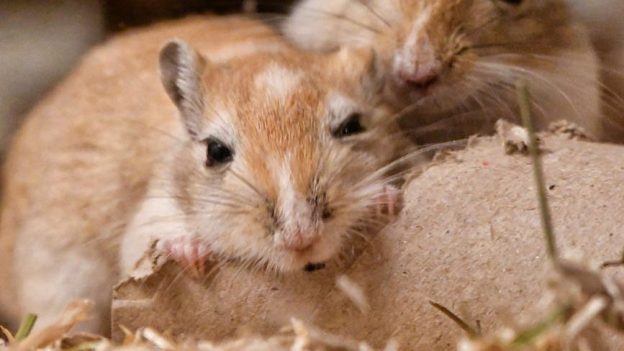
The grief softened over time, as grief often does. By January Kyli started talking about getting a new pet. In the meantime, her aquarium had served as home to a snake she and some classmates found in the schoolyard, and although they released it after a few weeks, it molted while in captivity, leaving Kyli a snakeskin souvenir. We washed and disinfected the aquarium. On the day of parent-teacher conferences, we once again traveled as a family to the pet store—only to find the cages in the rodent corner mostly empty. One contained an aging gerbil. Another, a white hamster that bit the pet-store lady assisting us, and drew blood. There were no dwarf hamsters, just Jumbo Biter. There was, however, one tan-and-white gerbil that seemed like an option. Kyli went into the back room with the pet-store lady to get a closer look, and before we knew it we were back on the highway home with Miss Gerbil in the aquarium. A bag of cat food balanced atop the cage to secure the screen lid.
Kyli named her new pet Tophee—Toph for short (like “trough” without the “r” sound)—and we stationed her in the dining room where we could see her often and get to know her. She was more active than Lucy had been, and more apt to scamper around on top of her bedding where we could see her. One day when Papa picked her up so Kyli could hold her, she shot off his hand to the floor, where she and we frantically scampered around until I grabbed her tight in my hand to lift her to safety. She did not appreciate this and bit me hard, leaving a bloody cut at the tip of my middle finger. Kyli again decided to take a gentle approach, reaching into her cage so Toph could get acquainted with her hand, talking softly to her and giving her treats, not taking her out of the cage to be held.
After a couple weeks, Kyli noticed Toph didn’t seem to want to open her eyes. Were they crusted shut? We couldn’t tell. Sometimes they were open, sometimes not. And she seemed to burrow less. We also questioned if she was drinking water. The hand-me-down water bottle she used sometimes required a bit of prodding to produce water. After some deliberation, and Kyli desperately wanting to take Toph to the vet, we took her to the pet store for an unofficial assessment. The pet-store lady who’d helped us purchase Toph, put on a long leather glove and reached in to hold and assess the little critter. She thought Toph might be dehydrated, asked about the warmth of our house, and suggested we try a new water bottle and watch to see if the eye situation worsened—if so, it could be a respiratory infection.
We moved Toph to a quiet corner of the living room, hoping she could rest more and get well. Over the next several days, she drank from her new water bottle, ate celery slices and Romaine lettuce, and seemed more active. Until she didn’t. Soon we realized we’d hardly seen her at all, as she seemed to be sleeping most of the time. We hauled a six-foot-long cardboard box from the basement to the dining room so we could hold and observe her outside of her cage. I scooped her up and placed her in the box. My heart sank as I watched her walk. She teetered to one side, getting in a few steady steps and then struggling again to maintain balance. Kyli watched tensely, and began to panic as I expressed my concern. We’d had rats who behaved that way, and they had to be put down for neurological problems.
I sat in the box with Toph; Kyli cried, “Why me? You had a hamster that lived for a long time, and you threw it against a wall! Why can’t I have a pet that doesn’t have all these problems?” I lifted Toph to my lap, sleeves pulled over my hands to protect against bites. She sat on my leg, barely moving, thin and lethargic. This was more than Kyli could bear and she paced around the living room crying, not wanting to look at Toph, feeling guilty for not being able to keep her healthy, desperate to do anything we could for her. As I sat in the box with Toph, Kyli approached me, tears on her cheeks, her face twisted in fear and sorrow. It was too much. Too much not-knowing. Too much angst at the thought of an innocent animal suffering. Too much powerlessness and insufficiency and fear. Kyli reached out her hand to me—“Mama, are you gonna be with me every step of the way?”
I, too, felt powerless, insufficient, and fearful. How could I be present to Kyli’s grief? How could I make a decision about taking a $30 rodent to a vet who would certainly charge more than $100? Kyli’s question handed me a lifeline. In asking me to be with her, she gave me something to hold onto. “Yes. Of course. I will.” I will be with you. I wouldn’t have it any other way. We will question together. We will cry together. We will make difficult choices together. You are not alone in your fear and grief. Together we will watch and worry and wait. Together we will make decisions. Together we will hold our insecurities and unanswerable questions. Together.
The next day I called the pet store for more advice. They wondered if Toph was warm enough, so we moved her in front of a heater vent, put a blanket over half her aquarium, and decided to offer her water on a spoon two or three times a day, buy new food, and give her some jarred baby food as well—pureed pumpkin. Toph again seemed to perk up, had an enormous appetite for sunflower seeds, and began rummaging around her cage more often.
But after a week, she returned to excessive sleeping and her sides still caved in a bit where she should be plump and round. We didn’t know what she needed. We consulted the internet, the pet store, and artificial intelligence. We didn’t know if she’d make it or not. I echoed Kyli’s sentiment—why can’t it just be simple? And I was grateful, knowing we would be together, every step of the way.
 My Favorite Subject