Author Archives: Tobi Goff

Unknown's avatar

About Tobi Goff

I am a writer, impertinent Christian, and recovering perfectionist. I (mostly) enjoy life in the Pacific Northwest with my husband and two daughters. Sleep is my drug of choice, and I like books, hugs, and piña colada milkshakes.

Childhood Memories

Childhood Memories

Blessed are You,
Lord our God,
King of the Universe,
for a thousand nights
falling asleep to Daddy’s guitar,
waking up to the sound of Mommy opening
the heavy curtains in the living room,
curtains she made.

Blessed are You
for frozen banana cream on warm cornbread,
buckets of succulent, sugary blackberries,
and the midday vegetable juice
I sometimes poured out
between the porch boards.

Blessed are You,
Lord our God,
King of the Universe,
for walks up Corn Creek Road,
one litter each of puppies and kittens,
rides in the green cart piled with dry cut grass,
the certainty of my parents’ faithfulness
to life and to each other,
under it all like bedrock.

A Finger to My Lips

What pulls at me today, daring to suggest my calm and holy center is not where I belong? Emotions roll like a ball in one of those handheld mazes, frozen in place as I s-l-o-w-l-y tip the maze, then a lightning-quick roll to the far corner before I can steady my hand.

So, what is pulling today?

Fear of disappointing my husband.

Heaviness from the impenetrable docket of housekeeping chores.

Despair over how my daughters have been treating each other.

Anxiety that I am a split second away from disappointing myself or someone else.

Terror because I am not in control of my inner world, or my outer world.

Is speeding up is the answer? More lists, more timekeeping, more discipline? No, because speed propels me out of my center, into the fears and despair.

The call is to slow down. Slowness requires trust—of myself, God, the people around me. Trust of time and the universe. What precedes trust? Willingness to accept a variety of outcomes, and to receive that I am well-loved in all of them.

Beginning at the end of myself, I find my way back to the beginning, receive the wideness of love, prevalent as air. As I breathe in love, I trust the intrinsic goodness of myself and others. I give up trust in outcomes and good behavior.

I choose slowness as an embodied reflection of my still and holy center. This is different than the stubborn slowness I use to distance myself from the needs of others, or the sullen slowness meant to display my tired and long-suffering soul.

With a playful but firm finger to my fretting lips, God intervenes. My churning heart stills once again in the embrace of grace and abundance. I am called to “unforced rhythms of grace,” where the daily cadence of faithfulness takes place within the finished song of grace.


~Scripture quote in the final paragraph is from Matthew 11:28-30 MSG: “Are you tired? Worn out? Burned out on religion? Come to me. Get away with me and you’ll recover your life. I’ll show you how to take a real rest. Walk with me and work with me—watch how I do it. Learn the unforced rhythms of grace. I won’t lay anything heavy or ill-fitting on you. Keep company with me and you’ll learn to live freely and lightly.”

Raindrops

Raindrops

Blessed are You,
Lord our God,
King of the Universe,
for raindrops,
pesky on glasses,
risky on a white t-shirt,
frisky as they land with a splash
in roadside puddles.

Blessed are You
for the wideness of meaning
in a raindrop:
hope—the end of drought,
fear—a tropical storm,
irritation—picnic at the park,
boredom—long and rainy spring.

Blessed are You,
Lord our God,
King of the Universe,
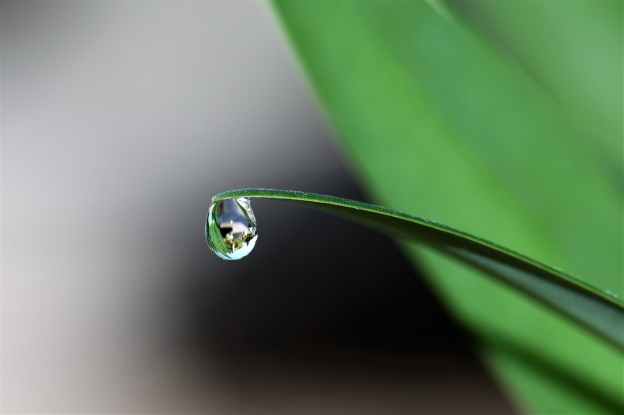
for the elegance of raindrops,
their tidy round wetness
highlighting beauty as they pause
on blades of grass, bluebird feathers,
rose petals, pine needles,
or dangle from the tiniest twig.
How do they hold on without fingers?

Alexander and Me

When Michael and I were newlyweds, our town welcomed a Hastings, in a large new building on Ninth Street by the auto parts store. We signed up for a membership and frequented the store—an inviting combination of books, coffee shop, and rows upon rows of DVDs to rent or buy. One evening we casually browsed books—I especially remember the prominent cookbook section with its bright colors—and wandered into the children’s book area.

“Hey, it’s Alexander and the Terrible, Horrible, No Good, Very Bad Day,” Michael said, pulling out a thin, blue book. “My high school English teacher read this to us.”

I took the book and opened to the first page, where a black-and-white illustration shows a small boy in pajamas, resignation on his face. I read aloud:

“I went to sleep with gum in my mouth and now there’s gum in my hair and when I got out of bed this morning I tripped on the skateboard and by mistake I dropped my sweater in the sink while the water was running and I could tell it was going to be a terrible, horrible, no good, very bad day.”

“That’s awful!” I said, as I turned the page and silently read on. The story continued in similar style, as Alexander suffered through the day. His teacher said he left out sixteen at counting time, the dentist found a cavity in his teeth but not in his two brothers’ teeth, there were lima beans for dinner, and during his too-hot bath he got soap in his eye and his marble went down the drain. Each page featured run-on sentences detailing the disappointments of childhood.

“Wow,” I said, handing the book back to Michael. “I don’t like it at all. Why would someone write a book like that?”

Michael looked slightly amused by my passionate reaction.

“Doesn’t it bother you?” I asked.

“I don’t know. It doesn’t seem to hit me the same way it hits you.”


Fast forward nearly 20 years. Alexander and the Terrible, Horrible, No Good, Very Bad Day is one of my favorite children’s books. This change illustrates the undoing and remaking of my inner landscape, especially after becoming a mother 11 years ago. Newlywed Me believed the world was a happy place and sadness was fixable. Late-30s Me prefers Glennon Doyle’s word “brutiful” to describe the world, and has mostly given up on trying to fix sadness. Newlywed Me thought children’s books should have color pictures, cheerful stories, and favorable endings. Late-30’s Me appreciates pencil and ink illustrations, stories of struggle, and inconclusive endings. Newlywed Me didn’t want to believe any day could be bad from start to finish. Late-30’s Me agrees with Alexander’s mother, that “some days are like that. Even in Australia.” Newlywed Me felt a sense of injustice when Alexander’s best friend rejected him, and when he got in trouble for being muddy after one brother made him fall in the mud and the other brother called him a crybaby. Late-30’s Me knows that friendship is fragile, and sometimes you get scolded for things that aren’t your fault.

Alexander suffered through his day. I suffered through the drudgery of stay-at-home-momming. Throughout the book, as Alexander voices his desires and frustrations, no one listens, and no one answers. Throughout the early years of parenting, I felt unseen and unheard.

On a piece of old electrical wiring sticking out of the wall in my unfinished home office hangs a “medal,” swag from a 5k I walked/ran with friends in 2021. It features a glittering butterfly above the words, “It’s okay to not be okay.” I first saw those words in traffic, painted on a car window at the intersection of Ninth and Rose. They gave me a permission I had needed for a long time: permission to not be okay, to be unable to fix my mind or my marriage or the bathroom formica that is partially detached from the countertop. I think it was Anne Lamott who wrote, “Everything is so not okay.” I agree.

Sometimes I get to fix things, and I like that. Most of the time I don’t, and I’m learning that a bleeding world feels much friendlier when I know “some days are like that,” some relationships are like that, some religions are like that, and one load of laundry containing the entire wardrobe of a baby can take an hour to fold.

Alexander was not happy when he went to bed that evening. The day ended much as it began:

“When I went to bed Nick took back the pillow he said I could keep and the Mickey Mouse night light burned out and I bit my tongue. The cat wants to sleep with Anthony, not with me. It has been a terrible, horrible, no good, very bad day.”

I am moved to laughter and tears, and most of all, relief. Some things in life simply call for a negative, bleak, too-long, awful sad list of adjectives.

If you’re not familiar with the Alexander books, this youtube video is a lovely read-aloud of Judith Viorst’s book that inspired today’s blog post.

Alexander, Who Used to Be Rich Last Sunday is another favorite.

Special thanks to my husband, Michael, for the idea to write on this topic.

Starling

Starling

Blessed are You,
Lord our God,
King of the Universe,
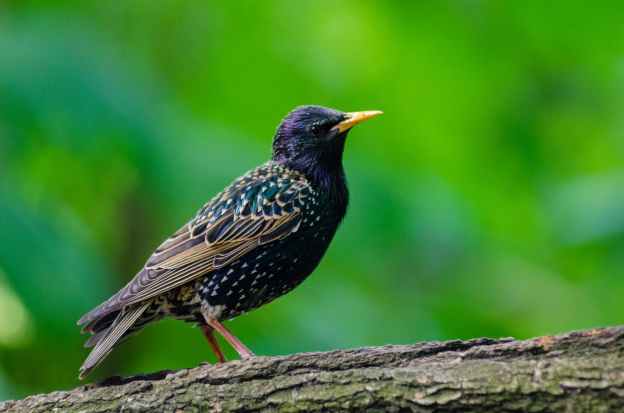
for starlings
in shapeshifting flocks
clouds of wings,
or neat rows on power lines
trailing stragglers at each end.

Blessed are You
for cacophony in the pecan tree this morning,
commanding my attention
as I step outside and look upward,
stare until I find movement,
the lean and pointy shape of a bird.

Blessed are You,
Lord our God,
King of the Universe,
for the company of starlings
floating and flapping,
unaware they catch my eye
and remind me that You know
each one.
Maybe I, too, can know a starling someday.

I Will Change, I Will Not Change

I fear Christian belief will have no real impact on my life. I’m aware that addiction, divorce, and abuse in the home wreak havoc among Christians as well as non-Christians. And the things we do to feel better about ourselves happen among Christians as well—keeping our stories and our houses as clean as possible, consuming coffee and sugar at alarming rates, moving from one place (or church) to another to escape the consequences of a damaging lifestyle or broken relationship.

Until recently, I spent little time considering the opposite fear—that God will influence, transform or otherwise impact me and my life. Carl McColman, author and fellow blogger, suggests, “Our deepest fear is not that there is no God. Our deepest fear is that God does exist and wants to become an intimate part of our lives, changing us forever.”1 I want to argue with him, but I can’t. I do fear God’s influence in my life. Chances are, He has a different list (does God have lists?) of priorities than I do, and His presence will affect change. I cannot sit with Him and expect to remain the same. This is unnerving at best, terrifying at worst, but also the thing I want more than anything else.

I hold both fears at once—that I will be changed, and that I will not be changed. McColman puts it in relational terms—the fear of loneliness/abandonment, or the fear of being engulfed. I want to keep God, and my dearest human companions, in a safe little space between those two realities. In this space, I will experience a controlled situation in which I am neither left nor overwhelmed.

There is no such space in intimate relationship. It’s not that God is in the business of leaving or overwhelming people. Rather, relationship is consent to be influenced. I am changed by the people I spend time with, and I, in turn, affect those same people. Is this also true in divine relationship? The Apostle Paul wrote, “And we all, with unveiled face, beholding the glory of the Lord, are being transformed into the same image from one degree of glory to another. For this comes from the Lord who is the Spirit.” (2 Corinthians 3:18 ESV)

I’m not sure I want to be unveiled with God. Isn’t that dangerous? Maybe we can work something out where I get to wear a veil. I’ll submit my list of prayer requests without approaching God. No need to bother Him; I know He’ll take care of things. Also, if His activity in my life is based on me doing a good job, I don’t need to spend time with Him. I can focus on being a kind and productive person, and He’ll take it from there. There are countless ways to avoid the influence of relationship. Keep it professional. Make rules. Perform. Retreat.

I suppose “influence” would be a good word to describe what happens when two people spend time together. Where does that leave control? “To have control is to have the power to run something in an orderly way.”2 Does God have this power? Is the universe orderly? Yes, it is, and no, it isn’t.

Influence is “the power to change or affect someone or something—especially the power to cause changes without directly forcing those changes to happen.”3 If I say God has influence but not control, have I emasculated Him in my view, or am I getting closer to freedom?

In a previous post I wrote, “Perhaps love is the pain of not being in control.” At the time of that writing, I explored what this means in terms of fearing my own feelings. Feelings often run free of logic and control, and therefore, I have tended to avoid them. Now, as I consider this statement in terms of relationship with God, it occurs to me this is a two-way street. God relinquishes control of me, and I relinquish control of Him. I believe this is painful for both of us.

At the same time, it is comforting. I approach God without the intent to control Him, knowing that likewise, He will not control me. I do not consent to be engulfed; I consent to be influenced. I do not consent to abandonment; I consent to a life that is not well-controlled, which is messy because love and free will are messy. Proximity includes vulnerability.

It is here that I may begin to love God. Also here is the shocking possibility that God allows me to influence Him. I don’t know how to love the Lord my God with all my heart. The best I’ve come up with in the past involved being respectful to Him, and nice to the person in front of me. There’s nothing wrong with that. But is it relationship?

I find no tidy conclusion, but I’ve stumbled upon a desire for consensual relationship with God. And so, I consent to be influenced. I consent to the pain of love, which is the pain of not having control. I accept that knowing God will change me, and it will not change me. I receive the fear of being an average human, the terror of becoming more, and all that it means to love because He first loved me.

Endnotes:
1McColman, Carl. The Big Book of Christian Mysticism, page 204.
2https://www.vocabulary.com/dictionary/control#:~:text=To%20have%20control%20is%20to,remote%20control%20for%20a%20television
3https://www.merriam-webster.com/dictionary/influence#:~:text=In%20modern%20use%2C%20the%20noun,something%20in%20an%20important%20way

Together

Together

Blessed are You,
Lord our God,
King of the Universe,
for what I can’t do alone—
friendship and love,
hugs and kisses,
move a piano,
put a bandaid on my back,
play tag,
sing harmony.

Blessed are You
for what I don’t want
to do alone—
celebrate Christmas,
feel overwhelmed,
blow out candles,
put together a puzzle,
go to the theater.

Blessed are You,
Lord our God,
King of the Universe,
for coming to a world
tired of being alone
as Emmanuel, “I am with you,”
and for creating me to crave
love and laughter,
connection and collaboration,
touch and togetherness,
melting into others
the way You melt into me.

Cone of Shame

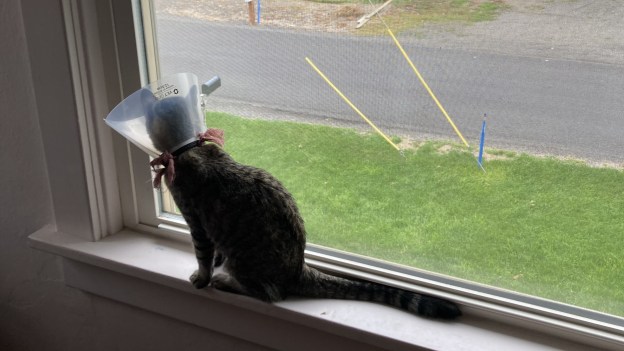
The youngest member of our family is sporting a cone of shame. She’s our six-month-old shorthair female cat, Phiona, and last week she had an overnight stay at the veterinary office to get spayed. We picked her up Wednesday morning, with a page of post-op instructions and a bag of syringes pre-filled with kitten-sized doses of pain medication. The vet assistant who discharged her instructed us to keep her as calm as possible for the next ten days, so we moved her food and litter into my office and there she convalesces.

Half of Phiona’s belly is shaved, with a one-and-a-half inch incision in the center, neatly sewn up. She wears a small cone on her small head, though it must seem large to her, and tremendously inconvenient. She can’t eat or drink without a person there to hold the dish still. Noises seem to come at her from strange directions, funneled through the cone. She licks the cone instead of her fur, and when her ear itches, the hind foot that pops up scratches at smooth plastic. There is no curling up to rest, no itching, and no bathing. Poop sometimes gets on the cone when she uses the litter box. Playing is a difficult proposition, as she can’t quite see her paws, nor coordinate them with her mouth to bite what she grabs, as kittens do.

Phiona doesn’t know the cone will come off after 10-14 days. As far as she knows, this may be her new normal—cooped up in one room of the house, wearing a constricting cone, unable to eat or drink until she has a visitor. If I were she, I would find this unbearable, and my attitude and behavior would follow suit. I’ve been watching her and imagining the deprivation of cat pleasures—a luxurious licking bath; a nap, curled up with nose tucked under tail; or a fierce romp, attacking string or toy with body, mouth, and all four appendages.

Phiona wears a cone of shame—or “Elizabethan collar” as it is called on the vet’s invoice—but she has no concept of shame. She doesn’t hide or hang her head. She purrs and plays and eats and drinks, and takes her medicine without complaint. How does she do this? I have watched her in amazement for a week, and I have no answer, only an increased awareness of how quick I am to sink into despair, to become angry when things aren’t how I want them to be, and to receive shame as my rightful state of mind. Phiona’s disposition is a compelling suggestion that there may be another way. Perhaps my humanity is not as volatile as I think, and the essentials of being human are more dependable than I realize. When I am limited, inconvenienced, slowed down, I do not lose my identity as a human being. I belong and I am invited to pleasure and peace as surely as when things are going my way.

I don’t have to always be well, productive, respectable, functional. I can rest when I am unwell. I can slow down when I am tired. I can enjoy the company of friends when I feel un-respectable. I can be waited on when I am not functional. I have permission to be human, and being human carries dignity with it through any circumstance. Whether buried in dept, or addiction, or depression, weighed down by sorrow and loss, or suffocating under secrets, each person is dignified. Whether disappointed in myself as a mom, humiliated by misunderstanding, or fearful of fallout after a mistake, I am dignified.

Thank you, Phiona, for teaching me that dignity is not complicated. You have modeled it through pain and confusion and the cone of shame, and have taught me again that my value is not in performance and my happiness is not in circumstances. But, I look forward to taking that cone off and watching you run and bathe and eat and drink, unrestricted.

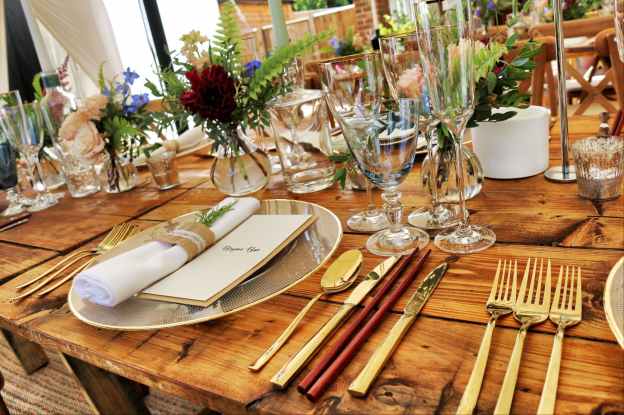
He Brought Me to His Banqueting Table

He Brought Me to His Banqueting Table

Blessed are You,
Lord our God,
King of the Universe,
for celebration—
a handshake
or handmade card,
a hatful of money
or armful of flowers.

Blessed are You
for birthday parties
and white elephant gifts,
balloon bouquets
and long-stemmed roses,
graduation caps
and dance recitals,
fireworks, hot dogs,
folks gathered together.

Blessed are You,
Lord our God,
King of the Universe,
for water drops on flower petals,
rainbows and radiant children.
Birdcalls announce morning,
crickets herald evening,
wordless celebration,
sun setting, moon rising,
Your banner over me is
love.

Love Is a Pain

I escaped the anxiety epidemic, I thought. Until this year.

I didn’t admit depression. Until last year. Only after taking antidepressants did I know the truth of my years of depression.

It’s late September, and anxiety adds itself to my truth. Anxiety feels different than depression, which for me exhibits as heaviness, intense overwhelm, and anger. Instead, a growing undercurrent of angst and tension in my thoughts and feelings came as a surprise—anxiety. I feel resentful about being “the only one who cleans around here,” nervous about irritating my friends, and more grouchy than usual because the kids “never listen to me”—anxiety.

I can’t blame a change in circumstances; life carries on as usual. I have to own an internal landscape of crankiness. In my journal I write, “I’m anxious but somehow I’m not letting it rise up. I’m not connecting well with myself or others. I don’t know what to do with this inner Rubik’s Cube of mental and emotional colors. There is no ‘lining up,’ just a lot of turning and twisting and muttering. I don’t feel depressed or exhausted, just a buzz of not-okay-ness, and fretting about what other people are thinking or doing.”

When my inner world gets uncomfortable, I settle for the companionship of fear. When I settle for fear, I choose to think instead of feeling. If I think rather than feel, I’ll have an an acceptable answer for most questions. If I think rather than feel, I tell myself, I reduce the risk of rejection; I avoid confronting what I don’t understand about myself; I cannot get stuck in feelings. If I think rather than feel, I will be dependable, and that, my friends, is very important.

I fear transience of warm feelings, and permanence of cold feelings.

I fear loss of control. Not measuring up. Disappointing someone. Sigh. Doesn’t that essentially mean I live afraid of life? No wonder I feel anxious. I can’t stop the world and get off.

Now that I know I’m anxious, what’s next? There are too many options: medication or meditation, solitary confinement (okay, that’s more of a wish than a real option), exercise, more coffee or less coffee, structure or flexibility.

I’ve been through this enough times to know fixing is not the loving response. But what is? Does love sit in the feelings? Maybe the loving response is reception—not the kind with cake and punch, but the kind that’s about welcome. Could receiving feelings be different than sitting in feelings? More like open hands and less like sackcloth and ashes?

When I think about setting the emotional tone in myself and in our home, I think of zen peacefulness—wouldn’t it be lovely if I were un-ruffleable?

But love is not only the ocean’s vast calm. It also knows the waves of anger, fear, and bitterness. Is it a ship? A lighthouse? A squawking seagull? What form does love take in the steady pounding of reality?

Perhaps love is the pain of not being in control.

I know well the pain of trying to control, and the aftermath of disconnection when I succeed in control. I am less familiar with the pain of releasing control. This pain is the pain of God’s very existence; the pain of having children who have a choice.

I want to control my children. I really, really want to control them. Also, I don’t want to control them. I know it’s not love, and desperately I want to love them.

I want to feel the raw pain of love rather than the grasping anxiety of control. I want my discomfort to be worthwhile. Let me trade in an obsession with control for the wildness of not being in control. Here my soul will meet with God, inside the terrifying invitation to feel. I will feel the risks of rejection, unknowing, and transience. They accompany my choice to love, and indicate that I have chosen to feel. God is here. Let control crash and burn. Loving is enough.

Also, I will medicate, and meditate, and drink more or less caffeine.