Category Archives: Belonging

Prayer, Revised and Expanded

My journal takes me back in time. September 25, 2015. Thirty years old. Married ten years. Two daughters—Kyli two months past her first birthday, and Kayt a month shy of her third. That means on the day I wrote this prayer I had a one-year-old and a two-year-old. No surprise that “broken,” “scared,” “no match,” and “tired” feature in this heart-cry, penned during a rare stolen moment. My heart bled out through the ink of my pen. I turned to the page and to my heavenly parent, because together they were the safest place I knew.

April 17, 2024. Thirty-eight years old. Married 18 years. Kyli and Kayt are now 9 and 11. We’re deeply settled into the house we were in the process of purchasing in 2015. And I’m writing, which I now realize is not only a safe place for me, but also a creative passion.

Today I’ll respond to myself in this prayer. A spiritual journey is a both/and experience, dense with contrast and contradiction. And so today maybe I disagree with my thirty-year-old self, but my experience and beliefs then were as valid as my experience and beliefs now.

Truthfully, I haven’t been writing spiritual content much recently. I’m weary of cultural Christian ideas, the sin-and-salvation language, the beliefs that tied my hands behind my back. But set all that aside, and there is a friendship. Prayer is a celebration of friendship.


Good morning, Lord.

I am in a place I know You do not intend for me to be. I’m literally sick with worry. I can’t stop my head from spinning and my heart from panicking. Please speak truth to my heart and save me from myself.

You can be in this place. It’s okay to not be okay. You won’t feel this way forever. And yes, keep believing there are better things ahead. You are held.

I believe the solution is walking with You, but I can’t even do that. I am so broken, so scared, so selfish. Please do it for me, Lord. Take my heart, take my marriage, take my parenting, take my responsibilities at church and book group and other places, take the move to the new house, take meal planning and grocery shopping, take the lies that cripple me. Take my heart of stone and replace it with a heart of flesh.

What does it look like to “walk with God”? You are beautiful and your life is beautiful. You are worn out. Ask for help. Take medication. Drink coffee. Watch TV shows. Cry. Plan a day for yourself—that is not selfish. Your heart of flesh is already there. And this grieving might be just the thing to help you find it.

I confess my selfishness, my desire for control, my fears, my misbeliefs. They are sin and they do not honor You. Please take them from me. Please fight this fight for me. I am no match for sin, no match for the devil, no match for life.

Overwhelmed, flooded, depressed, alone, trapped. You feel these things deeply. You are stronger than you think, and not as strong as you think. You might have to let get of what you’re holding tight, and holder tighter to the things you’ve been letting go. Don’t know what that means? Don’t fret. God really does have your back, and She’s not the least bit disappointed.

I can do nothing … but isn’t that a good thing? For Your strength is made perfect in weakness [2 Corinthians 12:9]. Please hedge me behind and before and lay your hand upon me [Psalm 139:5]. Please take away my addiction to negative emotions. Teach me to rejoice in Your victory in my life, to give You the glory, to have a heart of thanksgiving.

These things you dream of will happen. You will learn to enjoy feeling happy, to like yourself, to feel gratitude and joy.

Lord, I am lonely. I am broken. I am too self-centered to see the beauty of You and the many good gifts You are showering on me daily. I surrender to You, Lord. Please save me from myself, Lord.

God will save you from yourself by introducing you to your true self. It’s okay to be lonely and broken. You are also brave and kind and capable.

I need time with You daily in prayer and in the Bible but I feel helpless to make that time. Please do it for me.

God loves to spend time with you. She hears you.

Thank You that You see me as I am and love me. I am so tired of myself. I am so grateful that You are not overwhelmed by my brokenness. Thank You that You use brokenness for Your glory. Give me a testimony that will draw others to You. Lord, if I need a mentor, please provide.

Keep speaking these truths. And when you’re too tired to speak them, the Spirit will speak them for you. You don’t need a testimony; you are a testimony. And you always will be.

I am terrified of the day ahead of me. Take this from me, Lord. Give me eyes of faith. Remind my heart to lay everything at Your feet and let You do the heavy lifting. I want to take Your yoke upon me and learn of You, and accept the rest You promise [Matthew 11:29]. I want to be Your servant and friend so that others will be drawn to You.

Oh dear one, these days are so long and so hard. I see you. You can do hard things. And God is teaching you to rest, even now.

Thank You for my brokenness, thank You for trials and difficult times. Thank You that You are enough and everything else is a cherry on top. I choose by the power of Your Spirit to abide in You. Please let me be a branch today. [John 15:4, 5]

Way to go! You are receiving with open hands. But you know, “everything else” is the stuff life is made of, and it’s okay to want it to feel lighter. You are a branch. You are a badass. Many good things are coming for you, and one day you will feel excited about what the day holds. In the meantime, go get some coffee.

Everything Is Well but Not Okay

On Sunday morning I lay in bed with my back against my husband’s chest, and the cat propped against me with her hindquarters on the bed and the rest of her body relaxed against my belly. As she purred, Michael and I groggily checked in with each other about last night’s sleep and the coming day’s hopes. In that moment I knew I was the luckiest woman in the world.

Also, too many people I know are in agony. It’s the usual culprits—death, divorce, disease. Add to that a whole lot of problems that haven’t been named or categorized. I know people who are feeling the brokenness in their minds and bodies, whether it has a name or not.

We’re veeerrryy close to the beginning of a remodel project that will add a master bath to our home. I can’t wait for the first day of real work, when the contractor comes in and lays that heavy duty cardboard down to protect the floors, and they start demolishing walls. I’m giddy with excitement about the next few weeks of packing up my bookshelves and moving things around to accommodate the remodel. Don’t ask me to explain this joy, but by golly I’m going to revel in it whether I can explain it or not.

I’ve been crying more lately, which is oddly comforting. I haven’t cried much the last year and a half since I’ve been taking anti-depressants. Whatever curbs my depression and anger also curbs tears, and I’ve missed crying. Last night I cried at the end of the Disney movie, Elemental. I teared up recently during a dolphin show at Sea Life Park. And this morning I cried when I shared a heavy heart with friends and their response came back immediate and full of love.

Yesterday I met with the school counselor at our local alternative high school. I’m slowly making connections in the community with the goal of learning about trauma-informed education and someday facilitating writing groups that empower incarcerated and underprivileged people to tell their stories. I want to give them room to be seen and heard. Writing is one path toward wholeness, and wholeness matters. Two books near the top of my TBR pile will help me with this—Between the Listening and the Telling, by Mike Yaconelli, and Writing Alone and With Others, by Pat Schneider. Just looking at those books gives me a tiny burst of energy, and if I let myself imagine a future in which I write with others toward healing, I break into a smile. Hand me the tools and let me get started!

If someone is living a better life than me, I don’t know who it is. Of course it wouldn’t take long to write down a dozen things that could be improved—but why bother? Today is my day to live, as me. I have what I need. I am enough. God is big and bigger and biggest.

When I feel the tension, I often return to these quotes, best when read together:

“Everything is so not okay.” -Anne Lamott*

“All shall be well, and all shall be well, and all manner of things shall be well.” -Julian of Norwich

Yes.

*Okay, the truth is I’m pretty sure I read this in an Anne Lamott book, but I can’t find it again. If you know, send me the book title and page number.

Beach Body

Beach Body

Blessed are You,
Lord our God,
King of the Universe,
for bodies all over this beach,
like a bowl of mixed nuts
tossed in saltwater
and spread on the sand to dry.
How I am tempted to sort them
by shape and size and color.

Blessed are You for the confidence of jiggling white cheeks, divided by a teal thong,
for laissez-faire, leathered breasts who’ve seen more sun than most faces,
for awkward couples not sure how much of one another’s bare skin to touch,
and couples who’ve been walking barefoot in the foamy tide since before I was born.

Blessed are You,
Lord our God,
King of the Universe,
for every brave body,
here for sun and water and sand—
but also to be seen,
to remind me that every body is a “beach body.”
To paraphrase Jesus,
“The beach was made for bodies,
and not bodies for the beach.”
Every salty nut belongs.

From Pink Leather to Diversity

I cannot imagine the “Urgent need for Bibles” depicted on my social media feed and in letters from charities. I don’t know the hunger for Scripture that thousands have felt in prison, in remote villages, in countries hostile to Christianity. I have more Bibles than I want, and only need visit a book store or sit in a church pew to access even more.

Over the years, I’ve accumulated seven or eight Bibles, including a small pink New Testament with Psalms, a Seminars Unlimited Edition KJV (free for everyone who attended a Revelation Seminar series—hallmark of the Seventh-Day-Adventist Church), and the bright, almost-holographic NIV children’s Bible I earned by memorizing the books of the Bible. I’m still proud that I can recite the minor prophets in order.

During my high school years I bought a metal-covered NLT Bible with a magnetic clasp, and a Spanish/English NIV. In Senior Bible class, each student chose a new-to-us style or version of the Bible. I picked the Serendipity Bible, designed with questions and study helps in the margins for group discussion. Lover of small groups that I am, I thought—and still think—it’s brilliant. But I’ve hardly used it.

The only Bible I truly loved came to me in its pink leather cover on my ninth birthday. As I wrote in last week’s post, I read it all the way through that year, and over the next ten years it became like a fifth appendage. When I flip through it now, I find a quarter-sheet of paper with notes for a worship talk to the student body at my high school, and another with multiple-choice options, showing a checkmark beside the statement, “I rededicate my life to Christ today.”

I still get a feeling of companionship when I turn the pages of my pink Bible, but it’s connected to life before I moved away from home. I must have taken that Bible to church during my college years, but memories are vague. Did I have morning “quiet time”? I can’t remember. By the time I graduated from college, the focus of my small groups had moved away from Bible study and toward facilitating safe spaces for personal growth. The women in my life wanted to be heard, and so did I.

Two years after I graduated from college—and fifteen years after my parents gave me the pink Bible—my college-boyfriend-turned-husband gave me a burgundy NKJV Remnant Study Bible with my married name embossed on the front, in silver. Pink Bible retired to the Bible shelf, safe in a pleather case. But I never really moved in to my new Bible. Only a handful of verses are highlighted or underlined and no papers are tucked between the thin pages.

I can’t help but wonder if I loved the Bible as a book in its own right, or if I only loved that Bible. The pink Bible meant purpose, connection, expertise. Perhaps it filled the role of a cup of coffee or alcohol—to buffer social spaces. During my 20’s, as the years filled with grown-up responsibilities, the Bible settled down along with the rest of my life. The excitement of spiritual leadership, learning to drive, falling in love, and working a dozen different student jobs during my late teens and early 20’s turned into the predictability of a dual-income home. I rose at 5:40am for quiet time, and prayed through Stormie Omartian’s The Power of a Praying Wife at least twice. I read the Bible and journaled and expected life to continue in much the same way. The Bible was habit—was that all?

By the time I turned thirty, we’d added two babies to the family. Prayer journaling ceased during the years of babies and young children, and at the same time my confidence in God and Scripture took a beating. As I fought for sleep and struggled to maintain a shred of self-worth, my youthful confidence gave in to confusion, anger—and curiosity. I wrestled with God and mostly left the Bible out of it. An aching emptiness took hold of me, and the Bible’s companionship didn’t comfort. I read other books and prayed and went to counseling. Half a dozen agonizing years later I emerged with a different confidence and a different companion. My confidence resembled the flowing water of a mountain stream more than the steadfast rocks at its bottom. My new companion emerged as a sense of spiritual belonging and safety with myself and with the divine.

My “faith,” or whatever you want to name the relationship I have with myself and with the divine, is safe, flexible, curious, gentle. I have little interest in church doctrine, and equally slight interest in church pews. The occasional sermon I’m obliged to hear tends to raise my hackles. But I may be closer than I’ve ever been to possessing something I want to share. And it’s not a Bible study.

These days I’m timid with the Bible. When I want to find a verse, it’s faster to google a key phrase than open my Strong’s Exhaustive Concordance of the Bible, or—if I know the reference—I type it in BibleGateway and select the version I like best. My burgundy Bible sits on my writing desk more as a prop than a friend, and my pink Bible remains in the bookshelf.

Rachel Held Evans, in her book Faith Unraveled, takes readers along with her on the journey promised in the subtitle: How a Girl Who Knew All the Answers Learned to Ask Questions. Her Bible, like mine, absorbed a nontrivial portion of her time and energy as a teen. Unlike me, she started to ask questions, and learned that all questions do not have clean, three-point answers. Over time she found a different way to approach the Bible:

“As much as I struggle with the things I don’t like about the Bible—the apparent contradictions, the competing interpretations, the troubling passages—I’m beginning to think that God allows these tensions to exist for a reason. Perhaps our love for the Bible should be measured not by how valiantly we fight to convince others of our interpretations but by how diligently we work to preserve a diversity of opinion.”

Faith Unraveled, pg. 194

Diversity of opinion sounds terribly healthy. Am I that healthy? How comfortable am I, listening to another person share—from the Bible—a theological view different from mine? Will I allow them the certainty that irks me? On the other hand, am I able to hear doubts and questions without offering a solution? Can I experience spiritual intimacy with the people I disagree with, or only with those who have the same interpretations and “aha” moments that I do?

I’ve avoided the Bible for years now because when I pick it up and begin to read, I’m often thrown back into black-and-white thinking. Scripture is not a place of curiosity for me, but a textbook with answers. It’s hard to come back to a text I poured my life into as a teen, with a different view of myself and the world. We don’t fit together like we used to. But Rachel Held Evans gives me permission to try a more nuanced, messy relationship with my Bible. I haven’t picked it up yet, but I might. When I do, I want to look for diversity and contradiction, and practice making friends with the parts that are uncomfortable. I would like the Bible to be an irritating friend—by turns funny, exasperating, wise, sometimes a gentle companion and other times giver of good advice I’d rather not hear. I want it to remind me there are more questions than answers, and that what we write about God is as oddly erratic as what we write about humans. Maybe, in a year or ten, I will again be friends with a Bible. I don’t know what color the cover will be, but the inside won’t be black and white. It will be grey and rainbow.

What Is Kinship?

This morning I’m sitting in a favorite coffee shop as I write. Country music plays a little louder than I’d like from a speaker above, but quiet enough that I can overhear conversation. Two men in their seventies talk about therapy, travel plans, searching for a church that fits, and learning to support a recently-divorced family member. These men share themselves, hear each other, and speak encouragement. This, I think, is kinship.

I’m on a quest to learn about kinship. A google search provides this uninspiring two-word definition: blood relationship. But kinship can be so much bigger than that, a new way to see myself and others, a way that assumes value and connection. In kinship we are all on the same side of the line, rendering divides impotent. No “them,” only “us,” as Father Boyle would say. Only us.

Kinship has been slow-coming in my life. I grew up in a home where social time was considered a waste of time. If it wasn’t an event—like a birthday party or a hike to the lake—socializing didn’t happen. Although I’d like to blame my family and upbringing for my struggle to settle into friendship—I lived in a tiny community and was homeschooled through tenth grade—I’ve discovered my fears are not unique. Many women feel a lack of intimacy, and fear they don’t know how to participate in friendship. And, of course, each of us thinks other women have it figured out.

Every year I make a photo book commemorating our previous year. That may sound very organized, but it’s actually quite haphazard. Recently, I’ve been sorting through pictures from the last two years. As I put photos into categories and months—pets, school, March, November—a new category emerged: fun with girlfriends. These photo books will be the first to include a friendship photo spread—pictures of lunches out, movie nights, birthday coffee dates, pottery painting, and shopping fun. Looking at them, I feel connected, grateful, and not at all sure how it happened. I used to “do” friendship; now I enjoy friendship. I wish I could tell you five steps from lonely and anxious to connected and content, but, at least for me, it has been more mystical than methodical.

For most of my adult life I have compensated for lack of friendship by joining or creating small groups. A ladies group is my happy place. Crafts, Bible study, accountability, book-reading—it doesn’t matter. The structure provides a place for me to show up, participate in the mutual honoring of each other with our time, and complete the prescribed activity. Slowly I have ventured into one-on-one time with a handful of girlfriends, and casual activities together, like shopping. My circles of belonging widen.

The terror and the joy of intimacy with friends cannot be understated. Could one text or one misunderstanding upset it all and leave me in pain? Yes, it could. But in these relationships, do I feel seen, known, and safe? Do I invite these women into my home when I haven’t mopped the kitchen floor for three months, or done the dishes for three days? Yes, I do. Do I text them when I’m discouraged and take them coffee when I have a free morning? I do. Is it still scary, and do I have social anxiety? You bet.

Intimate relationships cannot be wrangled. It is a fools errand, seeking to avoid anxiety or relational fallout. Instead, I will allow anxiety and fear of intimacy to remind me that I am not impermeable. I am not above pain and misunderstanding. And this capacity for pain, this vulnerability, is what allows me life-giving connection, the joy of belonging, and the wonder of holding safe space for another person. This is the magic of being human.

Stories about men and women who stand in the gaps, go to the margins, hold hands with the desperate—these are my favorite. I want to be the hero in every story—the woman who taught homeless children, the man who endured exhausting legal battles to free wrongly-incarcerated men and women, the writer who teaches veterans to tell their stories, and the 22-year-old who adopted more than a dozen impoverished children.

At the same time, I don’t want to get anywhere near such unpredictable, messy situations. Can you imagine teaching at a homeless shelter, where traumatized children are in your classroom for 90 days or less? What about working long hours as a lawyer, toiling for years to see one ruling overturned, more years to find out it’s too late, the execution is scheduled. That may be charity, but it’s also insanity. How much could I handle?

There is tension between my relentless desire to love, and the ever-present awareness and fear of my limitations. I don’t know what’s coming for me in life, but I know I want to rise to the occasion and choose real love over false safety. I’m grateful for the thousands who have done this before me, proving it is possible and powerful. I watch the nonprofits in my hometown of Walla Walla, Washington, as they construct shelters for homeless, hold hands with the formerly incarcerated, provide dental services, food and clothing, love and dignity. I want to be part of that.

Children’s Home Society,* a local charity that works tirelessly to keep families together through in-home visits and a score of other services, has discovered the power of kinship—linking arms with the marginalized and misunderstood. Each year at their fundraising luncheon, one of their clients gives a keynote presentation, a story of their move from the thinness of broken family, addiction, and poverty, to a wholeness they didn’t know was possible. These people, unlike many of the donors in the room, haven’t been able to keep their lives “together” and show the polished side to society. But for that very reason, their stories are potent with hope. Every person in the room feels the energy of kinship. Hearts beat faster. Smiles appear. Applause is loud and long. Every one of us loves stories of redemption, and kinship is the catalyst for redemption.

Jesus born in a barn is kinship. He grew up to touch the untouchables, teach the stubborn, and include the rejected. He forever found beauty in ashes, wholeness in tragedy, and life in death. He defied categories, sweeping them into a circle and inviting them to hold hands, mix together like a delicious, forbidden stew. With a twinkle in His eye, He invites me into spaces where the ground is dry and barren. He invites me to bring kinship—the first drop of rain.


*Children’s Home Society is in the process of re-branding as Akin. I love this short-and-sweet name that includes the concept of kinship—the earth-shaking power of standing at the margins and holding hands.

Now What?

In a few days, 2024 will unfurl. I’m curious what the year will be like, for one reason I never expected: joy. I’m happy, content, grateful. After years of feeling heavy, taking life seriously, and forming relationships around mutual brokenness, happy is a little scary. My inner child tells me cheerful is good, but not happy. Happy is too … emotional. Cheerful is a choice. Happy is a feeling. God forbid I feel anything.

Boldness rises. I will step away from the heavy hand of survival to the wide open spaces of abundance. I will feel joy. And I will enjoy that joy. I will laugh and smile and say I’m doing great. It will be scary, but worth it.

Scary, because I’ve primarily related to God as therapist for so long. What will we do together if we’re not bonding over my anger, fear, and dislike of myself and my life?

Scary, because I’ve thrived on connecting with friends through a shared journey of personal growth. When I don’t have a problem to employ as a means to vulnerability, how will I connect deeply?

Scary, because I’ve believed that happy is irritating and naive. If I love my life, what will people think of me? What will I write about?

Yes, I’m afraid.

I’m also excited, tantalized by the potential of a tea-sipping life—warm, slow, fragrant. I’ve been dodging bullets and putting out fires, sleeping to avoid the chaos in my mind. What will it be like to enjoy wakefulness?

Here’s to 2023 for being ripe with friendship and love, catalysts for joy.

And here’s to 2024 for its potential to be well-lived rather than well-controlled.

God Is Not in Control, Part 3

When one person wants good things for another person, does that lead to a desire for control? In my relationships with my children, my parents, and my spouse, I’d say Yes. I have felt controlled by every family member, and in my turn I have tried to control them—often because I want good things for them. I want my kids to develop skills that will help them thrive as adults. I don’t want anyone to hurt them. I want them to be kind and confident and responsible. I want my spouse to get plenty of sleep and maintain a healthy weight. I want my parents to enjoy life.

But is the basis of all these good desires the fear of what may come if these things don’t happen—if things aren’t this way? Do I want a better marriage for my friend because I fear the marriage she’s in? Do I want better health for my spouse because I fear what poor health would do to our lives? Do I want my friend Alana to have better mental health because I fear her depression will affect the atmosphere of our small group? When life goes off the rails it may cost time, money, reputation, quality of life. Isn’t it better to stay on the rails?

I used to think so, but now I’m not sure. At what cost does a person stay on the rails? What is lost to the god of control? I don’t want to admit it, but likely what is lost is what I was trying to protect—peace, safety, belonging.

God’s way of moving in the world hardly resembles mine. He wants good things for us but has no desire to control. He is not fearful, because He is love. He is not trying to guard His resources or His reputation—He already gave both to us. God’s love is a love intertwined with loss and longing. It’s a love that accepts pain, and repeats the same loving action a 100th time even though there was no response the first 99 times. It is a voracious love, eager for more encounters.


Stacey Bess spent seven years teaching transient or homeless children, grades K-12, in a homeless shelter. Many of these children attended The School With No Name for only 90 days, the typical length of stay at the shelter. In her memoir, Nobody Don’t Love Nobody, Bess introduces Karen, a woman she connected with at the shelter through conversation and nights out. Later, when Karen had a baby, she moved in with Bess’s mom, who helped care for baby Liza. Bess and her mother provided safety, midnight taxi service, food and clothing. They did everything they knew to do to help Karen create a healthy life. But things didn’t turn out how they hoped. In Bess’s words:

Karen brought us to feel and know about tragedy in a completely new way. We wanted desperately to fix her. I picker her up every time she called, day or night, and my mother put up with her tantrums and drug use, both of us full of hope and confident in the power of love alone to heal all wounds. But what we learned from Karen was that sometimes the giving has to be enough.

Nobody Don’t Love Nobody, page 42

Karen didn’t lean in to a healthy life. Love didn’t “do the trick.” My immediate response is that Bess and her mom were overly optimistic. They needed better boundaries and a reality check.

But Bess’s conclusion was, “sometimes the giving has to be enough.” In other words, what they did was enough. Nothing was lost.

C. S. Lewis wrote, “Love is never wasted, for its value does not rest upon reciprocity.” This feels right and true to me, but … isn’t the value of God’s love that it saves us? What is the point if no one responds? Bess and her mother loved Karen and Liza, but it sure looks like the saving part didn’t happen. It is often said that Jesus would have died to save only one. What about none?

After “God so loved the world that He gave His only Son,” we have, “so that whoever believes in Him will not perish but have everlasting life.” Everlasting life—even if interpreted as fullness of life rather than living for billions of years and then more—is an outcome. Love does something. What happens if there is no “so that”? Could it be that God’s love affects us even if it doesn’t save us? Is that effect worthwhile?

I have no record of Karen’s inner world, but I’d bet she knew those women loved her. She certainly trusted them. Does God covet our trust more than a change in our behavior? More than a longterm relationship? Does He want us to know He loves us, more than He wants to save us? That could change everything.

A quick look in my Strong’s concordance reveals that the word “plan” isn’t in the Bible. I’m not by any means an advocate of returning to the King James Version of the Bible, but I find it intriguing that much-beloved Jeremiah 29:11, usually quoted as, “I know the plans I have for you,” reads this way in the KJV: “For I know the thoughts that I think toward you, saith the Lord, thoughts of peace, and not of evil.” Maybe God’s will isn’t a plan, so much as it is His thoughts toward us. Maybe Jesus showed us what God’s will looked like, more than what God’s plan entailed. Maybe love, the absence of control, leads directly to spontaneous liking, which is the soil of belonging.

Spontaneity is the antithesis of control. It requires presence more than planning, and curiosity more than control. As humans we often forgo belonging in pursuit of acceptance, “the action or process of being received as adequate or suitable, typically to be admitted into a group.” Pursuit of acceptance gives us control. If I can perform or conform my way into a group—if I can make myself suitable—I have some control. Belonging cannot be wrangled, and has a rather slippery definition: “an affinity for a place or situation.” I looked up the word “affinity” to put some flesh on that very short definition of belonging. Affinity is, “a spontaneous or natural liking for something or someone.” So, belonging is spontaneous or natural liking for a place or situation—or, I would add, for a person.

“Spontaneous liking” sounds terribly out of control. But it leaves room for imperfection and it embodies joy. If love is the pain of not being in control, is belonging the joy of embracing imperfection? Maybe I can want good things for a person—work for them, even—but ultimately allow the giving to be enough, and allow trust and belonging to matter more than saving.

November

I’m trying a different poem style this week. It’s challenging to rhyme after writing so much free verse poetry! It’s a different kind of week, kids home from school, extra time in the kitchen, gatherings with extended family. I’m grateful for each of you in the @jesusmyfavoritesubject family. Thank you for seeing me, and allowing me to see you.

November

In this month of gratitude
I struggle with a bad-itude.
I do not love this ugly mood
Or how my heart feels misconstrued.

My kids are not a quiet brood.
Today their antics light my fuse.
My inner peace they now intrude
Until I beg for solitude.

I am allowed disquietude,
But I’m not victim of my mood.
It’s likely this month will include
Both thoughtless acts and moments shrewd.

So I will eat Thanksgiving food,
Refrain from being trite or rude;
When we give thanks I will include
Some words of sincere gratitude.

Grace is not a platitude
And Love is wide in magnitude.
Here I belong, so I conclude
There’s latitude for attitude.

Cone of Shame

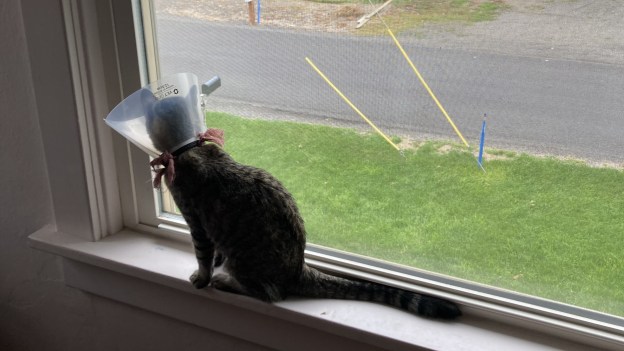
The youngest member of our family is sporting a cone of shame. She’s our six-month-old shorthair female cat, Phiona, and last week she had an overnight stay at the veterinary office to get spayed. We picked her up Wednesday morning, with a page of post-op instructions and a bag of syringes pre-filled with kitten-sized doses of pain medication. The vet assistant who discharged her instructed us to keep her as calm as possible for the next ten days, so we moved her food and litter into my office and there she convalesces.

Half of Phiona’s belly is shaved, with a one-and-a-half inch incision in the center, neatly sewn up. She wears a small cone on her small head, though it must seem large to her, and tremendously inconvenient. She can’t eat or drink without a person there to hold the dish still. Noises seem to come at her from strange directions, funneled through the cone. She licks the cone instead of her fur, and when her ear itches, the hind foot that pops up scratches at smooth plastic. There is no curling up to rest, no itching, and no bathing. Poop sometimes gets on the cone when she uses the litter box. Playing is a difficult proposition, as she can’t quite see her paws, nor coordinate them with her mouth to bite what she grabs, as kittens do.

Phiona doesn’t know the cone will come off after 10-14 days. As far as she knows, this may be her new normal—cooped up in one room of the house, wearing a constricting cone, unable to eat or drink until she has a visitor. If I were she, I would find this unbearable, and my attitude and behavior would follow suit. I’ve been watching her and imagining the deprivation of cat pleasures—a luxurious licking bath; a nap, curled up with nose tucked under tail; or a fierce romp, attacking string or toy with body, mouth, and all four appendages.

Phiona wears a cone of shame—or “Elizabethan collar” as it is called on the vet’s invoice—but she has no concept of shame. She doesn’t hide or hang her head. She purrs and plays and eats and drinks, and takes her medicine without complaint. How does she do this? I have watched her in amazement for a week, and I have no answer, only an increased awareness of how quick I am to sink into despair, to become angry when things aren’t how I want them to be, and to receive shame as my rightful state of mind. Phiona’s disposition is a compelling suggestion that there may be another way. Perhaps my humanity is not as volatile as I think, and the essentials of being human are more dependable than I realize. When I am limited, inconvenienced, slowed down, I do not lose my identity as a human being. I belong and I am invited to pleasure and peace as surely as when things are going my way.

I don’t have to always be well, productive, respectable, functional. I can rest when I am unwell. I can slow down when I am tired. I can enjoy the company of friends when I feel un-respectable. I can be waited on when I am not functional. I have permission to be human, and being human carries dignity with it through any circumstance. Whether buried in dept, or addiction, or depression, weighed down by sorrow and loss, or suffocating under secrets, each person is dignified. Whether disappointed in myself as a mom, humiliated by misunderstanding, or fearful of fallout after a mistake, I am dignified.

Thank you, Phiona, for teaching me that dignity is not complicated. You have modeled it through pain and confusion and the cone of shame, and have taught me again that my value is not in performance and my happiness is not in circumstances. But, I look forward to taking that cone off and watching you run and bathe and eat and drink, unrestricted.

Naked, Sacred Spirits

Friendship drama. I feel it in my body. I watch my daughters ride the waves of acceptance and rejection in the classroom or at play dates. I listen to adult friends struggling with relational tension. I talk about my own social anxiety and parasitic desire to look good and be right. I try to help my children understand their own and others’ behaviors, to see with a heart of grace. But when there’s nothing left to do or say, tension lingers in my body. Why?

Relationships are tenuous and fragile. I don’t like that. The clock ticks, lies are believed, trust breaks, narratives are written into the brain, and suddenly I am aware that I still question my value, my belonging, my place. Maybe I was skating by on trusting that everyone, including myself, would behave maturely. Then a moment of triggering or misunderstanding cracks me open, revealing a child who is still asking if she belongs here. Is she worthy of love?

Seeing through the crack to another person’s inner child is as frightening and vulnerable as being seen through my own cracks. I don’t feel authorized to talk to another person’s inner child. I sense the import of this mutual seeing—my inner child gazing at hers through our cracks—and I freeze. The stakes are high. I know that even if she is gracious to me, I may hide in fear; and even if I reach a gentle hand toward her, she may perceive a monster, commissioned to hurt her or keep her in her place.

How will our spirits see and feel and hear each other? I have no control over this. Maybe our faces and our words will look like friendship, but our spirits will henceforth sleep with one eye open when the other person is in the room. Maybe our spirits will come out of hiding, hold hands.

Her naked spirit and my naked spirit are sacred. They live in the company of the Great Spirit, God who shaped and breathed and spoke them to life. The connections I make to prove myself, or break to save myself—God imparts holiness to each one.

The overused analogy about how we’re all God’s children may be useful here. We squabble. We finagle to divide God’s affections or allegiance, but He is unaffected. “You are my favorite,” He says. “You are my favorite,”—to a sibling who took the lion’s share of ice cream, or lied about what I did, or made a face at me when He wasn’t looking, or apologized in a sour tone. Ugh.

God is 100% on my side. God is 100% on her side. I will lean in to this challenge. I will say Namaste—the divine in me greets the divine in you.