Category Archives: Belonging

Now What?

In a few days, 2024 will unfurl. I’m curious what the year will be like, for one reason I never expected: joy. I’m happy, content, grateful. After years of feeling heavy, taking life seriously, and forming relationships around mutual brokenness, happy is a little scary. My inner child tells me cheerful is good, but not happy. Happy is too … emotional. Cheerful is a choice. Happy is a feeling. God forbid I feel anything.

Boldness rises. I will step away from the heavy hand of survival to the wide open spaces of abundance. I will feel joy. And I will enjoy that joy. I will laugh and smile and say I’m doing great. It will be scary, but worth it.

Scary, because I’ve primarily related to God as therapist for so long. What will we do together if we’re not bonding over my anger, fear, and dislike of myself and my life?

Scary, because I’ve thrived on connecting with friends through a shared journey of personal growth. When I don’t have a problem to employ as a means to vulnerability, how will I connect deeply?

Scary, because I’ve believed that happy is irritating and naive. If I love my life, what will people think of me? What will I write about?

Yes, I’m afraid.

I’m also excited, tantalized by the potential of a tea-sipping life—warm, slow, fragrant. I’ve been dodging bullets and putting out fires, sleeping to avoid the chaos in my mind. What will it be like to enjoy wakefulness?

Here’s to 2023 for being ripe with friendship and love, catalysts for joy.

And here’s to 2024 for its potential to be well-lived rather than well-controlled.

God Is Not in Control, Part 3

When one person wants good things for another person, does that lead to a desire for control? In my relationships with my children, my parents, and my spouse, I’d say Yes. I have felt controlled by every family member, and in my turn I have tried to control them—often because I want good things for them. I want my kids to develop skills that will help them thrive as adults. I don’t want anyone to hurt them. I want them to be kind and confident and responsible. I want my spouse to get plenty of sleep and maintain a healthy weight. I want my parents to enjoy life.

But is the basis of all these good desires the fear of what may come if these things don’t happen—if things aren’t this way? Do I want a better marriage for my friend because I fear the marriage she’s in? Do I want better health for my spouse because I fear what poor health would do to our lives? Do I want my friend Alana to have better mental health because I fear her depression will affect the atmosphere of our small group? When life goes off the rails it may cost time, money, reputation, quality of life. Isn’t it better to stay on the rails?

I used to think so, but now I’m not sure. At what cost does a person stay on the rails? What is lost to the god of control? I don’t want to admit it, but likely what is lost is what I was trying to protect—peace, safety, belonging.

God’s way of moving in the world hardly resembles mine. He wants good things for us but has no desire to control. He is not fearful, because He is love. He is not trying to guard His resources or His reputation—He already gave both to us. God’s love is a love intertwined with loss and longing. It’s a love that accepts pain, and repeats the same loving action a 100th time even though there was no response the first 99 times. It is a voracious love, eager for more encounters.


Stacey Bess spent seven years teaching transient or homeless children, grades K-12, in a homeless shelter. Many of these children attended The School With No Name for only 90 days, the typical length of stay at the shelter. In her memoir, Nobody Don’t Love Nobody, Bess introduces Karen, a woman she connected with at the shelter through conversation and nights out. Later, when Karen had a baby, she moved in with Bess’s mom, who helped care for baby Liza. Bess and her mother provided safety, midnight taxi service, food and clothing. They did everything they knew to do to help Karen create a healthy life. But things didn’t turn out how they hoped. In Bess’s words:

Karen brought us to feel and know about tragedy in a completely new way. We wanted desperately to fix her. I picker her up every time she called, day or night, and my mother put up with her tantrums and drug use, both of us full of hope and confident in the power of love alone to heal all wounds. But what we learned from Karen was that sometimes the giving has to be enough.

Nobody Don’t Love Nobody, page 42

Karen didn’t lean in to a healthy life. Love didn’t “do the trick.” My immediate response is that Bess and her mom were overly optimistic. They needed better boundaries and a reality check.

But Bess’s conclusion was, “sometimes the giving has to be enough.” In other words, what they did was enough. Nothing was lost.

C. S. Lewis wrote, “Love is never wasted, for its value does not rest upon reciprocity.” This feels right and true to me, but … isn’t the value of God’s love that it saves us? What is the point if no one responds? Bess and her mother loved Karen and Liza, but it sure looks like the saving part didn’t happen. It is often said that Jesus would have died to save only one. What about none?

After “God so loved the world that He gave His only Son,” we have, “so that whoever believes in Him will not perish but have everlasting life.” Everlasting life—even if interpreted as fullness of life rather than living for billions of years and then more—is an outcome. Love does something. What happens if there is no “so that”? Could it be that God’s love affects us even if it doesn’t save us? Is that effect worthwhile?

I have no record of Karen’s inner world, but I’d bet she knew those women loved her. She certainly trusted them. Does God covet our trust more than a change in our behavior? More than a longterm relationship? Does He want us to know He loves us, more than He wants to save us? That could change everything.

A quick look in my Strong’s concordance reveals that the word “plan” isn’t in the Bible. I’m not by any means an advocate of returning to the King James Version of the Bible, but I find it intriguing that much-beloved Jeremiah 29:11, usually quoted as, “I know the plans I have for you,” reads this way in the KJV: “For I know the thoughts that I think toward you, saith the Lord, thoughts of peace, and not of evil.” Maybe God’s will isn’t a plan, so much as it is His thoughts toward us. Maybe Jesus showed us what God’s will looked like, more than what God’s plan entailed. Maybe love, the absence of control, leads directly to spontaneous liking, which is the soil of belonging.

Spontaneity is the antithesis of control. It requires presence more than planning, and curiosity more than control. As humans we often forgo belonging in pursuit of acceptance, “the action or process of being received as adequate or suitable, typically to be admitted into a group.” Pursuit of acceptance gives us control. If I can perform or conform my way into a group—if I can make myself suitable—I have some control. Belonging cannot be wrangled, and has a rather slippery definition: “an affinity for a place or situation.” I looked up the word “affinity” to put some flesh on that very short definition of belonging. Affinity is, “a spontaneous or natural liking for something or someone.” So, belonging is spontaneous or natural liking for a place or situation—or, I would add, for a person.

“Spontaneous liking” sounds terribly out of control. But it leaves room for imperfection and it embodies joy. If love is the pain of not being in control, is belonging the joy of embracing imperfection? Maybe I can want good things for a person—work for them, even—but ultimately allow the giving to be enough, and allow trust and belonging to matter more than saving.

November

I’m trying a different poem style this week. It’s challenging to rhyme after writing so much free verse poetry! It’s a different kind of week, kids home from school, extra time in the kitchen, gatherings with extended family. I’m grateful for each of you in the @jesusmyfavoritesubject family. Thank you for seeing me, and allowing me to see you.

November

In this month of gratitude
I struggle with a bad-itude.
I do not love this ugly mood
Or how my heart feels misconstrued.

My kids are not a quiet brood.
Today their antics light my fuse.
My inner peace they now intrude
Until I beg for solitude.

I am allowed disquietude,
But I’m not victim of my mood.
It’s likely this month will include
Both thoughtless acts and moments shrewd.

So I will eat Thanksgiving food,
Refrain from being trite or rude;
When we give thanks I will include
Some words of sincere gratitude.

Grace is not a platitude
And Love is wide in magnitude.
Here I belong, so I conclude
There’s latitude for attitude.

Cone of Shame

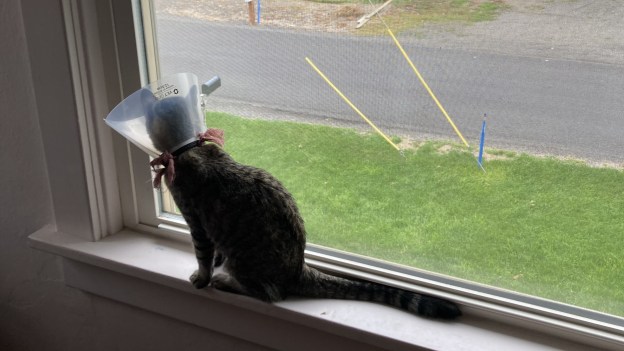
The youngest member of our family is sporting a cone of shame. She’s our six-month-old shorthair female cat, Phiona, and last week she had an overnight stay at the veterinary office to get spayed. We picked her up Wednesday morning, with a page of post-op instructions and a bag of syringes pre-filled with kitten-sized doses of pain medication. The vet assistant who discharged her instructed us to keep her as calm as possible for the next ten days, so we moved her food and litter into my office and there she convalesces.

Half of Phiona’s belly is shaved, with a one-and-a-half inch incision in the center, neatly sewn up. She wears a small cone on her small head, though it must seem large to her, and tremendously inconvenient. She can’t eat or drink without a person there to hold the dish still. Noises seem to come at her from strange directions, funneled through the cone. She licks the cone instead of her fur, and when her ear itches, the hind foot that pops up scratches at smooth plastic. There is no curling up to rest, no itching, and no bathing. Poop sometimes gets on the cone when she uses the litter box. Playing is a difficult proposition, as she can’t quite see her paws, nor coordinate them with her mouth to bite what she grabs, as kittens do.

Phiona doesn’t know the cone will come off after 10-14 days. As far as she knows, this may be her new normal—cooped up in one room of the house, wearing a constricting cone, unable to eat or drink until she has a visitor. If I were she, I would find this unbearable, and my attitude and behavior would follow suit. I’ve been watching her and imagining the deprivation of cat pleasures—a luxurious licking bath; a nap, curled up with nose tucked under tail; or a fierce romp, attacking string or toy with body, mouth, and all four appendages.

Phiona wears a cone of shame—or “Elizabethan collar” as it is called on the vet’s invoice—but she has no concept of shame. She doesn’t hide or hang her head. She purrs and plays and eats and drinks, and takes her medicine without complaint. How does she do this? I have watched her in amazement for a week, and I have no answer, only an increased awareness of how quick I am to sink into despair, to become angry when things aren’t how I want them to be, and to receive shame as my rightful state of mind. Phiona’s disposition is a compelling suggestion that there may be another way. Perhaps my humanity is not as volatile as I think, and the essentials of being human are more dependable than I realize. When I am limited, inconvenienced, slowed down, I do not lose my identity as a human being. I belong and I am invited to pleasure and peace as surely as when things are going my way.

I don’t have to always be well, productive, respectable, functional. I can rest when I am unwell. I can slow down when I am tired. I can enjoy the company of friends when I feel un-respectable. I can be waited on when I am not functional. I have permission to be human, and being human carries dignity with it through any circumstance. Whether buried in dept, or addiction, or depression, weighed down by sorrow and loss, or suffocating under secrets, each person is dignified. Whether disappointed in myself as a mom, humiliated by misunderstanding, or fearful of fallout after a mistake, I am dignified.

Thank you, Phiona, for teaching me that dignity is not complicated. You have modeled it through pain and confusion and the cone of shame, and have taught me again that my value is not in performance and my happiness is not in circumstances. But, I look forward to taking that cone off and watching you run and bathe and eat and drink, unrestricted.

Naked, Sacred Spirits

Friendship drama. I feel it in my body. I watch my daughters ride the waves of acceptance and rejection in the classroom or at play dates. I listen to adult friends struggling with relational tension. I talk about my own social anxiety and parasitic desire to look good and be right. I try to help my children understand their own and others’ behaviors, to see with a heart of grace. But when there’s nothing left to do or say, tension lingers in my body. Why?

Relationships are tenuous and fragile. I don’t like that. The clock ticks, lies are believed, trust breaks, narratives are written into the brain, and suddenly I am aware that I still question my value, my belonging, my place. Maybe I was skating by on trusting that everyone, including myself, would behave maturely. Then a moment of triggering or misunderstanding cracks me open, revealing a child who is still asking if she belongs here. Is she worthy of love?

Seeing through the crack to another person’s inner child is as frightening and vulnerable as being seen through my own cracks. I don’t feel authorized to talk to another person’s inner child. I sense the import of this mutual seeing—my inner child gazing at hers through our cracks—and I freeze. The stakes are high. I know that even if she is gracious to me, I may hide in fear; and even if I reach a gentle hand toward her, she may perceive a monster, commissioned to hurt her or keep her in her place.

How will our spirits see and feel and hear each other? I have no control over this. Maybe our faces and our words will look like friendship, but our spirits will henceforth sleep with one eye open when the other person is in the room. Maybe our spirits will come out of hiding, hold hands.

Her naked spirit and my naked spirit are sacred. They live in the company of the Great Spirit, God who shaped and breathed and spoke them to life. The connections I make to prove myself, or break to save myself—God imparts holiness to each one.

The overused analogy about how we’re all God’s children may be useful here. We squabble. We finagle to divide God’s affections or allegiance, but He is unaffected. “You are my favorite,” He says. “You are my favorite,”—to a sibling who took the lion’s share of ice cream, or lied about what I did, or made a face at me when He wasn’t looking, or apologized in a sour tone. Ugh.

God is 100% on my side. God is 100% on her side. I will lean in to this challenge. I will say Namaste—the divine in me greets the divine in you.

Holy Homemakers

Holy Homemakers

Blessed are You,
Lord our God,
King of the Universe,
for taking up residence in me.
I don’t think You are an implant,
sewn to the tissues of my brain, or heart.
You must live in that part of me
we humans fail to define,
the spirit or soul,
breath of life first passed
from Your lips to Adam’s
all those years ago.

Blessed are You for co-signing
on the mortgage
for these bones and flesh,
and putting Your name
next to mine
on the mailbox.

Blessed are You,
Lord our God,
King of the Universe,
for showing me how to belong
here in myself,
trusting what Your presence indicates—
that this is home—
my spirit, my body, and Your divinity
as homemakers.

Storms, and Other S-Words

Storms, and Other S-Words

Blessed are You,
Lord our God,
King of the Universe,
for sex.
I am drawn by passion
or a desire for passion.
I am drawn to celebrate the joy
and relief of belonging.

Blessed are You
for storms,
set to kill, or thrill,
or water the earth.
Thunderstorms ground me—
flashes of light,
beating of great sky-gongs,
loud but gentle fall of rain.
The smell of washed earth
says I belong here.

Blessed are You,
Lord our God,
King of the Universe,
for the safety of You—
a safety that embraces
mystery and madness,
skepticism and silence,
and humankind’s violent and dark
underbelly—human trafficking,
and other tragedies.

When there is not a wisp of cloud
over endless, hellish desert,
there is a whisper that you belong
in yourself and in the heart of God.

One Year on Antidepressants

The year after my daughter Kayt was born felt like three years. I guess that’s when my depression began. I often said I would’ve rather given birth a second time than gone through that first year with an infant. After a lifetime of receiving praise and recognition at work and school, the transition to an unnoticed 24/7 job was rather like being plucked from the heart of New York City and dropped in backwoods Alabama. Nothing worked the way it had before.

Kayt was perfect. Even the nurses in the birthing ward said she was one of the cutest babies they’d ever seen. I liked many aspects of caring for her, but I didn’t like being tired all the time, and I didn’t like having little control over how I spent my days. As months and years passed, my resentment grew. I was angry that I didn’t get to rest. Rest always felt like a liability because it could be interrupted at any time by someone else’s urgent needs.

Depression runs in my family—both sides—but I understood little about depression. I thought it meant feeling dark all the time, being unable to get out of bed, unable to accomplish anything. Since my go-to when I’m stressed is to do more, my productivity was rarely affected by my sense of well-being (or lack thereof). I plodded on, day and night. Cook, clean, shop for groceries, open mail, plan birthday parties. Nurse babies, read to toddlers, remind preschoolers to get dressed, fight with kindergartners about the letters of the alphabet, drive kids to and from school. I was often up at night. My kids never did that magical thing the parenting books call, “when they start sleeping through the night.”

When Kayt was 21 months old, our second daughter, Kyli, was born. A year later we moved to a larger house in the same town. The girls woke several times every night for weeks after we moved. A few months later, I started counseling. I was perfectly miserable in my perfect life, and I wanted help.

My counselor, Beth, became a trusted partner on my journey. She saw me—the real kind of seeing—and she started me on the path to seeing myself with compassion. But after seven years of intermittent personal therapy and marriage counseling, Michael and I found ourselves in a dark period. My depression deepened around April that year, and by the time it leveled out in June, it had made a significant negative impact on our marriage. I resisted our marriage counselor’s nudges toward trying antidepressants, until the moment I decided that if I could do something to spare my husband from a hollow wife, and my kids from an angry mother, I ought to try it.

My kind doctor offered to see me one morning before her first patient, so I didn’t have to wait months for an appointment. She prescribed Fluoxetine, and in mid-July last year, I began the drug experiment. Four days in I wrote, “I have had a significant increase in difficulty with sleeping (which is usually a non-issue for me). I have had trouble falling asleep, staying asleep, and going back to sleep, and twice I’ve been awake long enough in the wee hours of the morning that I start to feel nauseated and have to eat something before I can go back to sleep. Michael and I both feel that I do have improved emotional capacity. It has been a tiring week, but my ability to handle things without getting overwhelmed and shutting down seems to be better than usual. And I would say I feel less dark and discouraged, despite the difficulty sleeping and the resulting tiredness.”

A few weeks later my sleep had mostly returned to normal. By October I was settling into feeling more alive than I had in ten years, so when Michael suggested that the medication was affecting my libido (it was), I told him in no uncertain terms that I would not sacrifice my mental health for an orgasm. After working through that with our counselors, it was smooth sailing.

Fall became winter and I marveled at my capacity to enjoy life. I felt a renewed sense of agency as I regained the ability to choose a response other than anger to life’s frustrations. I knew I was lucky to have responded so well to the first medication I tried. A few friends had cautioned me or expressed concern about antidepressants, and I was well aware that a wide range of negative effects were possible. But the primary effect the medication had on me was to make me feel human again.

As spring approached, I wondered what my annual spring depression would look like. Three years in a row I’d darkened inside as the days grew longer and trees blossomed. My doctor said I could increase my dose of Fluoxetine if needed. Three weeks into April, I did. In my notes I wrote, “To this point, I have only positive things to say about being on Fluoxetine. I have come alive, enjoy so many things, and am more flexible and joyful. Started feeling my spring depression a few weeks ago, so I’m planning to try the higher dose for a month. Then hoping to go the opposite direction and maybe stop taking it later this year.”

Five days later I wrote, “I feel blank, like this higher dose of antidepressants has removed all ability to feel, all motivation, and almost all thought. I’m not sure I’ll be able to keep it up for a month. I write from my mental and emotional activity, so if there isn’t any, I’m not sure I’ll be able to write. I do have three topics in mind though, so I will try to write, and I will drink coffee and text friends and maybe do some yard work, definitely take a shower, force myself to cook, invite myself to enjoy the sunshine, maybe color some birthday cards for friends. I know I am okay, but I miss feeling it. I guess the plus side of being emotionally numb is that I don’t respond to everything with anger.”

Ten days later: “Thirty mg of Fluoxetine is a mixed bag. Motivation is down, libido is down, I don’t feel much emotion, haven’t cried except when Phred died (the family cat), and it seems like writing is more of a struggle. I’m just more numb, more blah. On the other hand, I feel pretty calm, not very angry. I’ve been more easily in touch with what I like and what I want, instead of what I should do, and I’ve been doing more fun things with the girls—a little less focused on tasks and more oriented to quality time. It’s weird to in some ways be more connected and in some ways more disconnected.”

After only two weeks on the higher dose, I was unable to refill one of my prescriptions and I dropped back to 20mg of Fluoxetine. A few days later I wrote, “I’m feeling good about it, now. I was pretty ‘muted’ and I’m feeling a bit more alive the last couple of days, and not too heavy.”

My spring depression slowly receded, and this summer has been the least stressful summer since kids came along 11 years ago. There’s no way of knowing how much of this has to do with antidepressants. My relationships, personal growth, the ages of my children, and even what I choose to eat and read are all in the mix. Ultimately, I’m glad I threw some drugs in there. I feel like I got my life back this past year, and I rediscovered the version of me that isn’t bitter and exhausted.

What have I learned about my mental health during this past year? I’ve noticed some things that don’t help me: exercise, to-do lists, a full schedule, guilt and shame (which can come from self-help books, religion, and—most often—my internal dialogue). There’s a longer list of things that do help me: small groups, one-on-one time with friends and with my spouse, coffee, writing, stillness, being flexible (I’ve learned this significantly reduces anger), learning to stay in friendship with myself and live out of my Spirit center, time in nature, recognizing when I fear myself, and allowing myself to experience intimacy and connection out of my imperfections (not my perfections).

My doctor encouraged me to take antidepressants for one full year and go from there. I’m a few days past the one-year mark, and trying to make a decision. I slept like shit last night and I feel like shit this morning, which makes me hesitant. On the other hand, I know what to watch for when I decrease medication: anger, loss of friendship with myself, feeling overwhelmed/helpless, moving from enjoyment to duty, feeling afraid. I’ll start my lower dose on Friday and see how it goes. There’s nothing to be afraid of. God and I and most of the people in my life are on my side. I’m not in a battle against myself (despite what the church taught me). I’m part of a big, dysfunctional human family, where everyone belongs simply because we are alive. And ultimately, belonging (and drugs) is the way out of depression.

Husband of a Mother

6:30 am. One bedroom door slams. Then another. Kids are scream-crying. Mom is crying behind one of those slammed doors, quieter but just as desperate. Dad was hoping to sleep until his alarm rang, but there will be no such extravagance today.

6:35 am. Dad slowly gets out of bed and stumbles across the hall in his boxers to hold and hear his distraught children. When he returns to the bedroom, Mom is in bed, spurting bursts of tears and anger, like a poorly-contained science experiment. Dad sinks back in bed to hold and hear the despair, and to quietly wonder how long this season of life will call on him to be more, always more.


Father’s Day was sweet and satisfying this year. We ate out at The Maple Counter for breakfast, shared gifts, and watched soapbox car racing on YouTube. As I was thinking about my husband, Michael, and how fortunate I am to parent with him, it occurred to me that perhaps as difficult and meaningful as it is to be a father, it is equally difficult and meaningful to be the husband of a mother.

A mother is immersed in emotions she often doesn’t understand. She sleeps much less than advised for mental and physical well-being. She is drenched with guilt and fear, which sometimes masquerade as control. A mother is on call 24/7—for days, weeks, months, years. She is on call for baby cries and soiled clothes, doctor appointments and play dates and skinned knees, temper tantrums and broken hearts, scissor and glue supervision, holding hands and finding shoes and wiping faces that don’t want to be wiped.

Who would sign up to be a support person to a mother? Such a person will be called upon to understand in times that defy understanding. They will bear witness to exhaustion, weeping, anger, and a beautiful body that is tired of being touched. They may endure the pain of watching a once-energetic woman become a hollow, methodical soul who can’t summon the energy to answer a question and has forgotten how to have fun. They will watch a mother pour hours into the planning and executing of a birthday party and have no capacity left for a goodnight kiss. They may stand by feeling helpless. They may step in to help and be criticized or ignored. They will be the object of resentment simply because they sleep a whole night or eat lunch while it’s still hot.

To stand with a mother, to witness her life, to love her, is a difficult prospect indeed.

Michael loved me as his wife for seven years before we were parents. He has loved me nearly 11 years as a mother. The demands on my time and emotions are less now than they were in the early years, but they will never end. I will always be a mother; my loving attention will never be only his again. He will witness the lives of our daughters not only as their father, but as a husband to their mother. He will forever be on this ride defined by unexpected turns and raw hearts, the kind of ride that remakes you with or without your permission, and invites you deep into love. Husband of a mother.

To all the men who love a mother, and to my husband especially: thank you.
Thank you for noticing.
Thank you for staying.
And thank you, too, for being selfish and annoying and knuckle-headed.
I couldn’t bear to be imperfect alone.

Sometimes I Feel Like a Black Hole

Often I have felt there is no cure for being me. I see my struggle—a desert stretching to the horizon. I feel like a black hole.

We’ve all had a friend who seems forever hungry for more attention and engagement. If we devoted every waking hour to their needs, they still would not be satisfied. I have felt that way about myself—like I will never get to the point where I am full and I can sit down with a sigh of contentment.

I suppose this is what some call the “God-shaped hole.” Since I’ve been a follower of Jesus my whole life, I thought didn’t have a God-shaped hole. Then I began to wonder. When I became still and thought about who I was, I cried. Evidence suggested that I did indeed have a hole, and it was not filled with God.

This was a disheartening realization, and a relief. Instead of assuming emptiness was all I could expect out of life, acknowledging the hole gave me hope—eventually. It took a while (years) to adjust to having a hole, but it was better than pretending I didn’t have one. I had put cones and yellow caution tape around that hole, keeping both myself and God out of it, not knowing my mess was inconsequential to God. I forgot that He willingly envelops me in Himself, and willingly lowers Himself into my frightening black depths.

“God meets our intensity of longing with intensity of longing,”* wrote Father Boyle. During this intensity I feel, this drivenness, this scrambling because I can never be satisfied—God moves toward me with equal intensity, with drivenness, with purpose, because He loves to satisfy me, and indeed He is satisfied with me. With Him there is contentment, enjoyment.

Do I still have a hole? Yes, but it’s not as scary and not as empty. It can be uncomfortable and unpredictable. Some days I still put up the orange cones and play it safe. But even on those days, I know that if I fall in, I’ll be okay. And most days I live life in that hole, because I’m not as scared of myself as I used to be, and it turns out that when I inhabit my own self and I hold hands with God, having a hole is not so bad.

*Gregory Boyle, The Whole Language: The Power of Extravagant Tenderness