Category Archives: Relationship

How to Be a Mother

Breathe. And not just
during the contractions.
You must be well-oxygenated
to care for another human being.

Give up. And not just
once. Keep at it.
You must release your grasp
before your muscles cramp.

Laugh. And not just
when it’s funny.
You must include sadness and shock
and exhaustion in your mirth.

Tell the truth. And not just
to yourself.
You must tell the other moms,
and listen to their tellings.

Accept your new self. And not just
the nurturing and brave parts.
You must accept the anger,
the desperation, the invisibility.

And remember to breathe.

What Version of Me Belongs?

I have chosen between attachment and authenticity a thousand times at least.

What do I mean by this?

I’ll loosely define attachment as a healthy sense of relational connection and belonging. And let’s think of authenticity as the ability to know ourselves and show up in the fullness of who we are, including the little quirks and details.

The choice between attachment and authenticity occurs when we must—or perceive we must—choose one of the two. For example, let’s say you’ve made a new acquaintance and you’re arriving at her house for the first time, with a plan to chat over a cup of tea. You might feel a little anxious, not knowing whether this will be awkward, and wondering about the future of your friendship. When you step in the door, your friend offers to take your coat. You’d rather leave it on until you warm up a bit, but instead you take it off and she whisks it away to a side room. Then she offers you scones, which are obviously hot from the oven and smell delicious. You accept and then notice there are raisins in them. You don’t like raisins. But rather than pick them out, you decide to eat them. In these moments, you are choosing attachment over authenticity. Sharing your preferences feels risky for the relationship, so you keep them to yourself.

Often, as in the above examples, we base our decision not on reality (you have no idea whether your friend would be offended by you picking out the raisins), but on a perception of what would best maintain your attachment—your relational connection—in the moment.

Let’s think about scenarios where the stakes are higher. A teen might have to choose between the authenticity of letting their parents know they’re transgender, or preserving attachment by not sharing that information. A pastor may have to choose between authentically and vulnerably requesting help for an addiction, or maintaining his position and his church relationships—his connection and belonging—because he knows he cannot have both. A person may choose to have sex with their partner because it’s easier to do what they don’t really want to do than it is to say the vulnerable truth and deal with the possible fallout of disconnection.

As children, and even as infants, when presented with a choice between authenticity and attachment, we choose attachment. Our survival depends on it. As we become adults, our circle of resources widens, and our options become more diverse. We don’t have to choose attachment over authenticity every time. Still, there is an element of risk to authenticity, and we weigh this consciously or subconsciously every day.

One of the most challenging environments to navigate this dynamic is religious circles—which in my case extend to my children’s private education, friends past and present, my readers, and even neighbors. Church seems a strange place to make a choice between belonging or being myself, yet I have felt it often there. Christians say, “Come as you are.” But I don’t think we meant it. Or, we mean it with a tag-on—“Come as you are, when you’re ready to change that to be like us.”

I have believed I can’t be me, because whatever improved version of me God has in mind is better than the current version of me—“sinful and selfish” me. Somehow being myself means heresy. I can’t be true to myself and to God at the same time. You know, something about “a house divided,” or how man’s thoughts are “evil continually.”

These days, I’m not sure I belong in church. But it doesn’t matter like it used to. I belong in myself, and that is sweet relief. I belong in the living room of God, who has become both mother and father to me. I am bonded spiritually, and it’s the safest place I’ve found yet to excavate and inhabit my authentic self.

God doesn’t ask Her children to choose between attachment and authenticity. Belonging is a foregone conclusion, and God’s favorite pastime might be holding your hand as you get acquainted with your authentic self. I think God emits joy-sparkles when He gets to witness you noticing yourself and connecting with the fun, complex, messed up, whole and holy person that you are.

Wherever attachment and authenticity occur together is sacred. These holy spaces may be inside us, in marriage or friendship, in nature or a good book. I’ve discovered that in settling into my own self, I can hold the paradox that I am okay and I am not okay. And it turns out God is way bigger than they said She was.


My understanding of these concepts leans heavily on Gabor Maté and Krispin Mayfield. Many thanks to them both for acquainting me with my own inner safety.


P.S. I posted an update today about trauma-informed writing groups. Check it out here.

A Small Circle

It’s a few minutes before 10 AM on July 3 when I pull up in front of a quiet, fenced, red-brick home in downtown Walla Walla. The smell of warm brownies has kept me company across town, and I lift the shallow box containing towel-wrapped goodies and an assortment of papers from the passenger seat. Karen Carmen, founder of Hope Street, meets me at the front door and invites me inside with her usual friendliness and practicality.

I don’t realize it yet, but today marks exactly one year since I began my inquiry into trauma-informed writing groups. This will be my first time leading a group, and I focus my attention on setting out snacks and organizing papers. I have one hour with the five women seated around the living room, where small talk centers on a dead-mouse smell that mysteriously snuck into the house that morning. No one can tell quite where it’s coming from.

Alicia, who works here at Hope Street, passes out notebooks and pens. Then we begin with a writing prompt that will serve as personal introductions. “Finish these three sentences,” I instruct, “and then we’ll go around the circle and read what we’ve written. First sentence: I am… Second sentence: Once I bought… Third sentence: I wish…”

After a minute or two, the sounds of writing stop and we take turns reading our answers. “Once I bought…” sentences bring a few chuckles, and “I wish…” statements are trailed by affirming mmm’s and hmmm’s. Then I introduce the writing prompt that will take most of our time—a reflection on a moment with someone important to us. I set a timer on my phone for 15 minutes.

When there are two minutes left, I invite everyone to bring their writing to a conclusion, and hastily do the same with mine. I unwrap the brownies and we’re drawn in by the smell. We hold the sugary chocolate squares—and healthy apple slices—on napkins, and fall into conversation.

After our break, it’s time to read aloud what we’ve written. The women urge me to read first, so I do—I wrote about my grandma, and how she looked sitting on the back-porch swing at her home in Texas. Alicia reads next, and most of the women read aloud. They live here together, so they know each other. I am the stranger in the room and I’m honored by their trust.

We give each other feedback as I have instructed: positive comments on what you like, what stays with you, what you remember. I am surprised and delighted by the quality of writing. Each writer has used wonderfully descriptive words, and—even better—conveyed emotion. I am also surprised that we finish reading aloud and commenting on each other’s writing a few minutes before 11:00, which feels like a stroke of luck rather than a credit to my time management (running late is my cardio).

Already I like these women, and I’m thrilled when they compliment my writing and leadership and respond positively to my offer to come again. I plop my stuff back in the box, and Alicia walks me to the front door. I didn’t expect this to be so smooth, so fun, so… easy. Energized and feeling slightly inflated, I drive home, high on the joy of connection, the excitement of future possibilities, and the smell of brownies, which lingers in the warm car.


Eight hours later, I arrive at a tall brick building on the other side of downtown Walla Walla. Powerhouse Theatre is hosting a Red Badge Project reading—nearly three hours of veterans reading aloud their stories of war and life and healing. As I drove here, it dawned on me that one year ago today I attended this same event. It’s what first inspired me to spread the healing power of trauma-informed writing. I feel a moment of completeness as I settle into a seat near the front of the theater. I have returned to the place where my dream began. One small circle is complete.


I imagine that coming years will add circle upon circle, ripples of words and connection and healing. In the meantime, I continue to open my schedule, my brain, my emotions to a wider understanding of what trauma-informed means, a broader experience in writing, and a growing network of personal connections. In addition to leading the group at Hope Street and attending the Red Badge Project event, favorite moments of learning and connection in July include:

  • Attending a Trauma-Informed Community of Practice meeting, hosted by Becky Turner
  • Chatting with Matt Lopez at FVC Gallery, and enjoying the art displays and exquisite coffee
  • Talking to my aunt Pam on the phone about writing, healing, kids, and all the things
  • Participating in Janelle Hardy’s five-day, online “Stories From the Body Writing Challenge”
  • Attending ITIC’s “Unlocking Human Connection: The Power of Person-Centered Thinking,” training event with Robert Peaden
  • Visiting with Mindy Salyers of Counseltation about the possibility of a writing group with some of her clients (she is a therapist for elementary schools and high schools)
  • Meeting Warren Etheredge after the Red Badge Project reading. Warren emceed the program both last year and this year. He is a founding faculty member and writing coach for Red Badge.

Life may not be a box of chocolates, but whatever it serves up deserves to be written down, perhaps in the safety of a living room, around a plate of brownies.

One of the women at Hope Street used the words “laughter” and “loneliness” together in her writing—a pleasant alliteration, but an unlikely pairing. I noted the way it stood out to me, paused me. And that evening at Powerhouse Theatre, as a slightly-bent older man read from the podium, the very same words came out of his mouth, one after the other: laughter and loneliness. These two words carry human experience, the feeling in our spirit of connection or estrangement, belonging or realizing we are untethered. This is why I want to write with people—so we can notice our laughter and loneliness, we can read it—speak it—aloud, we can know we are not alone.


Today’s blog post is also the most recent journal entry on my Writing Groups page. Scroll down the page to read more about what got me into this quest to form trauma-informed writing groups.

Holy Parents

This morning the third- and fourth-grade class at Milton-Stateline Adventist School tried something new. We wrote a blessing together. They chose the topic and all the adjectives and I was the scribe. I hope you enjoy their poem!

Holy Parents

Blessed are You,
Lord our God,
King of the Universe,
for parents—
courageous but strict,
funny but embarrassing,
sweet but grumpy,
loving but self-absorbed,
fun but assigners of chores.

Blessed are You for these
hardworking, graceful, responsible,
generous, smart, sarcastic,
handsome and beautiful,
yelling, fighting, forgetting
parents.

Blessed are You,
Lord our God,
King of the Universe,
for being our Daddy God,
and for our parents
who remind us of You—
giving us hugs when we need them,
helping us when we’re sad or scared,
giving us courage to learn new things.

Gained in Translation

“Thanks to you I have the goal of being someone good in this world.” So concludes the final letter from Alejandro*, and his words stop me.

I’ve been told I have influence—or rather, warned that I have influence. Better use it for good, they say. Watch yourself. Or, as the church-school song goes, “Oh be careful little tongue what you say… for the Father up above is looking down in love…” And I have been careful, which mostly feels like fear, anxiety, and judgement.

I’ve been told I have influence—but Alejandro’s words shocked me. It hadn’t occurred to me that I could inspire anyone to want to be good, and certainly not someone I’d never met in person.


In 2009, I was a few years married and worked full time at the Christian college from which I had recently graduated. That spring the student association hosted a concert by the Christian rock band, Superchick. It took place in the big dome at a neighboring college. While true fans moshed it up, I wished for earplugs from my seat on the bleachers. Somewhere in the course of the evening, the band made an appeal for child sponsors, and in the post-concert din and jostling, we managed to buy a CD and sponsor a child—Alejandro, from Bolivia.

For 14 years we exchanged letters with Alejandro, as he grew from a preschooler to a working man and graduated from Compassion International’s child sponsorship program at age 20. Early letters were written by Alejandro’s brother or his tutor. A letter in 2011 included this endearing anecdote: “It was a happy week for my family too because my brother was born and my mom was delicate so we couldn’t do anything for her birthday. She is better now and we are going to buy a cake for her. Alejandro helps me to wash the dishes because my mom is still delicate.” -signed by older brother Emilio.

Over the years we prayed for each other and shared favorite foods and the antics of our pets. One letter informed us that Alejandro’s pet goose had laid five eggs and was taking good care of them, and included an update on turkeys that had hatched some months before: “My mom likes them very much, she feeds them every moment.” Occasionally we’d make an extra monetary gift through the Compassion project, and a few months later we’d receive a picture showing what Alejandro bought with the money—clothing and shoes, “rubber dinosaurs,” a dresser for his clothes.

At first our letters traveled snail-mail between Bolivia and Washington state. Later, online letter-writing became available, but still it was a slow correspondence. I worried about asking the same questions or sharing the same information because I forgot what we covered in previous letters. I probably did forget things and repeat myself, but Alejandro responded to every letter with only the kindest words, and patiently answered our questions.

In 2023, Alejandro aged out of Compassion International’s sponsorship program and we each wrote a letter of farewell. His letter begins, “My dear friends Michael, Tobi, Kyli and Kayt, let me greet you, I am so grateful for all the time you were my friends and I was blessed with your sponsorship. Truly God touched your lives and through you He touched mine and my family’s. I am so grateful. You were really an unconditional support for so long, words would not be enough to show you how much I love and appreciate you.”

I am immediately touched, and simultaneously aware that these kind words register on a grand scale almost foreign to my daily narrative—God reaching through me to touch another, the elusive desire of every God-lover. “Unconditional” is not a word I would use to describe myself, but there it is. I choose to receive it.

Alejandro goes on to describe how the Compassion project helped him and his family, concluding “but above all, I received the word of God in my life, I was able to know Jesus, and I was able to understand that my life was better if I held His hand.” One sentence, profound gospel. My life was better if I held His hand.

Alejandro requested our continued prayers for guidance and for his family, and promised to pray for us: “I will pray that God will always bless you, that God will grant you the desires of your heart, that God will guide you well in everything you do, that God will keep you from all evil, and that you will now be able to continue blessing more lives as you did with me during all this time.”

Then he concluded, “Now, with a happy heart, for having completed the Compassion program, but also a little sad because I will no longer be in touch with you, I really feel you as part of my family, I will always have you in my heart my dear friends. Thanks to you I have the goal of being someone good in this world. God bless you always, your friend forever, Alejandro.”

It has been said some things are lost in translation, but, if anything, I’d say translation lent this final letter a beautiful simplicity. Alejandro’s translated words rank among the best prose I’ve read. They are high praise yet totally devoid of flattery. His gentle and grateful heart reminds me who I am—a daughter of God who does’t have to worry or hustle. I am blessed and I am a blessing—this is the sum of my existence. Alejandro, thanks to you I have the goal of being someone good in this world. I want to live up to your estimation of me. God bless you always.


*Not his real name.

Everything Is Well but Not Okay

On Sunday morning I lay in bed with my back against my husband’s chest, and the cat propped against me with her hindquarters on the bed and the rest of her body relaxed against my belly. As she purred, Michael and I groggily checked in with each other about last night’s sleep and the coming day’s hopes. In that moment I knew I was the luckiest woman in the world.

Also, too many people I know are in agony. It’s the usual culprits—death, divorce, disease. Add to that a whole lot of problems that haven’t been named or categorized. I know people who are feeling the brokenness in their minds and bodies, whether it has a name or not.

We’re veeerrryy close to the beginning of a remodel project that will add a master bath to our home. I can’t wait for the first day of real work, when the contractor comes in and lays that heavy duty cardboard down to protect the floors, and they start demolishing walls. I’m giddy with excitement about the next few weeks of packing up my bookshelves and moving things around to accommodate the remodel. Don’t ask me to explain this joy, but by golly I’m going to revel in it whether I can explain it or not.

I’ve been crying more lately, which is oddly comforting. I haven’t cried much the last year and a half since I’ve been taking anti-depressants. Whatever curbs my depression and anger also curbs tears, and I’ve missed crying. Last night I cried at the end of the Disney movie, Elemental. I teared up recently during a dolphin show at Sea Life Park. And this morning I cried when I shared a heavy heart with friends and their response came back immediate and full of love.

Yesterday I met with the school counselor at our local alternative high school. I’m slowly making connections in the community with the goal of learning about trauma-informed education and someday facilitating writing groups that empower incarcerated and underprivileged people to tell their stories. I want to give them room to be seen and heard. Writing is one path toward wholeness, and wholeness matters. Two books near the top of my TBR pile will help me with this—Between the Listening and the Telling, by Mike Yaconelli, and Writing Alone and With Others, by Pat Schneider. Just looking at those books gives me a tiny burst of energy, and if I let myself imagine a future in which I write with others toward healing, I break into a smile. Hand me the tools and let me get started!

If someone is living a better life than me, I don’t know who it is. Of course it wouldn’t take long to write down a dozen things that could be improved—but why bother? Today is my day to live, as me. I have what I need. I am enough. God is big and bigger and biggest.

When I feel the tension, I often return to these quotes, best when read together:

“Everything is so not okay.” -Anne Lamott*

“All shall be well, and all shall be well, and all manner of things shall be well.” -Julian of Norwich

Yes.

*Okay, the truth is I’m pretty sure I read this in an Anne Lamott book, but I can’t find it again. If you know, send me the book title and page number.

Big Joy

We returned a few days ago from vacation, and our upstairs cat, Phiona, seems particularly delighted to find me at my desk this morning. She jumps on my lap and leans into me. I put an arm around her and she settles down with loud purrs. I am charmed, as always, by her beauty and aliveness.

Other people’s cats—like other people’s kids—often look a little strange to me. I notice their proportions more than their personality, and nearly always conclude that my cat (or kid) is better. While I’m not proud of this, I’ve come to believe it’s a natural response to relationship. It is because I have a relationship with Phiona that I experience pleasure by looking at her, belonging when she flops across my feet for a nap, and joy when we play with the plastic bug my daughter tied to a piece of yarn.

“Joy is always relational,” write Marcus Warner and Chris Coursey in their book The 4 Habits of Joy-Filled People (p. 35). It’s a strong statement, but let’s play along and assume that joy is always relational. Put another way, joy comes from “knowing that someone is happy to see me” (p. 33). Is despair, then, the feeling that not a person in the world would be happy to see me? Is bitterness always relational too? Talk to a bitter person and you’ll get an earful about what they have or haven’t received at the hand of their dad, boss, roommate, kids, and church.

I wonder what joy looked liked for Jesus. Assuming He had an abundant supply from His relationship within the Trinity, would He also experience joy when people were happy to see Him? Imagine rounding the aisle at the grocery store, seeing Jesus, and spontaneously breaking into a joyful wave-and-smile. Does my joy produce joy in Him? It’s hard to imagine God coming away from an encounter with me feeling different than He felt before the encounter. And yet, if joy is always relational, then joy is the currency of divine-human interaction, and I’m inclined to believe this is not a one-way street.

Was Jesus’ greatest agony the (perceived) loss of all relationship on the cross? He asked his Father, “Why have You left me?” Stripped of relationship, what sustained Him? Dare I wonder if His relationship with Himself played a role? My inner critic says that question is sacrilegious. Relationship with self is so secular it’s scandalous. Love for us is what sustained Jesus.

But wasn’t that love for us something He found deep in His own self? Certainly He didn’t sacrifice Himself in loathing, as we are apt to do. He didn’t conclude that life wasn’t worth living. He must have valued life and held a deep regard—a love—for His own life, even as He parted with it. Perhaps it is in the safety of loving ones own self that a person finds strength to face death. After all, I will experience death alone, no matter how many people may be in the room. If I haven’t found peace in my own company, how can I receive death?

Sometimes I wonder what would happen to me if I existed only in relationship to God and to myself. How might I survive if war or disaster stripped human-to-human relationship from me? My guess is I would spend much of my time remembering the relationships of the past and desiring relationship in the future. It is human nature to visit a graveside and talk to a lost loved one, because even in the sorrow of death, we derive joy from that relationship.

I suppose it’s silly to spend time and energy considering lack of relationship, when the world I inhabit is drenched in relationship. And, truth be told, the joy of relationship finds expression in those who love themselves and those who don’t, those who fear death and those who don’t. Some folks are alone but not lonely, while others are lonely but not alone. It is in this complexity that God literally shows up everywhere. He’s not constrained to relationship with only those who love themselves, or only those who loathe themselves. His image is not confined to emanating from people who love well. His joy is not limited to those bathed in relationship.

There is no formula, and yes, even my response to this is divided—equal parts terror and comfort. I am outraged that “a” added to “b” doesn’t always equal “c,” but I am also relieved. I’m not hallucinating when I see exceptions, the edge cases that don’t fit my ideas of love and joy. I will be okay if I don’t follow the formula. In the meantime, I will cultivate joy by cultivating relationship. The scandalous promise of the upside-down kingdom is that as we exist in joyful relationship with God, we will find other people’s cats and kids looking a little less strange. The world of relationship will widen to include our enemies. We will be happy to see people, and they will know they are safe in relationship with us. That’s how I want to live.

Twenty Years in Love

I remember only bits and pieces. A small, formal couch with burgundy upholstery and a rounded back. Our clothes still shedding cold air from the winter chill. Michael’s tan coat, puffy in a way that rounded his lean figure. The Boyd’s Bear he hid in that coat.

Michael was a junior in college, double-majoring in mathematics and computer science. I was a first-year student pursuing an associate degree in accounting. Michael lived at home; I lived in the dorm. I attended required worships and ate in the cafeteria; he didn’t attend evening worships and his mom still cooked his dinner most nights. Our paths didn’t cross.

Until mutual friends set us up on a blind date—a story for another time. He waited two or three months to ask me out again, to his sister’s New Year’s party. In the meantime, we got acquainted on Instant Messenger. At some point, I confessed my interest in him on a couch in the church youth room. Come to think of it, couches are kind of a thing for us. He asked me to be his girlfriend on a couch, and our first kiss was also on a couch. Anyway, after discovering our mutual interest in each other and going to the New Year’s party, what was next?

Could we formally-informally get to know each other? We decided we’d find times to meet on campus and talk—not formal dates, but an intentional time to get acquainted. At least that’s what I thought. I don’t remember who arrived at our meeting point first—third floor of Kretschmar Hall. Fancy, uncomfortable-looking furniture dressed up the wide space in the hall outside the president’s office. Administrators had gone home for the day and it was quiet.

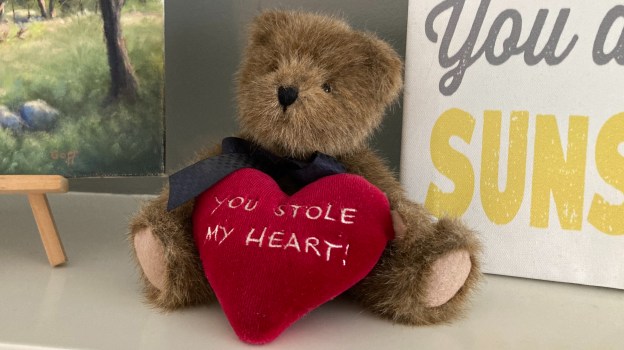
I don’t remember what I was wearing or what I was thinking. Michael wore blue jeans, a t-shirt, and that tan coat. Maybe I remember the coat because of all the time we spent together that winter, or maybe I remember it because on this day Michael reached inside it and pulled out a teddy bear. “I’d be honored if you would be my girlfriend,” he said, holding it out to me. The teddy bear held a plush heart with an embroidered message, “You stole my heart.”

If I’d known then what I know now, I would’ve grabbed that bear, squeezed it tight against my heart and jumped onto Michael’s lap. Grinning a big yes, I’d have squeezed him, tucking my nose under his ear. But, as I didn’t know him yet, I didn’t give him an answer. I accepted the bear and told him I wanted to pray about it.

If we began dating, he would be my first boyfriend. I’d fastidiously avoided dating in high school—you know, I-kissed-dating-goodbye and all that purity culture stuff. I had been in college only a few months, and other than our blind date, had been on only one other date—and a couple times guys bought me a burger or ice cream. In other words, this was a big deal.

I don’t remember how long we talked, or how long I made him wait for my answer. I prayed about it during Tuesday evening worship in Heubach chapel, an intimate sanctuary across a breezeway from the imposing College Church. It was simple—write your student ID on the leader’s clipboard, pick a pew in the nearly-dark chapel, and sing, or listen to the singing.

So there I sat, near the back, in a sanctuary of song, asking God what She thought of me dating Michael. She didn’t have much to say. In fact, He said nothing. But I took the quiet peace in my heart as a green light. I’m guessing I didn’t waste much time letting Michael know my answer. I’m not exactly sure he asked me on the 21st, but we’ve been telling it that way for as long as I can remember, which makes today just a few a days past the twenty-year anniversary of our first yes.

I phoned my parents with the news and they developed a sudden, intense interest to come visit—an interest that had never occurred before and never occurred again. After all the parents met each other and nothing exploded, we launched into dating with a surprising amount of devotion, insecurity, and delight. Michael was my first and last boyfriend, and I feel for him, being the only one to iron out my wrinkles all these years.

Not that he didn’t have any wrinkles. The first time he took me to his house, he asked me to wait in the living room while he took a broom and dustpan to his room. I’m pretty sure that dustpan was brimming after a hasty sweep. Twenty years later we’re still ironing out each other’s wrinkles, but perhaps more importantly we’ve learned to live with wrinkles. Our foibles have just a bit of charm when we remember to laugh about them.

It’s strange after twenty years of togetherness and eighteen and a half years of marriage to revisit the moment on the couch, the simplicity, the significance. Nobody knows exactly what they’re signing up for with a yes to love. And I say yes again today with equally sparse knowledge about the next twenty years.

But this I know: Michael, I am honored to be your girlfriend, best friend, wife, parenting partner, and annoying roommate. Thank you for asking. Thank you for countless opportunities to say yes to love.

Cat-Size Heart

I invented a new drink today—cofftea. I steeped a bag of decaf chai, added about a half inch of bottled Starbucks caramel macchiato coffee, and a splash of low-sugar, sweet-cream-flavored creamer. It was perfect. Tea, as Ted Lasso said, tastes like hot brown water. Coffee is too strong and too caffeinated. Cofftea is just right.

I’m writing in the living room recliner, cofftea beside me, snow outside, listening to the heater combat the 19-degree weather while frozen rain pelts the house’s metal siding. Michael comes downstairs for home-office pleasantries, and our cat Phiona follows. She tangles herself in a long piece of tinsel-like gold streamer. She chews it while twisting about on the floor, then gets up and saunters slowly to a different part of the room. The tinsel is wrapped around her tail and trails after her, setting off a round of wild contortions. She leaps to the couch, paws churning on the leather, propels herself across the side table and under a chair, where she pauses before rushing to the middle of the room for another tussle with the tinsel. Michael takes the gold-tinsel streamer and he and Phiona pad back upstairs where she will likely settle down on her pillow at the window beside his desk.

When I was a kid, we had a no-pets-in-the-house rule, observed without exception for dogs, and occasionally broken for a supervised half-can of cat food or bowl of warm milk on the kitchen floor for kitty. There was also an exception for summertime jars filled with tadpoles in mud-puddle water, and the hamster who occupied a small aquarium in my bedroom. Ladybug was her name, and I’m sorry to say I grew tired of her biting and pooping and messing up her aquarium, and felt relieved when she died.

As an adult, I’ve dabbled in fish and rodents, decided I don’t have patience for a dog (or children, but it’s too late to return them), and have settled on cats as my pet of choice. Last spring we lost our 18-year-old cat, Phred, to a traffic accident, leaving us with geriatric Phrank, who hasn’t yet used up his nine lives. A few months later, in midsummer, we adopted a kitten—a birthday gift for our daughter Kyli, who named her Phiona. She is unceasingly gentle and relationally devoted (as much as possible for a cat). She keeps her claws retracted during play, and if she bites, she gives an apologetic lick. She is very chatty and will often respond with trills and meows when spoken to. Our family of four is under the spell of her charming face, maniacal antics, and friendly conversations.

I don’t mean to be judgy, but I think people who choose not to have pets still think happiness is a clean house and no vet bills. Yesterday Phiona chewed the cord for Kyli’s headphones in three pieces—two large and a small. A couple weeks ago one of Phiona’s eyes clouded over and we took her to Animal Clinic of Walla Walla to get it checked out. (Nothing was wrong.) The bigger she gets the more she eats and the more she potties, which means increasing cat food and litter costs. She scratches the couch and the mattresses, makes herself at home on the dining table, and wakes me every night between midnight and 1am for no apparent reason.

The petless people aren’t fools. I just think they have grinch-hearts that need to grow a few sizes (apologies to my petless parents and friends). I can only assume my own capacity to handle the inconvenience—and receive the love—of pets has room to grow, since I am not yet ready for the exuberance, mess, and affection of a dog. Maybe my heart is only mid-sized.

It’s no secret that introducing any living thing—plant or animal—into life carries a legal-pad list of complications. Plants need water and sun and god-knows-what-else, and they grow oddly out of proportion, drop leaves, forget to bloom, and either die under ideal conditions or thrive under heinous neglect. Yes, there are books on plant care, but there are also books on parenting, and we know how well that turns out. Oh, and my parents don’t go for indoor plants either—at least not living ones. I mean, who wants dirt in the house. Silk plants are a no-fuss, wash-in-the-bathtub-every-five-years type of happiness. Good luck finding any living foliage with that kind of low-maintenance guarantee.

Recently, I drove downtown via my usual route. Power poles and power lines compete with trees along the road. Why, I wondered, do we bring in a specialized truck to dig a hole and place a dead piece of wood in the ground to hold the lines, when strong, living trees are plentiful and perfectly located? Well, because trees are alive, and life is inconvenient. Trees grow taller and wider, swallow up wires, and attract wildlife. They’re unpredictable. And for power lines we need predictable.

Where am I on the continuum of power pole to dog-lover? How much life can I tolerate? I’d say a plant is less trouble than a cat, and a cat is less trouble than a spouse, and a spouse is (usually) less trouble than a child. Rules and stonewalling, tone of voice and expectations help corral my people into something I can perceive as manageable, but how much management is too much? How do I know when I’m opting for the less-alive version because it takes less maintenance, less money, less emotional involvement? As a wife, mother, and friend, do I optimize for dead traits, or living ones?

In 2023 I settled for a mid-size heart. Will 2024 be the year to grow another size? Don’t get any wild ideas—I’m not adopting a dog. But maybe I won’t assign chores when my kids get loud, and I’ll stop counting out the pieces of fruit each family member gets at breakfast. Maybe I’ll take bedtime noise and moldy lunchboxes in stride, and smile more when I get woken at night. I’m not going for superhuman here. Just a little more life, and a slightly bigger heart to pump blood so my extremities don’t go numb.

What Is Kinship?

This morning I’m sitting in a favorite coffee shop as I write. Country music plays a little louder than I’d like from a speaker above, but quiet enough that I can overhear conversation. Two men in their seventies talk about therapy, travel plans, searching for a church that fits, and learning to support a recently-divorced family member. These men share themselves, hear each other, and speak encouragement. This, I think, is kinship.

I’m on a quest to learn about kinship. A google search provides this uninspiring two-word definition: blood relationship. But kinship can be so much bigger than that, a new way to see myself and others, a way that assumes value and connection. In kinship we are all on the same side of the line, rendering divides impotent. No “them,” only “us,” as Father Boyle would say. Only us.

Kinship has been slow-coming in my life. I grew up in a home where social time was considered a waste of time. If it wasn’t an event—like a birthday party or a hike to the lake—socializing didn’t happen. Although I’d like to blame my family and upbringing for my struggle to settle into friendship—I lived in a tiny community and was homeschooled through tenth grade—I’ve discovered my fears are not unique. Many women feel a lack of intimacy, and fear they don’t know how to participate in friendship. And, of course, each of us thinks other women have it figured out.

Every year I make a photo book commemorating our previous year. That may sound very organized, but it’s actually quite haphazard. Recently, I’ve been sorting through pictures from the last two years. As I put photos into categories and months—pets, school, March, November—a new category emerged: fun with girlfriends. These photo books will be the first to include a friendship photo spread—pictures of lunches out, movie nights, birthday coffee dates, pottery painting, and shopping fun. Looking at them, I feel connected, grateful, and not at all sure how it happened. I used to “do” friendship; now I enjoy friendship. I wish I could tell you five steps from lonely and anxious to connected and content, but, at least for me, it has been more mystical than methodical.

For most of my adult life I have compensated for lack of friendship by joining or creating small groups. A ladies group is my happy place. Crafts, Bible study, accountability, book-reading—it doesn’t matter. The structure provides a place for me to show up, participate in the mutual honoring of each other with our time, and complete the prescribed activity. Slowly I have ventured into one-on-one time with a handful of girlfriends, and casual activities together, like shopping. My circles of belonging widen.

The terror and the joy of intimacy with friends cannot be understated. Could one text or one misunderstanding upset it all and leave me in pain? Yes, it could. But in these relationships, do I feel seen, known, and safe? Do I invite these women into my home when I haven’t mopped the kitchen floor for three months, or done the dishes for three days? Yes, I do. Do I text them when I’m discouraged and take them coffee when I have a free morning? I do. Is it still scary, and do I have social anxiety? You bet.

Intimate relationships cannot be wrangled. It is a fools errand, seeking to avoid anxiety or relational fallout. Instead, I will allow anxiety and fear of intimacy to remind me that I am not impermeable. I am not above pain and misunderstanding. And this capacity for pain, this vulnerability, is what allows me life-giving connection, the joy of belonging, and the wonder of holding safe space for another person. This is the magic of being human.

Stories about men and women who stand in the gaps, go to the margins, hold hands with the desperate—these are my favorite. I want to be the hero in every story—the woman who taught homeless children, the man who endured exhausting legal battles to free wrongly-incarcerated men and women, the writer who teaches veterans to tell their stories, and the 22-year-old who adopted more than a dozen impoverished children.

At the same time, I don’t want to get anywhere near such unpredictable, messy situations. Can you imagine teaching at a homeless shelter, where traumatized children are in your classroom for 90 days or less? What about working long hours as a lawyer, toiling for years to see one ruling overturned, more years to find out it’s too late, the execution is scheduled. That may be charity, but it’s also insanity. How much could I handle?

There is tension between my relentless desire to love, and the ever-present awareness and fear of my limitations. I don’t know what’s coming for me in life, but I know I want to rise to the occasion and choose real love over false safety. I’m grateful for the thousands who have done this before me, proving it is possible and powerful. I watch the nonprofits in my hometown of Walla Walla, Washington, as they construct shelters for homeless, hold hands with the formerly incarcerated, provide dental services, food and clothing, love and dignity. I want to be part of that.

Children’s Home Society,* a local charity that works tirelessly to keep families together through in-home visits and a score of other services, has discovered the power of kinship—linking arms with the marginalized and misunderstood. Each year at their fundraising luncheon, one of their clients gives a keynote presentation, a story of their move from the thinness of broken family, addiction, and poverty, to a wholeness they didn’t know was possible. These people, unlike many of the donors in the room, haven’t been able to keep their lives “together” and show the polished side to society. But for that very reason, their stories are potent with hope. Every person in the room feels the energy of kinship. Hearts beat faster. Smiles appear. Applause is loud and long. Every one of us loves stories of redemption, and kinship is the catalyst for redemption.

Jesus born in a barn is kinship. He grew up to touch the untouchables, teach the stubborn, and include the rejected. He forever found beauty in ashes, wholeness in tragedy, and life in death. He defied categories, sweeping them into a circle and inviting them to hold hands, mix together like a delicious, forbidden stew. With a twinkle in His eye, He invites me into spaces where the ground is dry and barren. He invites me to bring kinship—the first drop of rain.


*Children’s Home Society is in the process of re-branding as Akin. I love this short-and-sweet name that includes the concept of kinship—the earth-shaking power of standing at the margins and holding hands.