Tag Archives: life

Mother Blindness

In a book of picture puzzles from my childhood, there is a spread of photos showing ordinary objects, pictured from unordinary angles—a box of colored pencils viewed from the points of their sharpened tips, a toothbrush viewed from the end of its handle, a sailboat viewed from above. The pencils look like wooden hexagons with colored spots in the middle.

That is how I always viewed my mother—at an odd angle and a little too close. She and other immediate family members are, of all people, most mysterious to me. When asked for Christmas gift ideas for a family member, or what size shoes my kids are wearing, I have no answer. But I have friends for whom I could answer those questions. 

Although I find this blindness-by-proximity disconcerting with my kids and spouse, it’s downright terrifying with my parents. The terror is well-hidden, but persistent. I try to see and understand, but the spaces we share feel like an ever-changing environment, without enough information. I can’t quite figure it out sufficiently to relax. This description seems fitting for a violent or abusive environment, but my childhood fits neither of those categories. Rather, I find it unnerving that the people who were my whole environment and by definition my “normal” as a kid, now seem so full of paradox as to be not understood. Proximity can make a mess of things.

In some ways my childhood feels like another life with different people. In other ways it is the riddle whose solution answers all my questions about who I am today. But no matter how much therapy I engage, no matter the journals I fill, no matter the hours spent with my parents, they remain an enigma to me. It’s like I know what they are, but when I look at them, what I know and what I’m seeing are mismatched overlays. This leads to mild feelings of insanity.

I assumed this insanity was permanent, until my mother died. As I wrote her obituary, looked at photos, and listened to family and friends share memories, a clear picture took form, captured from the correct angle. The proportions are true, there is color and detail, and I’m not sure I could describe her to someone, but I am beginning to imagine I could. 

The stories accomplish most of this astonishing work. A month after my mother passed, we facilitated a memorial service on Zoom, for the people from different seasons of my mom’s life who live far and wide. My mom’s siblings and friends and coworkers told stories, and each one added texture and color, shape and shadow and light. I found after the memorial that I held a more complete picture of my mother for the very first time. I felt I could hang it on the refrigerator with a magnet, or put it in a memory book or show it to friends. 

The picture I had before was scarcely more than one cheekbone and a jawline, recognizable primarily by what was missing. I still have that picture, its edges worried after more than 20 years of frequent handling. I will keep it to honor those years of not-knowing.


Three weeks after the Zoom service, my dad and sister and I, with the kind help of a pastor friend, facilitated an in-person memorial service, and again people shared memories—the neighbor she walked with in the mornings, who now has bird-feeders and birdhouses because my mom “made her a birdie”; the coworker she had fun parties with when their students were on vacation; the young nephews she helped to weave baskets; and the coworker at a Seventh-Day Adventist boarding school for whom my mom procured beer from our neighbor for the teacher’s science experiment.

“That’s me!” I whispered to my husband after the story about the beer. To fully appreciate the beer story, you must understand that staff employed at SDA institutions—like my mother—can get their wrists slapped, or employment terminated, for purchasing alcohol. But my mother, unconcerned about handling alcohol (despite the fact that to my knowledge she never tasted so much as a drop), asked our neighbor for a can of beer and brought it to school for her coworker.

Beneath my mother’s conservative lifestyle was a “try me” demeanor, ready to rise to socially unacceptable challenges, or do things many would opt out of. I see that in myself, and as I make the connection with my mom, I again am surprised that my vision has cleared so noticeably after my mother’s death. How did I not see her and me overlapping before? How did I not see that my jump off a 40-foot structure in the middle of the river without a second thought, or walking with total ease into the state penitentiary as a volunteer, were akin to her trying out my cousins’ rollerblades, on a hill, when she was forty years old (bruises ensued), or picking up a hitchhiking woman and then organizing a baby shower for her?

It’s been said that what humans want most is to be seen. We want witnesses to our life. I’m not sure if my mother saw me. Certainly she was a witness to my life, and knew things about me that I still don’t know about myself. But when she looked at me, I couldn’t tell if she saw me. It seemed she always filtered me somehow, through what she thought I was, or thought I should be, often missing who I actually am. Was her perspective also too up-close-and-personal for clear focus or a complete picture?

If a mother cannot see her child, can she allow that privilege for others in her child’s life—allow aunties and friends and bosses to see more than she? Of course, now I am thinking of myself as a mother, and my own children, the way they, too, seem partial and out of focus. With such fierce desire it hurts, I want my children to be seen, want loving witnesses for their life. But it may not be me who sees them best. My witness, my angle, has its benefits and drawbacks, and I don’t imagine I will see my children with the simplicity allowed to those who become acquainted with them in normal ways. After all, I knew them first in my belly, an introduction altogether different than meeting someone at the desk beside yours in school, or on the playground, or at lunch or work or coffee shops or church.

I realize that some children have connection with their parents that is clear and true and intimate. Not everyone is blindly grasping like me. But here I am. What is here for me in this awareness of mother-blindness? Perhaps this discovery is an invitation to a moment of surrender. I release my mother from any requirement to have seen me better. I release myself from the nagging guilt that I ought to understand best those who are closest to me. And I release my children to be seen by others, better than by me. I am a witness, an ally, a source of history and recipes and inside jokes. But I may be seeing the sailboat from above and entirely miss that it has a towering mast.

If my love is indeed riddled with gaping blind spots, I have newfound gratitude for the eyes-open love from others for my family—parents and sister, husband and kids. And I have newfound grace for my proximate blindness. I cannot—nor do I want to—create distance for the sake of clarity. So I will settle for a skewed view, trusting that my immediate family members will ultimately see themselves through the eyes of many, all with different perspectives, and through the eyes of God, the only character in this story without blind spots.

Blind though I may be, you’ll find me here, watching and listening, soaking in the narrative that is mine, cherishing the pictures that are mine alone. Even blindness does not deter a mother.
Ray of Frickin’ Sunshine

I am a ray of frickin’ sunshine.
I smile-scowl all the time.
I stretch to befriend gratitude,
Supposedly to help my attitude.
But a realist once is a realist always,
And I’ll speak my truth ‘til the end of my days.
Sometimes it’s dark and sometimes it’s light—
I’ve learned that both unlock the good life.

So while I smile and laugh a lot,
Don’t mistake me for an optimism ‘bot,
Cuz I’ll smile while I rain on your parade.
The truth can be heavy but I’m not afraid.

Let’s do this together, the sunshine and the cursing.
A vanilla life would surely be the worst thing.
And if I can be a ray of frickin’ sunshine,
Everyone can smile and swear at the same time.
Love is intricately woven paradox,
So enter in—love’s your perfect detox.
It can hold the shit and the glitter too.
That’s the life I ascribe to, how about you?

Father Church, Mother Earth

I attended church every Sabbath (Saturday, in my faith tradition) for the first thirty years of my life. That’s 1,560 Saturdays. Allowing for a few skips, I’ll round down to 1,500. I participated in at least a few hundred of those, either up front or behind the scenes, most often in music—song service, choir, special music, offertory. I served as deaconess and Sabbath School Superintendent, provided children’s story, directed and participated in skits, coordinated VBS (Vacation Bible School), collected offering, counted offering, served on the floral committee . . . You get the idea. Church held an unquestioned space in my life.

Fast forward ten years, to a Sabbath in early spring. I drive to the far side of the small town where I live and meet my sister at Mill Creek Channel. We’ve only just begun walking the paved trail when I spot a mother mallard riding the creek, which is high and moving fast. Cement dividers at regular intervals create mini waterfalls. A single duckling follows Mother Mallard, and I wonder aloud if its siblings drowned from similar rough rides. In the froth where the water drops, the duckling disappears for a moment, then pops up like cork.

Five minutes later we cut off the path, toward a patch of trees where we’ll find what we’ve come to see. For much of the winter I’ve been coming here on weekends, and in spaces that were bare last time I visited, green plants have proliferated. A few steps into the greenery, a tree trunk bears a light-colored, concave mark a couple feet above ground, where a beaver has gnawed off an almost-heart-shaped patch of bark and wood. Walking past this, we step over and around tender new trees and bushes, and baby horsetail plants that look like bottle brushes.

Evidence of beavers is everywhere—small trees felled by a characteristic hourglass-shaped chewing pattern, wood chips, logs stripped of bark, and at the stream, multiple stick-and-mud dams upon which tall grasses grow. Coming up from the stream bank, we hoist ourselves over a large, smooth log and walk to the edge of this semi-open space, where the brush becomes thick and prickly. A ground-level tunnel through the underbrush indicates one of the beavers’ paths. A few feet in front of the tunnel opening is a tree I’ve been photographing, perhaps 18 inches in diameter and so tall I don’t venture a guess at its height. Where the beavers have chewed into the tree, only a thin portion of the trunk remains. I had hoped to track their progress in felling the tree—at what point it would succumb to gravity?—but I am disappointed to see that here, and elsewhere in the clearing, it appears the beavers are no longer active. The only change is the color of wood chips on the ground, from bright and fresh two months ago, to a dark gray. Have the beavers been captured and moved elsewhere?

I will come again and look, but for now we weave our way out of the spring undergrowth and return to the paved walkway. Here we part ways, as my sister returns to the parking lot and I continue along Mill Creek Channel. A handful of minutes later, I cross the creek on a corrugated metal bridge. The rushing water, visible under the bridge, makes me feel unsteady on my feet. Reaching the other side, I walk to a bench maybe twenty yards away and it and sit down.

Although I know the water is flowing “down,” some wavelets appear to flow “up,” jumping and curving in a seemingly reversed fashion. At my feet, wild grasses with freshly-minted purple and green seed-heads wobble and sway in a light wind. Under the water, longer grasses, submerged when the creek rose with rainwater, flow long and smooth. The air smells fresh, almost like a waterfall, and I breathe in slowly. Walkers, alone or in groups of two or three, all accompanied by one or more dogs, pass behind me, but I scarcely hear them over the loud and steady surge of the water. An occasional birdsong breaks through.

The sky is blended blue and white, and the sun on my back comes and goes as clouds shapeshift and bend to the wind. All this hospitality, my soul soaks it in. My back and shoulders relax. Sitting here, I recall decades of Sabbaths in church. If I still attended church, that’s where I’d be right now. I don’t miss it. Why?

How could I belong to something for 30 years and feel no sense of loss? Or maybe the sense of loss has faded away with time. I did miss traditional church when we transitioned to leading a house church. House church was different—in ways I loved, and ways I didn’t love. When we stepped away from house church after six years, I didn’t know what was next. Traditional church felt weird; staying home felt weird. 

Today, I think I might know what’s next. This. Mother Nature. Or, if you prefer, God’s presence in the outdoors, in the rhythm of water, the sound of birds, the antennae on an insect smaller than my fingertip, patterns in tree bark and in the sky. I need this mothering, a learning of beauty, impermanence, sound and silence. Here I find endless discovery saturated with companionship.

On many Sabbaths last winter I took a walk on another nature path not far from our home, either alone or with one or more of kids/husband. The secluded trails enchanted me with their secret stream and vines with berries, bright red and white. I watched a flock of starlings shapeshift in the sky above a meadow. I sat in the grasses at the base of a naked deciduous tree and paid attention—to the slug on my shoe, the cold and sunny sky. I felt my feet on the earth, and marveled at an enormous wild apple tree. And each time my car crunched out of the gravel parking lot, I was kinder, more hopeful, more grounded. These were lessons learned not in words but in silence. Not through instruction but curious awareness. I found complexity, not perfection. Death mixed with life. The way living things trust the land, and the land trusts living things.


As I sit by Mill Creek, I think about all this and wonder if church is my Father, and nature my Mother. I spent 30 years in my Father’s house; will I spend another 30 in my Mother’s house? I have explored ad nauseam the ways God is my father. But I’ve only just begun to learn how God is my mother.

Mothers are complicated. I want to release my expectations—based on my experience with my own mother, based on what the Bible or churches say about God as mother—and I want to experience it, to accumulate stories of my Mother and I, to come up against the edges of her that nudge me where I don’t like to be nudged, to soak in the warmth of her voluminous embrace. I suspect Mother God will at times disappoint me, and I will try her with my stubborn certainties. I also suspect that, like my Father, she is both safe and wild. 

I rise and follow the path along this side of the creek, taking pictures of farmhouses flanked with bright green meadows, and closeups of pink blossoms on trees. I am startled by a bird flying rapidly toward me, an osprey. He or she carries a stick some two feet long, and passes directly overhead. I turn to keep the bird in sight, and it lands across the creek on a nesting platform where a nest is taking shape. 


A few days later, I pull books off my shelf, looking for descriptions of masculine and feminine traits—not physical traits, but the ways of being that lie within those terms. Will I find evidence that church leans masculine and nature leans feminine? Are Mother God and Mother Nature one and the same?

In Mirabai Starr’s book, Wild Mercy, I find these descriptions:

Feminine: An aggregate of qualities such as mercy, loving-kindness, wildness, inclusiveness, radical truth telling and tendencies such as nurturing, subversive, relational, community building, heart centered, honoring of embodied experience, comfortable with ambiguity.

Divine Masculine: The sublime aspects of the masculine spiritual paradigm, an inclination toward detachment [objective, impartial, unemotional] and transcendence, intellectual clarity and religious rigor, purification and perfection.

(Bracketed words are mine)

Wildness. Nurturing. Honoring of embodied experience. Comfortable with ambiguity. These I find in nature. I soak in them and I am still thirsty; my capacity to hold more remains undiminished. I dip into Mother Nature again and again, and I come home to myself every time.


Last summer, when my sister was sorting through old family papers, she texted me a picture of a sheet of lined, yellow paper, torn from a mini legal pad. “TOBI June 89 (4 yrs)” is printed at the top in my mom’s writing, and below that, four quotes from my four-year-old self:

“Do you think God needed a ladder to get the sky up there?”
“Is Jesus going to be comin’ ‘round the mountain when he comes?”
“God isn’t a he, God is a she!!”
“Do you think God made our feet first so we could stand while he made the rest of us?”

Three questions and a statement, as only a four-year-old can say them.

After years of grappling with whether it would be offensive to use feminine pronouns to refer to the divine, and with my recent curiosity about Mother God, the statement grabbed me. It seemed my four-your-old self had shown up to give me permission to fall in love with an (obviously!) female God.


In my early thirties I sought help through mental health therapy. I brought my list of goals to the first session, but only later would I come to understand that essentially what I wanted was the ability to live with myself comfortably. My Christian therapist tasked me with writing out internal messages I’d inherited from my dad, and then writing what God might say instead. I cherish the many pages of writing which came out of that exercise, and the ripple effect of healthier thought patterns that affirm my value and wholeness. And I wonder if it is time to do the same exercise for mothers—my earthly mother and my divine Mother. What is my mother’s legacy inside me, and how is God’s mothering different? What are Mother Nature’s messages to me? 

And what will be the ripple effect this time? Mirabai Starr writes, “… I believe in the healing energy of the feminine as a fire that can melt the frozen heart of the world, the artistry that will mend the tattered web of interconnection.” This I want to receive, and this I want to regift to my children and my community. Let me be a melter of frozen hearts, mender of tattered connections. 


I sit on my porch, tea in hand. Tall, green-leafed bushes grow outside the deck railing, and trees canopy the lawn and driveway, such that nearly my entire view is green. (Later, I ask Google the meaning of the color green, and the AI overview tells me green has a calming effect that slows metabolism and promotes physical and emotional wellbeing. Green also symbolizes renewal.) An inordinate amount of rustling arises as squirrels and birds nose and scratch their way through old autumn leaves beside the gravel drive, searching for tiny treasures in exoskeletons. The new, green leaves of the canopy move continually, and I am amazed by their responsiveness to mere whispers of air. A squirrel sleeps on a tree branch—the same branch I can see from an upstairs window, where I often watch squirrels sleeping or bathing, like a cat. Sleeping squirrels, dancing leaves, the color green—these are “the artistry that will mend the tattered web of interconnection.” These are my Divine Mother.

What She Wants Most

Escape. This is what she wants most in the world. 

She has bumped into a cliché, that this is not the life she wanted. 

But also it is. The husband, the house, the backyard with towering trees and a play-set for her daughters.

She has decided she needs a week alone, preferably on an island far from here. Away from the husband who wants sex. Away from the house that is just a little too full of life and all that life implies. Away from the back yard where nothing bothers to ask before it grows another foot, and her young daughters still need supervision to be outdoors and help to go down the slide. Every fall the towering trees dump a million and one leaves, and in the prickly cold the family rakes and hauls and piles.

The worst thing of all is that when she reaches the ends of her fantasies—the deserted island, the silent retreat at a monastery, or even the house to herself for a week with no kids and no husband—yes, at the ends of the fantasies she is still weary, estranged from herself, married to her chosen life, nothing has changed. And that is the dagger to her heart. Past the hopeful fantasies lies the truth, that she doesn’t want another life, but neither does she want this one—the sleep-challenged nights, the rotting homemade play-doh, the almost-empty bin of cat food, dishes on repeat, never alone but often lonely, a dutiful, tired, empty well.


She is lying. About the escape. This is what she wants most in the world. 

She has explored her options and reached a conclusion. She wants to be at home with herself. She wants to feel relaxed in her own skin, perhaps even to like herself. She is aware of this possibility only dimly, and aware it will cost more than the option of escape. Escape is quick. Therapy is slow. But it becomes apparent that her own hostility toward herself is the culprit of her discontent. And this revelation is an invitation. To what, she’s not sure. Is this a battle? A puzzle? A zombie apocalypse?

Perhaps yes to all of the above. This is unsettling, though perhaps less unsettling than the lonely, empty well. This battle/puzzle/apocalypse promises change, momentum. She gets to keep the husband, the house, and the kids, and discard the shame and scarcity.

She doesn’t know it yet, but she will discover self-friendship. She will experience her own self as her most trustworthy ally, and she will learn to enjoy her own company. She will discover that friendship with herself is an expansive container, able to hold the pieces of her life, even those that seem incongruous. She is not a pantry, but a cathedral.

And when she has absorbed this truth, she might still take that week alone when she gets the chance, but rather than an escape, it will be a celebration.

Death Is Beautiful

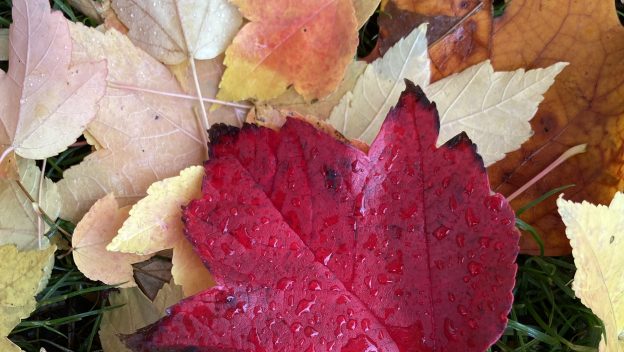
Death is beautiful. City streets and sidewalks are papered in it. Trees shout it with blazing reds and yellows—a rare season when the glow of sunset settles onto every country road and city block. And the individual deaths are as beautiful as the collective. If I dare use the worn-out snowflake analogy, each leaf is one-of-a-kind—the blend of colors, the shape and length of the stem, edges pointy or rounded, symmetry perfect or lopsided. Even the way it rides air currents to the ground is singular.

In the Celtic spiritual tradition, the phrase “thin places” describes those times when the veil thins between the now and the eternal, the ordinary and the extraordinary, and we see what is usually hidden. Death is one of those thin places.

Months before autumn, I walked a fog-covered beach on the Pacific Ocean, and death everywhere arrested me, stunned me, captivated me with its patterns and beauty. The oval-shaped outside of a small chiton shell—previously home to a creature that might have been the child of a limpet and a sea slug—was mossy green. But inside, surrounded by a wrinkly cream-colored girdle, an almost-neon aqua blue lit up the connected shell plates, and I stared in wonder. The shell of an urchin, now spineless, was covered with perfect rows of raised dots in muted tones of pink and green. The purple inside of a crab shell had patterns like light shining through water. Round jellyfish, symmetric from their thin edges to the white motif near their fat centers, lay stranded on the sand. A dead dragonfly, wings spread as if on display, had the bluest body, a peaceful gray-blue, but nothing dull about it.

My daughter picked up a crab shell which had been home to a couple dozen barnacles, and I imagined it in its heyday, scuttling through tide pools, unknowingly feeding the barnacles on its back, as well as itself. Uprooted seaweed formed circles and figure-eights. My daughters and I stomped on the seaweed air floats, trying to outdo each other with satisfying pops. One already-cracked float looked like Pac-Man, and another like a pelican’s head and neck. Shells, once symmetric, had broken into fragments and been polished smooth by the sand—pinks mottled like granite, colored ovals reminiscent of planetary rings, layered blues, and swaths of pearly iridescence. An art museum at my fingertips. 

As I contemplate the beauty of death, I can’t help but wonder what it will be like when someone I love dies. Will I feel the thinness between earth and heaven? Will there be beauty? Or will it be clinical, disturbing, exhausting, or—worst of all—sudden and too soon? I’ve never been with a person at death. I am curious—will there be a glimpse of what I have not seen before?

There is room for magic in morbidity. Although the leaves will turn brown, rot in the rain, and return to the soil, their week of splendor remains undiminished. Although every empty crab shell represents a death, and the waves and crunching feet will not leave them whole, they are no less exquisite. Although I will die, my passage from this life will squeeze the mortal and the immortal together for just a moment, creating a beautiful, painful, thin place.

Exposed by Proximity

Children scare me. Even my own children. I do not like this, and admit it reluctantly. Children make noises at the wrong times, go where they shouldn’t in the blink of an eye, and express emotions with their bodies. In a word, they are unpredictable. 

The most likely culprit for my fear and discomfort is a desire to feel safe by being in control. This is also something I don’t want to admit. Isn’t it better to go with the flow? Not to mention that control is largely an illusion anyway. And Jesus not only loved children; He suggested we emulate them.

But that doesn’t help me with in-the-trenches moments with kids. I can’t ever find the one right answer I’m looking for. Should a kid have snacks or eat only at mealtimes? If I give someone else’s kid dessert, or put on a TV show, will that be the end of life as we know it? If two toddlers fight, and both hurt each other, do we call it even and move on, or should they be punished or lectured? How do I know in what moments to expect my children to toe the line, and in what moments to suspend expectations and get ice cream? And don’t even start on the pros and cons of vaccines. 

No matter the age of a child, my response to them could affect them for the rest of their lifetime. I am not okay with this. Will I be the one who offers grace or wisdom or a listening ear that gives permission for a child to like themselves? Or will I give advice at the wrong time, be lenient when the consequences are life threatening, or give peanut butter crackers to the kindergartner with a severe peanut allergy and get locked up for murder?

The stakes are too high. Somebody please lower them. Tell me I don’t have influence, I’m not culpable, my instincts can never go wrong. But no, once more I must make peace with uncertainty. I must receive the truth that I will both harm and help my children and other children. Sometimes I will hurt and another will heal. Sometimes I will heal what another has hurt. And some hurts won’t be healed. 

No matter the stakes, I am not superhuman. I will break what needs to be held together, and I will clamp down on what needs to be released. Damn, I hate that. 

Then again, maybe the children in my life are my greatest ally in accepting my humanness. I doubt the fear will go away. But maybe it could prompt a mantra: I am in this moment, with this child, and we are both getting to know ourselves. There’s something sacred under the scary feeling, a gift of mutual vulnerability that exists here where I am exposed.

Run-on Marriage

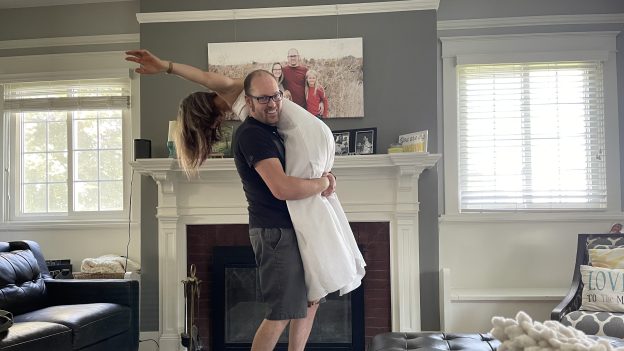
Last week Michael and I celebrated 20 years of marriage. The run-on sentence below illustrates our run-on marriage. (And yes, we’re still crazy about each other, in addition to driving each other crazy.)

I cannot get in bed when the bedcovers are frumpy, drifting off the end of the bed, sideways, knowing that if I do lie down and tug on them I will get too much sheet, too little blanket, and the wrong corner of the comforter; but I do not make my bed in the morning—I make it right before I climb in bed at night, tugging with exaggerated exclamations as I dislodge cats, and my poor husband too, because there’s a tiny possibility that I idolize sleep and this bed is my altar and before I sacrifice my body the altar must be prepared as if for a temperamental god of linens, and I like to remind my husband that before I met him my sheets would stay tucked in and straight for months at a time, but since his feet hang over the end of the bed and he tosses and turns at night, I have to straighten the covers every single day, and I accomplish this with more violent energy and bitter comments than necessary, although one would think after 20 whole years I would have adjusted and calmed down about it—but he huffs and makes less-than-charitable remarks every time he drives, and he has been driving for twenty-five years, so I guess we are both going to have our snide remarks and adult tantrums and all shall be well. 

P.S. I usually use stock photos, but the photo for this post is of my husband and I earlier this month. I barely squeezed into my wedding dress, which I attempt every September as our anniversary rolls around.

Mothers Are Stalkers

Every mother is a stalker—stealthy as a fox, or loud and proud as a heckler. 

She may try on other hats—friend, playmate, shopping buddy, or cook. But she will always return to the well-worn stalker cap. 

No one knows exactly why. Perhaps all those years of sleep deprivation affected her brain. Or maybe her partner has become boring and she needs to trail someone interesting. Or her dream of being a paparazzo never panned out and she’s done repressing her hunger for juicy stories.

Could it be revenge—on her own mother, or on her child—for needing her when she didn’t want to be needed? Is it fear, masquerading as care? Control masquerading as curiosity? Perhaps sheer boredom is the culprit. 

Or it could be force of habit—one that began while watching an infant’s chest rise and fall, then following a toddler through play structures, teaching a child how to use a toothbrush, then how to handle a kitchen knife. A long stint as chauffeur cements the habit, and by the time a kid has wheels of their own, stalking is like a nervous mother-twitch that can’t be medicated.

Whatever the case, mothers are stalkers, and children are their prey. They follow, but never shoot. They scribble notes and report to their partner in bed at night. They buy new camo when the old is detected, and they keep on stalking even when the tap-tap of their walkers is a dead giveaway.

And, depending on your religious beliefs, upon death they have the best of all—that birds-eye view they always wanted, the ability to hover without being detected, and maybe even a direct line to put in a few suggestions to God about how their child’s life should go.

Walk Repenting

“… the soft animal of my body …”

As I put the car in park, I leaned forward and squinted to read the blue letters on the bumper sticker of the car in front of me. “maybe the soft animal of my body wants to walk a thousand miles repenting”

I’d never heard a human body described as a soft animal before. Did I have a soft self, and did it want to repent?

It was Tuesday morning, Colville Street, a much needed coffee-and-writing date with myself. I turned off the engine, and hoping the woman in the red shirt exiting the store to my right was not the owner of the car, I snapped a photo of the bumper sticker. A silhouette of geese flying over cattails on the right side of the message added to the calm invitation I felt from those words. 

Not wanting to linger with my phone camera pointed at the back end of a stranger’s car, I made a quick detour into the building the red-shirted woman had just exited. Like a mini mall, a half dozen boutique clothing and food/wine shops occupied storefronts along a wide hallway. I noticed a sign for a soon-to-be bagel shop on the brown-paper-covered windows of a corner space. The slurpy sounds of a paint roller accompanied the smell of fresh paint.

The shop around the corner used to sell my favorite coffee smoothie—made with raw cashews, dates, and cocoa powder. They had closed some months ago, but I’d heard the new occupant of their space served the same smoothies. I walked in slowly and surveyed a freezer with everything from ice cream bars to frozen quarts of house-made soup. The deli fridge held a mouthwatering assortment of unique grab-and-go foods, such as spiced garbanzo beans. When I got to the cheeses, I noticed the front counter out of the corner of my eye, and above it the list of smoothies. No coffee smoothie. 

The bumper sticker I’d photographed still rolled around in my mind as I perused a couple shelves of dry goods, then stepped over to the counter. “Hi,” I spoke to the southern-California-pretty girl, feeling self-conscious in my workout clothes and messy half-ponytail. “This is my first time here since this store changed owners,” I offered awkwardly, “so I’m just checking it out.”

“Okay. Welcome.” She smiled.

“Do you have a coffee smoothie?”

“No. We’re working on it.” She gestured to a middle-aged woman with light brown hair, seated behind a laptop at the nearest round table. 

“I’m trying to get the consistency right,” the woman offered. I showed her the recipe I use at home for a coffee smoothie, and we chatted for a while. She told me about the plans she has with her business partner to open a sandwich shop in the small empty storefront next door. I wished her luck with the business ventures and returned the way I’d come, back to the sidewalk by my car. No police waited to take my phone away or arrest me for taking pictures of bumper stickers.

I grabbed my laptop, sweatshirt, journal and book from my car and headed toward my original destination for a weekday morning self-date—the coffee shop beside the mini-mall. 

I ordered a hot matcha latte, paid with a gift card, and chose a table in the corner. Then I settled in with my journal and returned to pondering the bumper sticker: maybe the soft animal of my body wants to walk a thousand miles repenting. Yes, my body seems to say, I want to do this. I ask my body, why?

Because pretense is not a way to spend a life.

Because I am sorry this world is not a comfortable place for a hundred families I know and billions I don’t know. 

I am sorry for the miscarriages and painful marriages, sorry for the systems that don’t see people, and the people who don’t see themselves, sorry I have loved control more than gentleness, sorry for the disease and dis-ease that never ask before they darken our doors.

I am sorry for the loss of hard-to-hear human stories to easy-to-apply inhumane labels, sorry that emotional and physical safety are a privilege and not a right, sorry for all the grief that is carried alone because we are scared to name our own grief and to witness the grief of others. 

I am sorry we look at teenagers and see youthful bodies and immature minds, but don’t see the loneliness or oppressive unanswered questions, sorry we look at children and see their food-smeared faces, hear their unfiltered words, but don’t see their whole souls—meant to awaken us to the wholeness that is their birthright and ours.

I am sorry there is no easy way out of addiction or a demeaning job or loneliness, sorry that pain is par for the course and I sometimes pretend it’s not, and sorry I forget that joy is also par for the course and I sometimes pretend otherwise.

I am sorry that plants are largely unheard and animals are prized or passed over, but rarely known, sorry I’m an unsafe stranger to some, and an unsafe friend to others, sorry for all the ways I have confirmed the loneliness in another person’s spirit.

I am sorry I swallow my food without giving thanks to the earth and the farmers and God.

So yeah, I could walk a thousand miles repenting, my soft body says. And I want to grasp other soft bodies and bring them with me, to walk together barefooted until our soft mass of bodies spreads repentance across every landscape, until we have repented our way home, which is not a place of individual belonging, but of collective belonging.

And then my body is done speaking. She relinquishes the pen back to my mind, and I see the paper I am writing on, the smooth blonde wood of the table underneath. I notice my cold ankles, the barista’s laughter, and a melancholy female voice singing through the shop speakers.

I notice the way my fingers wrinkle as I hold a blue pen with black ink, and see for the first time that the tiny screws on the metal logo attached to my purse are fake.

After a while, I notice that I am noticing, and I wonder—if fifteen minutes of quiet repentance awakens me this much, what might be born of a thousand miles?


Lunch time nears. I return to the shop with no coffee smoothie and purchase a cauliflower and garbanzo bean salad. While I eat, I think about repentance. Is repentance a list of sins and regrets before God? Is it turning a different direction, choosing a better way? Is it a walk, the bodily healing of circulation, the mental healing of gazing at the horizon, the spiritual healing of engaging with the landscape of humanity? My body says this might be the case. Perhaps it is all of these and more, an invitation to be awake, to be soft, to hold each other gently…for a thousand miles, if necessary.

The Red Circle

A perfect dark-red, circular spot on the beige carpet. I reached down and touched it, first with a finger and then my thumb, pressing lightly. Sure enough, something wet and red thinly coated my fingers. It had to be blood. But where did it come from?

“There’s blood on the carpet,” I announced to my mother. We had just spent 40 minutes getting her from the dining table to the couch—a distance of about 12 feet. She was certain I couldn’t help her stand up, that my dad had to be there for her to move. My parents recently relocated, and dad was at the old house cleaning out the garage. They would sign closing documents that afternoon for the sale of the house. I came to be with my mother, whose mobility and cognitive ability had declined rapidly over the past few months.

Back at the dining table, I’d held out my arms to help her stand, but she made no attempt to respond. I moved the walker in front of her and held it steady so she could pull herself up, but still she didn’t move. Then she wanted to get down to the floor and crawl. She instructed me to bring some towels to soften the floor. I spread a thick blanket, doubled over, between her dining chair and the edge of the living room carpet. She leaned forward and tried to rest a hand on the floor, but lost her nerve. At her insistence, we called my dad. He said yes, I could move her. Again, I held out my arms—no response. I brought the walker over—she tried holding it in different ways but never got to the standing-up part. She tried again to get to the floor with similar results—her hesitant hand reached low.

I kept offering to help her stand, as that seemed to me the best option, but she said she didn’t want to hurt me. She is several inches taller than me, but only a few pounds heavier. I had helped her stand and walk many times before. Perhaps her reticence resulted from a recent fall, although I wasn’t there at the time of her fall. She asked who else could help her and named an acquaintance who had visited a couple days before. When she determined that I was, indeed, the only available person to move her, she asked for my dad again and cried. An hour earlier she had announced, “This afternoon I’m scheduled to have a nervous breakdown.” I was beginning to agree.

My mother insisted that she could not stand up with her feet on the smooth floor of the dining room, but only on the carpet. In response, I grabbed the front legs of the wooden chair she occupied and pulled it to the edge of the carpet. Now we had less than six feet to go. I held out my arms again, instructing her to hold onto my biceps as I held her elbows. I planted my knees against her right leg and pulled her up—sort of. She doesn’t straighten up all the way when she stands. I put my arm around her back to keep her from sinking back down, and pulled the walker in front of her.

A one-inch scooch, a six-inch step, a rapid little shuffle. She leaned forward on her toes, her center of gravity moving precariously in front of her as her heels came off the floor. I lifted her foot so she could move it forward. Then again the other foot. Then a step on her own. Then a one-inch scooch. Somehow she got her back turned to the couch and sank down onto the cushions. However, she wanted to lie, and would need to be closer to one end of the couch to make room for her legs to stretch out. Rather than attempt convincing her to stand again, I grabbed her blue jeans on each side of her hips and heaved her slowly across the couch. I lifted her feet onto the couch, then blue-jean-heaved her a little more until her hips rested perpendicular to the back of the couch. A large array of pillows served as a back rest. I spread a fluffy white blanket over her.

“I haven’t brushed my teeth in three days.” She seemed worried about looking well-kept for the house signing, although I had no idea how long it really had been since she last brushed. I poked around in the bathroom drawers and cupboards until I found floss, toothpaste, and toothbrush. She couldn’t floss. I tore off a piece of waxed floss, wound the ends around my fingers, and started with the teeth that were easiest to reach. After flossing most of her teeth, I handed her the toothbrush, which she had instructed me to wet, but not apply toothpaste. She proceeded with brushing on her own. When she finished, she asked me to take a picture of her shiny clean smile and text it to my dad.

It was at this point I noticed the red spot on the carpet. What could have produced a clean drop of blood? My mother suggested I check her knee, which I did—but given that she had jeans on, it couldn’t have dripped blood unless she had a gushing wound that soaked her pants in blood. We checked her elbows too—had she bumped into something and not realized it? No, no signs of blood on my mother. “I’m on my period,” I confessed, “but I don’t understand how I could have dripped blood on the floor like that.” As we discussed the possibilities, she concluded that my menstrual bleeding was the mostly likely culprit.

I wetted a paper towel in the kitchen and went to work on the red spot. Much to my relief, it came out of the carpet with minimal scrubbing. I had no interest in staining carpet at my parents’ house—the very same parents who kept cream-colored carpet in near-perfect condition for 20 years while farming and raising two kids. I knew better than to soil it.

As I turned, my mother noticed blood on my shorts. Another piece of the puzzle. I hastened to the restroom and found that indeed there was blood on my shorts. They were loose, pink-purple shorts made of sweat-pant material. As I cleaned them the best I could without actually taking them off and washing them, I realized what must have happened. When I sat on the edge of the couch to floss my mom’s teeth, I must have leaned into such a position that my underwear and pad weren’t fully in place. Hence, a few drops of blood had fallen onto my shorts, and from there one of them dripped to the carpet.

I have this idea that at 40 years of age, period “accidents” should be a thing of the past. It’s not like I’m new at this bleeding-out-of-my-vagina thing. But there I was, cleaning blood from various surfaces. My mother was unconcerned, a conversational ally as we pieced together what had happened. How strange that in the afternoon’s events, simply standing up would be infinitely more stressful than blood on the carpet.

Oddly, when it was all over, I primarily felt gratitude. It’s awkward to be a fully functional person around a not-fully-functional person. It feels weird that I can floss my teeth and walk where I want to, and my mother can’t. I’m never quite certain what to offer in terms of help, and since her mobility and cognitive ability are a little different each time I visit—sometimes more and sometimes less—it’s a moment-by-moment game. Not the kind of game I’m good at.

This blood on the floor was a gift. An opportunity for me to be vulnerable, to need help solving a problem, to have an awkward dysfunction of sorts. It allowed our roles to feel just a bit more “normal” for a few minutes—she the mother, I the child. I miss that.