Category Archives: Uncategorized

Codependectomy In Progress

Before we explore my codependent tendencies, let me say this: I am not a codependent, and neither are you. We are human beings, made in the image of God, with tendencies to forget who we are.

Often I have believed the lie that I must perform for others because they would never choose to be with me if I wasn’t doing something for them. This belief sits on top of another lie: I am not worthy of friendship, or to be loved and cared for by another human being.

I have spent most of my life feeling like a liability to the people around me, or combating that feeling by behaving well to ensure I’m not a liability. This is a tense and fearful space in which to exist. If I assume I’m a liability when I’m not performing well, I also believe other people are a liability if they are not performing well. Which of course leads to judgement and resentment and all sorts of fun. This is a mess indeed. So Jesus has been helping me disentangle from the space in which I believe I must be thought well of by others to be ok.

My safest relationship—with my husband—is the first to undergo a codependectomy. I write in my journal:

I can’t keep Michael happy, and Michael can’t keep me happy. I am ok without him, and he is ok without me. My identity is not in Michael, and Michael’s identity is not in me. Michael will be annoyed with me, frustrated by me, and hurt by me. Michael will be distracted, impatient, codependent and clingy; and he will keep score, be disappointed in me, and sometimes resent the discomfort I cause in his life.

I feel like the world is not right when Michael is not happy with me. I feel like a liability. I fear that loss of intimacy will leave me free-falling until he catches me again. But when I believe these things, I have given Michael power over me in a way that is damaging to both of us. As long as I think I am responsible for Michael’s happiness, I will feel anxious, worthless, and not-enough whenever he or I struggle.

The truth is, I couldn’t be better. God never expects me to keep another person happy. My identity is wholeness, and “liability” has no place in that. I am not free falling. I am standing on solid ground. My reality does not change when Michael moves away from me. Jesus is always in His room in my heart, and I am always in my room in His heart. This centers me. I always belong. I am always desired.

Michael being pleased with me is not welcome relief from being a failure, nor is it my due as his wife. It’s more like him agreeing with God about me: like they’re hanging out together and they’re both saying how much they like me. I get to just stand there and feel the wonder of it… whether it’s both of them, or just Jesus.

Not being responsible for Michael’s happiness doesn’t look like a cold shoulder; it looks like compassion—for myself, and for him. One morning as I grapple with this, I hear the Spirit say, “you don’t need to do anything to be ‘good enough’ today.” And I think, “what do I do with my family while I’m not doing anything?” They need me, continually, relentlessly, deeply. I am set free in Jesus, but often I don’t know what “free” looks like. (Culture tells me it’s getting what I want and doing what I feel like, and I know that’s not true. It has to be better than that.) What does freedom in the midst of needy people look like? I think Jesus knows, considering His three or so years of being followed around by hundreds of needy, clingy, freaked out and insecure people.

Jesus said to the woman at the well, “Those who drink the water I give will never be thirsty again. It becomes a fountain within them, giving them eternal life.” (John 4:14) And maybe He says this to me: “I know Michael and the girls feel like leeches sometimes, but the life I’m giving you they can’t suck out of you.”

I have been trying to do a lot of things for myself that Jesus is already doing for me. He said, “I will ask the Father, and He will give you another Helper to be with you forever,” and the Amplified Bible adds these words parenthetically after Helper: Comforter, Advocate, Intercessor, Counselor, Strengthener, Standby. (see John 14:16, AMP)

So, throughout my long day of being needed…
God is my Comforter, who eases my grief or distress.
God is my Advocate, who publicly supports and recommends me.
God is my Intercessor, who intervenes on my behalf.
God is my Counselor, who gives guidance for my problems.
God is my Strengthener, who provides additional strength.
God is my Stand-by, who is ready to be deployed as back-up in an emergency.

“All that I have is yours… come in and celebrate,” Jesus says to His children (see Luke 15:28-32). I am rich. I am full. I am righteous. I am daughter. I don’t need to prove who I am, protect myself, or provide for myself. Jesus was tempted by Satan (and others) to prove Himself, protect Himself, and provide for Himself,1 but He knew who He was, and He has gifted me that unshakeable identity.

As Gregory Boyle said, “What saves us in the present moment is being anchored in love and tethered to a sustaining God who keeps reminding us of our unshakeable goodness and the goodness of others.”2

I have to wonder, if I’m not worried about proving, protecting, or providing, then what am I going to do today? I have lived in not-enough so long that I’m hardly aware other spaces exist, and I don’t know what they look like. Maybe this?—Love. Create. Belong. Enjoy. Celebrate.

I don’t need to be doing something to be worth something.
I don’t need to be “put together” to be worth something.
I don’t need to understand myself to be worth something.
I don’t need to be in control to be worth something.
I am full by default. I am worth something when I am wrong, tired, uninteresting, lost (literally or metaphorically), or without reason.

Some days, living in this truth looks like a journal entry:

I don’t need my kids to have affection for me or obey me. I don’t need my writing group to affirm what I write. I don’t need my parents to approve of my choices or opinions. I don’t need my friends to respond to everything I say, or to think well of me. I don’t need my husband to agree with me, or always be kind to me, or do what I think he should do. I don’t need my extended family to think well of me. It’s ok for people to disagree with me, and to misunderstand me. I could lose in any or all of these relationships and I would still be who I am: God’s favorite, the one He is delighted in and to whom He has given His whole self.

Every Friday night our family has a special meal. The food is in actual serving dishes, the table is decorated, and we always have a beverage and dessert. This tradition came out of a conversation with my husband about how to incorporate the Beloved Creed into our family routine. It was his idea to speak it aloud together as part of a special meal. And so we speak:

I’m not what I do.
I’m not what I have.
I’m not what people [think or] say about me.
I am the beloved of God.
It’s who I am.
No one can take it from me.
I don’t have to worry.
I don’t have to hurry.
I can trust my friend Jesus and share His love with the world.

If—like me—you struggle with insecurity, let’s dare to believe we are a good idea, we belong, and we are beloved.

Endnotes:
1Paul Coneff with Lindsey Gendke, The Hidden Half of the Gospel: How His Suffering Can Heal Yours (Maitland: Two Harbors Press, 2014, 2016), 15.
2Gregory Boyle, The Whole Language: The Power of Extravagant Tenderness (New York: Avid Reader Press, 2021), 34.


God, Who Is Asking Nothing

I have always thought I wasn’t supposed to like myself, and certainly not love myself. I thought loving myself would take me far from God. But one night when I was ruminating at 4am, I realized that God likes me and loves me; so liking and loving myself puts me in alignment and agreement with God, and therefore closer to Him. I can like myself and love myself. I can be kind to myself. I can marvel at what I am capable of as a human being, made in the image of God Himself.

As I mentioned in my March 2nd post, reading The Whole Language, by Gregory Boyle, has been transformational for me. One day I came across these words, spoken by the homie Raul: “I take myself to court every day…and every day…I find myself guilty.”1 And I cried. I sobbed. I could have written those words. I taste the pain they carry.

But what about this exchange? Victor, another homie who is discovering he is loved, says to Boyle (whom the homies call “G”), “Damn, G.—I’m in love and it feels proper.”

“Who ya in love with?” Boyle asks.

“Myself,” says Victor.2

And I wondered, could that be my experience? Dare I move from being on trial to being loved? I wrote in my journal:

I am not on trial. There is no standard I am being held to.

Previously, at times, I have felt some relief by adjusting the standard, but always it has been there, mocking me—jeering, prodding, torturing. I think it’s very much like being a prisoner of war, with perfectionism as my captor. No matter how I behaved, my captor tripped me and then laughed at me sprawled on the muddy ground; yet all the while telling me that if I just behaved better, things would be better for me. There was very little living as a POW.

But outside of camp I am not always afraid. I am treated with tenderness regardless of what I am experiencing. I am not watched, but I am seen. I am not becoming better, but I am healing.

God has been patient with me over the years as I have held Him at arms length with reasons He really didn’t love me—either because of me, or because of Him. I think, surely acceptance is tied to performance (haven’t my fellow human beings made this clear?). Surely God is not a masochist, eager to hang out with someone who is short-tempered and vindictive. I have been a wounded child, over-performing, because being loved is too good to be true.

But if I don’t love myself, God’s love stays “out there.” Every criticism I have of myself is a criticism I have of someone else. So when I learn to love myself, be playful with myself about my shortcomings, wink at my missteps, embrace myself when I have caused pain… can you imagine? Then I will do unto others as I have done unto myself.

My human experience tells me this: people don’t care about me unless I am performing well or operating on their agenda. And poor God, I slathered this mindset all over Him. I figured that since I was not performing well and was way off what I thought God’s agenda was, that He just didn’t care, didn’t have time or interest for me. I would have never put those words to it, but that’s the spiritual space I was living out of, whether I knew it or not. This had nothing to do with God, but with lies I believed about Him. The truth is, my performance was never on His radar, except for that afternoon on the cross when He took it from me and that resurrection morning when He replaced it with His life of perfection. It is His delight to remind me who I really am, to provide everything for me, and then to sit back and watch me enjoy being alive.

I’m reading a Bible study about parenting with the Holy Spirit, and I came across this: “The One who remains with us doesn’t need anything from us.”3 Wait, what? Wow. As a mother of young children, I find this exhilarating. I am needed, all day, every day, by everyone in my home. But God who dwells in me doesn’t need anything from me.

Jesus said it is better to give than to receive, yet we are confused that He is giving to us and not asking anything from us. Boyle writes, “God is only interested in lavishing us with extravagant tenderness, and yet we are convinced that God is thinking we all could just do a better job.”4

“Enter by the narrow gate,” Jesus said, “because wide is the gate and broad is the way that leads to death and there are many who go in by it. Because narrow is the gate and confined is the way which leads to life, and there are few who find it.” (Matthew 7:13, 14). This is true not because God is not abundantly present, nor because it is hard to be good, but because it is hard to be loved. Love seems too good to be true, so we don’t believe it. We have settled for trying to be better, instead of being loved. But what riches, what broken-open extravagance, await those who receive frightening, crazy, juicy love, and who throw their arms wide open and love themselves.

What is God’s agenda? To love me. I have made this extremely difficult for Him. It is entirely my fault that there have been some necessary precursors to living loved: first, to take my eyes off my performance; and second, to rivet my gaze to His abundance. God who gives: His mind (1 Corinthians 2:16), His Spirit (John 14:16, 17), His resurrection power (Ephesians 1:19, 20), His faith (Revelation 14:12), His grace (Ephesians 4:7, NKJV), His love (1 John 4:19, NIV). He has given us every spiritual blessing, redemption, forgiveness, abundant grace, knowledge of the mystery of His will, an inheritance (see Ephesians 1:3-12), and so much more.

A God whose only agenda is to love me, and who has already redeemed me, does seem too good to be true. And here is where I sit with my back to God. I have come to Him, but I have not dared to look at Him. I have responded to His call, but I have come into His presence with my head down, holding in my hand a wrinkled picture of Him that Satan drew in the garden millennia ago. I know all too well that as long as I picture God holding a ruler instead of a rose—with an expression of disappointment instead of desire—I remain unchanged. But when I dare to let my guard down and look God in the face, for the first time I know who He is, and simultaneously who I am: His daughter. The devil’s drawing in my hand turns to dust as I look at God’s face and see compassion, welcome, belonging, tenderness, and joy.

Just as someone anxious for news looks into the face of their loved one, and without any words knows it is good news, and cries tears of relief; so I have looked into the face of God, known who I am, and cried tears of relief. The news is good. Death has ended in resurrection. Lies have been exposed and turned to dust. Slavery is over. Jesus is alive, and He has brought me with Him.

As I sit with God I can’t help but wonder, why now? Why didn’t I know I was loved when I read the Bible through at eight years old, or when I got baptized—also at eight years old, or when I prayer-journaled daily for 15 years, or when I was in ministry, or when I got married, or when I had babies? How could I spend all that time as a “Christian,” knowing that God doesn’t love as people love, but never truly knowing. This grieves me. I have interacted with myself and others from an identity of not-enough, which looks a lot like fear and anger. So I ask God, why this confused and bumbling journey? And He says, this journey has not been what you thought it would be, but you are what I wanted all along. I have always enjoyed being with you. That you are alive in the world delights me. I don’t need anything else.

It is in receiving the truth that I am loved, and that God doesn’t need anything from me, that I am finally able to give Him anything at all; that I sit down in His lap and know I belong.

Endnotes:
1Gregory Boyle, The Whole Language: The Power of Extravagant Tenderness (New York: Avid Reader Press, 2021), 32.
2Ibid., 28.
3 Jeannie Cunnion, Never Alone: Parenting in the Power of the Holy Spirit (Nashville: Lifeway Press, 2021), 28.
4Boyle, 9.

In Loving Memory

A year ago today—on March 9, 2021—my Grandma Foster passed away. She was 97 years old. Her name was Ruth Vernelle Foster, but everyone called her Vernelle, and I called her Grandma. Visits to my grandparents were rare, as they lived in Texas and my family lived in Oregon. We saw them once a year or less, which left our relationship perhaps less intimate, but also unvarnished by the inevitable friction that comes with living in close proximity.

Although my Grandma Foster—and Grandpa—lived in California when I was born, my only memories of our visits are at their retirement home on Lake Texoma. My sister and I would follow Grandpa along the lake shore, clambering over the large sand-colored rocks that bordered the water, and watch him fish. If he caught something worth cooking up, Grandma would bread it in cornflakes and bake it to perfection. Then we’d all enjoy it around the large dining table right inside the front door, next to the hat rack overflowing with Grandpa’s trucker hats (to him they were fishing hats). The hats were a motley bunch, as they had all joined his collection by washing up on the lake shore, lost treasures of boaters on a windy day.

The layout of Grandma and Grandpa’s home was ahead of its time, with an open floor plan and high ceiling. The dining area, large living room, and kitchen, were all one open space, with a sliding glass door at the back, leading to a large deck with two porch swings facing the lake. A lot of swinging went on at Grandpa and Grandma’s house. If it wasn’t in the porch swings, it was in the backyard hammock or the kid swing. Grandma was a great swinging companion. She was content to be quiet or to talk, and never had an agenda.

The lake view was peaceful, with fishing boats and colorful sailboats often passing by, and the Oklahoma shore in the far distance. There was often animal activity on the front porch at the bird feeders, which were really squirrel feeders. It was a delight to watch the squirrels scampering around or enjoying an easy meal. There was one bird we saw at regular intervals, but it wasn’t on the front porch. It was in the house, inside the beautifully carved wooden cuckoo clock. My sister and I tried to see that bird every hour when it came out. We’d rush pell-mell from anywhere in the house to stand under the clock and watch the tiny bird poke its head out. Twelve o’clock was the best showing, with twelve “cuckoos” ringing out before the bird ducked back inside.

It was generally quiet at Grandpa and Grandma’s house, but things would liven up when our cousins came over—two boys just younger than my sister and me. The school bus dropped them off at Grandma and Grandpa’s every afternoon. Probably my favorite, and one of my clearest, memories with the cousins was decorating Easter eggs. Grandma hard-boiled dozens of eggs and had all the trappings to dye them. She set us four cousins up at the table and we went to work coloring those eggs. Then we hid them in the yard, found them, and hid and found them, over and over until the eggs fell apart. I must have been quite young—6 years old perhaps—and that was a wondrous Easter for me. We didn’t celebrate Easter at home, and I had never done anything like that.

One year Grandma let us keep a Box turtle we found. She provided a cardboard box for it to live in, and kitchen scraps to feed it, and we surely enjoyed that turtle! Sometimes we passed time by watching the Andy Griffith Show on the little TV in the living room, or following Grandpa around, or reading the kids books in the guest room. Since our home was a bastion of only true stories, Grandma’s house is where I read nursery rhymes, stories about Winnie the Pooh, and other children’s fiction.

Grandma and Grandpa’s neighborhood was quiet and open—I don’t recall very many fences. It was off the main road, so the folks who lived there were the primary “traffic.” My parents and sister and I often took walks around the neighborhood. There was a small cemetery at the corner where the main road ran perpendicular to their little peninsula, and a camp which we sometimes wandered through. Four houses down, and also on the lakefront, lived my Great-Aunt Jean, Grandma’s sister. She had the most wonderful southern accent and the softest old lady skin. We always visited her rather formally: our family of four would walk to her house, sit together in the living room, and have a visit. After our visits we would chuckle about how her “yeahs” trailed off with a southern echo: yeah-eah-eah.

Grandma and Grandpa always sent birthday cards with $20. They would both write in the card—Grandma in cursive, and Grandpa in all uppercase letters. Grandma was a thoughtful gift-giver. Gifts were rare but always quality and meaningful. When my mom built us a three-story dollhouse, Grandma purchased some very elegant dining furniture and other pieces to furnish it. When I was three years old, Grandpa and Grandma came to our house for a visit. I don’t remember anything about it except what is in pictures: beautiful pastel pink and blue quilts, handmade and quilted for my sister and me, with each of our names embroidered on them. I slept under that quilt for many years, and now my kids use it, for blanket forts or an afternoon snack in the back yard. Later Grandma hand-stitched a pillow case with my initials on it, which I used in my college dorm room.

Fifteen years after that visit, Grandpa and Grandma came to Oregon for my high school graduation. It was their first time traveling by air, and I felt pretty special that they wanted to be there to celebrate with me. Two years later Grandma came north again, this time to Washington for my wedding. She was always a quiet presence. I don’t remember her ever being controlling, although she had a very matter-of-fact way of speaking and wasn’t shy about her opinions. But she always ended with a chuckle that seemed to say “what will be will be.” Her laugh was probably the most-mentioned attribute at her memorial service, which we attended on Facebook Live last March. She laughed often, laughed till she cried, and could laugh and talk at the same time.

Grandma and Grandpa were married 78 years, of which I am very proud—easy for me to say since I didn’t have to do any of the hard work to keep a marriage alive for that long. Grandpa could be bossy at times, and he had quirky habits like unplugging kitchen appliances before leaving the house. One time we came to visit and there was chicken wire all along the front of the garage. We found out he had installed it there after Grandma had an accidental bump into the garage door with the car.

Grandma spent countless hours making memory books for her kids and grandkids. I have two large photo albums with photos, memories, newspaper clippings, and letters, going back to my great-great-great-grandparents. She included all the artwork, letters and cards I sent her over the years, as well as letters from my parents that talked about how I was learning and growing as an infant and child. Grandma had a methodical way of putting together these memories, always including dates and other details that would help orient anyone who had not been present to the events. Along with being well-versed in family history, Grandma also had an eye on the future. Her son—my father—who is a classical guitarist, received a letter from her containing a list of songs she wanted him to play at her funeral, 20 years before she passed away. And when she did finally breath her last, her funeral was already planned, by her.

It may be that my penchant for planning, my big smile, and my loud laugh, journeyed from Grandma’s DNA to mine. And one day I hope to be a grandma who can sit on a porch swing without an agenda, adopt a wild animal as a pet for my grandchildren, and laugh about almost anything. Thank you, Grandma, for showing me how to do the things humans were made for: creating things, and loving fellow humans.

My sister Jody, Grandma, and me, with the new quilts, May 1988.
Four-generations: my grandparents on either end of the couch; and me, my daughter Kayt, and my dad in the middle. This photo and the one below are from our last visit to Grandma and Grandpa at their Texas lakefront home, June 2013.
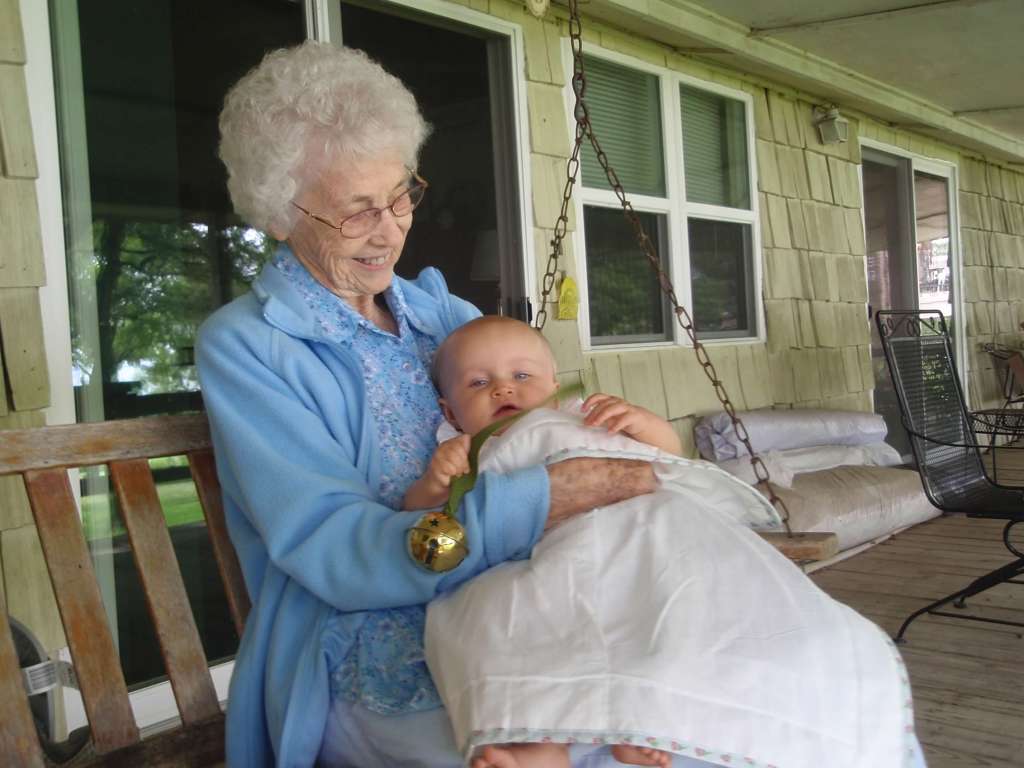
Grandma on the porch swing, holding my daughter Kayt.

Books I Read In 2021

Books By Favorite New Authors:

  • Bird by Bird: Some Instructions on Writing and Life, by Anne Lamott
  • Traveling Mercies: Some Thoughts on Faith, by Anne Lamott
  • Help, Thanks, Wow: The Three Essential Prayers, by Anne Lamott
  • The Whole Language: The Power of Extravagant Tenderness, by Gregory Boyle
  • Dusk, Night, Dawn: On Revival and Courage, by Anne Lamott

Two things changed my life in 2021: 1) the MUK LUKS® my mother-in-law gave me (my feet are the warmest they’ve been since leaving my mother’s womb), and 2) the book The Whole Language: The Power of Extravagant Tenderness, by Gregory Boyle. This book took God right out of the box I had Him in. It pushed me in the best way possible, away from the shallows into a deep, expansive God. It changed how I think about myself and the people around me. It made me laugh and cry. I copied line upon line into my journal:

“God meets our intensity of longing with intensity of longing.”

“We always need to abandon ‘performance’ when it comes to God, and walk instead into the arms of encounter.”

“God is only interested in lavishing us with extravagant tenderness, and yet we are convinced that God is thinking we all could just do a better job.”

“What saves us in the present moment is being anchored in love and tethered to a sustaining God who keeps reminding us of our unshakable goodness and the goodness of others.”

In addition to these legalism-defying snapshots of God, the book overflows with stories of the “homies” Father Boyle works with at Homeboy Industries. These stories of wounded people who wound others—but find themselves always in the good graces of God—paint the most ravishing picture of Jesus. This book gave me permission to say, “I couldn’t be any better,” instead of “I’m such a mess.”

Boyle has written two other books, one of which I’ve already read this year; the other is on my nightstand ready to be imbibed. He spoke at the university here where I live, and I met him afterward. This was long before I had read any of his books, but it still gives me bragging rights (wink).

Another author whom I read for the first time last year, and immediately fell in love with, is Anne Lamott. The first Lamott book I read was Bird by Bird: Some Instructions on Writing and Life. It was recommended by multiple friends, and when I finally read it I was hooked. “Good writing is about telling the truth,” she writes, and she is wildly honest. She is refreshing, funny, and deeply real. Special thanks to my sister for lending me several of her Lamott books to feed my addiction.

Fiction and Stories

  • Stormie, by Stormie Omartian
  • Kisses from Katie: A Story of Relentless Love and Redemption, by Katie Davis, with Beth Clark
  • The Bridge, by Karen Kingsbury
  • A Time to Mend, A Time to Gather, and A Time to Surrender (3 books), by Sally John & Gary Smalley
  • The Secret Garden, by F. Hodgson Burnett

I have read Stormie several times. It’s an easy read and a powerful story of God’s redemption in the aftermath of being raised by a mentally ill mom. Kisses from Katie is an unexpected tale of Jesus’ love in the life of a teenage girl who moved to Uganda and adopted 13 daughters.

If you like Christian fiction and haven’t read Karen Kingsbury, definitely give her a try. I’ve enjoyed dozens of her books. The series by Sally John and Gary Smalley was excellent as well.

I read The Secret Garden aloud to my husband—a fun way to revisit a classic. We’ve also read Tom Sawyer aloud together, and The Hobbit.

Parenting Books

  • How To Talk So Kids Will Listen & Listen So Kids Will Talk, by Adele Faber and Elaine Mazlish
  • Discipline That Connects With Your Child’s Heart: Building Faith, Wisdom, and Character in the Messes of Daily Life, by Jim and Lynne Jackson

Parenting is a tough subject to write about. As parents, we look for answers, but I think we know that no method is really an answer. I appreciated the respectful and emotionally intelligent approach of How To Talk So Kids Will Listen & Listen So Kids Will Talk, as well as the reflection questions and practice exercises.

Discipline That Connects With Your Child’s Heart is my favorite parenting book and the only one I have returned to multiple times. I always refer to it as “the book that sent me to counseling,” which is true. It has a number of suggestions for being safe with our children, such as taking a minute to calm down before responding to a stressful situation. One idea was to keep a small bottle of lotion in your pocket and take time to stop and rub lotion into your hands so you can emotionally re-center before engaging with your kid(s). I read that, and I knew I needed a month on a desert island to re-center… and that’s when it occurred to me that counseling might be in order. I was fortunate to find a counselor whose guidance was in sync with the Holy Spirit in my life. What a blessing that was during the most trying years of parenting preschoolers.

Religion and Self-Help Books

  • In the Realm of Hungry Ghosts: Close Encounters with Addiction, by Gabor Maté
  • The Ruthless Elimination of Hurry, by John Mark Comer
  • God Has a Name, by John Mark Comer
  • All Shall Be Well: Awakening to God’s Presence in His Messy, Abundant World, by Catherine McNiel
  • A Personal Perspective, by Sonya Lang Hackett
  • Love Lives Here: Finding What You Need in a World Telling You What You Want, by Maria Goff
  • Happiness Is a Serious Problem: A Human Nature Repair Manual, by Dennis Prager
  • The Lies We Believe about God: Knowing God for Who He Really Is, by Dr. Chris Thurman
  • The Meaning of Marriage: Facing the Complexities of Commitment with the Wisdom of God, by Timothy Keller with Kathy Keller

I’ve ordered these books from most favorite to least favorite. I won’t comment on all of them. First, let me say that I have received tremendous insight from Timothy Keller’s books and sermons, and I would recommend everything I’ve read or listened to, except this book on marriage. It was unbearably dry, and so long… it may be represented in one or two of my gray hairs.

John Mark Comer was my favorite new author last year and I enjoyed his books again this year. Catherine McNiel is another author I returned to, and would recommend, especially for young mothers.

At the top of the list is a book recommended by my friend Ruth. It’s a longer book (536 pages), but it was such a blessing. It gave me a much broader and more informed perspective on addiction. I enjoyed the stories more than the medical explanations, but both were helpful. Maté writes with authenticity and understanding. He was also featured in a documentary titled The Wisdom of Trauma, which has sparked an ongoing conversation about mental illness and addiction. I’ll close this post with a quote from Maté: “Trauma is not what happens to you. Trauma is what happens inside you, as a result of what happens to you.”

Cohabiting With God

I have spent much time at the frazzled edges of my life, floundering in feelings, confused, overwhelmed. Only recently have I become aware that I have a center: a place to come back to, where I always belong, and where my value is not hanging in the balance.

One day last November I settled in my prayer chair with a handful of stressful dreams still on my mind. I felt overwhelmed and tired, but I didn’t want to dwell on that and get bogged down. I sang quietly. Somehow I expressed a desire for companionship: I didn’t need to be happy, but to know I was not alone. And a very clear impression came to me of a simple bedroom in my heart, with Jesus in it. It was a small room, and Jesus sat on a single bed with a white bedspread. This verse came to mind: “Then Christ will make His home in your hearts as you trust in Him” (Ephesians 3:17a, NLT). And I just sat there and enjoyed His companionship for a while—I don’t know how long, maybe half an hour. We didn’t say much. Having typically felt the need to be talking —either in my head or out loud—when I sit with Jesus, this long stretch of quiet companionship was a new experience. It was lovely and life-giving, like sitting with your head on the shoulder of a loved one and just breathing in the quiet acceptance of that space.

This awareness of Jesus in me has captivated me with peaceful excitement. After that first impression I returned to the image of Jesus seated on His bed in my heart over and over. I realized there was a second bed on the wall facing Jesus’ bed, and that it was for me to rest in, or a place to sit and talk with Jesus. “Christ in me, the hope of glory” (Colossians 1:27).

Somehow in this brief moment—this mental image—Jesus went from being “out there” to being “in here.” This reminds me of an experience I had last fall when I was getting quiet in the mornings: I would take a moment to pay attention to what was in my very center, and find great peace there—as if God was in me and I simply needed to pay attention. This knowing that I am centered in the love and presence of Jesus is exhilarating. It has power (He has power) over the frantic and fearful state that has often been my identity.

It’s kind of like the eye of a storm, except that the calm center trumps the destruction around it. It is the Truth, and it has the final say. This is Jesus’ bedroom in my heart: a Presence that embodies tenderness; an open door; an extra bed for me to flop down on. Chaos and lies stop at the door, because Jesus emptied Himself (Philippians 2:7, ESV) to purchase this holy space for me. And even Chaos and Evil know that this Love is the greatest power in the universe. They respect Love’s jurisdiction. (James 2:19)

I am holy (Colossians 3:12, NIRV). This holy center, like the smooth innards of a chocolate truffle, is as pleasurable as it is satisfying. Every moment, I am gifted this opportunity to “taste and see that the Lord is good” (Psalm 34:8a); to know God as provider (Philippians 4:19), identity (1 Corinthians 2:16), and refuge (Psalm 46:1).

God who is Ever-Present, Emmanuel: this is miracle of miracles. From heaven, to earth, to the hearts of humans, this Love moves always toward us, desiring intimacy, inviting little us into the holy enormity of oneness (John 17:21). And so I come to know that I am not on the fringes, not on the outside waiting to be let in, but already inside. Holy. Whole. Free from the clutches of confusion and shame. Alive.

God’s life has literally taken up residence inside me (1 John 4:15, 16). Big God living in little me (Romans 8:11). I am His home address. And He is my riches (Ephesians 3:8), my fullness (Ephesians 3:19), my friend (John 15:15), sibling (Romans 8:29, NIV), and parent (2 Corinthians 6:18)—relating to me in every way possible because I am His prize (James 1:18, NLT), His pride and joy (Hebrews 12:2).

God’s life has literally taken up residence inside you. Big God living in little you. You are His home address. And He is your riches, your fullness, your friend, sibling, and parent—relating to you in every way possible because you are His prize, His pride and joy.

Photo by cottonbro from Pexels

Writing My Eulogy

I didn’t set out to write my own eulogy. It just happened one morning as I journaled: I want to go to Anthony Lakes today, but I think I’m running from something, hoping the lakes will sooth my spirit. I’m on edge, discontented, anxious. I could blame Michael’s excessive screen time or my premenstrual hormones, but no matter the cause I have to live with myself, and my family has to live with me.

At this point I paused, uncertain what to do with myself, uncomfortable with my pittance of emotional energy to face the day. Then my Counselor (Jesus) nudged me to write, Who am I? Another pause, and then these words: I am a loving mom, a devoted wife, a faithful friend, a humble (sometimes) follower of Jesus.

Hmm. What a strange re-route, from anxious and inadequate to “loving mom” and “devoted wife.” My un-counseled conclusion would have been: I am messed up and have some work to do. So this whole eulogy-writing business was definitely God’s idea. And, really, it’s just like Him to gently lift my thick blanket of not-enough and let in a little oxygen.

I exist in the mess that is my life, looking at it all from an uncomfortably close distance. My life probably looks good to people who don’t know me, and even to some who do. But from this distance (which is to say, no distance at all), the anger and complaining are hard to miss. I make a new mess while cleaning up the current one. I step in the yuck that is my hurry and worry, and I track it around. I feel piled high, like a sink lost under dirty dishes, and it’s hard to see anything else.

And yet, by some miracle, I believe those words I wrote: loving mom, devoted wife, faithful friend, sometimes-humble follower of Jesus. I am those things. Within these roles things get messy, but if I zoom out just a bit, I can see a baseline, something to come back to on those days when all I see is the proliferation of both literal and metaphorical dirt in my life.

The Counselor closed my journaling with these thoughts: Today doesn’t have to be a growth day. I don’t have to become a better wife, friend, mom, or follower of Jesus. I can be what I already am and it will be ok.

Empty and Ugly, Seen and Loved

Not long ago, on a Sunday, I was feeling not-good-enough and lifeless. The joy of holiday family time had morphed into a funk. I started the day feeling trapped in my role as wife and mom. The happiness of the household rested heavily on my shoulders, while my own happiness was quite uncertain. The day was slated to be a typical Sunday, trying to keep the kids on task for chores, getting ready for the week ahead, hopefully relaxing some.

My father-in-law had given us an Instant Pot for Christmas and we set out to hard boil eggs in it. Success! While the eggs cooled off in their ice bath I worked on a new puzzle (also a Christmas gift). Then my daughter Kyli and I returned to the kitchen to make deviled eggs. As we removed hard shells from rubbery eggs, my husband, Michael, shared a tip he had seen on YouTube about an easy way to peel hard-boiled eggs: roll them to crack the shell around the middle of the egg, and then slide the two ends of shell off the egg, easy-peasy. Well, I tried it and my egg started to break in half. I made an off-hand comment about how things never turn out the way it’s shown on YouTube, which triggered Michael (who was also already in a funk). He disappeared upstairs. This added to my distorted sense that I must be available to my family, take care of them, and keep them happy.

As I nagged our two young daughters about piano practice and showers and taking care of their pets, my stress level dialed up. My emotional capacity was insufficient for the girls’ interminable distractions and dragging feet. As the day wore on I felt more frustrated and inadequate. After lunch I retreated to my bedroom to be still and alone. I checked my phone and found a text discussion among our Monday moms’ prayer group, about day-after-Christmas goals. Someone sent this placard: “My two goals for today were to get out of bed and drink coffee. So far, I am a success.” There was a general agreement about the placard, a comment on the cold weather, and I plunged in with this: “I’m in a mood today. I feel worthless and angry. My kids are taking the entire day to take a bath and play their piano songs, and Michael is not impressed with my mood.” Within five minutes I had two offers to take my girls for the afternoon, multiple people praying for me, an invitation to a moms’ movie night, an offer to babysit later in the week, and many encouraging words. All I could do was cry. I went from feeling invisible to knowing I was seen and loved. It was cleansing. I didn’t know how life-sucked I felt until these women’s words gave me life.

I re-read their words. Chantel said, “Ah, I’m sorry Tobi. Can I bring you a coffee (or anything else to cheer you up)?” Tiffaney said, “So sorry Tobi! And just like that it starts dumping snow… like God saying, ‘I got this. I’m still here when you’re in a bad mood.’” Rufus said, “So glad that in all we face, our Father is in it with us and we are not alone, never abandoned! How amazing we are not valued by how we feel, but Who He is. Praying you through, sister.” After a good cry, I made plans to get coffee with Chantel, and Michael agreed to hang out with the kids at home.

Chantel picked me up and treated me to coffee at Roasters, then took me home to “say hello” to the family—her husband and seven kids, and the in-laws who were visiting. I stayed for two hours. Coryell (age 10) showed me most of the features of the camera she got for Christmas, and gave me a friendship necklace for my daughter Kayt. Bailey (age 6) showed me the mini piano keyboard she got for Christmas, and played tic tac toe with me. The youngest girls—Jessie and Marcy—requested hand sanitizer from my purse. Charlie (age 6) tried to solve a metal puzzle I had in my purse. Linda (the mother-in-law) served me homemade fruit cake with whipped topping. Jessie had giggle fits on Chantel’s back. Chantel shared a discussion she recently had about the shepherds telling everyone about Jesus, and how she thought of me as someone who does that kind of sharing. The kids laughed when I told them the reason I was at their house alone: “I’m in time-out from my family for being too grumpy.”

When it was time to go home, I realized that emptiness and inadequacy had given way to feeling rejuvenated and peaceful. And unknown to me at the time, Chantel’s husband Nic invited Michael to go to a movie at the theater that evening.

This is community, and it is sacred. Jesus ministered to me through all these friends.

As I reflect on that miraculous afternoon, I realize I experienced community in a new way. I have been blessed throughout my life to be part of a loving church community, and I have always been celebrated and supported. I was showered with gifts at my 8th grade homeschool graduation in the community where I grew up. Where I now live, there are always baby showers and meal deliveries, wedding showers, and birthday parties. All of these are, to me, “legitimate” reasons for being cared for or celebrated; having a crappy day is NOT legitimate.

I have a wonderful life, so when I have a depressed day (which happens often), I pile on lots of shame for not being happy in my great life. I do not feel worthy of support, because the reason I desire support seems unacceptable. Yes, of course new moms, or kids graduating from school, ought to be supported and celebrated. But me with my lousy attitude? Not worthy.

My friends called all this stinkin’ thinkin’ into question by showering me with compassion in the midst of my anger and grumpiness. Now I know what it’s like to feel supported—to live in community—as a fragile human being: one who is allowed to be burdened by life and be held up by someone else.

That’s God

Last evening my sister, my husband, and I attended a screening of the documentary Since I Been Down, which follows the lives of young men and boys from the Hilltop neighborhood in Tacoma, Washington, to prison. For more info, visit https://www.sinceibeendown.com. There’s also an excellent synopsis of the storyline here: https://www.imdb.com/title/tt14519366/?ref_=fn_al_tt_1. What follows is my musing after seeing the film.

When someone who has a 777-year prison sentence lives with purpose and hope, that’s God.

When a mother, whose innocent son was shot and killed, forgives—that’s God.

When tattooed men in a prison classroom understand justice as listening to the person next to them, that’s God.

When men who are quarantined from society, for life, choose to give of themselves to the people around them, that’s God.

When men of different races, from opposing gangs, covered with tattoos that censure each other, sit at the same table and joke together, that’s God.

When an older gang member slips $5 to a middle school gang member because he knows that kids’ parents aren’t putting food on the table, that’s God.

When a man who has been shown that he is worth nothing, finds that he is worth something, that’s God.

When fear and self-protection give way to curiosity, and then to the intimacy of shared humanity, that’s God.

When a grandmother forgives the mom who beat her three-year-old granddaughter to death, that’s God.

When a woman stands with the oppressed, and she voices that we are all perpetrators and we are all victims, that’s God.

When a lifer feels free for the brief moments he stands in front of his peers in a prison classroom, that’s God.

God was the Life in this film, though His name was never mentioned.

For where there is courage, compassion, and creativity, that’s God.

Where there is forgiveness, faithfulness, and friendship, that’s God.

Where there is hope, humility, and humor, that’s God.

In the movie It’s a Wonderful Life, George Bailey visits the richest man in town—Mr. Potter—and begs for help when he is at the end of his rope. After grilling George about his assets, and finding the only monetary asset he has is a $500 life insurance policy, Mr. Potter tells him, “You’re worth more dead than alive.” George Bailey stumbles from Mr. Potter’s office and finds his way to a bridge, where he would have ended his life, were it not for a tattered angel who showed him his worth without reference to money.

Many men and women have been told by those of us with money that they are worth more dead than alive.

When beauty and passion arise in a place where men are left for dead, that’s God.

God, who was tried, tortured, and killed, emerged from a guarded tomb, alive. And He stands with those who are tried, sentenced, locked away, and guarded, and—through them—shows us what it looks like to be alive.

Stillness (Part 3): Is God Trustworthy?

God says, “Be still, and know that I am God!” (Psalm 46:10a NLT). I wonder how “they” decide where to place exclamation points in scripture. This one startles me, like maybe God just shouted a little bit. It’s like He knows it takes an act of nature to shake me out of performing and perfecting.

Learning to be still with Jesus is an ongoing pursuit for me. For years my habitual quiet time in the morning was infused with a hurry/produce mentality. I focused my time around memorizing a chapter of the Bible or reading one chapter of a book each day. I would journal all my angst, problems, and frustration over my lack of control. Ever so slowly I have learned to be still in God’s presence. Learning to be without an agenda has often resulted in tears. For most of my life I didn’t know what it was like to be seen and loved. As I came to experience Jesus, I cried many tears: tears of joy over being loved for no reason, and tears of grief over releasing who I was striving to be. 

After a long season of either crying or feeling “blank” in my quiet times, I began to listen. I got really honest. I learned to take inventory of my heart. The thing about sitting with Jesus is that He doesn’t meet me where I wish I was; He meets me where I actually am.

I remember the day I was sitting in my “prayer chair” looking into the expansive greenness of a large tree near the window. I was thinking about trusting God, and realized that I could not pray, “I trust You today.” I didn’t trust God. I had no idea what He would ask me to do and I had no intention of handing Him my life to do with as He pleased. This was hard to admit. It’s kind of awkward when you’ve been a Christian for 30 years and realize you still think you’re a better god than God.

But I can’t manage trust the way I manage brushing my teeth. It doesn’t happen because I write it on my schedule. It happens when I get to know someone who’s trustworthy.

My honest reflection landed me here: I want to want to trust God. That’s two levels away from actually trusting, but it was a start: the beginning of “starting over” getting to know God. A year or two later a day came where I felt that God just might manage my day better than I could. Trust. Built on honesty, hard questions, arguments, and the discovery that God is emotional safety on steroids. Often I didn’t know my own heart, but Jesus brought it to the surface so we could engage with it together. At first this took a long time, but gradually it happened faster.  

Other things flowed into my quiet time as well. I began to enjoy praying for all kinds of people: family, friends, acquaintances, classmates, neighbors, strangers. I began to catch myself when I started to rant and have a pity party, and instead make a choice to say what I was thankful for, or to praise God for who He is, or to revisit a promise or a truth He had previously given me. Quiet time became a daily opportunity to be seen and loved, no matter what state I was in.

Then, because God is absurdly good to me (I am His favorite child), this practice of stillness filtered into other parts of my day. I began to experience more emotional safety in relationships, and I watched the clock less when spending time with people. God invited me to do daily tasks one at a time, relieving my exhausting mental multitasking. I began to seek stillness and allow tears or rest instead of pushing myself harder when tired. Fruits of the Spirit like patience—for which I had cajoled God for years—began to show up.

One week last fall was ridiculously busy. I was harvesting and processing garden produce, preparing for my daughter’s birthday, and putting together a chapel talk for my kids’ school, in addition to writing several hours more than usual. The kids got sent home from school one day because of a power outage, and I felt behind all week. As I watched myself go through the week I noticed unusual behaviors: I didn’t demand that my family be as busy as me. I didn’t get up early, stay up late, or skip meals to keep being productive. I didn’t make long lists and then freak out when I only finished half. I took short naps. I took time to be still in the mornings and evenings. I often engaged in the task I was doing without rehearsing the next five tasks in my mind. I was flexible when timelines or events changed.

I didn’t even know that was possible. 

I have a sneaking suspicion that God knew.

It was still a tough week, but there was a taste of grace. I was impatient sometimes. I complained about all I had to do. At times, I stilled my body but my mind and spirit didn’t follow suit. Yet there was a breeze of grace that has not often been present. There was a tendency to stop when I felt anxious or tired, instead of going faster. There was an acceptance of the times when stillness was a physical choice but mental rest didn’t follow.

One afternoon I started a fire in the outdoor fire pit, with great hopes of enjoying a deep breath in my spirit. I sat down with a blanket and a book. I started a poem about my tangled feelings. But I ended up more anxious than I began. Sometimes that’s how it goes. 

I bumble along, and God persistently shows up. I am humbled, and grateful to the point of tears, for all the moments that were redeemed by His grace that long week. The times when I helped my children instead of demanding they go faster. The times I snuggled with my husband instead of doing one more thing. Participating with my daughter in baking and party preparations. Time spent with friends. These were all gifts from a persistent God who shows me the beauty of stillness despite my adamance that going fast and doing more is a noble agenda which He ought to adopt with me. 

Stillness is an act of trust. Stillness is changing my life. 

Stillness (Part 2): Is God Crazy?

God has a knack for suggesting stillness when it sounds like the worst possible idea. Imagine the Israelites leaving behind hundreds of years of slavery in Egypt, and suddenly seeing the Egyptian army coming after them as they approach the Red Sea. Terrified, they declare they would rather go back to be slaves than die. Sounds logical to me. But Moses says, “Don’t be afraid. Just stand still and watch the Lord rescue you today. The Egyptians you see today will never be seen again. The Lord himself will fight for you. Just stay calm.” (Exodus 14:13,14 NLT) “Just stay calm”? Really, God? You’re just going to say that? Of all the times to stand still, this seems like the worst. 

On some level I can relate to the Israelites, being trapped between slavery and salvation. My brokenness—from which God has already delivered me in Christ—pursues and traps me. Fear and anxiety rush in and I am ready to run back to my slavery: impatience, control, and being right. I would rather perform than be set free. I am afraid of myself and the cavernous ugliness I have seen inside. When things are not turning out how I want, it sounds much safer to reach for control than to sit between the enemy and an unknown outcome. But sometimes that is exactly what I am invited to do. And sometimes watching and waiting is the catalyst for victory.

Last winter our marriage stepped off solid ground onto a suspension bridge. There was a bit of wobbling and a few moments where we held our breath. After one of many difficult conversations, I was left looking down at the chasm below and wondering if that’s where we were going to end up. As I prayed, I had a strong impression that I was to watch and wait—that God was on the move but I needed to be still. So I was. By God’s grace I didn’t dwell on painful words or unanswerable questions. I waited. When fear rolled in with a choking sensation and suggested that I fight or flee, I prayed aloud, reminding God what He had asked of me and asking for His help to continue watching and waiting. After several days I saw God’s handiwork, in the form of a handwritten letter from my husband. God fought the battle for me as I watched and waited.

When God is involved, stillness can be productive. Look at the moment of stillness in this story of Jesus going to Nain:

Now it happened… that [Jesus] went into a city called Nain… and when He came near the gate of the city, behold, a dead man was being carried out, the only son of his mother; and she was a widow. And a large crowd from the city was with her. When the Lord saw her, He had compassion on her and said to her, “Do not weep.” Then He came and touched the open coffin, and those who carried him stood still. And He said, “Young man, I say to you, arise.” So he who was dead sat up and began to speak. And He presented him to his mother. (Luke 7:11-15, NKJV)

Did you catch it? The pallbearers stand still. 

When something is dead—whether it be a dream, an opportunity, a relationship—we take the next logical step and bury it. And rightly so, for dead things left in the open begin to stink. But Jesus may be audacious enough to stop us on the way to the hole in the ground. I want to get the ordeal over with. But if I pay attention to Jesus, He may simply be asking me to pause. 

I realize when I look at these stories that it can be ill-advised to be logical with Jesus. He may ask me sometimes to stop and be still when I am taking what is the undeniably obvious next step. Am I willing to still myself and see what He is going to do?

There are times to take action, yes. There are also times to stand still. Permit me one more Bible story: Judah’s king, Jehoshaphat, is terrified by the approach of not one, but three armies. He fasts and prays, and orders his whole kingdom to do the same. In response, God’s Spirit comes upon a guy named Jahaziel, and this is what he says: “‘Listen, all you people of Judah and Jerusalem! Listen, King Jehoshaphat! This is what the Lord says: Do not be afraid! Don’t be discouraged by this mighty army, for the battle is not yours, but God’s… you will not even need to fight. Take your positions; then stand still and watch the Lord’s victory’” (2 Chronicles 20:15-17b, NLT, emphasis added). Sure enough, the enemies coming against Judah in battle kill each other, and Jehoshaphat’s army just watches. 

Isn’t that crazy? 

Is it possible that sometimes I miss what God is saying because I’m only listening for actions I can take? Maybe I give God multiple-choice, but His answer isn’t on the list. Doing nothing seems counterintuitive to problem solving. 

If we are parents, sometimes we have to tell our kids to wait: for cookies to cool, for glue to dry, for the day of the party to arrive. By the same token, we may be asked by Daddy God to wait when it seems obvious what the next step ought to be. The antidote for white-knuckled waiting—or rushing in headlong—is the slow building of trust, creating a safe space for stillness. As God shows His heart to us, we let His love soak deep into our bones so that we may trust Him, crazy though He may be.

blank

A couple things to check out: 1) this freeing song about stillness, by Hillary Scott. 2) my new Facebook page @jesusmyfavoritesubject. Love ya’ll. Thanks for reading.