Category Archives: Uncategorized

Stillness (Part 1): Scary or Safe?

Here’s what irritates me the most about Jesus: He is never in a hurry. Of course I don’t like to be hurried. But life is fast and full and I want people to jump when I say jump. God is not on board with this plan. This would have been me living with Jesus: “Twenty minutes until Sabbath, Jesus!” “It’s meal time.” “Jesus, You’ve been preaching for three hours.” I would have been the disciple reminding Jesus that the people were hungry and needed to go home (see Matthew 14:15). And, when He stopped to talk with a random lady on his way to a dying girl, I might have burst a blood vessel. (see Luke 8:41-49) 

As a child I was taught to keep moving and be productive. In my teens constant productivity made me somewhat of an oddity. I took summer courses in addition to working full time; I multitasked during movies; and I often carried a book with me to occupy myself should things start to drag. My first recollection of anyone pushing back on this trait was when I began dating. When I met my first (and last) boyfriend, Michael, I was taking a full university class load and working three part-time campus jobs totaling about 30 hours a week. Very soon after we began dating, Michael encouraged me to quit one of my jobs, which I did. He often challenged my hurried and productive lifestyle simply because he didn’t live that way. For example, I always walked fast; he couldn’t stand walking fast. Over time he taught me to “stroll,” as he liked to call it. This drove me nuts!

Often I have found slowing down produces anxiety in me. When I slow down I must face who I am. This can be debilitating. The truth is hard to swallow: I am not who I want to be and change is costly. Constant activity shields me from the awareness that I am scrambling for safety I don’t have—the kind of quiet safety that anchors my spirit. Hustling and productivity provide an escape. Being productive is a deeply ingrained habit, rewarded by my family of origin and my country’s culture. Slowing down requires engaging in the difficult process of renovating my beliefs about myself. While I may find all this terrifying, God is ready to roll up His sleeves and get to work.

If learning to be still began when I started dating Michael, it has now occupied half my life. I spent a decade learning to slow physically: to enjoy a relaxing stroll, to watch a movie and let it be the only activity, to sit and watch the birds. For the most part I have eased into this over time and am finding it comfortable.

Mental stillness has come at a much greater price. My first few years as a stay-at-home mom I managed to “perform” in my new role, as I had in all previous roles. I kept my babies fed and washed and responded to their cries. I cooked and cleaned and went to mommy groups. But shortly after my girls turned one and three years old, I began to struggle mentally and emotionally. The stillness of being home all day was a place of reflection in which all I could see were distortions and shadows. Compassion and hope were blotted out by fear of who I was and fear of getting things wrong. I would cry whenever someone said I was a good mom, because I desired it with every fiber of my being yet felt estranged from it. I pushed myself through each day because I felt if I stopped I would never get up again. I thought if I admitted I was lonely, discouraged and afraid, I would be swallowed up by those feelings.

I have often said the worst possible scenario for my mental health is to be alone in my own mind. Here I was, at home all day with these little people who no longer exhausted me to the point of survival mode, and I found that living with myself was the most painful thing I had ever endured. As a companion to myself, I was critical, short-tempered and punitive. I was so hard on myself that I lived in constant fear and decision-paralysis. God forbid I make a “wrong” choice about how to handle the hundred-and-one decisions I made about my children every day. I was, as they say, my own worst enemy. I was unable to cheer myself on, and instead found every reason to point out how I was not meeting expectations. I had never learned to be kind to myself. I could not let the waters still, to see my beautiful reflection clearly. I was quick to throw stones—to rend the image—because I identified with my brokenness more than my beauty.

One evening after a particularly difficult bedtime with my girls, I retreated to the recliner prepared to rehearse my awfulness and parade my ugliness before myself. Maybe enough shame would help me get my shit together (I’m not sure why I still believe that when it has yet to “work”). But God had other ideas. I felt Him embracing me, and I knew He was there not to talk about how to do better next time, but to hold me because He knew how much it hurt this time. I don’t understand why God is like this, but slowly I am learning to follow His lead. I am learning to embrace myself when I cause pain. And if I can embrace myself when I cause pain, then I can embrace others when they cause pain. I can invite them into this stillness, in which God’s holy presence holds all of us with tenderness. Stillness becomes a place of expanding kindness.

For six years now God has been loosening my corset little by little, teaching me to take up space, to breathe, until the corset is almost forgotten, and I am even invited to be plump and to enjoy it. I can be kind to myself. And when I am, it’s not so bad to be alone and still.

“I desire mercy”

Judge Not

I’ve memorized three fourths of the Sermon on the Mount, twice. In retrospect, I could have saved time and memorized two verses: “Judge not, that you be not judged. For with what judgement you judge, you will be judged; and with the measure you use, it will be measured back to you.”1 God’s Spirit has brought these verses to my mind hundreds of times (and none of the other 100+ verses). I think this means I have a propensity to judge.

To “judge not,” Jesus adds this: “And why do you look at the speck in your brother’s eye, but do not consider the plank in your own eye? Or how can you say to your brother, ‘Let me remove the speck from your eye’; and look, a plank is in your own eye? Hypocrite! First remove the plank from your own eye, and then you will see clearly to remove the speck from your brother’s eye.”2 In other words, start with my laundry list of brokenness. There’s approximately a 100% chance that I will not get all the planks out of my eyes before I die. “Let the one who has never sinned throw the first stone,”3 Jesus said. I may as well give away my rock collection. (On second thought, given my embarrassment over its magnitude, I’m heading out to secretly bury it in the back yard.)

The beauty of putting on gloves and taking hold of the plank in my own eye is this: when I work with God on my laundry list of brokenness I have a story to tell. It is a story of impatience, dishonesty, distrust, pride, blame, anger, fear, self-loathing, self-righteousness, and desperation on my side, and a story of faithfulness, strength, beauty, power, grace, companionship, desire and intimacy on His side. It is an improbable love story. It is a true story.

When was the last time you were inspired by someone telling you their opinion?

When was the last time you were inspired by someone telling you their story?

Getting on a soapbox rarely changes a life for the better. As much as I want to fix the world (or the person next to me) with what I know, I must bite my tongue – hard – and take my soapbox issues to God. Whether it’s a big issue (vaccination, LGBTQ rights) or a small issue (diet, clothing), I will heal myself and bless others by bringing all my opinions, knowledge, arrogance, anger, determination, self-righteousness, good will, and certainty and sitting with God in all of that. He sees through the things I’m hiding behind and He is the only one able to clean the dirt out of my filters. Chances are if I want to stand up tall and shout, that is my cue to sit down small and listen. And maybe while I’m listening I’ll notice more of what Jesus says to people (like me) who struggle with judgement.

You Would Not Have Condemned The Guiltless

Sometime after the Sermon on the Mount, Jesus is getting in trouble for socializing with low-lifes. The religious elite want to know why he would do such a thing?! Jesus told them, “Those who think they are healthy don’t recognize their need for a doctor, but those who know they are sick do recognize their need. Rather than critiquing others, your time would be better spent exploring what the Scripture means when it says, ‘I want mercy, not ritual sacrifice.’ For I haven’t come to call those who are right and healthy in heart and mind, but those who are sick and in need of restoration to God’s original ideal.”4 The Scripture Jesus quotes here is Hosea 6:6: “For I desire mercy and not sacrifice, and the knowledge of God more than burnt offerings.”5

Jesus quoted this verse a second time when the Pharisees lambasted Him for allowing His disciples to pluck grain and eat it on the Sabbath. He responded, “Have you not read what David did when he was hungry, he and those who were with him: how he entered the house of God and ate the showbread which was not lawful for him to eat, nor for those who were with him, but only for the priests? But if you had known what this means, ‘I desire mercy and not sacrifice,’ you would not have condemned the guiltless. For the Son of Man is Lord even of the Sabbath.”6

“If you had known what this means,” Jesus said, “you would not have condemned the guiltless.” Could I find a way out of my judgmental spirit by learning the meaning of Hosea 6:6? On a mission for answers, I hefted open Strong’s Exhaustive Concordance of the Bible and began looking up verses on mercy. One of the first verses was really sweet but became disturbing when I read the whole passage. This was rather deflating, so I moved on. I looked up the Hebrew word used here for mercy:

“checed kheh’-sed; kindness; by implication (towards God) piety: rarely (by opposition) reproof, or (subject.) beauty:–favour, good deed (-liness, -ness), kindly, (loving-)kindness, merciful (kindness), mercy, pity, reproach, wicked thing.”7

This was less than insightful. It goes from “kindness” to “wicked thing” in one breath (maybe two). At this point I gave up and called on my sister, who happens to have a doctoral degree in ancient near-eastern languages. I said I felt like someone vomited on me when I read this definition. She laughed. Then she proceeded to say that this word hesed usually refers to the covenant loyalty of God. Thank goodness for sisters.

The covenant loyalty of God actually means something to me. It means faithfulness. It means that God is in a relationship with humans, and when it turned out humans were grossly incapable of being in relationship with God, Jesus came to be the human-in-love-with-God that we had failed to be. In doing so, He gifted that relationship – brilliantly alive with love – to each of us. In other words, He is faithful to us, and – given the rigor mortis settling into our hearts – He is also faithful for us.

Now with some idea of the meaning of mercy, I moved on to examine sacrifice. I gave up on my concordance and googled the definition: “the offering of animal, plant, or human life or of some material possession to a deity, as in propitiation or homage.”8 God does not desire sacrifice, which means He does not desire appeasement, guilt gifts, lip service, or rote prayers. I get it. It would be both insulting and irritating (not to mention intimacy-killing) if my husband Michael related to me primarily with a posture of appeasement, gave me gifts (but didn’t listen) when he hurt my feelings, told people “I am lucky to be married to Tobi” in a superior tone as if I was a trophy, or repeated the same loving words to me every morning in a monotone while he got dressed. Um, no thanks.

Bold Compassion

Hosea 6:6 finishes like this: “I want you to know me more than I want burnt offerings.”9 In other words, God wants a relationship with you more than He wants you to behave well. Or, as I have said before, God wants me more than anything I can do for Him. When God says He desires mercy rather than sacrifice, He means we can sit down hard – like a nurse after a 12-hour shift – on His covenant faithfulness, His mercy (hesed). We sit in mercy rather than trying to be good. We allow situations and people (beginning with ourselves) to not always be above reproof.

Only after my heart is swallowed up in God’s heart, and God’s heart is somehow – miraculously – beating in mine, does it become safe for me to speak. And (much to my annoyance) a prerequisite for changing how I speak to others is changing how I speak to myself. By God’s grace I learn to be merciful to myself first. Mercy means meeting humanness with compassion. Not trying to stamp out all flaws and brokenness. Not demanding that everything be fixed right away.

As I receive God’s ridiculous, abundant mercy as eye drops to my plank-filled eyes, I begin to see more clearly. I look on others with compassion. I get curious about their stories. And when I am tempted to get on a soapbox, mercy asks whether I can be more interested in dying for what I believe than in killing others for what they believe. There are many shades of death to my desires, opinions, certainty. Am I willing to examine what needs to die in me rather than what needs to die in others?

Chances are, when I remember the planks in my eyes and the rocks buried in my back yard I will be humbled, and from a place of humility I will see others as companions both in brokenness and in being recipients of lavish, lifesaving mercy. I will come to know that others are worthy of friendship and storytelling, and that both my good behavior and my judgements are insulting. Let me say that again. People are worthy of friendship and storytelling, and our good behavior (sacrifice) is insulting.

Mercy is not the alternative to confrontation; it is the confrontation: the statement, the interaction. If I am not trying so hard (sacrificing myself) to be good, then neither will I expect others to sacrifice themselves to my standards. Instead, my own attitude of repentance and my story of restored vision prepare the way for others to repent and to see. This is where it gets good. This is where life and freedom pour into the world and we all shout with joy at the goodness of God.

Preparing The Way

These lyrics from Caedmon’s Call put it into the larger perspective of the redemption narrative:

The Word of the Lord came one evening
Concerning His bride’s great sin
He’d send down His Word to renew her
To prepare for the Bridegroom again
The Word said repent
From seeking vain glories
While the gifts in the Lord’s name you give
Repent of all the first stones cast to kill
While your own self-righteousness lives

Prepare ye the way for the Lord
Prepare ye the way for the kingdom10

Both John the Baptist and Jesus preached these words: Repent, for the kingdom of heaven is near.11 What is repentance? Repentance can include remorse, and saying “I’m sorry,” but that’s not all it is. Repentance is receiving new information and allowing it to change behavior. Repentance is also a postural change, a turning toward the great Teacher and away from the lies we have lived in. Repentance is releasing an old way and accepting a new one. Repentance happens all the time, in hundreds of moments, and will never stop until we die. It is a lifestyle, not a one-and-done step. And what’s astonishing is that repentance prepares the way for an explosion of life. Jesus did not come all the way down here to put a bandaid on us, and He did not go to hell and back on the cross to give us bragging rights about being good. He came to set us free and to make us alive, and we don’t even know what those words mean until we begin to explore them with Jesus.

The Truest Story

God is the greatest story-writer, hands-down. He is writing countless stories, and every one is a riveting tale of betrayal, mental illness, hopelessness and destruction, into which His mercy and compassion come, bearing gifts. He sees my propensity to judge, turned inward in self-loathing and outward in self-righteousness. He comes into my story as the counterpoint to every bit of ugly. There is nothing ugly in me for which He does not hold something beautiful to offer me in exchange. This love story is always worth telling, and it packs a punch no amount of opinion-touting ever could.

Jesus knows I want to be rescued even before I do. He’s ready with a message of mercy that rescues me from relating to myself and others with biting criticism. He gifts me His own life (yes, He is absolutely crazy), and gently refuses my filthy rags12 (“good” behavior). He scandalizes my good Christian life with the news that He desires mercy and not sacrifice. He invites me to abide with Him so I may speak to myself with compassion. He humbles me so I am more willing to die than to kill. He shows me the beauty of stories – both listening and telling.

Jesus confronts me with mercy and I am delivered to a posture of repentance. Repentance makes way for the Kingdom of Heaven.

I am a person who lived in a land of deep darkness, upon whom a great light has dawned.13 Are you with me?


Footnotes
1 New King James Version Bible. Matthew 7:1-2. https://www.biblegateway.com
2 New King James Version Bible. Matthew 7:3-5. https://www.biblegateway.com
3 see John 8:7, various translations
4 The Remedy paraphrase. Matthew 9:12-13. emphasis added
5 New King James Version Bible. Hosea 6:6. https://www.biblegateway.com
6 New King James Version Bible. Matthew 12:3-4,7-8. https://www.biblegateway.com. emphasis added
7 Strong, James. Strong’s New Exhaustive Concordance of the Bible. World Bible Publishers, Inc., 1986
8 https://www.dictionary.com/
9 New Living Translation Bible. Hosea 6:6b. https://www.biblegateway.com
10 Caedmon’s Call. “Prepare Ye the Way.” Long Line of Leavers. Essential, 2000. Transcript of lyrics
11 see Matthew 3:2 and 4:17, various translations
12 New International Version Bible. Isaiah 64:6. https://www.biblegateway.com. This verse reads: “All of us have become like one who is unclean, and all our righteous acts are like filthy rags; we all shrivel up like a leaf, and like the wind our sins sweep us away.”
13 see Isaiah 9:2, various translations

Photo by EKATERINA BOLOVTSOVA from Pexels


A Prayer

Lord, you are Creator. I am created. I am not worthy to be your child. But because you love me you chose to adopt me, at cost to yourself. I was behind enemy lines, and in your journey to rescue me, you perished. That was the one moment in history where hope seemed untenable. All we could see on the horizon was death. But to my astonishment, life returned to your body, and where you had passed through enemy fire there was now a path. The path was ablaze with life, in shuddering contrast to the darkness and death on either side, and you offered to walk across it with me. Others began to come, and as our numbers grew I noticed you could hold hands with not just two of us, but with all who came. Somehow each person who joined the walk had your hand to hold, and we passed from death to toward life, knowing we were walking on holy ground. And all the while as we walked I couldn’t stop thinking that you came to get me and you died on the way.

Photo by Gladson Xavier from Pexels

Prodigal

I feel like the prodigal son – shy, ashamed, and yet stumbling toward You because I know You are my only hope.

But You are running and embracing me.

You are certain of your feelings toward me.

You are celebrating me without examining me. Throwing a party before You assess my spiritual condition.

I turned toward you. That’s all. And You rejoiced. You pulled me into You and said I belong.

You honored me, not because I was honorable, but because you missed me.

Your greatest joy is to be with me, and to know that I am home with You – found and provided for, alive again.

Photo by Keira Burton from Pexels

Rest… Again

When I come to Jesus trying to fix things and in despair over my humanity, His response is usually the same: He invites me to rest. Always I want to do more, and always He invites me to do less. This has been a consistent pattern for years. It is hard for me to be still and know that He is God (Psalm 46:10). It is hard for me to be still and allow myself to be human.

Growing up in the faith tradition called Seventh-Day Adventism, a 24-hour seventh-day Sabbath is a central component of my faith story. This has its pros and cons. As a performance oriented person who has trouble sitting down and who feels uncomfortable when I’m “relaxing”, growing up with 24 hours of down-time built into my week was an incredible gift. With no effort on my part, I developed a habit that would have felt like sheer torture had I tried to develop it later in life. One of the cons of growing up in a religion centered around Sabbath is that resting on the seventh day can start to work its way up to the level of importance of Jesus’ death and resurrection. There was an unspoken idea (well, occasionally it was blurted right out) that I better not work on the Sabbath if I wanted to be saved. But while avoiding work on the Sabbath was a priority, no one actually talked about what rest looks like (or I wasn’t listening). So here I find myself, keeping a faith tradition of Sabbath that may be as old as time, but I can’t tell you what it means to rest in a Biblical sense. And yet… I am catching glimpses.

October – While reading a novel, I am surprised when tears spring to my eyes at the words of Ellie Whitcomb: “Today’s news is always tomorrow’s liner for the canary cage” (from the novella Engaging Father Christmas by Robin Jones Gunn). This soul-tiredness, this sense of deep responsibility, this desire to get life right – it weighs heavy on me. Knowing that today’s news is no longer news tomorrow is comforting. I take a deep breath. I learn that taking today less seriously might be the oxygen of rest.

October 17 – Lord, will You give me courage to feel sadness, and is it too much to ask to not get lost in it? “Take a deep soul breath,” You say, “You are seen and loved.” Maybe now is not the time to ask You to show me my sin as I was planning to do. Or perhaps this is my sin: trying hard instead of resting in You, and then disconnecting from everyone because trying so hard takes all my energy. I don’t know. I can see You with me all along – waking me up at the exact right moment, giving me the idea of supper by the fire when I was too tired to cook for Friday supper – and Michael suggesting a smoothie and making ramen noodles. You’ve been there in music and stillness and walking me through a lot of days without worrying about my to-do list. I just hate it when I feel like a liability instead of an asset. I want to be strong and good and positive and energetic all the time. I don’t like tired and sad and lonely. But as I sit here I am confident of Your presence in spite of my confusion. And I know You are teaching me that You are in the mess. Perhaps as You embrace me in my messiness I can learn to rest even in the mess. My heart doesn’t have to be vacuumed and dusted for You to be comfortable there. In a way You bring Your own cleanliness with You. And that’s a relief, because if You were waiting on me You’d never be able to move in. Thank You for quieting me with Your love. Sometimes rest comes in getting more comfortable with brokenness. It’s ok to not be ok. This too shall pass. I am called to a life of resting in God’s faithfulness, not a life of trying to be good (or energetic).

October 29 – I feel lost. Am I supposed to have a sense of purpose? What ties together parenting and wifeing and cleaning and texting friends and taking meals to people and being a church? My life feels so scattered. I feel scattered. I have a feeling that the purpose that ties all together is love… but that feels so ethereal, so not me. I’m still selfish and controlling and think the world revolves around me. What does it look like to claim my identity in Christ? He lived and died to accomplish something, right? Why do I still feel like I’m not getting it? God, what are you doing? Where are You at work and how do I join You? …You say I’m already joining You in Your work. You say my messiness is a distraction. And I say, How could it not be? It’s like someone screaming in my face while I’m trying to meditate. I know Your first goal is not to fix me… what do You want? I’ve got nothing, Lord. So whatever is my part better be easy or be something I’m doing already. “Rest,” You say. “Let your full weight down on Jesus. Breathe in His love. Let Him figure everything out. Release Every Single Thing to Jesus: R.E.S.T. in Jesus.” Release writing and reading, pictures and parenting, scheduling and holiday preparations, yard work and cooking, wifeing and friending, praying and sleeping, cleaning and to-do lists, caring for others and inviting them to Your kingdom, crocheting and quilting, applesauce and sweet relish, my emotions and my thoughts, my purpose and my heart, getting up in the morning. Sometimes rest comes in trust. I can take a deep breath and let God be perfect and faithful, not me. I can let go my strangle hold on all the things.

November 1 – When I read the Bible I learn that rest is not a state of mind I could somehow put myself in. It is a gift. “Come to me, all of you who are weary and carry heavy burdens, and I will give you rest,” Jesus said (Matthew 11:28). Maybe my next move toward Jesus is about doing less, not more. Come to think of it, hasn’t He been telling me that for a year? No, I think longer. I remember declining to help with Vacation Bible School as a turning point, summer of 2016; and the year of therapy in 2017. I don’t think it will ever stop, this untangling from lies. Rest comes in letting God be the “untangler” and letting myself be the “rester.”

December 4 – God has whispered stillness to me in this chorus (sung to the tune of Jesus Is The Answer): “Tobi’s not the answer for the world today. Above her there is Jesus, Jesus is the way.” It is humbling to realize how often and how deeply I want to be the answer. Not only do I want to live my perfect life, I want to help everyone around me live theirs. If they need money, I want to give it to them. If they need marital advice, I secretly hope God will give me perfect words to counsel them. If they need emotional support, I want them to join my small group. In my own life there is a continuous supply of situations that need to be fixed: the dirty house, the kids’ attitudes, the broken toys, the snafu with extended family… But when I remember Jesus is above me, I can take a deep breath. I learn that letting Someone else be in charge can be freeing.

January 7 – I soak in these words from Michael Card: “Trusting Him is no more than the simple awareness that He is holding you.” I learn that rest comes in trusting that I am held.

February – I am afraid of not being in control. Somewhere in the underpinnings of my psyche I believe that if I’m not in control of myself and the people around me, all is lost. There is a sense of catastrophe that squeezes at my chest in the everyday moments that are out of my control – schedules changing, kids in a yelling match, spilled paint and spilled milk, watching my husband react to the kids in a way I don’t think is helpful. I feel an awful mix of being overwhelmed and helpless. I fight by taking control, or flee by going deadpan. I’m afraid to engage, to show up. Parenting has a way of throwing this fear of losing control up in my face over, and over, and over again. These are the moments when it is hardest to take the deep breath God is offering. The Holy Spirit within reminds me: It’s ok when other people don’t do what I want. I don’t have to control. God is my provider and His resources never run out.

February 8 – At bedtime I realize I cannot possibly sleep in the state I’m in. I am anxious. My heart is heavy and it tells my body to hold on tight – to what, I’m not sure. I fetch my phone and begin listening to music, letting the tears flow. In music I find hope, I find permission to be broken. I meet the Spirit of God, holding me yet again. I begin to breathe. I listen to a song my sister shared with me over a cup of shared brokenness: You Can Do This Hard Thing, by Carrie Newcomer. The words give me permission to be sad, and in the sadness I find courage: “You can do this hard thing. You can do this hard thing. Its not easy I know, but I believe that it’s so. You can do this hard thing.”

So rest comes: in music, trust, better knowing who God is, loosening my grip, getting comfortable with brokenness, receiving the Gift, letting God be the One in control. Sometimes rest in body and spirit happen simultaneously, but often it is one without the other. I think God wants all of us to experience both – to enjoy quietness of mind and body; to enjoy both inner peace and physical stillness. I have never been good at either. But God is persistent – almost pesky – with His offering of rest. Thank you Father/Jesus/Spirit.

Photo by Ihsan Aditya from Pexels

What God Wants

Do you sometimes – or always – think God wants you to suffer? I do. It’s an odd mix of the “no pain, no gain” mentality, Biblical calls to perfection (anyone who looks at the mess I am and demands perfection must be in favor of suffering), and the growing realization that I experience life as suffering whether anything painful is happening to me or not.

There is much that could be said about pain and suffering, but today I would simply like to share a few moments in which God challenged my idea that He wants me to suffer. As I sat in morning quiet, these words came to mind, as if from God: “I want you to feel safe; be content; have everything you need. I will always be with you when things are hard and wrong, but that is not my desire for you.” As I pondered this, I thought about the way God shows Himself in the 23rd Psalm:

  • He lets me rest (or as the NKJV says, “He makes me to lie down” – this wording is a lot more accurate for me: Mrs. I-Must-Be-Productive)
  • He leads.
  • He restores.
  • He is with me when death or enemies threaten.
  • He comforts.
  • He honors.
  • He – living in me – leaves a wake of goodness and mercy behind me as I go through life.
  • He invites me to live in His home when I can live on this earth no longer.

If I think about suffering from a parenting perspective, I understand that watching with a heart of love while a child suffers is always painful. It may be that God “allows” suffering, or even “causes” suffering, but could it be that suffering is not His desire for me?

I like this perspective from my favorite parenting book: “…we administer consequences not with the belief that enough pain will lead to change, but knowing that learning the Father’s way can sometimes be painful.” (Discipline That Connects With Your Child’s Heart, pg. 36)

I believe God suffers for me and with me – never as One looking on, but always as One being broken alongside me. Could it be that as this togetherness sinks in I might experience life more like being led, restored, comforted, and honored, and less like suffering?

Books I Read in 2020

I still have some of my first book lists so just for fun I pulled them out as I was writing this post.

They are a testament to the organized person I used to be. Besides the title and author(s) of each book, the list also includes the number of pages, the month I read the book, whether it is fact or fiction, and where I acquired the book. In the year 2000 – the year I turned 15 – I read 80 books. In 2001 I read only 21 books, suggesting that homeschooling was a major factor in the number of books I read. I finished 10th grade at home and started attending a private Christian high school for 11th grade in 2001.

Interestingly, two authors I read in 2020 are prominently featured in my 2000 book list: C. S. Lewis (ten books), and Robin Jones Gunn (30 books). One book got the word BORING beside it. I still remember slogging through that one. Looking over my old book lists was a fun trip down memory lane, and I noticed the genres of my reading material are basically the same now as then.

I’m listing 27 books I read this year, and have divided them into four categories: fiction, books I read aloud to my daughters, theology/spirituality and personal growth, and miscellaneous. I have previously read seven of the 27 books, some of them multiple times (there is always more to glean from classics like Mere Christianity). I also have certain authors I’m enjoying in this season of life, and I like to read something by them each year: Brené Brown, Timothy Keller, Rachel Held Evans. I discovered John Mark Comer this year and plan to read all his books.

Fiction

  • Grace, by Shelley Shepard Gray
  • Moonlight On The Millpond, by Lori Wick
  • A Time to Dance and A Time to Embrace, by Karen Kingsbury 
  • Finding Father Christmas, by Robin Jones Gunn
  • Engaging Father Christmas, by Robin Jones Gunn

I admit my fiction list is extremely narrow and uninteresting. All the titles are Christian romance novels. Robin Jones Gunn is my favorite fiction author, and I often re-read her Glenbrooke Series. This Christmas I signed up for the Hallmark Now 7-day free trial so I could watch the three movies based on the Father Christmas stories.

I tried to read the Anne of Green Gables series again this year, but I got bogged down. I’m not sure what that was about. I loved those books when I read them as a teen, and if I remember correctly I read them multiple times. Perhaps being mother to a talkative eight year old causes me to have an aversion to a character who talks continuously. Ha!

Books I Read Aloud To My Daughters

  • Dr. Rabbit, by Eric B. Hare
  • Love Does for Kids, by Bob Goff and Lindsey Goff Viducich
  • Born Free, by Joy Adamson 
  • Living Free, by Joy Adamson
  • The Seven Secrets of Somewhere Lake, by Sam Campbell
  • Soul Surfer, by Bethany Hamilton (with Sheryl Berk and Rick Bundschuh)

Other than Love Does for Kids, all these books were re-reads. My daughters (ages 6 and 8) especially enjoyed the Joy Adamson books, which tell the story of lioness cub Elsa, and the author’s continued friendship with her as Elsa became an adult lion and was released to the wild. According to wikipedia.org, Born Free spent 13 weeks at the top of the New York Times bestseller list when it was published in 1960. I had not read these books since I was a teen, and it was fun to revisit the story with my daughters.

Another favorite author from my childhood that I am now sharing with my children is Sam Campbell. During the spring COVID quarantine Your Story Hour posted read-alouds on YouTube for the book Loony Coon, and my girls ate up every minute of it. They were also fully engaged in the funny and heartwarming story The Seven Secrets of Somewhere Lake. If you’ve not read Campbell before, don’t start with a philosophical read like How’s Inky. Try Loony Coon or Eeny, Meeny, Miney, Mo… and Still – Mo: Lessons in Living From Five Frisky Red Squirrels.

Soul Surfer was the middle step in a three-step experience of learning Bethany Hamilton’s story. First we watched the documentary Bethany Hamilton: Unstoppable. Then we read the book. Last we watched the 2011 movie Soul Surfer. Besides enjoying the story, this was also a great way to look at how nonfiction is often woven with fiction for storytelling purposes such as a movie.

Theology/Spirituality and Personal Growth

  • I Thought It Was Just Me (But It Isn’t): Making the Journey from “What Will People Think?” to “I Am Enough,” by Brené Brown 
  • Mere Christianity, by C.S. Lewis (reread)
  • The Reason for God: Belief in an Age of Skepticism, by Timothy Keller (audio book)
  • To Hell With The Hustle, by Jefferson Bethke
  • Long Days of Small Things: Motherhood as a Spiritual Discipline, by Catherine McNiel
  • The Ruthless Elimination of Hurry, by John Mark Comer
  • Living Loved: Recognizing and Responding to God, by Laurice Shafer (reread)
  • The Road Back to You: An Enneagram Journey to Self-Discovery, by Ian Morgan Cron and Suzanne Stabile
  • A Year of Biblical Womanhood: How a Liberated Woman Found Herself Sitting on Her Roof, Covering Her Head, and Calling Her Husband “Master,” by Rachel Held Evans
  • The God-Shaped Heart: How Correctly Understanding God’s Love Transforms Us, by Timothy Jennings
  • The Sonship of Christ, by Ty Gibson 
  • Garden City: Work, Rest, and the Art of Being Human, by John Mark Comer

For me this genre always clocks the most reading hours. My favorite of all the books I read this year was The Ruthless Elimination of Hurry by John Mark Comer. I don’t entirely understand why, but that book was water to my soul. I drank it up, I sank into its cool depths, I was inspired and refreshed and given permission to breath.

Long Days of Small Things: Motherhood as a Spiritual Discipline is a book I wish I had read every year since my first daughter came along (a tall order considering it was not yet published). The gift it gave me was the realization that the tasks of mothering are acts of worship. It reframed the daily grind in a way that gave me permission to breath a little deeper. I recommend it to anyone with a baby or young child(ren).

Miscellaneous

  • The Boy Who Harnessed the Wind: Creating Currents of Electricity and Hope, by William Kamkwamba and Bryan Mealer
  • No Shortcuts to the Top: Climbing the World’s 14 Highest Peaks, by Ed Viesturs with David Roberts
  • Seriously…I’m Kidding, by Ellen DeGeneres
  • Rebel With A Cause: Finally Comfortable being Graham, by Franklin Graham

The Boy Who Harnessed the Wind opened my eyes to another person’s world, and that is what I loved most about it. The Ellen DeGeneres book was purely entertainment. The other two stories were fun and interesting reads about men who have an almost insatiable thirst for adventure, and a high tolerance for risk. Since I’m at the opposite end of that spectrum, reading is the ideal way for me to share their experiences.

That’s all, folks. I’d love to hear about what you read in 2020, or what’s at the top of your list for reading in 2021.

Photo by Taryn Elliott from Pexels

God Room

I’m reading Franklin Graham’s book, Rebel With A Cause. In it there is a chapter titled “God Room,” in which Graham describes some of his experiences with Bob Pierce, and what Pierce taught him about God room. Here’s how he describes it.

“What do you mean?” I asked him once when he started talking about “God room.” He gave me a glance that was close to disgust, almost as if to say, “Don’t you know?” He took a deep breath and sighed before he said, “‘God room’ is when you see a need and it’s bigger than your human abilities to meet it. But you accept the challenge. You trust God to bring in the finances and the materials to meet that need.

“You get together with your staff, your prayer partners, and supporters, and you pray. But after all is said and done, you only raise a portion of the resources required.

“Then you begin to watch God work. Before you know it, the need is met. At the same time, you understand you didn’t do it. God did it. You allowed Him room to work.”

Franklin Graham, Rebel With A Cause

Graham’s book is full of “God room” stories – for hospitals in war-torn countries, refugees in crisis, remote populations unreached by the gospel, and ministries in developed countries. As he described this principal of how God works, it resonated with me. After all, isn’t there always a gap between finite humans and infinite God? And isn’t that gap where God does His best work? Isn’t that gap where Jesus is?

As I pondered “God room,” I thought perhaps a project I’m involved with for a local ministry would be a good place to put it to the test, so to speak. But on God’s prompting I realized my character is where “God room” is happening in my life. Certainly if ever there was a gap between resources and the desired outcome, this is it! The more I become acquainted with God’s kingdom of love, the more I see my brokenness and my deeply fearful and selfish condition. And the wider the gap appears between me and the way God describes Himself and His people.

I have wanted so badly for God to tell me up front what He’ll do in my character. I have given up on being loving and humble and gracious because it is SO FAR from reality. But now I think, maybe God allows me to see the dire condition of my character as an invitation to step into God room.

To become a Christian – to follow and believe Christ – is a bold move. As a Christian I make claims about who I am that seem completely unfounded in reality. I say I am a new creation, an actual child of God Himself, a chosen one. Sometimes when I hear these old sayings with new ears I realize just how wild and crazy that is. And I see how far my character is from God’s kingdom of love.

But God, with His glorious, unlimited resources, empowers me with inner strength through His Spirit, to trust Him, and to experience His love, which makes me complete! (see Ephesians 3:14-21) This is God working, in His “God room.”

When I think of all this, I fall to my knees and pray to the Father, the Creator of everything in heaven and on earth. I pray that from his glorious, unlimited resources he will empower you with inner strength through his Spirit. Then Christ will make his home in your hearts as you trust in him. Your roots will grow down into God’s love and keep you strong. And may you have the power to understand, as all God’s people should, how wide, how long, how high, and how deep his love is. May you experience the love of Christ, though it is too great to understand fully. Then you will be made complete with all the fullness of life and power that comes from God. Now all glory to God, who is able, through his mighty power at work within us, to accomplish infinitely more than we might ask or think. Glory to him in the church and in Christ Jesus through all generations forever and ever! Amen.

Ephesians 3:14-21, New Living Translation

I can live in the human room, or I can live in “God room.” Only by God’s grace can I move into God’s room, and He decides what and how to provide. Graham said Pierce had a terrible temper that never went away. I don’t get to decide which rough edges God will smooth in my character.

God, the more I know You, the more I am ok with You deciding what happens in the God room. (Of course God decides! It’s His room). I am content just being there with You. What an intoxicating combination of peace and power, gentleness and glory, and intimacy between infinitely different beings. Only with God could safety and wildness coexist so richly.

Graham said Pierce reminded him of these words of Jesus: “The wind blows wherever it wants. Just as you can hear the wind but can’t tell where it comes from or where it is going, so you can’t explain how people are born of the Spirit.” (John 3:8, NLT)

I have spent so much time trying to get what I want, when God is working somewhere else. This is spitting into the wind. I don’t want to spit into the wind, I want to move with the Wind. And last I checked there is a mighty gale and simultaneously a gentle breeze blowing in this mysterious place of belonging I now call “God room.”

Photo by Guy Kawasaki from Pexels

Fixing or Loving

When I was a child, there was a reason for everything. If a neighbor died of cancer or had a heart attack, it was because of their diet and lifestyle. If a marriage fell apart it was because of this or that decision or pattern, or something they didn’t do that they should have. If a friend got hurt, it was because they took an unwise risk. If a church member’s kids didn’t turn out, it was a direct result of bad parenting. Instead of being broken with the broken, we labeled them. I grew up believing the lie that if others – if I – make the right choices things will turn out well.

Not just big things, but little things too: if I didn’t sleep well, it must have been something I ate. If I didn’t respond well, it was because you provoked me. If I forgot to take something to the post office, it was because you didn’t put it by the back door where I would see it. If I broke something, it was because I wasn’t being careful enough. If I had a hard time emotionally it was because I wasn’t controlling myself enough. Every problem had either a solution or someone/something to blame. As an adult I fight the truth and am simultaneously freed by it: problems are normal.

If I believe that all problems are fixable, then a loving, all-powerful God is the best thing since sliced bread! Bring some of that loving power over here and fix this! Fix that! I can pray for my problems, I can even pray for your problems. This could be amazing! Feeling anxious? There’s a verse for that. Having marriage problems? There’s a prayer book for that. Having doubts? There’s a reason for everything. Experiencing mental health problems? Get your whole church to pray.

There’s only one problem: God’s presence doesn’t actually fix everything (yet). And believing it does makes me a villain, both to myself and others. I sit in judgement over myself, always a finger pointing that I must not be trusting enough, praying enough, believing enough. And I point that same finger at everyone around me. And sometimes, when prayer or believing doesn’t “work”, I point my finger at God.

As a result of a recent season of questioning God’s character, I decided to start reading the New Testament in a paraphrase I’m less familiar with (to avoid hearing all the voices of my childhood), asking the Holy Spirit to be my Teacher. And so I begin in Matthew 1:1 with these words: “Jesus Christ was a descendant…” Despite having read the genealogy in Matthew many times, I had always thought of Jesus’ coming as an insertion. He’s up there, we’re down here, and He came and inserted himself into our world. But Matthew says He descended: he came from humans. He had human parents and grandparents and great grandparents, and so on, all the way back to Adam and Eve. So human. So humble. God descending from man, part of a human family just like today’s broken families (with a little barbarism thrown in).

Jesus entered this world among whispers about premarital sex. Then his parents were forced to travel at the time when most mothers are nesting and travel plans are on hold. They didn’t get to bring him home to the nursery they had been preparing, but brought Him into the world in an over-crowded city away from home. And before they had a chance to return home and settle down, they were woken in the middle of the night with the adrenaline-pumping, terrifying news that the governor was planning to kill their baby and they must flee. No time to think, throwing things in bags, running out the door, traveling under the stars and hoping not to be detected by soldiers. Or acquaintances who might betray them.

When they arrived in another country they settled down. Foreign language, foreign customs. How to make a living? Make friends? Be a proper Jew without the support of a loving community? It occurs to me that Jesus’ childhood was more broken than my own. Rumors. Running. Fear. Fugitive. Less adorable than Christmas plays, and more messy and dramatic.

When the governor back home realized he had no way to find Jesus and kill Him, “he was furious and ordered all the boys in Bethlehem and its vicinity, under two years of age, to be killed.” (Matthew 2:16) Jesus, being God Himself, and therefore perfectly in God’s will, did not experience life as neat and tidy and peaceful. As I finish the first two chapters of Matthew, I realize I have discovered something: drama and messiness are not a counter-indication of God’s presence. In some cases, they are the direct result of His presence.

Life is messy. I’m a mess. You’re a mess. At some point we’re ALL going to have to face cancer, divorce, mental health issues, financial ruin, trauma, death. If it’s not you or me, it’s our parents or siblings or friends or coworkers or church members. If I believe God’s first move is to fix the mess, then the only way forward is frustration. Either I’m frustrated God isn’t doing his part, or frustrated I’m not doing my part. Something isn’t working. To always believe there is something wrong with me is to perpetuate imprisonment. To always believe there is something wrong with you is to perpetuate separateness. Judgement.

Yes, God is perfect, but when we don’t look for Him in the mess, we miss Him. Your life being messy – my life being messy – doesn’t mean God is not present. God is present in the brokenness. He would rather compromise His own reputation than keep His distance in heaven, and He is here getting messy with us. I don’t know how all this works, but I know that God meets me in the moments when I hurt people around me, disappoint myself, and slog through the unexpected messes of life. Love does not always fix, but love is present. Perhaps if I get more comfortable with the things I don’t like in life, like the grinch my heart will grow three sizes.

Photo by Netaly Reshef from Pexels

75 Memories of Daddy

My dad turned 75 years old on August 25. Recently we’ve had the opportunity to reminisce, looking through old photos and hearing stories of the nearly 40 years he lived before I came on the scene. School was never his place to shine, and thus yields some of the best stories. He distinctly remembers one teacher – Donald Lamb – and a day his boredom got the better of him. As Mr. Lamb wrote on the chalk board, he made a noise in his throat, but he stopped whenever the teacher turned around. He kept quiet when Mr. Lamb asked who was making the noise, but it seems Mr. Lamb had a pretty accurate sense of aural direction, because at recess he came and stood by my dad for a long time with his arms folded. He didn’t say anything, but they both knew what it was about.

In high school my dad sported a ducktail hair style, held in place with Butch Wax, which melted and dripped down his back on hot days. High school was not a pleasant experience for him – as he puts it, “I wouldn’t go to my high school reunion if I lived across the street.” College didn’t fare much better. My favorite of his college stories is from singing class (he was majoring in music). While his classmates all chose to sing classical pieces, he showcased his southern roots by singing “I’ve Been Everywhere” by Johnny Cash.

A talented classical guitarist, Daddy made a living playing in restaurants and resorts and teaching lessons. For the most part he lived alone and subsisted on freezer meals, which is impossible for me to imagine because he has been a passionate advocate of healthy eating ever since I can remember. Then one fine day my mother showed up for a guitar lesson at a music shop in Santa Barbara, CA, and her teacher became her husband. A few years later I came along. In honor of my dad’s 75th birthday I wrote down 75 of my memories of him. I remember him:

  1. Playing the guitar in the overstuffed chair, with me curled up in the corner behind him
  2. Prodding my stomach with his fingers toward the end of a meal to see if I was full or “had more room” and could eat more
  3. Making milk toast – a delightful combination of honey and milk and crispy and soggy bread
  4. Playing his guitar on the riverbank
  5. Sneezing so loud we could hear him from anywhere on our property of several acres
  6. Feeding the dog every night – a combination of dry dog food, water, fruit and veggie scraps, and the leftover pulp from making vegetable juice
  7. Playing the guitar in his office, long after I went to bed
  8. Apologizing for hitting me (the only time he ever hit me)
  9. Apologizing for getting angry and shouting a curse word (also the only time I ever recall him doing that)
  10. Teaching me to drive – in the old truck, the van, and the family car
  11. Working with me one summer at a peach and nectarine orchard, when I was only fifteen and couldn’t drive there on my own
  12. Playing “You Are My Sunshine” on the piano
  13. Showing my sister and I how to use his fancy rubber band gun
  14. Enjoying music – especially Elvis Presley and Bob Dylan
  15. Standing at the sink with a glass of water, trying to lessen the pain of recurring acid reflux
  16. Standing in front of the wood-burning stove doing the “Sun Exercise”
  17. Watching old comedies – The Shakiest Gun In The West with Don Knotts, the Andy Griffith Show and the Amos and Andy Show
  18. Fishing on the riverbank, and occasionally bringing home one or more salmon or steelhead, gutting them, and baking, smoking or canning the meat
  19. Making scrambled eggs and shredding beef jerky on top
  20. Asking me if I needed to go #1 or #2 and his incredulity when I didn’t know which I needed to go
  21. On long trips, stopping the van on the side of the road and standing “behind” the open car door to pee
  22. Cracking a whip – and cracking seaweed at the beach like a whip
  23. Teaching me to play the guitar
  24. Pruning fruit trees
  25. Playing the guitar on stage
  26. Saving the best food for company
  27. Buying fudge
  28. Coming home from town with a Hershey’s Milk Chocolate Almond Bar wrapper on the car dash (evidence that he didn’t ALWAYS eat healthy)
  29. Removing boards from the front porch to get our dog and her newborn puppies out from under the back of the porch
  30. “Strongly encouraging” my sister and I to sing for old people (whom he always made a point of visiting)
  31. Dressing up in a suit and tie to play sacred music concerts
  32. Deriving immense pleasure from people watching
  33. Telling about how he got to touch Elvis Presley’s hair at one of the Elvis concerts he went to
  34. Memorizing scripture – especially Proverbs
  35. Reading Turkey Trott at Christmas – the only time he ever read a children’s book to my sister and me
  36. Telling me not to say “crud” because it’s like saying “crap”
  37. Teaching me to play checkers
  38. Putting peanut butter on an apple peel, giving it to the dog, and laughing until he cried while the dog tried to lick it off the roof of her mouth
  39. Giving tight hugs
  40. Teaching me how to use tools – hammer, level, pruning shears
  41. Appreciating beauty – in nature, in music, in art
  42. Listening to NPR and “Car Talk”
  43. Shocking me when he came out of the bedroom with his beard shaved off when I was very little
  44. Driving like a maniac down Tiller Trail Highway to make it to the post office before the mail went out for the day
  45. Buying soft serve for the family at am/pm gas stations
  46. Carrying pincher bugs out of the house instead of squishing them
  47. Waxing the car
  48. Buying overripe bananas in bulk (to freeze for smoothies)
  49. Going down to the creek to hook up the water pump
  50. Taking us bike shopping
  51. Going for bike rides on Shoreline Trail at Lost Creek Lake
  52. Telling stories: about falling asleep on his motorcycle, the turtle that peed on him, the laundry soap commercial
  53. Making a “confession of faith” in front of our church family to become a member (he had been baptized into a different denomination when he was young)
  54. Standing in the doorway of our bedroom and saying “Good night” in unison with my mom
  55. Carrying us to bed on his “horse back” when we were little
  56. Teaching me to paint, clean gutters, sort produce, plant seeds, thin and pick fruit, crack walnuts, tend a burning brush pile
  57. Recording for me an album of songs I wrote
  58. Reading from his overflowing “reading stand” at meals – health newsletters, newspapers, personal letters, religious newsletters or sermons, even advertisements
  59. Giving the dog corn on the cob
  60. Putting his hand on my head and saying “This is Tobi” when I was four years old and getting ready to sing “My God Is So Great” with my sister in his sacred guitar concerts
  61. Working in the yard early, working in the yard late: I remember waking up on summer mornings to the sound of him outside running sprinklers to water the lawn and garden
  62. Unapologetically sharing his opinions about what other people ate, and how they spent their money
  63. Stripping my sister and me down to brush the sand off from head to toe before we could get in the van after an afternoon at beach
  64. Working random jobs in our tiny community – sorting wood at Thunderbird Furniture, being a guard at the temporary camp set up for firefighters responding to forest fires, driving the delivery truck for a local greenhouse
  65. Cutting Charlie Brown Christmas trees on our property
  66. Dressing up as Santa for Christmas once or twice when I was little
  67. Posing everyone for pictures – especially with home grown food, or flowers/landscapes
  68. Cleaning the chimney, which made the most AWFUL noises in the house
  69. Taking a shower in the front yard with the solar shower he built
  70. Saying with complete sincerity that my mom still had the body of a 16 year old when she was in her 50’s
  71. Letting go of my hand when I was pulling him with the whole weight of my body, and then teaching me to put one leg back so I wouldn’t fall when he let go
  72. Watching TV at my grandparents’ houses and in hotels (we didn’t have one at home)
  73. Playing his guitar in the car
  74. Wearing goggles while cutting onions to settle a disagreement with my mom about what exactly causes a person’s eyes to water
  75. Leaving church during the closing hymn so he wouldn’t have to talk to anyone

Thank you, Daddy, for being the brave man in a family of women (me, my mom, and my older sister), for not being afraid to have questions about life, for showing up every day no matter how hard it was, for laughing until you cried, for loving music, and for giving me these memories.

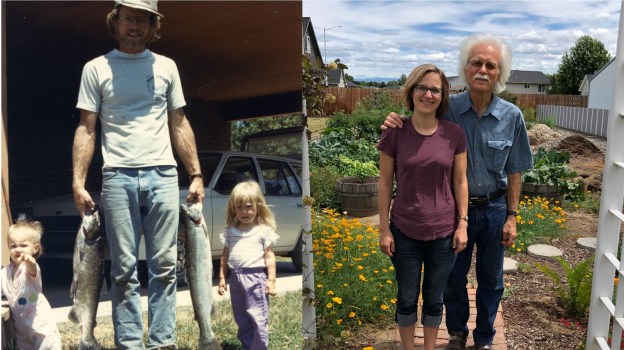
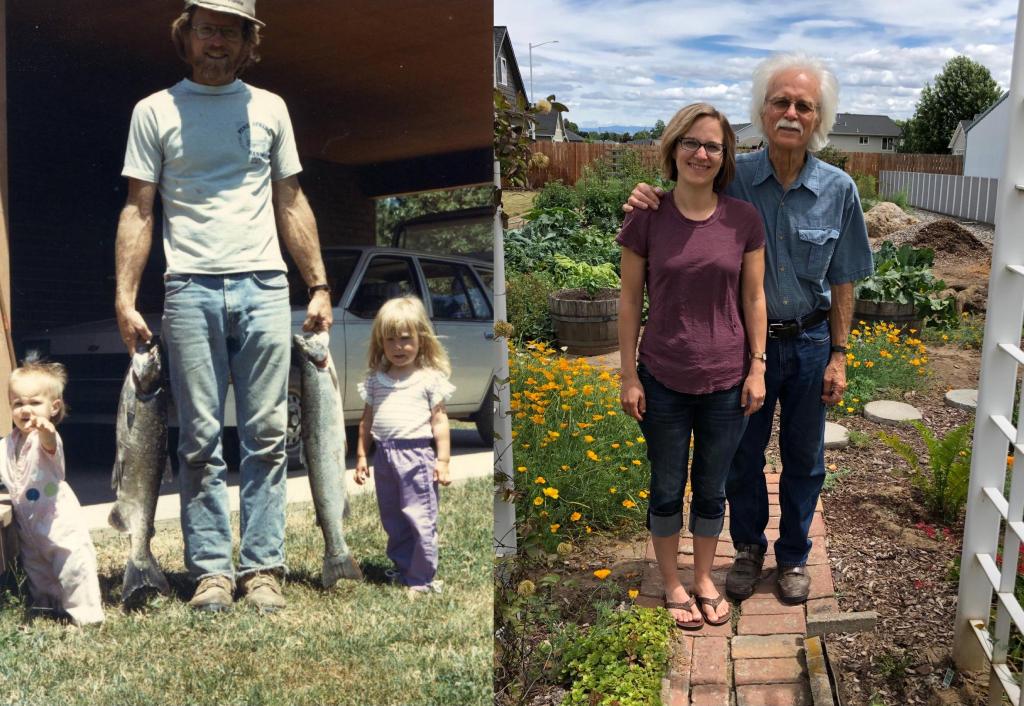
The pictures don’t show up very well in the header, so here they are again. I’m on the left in both photos – 1986 and 2020.