Tag Archives: cats

Big Joy

We returned a few days ago from vacation, and our upstairs cat, Phiona, seems particularly delighted to find me at my desk this morning. She jumps on my lap and leans into me. I put an arm around her and she settles down with loud purrs. I am charmed, as always, by her beauty and aliveness.

Other people’s cats—like other people’s kids—often look a little strange to me. I notice their proportions more than their personality, and nearly always conclude that my cat (or kid) is better. While I’m not proud of this, I’ve come to believe it’s a natural response to relationship. It is because I have a relationship with Phiona that I experience pleasure by looking at her, belonging when she flops across my feet for a nap, and joy when we play with the plastic bug my daughter tied to a piece of yarn.

“Joy is always relational,” write Marcus Warner and Chris Coursey in their book The 4 Habits of Joy-Filled People (p. 35). It’s a strong statement, but let’s play along and assume that joy is always relational. Put another way, joy comes from “knowing that someone is happy to see me” (p. 33). Is despair, then, the feeling that not a person in the world would be happy to see me? Is bitterness always relational too? Talk to a bitter person and you’ll get an earful about what they have or haven’t received at the hand of their dad, boss, roommate, kids, and church.

I wonder what joy looked liked for Jesus. Assuming He had an abundant supply from His relationship within the Trinity, would He also experience joy when people were happy to see Him? Imagine rounding the aisle at the grocery store, seeing Jesus, and spontaneously breaking into a joyful wave-and-smile. Does my joy produce joy in Him? It’s hard to imagine God coming away from an encounter with me feeling different than He felt before the encounter. And yet, if joy is always relational, then joy is the currency of divine-human interaction, and I’m inclined to believe this is not a one-way street.

Was Jesus’ greatest agony the (perceived) loss of all relationship on the cross? He asked his Father, “Why have You left me?” Stripped of relationship, what sustained Him? Dare I wonder if His relationship with Himself played a role? My inner critic says that question is sacrilegious. Relationship with self is so secular it’s scandalous. Love for us is what sustained Jesus.

But wasn’t that love for us something He found deep in His own self? Certainly He didn’t sacrifice Himself in loathing, as we are apt to do. He didn’t conclude that life wasn’t worth living. He must have valued life and held a deep regard—a love—for His own life, even as He parted with it. Perhaps it is in the safety of loving ones own self that a person finds strength to face death. After all, I will experience death alone, no matter how many people may be in the room. If I haven’t found peace in my own company, how can I receive death?

Sometimes I wonder what would happen to me if I existed only in relationship to God and to myself. How might I survive if war or disaster stripped human-to-human relationship from me? My guess is I would spend much of my time remembering the relationships of the past and desiring relationship in the future. It is human nature to visit a graveside and talk to a lost loved one, because even in the sorrow of death, we derive joy from that relationship.

I suppose it’s silly to spend time and energy considering lack of relationship, when the world I inhabit is drenched in relationship. And, truth be told, the joy of relationship finds expression in those who love themselves and those who don’t, those who fear death and those who don’t. Some folks are alone but not lonely, while others are lonely but not alone. It is in this complexity that God literally shows up everywhere. He’s not constrained to relationship with only those who love themselves, or only those who loathe themselves. His image is not confined to emanating from people who love well. His joy is not limited to those bathed in relationship.

There is no formula, and yes, even my response to this is divided—equal parts terror and comfort. I am outraged that “a” added to “b” doesn’t always equal “c,” but I am also relieved. I’m not hallucinating when I see exceptions, the edge cases that don’t fit my ideas of love and joy. I will be okay if I don’t follow the formula. In the meantime, I will cultivate joy by cultivating relationship. The scandalous promise of the upside-down kingdom is that as we exist in joyful relationship with God, we will find other people’s cats and kids looking a little less strange. The world of relationship will widen to include our enemies. We will be happy to see people, and they will know they are safe in relationship with us. That’s how I want to live.
Cat-Size Heart

I invented a new drink today—cofftea. I steeped a bag of decaf chai, added about a half inch of bottled Starbucks caramel macchiato coffee, and a splash of low-sugar, sweet-cream-flavored creamer. It was perfect. Tea, as Ted Lasso said, tastes like hot brown water. Coffee is too strong and too caffeinated. Cofftea is just right.

I’m writing in the living room recliner, cofftea beside me, snow outside, listening to the heater combat the 19-degree weather while frozen rain pelts the house’s metal siding. Michael comes downstairs for home-office pleasantries, and our cat Phiona follows. She tangles herself in a long piece of tinsel-like gold streamer. She chews it while twisting about on the floor, then gets up and saunters slowly to a different part of the room. The tinsel is wrapped around her tail and trails after her, setting off a round of wild contortions. She leaps to the couch, paws churning on the leather, propels herself across the side table and under a chair, where she pauses before rushing to the middle of the room for another tussle with the tinsel. Michael takes the gold-tinsel streamer and he and Phiona pad back upstairs where she will likely settle down on her pillow at the window beside his desk.

When I was a kid, we had a no-pets-in-the-house rule, observed without exception for dogs, and occasionally broken for a supervised half-can of cat food or bowl of warm milk on the kitchen floor for kitty. There was also an exception for summertime jars filled with tadpoles in mud-puddle water, and the hamster who occupied a small aquarium in my bedroom. Ladybug was her name, and I’m sorry to say I grew tired of her biting and pooping and messing up her aquarium, and felt relieved when she died.

As an adult, I’ve dabbled in fish and rodents, decided I don’t have patience for a dog (or children, but it’s too late to return them), and have settled on cats as my pet of choice. Last spring we lost our 18-year-old cat, Phred, to a traffic accident, leaving us with geriatric Phrank, who hasn’t yet used up his nine lives. A few months later, in midsummer, we adopted a kitten—a birthday gift for our daughter Kyli, who named her Phiona. She is unceasingly gentle and relationally devoted (as much as possible for a cat). She keeps her claws retracted during play, and if she bites, she gives an apologetic lick. She is very chatty and will often respond with trills and meows when spoken to. Our family of four is under the spell of her charming face, maniacal antics, and friendly conversations.

I don’t mean to be judgy, but I think people who choose not to have pets still think happiness is a clean house and no vet bills. Yesterday Phiona chewed the cord for Kyli’s headphones in three pieces—two large and a small. A couple weeks ago one of Phiona’s eyes clouded over and we took her to Animal Clinic of Walla Walla to get it checked out. (Nothing was wrong.) The bigger she gets the more she eats and the more she potties, which means increasing cat food and litter costs. She scratches the couch and the mattresses, makes herself at home on the dining table, and wakes me every night between midnight and 1am for no apparent reason.

The petless people aren’t fools. I just think they have grinch-hearts that need to grow a few sizes (apologies to my petless parents and friends). I can only assume my own capacity to handle the inconvenience—and receive the love—of pets has room to grow, since I am not yet ready for the exuberance, mess, and affection of a dog. Maybe my heart is only mid-sized.

It’s no secret that introducing any living thing—plant or animal—into life carries a legal-pad list of complications. Plants need water and sun and god-knows-what-else, and they grow oddly out of proportion, drop leaves, forget to bloom, and either die under ideal conditions or thrive under heinous neglect. Yes, there are books on plant care, but there are also books on parenting, and we know how well that turns out. Oh, and my parents don’t go for indoor plants either—at least not living ones. I mean, who wants dirt in the house. Silk plants are a no-fuss, wash-in-the-bathtub-every-five-years type of happiness. Good luck finding any living foliage with that kind of low-maintenance guarantee.

Recently, I drove downtown via my usual route. Power poles and power lines compete with trees along the road. Why, I wondered, do we bring in a specialized truck to dig a hole and place a dead piece of wood in the ground to hold the lines, when strong, living trees are plentiful and perfectly located? Well, because trees are alive, and life is inconvenient. Trees grow taller and wider, swallow up wires, and attract wildlife. They’re unpredictable. And for power lines we need predictable.

Where am I on the continuum of power pole to dog-lover? How much life can I tolerate? I’d say a plant is less trouble than a cat, and a cat is less trouble than a spouse, and a spouse is (usually) less trouble than a child. Rules and stonewalling, tone of voice and expectations help corral my people into something I can perceive as manageable, but how much management is too much? How do I know when I’m opting for the less-alive version because it takes less maintenance, less money, less emotional involvement? As a wife, mother, and friend, do I optimize for dead traits, or living ones?

In 2023 I settled for a mid-size heart. Will 2024 be the year to grow another size? Don’t get any wild ideas—I’m not adopting a dog. But maybe I won’t assign chores when my kids get loud, and I’ll stop counting out the pieces of fruit each family member gets at breakfast. Maybe I’ll take bedtime noise and moldy lunchboxes in stride, and smile more when I get woken at night. I’m not going for superhuman here. Just a little more life, and a slightly bigger heart to pump blood so my extremities don’t go numb.

Cone of Shame

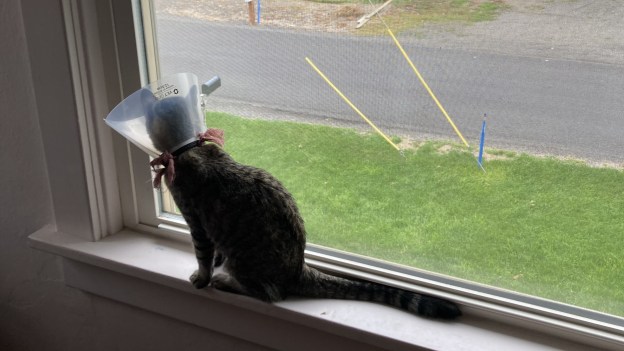
The youngest member of our family is sporting a cone of shame. She’s our six-month-old shorthair female cat, Phiona, and last week she had an overnight stay at the veterinary office to get spayed. We picked her up Wednesday morning, with a page of post-op instructions and a bag of syringes pre-filled with kitten-sized doses of pain medication. The vet assistant who discharged her instructed us to keep her as calm as possible for the next ten days, so we moved her food and litter into my office and there she convalesces.

Half of Phiona’s belly is shaved, with a one-and-a-half inch incision in the center, neatly sewn up. She wears a small cone on her small head, though it must seem large to her, and tremendously inconvenient. She can’t eat or drink without a person there to hold the dish still. Noises seem to come at her from strange directions, funneled through the cone. She licks the cone instead of her fur, and when her ear itches, the hind foot that pops up scratches at smooth plastic. There is no curling up to rest, no itching, and no bathing. Poop sometimes gets on the cone when she uses the litter box. Playing is a difficult proposition, as she can’t quite see her paws, nor coordinate them with her mouth to bite what she grabs, as kittens do.

Phiona doesn’t know the cone will come off after 10-14 days. As far as she knows, this may be her new normal—cooped up in one room of the house, wearing a constricting cone, unable to eat or drink until she has a visitor. If I were she, I would find this unbearable, and my attitude and behavior would follow suit. I’ve been watching her and imagining the deprivation of cat pleasures—a luxurious licking bath; a nap, curled up with nose tucked under tail; or a fierce romp, attacking string or toy with body, mouth, and all four appendages.

Phiona wears a cone of shame—or “Elizabethan collar” as it is called on the vet’s invoice—but she has no concept of shame. She doesn’t hide or hang her head. She purrs and plays and eats and drinks, and takes her medicine without complaint. How does she do this? I have watched her in amazement for a week, and I have no answer, only an increased awareness of how quick I am to sink into despair, to become angry when things aren’t how I want them to be, and to receive shame as my rightful state of mind. Phiona’s disposition is a compelling suggestion that there may be another way. Perhaps my humanity is not as volatile as I think, and the essentials of being human are more dependable than I realize. When I am limited, inconvenienced, slowed down, I do not lose my identity as a human being. I belong and I am invited to pleasure and peace as surely as when things are going my way.

I don’t have to always be well, productive, respectable, functional. I can rest when I am unwell. I can slow down when I am tired. I can enjoy the company of friends when I feel un-respectable. I can be waited on when I am not functional. I have permission to be human, and being human carries dignity with it through any circumstance. Whether buried in dept, or addiction, or depression, weighed down by sorrow and loss, or suffocating under secrets, each person is dignified. Whether disappointed in myself as a mom, humiliated by misunderstanding, or fearful of fallout after a mistake, I am dignified.

Thank you, Phiona, for teaching me that dignity is not complicated. You have modeled it through pain and confusion and the cone of shame, and have taught me again that my value is not in performance and my happiness is not in circumstances. But, I look forward to taking that cone off and watching you run and bathe and eat and drink, unrestricted.