Tag Archives: connection

Books I Read in 2023

I read over 30 books in 2023. I’d like to think I choose what I read. But, as with many facets of life, the people I know—and whatever version of fate I ascribe to—play a large part. Last year I picked up nine books at a Writing For Your Life conference—none of which I would have read otherwise. Several were written by authors at the conference, others lay piled on a “free” table in the foyer, and another—Grace Notes—was a not-yet-published manuscript. The author and fellow conference attendee, Cheyenne Wilbur, agreed to let me try my copyediting skills on his book. Grace Notes was the only work of fiction I read last year. With no forethought or planning, I gravitated toward nonfiction.

In 2023 I read at least ten books recommended by friends and family—ranging from depression-era stories to books on writing. I selected books for a dozen reasons I know, and probably a score more subconscious reasons. I chose because of the author’s name—Richard Rohr, Rachel Held Evans, Anne Lamott; or because of the title—Intersexion: A Story of Faith, Identity, and Authenticity; or because I wanted to learn more about mysticism—The Big book of Christian Mysticism, and Wild Mercy. Some books, unread on my shelf since high school, had to be read or sent to the thrift store, making room for more recent acquisitions.


Eleven books by authors I know, or have connected with in some way, appear on my reading list. I treasure each of these connections, and find myself astonished by the quantity of people who write bravely, skillfully, and often while also attending to other full-time commitments.

A nurse and author of several books, Susan L. Schoenbeck, introduced herself to me on LinkedIn because of a mutual connection. Her experience—both personally and professionally—with near-death experiences piqued my interest and I purchased her self-published book Heaven and Angels.

My friend and cousin-in-law, Clair Gabriel, embraced her creative-writing skills and published a book on Amazon: Pregnancy, Birth, and Oh, Baby! It’s a quick and encouraging read, both important traits for a target audience of young mothers.

At the year’s end, I absorbed one last book, written by the former pastor of my childhood home church, Carl Wilkens. The book is titled I’m not leaving., with this singular statement on the cover: “Rwanda through the eyes of the only American to remain in the country through the 1994 genocide.” It was a thought-provoking read, ripe with unanswerable questions and the traits that empower a person to navigate such answerless queries and harrowing circumstances: love and connection.

Books by authors I met at the Writing For Your Life conference:

  • The Hundred Story Home: A Memoir About Finding Faith in Ourselves and Something Bigger, by Kathy Izard
  • Grace Notes, by John Cheyenne Wilbur
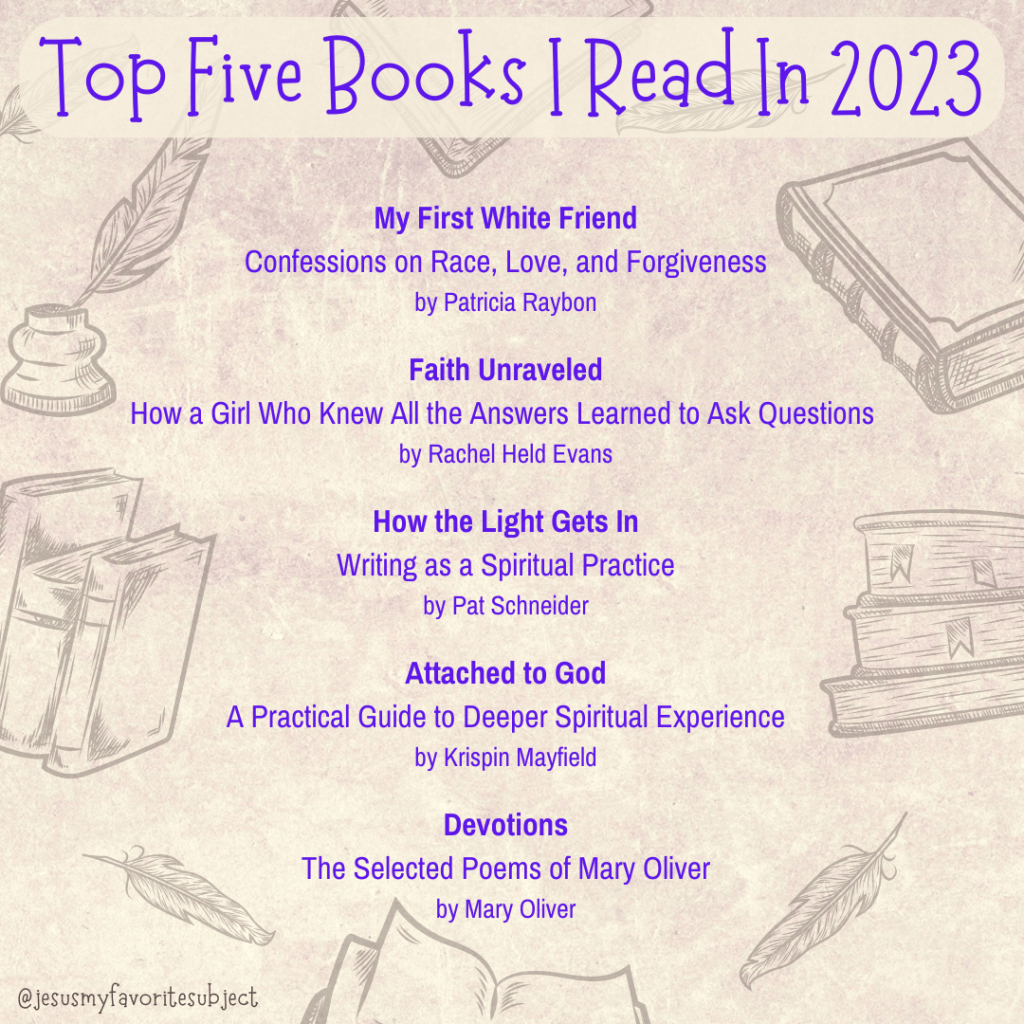
  • My First White Friend: Confessions on Race, Love, and Forgiveness, by Patricia Raybon
  • The Big Book of Christian Mysticism: The Essential Guide to Contemplative Spirituality, by Carl McColman
  • unbelieve: poems on the journey to becoming a heretic, by Marla Taviano

Books by authors in the Christian writing critique group I attend:

  • Surviving the Sand: My Family’s Struggle to Farm the Pasco Desert, by Helen Lingscheit Heavirland
  • Life Aboard a Sinking Ship: Mishaps and Mayhem on a Navy Tugboat, by Lee Yates as told to Blanche Yates
  • Building the Columbia River Highway: They Said It Couldn’t Be Done, by Peg Willis

Until last year, children’s books comprised nearly all my reading of poetry. Think Dr. Seuss and Shel Silverstein. When I started writing poems, I knew I needed to overcome my fear of poetry that isn’t illustrated and in large print. My sister helped by recommending several poets, and I read five books of poetry—including a compilation containing three of my poems, and the above-mentioned book by Marlia Taviano.

  • Swallow’s Nest: Poetry Journal, Fourth Annual Issue—December 2022, compiled by Linda L. Kruschke for Oregon Christian Writers
  • To Bless the Space Between Us: A Book of Blessings, by John O’Donohue
  • Stripped, by Cara Alwill Leyba
  • Devotions: The Selected Poems of Mary Oliver, by Mary Oliver

My reading last year included only one or two books from the self-help genre. I’d like to think this is because my mental and emotional health are improving. Or maybe I have that backward, and my mental and emotional health are improving because I’m not reading so many self-help books. Instead, I read more stories. There must be a technical term other than “story”—I’m sure “memoir” would apply to some—but to me these books are lovely because they are stories. The authors don’t tell me what to think. Rather, they invite me into their experiences. A good story is an offer of intimacy, a passageway to the inner workings of another human being and the wildness of their story. In addition to half a dozen of the above-listed books by authors I know, here are the stories I read last year.

  • Julie & Julia, by Julie Powell
  • Growing Up, by Russell Baker
  • Once Upon an Island: The Adventures of a Young Couple Who Did Buy Their Dream Island, by David Conover
  • I Went to the Woods: The Adventures of a Bird Photographer, by Ronald Austing
  • Faith Unraveled: How a Girl Who Knew All the Answers Learned to Ask Questions, by Rachel Held Evans
  • Intersexion: A Story of Faith, Identity, and Authenticity, by Cynthia Vacca Davis
  • The Face of Addiction: Stories of Loss and Recovery, by Joshua Lawson
  • Sealed: An Unexpected Journey Into the Heart of Grace, by Katie Langston
  • Love Warrior: A Memoir, by Glennon Doyle
  • Birding Against All Odds, by Joan Easton Lentz

Every one of the spiritual books I read felt like friendship. These books saw my heart and spoke both things I knew and things I didn’t yet know. They pushed me to try new things, think new thoughts, ask new questions. God and spirituality captivate me in a way nothing else does. I underline, write down page numbers, read aloud to my husband, and text paragraphs to friends. Although this happens with other books as well, it is spiritual books that most often invite me home, to a profound sense of belonging.

  • How the Light Gets In: Writing as a Spiritual Practice, by Pat Schneider
  • Attached to God: A Practical Guide to Deeper Spiritual Experience, by Krispin Mayfield
  • Small Victories: Spotting Improbable Moments of Grace, by Anne Lamott
  • The Tao of Pooh: The Principles of Taoism Demonstrated by Winnie the Pooh, by Benjamin Hoff
  • False Intimacy: Understanding the Struggle of Sexual Addiction, by Dr. Harry W. Schaumburg
  • Wild Mercy: Living the Fierce and Tender Wisdom of the Women Mystics, by Mirabai Starr
  • Forgive Everyone Everything, by Gregory Boyle, art by Fabian Debora
  • Seeking the Triune Image of God in You: A Glimpse Through a Keyhole, by Jeffrey D. Hill
  • Breathing Under Water: Spirituality and the Twelve Steps, by Richard Rohr

Re-reads. Finally, I read these three books a second time, because, in my humble opinion, they are just that good.

  • The Whole Language: The Power of Extravagant Tenderness, by Gregory Boyle
  • Bird by Bird: Some Instructions on Writing and Life, by Anne Lamott
  • Present Over Perfect: Leaving Behind Frantic for a Simple, More Soulful Way of Living, by Shauna Niequist

Thirty-seven books, and probably a few more I forgot to write down. It is a still-infant privilege, this copious access to written material. And yet, having grown up in America late in the 21st century, I can’t imagine anything else. Shelves of books are the backdrop to my office, my small groups, and my mental and emotional spaces. I am profoundly thankful for each author who puts their words into public spaces, and for the privilege of having time to pick up those words and hang out with them.

What did you read in 2023? Leave a comment and maybe I’ll add your recommendation to the list of books I want to read.
Now What?

In a few days, 2024 will unfurl. I’m curious what the year will be like, for one reason I never expected: joy. I’m happy, content, grateful. After years of feeling heavy, taking life seriously, and forming relationships around mutual brokenness, happy is a little scary. My inner child tells me cheerful is good, but not happy. Happy is too … emotional. Cheerful is a choice. Happy is a feeling. God forbid I feel anything.

Boldness rises. I will step away from the heavy hand of survival to the wide open spaces of abundance. I will feel joy. And I will enjoy that joy. I will laugh and smile and say I’m doing great. It will be scary, but worth it.

Scary, because I’ve primarily related to God as therapist for so long. What will we do together if we’re not bonding over my anger, fear, and dislike of myself and my life?

Scary, because I’ve thrived on connecting with friends through a shared journey of personal growth. When I don’t have a problem to employ as a means to vulnerability, how will I connect deeply?

Scary, because I’ve believed that happy is irritating and naive. If I love my life, what will people think of me? What will I write about?

Yes, I’m afraid.

I’m also excited, tantalized by the potential of a tea-sipping life—warm, slow, fragrant. I’ve been dodging bullets and putting out fires, sleeping to avoid the chaos in my mind. What will it be like to enjoy wakefulness?

Here’s to 2023 for being ripe with friendship and love, catalysts for joy.

And here’s to 2024 for its potential to be well-lived rather than well-controlled.

A Blessing for Time

A Blessing for Time

Blessed are You, Lord our God, King of the Universe,
for Solomon’s wisdom: a time for everything.
A time to feel and a time to numb.
A time to argue and a time to agree.
A time to shower and a time to stink.
A time for kale and a time for funnel cake.
A time for cleaning and a time for doing anything but.
A time for water and a time for wine.

Blessed are You for creating and embracing
every shape, angle, paradox—all we see as incompatible.
You invite us out of the disconnections we struggle under,
to the connections we fear. We dare to hold hands,
to join what appears unjoinable.
We are shocked by Your current, flowing in real time.

Blessed are You, Lord our God, King of the Universe,
for gathering all under Your wings,
though You know we may explode
like a chemistry experiment,
or implode like a punctured balloon.
You made a time for everything—
for this moment—
whether calm or catastrophic,
serene or scattered,
fragrant or foul.
Blessing is the birthright of time.

From Jesus Freak to Evangelism Phobia, Part Two

In this post—as in last week’s post—I use words like “Evangelism,” “Witnessing,” “Christianity,” and “Religion.” Each reader will have a different understanding of these words, both in denotation and connotation. Personally, I’m in the murky depths, somewhere between a conservative upbringing and an emerging mystical faith, still feeling around for a vocabulary that doesn’t cause pain.

***

“Aren’t you the one with a blog talking about Jesus?” Khalid asked.

I was at the home of my friends, Khalid and Tiffaney. They’d been to a concert earlier that week, which I avoided because of the musician’s evangelistic bent. “I don’t like evangelism,” I said, which prompted Khalid’s question about my blog.

“I certainly hope people don’t think I’m evangelizing!” I deflected the question.

It had not occurred to me that my blog (and my social handle @jesusmyfavoritesubject) could be viewed as evangelism. I have written over 100 blog posts, with the premise that talking about Jesus is one of my favorite things to do. What is that, if it’s not evangelism? Suddenly, I needed to answer this question.

I asked my husband if what I’m doing is evangelism. In his typical style, he looked up the word on his phone and found half a dozen definitions, all of which involved the concept of convincing another person. A Google search tells me that to convince is: to bring (as by argument) to belief, consent, or a course of action; persuade; cause (someone) to believe firmly in the truth of something. Combine this with the gospel of Jesus Christ, and you have evangelism: teaching or preaching about Jesus with the aim to bring about belief or action. Is that what I’m doing? I don’t want to answer.

A gray Jeep with a “Jesus Loves You” bumper sticker kept showing up on B Street last week. I passed it on my way home from school pick-up, and it got me all up in arms. Rather than joy at the sweet reminder of how loved I am, my response was irritation. People have all different conceptions of Jesus; the person displaying the sticker has no idea how many painful ideas he or she is promoting along with the positive ones. “Jesus Loves You” doesn’t see people, it talks at them. It doesn’t have any idea what tragedies or triumphs are on the reader’s mind, and it cannot weep or rejoice with them. The sticker is evangelism. I don’t like that I don’t like it … but I don’t like it.

One Friday afternoon, while chatting with my friend Celina at her dining room table, I brought up the question of whether I’m evangelizing. She asked, “If you’re not trying to convince when you write, what are you trying to do? What do you hope will happen when people read your blog?”

“I want people to feel seen,” I said. “I want them to be able to take a deep breath. I want them to know they’re okay.”

If God is in the picture, I hope people will see God seeing them.

On the eve of my recent 38th birthday, I spent a couple hours making a mental list of 38 people who have influenced me. It included coworkers, authors, family, and friends. Every influence was gentle; not one produced an about-face change in my life. They were quiet but strong: my boss—Jerry Mason—who believed in me, gave me responsibilities I would never have pursued on my own, and whose confidence in me was a steady presence in my life for over eight years; the authors—Gregory Boyle, Barbara Brown Taylor, Anne Lamott—who gave me permission to breathe, to try life open-handed; our mom tribe—half a dozen ladies who see me and allow me to see them. This is the kind of influence I hope for in writing.

I suppose I’m inviting people to be at home in themselves, rather than reject themselves to be at home in Christ. Krispin Mayfield, in his book Attached to God, writes about the Christian experience of sinfulness, and compares it to the pain of disconnection described in attachment theory.

It struck me that the theology I’d been given and the attachment literature I was reading seemed to be describing the exact same thing but offering different explanations. The theology taught that this awful feeling of ‘inner deformity’ was because of things we’ve done—lying to our parents, disrespecting teachers, sneaking extra candy. The psychology suggested that the terrible feeling came from what has been done to us. … (pg. 169)

When we have an insecure attachment, we feel awful inside not because of our sin but because of our unmet needs. It is the feelings of distance and separation that create the intense pain of shame. … (pg. 170)

“We think that if we can get a little bit better, a little less sinful, we will feel better about ourselves. In reality, true connection heals shame. (pg. 173)

True connection. That I might be willing to shout from the rooftops. I want to offer the things I thought I had because I was a Christian, but slowly and devastatingly found out I didn’t have: hope, peace, love, joy. These are almost synonymous with Christianity, but they evaded me for decades. So as I’ve found them, I’ve also found different language. When I share hope, I talk about how it’s okay to not be okay. When I share peace, I talk about disentangling from perfectionism. When I share love, I talk about expansiveness. When I share joy, I talk about coffee and friends.

I guess I’ve always wanted people to know they’re loved, and for a long time I thought telling them about Jesus was the best way to do that. But I was “the blind, leading the blind.” Religion created a structure in which I could feel my way around while my eyes were closed. But at some point I started bumping into sharp corners, and I didn’t feel safe any more. God suggested I sit still and open my eyes. In that terrifying posture of stillness, I learned to hold hands with myself, let myself be loved, and let life be both brutal and beautiful—“brutiful,” as Glennon Doyle would say. The structure of religion was an external protection. The beauty of loving and being loved is an internal strength. I’m learning to be strong rather than safe, and that’s what I want share. Is that evangelism? I still wonder about that.

A Need to Need

A Need to Need

Reflections – week 7b

Welcome to week seven (part two) of reflections inspired by my current small groups. Together with some of my favorite women, I’m exploring these books: Father’s House: The Path That Leads Home, and The Whole Language: The Power of Extravagant Tenderness. Next Wednesday’s post for week 8 will conclude this series.

I’m finding joy here, and I’m pleased you’re with me on this journey.

Father’s House. Lesson seven. Myth #41: God turns His back on me when I have needs—especially needs that are annoying or ongoing.

Having needs is a no-go for me, for many reasons. Needing is vulnerable. If I need, I’m giving another person the opportunity to help or ignore me, and that’s way too far out of my control. Needing is weak; it happens because I didn’t plan right, or I made a mistake. In short, needing is never safe. Never. If I’m not strong, I’m worthless. Needs are more likely to create distance than bring connection. I don’t feel safe within my own self to have a need; heaven forbid I need something from my husband or friends, or from God Himself.

Father’s House points out that, “Everywhere Jesus went we encounter His immeasurable goodness—healing ALL who came to Him, delivering people from demonic torment, raising the dead, forgiving sinners, loving the unlovely and dining with the disreputable.”2 Yes, but this is all about doing, and I get hung up there. It sounds like Jesus went around fixing things, but my spiritual experience tells me that’s a mis-read. God hasn’t been much into fixing me. I think the Bible, the way people talk about the Bible, and the way I understand Jesus have given me the wrong idea of Father.

There is a God I know and trust, a Father I have encountered in my anger and fear and self-loathing; in music and friends and words and quietness. I have found His abiding presence in my knotted heartstrings, and in the cadence of my day. But there is also a Father who isn’t going to help me live my life, who is okay with me running on empty and doing only what I can do in my humanness. I am terrified to approach Him with deeply felt needs. Does God actually respond to a person’s real, tangible needs? What about the intangible needs I don’t even have words for? How often will God “meet” my needs, whatever that means? If it’s one time out of ten, I’d rather not ask.

I want a loving Father’s help, but the stakes feel high. I always end up angry at Him, at me, or at both of us—probably because I have expectations. I want a contract. In fact, a prenuptial agreement would be nice. I’d like to know what I get out of this when God stops showing up.

But I also want to know what it’s like to be cared for. I want to trust, to settle into what is better than a contract.

Father’s House. Day Two. Page 125: “Now climb up in [Papa’s] lap in His big chair and tell Him what you need from Him. Lay it all out.”3 I’m terrified to admit that I need to be lavishly loved, that I want to be celebrated. But I know I will settle for less if I keep clutching my needs, unwilling to hold them out, to allow someone else to see them. So I follow directions. I make a list of what I need from Papa.

I need You to bless me.
I need You to see me.
I need Your seeing to precipitate action on my behalf.
I need You to remind me it’s okay not to be useful.
I need You to move toward me with interest and intention.
I need You to want to hear from me as much when I’m doing poorly as when I’m doing well.
I need You to like being with me.
I need You to behave extravagantly toward me.
I need to be wedded to You—a forever kind of togetherness.
I need “enough” to be out of the equation—no evaluating.
I need to order takeout and waste time with You, in my pajamas.
I need to hold hands with You.
I need You to ask how I’m doing and listen without an agenda.

My list surprises me. It seems I’m more interested in being seen and loved than being served or dealt a fair hand. I’m not sure how I feel about this. I know relationship is better than rules, but sometimes I want God to follow the rules. Sometimes predictable feels safe.

Maybe predicting is rather like weather forecasting. You end up with a mix of everything, undefined no matter how hard you try to define it. But, every day we know there will be weather. I don’t know how God is going to show up today, but I know He’s going to show up. It might not be the sunshine I prayed for, but I need never fear I’ll wake up to a day with no weather at all. God is alive and I am alive, and there are days when all that aliveness is unpredictable, stormy, maybe even disastrous. But no one will wonder if anything happened that day. We’ll know. So I don’t need God to run my life, or predict my life, or change the forecast to be in my favor. I just need Him to like me and see me and bless me, and keep showing up.

It is safe to have needs in Papa’s house.

Gregory Boyle writes that when we are “held by a no-matter-what-ness” we can “reidentify and accept [ourselves] with a mystical wholeness. You can then discard all those things that previously you held back. The places where you used to get stuck. … After that, it’s not so much smooth sailing as it is resilient and integrated enough to deepen the sense of your own truth.”4 My truth is that God’s Spirit joins with my mine to affirm that I am His child (Romans 8:16). I hear His affirmation, and I make another list.

God says,
I’m so glad you’re here.
I love holding you.
I love being with you.
I am and I have all that you need.
Together, let’s rest in what is finished. Let’s rest for a long time.
Let’s be together with no distractions. Let’s have fun together.
Let’s go for a walk, get ice cream, love every person we see.
Let’s enjoy and create.
Let’s take everything that burdens and stresses you and put it on my docket. You’re free.
Let’s do relationships together. Let’s parent together.
Let me spoil you. Let me do more than you “deserve.”
Let me warm you and feed you and provide a feast of beauty for your eyes.
Let’s be alive together. I release you from the identity of responsible servant-child and name you sparkling heiress. I’m your Daddy. I made this world and the people in it. You can’t break anything or anyone in a way that I can’t re-make.
I always have your back (and your front and sides).
I know you. You don’t ever need to hide, or explain yourself to me. You make perfect sense.
You’re exactly where you need to be. Every moment.
You are not bound or caged. You are wild and free and alive.
You cannot lose my favor. I would never think to say that, because it seems silly to me, so thank you for letting me know what you need to hear.
“I’ll love you forever. I’ll like you for always. As long as I’m living [which will be a long time], my [daughter] you’ll be.”5

I have believed I am worthy of having what God perceives as my needs met, but not worthy of having what I perceive as my needs met. Now I’m less sure that’s an important distinction. God is listening and loving. He is not measuring and monitoring. That’s about as safe as it gets. So I will practice bringing my needs to the table, and I will take comfort in being “held by a no-matter-what-ness.” In Papa’s house, needs are a point of connection. They are a meeting place for intimate friends. They are safe.

Endnotes:
1See Father’s House, page 120
2Father’s House,page 127
3Father’s House,page 125
4The Whole Language, page 110
5Love You Forever, by Robert Munsch

The Light Between Us

I’m taking a break this week from Father’s House and The Whole Language, to write about a different small group I’m in. There are four of us, meeting via Zoom to share our experiences through a compassion and wholeness workbook. The author of this workbook is my beloved sister, Dr. Jody Washburn. “Dr. Washburn” doesn’t roll off my tongue right, so at the risk of being an impudent younger sister, I’ll refer to her as “Jody.”

The full title of the workbook is, “Compassion & Wholeness: Engaging with Care and Curiosity on the Healing Journey.” This makes me smile. I love every beautiful word strung together into an invitation. Compassion… my invitation to care for another. Wholeness… my invitation to care for myself. And each of these spaces explored with curiosity, which is the antidote for judgement and shame—a healing journey indeed.

Jody writes about two barriers to belonging: 1) feeling “we have to hide or downplay who we are in order to belong,” or 2) feeling like belonging will come when we can “fix” others so they are more like us. Is there a space in which we can maintain our individuality, allow others to maintain theirs, and experience intimacy, belonging?

I have often felt this tension between hiding me or fixing you. I’m certain I will only be accepted if I meet expectations—not just in the workplace, but in friendship and at home as well. Therefore much of my energy goes into meeting expectations (real or imagined). Yet I know from painful experience that performance does not breed intimacy. People may “like” me, but they don’t know me. They know my performing self, or my “representative,” as Glennon Doyle would say. My real self suspects that if she were known, she would be rejected. Each time I allow my tired or confused or sad self show, there is a real possibility of shame-reinforcing rejection. People need me to make sense, to show up consistently, and to manage my own emotions. I suppose the most awful thing about this is that there is some truth to it. But this truth no longer has my loyalty. I have left it behind for something else.

I suppose my “something else” could be described as discomfort, but it is a discomfort leading to delicious comfort, to an internal wholeness I didn’t know was possible, and an intimacy with others I could not imagine. The discomfort is in losing control (or the illusion of control), receiving my own impossible-to-understand internal experiences, and receiving the experiences of others. No fixing. This is a terrifying freedom and a portal to a new dimension, a tangled and beautiful garden of love.

“Connection with [myself] and connection with others,” Jody writes. Yes, I respond. Yes.

Jody illustrates these two connections with pairs of words from various authors and speakers:
individuation and intimacy
authenticity and attachment
individuality and belonging
and my personal favorite, from Maya Angelou: “I belong to everyone. I belong to no one.”

Jody is a Hebrew scholar (I know, my sister is super cool). She describes the Hebrew word “Shalom,” which we often equate with peace, as “the harmonious working of a complex system”—another way to imagine this space we occupy of belonging both to ourselves and to others. Shalom makes an outrageous suggestion, that the complexities of ourselves and our world are somehow beautifully compatible. My own existence and the existence of each person I know, is an invitation to dance. I am invited to dance with myself, and I am invited to dance with you. Together we find a balance we could not find alone. This balance requires authenticity—a willingness to see and share my own insides, and to see and receive your insides. This seeing shines a lights into the shared spaces we occupy and allows us to dance the dance of intimacy, a miraculous, harmonious duet emerging from what seemed like incompatible notes and unwilling instruments.

As my friends and I talk on Zoom about all these ideas, we are drawn repeatedly to our own desire for an increased capacity to show compassion. As mothers, we lament our bitterness, anger, and attempts to control our children. Yet it is clear that compassion is not a “fake-it-till-you-make-it” prospect, nor is it achieved by trying harder or learning more. How are we to cultivate something that cannot be wrestled or prayed or shamed into being? How do I move from desiring compassion to a real response of curiosity and care when my children are battling for the upper hand in an insult war, or waking me up for the fifth time in one night? I am certain compassion must come from my core, yet I know I cannot surgically place it there. Oh, how I wish for a compassion pace-maker to fill in my glitches and keep me alive.

My sister’s workbook holds hints about what it looks like to move into compassionate space. One hint is embodiment. Hillary McBride writes, “Embodiment is a coming home, a remembering of our wholeness, and a reunion with the fullness of ourselves.” This remembering is the beginning of creating. Before I create, I need to make friends with my body. I answer Jody’s workbook questions. “What messages have you received, growing up and at other times in your life, about your body?” My answer surprises me. I had not put this into words until now: “My body is useful apart from my spirit/emotions/mind. It is useful for showing up where I don’t want to be, doing what I don’t want to do, accomplishing things for other people.” It makes sudden sense that I have felt divided against myself, ill with chronic internal bickering. I have used my body, and allowed others to use it. I didn’t know my body was me. I think this is what “dis-integration” means. Resentment and a lack of agency follow disintegration, and all at once it makes sense that I have been mired in a stinking swamp of resentment.

Another hint about compassionate space is “compassionate witnessing,” which includes the ability to hold space for what feel like mutually exclusive experiences. How can I feel comforted and fearful at the same time in my husband’s arms? How can I desire time alone and long for connection in one moment? How can my friends be both graceful and judgmental? How can my world be crammed so full of pain and beauty that I find the two squashed together in uncomfortable proximity? Jody talks about expanding circles of compassionate witnessing, encompassing self and others. She closes her workbook with these words from Stephanie Foo.

So this is healing, then, the opposite of ambiguous dread: fullness. I am full of anger, pain, peace, love, of horrible shards and exquisite beauty, and the lifelong challenge will be to balance all of those things, while keeping them in the circle. Healing is never final. It is never perfection. But along with the losses are the triumphs.

Little by little, I find the spaces inside me where compassion resides, and I step into those spaces more often. Compassion lives in my awareness of my body. It comes to life in my imagination and springs forth from my inherent creativity. I am shocked to discover that as I occupy these spaces, I walk out of fear into love. I see without squinting and I touch without recoiling. My life appears before me as a patch of wildflowers to enjoy rather than a blotch of weeds to destroy. An invitation to compassion is ultimately an invitation to joy and pain. It is the wonder of occupying what at one time seemed untouchable—the space between two people. Jody shares the words of Orland Bishop: “Future is the space between two or more human beings.” God invites me into that future, into what Jody describes as an emerging, co-created, relational space, and what I like to call, “the light between us.”

Dr. Jody Washburn’s “Compassion & Wholeness” workbook is available here. All quotes in this post are from her material.

Photo by Ray Bilcliff: https://www.pexels.com/photo/antelope-canyon-arizona-1533512/

What If?

I’m reading a book that is speaking beautifully to what God is doing in my life right now. It is resonating deeply with me. It seems every chapter is putting words to something I have experienced, and at the same time inviting me to know more. I found out the author is a pastor in Portland. We live in the Pacific Northwest and sometimes visit Portland, so… maybe sometime on a trip we could go to his church and meet him. I have just a bit of nervous excitement, considering this possibility. I imagine I would have a great conversation with him, because I feel like he already understands me, and I him.

Has this ever happened to you? Maybe you have a favorite musical artist you would love to meet, because their music has touched you or been the soundtrack to significant seasons or events in your life. Or maybe, like me, you’ve read a book and felt connected so much to the message or story that you wanted to meet the author. Maybe there’s an actor who has played a role that resonated with you, and it would be a dream come true to meet him/her. Perhaps there’s someone in history that you long to meet. Maybe you admire someone who has changed their corner of the world with loving service to the poor or by championing social justice, and you would be honored just to get the chance to shake their hand.

Admiration often leads to a desire to connect. We see something, feel something, hear something that resonates with our selves and we feel seen and known. Sometimes we breath a sigh of relief that we are not alone. And sometimes we think how lovely it would be to meet the person who wrote/created/did that thing we connected with. When we feel seen and known – or when someone opens a portal for us to see and know something we were previously blind to – we automatically respond with an open-hearted desire for connection.

What if I could see God’s creating and doing and acting with these same eyes of admiration? How awe-inspiring it is to watch a sunrise or see dolphins playing in the ocean. I think about the incredible transformation of metamorphosis – a squishy grub becoming a beautiful winged insect. I think about trees that look dead in winter and every spring burst forth in fat buds of leaves and flowers. I think about the peace of a lake in the forest, or the power of a roaring waterfall. I think about all the selfless acts around the world – among my friends, on the news, and in books about times past. I think about all the heroes who have put others’ lives before their own.

And I think, what if I could meet that Guy – the very one who paints thousands of breathtaking sunsets. The one who made the dolphins, the birds, and all the beautiful, curious, strong, smart, playful creatures. He must be an incredible Guy! What if there is one Person behind every act of kindness, sacrifice, and love the world over, and I could meet him?! Talk about a celebrity of celebrities!

What if this Person could bear the full weight of my admiration: I would never find out he changed his mind about loving, or had an affair, or embezzled money, or alienated his children, or went bankrupt, or stopped telling the truth. Rather, the more I learned about him the more I witnessed his integrity. What if this desire I have to shake hands with someone I admire, or to have an intimate dinner with someone famous whose talents inspire me, or to connect with someone who has connected with me – whose words or music or life has entered the sacred spaces in my heart and comforted me or changed me or simply been my inner companion – what if all that desire is realized in Jesus? What if all the admiration and inspiration – the moments of connection and feeling known – were actually moments with Jesus?

What if the most incredible Personality ever to walk the earth knows who I am? And what if he wants to not only shake hands with me and have an intimate dinner with me, but also to be my best friend? To be seen with me and know that I am being seen with him. What if I found out those sunsets and songs were messages he was hoping would find their way to me? What if he is as excited to meet me as I am to meet him; and he is as excited to be my friend as I am to be his? What if he is so humble that I never feel less-than in his presence, yet so powerful and dynamic that I am infused with zest for life just being around him?

What if all the people I have admired, all the sunsets that have quieted my soul, all the words and music that have held me or inspired me or challenged me or made me feel seen – what if the Man behind all that doesn’t live in Portland, but right here? What if I could meet him right now? And what if, when I meet him – full of nervous anticipation, admiration, and self-consciousness-trying-to-be-calm – he says he wants to stay with me for a while (well, actually forever): to have intimate dinners every day, to write music together, to have me sit beside him as he paints the sky? What if all I have admired and all that has inspired me are the work of one Person who is as deeply interested in me as I am in him? What if every day he wants to see me and know me?

What if I start to become like him? What if I make more beautiful things? What if I commit more selfless acts? What if I do things that invite others to be seen and known?

And what if this friendship is not just for life, but for the afterlife? Not only does he want to live with me at my house, but he’s making a room for me in his opulent mansion. There’s a room with my name carved on the door. And there is music and celebration and acts of love and intimate dinners every day. Finally my heart is full. My admiration has met its object and I am overcome by a sense of completeness and wholeness I know I was always looking for. Hope has been fulfilled. My heart is at rest.

Unforgettable in every way
And forever more, that’s how you’ll stay
That’s why, darling, it’s incredible
That someone so unforgettable
Thinks that I am unforgettable too

– “Unforgettable” by Gordon Irving