Tag Archives: family

Cousins

Cousins

Blessed are You,
Lord our God,
King of the Universe,
for cousins—
like siblings
but without the drama,
similar to me in ways that are comfortable,
and familiar with the foibles
of the adults in my life.

Blessed are You
for sleepovers and Mad Libs,
tea parties and birthday parties,
visits to city parks and county fairs,
and standing in the concession line
at the pool, dripping wet,
to buy popsicles and pretzels.

Blessed are You,
Lord our God,
King of the Universe,
for older cousins who take
the burden of all the “firsts,”
and younger cousins who put up with
the older ones bossing them around.
You knew we’d need friends
who were actually relatives
but not our immediate family,
so You made cousins.

Cat-Size Heart

I invented a new drink today—cofftea. I steeped a bag of decaf chai, added about a half inch of bottled Starbucks caramel macchiato coffee, and a splash of low-sugar, sweet-cream-flavored creamer. It was perfect. Tea, as Ted Lasso said, tastes like hot brown water. Coffee is too strong and too caffeinated. Cofftea is just right.

I’m writing in the living room recliner, cofftea beside me, snow outside, listening to the heater combat the 19-degree weather while frozen rain pelts the house’s metal siding. Michael comes downstairs for home-office pleasantries, and our cat Phiona follows. She tangles herself in a long piece of tinsel-like gold streamer. She chews it while twisting about on the floor, then gets up and saunters slowly to a different part of the room. The tinsel is wrapped around her tail and trails after her, setting off a round of wild contortions. She leaps to the couch, paws churning on the leather, propels herself across the side table and under a chair, where she pauses before rushing to the middle of the room for another tussle with the tinsel. Michael takes the gold-tinsel streamer and he and Phiona pad back upstairs where she will likely settle down on her pillow at the window beside his desk.

When I was a kid, we had a no-pets-in-the-house rule, observed without exception for dogs, and occasionally broken for a supervised half-can of cat food or bowl of warm milk on the kitchen floor for kitty. There was also an exception for summertime jars filled with tadpoles in mud-puddle water, and the hamster who occupied a small aquarium in my bedroom. Ladybug was her name, and I’m sorry to say I grew tired of her biting and pooping and messing up her aquarium, and felt relieved when she died.

As an adult, I’ve dabbled in fish and rodents, decided I don’t have patience for a dog (or children, but it’s too late to return them), and have settled on cats as my pet of choice. Last spring we lost our 18-year-old cat, Phred, to a traffic accident, leaving us with geriatric Phrank, who hasn’t yet used up his nine lives. A few months later, in midsummer, we adopted a kitten—a birthday gift for our daughter Kyli, who named her Phiona. She is unceasingly gentle and relationally devoted (as much as possible for a cat). She keeps her claws retracted during play, and if she bites, she gives an apologetic lick. She is very chatty and will often respond with trills and meows when spoken to. Our family of four is under the spell of her charming face, maniacal antics, and friendly conversations.

I don’t mean to be judgy, but I think people who choose not to have pets still think happiness is a clean house and no vet bills. Yesterday Phiona chewed the cord for Kyli’s headphones in three pieces—two large and a small. A couple weeks ago one of Phiona’s eyes clouded over and we took her to Animal Clinic of Walla Walla to get it checked out. (Nothing was wrong.) The bigger she gets the more she eats and the more she potties, which means increasing cat food and litter costs. She scratches the couch and the mattresses, makes herself at home on the dining table, and wakes me every night between midnight and 1am for no apparent reason.

The petless people aren’t fools. I just think they have grinch-hearts that need to grow a few sizes (apologies to my petless parents and friends). I can only assume my own capacity to handle the inconvenience—and receive the love—of pets has room to grow, since I am not yet ready for the exuberance, mess, and affection of a dog. Maybe my heart is only mid-sized.

It’s no secret that introducing any living thing—plant or animal—into life carries a legal-pad list of complications. Plants need water and sun and god-knows-what-else, and they grow oddly out of proportion, drop leaves, forget to bloom, and either die under ideal conditions or thrive under heinous neglect. Yes, there are books on plant care, but there are also books on parenting, and we know how well that turns out. Oh, and my parents don’t go for indoor plants either—at least not living ones. I mean, who wants dirt in the house. Silk plants are a no-fuss, wash-in-the-bathtub-every-five-years type of happiness. Good luck finding any living foliage with that kind of low-maintenance guarantee.

Recently, I drove downtown via my usual route. Power poles and power lines compete with trees along the road. Why, I wondered, do we bring in a specialized truck to dig a hole and place a dead piece of wood in the ground to hold the lines, when strong, living trees are plentiful and perfectly located? Well, because trees are alive, and life is inconvenient. Trees grow taller and wider, swallow up wires, and attract wildlife. They’re unpredictable. And for power lines we need predictable.

Where am I on the continuum of power pole to dog-lover? How much life can I tolerate? I’d say a plant is less trouble than a cat, and a cat is less trouble than a spouse, and a spouse is (usually) less trouble than a child. Rules and stonewalling, tone of voice and expectations help corral my people into something I can perceive as manageable, but how much management is too much? How do I know when I’m opting for the less-alive version because it takes less maintenance, less money, less emotional involvement? As a wife, mother, and friend, do I optimize for dead traits, or living ones?

In 2023 I settled for a mid-size heart. Will 2024 be the year to grow another size? Don’t get any wild ideas—I’m not adopting a dog. But maybe I won’t assign chores when my kids get loud, and I’ll stop counting out the pieces of fruit each family member gets at breakfast. Maybe I’ll take bedtime noise and moldy lunchboxes in stride, and smile more when I get woken at night. I’m not going for superhuman here. Just a little more life, and a slightly bigger heart to pump blood so my extremities don’t go numb.

What Is Kinship?

This morning I’m sitting in a favorite coffee shop as I write. Country music plays a little louder than I’d like from a speaker above, but quiet enough that I can overhear conversation. Two men in their seventies talk about therapy, travel plans, searching for a church that fits, and learning to support a recently-divorced family member. These men share themselves, hear each other, and speak encouragement. This, I think, is kinship.

I’m on a quest to learn about kinship. A google search provides this uninspiring two-word definition: blood relationship. But kinship can be so much bigger than that, a new way to see myself and others, a way that assumes value and connection. In kinship we are all on the same side of the line, rendering divides impotent. No “them,” only “us,” as Father Boyle would say. Only us.

Kinship has been slow-coming in my life. I grew up in a home where social time was considered a waste of time. If it wasn’t an event—like a birthday party or a hike to the lake—socializing didn’t happen. Although I’d like to blame my family and upbringing for my struggle to settle into friendship—I lived in a tiny community and was homeschooled through tenth grade—I’ve discovered my fears are not unique. Many women feel a lack of intimacy, and fear they don’t know how to participate in friendship. And, of course, each of us thinks other women have it figured out.

Every year I make a photo book commemorating our previous year. That may sound very organized, but it’s actually quite haphazard. Recently, I’ve been sorting through pictures from the last two years. As I put photos into categories and months—pets, school, March, November—a new category emerged: fun with girlfriends. These photo books will be the first to include a friendship photo spread—pictures of lunches out, movie nights, birthday coffee dates, pottery painting, and shopping fun. Looking at them, I feel connected, grateful, and not at all sure how it happened. I used to “do” friendship; now I enjoy friendship. I wish I could tell you five steps from lonely and anxious to connected and content, but, at least for me, it has been more mystical than methodical.

For most of my adult life I have compensated for lack of friendship by joining or creating small groups. A ladies group is my happy place. Crafts, Bible study, accountability, book-reading—it doesn’t matter. The structure provides a place for me to show up, participate in the mutual honoring of each other with our time, and complete the prescribed activity. Slowly I have ventured into one-on-one time with a handful of girlfriends, and casual activities together, like shopping. My circles of belonging widen.

The terror and the joy of intimacy with friends cannot be understated. Could one text or one misunderstanding upset it all and leave me in pain? Yes, it could. But in these relationships, do I feel seen, known, and safe? Do I invite these women into my home when I haven’t mopped the kitchen floor for three months, or done the dishes for three days? Yes, I do. Do I text them when I’m discouraged and take them coffee when I have a free morning? I do. Is it still scary, and do I have social anxiety? You bet.

Intimate relationships cannot be wrangled. It is a fools errand, seeking to avoid anxiety or relational fallout. Instead, I will allow anxiety and fear of intimacy to remind me that I am not impermeable. I am not above pain and misunderstanding. And this capacity for pain, this vulnerability, is what allows me life-giving connection, the joy of belonging, and the wonder of holding safe space for another person. This is the magic of being human.

Stories about men and women who stand in the gaps, go to the margins, hold hands with the desperate—these are my favorite. I want to be the hero in every story—the woman who taught homeless children, the man who endured exhausting legal battles to free wrongly-incarcerated men and women, the writer who teaches veterans to tell their stories, and the 22-year-old who adopted more than a dozen impoverished children.

At the same time, I don’t want to get anywhere near such unpredictable, messy situations. Can you imagine teaching at a homeless shelter, where traumatized children are in your classroom for 90 days or less? What about working long hours as a lawyer, toiling for years to see one ruling overturned, more years to find out it’s too late, the execution is scheduled. That may be charity, but it’s also insanity. How much could I handle?

There is tension between my relentless desire to love, and the ever-present awareness and fear of my limitations. I don’t know what’s coming for me in life, but I know I want to rise to the occasion and choose real love over false safety. I’m grateful for the thousands who have done this before me, proving it is possible and powerful. I watch the nonprofits in my hometown of Walla Walla, Washington, as they construct shelters for homeless, hold hands with the formerly incarcerated, provide dental services, food and clothing, love and dignity. I want to be part of that.

Children’s Home Society,* a local charity that works tirelessly to keep families together through in-home visits and a score of other services, has discovered the power of kinship—linking arms with the marginalized and misunderstood. Each year at their fundraising luncheon, one of their clients gives a keynote presentation, a story of their move from the thinness of broken family, addiction, and poverty, to a wholeness they didn’t know was possible. These people, unlike many of the donors in the room, haven’t been able to keep their lives “together” and show the polished side to society. But for that very reason, their stories are potent with hope. Every person in the room feels the energy of kinship. Hearts beat faster. Smiles appear. Applause is loud and long. Every one of us loves stories of redemption, and kinship is the catalyst for redemption.

Jesus born in a barn is kinship. He grew up to touch the untouchables, teach the stubborn, and include the rejected. He forever found beauty in ashes, wholeness in tragedy, and life in death. He defied categories, sweeping them into a circle and inviting them to hold hands, mix together like a delicious, forbidden stew. With a twinkle in His eye, He invites me into spaces where the ground is dry and barren. He invites me to bring kinship—the first drop of rain.


*Children’s Home Society is in the process of re-branding as Akin. I love this short-and-sweet name that includes the concept of kinship—the earth-shaking power of standing at the margins and holding hands.

In Loving Memory

A year ago today—on March 9, 2021—my Grandma Foster passed away. She was 97 years old. Her name was Ruth Vernelle Foster, but everyone called her Vernelle, and I called her Grandma. Visits to my grandparents were rare, as they lived in Texas and my family lived in Oregon. We saw them once a year or less, which left our relationship perhaps less intimate, but also unvarnished by the inevitable friction that comes with living in close proximity.

Although my Grandma Foster—and Grandpa—lived in California when I was born, my only memories of our visits are at their retirement home on Lake Texoma. My sister and I would follow Grandpa along the lake shore, clambering over the large sand-colored rocks that bordered the water, and watch him fish. If he caught something worth cooking up, Grandma would bread it in cornflakes and bake it to perfection. Then we’d all enjoy it around the large dining table right inside the front door, next to the hat rack overflowing with Grandpa’s trucker hats (to him they were fishing hats). The hats were a motley bunch, as they had all joined his collection by washing up on the lake shore, lost treasures of boaters on a windy day.

The layout of Grandma and Grandpa’s home was ahead of its time, with an open floor plan and high ceiling. The dining area, large living room, and kitchen, were all one open space, with a sliding glass door at the back, leading to a large deck with two porch swings facing the lake. A lot of swinging went on at Grandpa and Grandma’s house. If it wasn’t in the porch swings, it was in the backyard hammock or the kid swing. Grandma was a great swinging companion. She was content to be quiet or to talk, and never had an agenda.

The lake view was peaceful, with fishing boats and colorful sailboats often passing by, and the Oklahoma shore in the far distance. There was often animal activity on the front porch at the bird feeders, which were really squirrel feeders. It was a delight to watch the squirrels scampering around or enjoying an easy meal. There was one bird we saw at regular intervals, but it wasn’t on the front porch. It was in the house, inside the beautifully carved wooden cuckoo clock. My sister and I tried to see that bird every hour when it came out. We’d rush pell-mell from anywhere in the house to stand under the clock and watch the tiny bird poke its head out. Twelve o’clock was the best showing, with twelve “cuckoos” ringing out before the bird ducked back inside.

It was generally quiet at Grandpa and Grandma’s house, but things would liven up when our cousins came over—two boys just younger than my sister and me. The school bus dropped them off at Grandma and Grandpa’s every afternoon. Probably my favorite, and one of my clearest, memories with the cousins was decorating Easter eggs. Grandma hard-boiled dozens of eggs and had all the trappings to dye them. She set us four cousins up at the table and we went to work coloring those eggs. Then we hid them in the yard, found them, and hid and found them, over and over until the eggs fell apart. I must have been quite young—6 years old perhaps—and that was a wondrous Easter for me. We didn’t celebrate Easter at home, and I had never done anything like that.

One year Grandma let us keep a Box turtle we found. She provided a cardboard box for it to live in, and kitchen scraps to feed it, and we surely enjoyed that turtle! Sometimes we passed time by watching the Andy Griffith Show on the little TV in the living room, or following Grandpa around, or reading the kids books in the guest room. Since our home was a bastion of only true stories, Grandma’s house is where I read nursery rhymes, stories about Winnie the Pooh, and other children’s fiction.

Grandma and Grandpa’s neighborhood was quiet and open—I don’t recall very many fences. It was off the main road, so the folks who lived there were the primary “traffic.” My parents and sister and I often took walks around the neighborhood. There was a small cemetery at the corner where the main road ran perpendicular to their little peninsula, and a camp which we sometimes wandered through. Four houses down, and also on the lakefront, lived my Great-Aunt Jean, Grandma’s sister. She had the most wonderful southern accent and the softest old lady skin. We always visited her rather formally: our family of four would walk to her house, sit together in the living room, and have a visit. After our visits we would chuckle about how her “yeahs” trailed off with a southern echo: yeah-eah-eah.

Grandma and Grandpa always sent birthday cards with $20. They would both write in the card—Grandma in cursive, and Grandpa in all uppercase letters. Grandma was a thoughtful gift-giver. Gifts were rare but always quality and meaningful. When my mom built us a three-story dollhouse, Grandma purchased some very elegant dining furniture and other pieces to furnish it. When I was three years old, Grandpa and Grandma came to our house for a visit. I don’t remember anything about it except what is in pictures: beautiful pastel pink and blue quilts, handmade and quilted for my sister and me, with each of our names embroidered on them. I slept under that quilt for many years, and now my kids use it, for blanket forts or an afternoon snack in the back yard. Later Grandma hand-stitched a pillow case with my initials on it, which I used in my college dorm room.

Fifteen years after that visit, Grandpa and Grandma came to Oregon for my high school graduation. It was their first time traveling by air, and I felt pretty special that they wanted to be there to celebrate with me. Two years later Grandma came north again, this time to Washington for my wedding. She was always a quiet presence. I don’t remember her ever being controlling, although she had a very matter-of-fact way of speaking and wasn’t shy about her opinions. But she always ended with a chuckle that seemed to say “what will be will be.” Her laugh was probably the most-mentioned attribute at her memorial service, which we attended on Facebook Live last March. She laughed often, laughed till she cried, and could laugh and talk at the same time.

Grandma and Grandpa were married 78 years, of which I am very proud—easy for me to say since I didn’t have to do any of the hard work to keep a marriage alive for that long. Grandpa could be bossy at times, and he had quirky habits like unplugging kitchen appliances before leaving the house. One time we came to visit and there was chicken wire all along the front of the garage. We found out he had installed it there after Grandma had an accidental bump into the garage door with the car.

Grandma spent countless hours making memory books for her kids and grandkids. I have two large photo albums with photos, memories, newspaper clippings, and letters, going back to my great-great-great-grandparents. She included all the artwork, letters and cards I sent her over the years, as well as letters from my parents that talked about how I was learning and growing as an infant and child. Grandma had a methodical way of putting together these memories, always including dates and other details that would help orient anyone who had not been present to the events. Along with being well-versed in family history, Grandma also had an eye on the future. Her son—my father—who is a classical guitarist, received a letter from her containing a list of songs she wanted him to play at her funeral, 20 years before she passed away. And when she did finally breath her last, her funeral was already planned, by her.

It may be that my penchant for planning, my big smile, and my loud laugh, journeyed from Grandma’s DNA to mine. And one day I hope to be a grandma who can sit on a porch swing without an agenda, adopt a wild animal as a pet for my grandchildren, and laugh about almost anything. Thank you, Grandma, for showing me how to do the things humans were made for: creating things, and loving fellow humans.

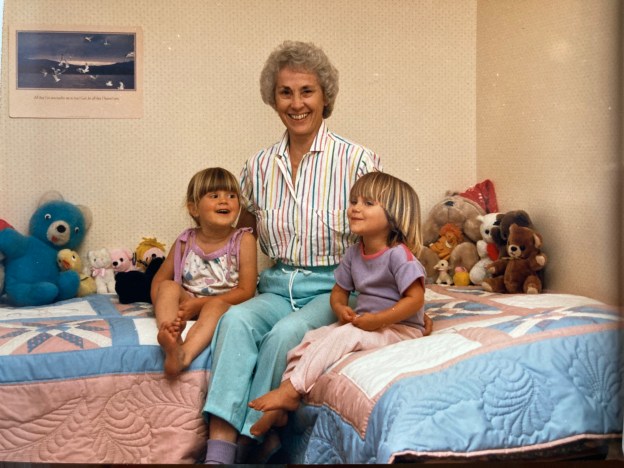
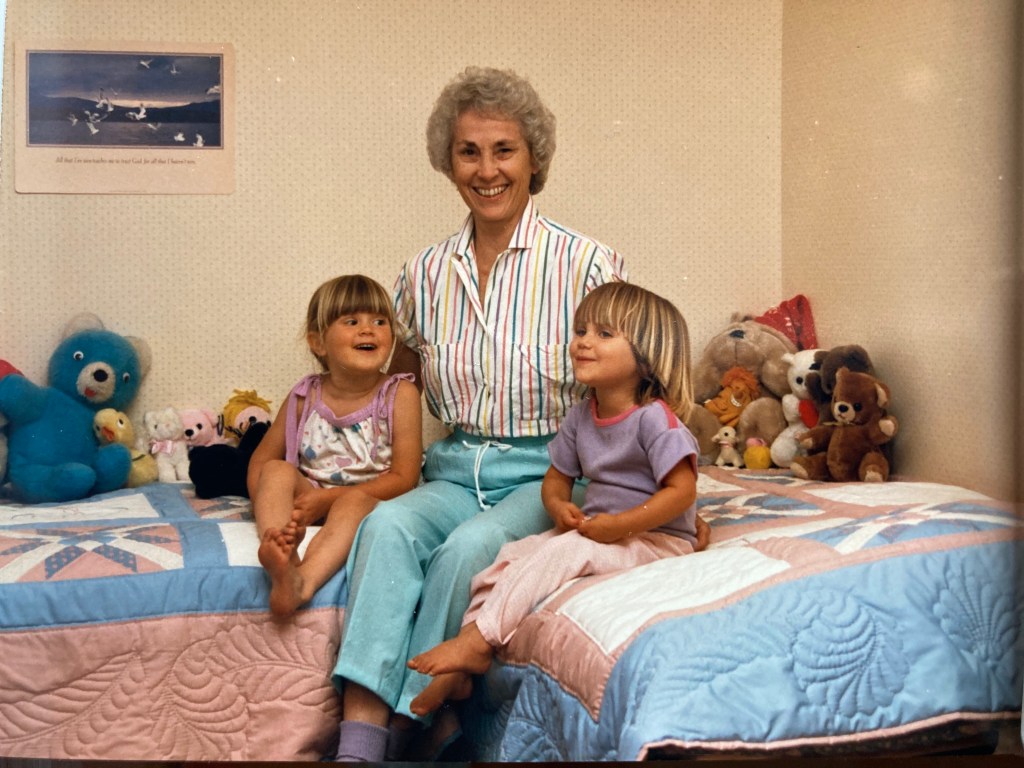
My sister Jody, Grandma, and me, with the new quilts, May 1988.
Four-generations: my grandparents on either end of the couch; and me, my daughter Kayt, and my dad in the middle. This photo and the one below are from our last visit to Grandma and Grandpa at their Texas lakefront home, June 2013.
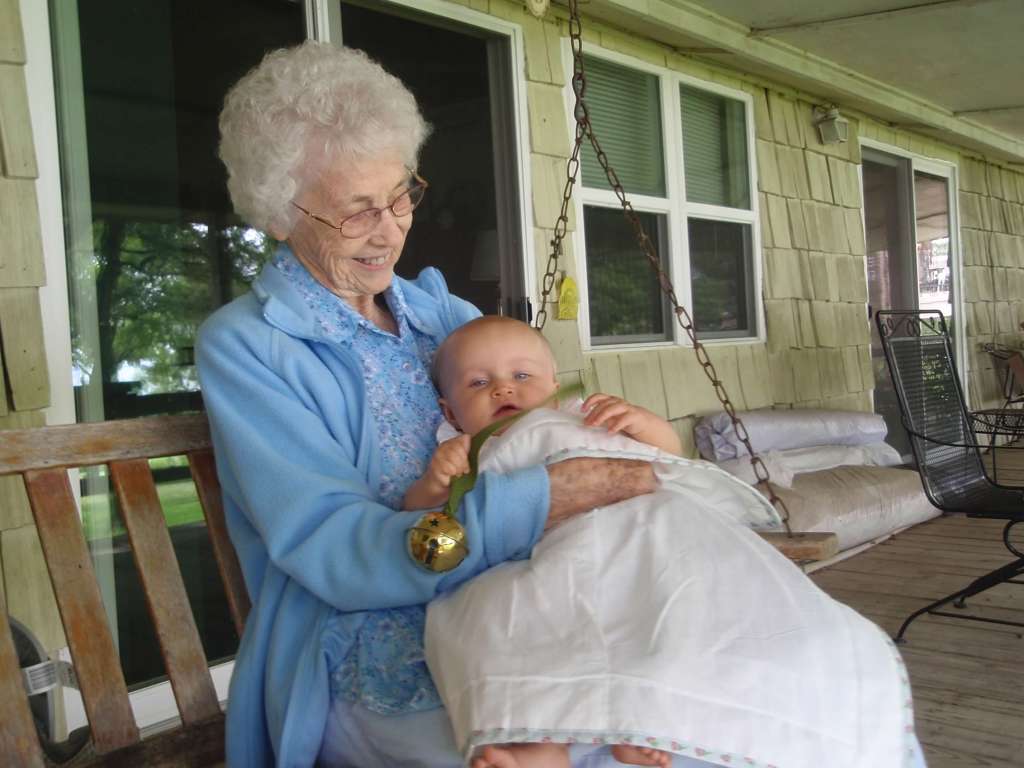
Grandma on the porch swing, holding my daughter Kayt.

Obedience, Part Unknown

It’s time to get personal with all the talk about obedience. If you didn’t know, I’m writing a series of five posts on obedience:
Obedience, Part 1 – Turning
Obedience, Part 2 – Agreeing or Trusting?
Obedience, Part 3 – What Precedes Obedience
Obedience, Part 4 – What Follows Obedience
Obedience, Part 5 – Disobedience

“Obedience, Part Unknown” was not going to be in the series, but I’m struggling today and it’s time to share the struggle. But first, how the difficulty began; which is actually a story I love to tell.

A couple months ago I was feeling inadequate and overwhelmed in parenting, which is not at all unusual for me. However, this time things were at the point I felt something needed to be done. My seven year old daughter was saying she felt like the worst person in the world, that she hated herself, and that she wished she were dead. Fear and worry swooped in to tell me it was my fault for being a perfectionist, and that not having the right solution would result in lifelong negative consequences.

As my mind began to spin up a tornado and my soul began to clench in fear, the Holy Spirit threw me a rope. He reminded me that I didn’t have to descend into despair, and He also informed me that I was not strong enough on my own to fight that battle. He instructed me to reach out to my friends for prayer, and so by God’s grace and praying friends I made the journey over the next 24 hours from “this is big and I can’t solve it and that’s bad” to “God loves my daughter even more than I do and He knows exactly what she needs.” In my heart I sensed that God was asking me to wait on Him. It was not time to act, it was time to trust, and then from the quiet of trust, to listen. This was all His work, not mine. I simply responded.

Within a day or two of this, my husband and I had our weekly “M&P,” which is a time we spend after the kids are in bed talking about either our marriage or parenting. We prayed and I shared my concern about our daughter, and then we had the most wonderful conversation about our lives being too full. There is absolutely no explanation for it being wonderful except that God showed up. Generally, conversations about how we spend our time have been anything but wonderful. Weekends have been the crucible of our marriage because unplanned time sends us in opposite directions: my husband to relaxing and entertainment, and me to chores and activities. But throughout this conversation we expressed ourselves well, we heard each other well, and we reached the same conclusion: our life is too full and God is calling us to slow down.

Typically my response to any sort of conclusion is to take action. Time to buy a car? Ok, let’s go get one tomorrow. Time to plan a birthday party? I’ll start the guest and supply lists right now. But I experienced this calling from God as if a divine Parent was truly in charge. I didn’t feel the need to make it happen. My husband and I both agreed that we were to slow down our lives, but we didn’t know how. We even agreed that if we were to sit down with the intent to discuss our schedule, two things could happen: 1) no individual item would ever make the cut, because each one had been chosen for a good reason in the first place (how could we cancel date night, dinner with friends, or art lessons for the kids?), and 2) if we did actually find something to cut, our lists would be opposite: what he wanted to cut would be what I wanted to keep, and vice versa.

So here we sat, unexpectedly in peace and agreement, waiting for God to reveal what He had in mind for us. Some weeks later as I was in the kitchen getting a glass of water, the thought came to me that we could decide on our schedule based on what we know God has called us to. In other words, those things in our life we know He has directed us to do would remain, and everything else would get cut. I tucked that thought away for later, and through unanticipated circumstances we found ourselves at home alone on a Saturday morning for two hours. I suggested we talk more about God’s plan for our time, and my husband reservedly agreed. Again we experienced the same oneness of mind as our previous conversation, and we felt God was asking us to lay aside those things that He had not called us to do. (Our focus was the time between school and bedtime, so we were not talking about changes to my husband’s work schedule, or to time commitments in the first part of the day).

As we conversed over the next couple of weeks, we identified three things we knew God had clearly called us to, and we decided it was time to tell the kids our plan and start eliminating everything else from our evening schedule. Previous to these changes, we were out of the house five nights a week on average. And this was after saying no to quite a few opportunities. We communicated with our extended family – who are our primary babysitters – that we would be making changes, and were blessed to have their support. We started to get excited about more evenings at home as a family, and maybe the option to invite people for dinner occasionally – something we had not been able to do for some time. Our focus was on keeping things off the calendar, so dinner invitations would be more spontaneous – not planned weeks ahead.

So, that’s the story. We basically started following this new calling at the beginning of January, which felt very fitting. Here we are a few weeks in, and it’s getting hard. At first it was a relief, even a joy, to look at the empty calendar, knowing that we were right where God wanted us to be, and that we didn’t have to always be going here and there. Then the social invitations started coming in. Last weekend we had three social invitations on Saturday evening. My stress level went up as we tried to decide which was the most important, whether we should do any at all, how late we could respond to the invitations without being thoughtless toward the hosts, and so on. I was texting people, feeling torn and overwhelmed. Part of me wanted to go ahead and respond with Yes to two of the invitations, as they would fit together nicely. Part of me thought we should pick one. Part of me wanted to say no to all of them. And this uncertainty was a huge energy drain. I was stressed, wanting to keep each of my family members happy and also (to be completely honest) keep up good impressions with the friends who had invited us. We ended up choosing one event, which kept us up late, and in the end I felt overextended and emotionally exhausted (more from the decision making than the event, which seems ridiculous).

So how do I navigate this? We’re not trying to completely eliminate our social life, but we are trying to slow it down. And although I am absolutely certain of God’s calling to a quieter schedule, I am not as sure how to make the individual decisions. We’ve been reading a new book by Jefferson Bethke titled “To Hell with the Hustle: Reclaiming Your Life in an Overworked, Overspent and Overconnected World.” It explores the ways life has changed in the last two hundred years with cars, electric lights, worldwide time zones, and all the things that enable us to have the very full lives we have today. It has been eyeopening, and an encouraging read as it echoes the heart calling God has given us for this season.

And yet I still don’t know what I’m doing. Today school was cancelled because of snow. I decided to have a fun day with my girls, and we each picked something to do: bake cookies, make cereal necklaces, and dance along with kid song videos. I also took my first-grader on a mommy-daughter date because she has been asking for some time alone with me. Then I started getting social invitations. Four, to be exact, all before 1:00 (and there may still be more to come?). And I like them all. What’s not to love about sledding and lunch and playdates? Each time I agonize. The kids would love to do it. It would be good to get out of the house. But here’s the real kicker. I realized as I responded No to each one that there may be a cost to this obedience. Friendships only last when you invest in them. If we are going to be centered at home, we are essentially tightening our circle, and some relationships may be lost. If I am investing more time at home, the obvious flip side is that I’m investing less time outside the home. How can I say no to the meal trains, the mom nights, the potlucks and sledding invitations, the dinner invitations, the birthday parties, the playdates at the park?

And then I pause for a moment right in the middle of this thought and realize how blessed I am! What an incredibly warm and wonderful place to be – surrounded by friends I admire and cherish, who regularly invite me into their activities and their homes. I have a story for another day about hungering for friendship, and by God’s grace here I am drowning in it.

But back to my original thought. What to do? I must say no. I am called to say no. As Bethke says in the aforementioned book, “If you’re not saying no to good things, you’re probably not saying no enough.” This is uncomfortable. But despite the discomfort I can be grateful, because all is good. The calling to slowness is good. The friendships are good. There is nothing bad here, but there is a calling. There is a culling. There is a cost. In all of it I am blessed. I am blessed to have a loving Father who cares enough to orchestrate the details of my life. I am blessed to be surrounded by a loving community of friends and family. I am also blessed to discover the freedom that comes with the word No. 

Is it painful? Yes. Is it also peaceful? Yes. Is there a cost? Yes. Do I know what the cost will be? No. Am I called to obedience? Yes. Can I be obedient on my own? No. It is all the work of God, from start to finish. In his book Mere Christianity C. S. Lewis points out that “Christ Himself sometimes describes the Christian way as very hard, sometimes as very easy. He says, ‘Take up your Cross” – in other words, it is like going to be beaten to death in a concentration camp. Next minute he says, ‘My yoke is easy and my burden light.’ He means both.” So here I am, feeling peaceful and blessed, and simultaneously uncomfortable and sad. God is asking me to do something hard, but the truth is that He does all the hard  stuff. I just turn toward Him in obedience.

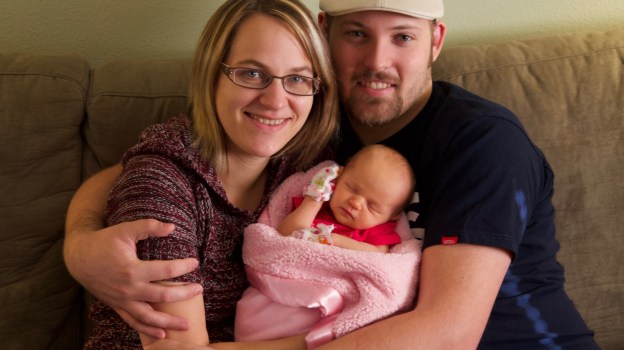
Today the photo for my post is a picture of my husband and me with our older daughter when she was about a week old. The first time I looked at this picture, God impressed an image on my mind that still comes to me every time I see it. In the picture you can see our daughter, with my arm around her, and my husband’s arms around both of us. In my mind’s eye God showed me His arms as another Person around all of us. Here we are seven years later, facing new challenges, but we are still held. And being held is worth fighting for. It’s worth obedience, even knowing it comes with discomfort and loss and the unknown.