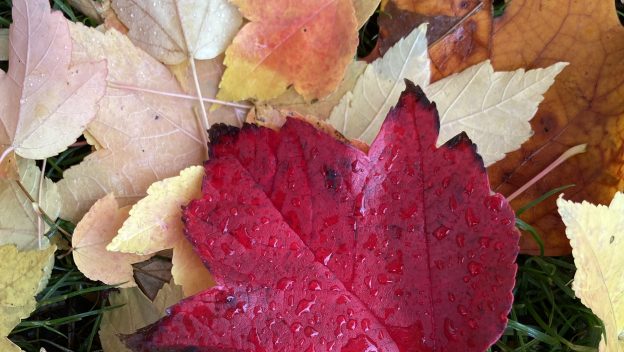
Death is beautiful. City streets and sidewalks are papered in it. Trees shout it with blazing reds and yellows—a rare season when the glow of sunset settles onto every country road and city block. And the individual deaths are as beautiful as the collective. If I dare use the worn-out snowflake analogy, each leaf is one-of-a-kind—the blend of colors, the shape and length of the stem, edges pointy or rounded, symmetry perfect or lopsided. Even the way it rides air currents to the ground is singular.
In the Celtic spiritual tradition, the phrase “thin places” describes those times when the veil thins between the now and the eternal, the ordinary and the extraordinary, and we see what is usually hidden. Death is one of those thin places.
Months before autumn, I walked a fog-covered beach on the Pacific Ocean, and death everywhere arrested me, stunned me, captivated me with its patterns and beauty. The oval-shaped outside of a small chiton shell—previously home to a creature that might have been the child of a limpet and a sea slug—was mossy green. But inside, surrounded by a wrinkly cream-colored girdle, an almost-neon aqua blue lit up the connected shell plates, and I stared in wonder. The shell of an urchin, now spineless, was covered with perfect rows of raised dots in muted tones of pink and green. The purple inside of a crab shell had patterns like light shining through water. Round jellyfish, symmetric from their thin edges to the white motif near their fat centers, lay stranded on the sand. A dead dragonfly, wings spread as if on display, had the bluest body, a peaceful gray-blue, but nothing dull about it.
My daughter picked up a crab shell which had been home to a couple dozen barnacles, and I imagined it in its heyday, scuttling through tide pools, unknowingly feeding the barnacles on its back, as well as itself. Uprooted seaweed formed circles and figure-eights. My daughters and I stomped on the seaweed air floats, trying to outdo each other with satisfying pops. One already-cracked float looked like Pac-Man, and another like a pelican’s head and neck. Shells, once symmetric, had broken into fragments and been polished smooth by the sand—pinks mottled like granite, colored ovals reminiscent of planetary rings, layered blues, and swaths of pearly iridescence. An art museum at my fingertips.
As I contemplate the beauty of death, I can’t help but wonder what it will be like when someone I love dies. Will I feel the thinness between earth and heaven? Will there be beauty? Or will it be clinical, disturbing, exhausting, or—worst of all—sudden and too soon? I’ve never been with a person at death. I am curious—will there be a glimpse of what I have not seen before?
There is room for magic in morbidity. Although the leaves will turn brown, rot in the rain, and return to the soil, their week of splendor remains undiminished. Although every empty crab shell represents a death, and the waves and crunching feet will not leave them whole, they are no less exquisite. Although I will die, my passage from this life will squeeze the mortal and the immortal together for just a moment, creating a beautiful, painful, thin place.
 My Favorite Subject