Tag Archives: reading

Books I Read In 2024

I read 26 books last year. Let’s look at the boring category first: SELF HELP. (I won’t tell if you skip down the page)

Two of these books were suggested by friends, who read them with me. I’ve copied a favorite quote from each book.

“People who don’t know what they find satisfying generally struggle to know who they really are. Our identity and our passions are intimately connected.” (page 168)
The 4 Habits of Joy-Filled People, Marcus Warner and Chris M. Coursey, 179

“… if we are to stay connected with our soul, we will need to have the capacity to sometimes be dreadful, objectionable, or offensive.” (pages 64-65)
The Vital Spark: Reclaim Your Outlaw Energies and Find Your Feminine Fire, Lisa Marchiano, LCSW, 249

“Other people’s frustrations won’t kill you. Their opinions can’t take you out. You can indeed choose a new yes, or a continued yes. You can keep at the thing you love, even if it isn’t producing results yet. You can say yes to what you want to say yes to. … Are you just into it? That is reason enough.” (page 129)
Fierce, Free, and Full of Fire: The Guide to Being Glorious You, Jen Hatmaker, 221

“There is a season between deliverance and dominion that is called dependence.” (page 193)
She Is Free: Learning the Truth About the Lies That Hold You Captive, Andi Andrew, 203


FICTION. In 2023 I read only one work of fiction—I edited it for a friend. I determined to read more fiction in 2024, and I did! I enjoyed, but didn’t love, these reads. Maybe 2025 will be the year I find a fiction book to love.

The Innocents at Home: Children of the 1940’s, Mary Stone, 241

Facing the Dawn, Cynthia Ruchti, 310

Love, Jacaranda, Alex Flinn, 356

All Other Nights, Dara Horn, 363

One Corpse Too Many, Ellis Peters, 275

The Minister’s Restoration, George MacDonald, edited by Michael R. Phillips, 207


POETRY. I had the privilege of joining the book launch team for Marla Taviano’s book whole: poems on reclaiming the pieces of ourselves and creating something new (268 pp.). It’s a quick, fun read, and Marla’s authenticity creates space for a whole range of questions and “questionable thoughts” about Christianity/religion.

Made of Rivers by Emory Hall (68 pp.) is fabulous. It was recently re-released with thirty additional poems. Go buy it.

OR, if you can only buy one book of poetry today, you might consider All Along You Were Blooming: Thoughts for Boundless Living, by Morgan Harper Nichols (182 pp.). My dream as a writer is to create spaces with my words that allow folks to breathe, allow their souls to sit down in peace. This collection of poems did those exact things for me. It’s a wonderful read for a quiet hour on the weekend, or a way to rest your spirit when you climb in bed at night.


CREATIVITY AND WRITING. I’ve read some pretty amazing books by writers, about writing. Lots of people write about things they know about, and the books are good, but reading the words of a skilled writer is always more fun. Maybe I’m biased, but I think the best how-to books are about writing, because writers wrote them. Am I making any sense?

Julia Cameron’s book, The Artist’s Way: A Spiritual Path to Higher Creativity (235 pp.), would fall in the category of excellent-book-about-writing, written by an excellent writer. And if you like The Artist’s Way, she has perhaps a dozen more books with related content. Take a deep dive.

The Artist’s Rule: Nurturing Your Creative Soul With Monastic Wisdom, by Christine Valters Paintner (162 pp.), is an invitation to embrace the intersection of the spiritual and the creative—or, in her words, your inner monk and inner artist. I loved every page, had a lot of fun with the writing prompts, and tried some new things, like wabi-sabi photography.

Mark Yaconelli’s book, Between the Listening and the Telling: How Stories Can Save Us (183 pp.), is a compelling showcase for the power of story. It reignited my passion for storytelling and story-listening as community activities.


STORIES. All good. Of course the one about Gregory Boyle (G-dog) was a favorite, along with What My Bones Know. My daughter picked up The Invisible Thread at a used book fair. It’s the memoir of a young second-generation Japanese American who lived in a U.S. concentration camp during World War II. I read it because I knew nothing about the experience of Japanese Americans during the war, and to see if it was appropriate for an 11-year-old to read (in my opinion, it is).

G-Dog and the Homeboys: Father Greg Boyle and the Gangs of East Los Angeles, Celeste Fremon, 314

Happy Trails: The Story of Roy Rogers and Dale Evans, with Carlton Stowers, 207

I Know Why the Caged Bird Sings, Maya Angelou, 289

Surviving the White Gaze: A Memoir, Rebecca Carroll, 318

A Beautiful Mind: The Life of Mathematical Genius and Nobel Laureate John Nash, Sylvia Nasar, 390

What My Bones Know: A Memoir of Healing from Complex Trauma, Stephanie Foo, 321

The Invisible Thread, Yoshiko Uchida, 133


SOUL FOOD, my favorite! The books in the CREATIVITY AND WRITING category would fit here as well.

Eat, Pray, Love, by Elizabeth Gilbert (331 pp.)—it’s popular for a reason. The blend of delectable writing with deep insight and the permission to be human made it a special occasion each time I sat down to read. I celebrated these good feelings by taking the book to a coffee shop a few times, to revel in the experience.

Here’s a favorite passage from Somehow: Thoughts on Love, by Anne Lamott (191 pp.). I don’t know how I got by with reading only one Lamott book in 2024, and I plan to partake of at least a few this year.
“When we screw up … it is never the final word. The fact that this happens to all of us allows us to have a tenderness about the broken places. … hope is believing this one thing, that love is bigger than any grim, bleak shit anyone can throw at us. And I believe. Also, my experience is that grace bats last.” (pages 85-86)

And, without planning it, the first book I read in 2024 is last on the list: Running to the Mountain: A Midlife Adventure, by Jon Katz (242 pp). Here’s a quote.
“Spirituality is usually presented in terms of the Big Payoff—Merton finds faith sitting in a church one day. I’d expected something similarly dramatic. It took me weeks to grasp that this was going to be painstaking and meticulous work, hand-to-hand combat of the most intensely personal sort—with myself. Day by day, chore by chore, I’d know more in six months or a year—if I were lucky—than I did now.” (page 83)

And that concludes my reading for last year.

Blessed Books

Blessed Books

Blessed are You,
Lord our God,
King of the Universe,
for books of all shapes and sizes.
My Bible concordance weighs 4.6 pounds,
a giant next to the tiny hardcover
book of proper etiquette, 2.2 ounces.

Blessed are You for books—strangers,
who may become friends as I turn the pages,
or allies, or acquaintances,
or enemies who confine me,
mentors who challenge me,
or therapists who help me find myself.
Books have saved me, expanded me, held me.

Blessed are You,
Lord our God,
King of the Universe,
for the pleasure of reading in bed
with a comforter and pillows
and a cat curled at my feet;
for the companionship
of books that fit in purses or pockets
and travel with me on an airplane,
or to a chair in the back yard.
Each is a gift in some way:
friendship, adventure, humor, mystery, wit and wisdom;
and every story is a sacred portrait of those made in Your image.

Books I Read in 2023

I read over 30 books in 2023. I’d like to think I choose what I read. But, as with many facets of life, the people I know—and whatever version of fate I ascribe to—play a large part. Last year I picked up nine books at a Writing For Your Life conference—none of which I would have read otherwise. Several were written by authors at the conference, others lay piled on a “free” table in the foyer, and another—Grace Notes—was a not-yet-published manuscript. The author and fellow conference attendee, Cheyenne Wilbur, agreed to let me try my copyediting skills on his book. Grace Notes was the only work of fiction I read last year. With no forethought or planning, I gravitated toward nonfiction.

In 2023 I read at least ten books recommended by friends and family—ranging from depression-era stories to books on writing. I selected books for a dozen reasons I know, and probably a score more subconscious reasons. I chose because of the author’s name—Richard Rohr, Rachel Held Evans, Anne Lamott; or because of the title—Intersexion: A Story of Faith, Identity, and Authenticity; or because I wanted to learn more about mysticism—The Big book of Christian Mysticism, and Wild Mercy. Some books, unread on my shelf since high school, had to be read or sent to the thrift store, making room for more recent acquisitions.


Eleven books by authors I know, or have connected with in some way, appear on my reading list. I treasure each of these connections, and find myself astonished by the quantity of people who write bravely, skillfully, and often while also attending to other full-time commitments.

A nurse and author of several books, Susan L. Schoenbeck, introduced herself to me on LinkedIn because of a mutual connection. Her experience—both personally and professionally—with near-death experiences piqued my interest and I purchased her self-published book Heaven and Angels.

My friend and cousin-in-law, Clair Gabriel, embraced her creative-writing skills and published a book on Amazon: Pregnancy, Birth, and Oh, Baby! It’s a quick and encouraging read, both important traits for a target audience of young mothers.

At the year’s end, I absorbed one last book, written by the former pastor of my childhood home church, Carl Wilkens. The book is titled I’m not leaving., with this singular statement on the cover: “Rwanda through the eyes of the only American to remain in the country through the 1994 genocide.” It was a thought-provoking read, ripe with unanswerable questions and the traits that empower a person to navigate such answerless queries and harrowing circumstances: love and connection.

Books by authors I met at the Writing For Your Life conference:

  • The Hundred Story Home: A Memoir About Finding Faith in Ourselves and Something Bigger, by Kathy Izard
  • Grace Notes, by John Cheyenne Wilbur
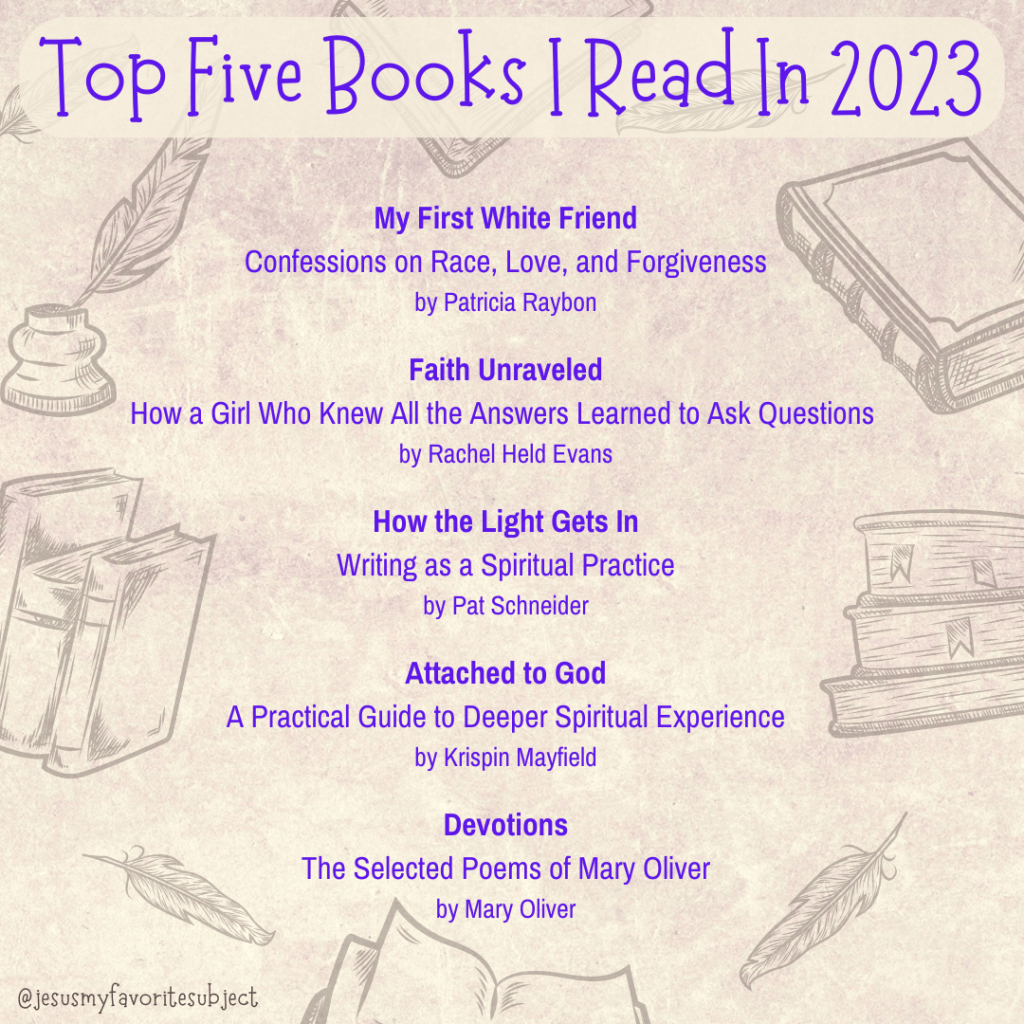
  • My First White Friend: Confessions on Race, Love, and Forgiveness, by Patricia Raybon
  • The Big Book of Christian Mysticism: The Essential Guide to Contemplative Spirituality, by Carl McColman
  • unbelieve: poems on the journey to becoming a heretic, by Marla Taviano

Books by authors in the Christian writing critique group I attend:

  • Surviving the Sand: My Family’s Struggle to Farm the Pasco Desert, by Helen Lingscheit Heavirland
  • Life Aboard a Sinking Ship: Mishaps and Mayhem on a Navy Tugboat, by Lee Yates as told to Blanche Yates
  • Building the Columbia River Highway: They Said It Couldn’t Be Done, by Peg Willis

Until last year, children’s books comprised nearly all my reading of poetry. Think Dr. Seuss and Shel Silverstein. When I started writing poems, I knew I needed to overcome my fear of poetry that isn’t illustrated and in large print. My sister helped by recommending several poets, and I read five books of poetry—including a compilation containing three of my poems, and the above-mentioned book by Marlia Taviano.

  • Swallow’s Nest: Poetry Journal, Fourth Annual Issue—December 2022, compiled by Linda L. Kruschke for Oregon Christian Writers
  • To Bless the Space Between Us: A Book of Blessings, by John O’Donohue
  • Stripped, by Cara Alwill Leyba
  • Devotions: The Selected Poems of Mary Oliver, by Mary Oliver

My reading last year included only one or two books from the self-help genre. I’d like to think this is because my mental and emotional health are improving. Or maybe I have that backward, and my mental and emotional health are improving because I’m not reading so many self-help books. Instead, I read more stories. There must be a technical term other than “story”—I’m sure “memoir” would apply to some—but to me these books are lovely because they are stories. The authors don’t tell me what to think. Rather, they invite me into their experiences. A good story is an offer of intimacy, a passageway to the inner workings of another human being and the wildness of their story. In addition to half a dozen of the above-listed books by authors I know, here are the stories I read last year.

  • Julie & Julia, by Julie Powell
  • Growing Up, by Russell Baker
  • Once Upon an Island: The Adventures of a Young Couple Who Did Buy Their Dream Island, by David Conover
  • I Went to the Woods: The Adventures of a Bird Photographer, by Ronald Austing
  • Faith Unraveled: How a Girl Who Knew All the Answers Learned to Ask Questions, by Rachel Held Evans
  • Intersexion: A Story of Faith, Identity, and Authenticity, by Cynthia Vacca Davis
  • The Face of Addiction: Stories of Loss and Recovery, by Joshua Lawson
  • Sealed: An Unexpected Journey Into the Heart of Grace, by Katie Langston
  • Love Warrior: A Memoir, by Glennon Doyle
  • Birding Against All Odds, by Joan Easton Lentz

Every one of the spiritual books I read felt like friendship. These books saw my heart and spoke both things I knew and things I didn’t yet know. They pushed me to try new things, think new thoughts, ask new questions. God and spirituality captivate me in a way nothing else does. I underline, write down page numbers, read aloud to my husband, and text paragraphs to friends. Although this happens with other books as well, it is spiritual books that most often invite me home, to a profound sense of belonging.

  • How the Light Gets In: Writing as a Spiritual Practice, by Pat Schneider
  • Attached to God: A Practical Guide to Deeper Spiritual Experience, by Krispin Mayfield
  • Small Victories: Spotting Improbable Moments of Grace, by Anne Lamott
  • The Tao of Pooh: The Principles of Taoism Demonstrated by Winnie the Pooh, by Benjamin Hoff
  • False Intimacy: Understanding the Struggle of Sexual Addiction, by Dr. Harry W. Schaumburg
  • Wild Mercy: Living the Fierce and Tender Wisdom of the Women Mystics, by Mirabai Starr
  • Forgive Everyone Everything, by Gregory Boyle, art by Fabian Debora
  • Seeking the Triune Image of God in You: A Glimpse Through a Keyhole, by Jeffrey D. Hill
  • Breathing Under Water: Spirituality and the Twelve Steps, by Richard Rohr

Re-reads. Finally, I read these three books a second time, because, in my humble opinion, they are just that good.

  • The Whole Language: The Power of Extravagant Tenderness, by Gregory Boyle
  • Bird by Bird: Some Instructions on Writing and Life, by Anne Lamott
  • Present Over Perfect: Leaving Behind Frantic for a Simple, More Soulful Way of Living, by Shauna Niequist

Thirty-seven books, and probably a few more I forgot to write down. It is a still-infant privilege, this copious access to written material. And yet, having grown up in America late in the 21st century, I can’t imagine anything else. Shelves of books are the backdrop to my office, my small groups, and my mental and emotional spaces. I am profoundly thankful for each author who puts their words into public spaces, and for the privilege of having time to pick up those words and hang out with them.

What did you read in 2023? Leave a comment and maybe I’ll add your recommendation to the list of books I want to read.

Books I read in 2022

Favorite new-to-me Author: Barbara Brown Taylor

  • Leaving Church: A Memoir of Faith
  • An Altar in the World: A Geography of Faith
  • Holy Envy: Finding God in the Faith of Others

As I review the list of books I read last year, I am reminded of God’s propensity to show up with impeccable timing. My introduction to Barbara Brown Taylor was one such instance. Last year my sister connected me with Writing for Your Life, and I considered attending one of their conferences featuring Barbara Brown Taylor as a speaker. I wasn’t familiar with her so I decided to order one of her books—see if I might like (or dislike) her writing. The book I ordered was Leaving Church, an appropriate title, given that our family had recently stepped down from six years in house church leadership.

When I start writing quotes on note cards, I know I’ve found a favorite new author. I felt seen and affirmed as I read Barbara’s story. Here are samples from my note cards:

“I had kept my soul so hitched to the plow that it stood between the traces even after the harness was off, oiled, and hung on the wall.”

“If you decide to live on the fire that God has kindled inside of you instead of rushing out to find some sticks to rub together, then it does not take long for all sorts of feelings to come out of hiding.”

“I decided to take a rest from trying to be Jesus … Today I will take a break from trying to save the world and enjoy my blessed swath of it instead. I will give thanks for what is instead of withholding my praise until all is as it should be. If I get good enough at this, I may even be able to include my sorry self in the bargain.”

So good.

After Leaving Church, I read An Altar in the World, which again coincided with a turning point in my life—or maybe created that turning point. The final chapter is about blessing, a topic I had never heard of, despite the word’s frequent appearance in Scripture and around the dinner table. Barbara wrote, “The most ordinary things are drenched in divine possibility.” I was captivated. I began writing blessings, beginning each with the phrase, “Blessed are You, Lord our God, King of the Universe.” I have found joy as I discover the divine in dirt and desire, bodies and brokenness, tears and trees. I have written nearly thirty blessings, and post one to my blog and social media every Monday. This has been an exciting journey for me into the world of poetry. Even more amazing, it has opened my eyes to the wonders of the natural world and of daily experiences, in a way I never thought possible.

Next I read Holy Envy: Finding God in the Faith of Others, a continuation of Barbara’s personal faith story, and an invitation to God’s presence in the people and practices of faiths other than Christianity. An excellent read.

Fiction and Stories

  • Run To Overcome: The Inspiring Story of an American Champion’s Long-Distance Quest to Achieve a Big Dream, by Meb Keflezighi with Dick Patrick
  • Just Mercy: A Story of Justice and Redemption, by Bryan Stevenson
  • Nobody Don’t Love Nobody: Lessons on Love from the School With No Name, by Stacey Bess
  • Overcomer, by Chris Fabry, a novelization based on the motion picture by Alex Kendrick and Stephen Kendrick
  • Carry On, Warrior: The Power of Embracing Your Messy, Beautiful Life, by Glennon Doyle Melton

Short notes on these:

Run to Overcome My favorite part was the first couple of chapters, detailing the author’s early life in Eritrea, and the determination of his parents to seek out a new life for their large family.

Just Mercy This story demonstrates what compassion and empathy, justice and mercy look like with skin on. I highly recommend it. (The movie is good too).

Nobody Don’t Love Nobody Another flesh-and-blood illustration of compassion, this is a moving story that forever changed the way I view helping others.

Overcomer Enjoyable read. Based on the movie, which I also enjoyed.

Carry On, Warrior One of the qualities I most admire in writing is the ability to put one’s inner world into words. Glennon Doyle Melton has a gift for this. Carry On, Warrior was a funny, refreshing and personally challenging read.

Spiritual and Self-Help Books

  • Barking to the Choir: The Power of Radical Kinship, by Gregory Boyle
  • Tattoos on the Heart: The Power of Boundless Compassion, by Gregory Boyle
  • Almost Everything: Notes on Hope, by Anne Lamott
  • Grace (Eventually): Thoughts on Faith, by Anne Lamott
  • The Making of a Mystic: My Journey With Mushrooms, My Life as a Pastor, and Why It’s Okay for Everyone to Relax, by Kevin Sweeney
  • Braving the Wilderness: The Quest for True Belonging and the Courage to Stand Alone, by Brené Brown
  • MOMumental: Adventures in the Messy Art of Raising a Family, by Jennifer Grant
  • The Hidden Half of the Gospel: How His Suffering Can Heal Yours, by Paul Coneff with Lindsey Gendke
  • No Cure for Being Human (and Other Truths I Need to Hear), by Kate Bowler
  • Free From Sin: The Audacious Claim of Gospel Freedom and What It Means for You, by Jonathan Leonardo
  • No Longer I: The Power of the Gospel Like You Have Never Heard It Before, by Jacob Hotchkiss
  • Grace Based Parenting: Set Your Family Free, by Tim Kimmel

I’ve ordered these books by how much I enjoyed them (starting with the most enjoyable). I won’t comment on every one.

Gregory Boyle and Anne Lamott were my favorite new authors in 2021. I continued reading them this year and was not disappointed.

The Making of a Mystic caught my eye because Gregory Boyle often quotes the great mystics, but I had no idea what a mystic is. When I watched this book interview with Kevin Sweeney, author of The Making of a Mystic, I was intrigued. I ordered the book and read with rapture. It is a fascinating personal story, and an invitation to a new way of seeing, well, everything.

Brené Brown is a longtime favorite author. I thoroughly enjoyed Braving the Wilderness. Here is one of my favorite passages, from the chapter titled, “Hold Hands. With Strangers.” (emphasis added)

While we may all be gathered behind the same bunkers of political or social belief and ideology, we’re still alone in them. And even worse, we’re constantly monitoring ourselves. The looming threat of blowback should we voice an opinion or idea that challenges our bunker mates keeps us anxious. When all that binds us is what we believe rather than who we are, changing our mind or challenging the collective ideology is risky.

When a group or community doesn’t tolerate dissent and disagreement, it forgoes any experience of inextricable connection. There is no true belonging, only an unspoken treaty to hate the same people. This fuels our spiritual crisis of disconnection.

MOMumental is a humble and humorous collection of stories about Jennifer Grant’s parenting adventures. It is encouraging, which every parenting book should be if at all possible. I fell in love with Jennifer’s children’s books—especially Maybe God Is Like That Too—which led me to try one of her books for women. This is one of those books I wish I’d read six or seven years ago, when I needed more moments of grace to survive preschool parenting.

The Hidden Half of the Gospel, Free From Sin, and No Longer I were theological reads, with which I developed a love-hate relationship. I found life-giving ideas that resonated with my personal journey. I also found a prescriptive way of speaking that triggered my shame-based, black-and-white patterns of thinking. I take full credit for this, as I would not say any of them endorse shame and legalism. It was simply a manner of speaking that was at times triggering for me.

In conclusion, I am not the same person I was a year ago, and that is due in part to many of these books. Reading good writing is a thrill, as are the “me too” moments, and the “I’d never thought of it that way before” moments. Reading opens me, and oh, how I want to be open. Here’s to another year of reading, another year of intimacy with beautiful, broken people.

Books I Read In 2021

Books By Favorite New Authors:

  • Bird by Bird: Some Instructions on Writing and Life, by Anne Lamott
  • Traveling Mercies: Some Thoughts on Faith, by Anne Lamott
  • Help, Thanks, Wow: The Three Essential Prayers, by Anne Lamott
  • The Whole Language: The Power of Extravagant Tenderness, by Gregory Boyle
  • Dusk, Night, Dawn: On Revival and Courage, by Anne Lamott

Two things changed my life in 2021: 1) the MUK LUKS® my mother-in-law gave me (my feet are the warmest they’ve been since leaving my mother’s womb), and 2) the book The Whole Language: The Power of Extravagant Tenderness, by Gregory Boyle. This book took God right out of the box I had Him in. It pushed me in the best way possible, away from the shallows into a deep, expansive God. It changed how I think about myself and the people around me. It made me laugh and cry. I copied line upon line into my journal:

“God meets our intensity of longing with intensity of longing.”

“We always need to abandon ‘performance’ when it comes to God, and walk instead into the arms of encounter.”

“God is only interested in lavishing us with extravagant tenderness, and yet we are convinced that God is thinking we all could just do a better job.”

“What saves us in the present moment is being anchored in love and tethered to a sustaining God who keeps reminding us of our unshakable goodness and the goodness of others.”

In addition to these legalism-defying snapshots of God, the book overflows with stories of the “homies” Father Boyle works with at Homeboy Industries. These stories of wounded people who wound others—but find themselves always in the good graces of God—paint the most ravishing picture of Jesus. This book gave me permission to say, “I couldn’t be any better,” instead of “I’m such a mess.”

Boyle has written two other books, one of which I’ve already read this year; the other is on my nightstand ready to be imbibed. He spoke at the university here where I live, and I met him afterward. This was long before I had read any of his books, but it still gives me bragging rights (wink).

Another author whom I read for the first time last year, and immediately fell in love with, is Anne Lamott. The first Lamott book I read was Bird by Bird: Some Instructions on Writing and Life. It was recommended by multiple friends, and when I finally read it I was hooked. “Good writing is about telling the truth,” she writes, and she is wildly honest. She is refreshing, funny, and deeply real. Special thanks to my sister for lending me several of her Lamott books to feed my addiction.

Fiction and Stories

  • Stormie, by Stormie Omartian
  • Kisses from Katie: A Story of Relentless Love and Redemption, by Katie Davis, with Beth Clark
  • The Bridge, by Karen Kingsbury
  • A Time to Mend, A Time to Gather, and A Time to Surrender (3 books), by Sally John & Gary Smalley
  • The Secret Garden, by F. Hodgson Burnett

I have read Stormie several times. It’s an easy read and a powerful story of God’s redemption in the aftermath of being raised by a mentally ill mom. Kisses from Katie is an unexpected tale of Jesus’ love in the life of a teenage girl who moved to Uganda and adopted 13 daughters.

If you like Christian fiction and haven’t read Karen Kingsbury, definitely give her a try. I’ve enjoyed dozens of her books. The series by Sally John and Gary Smalley was excellent as well.

I read The Secret Garden aloud to my husband—a fun way to revisit a classic. We’ve also read Tom Sawyer aloud together, and The Hobbit.

Parenting Books

  • How To Talk So Kids Will Listen & Listen So Kids Will Talk, by Adele Faber and Elaine Mazlish
  • Discipline That Connects With Your Child’s Heart: Building Faith, Wisdom, and Character in the Messes of Daily Life, by Jim and Lynne Jackson

Parenting is a tough subject to write about. As parents, we look for answers, but I think we know that no method is really an answer. I appreciated the respectful and emotionally intelligent approach of How To Talk So Kids Will Listen & Listen So Kids Will Talk, as well as the reflection questions and practice exercises.

Discipline That Connects With Your Child’s Heart is my favorite parenting book and the only one I have returned to multiple times. I always refer to it as “the book that sent me to counseling,” which is true. It has a number of suggestions for being safe with our children, such as taking a minute to calm down before responding to a stressful situation. One idea was to keep a small bottle of lotion in your pocket and take time to stop and rub lotion into your hands so you can emotionally re-center before engaging with your kid(s). I read that, and I knew I needed a month on a desert island to re-center… and that’s when it occurred to me that counseling might be in order. I was fortunate to find a counselor whose guidance was in sync with the Holy Spirit in my life. What a blessing that was during the most trying years of parenting preschoolers.

Religion and Self-Help Books

  • In the Realm of Hungry Ghosts: Close Encounters with Addiction, by Gabor Maté
  • The Ruthless Elimination of Hurry, by John Mark Comer
  • God Has a Name, by John Mark Comer
  • All Shall Be Well: Awakening to God’s Presence in His Messy, Abundant World, by Catherine McNiel
  • A Personal Perspective, by Sonya Lang Hackett
  • Love Lives Here: Finding What You Need in a World Telling You What You Want, by Maria Goff
  • Happiness Is a Serious Problem: A Human Nature Repair Manual, by Dennis Prager
  • The Lies We Believe about God: Knowing God for Who He Really Is, by Dr. Chris Thurman
  • The Meaning of Marriage: Facing the Complexities of Commitment with the Wisdom of God, by Timothy Keller with Kathy Keller

I’ve ordered these books from most favorite to least favorite. I won’t comment on all of them. First, let me say that I have received tremendous insight from Timothy Keller’s books and sermons, and I would recommend everything I’ve read or listened to, except this book on marriage. It was unbearably dry, and so long… it may be represented in one or two of my gray hairs.

John Mark Comer was my favorite new author last year and I enjoyed his books again this year. Catherine McNiel is another author I returned to, and would recommend, especially for young mothers.

At the top of the list is a book recommended by my friend Ruth. It’s a longer book (536 pages), but it was such a blessing. It gave me a much broader and more informed perspective on addiction. I enjoyed the stories more than the medical explanations, but both were helpful. Maté writes with authenticity and understanding. He was also featured in a documentary titled The Wisdom of Trauma, which has sparked an ongoing conversation about mental illness and addiction. I’ll close this post with a quote from Maté: “Trauma is not what happens to you. Trauma is what happens inside you, as a result of what happens to you.”

Books I Read in 2020

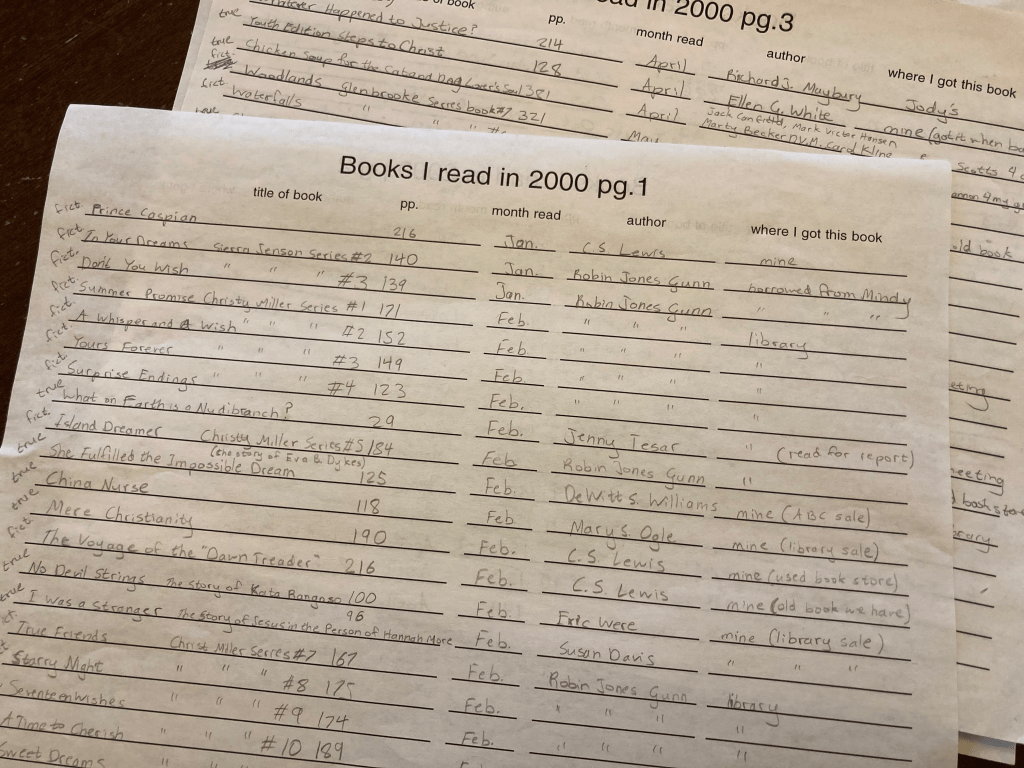
I still have some of my first book lists so just for fun I pulled them out as I was writing this post.

They are a testament to the organized person I used to be. Besides the title and author(s) of each book, the list also includes the number of pages, the month I read the book, whether it is fact or fiction, and where I acquired the book. In the year 2000 – the year I turned 15 – I read 80 books. In 2001 I read only 21 books, suggesting that homeschooling was a major factor in the number of books I read. I finished 10th grade at home and started attending a private Christian high school for 11th grade in 2001.

Interestingly, two authors I read in 2020 are prominently featured in my 2000 book list: C. S. Lewis (ten books), and Robin Jones Gunn (30 books). One book got the word BORING beside it. I still remember slogging through that one. Looking over my old book lists was a fun trip down memory lane, and I noticed the genres of my reading material are basically the same now as then.

I’m listing 27 books I read this year, and have divided them into four categories: fiction, books I read aloud to my daughters, theology/spirituality and personal growth, and miscellaneous. I have previously read seven of the 27 books, some of them multiple times (there is always more to glean from classics like Mere Christianity). I also have certain authors I’m enjoying in this season of life, and I like to read something by them each year: Brené Brown, Timothy Keller, Rachel Held Evans. I discovered John Mark Comer this year and plan to read all his books.

Fiction

  • Grace, by Shelley Shepard Gray
  • Moonlight On The Millpond, by Lori Wick
  • A Time to Dance and A Time to Embrace, by Karen Kingsbury 
  • Finding Father Christmas, by Robin Jones Gunn
  • Engaging Father Christmas, by Robin Jones Gunn

I admit my fiction list is extremely narrow and uninteresting. All the titles are Christian romance novels. Robin Jones Gunn is my favorite fiction author, and I often re-read her Glenbrooke Series. This Christmas I signed up for the Hallmark Now 7-day free trial so I could watch the three movies based on the Father Christmas stories.

I tried to read the Anne of Green Gables series again this year, but I got bogged down. I’m not sure what that was about. I loved those books when I read them as a teen, and if I remember correctly I read them multiple times. Perhaps being mother to a talkative eight year old causes me to have an aversion to a character who talks continuously. Ha!

Books I Read Aloud To My Daughters

  • Dr. Rabbit, by Eric B. Hare
  • Love Does for Kids, by Bob Goff and Lindsey Goff Viducich
  • Born Free, by Joy Adamson 
  • Living Free, by Joy Adamson
  • The Seven Secrets of Somewhere Lake, by Sam Campbell
  • Soul Surfer, by Bethany Hamilton (with Sheryl Berk and Rick Bundschuh)

Other than Love Does for Kids, all these books were re-reads. My daughters (ages 6 and 8) especially enjoyed the Joy Adamson books, which tell the story of lioness cub Elsa, and the author’s continued friendship with her as Elsa became an adult lion and was released to the wild. According to wikipedia.org, Born Free spent 13 weeks at the top of the New York Times bestseller list when it was published in 1960. I had not read these books since I was a teen, and it was fun to revisit the story with my daughters.

Another favorite author from my childhood that I am now sharing with my children is Sam Campbell. During the spring COVID quarantine Your Story Hour posted read-alouds on YouTube for the book Loony Coon, and my girls ate up every minute of it. They were also fully engaged in the funny and heartwarming story The Seven Secrets of Somewhere Lake. If you’ve not read Campbell before, don’t start with a philosophical read like How’s Inky. Try Loony Coon or Eeny, Meeny, Miney, Mo… and Still – Mo: Lessons in Living From Five Frisky Red Squirrels.

Soul Surfer was the middle step in a three-step experience of learning Bethany Hamilton’s story. First we watched the documentary Bethany Hamilton: Unstoppable. Then we read the book. Last we watched the 2011 movie Soul Surfer. Besides enjoying the story, this was also a great way to look at how nonfiction is often woven with fiction for storytelling purposes such as a movie.

Theology/Spirituality and Personal Growth

  • I Thought It Was Just Me (But It Isn’t): Making the Journey from “What Will People Think?” to “I Am Enough,” by Brené Brown 
  • Mere Christianity, by C.S. Lewis (reread)
  • The Reason for God: Belief in an Age of Skepticism, by Timothy Keller (audio book)
  • To Hell With The Hustle, by Jefferson Bethke
  • Long Days of Small Things: Motherhood as a Spiritual Discipline, by Catherine McNiel
  • The Ruthless Elimination of Hurry, by John Mark Comer
  • Living Loved: Recognizing and Responding to God, by Laurice Shafer (reread)
  • The Road Back to You: An Enneagram Journey to Self-Discovery, by Ian Morgan Cron and Suzanne Stabile
  • A Year of Biblical Womanhood: How a Liberated Woman Found Herself Sitting on Her Roof, Covering Her Head, and Calling Her Husband “Master,” by Rachel Held Evans
  • The God-Shaped Heart: How Correctly Understanding God’s Love Transforms Us, by Timothy Jennings
  • The Sonship of Christ, by Ty Gibson 
  • Garden City: Work, Rest, and the Art of Being Human, by John Mark Comer

For me this genre always clocks the most reading hours. My favorite of all the books I read this year was The Ruthless Elimination of Hurry by John Mark Comer. I don’t entirely understand why, but that book was water to my soul. I drank it up, I sank into its cool depths, I was inspired and refreshed and given permission to breath.

Long Days of Small Things: Motherhood as a Spiritual Discipline is a book I wish I had read every year since my first daughter came along (a tall order considering it was not yet published). The gift it gave me was the realization that the tasks of mothering are acts of worship. It reframed the daily grind in a way that gave me permission to breath a little deeper. I recommend it to anyone with a baby or young child(ren).

Miscellaneous

  • The Boy Who Harnessed the Wind: Creating Currents of Electricity and Hope, by William Kamkwamba and Bryan Mealer
  • No Shortcuts to the Top: Climbing the World’s 14 Highest Peaks, by Ed Viesturs with David Roberts
  • Seriously…I’m Kidding, by Ellen DeGeneres
  • Rebel With A Cause: Finally Comfortable being Graham, by Franklin Graham

The Boy Who Harnessed the Wind opened my eyes to another person’s world, and that is what I loved most about it. The Ellen DeGeneres book was purely entertainment. The other two stories were fun and interesting reads about men who have an almost insatiable thirst for adventure, and a high tolerance for risk. Since I’m at the opposite end of that spectrum, reading is the ideal way for me to share their experiences.

That’s all, folks. I’d love to hear about what you read in 2020, or what’s at the top of your list for reading in 2021.

Photo by Taryn Elliott from Pexels