Tag Archives: relationships

Run-on Marriage

Last week Michael and I celebrated 20 years of marriage. The run-on sentence below illustrates our run-on marriage. (And yes, we’re still crazy about each other, in addition to driving each other crazy.)

I cannot get in bed when the bedcovers are frumpy, drifting off the end of the bed, sideways, knowing that if I do lie down and tug on them I will get too much sheet, too little blanket, and the wrong corner of the comforter; but I do not make my bed in the morning—I make it right before I climb in bed at night, tugging with exaggerated exclamations as I dislodge cats, and my poor husband too, because there’s a tiny possibility that I idolize sleep and this bed is my altar and before I sacrifice my body the altar must be prepared as if for a temperamental god of linens, and I like to remind my husband that before I met him my sheets would stay tucked in and straight for months at a time, but since his feet hang over the end of the bed and he tosses and turns at night, I have to straighten the covers every single day, and I accomplish this with more violent energy and bitter comments than necessary, although one would think after 20 whole years I would have adjusted and calmed down about it—but he huffs and makes less-than-charitable remarks every time he drives, and he has been driving for twenty-five years, so I guess we are both going to have our snide remarks and adult tantrums and all shall be well. 

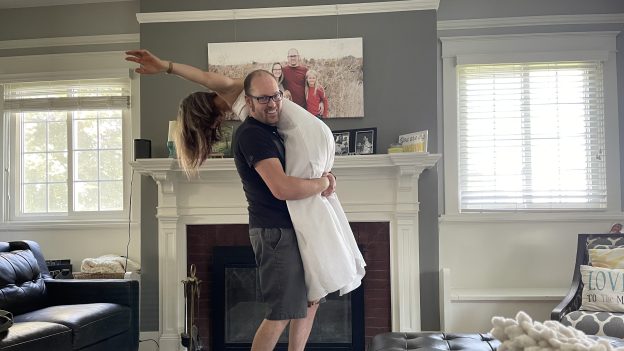
P.S. I usually use stock photos, but the photo for this post is of my husband and I earlier this month. I barely squeezed into my wedding dress, which I attempt every September as our anniversary rolls around.

Everything Is Well but Not Okay

On Sunday morning I lay in bed with my back against my husband’s chest, and the cat propped against me with her hindquarters on the bed and the rest of her body relaxed against my belly. As she purred, Michael and I groggily checked in with each other about last night’s sleep and the coming day’s hopes. In that moment I knew I was the luckiest woman in the world.

Also, too many people I know are in agony. It’s the usual culprits—death, divorce, disease. Add to that a whole lot of problems that haven’t been named or categorized. I know people who are feeling the brokenness in their minds and bodies, whether it has a name or not.

We’re veeerrryy close to the beginning of a remodel project that will add a master bath to our home. I can’t wait for the first day of real work, when the contractor comes in and lays that heavy duty cardboard down to protect the floors, and they start demolishing walls. I’m giddy with excitement about the next few weeks of packing up my bookshelves and moving things around to accommodate the remodel. Don’t ask me to explain this joy, but by golly I’m going to revel in it whether I can explain it or not.

I’ve been crying more lately, which is oddly comforting. I haven’t cried much the last year and a half since I’ve been taking anti-depressants. Whatever curbs my depression and anger also curbs tears, and I’ve missed crying. Last night I cried at the end of the Disney movie, Elemental. I teared up recently during a dolphin show at Sea Life Park. And this morning I cried when I shared a heavy heart with friends and their response came back immediate and full of love.

Yesterday I met with the school counselor at our local alternative high school. I’m slowly making connections in the community with the goal of learning about trauma-informed education and someday facilitating writing groups that empower incarcerated and underprivileged people to tell their stories. I want to give them room to be seen and heard. Writing is one path toward wholeness, and wholeness matters. Two books near the top of my TBR pile will help me with this—Between the Listening and the Telling, by Mike Yaconelli, and Writing Alone and With Others, by Pat Schneider. Just looking at those books gives me a tiny burst of energy, and if I let myself imagine a future in which I write with others toward healing, I break into a smile. Hand me the tools and let me get started!

If someone is living a better life than me, I don’t know who it is. Of course it wouldn’t take long to write down a dozen things that could be improved—but why bother? Today is my day to live, as me. I have what I need. I am enough. God is big and bigger and biggest.

When I feel the tension, I often return to these quotes, best when read together:

“Everything is so not okay.” -Anne Lamott*

“All shall be well, and all shall be well, and all manner of things shall be well.” -Julian of Norwich

Yes.

*Okay, the truth is I’m pretty sure I read this in an Anne Lamott book, but I can’t find it again. If you know, send me the book title and page number.

Cousins

Cousins

Blessed are You,
Lord our God,
King of the Universe,
for cousins—
like siblings
but without the drama,
similar to me in ways that are comfortable,
and familiar with the foibles
of the adults in my life.

Blessed are You
for sleepovers and Mad Libs,
tea parties and birthday parties,
visits to city parks and county fairs,
and standing in the concession line
at the pool, dripping wet,
to buy popsicles and pretzels.

Blessed are You,
Lord our God,
King of the Universe,
for older cousins who take
the burden of all the “firsts,”
and younger cousins who put up with
the older ones bossing them around.
You knew we’d need friends
who were actually relatives
but not our immediate family,
so You made cousins.

Big Joy

We returned a few days ago from vacation, and our upstairs cat, Phiona, seems particularly delighted to find me at my desk this morning. She jumps on my lap and leans into me. I put an arm around her and she settles down with loud purrs. I am charmed, as always, by her beauty and aliveness.

Other people’s cats—like other people’s kids—often look a little strange to me. I notice their proportions more than their personality, and nearly always conclude that my cat (or kid) is better. While I’m not proud of this, I’ve come to believe it’s a natural response to relationship. It is because I have a relationship with Phiona that I experience pleasure by looking at her, belonging when she flops across my feet for a nap, and joy when we play with the plastic bug my daughter tied to a piece of yarn.

“Joy is always relational,” write Marcus Warner and Chris Coursey in their book The 4 Habits of Joy-Filled People (p. 35). It’s a strong statement, but let’s play along and assume that joy is always relational. Put another way, joy comes from “knowing that someone is happy to see me” (p. 33). Is despair, then, the feeling that not a person in the world would be happy to see me? Is bitterness always relational too? Talk to a bitter person and you’ll get an earful about what they have or haven’t received at the hand of their dad, boss, roommate, kids, and church.

I wonder what joy looked liked for Jesus. Assuming He had an abundant supply from His relationship within the Trinity, would He also experience joy when people were happy to see Him? Imagine rounding the aisle at the grocery store, seeing Jesus, and spontaneously breaking into a joyful wave-and-smile. Does my joy produce joy in Him? It’s hard to imagine God coming away from an encounter with me feeling different than He felt before the encounter. And yet, if joy is always relational, then joy is the currency of divine-human interaction, and I’m inclined to believe this is not a one-way street.

Was Jesus’ greatest agony the (perceived) loss of all relationship on the cross? He asked his Father, “Why have You left me?” Stripped of relationship, what sustained Him? Dare I wonder if His relationship with Himself played a role? My inner critic says that question is sacrilegious. Relationship with self is so secular it’s scandalous. Love for us is what sustained Jesus.

But wasn’t that love for us something He found deep in His own self? Certainly He didn’t sacrifice Himself in loathing, as we are apt to do. He didn’t conclude that life wasn’t worth living. He must have valued life and held a deep regard—a love—for His own life, even as He parted with it. Perhaps it is in the safety of loving ones own self that a person finds strength to face death. After all, I will experience death alone, no matter how many people may be in the room. If I haven’t found peace in my own company, how can I receive death?

Sometimes I wonder what would happen to me if I existed only in relationship to God and to myself. How might I survive if war or disaster stripped human-to-human relationship from me? My guess is I would spend much of my time remembering the relationships of the past and desiring relationship in the future. It is human nature to visit a graveside and talk to a lost loved one, because even in the sorrow of death, we derive joy from that relationship.

I suppose it’s silly to spend time and energy considering lack of relationship, when the world I inhabit is drenched in relationship. And, truth be told, the joy of relationship finds expression in those who love themselves and those who don’t, those who fear death and those who don’t. Some folks are alone but not lonely, while others are lonely but not alone. It is in this complexity that God literally shows up everywhere. He’s not constrained to relationship with only those who love themselves, or only those who loathe themselves. His image is not confined to emanating from people who love well. His joy is not limited to those bathed in relationship.

There is no formula, and yes, even my response to this is divided—equal parts terror and comfort. I am outraged that “a” added to “b” doesn’t always equal “c,” but I am also relieved. I’m not hallucinating when I see exceptions, the edge cases that don’t fit my ideas of love and joy. I will be okay if I don’t follow the formula. In the meantime, I will cultivate joy by cultivating relationship. The scandalous promise of the upside-down kingdom is that as we exist in joyful relationship with God, we will find other people’s cats and kids looking a little less strange. The world of relationship will widen to include our enemies. We will be happy to see people, and they will know they are safe in relationship with us. That’s how I want to live.

What Is Kinship?

This morning I’m sitting in a favorite coffee shop as I write. Country music plays a little louder than I’d like from a speaker above, but quiet enough that I can overhear conversation. Two men in their seventies talk about therapy, travel plans, searching for a church that fits, and learning to support a recently-divorced family member. These men share themselves, hear each other, and speak encouragement. This, I think, is kinship.

I’m on a quest to learn about kinship. A google search provides this uninspiring two-word definition: blood relationship. But kinship can be so much bigger than that, a new way to see myself and others, a way that assumes value and connection. In kinship we are all on the same side of the line, rendering divides impotent. No “them,” only “us,” as Father Boyle would say. Only us.

Kinship has been slow-coming in my life. I grew up in a home where social time was considered a waste of time. If it wasn’t an event—like a birthday party or a hike to the lake—socializing didn’t happen. Although I’d like to blame my family and upbringing for my struggle to settle into friendship—I lived in a tiny community and was homeschooled through tenth grade—I’ve discovered my fears are not unique. Many women feel a lack of intimacy, and fear they don’t know how to participate in friendship. And, of course, each of us thinks other women have it figured out.

Every year I make a photo book commemorating our previous year. That may sound very organized, but it’s actually quite haphazard. Recently, I’ve been sorting through pictures from the last two years. As I put photos into categories and months—pets, school, March, November—a new category emerged: fun with girlfriends. These photo books will be the first to include a friendship photo spread—pictures of lunches out, movie nights, birthday coffee dates, pottery painting, and shopping fun. Looking at them, I feel connected, grateful, and not at all sure how it happened. I used to “do” friendship; now I enjoy friendship. I wish I could tell you five steps from lonely and anxious to connected and content, but, at least for me, it has been more mystical than methodical.

For most of my adult life I have compensated for lack of friendship by joining or creating small groups. A ladies group is my happy place. Crafts, Bible study, accountability, book-reading—it doesn’t matter. The structure provides a place for me to show up, participate in the mutual honoring of each other with our time, and complete the prescribed activity. Slowly I have ventured into one-on-one time with a handful of girlfriends, and casual activities together, like shopping. My circles of belonging widen.

The terror and the joy of intimacy with friends cannot be understated. Could one text or one misunderstanding upset it all and leave me in pain? Yes, it could. But in these relationships, do I feel seen, known, and safe? Do I invite these women into my home when I haven’t mopped the kitchen floor for three months, or done the dishes for three days? Yes, I do. Do I text them when I’m discouraged and take them coffee when I have a free morning? I do. Is it still scary, and do I have social anxiety? You bet.

Intimate relationships cannot be wrangled. It is a fools errand, seeking to avoid anxiety or relational fallout. Instead, I will allow anxiety and fear of intimacy to remind me that I am not impermeable. I am not above pain and misunderstanding. And this capacity for pain, this vulnerability, is what allows me life-giving connection, the joy of belonging, and the wonder of holding safe space for another person. This is the magic of being human.

Stories about men and women who stand in the gaps, go to the margins, hold hands with the desperate—these are my favorite. I want to be the hero in every story—the woman who taught homeless children, the man who endured exhausting legal battles to free wrongly-incarcerated men and women, the writer who teaches veterans to tell their stories, and the 22-year-old who adopted more than a dozen impoverished children.

At the same time, I don’t want to get anywhere near such unpredictable, messy situations. Can you imagine teaching at a homeless shelter, where traumatized children are in your classroom for 90 days or less? What about working long hours as a lawyer, toiling for years to see one ruling overturned, more years to find out it’s too late, the execution is scheduled. That may be charity, but it’s also insanity. How much could I handle?

There is tension between my relentless desire to love, and the ever-present awareness and fear of my limitations. I don’t know what’s coming for me in life, but I know I want to rise to the occasion and choose real love over false safety. I’m grateful for the thousands who have done this before me, proving it is possible and powerful. I watch the nonprofits in my hometown of Walla Walla, Washington, as they construct shelters for homeless, hold hands with the formerly incarcerated, provide dental services, food and clothing, love and dignity. I want to be part of that.

Children’s Home Society,* a local charity that works tirelessly to keep families together through in-home visits and a score of other services, has discovered the power of kinship—linking arms with the marginalized and misunderstood. Each year at their fundraising luncheon, one of their clients gives a keynote presentation, a story of their move from the thinness of broken family, addiction, and poverty, to a wholeness they didn’t know was possible. These people, unlike many of the donors in the room, haven’t been able to keep their lives “together” and show the polished side to society. But for that very reason, their stories are potent with hope. Every person in the room feels the energy of kinship. Hearts beat faster. Smiles appear. Applause is loud and long. Every one of us loves stories of redemption, and kinship is the catalyst for redemption.

Jesus born in a barn is kinship. He grew up to touch the untouchables, teach the stubborn, and include the rejected. He forever found beauty in ashes, wholeness in tragedy, and life in death. He defied categories, sweeping them into a circle and inviting them to hold hands, mix together like a delicious, forbidden stew. With a twinkle in His eye, He invites me into spaces where the ground is dry and barren. He invites me to bring kinship—the first drop of rain.


*Children’s Home Society is in the process of re-branding as Akin. I love this short-and-sweet name that includes the concept of kinship—the earth-shaking power of standing at the margins and holding hands.
Worthwhile

Worthwhile

Blessed are You,
Lord our God,
King of the Universe,
for deciding human life was a good idea,
and for the total helplessness
of an infant,
causing mother and child to turn
toward each other over and over,
a hundred times
and then a hundred more.

Blessed are You
for giving us courage,
the desire to survive
and—even more so—to thrive,
to persist in the relationships
that continually test
and sustain us.

Blessed are You
for giving us courage
to believe in one another:
I am worthwhile, worth stillness.
You are worthwhile, worth time.
We are worthwhile, worth effort.

Blessed are You,
Lord our God,
King of the Universe,
for giving us courage
to act, or to be still,
to affirm our own dignity
and the dignity of another,
gifting us the intimacy
You created us for,
eternal turning
toward each other,
seeing and being seen.