Tag Archives: transformation

Disrupt the System, Applaud Early

Applause: public approval or praise expressed by clapping hands together.

Some fifteen years ago, I stood while applauding after a Distinguished Faculty Lecture at my alma mater. Is it a standing ovation if only one person stands? I stood, exuberant about the depth of understanding and connection I experienced during the lecture. But as my peripheral vision told me that no one else stood, self-consciousness bubbled up. Why am I the only one deeply affected? Does everyone else already have a depth of experience such that the lecture was run-of-the-mill for them? My pulse quickened and I lowered into my seat, certain everyone must be giving me the side-eye, judging my way of being in the world.

Looking back, I am proud of that moment. I know now that many of us who speak or write or reveal ourselves in some way, need only one person to stand. Only one person to send a note letting us know our words created connection.

Late last July, I attended “heART on display,” an event featuring artwork by incarcerated or formerly incarcerated individuals. Cedar Rain Spirits, a distillery and BBQ in downtown Walla Walla, hosted the event, curated by Devon Player, whom I met through the Walla Walla Community Change Team. Outside the narrow storefront, a sandwich board on the sidewalk announced the event. Inside, people mingled, music blared, and art lined much of the two long walls that extended to the back of the venue.

For the next hour, I perused art, snacked on free hors d’oeuvres, asked a few questions, and flattened myself into tables and walls to avoid bumping into fellow guests. As I chose art to purchase—proceeds to benefit Running Waters Equity Fund and the Black Prisoners Caucus—Devon took the mic and introduced a guest speaker, Anthony Covert. We all quieted where we sat or stood, and turned to listen.

Anthony was sentenced to 432 months (36 years) in prison at the age of 18. He served 16 of those, and walked free on June 10, 2024. As he talked about sitting in prison, alone with himself, I stumbled into sudden affinity with him. We “outside” (unincarcerated) folks have so much available to distract ourselves; it is a rare and excruciating experience to be alone with ourselves. “ But when you’re sitting in that prison cell and all you got is those four walls—sometimes with a celly, sometimes not—you have to sit with yourself.” And, he says, you have to ask yourself questions, about how you came to be in this place, and what your purpose is now that you’re here. 

My own season of being alone with myself and asking hard questions transpired during stay-at-home momming. I recognized that singular agony of sitting with oneself, and the subsequent decision to engage with tricky, heavy questions. As an incarcerated, black young man, Anthony felt it in the isolation of prison. As a middle class, white mother of an infant and toddler, I felt it in the isolation of motherhood. Although our experiences differed, Anthony’s words connected intimately with my inner world as a stay-at-home mom. Because he exposed his pain, I felt seen in mine. Our stories held hands for a just a moment. 

I wanted to applaud, but other listeners were intent, soaking up the story, not ready to respond. Anthony continued, and when he shared the completion of a college degree, while incarcerated, with a 3.98 GPA, everyone applauded, including me. Later, when he talked about his clemency hearing and the unanimous vote to grant him clemency, we applauded again. It was then that I noticed my moments of connection were not the same as the moments of applause. Before Anthony’s clemency hearing, when anxiety was high, Anthony’s friend Demar told him, “Go in there and show them who you are.” That moment connected. That moment I wanted to clap or sigh, or give the man a hug. Show them who you are.

Why the dissonance between my moments of kinship with the speaker, and our collective moments of applause? Could it be that as a society we are quick to applaud measurable achievement, but not moments of quiet strength? What about times of agonizing surrender—to our brokenness, and simultaneously to our wholeness? 

Anthony described us on the “outside” as an invisible army that stands with those on the “inside.” Because our worlds are disconnected, there is a wall isolating our compassion and assistance from the insiders’ knowledge, and/or response. Knowing this, may we be courageous to continue engaging—despite the lack of testimonials, catchy postcards, and fundraising galas that feed the selfish side of our generosity. 

“ There’s no fixing the system. It is what it is,” Anthony said. “But what you can do is disrupt it in certain areas, right? To give people opportunities to come home.”

What if applause—public approval or praise—happened earlier in the story, and it served to recognize nothing more than our humanity, the intrinsic dignity of our existence? What if clapping said, “you got this,” more than, “you did something big and measurable”? Better yet, what if approval and praise showed up in the process and in the conclusion? What if it gave people opportunities to come home—to themselves, to their families, to their communities? I need this. I suspect we all do.

I want to applaud early—for my children, my spouse, my friends, my community. A healer is “someone who can see the movement toward wholeness in you more clearly than you can at any given moment,” wrote Rachel Naomi Remen. Let’s open our eyes to see. Put your hands together for humanity. 

Let’s applaud smallness. Clap for the courage it takes to engage with our own selves and our messy stories. Cheer at the thin places in our stories, where pain and intention form a bond and point us in a new direction. Celebrate wholeness even as it lingers in the wings. Disrupt the narrative in ways that invite belonging. 
I Will Change, I Will Not Change

I fear Christian belief will have no real impact on my life. I’m aware that addiction, divorce, and abuse in the home wreak havoc among Christians as well as non-Christians. And the things we do to feel better about ourselves happen among Christians as well—keeping our stories and our houses as clean as possible, consuming coffee and sugar at alarming rates, moving from one place (or church) to another to escape the consequences of a damaging lifestyle or broken relationship.

Until recently, I spent little time considering the opposite fear—that God will influence, transform or otherwise impact me and my life. Carl McColman, author and fellow blogger, suggests, “Our deepest fear is not that there is no God. Our deepest fear is that God does exist and wants to become an intimate part of our lives, changing us forever.”1 I want to argue with him, but I can’t. I do fear God’s influence in my life. Chances are, He has a different list (does God have lists?) of priorities than I do, and His presence will affect change. I cannot sit with Him and expect to remain the same. This is unnerving at best, terrifying at worst, but also the thing I want more than anything else.

I hold both fears at once—that I will be changed, and that I will not be changed. McColman puts it in relational terms—the fear of loneliness/abandonment, or the fear of being engulfed. I want to keep God, and my dearest human companions, in a safe little space between those two realities. In this space, I will experience a controlled situation in which I am neither left nor overwhelmed.

There is no such space in intimate relationship. It’s not that God is in the business of leaving or overwhelming people. Rather, relationship is consent to be influenced. I am changed by the people I spend time with, and I, in turn, affect those same people. Is this also true in divine relationship? The Apostle Paul wrote, “And we all, with unveiled face, beholding the glory of the Lord, are being transformed into the same image from one degree of glory to another. For this comes from the Lord who is the Spirit.” (2 Corinthians 3:18 ESV)

I’m not sure I want to be unveiled with God. Isn’t that dangerous? Maybe we can work something out where I get to wear a veil. I’ll submit my list of prayer requests without approaching God. No need to bother Him; I know He’ll take care of things. Also, if His activity in my life is based on me doing a good job, I don’t need to spend time with Him. I can focus on being a kind and productive person, and He’ll take it from there. There are countless ways to avoid the influence of relationship. Keep it professional. Make rules. Perform. Retreat.

I suppose “influence” would be a good word to describe what happens when two people spend time together. Where does that leave control? “To have control is to have the power to run something in an orderly way.”2 Does God have this power? Is the universe orderly? Yes, it is, and no, it isn’t.

Influence is “the power to change or affect someone or something—especially the power to cause changes without directly forcing those changes to happen.”3 If I say God has influence but not control, have I emasculated Him in my view, or am I getting closer to freedom?

In a previous post I wrote, “Perhaps love is the pain of not being in control.” At the time of that writing, I explored what this means in terms of fearing my own feelings. Feelings often run free of logic and control, and therefore, I have tended to avoid them. Now, as I consider this statement in terms of relationship with God, it occurs to me this is a two-way street. God relinquishes control of me, and I relinquish control of Him. I believe this is painful for both of us.

At the same time, it is comforting. I approach God without the intent to control Him, knowing that likewise, He will not control me. I do not consent to be engulfed; I consent to be influenced. I do not consent to abandonment; I consent to a life that is not well-controlled, which is messy because love and free will are messy. Proximity includes vulnerability.

It is here that I may begin to love God. Also here is the shocking possibility that God allows me to influence Him. I don’t know how to love the Lord my God with all my heart. The best I’ve come up with in the past involved being respectful to Him, and nice to the person in front of me. There’s nothing wrong with that. But is it relationship?

I find no tidy conclusion, but I’ve stumbled upon a desire for consensual relationship with God. And so, I consent to be influenced. I consent to the pain of love, which is the pain of not having control. I accept that knowing God will change me, and it will not change me. I receive the fear of being an average human, the terror of becoming more, and all that it means to love because He first loved me.

Endnotes:
1McColman, Carl. The Big Book of Christian Mysticism, page 204.
2https://www.vocabulary.com/dictionary/control#:~:text=To%20have%20control%20is%20to,remote%20control%20for%20a%20television
3https://www.merriam-webster.com/dictionary/influence#:~:text=In%20modern%20use%2C%20the%20noun,something%20in%20an%20important%20way

An Invitation to Mystery

An Invitation to Mystery

Blessed are You,
Lord our God,
King of the Universe,
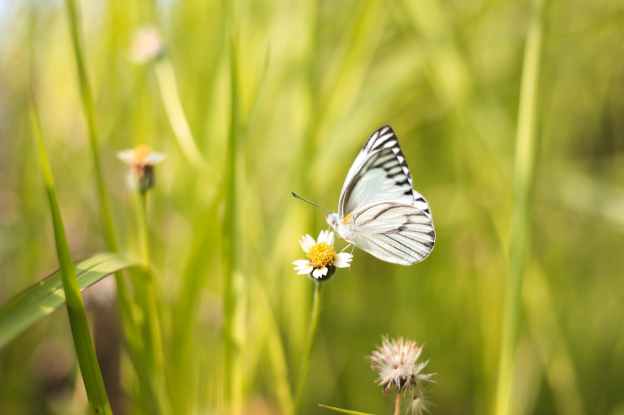
for caterpillars,
who quietly eat their way
from size zero to plus-size.

When they grow up
they find a place to hang
from their last proleg,
upside down.
Do they know they will never
eat another leaf?
that their next meal
and every meal thereafter
will be liquid?
Do they know they will
keep only their six front legs?

We humans were like caterpillars
in the garden of Eden,
squishy and naked,
immersed in plenty.
But we didn’t trust the plenty,
didn’t trust ourselves,
didn’t trust God.
We left the mystery of plenty
for the certainty of scarcity.
Perhaps it would have been better for us
to surrender to love,
and to allow love
an element of mystery.

Instead we work
to stay the same size,
the same shape,
eat the same leaves.
We use what we know
to fight against God
and each other,
forgetting that mystery
has its own peace,
and not-knowing sometimes
makes butterflies.

God’s Idea

God’s Idea

Blessed are You,
Lord our God,
King of the Universe,
for having Your own ideas,
different than mine—
puzzling, maddening, beautiful ideas.

Blessed are You for inviting me
from predictable to profound,
always reaching for a new surprise
from Your pocket or bookshelf,
Your eyes twinkling.

Blessed are You,
Lord our God,
King of the Universe,
for surprising me with joy and patience,
witnessing my jaw drop—
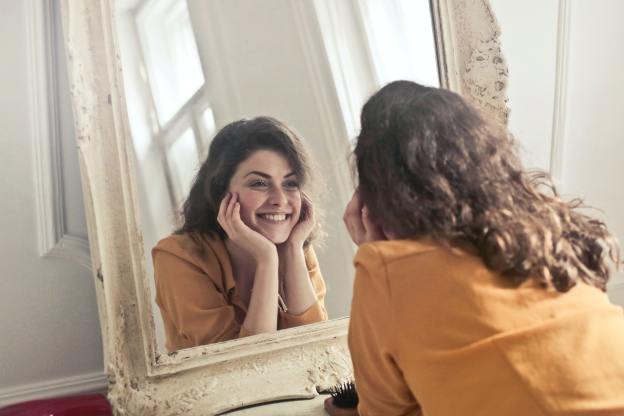
I stare at myself in wonder.
I watch myself be Your daughter,
and I glow with gratitude.
Your idea of me is so much better
than mine ever was.

Photo by Andrea Piacquadio: https://www.pexels.com/photo/photo-of-woman-looking-at-the-mirror-774866/