Tag Archives: writing

Death Is Beautiful

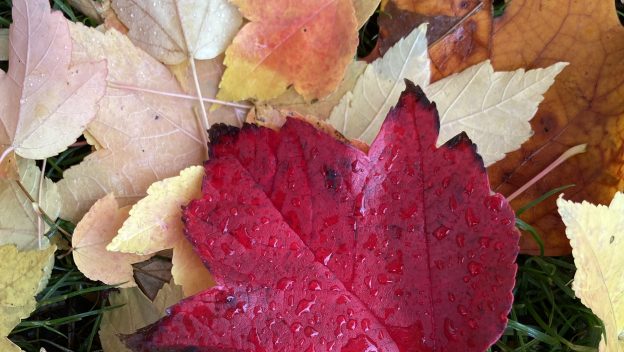
Death is beautiful. City streets and sidewalks are papered in it. Trees shout it with blazing reds and yellows—a rare season when the glow of sunset settles onto every country road and city block. And the individual deaths are as beautiful as the collective. If I dare use the worn-out snowflake analogy, each leaf is one-of-a-kind—the blend of colors, the shape and length of the stem, edges pointy or rounded, symmetry perfect or lopsided. Even the way it rides air currents to the ground is singular.

In the Celtic spiritual tradition, the phrase “thin places” describes those times when the veil thins between the now and the eternal, the ordinary and the extraordinary, and we see what is usually hidden. Death is one of those thin places.

Months before autumn, I walked a fog-covered beach on the Pacific Ocean, and death everywhere arrested me, stunned me, captivated me with its patterns and beauty. The oval-shaped outside of a small chiton shell—previously home to a creature that might have been the child of a limpet and a sea slug—was mossy green. But inside, surrounded by a wrinkly cream-colored girdle, an almost-neon aqua blue lit up the connected shell plates, and I stared in wonder. The shell of an urchin, now spineless, was covered with perfect rows of raised dots in muted tones of pink and green. The purple inside of a crab shell had patterns like light shining through water. Round jellyfish, symmetric from their thin edges to the white motif near their fat centers, lay stranded on the sand. A dead dragonfly, wings spread as if on display, had the bluest body, a peaceful gray-blue, but nothing dull about it.

My daughter picked up a crab shell which had been home to a couple dozen barnacles, and I imagined it in its heyday, scuttling through tide pools, unknowingly feeding the barnacles on its back, as well as itself. Uprooted seaweed formed circles and figure-eights. My daughters and I stomped on the seaweed air floats, trying to outdo each other with satisfying pops. One already-cracked float looked like Pac-Man, and another like a pelican’s head and neck. Shells, once symmetric, had broken into fragments and been polished smooth by the sand—pinks mottled like granite, colored ovals reminiscent of planetary rings, layered blues, and swaths of pearly iridescence. An art museum at my fingertips. 

As I contemplate the beauty of death, I can’t help but wonder what it will be like when someone I love dies. Will I feel the thinness between earth and heaven? Will there be beauty? Or will it be clinical, disturbing, exhausting, or—worst of all—sudden and too soon? I’ve never been with a person at death. I am curious—will there be a glimpse of what I have not seen before?

There is room for magic in morbidity. Although the leaves will turn brown, rot in the rain, and return to the soil, their week of splendor remains undiminished. Although every empty crab shell represents a death, and the waves and crunching feet will not leave them whole, they are no less exquisite. Although I will die, my passage from this life will squeeze the mortal and the immortal together for just a moment, creating a beautiful, painful, thin place.

The Red Circle

A perfect dark-red, circular spot on the beige carpet. I reached down and touched it, first with a finger and then my thumb, pressing lightly. Sure enough, something wet and red thinly coated my fingers. It had to be blood. But where did it come from?

“There’s blood on the carpet,” I announced to my mother. We had just spent 40 minutes getting her from the dining table to the couch—a distance of about 12 feet. She was certain I couldn’t help her stand up, that my dad had to be there for her to move. My parents recently relocated, and dad was at the old house cleaning out the garage. They would sign closing documents that afternoon for the sale of the house. I came to be with my mother, whose mobility and cognitive ability had declined rapidly over the past few months.

Back at the dining table, I’d held out my arms to help her stand, but she made no attempt to respond. I moved the walker in front of her and held it steady so she could pull herself up, but still she didn’t move. Then she wanted to get down to the floor and crawl. She instructed me to bring some towels to soften the floor. I spread a thick blanket, doubled over, between her dining chair and the edge of the living room carpet. She leaned forward and tried to rest a hand on the floor, but lost her nerve. At her insistence, we called my dad. He said yes, I could move her. Again, I held out my arms—no response. I brought the walker over—she tried holding it in different ways but never got to the standing-up part. She tried again to get to the floor with similar results—her hesitant hand reached low.

I kept offering to help her stand, as that seemed to me the best option, but she said she didn’t want to hurt me. She is several inches taller than me, but only a few pounds heavier. I had helped her stand and walk many times before. Perhaps her reticence resulted from a recent fall, although I wasn’t there at the time of her fall. She asked who else could help her and named an acquaintance who had visited a couple days before. When she determined that I was, indeed, the only available person to move her, she asked for my dad again and cried. An hour earlier she had announced, “This afternoon I’m scheduled to have a nervous breakdown.” I was beginning to agree.

My mother insisted that she could not stand up with her feet on the smooth floor of the dining room, but only on the carpet. In response, I grabbed the front legs of the wooden chair she occupied and pulled it to the edge of the carpet. Now we had less than six feet to go. I held out my arms again, instructing her to hold onto my biceps as I held her elbows. I planted my knees against her right leg and pulled her up—sort of. She doesn’t straighten up all the way when she stands. I put my arm around her back to keep her from sinking back down, and pulled the walker in front of her.

A one-inch scooch, a six-inch step, a rapid little shuffle. She leaned forward on her toes, her center of gravity moving precariously in front of her as her heels came off the floor. I lifted her foot so she could move it forward. Then again the other foot. Then a step on her own. Then a one-inch scooch. Somehow she got her back turned to the couch and sank down onto the cushions. However, she wanted to lie, and would need to be closer to one end of the couch to make room for her legs to stretch out. Rather than attempt convincing her to stand again, I grabbed her blue jeans on each side of her hips and heaved her slowly across the couch. I lifted her feet onto the couch, then blue-jean-heaved her a little more until her hips rested perpendicular to the back of the couch. A large array of pillows served as a back rest. I spread a fluffy white blanket over her.

“I haven’t brushed my teeth in three days.” She seemed worried about looking well-kept for the house signing, although I had no idea how long it really had been since she last brushed. I poked around in the bathroom drawers and cupboards until I found floss, toothpaste, and toothbrush. She couldn’t floss. I tore off a piece of waxed floss, wound the ends around my fingers, and started with the teeth that were easiest to reach. After flossing most of her teeth, I handed her the toothbrush, which she had instructed me to wet, but not apply toothpaste. She proceeded with brushing on her own. When she finished, she asked me to take a picture of her shiny clean smile and text it to my dad.

It was at this point I noticed the red spot on the carpet. What could have produced a clean drop of blood? My mother suggested I check her knee, which I did—but given that she had jeans on, it couldn’t have dripped blood unless she had a gushing wound that soaked her pants in blood. We checked her elbows too—had she bumped into something and not realized it? No, no signs of blood on my mother. “I’m on my period,” I confessed, “but I don’t understand how I could have dripped blood on the floor like that.” As we discussed the possibilities, she concluded that my menstrual bleeding was the mostly likely culprit.

I wetted a paper towel in the kitchen and went to work on the red spot. Much to my relief, it came out of the carpet with minimal scrubbing. I had no interest in staining carpet at my parents’ house—the very same parents who kept cream-colored carpet in near-perfect condition for 20 years while farming and raising two kids. I knew better than to soil it.

As I turned, my mother noticed blood on my shorts. Another piece of the puzzle. I hastened to the restroom and found that indeed there was blood on my shorts. They were loose, pink-purple shorts made of sweat-pant material. As I cleaned them the best I could without actually taking them off and washing them, I realized what must have happened. When I sat on the edge of the couch to floss my mom’s teeth, I must have leaned into such a position that my underwear and pad weren’t fully in place. Hence, a few drops of blood had fallen onto my shorts, and from there one of them dripped to the carpet.

I have this idea that at 40 years of age, period “accidents” should be a thing of the past. It’s not like I’m new at this bleeding-out-of-my-vagina thing. But there I was, cleaning blood from various surfaces. My mother was unconcerned, a conversational ally as we pieced together what had happened. How strange that in the afternoon’s events, simply standing up would be infinitely more stressful than blood on the carpet.

Oddly, when it was all over, I primarily felt gratitude. It’s awkward to be a fully functional person around a not-fully-functional person. It feels weird that I can floss my teeth and walk where I want to, and my mother can’t. I’m never quite certain what to offer in terms of help, and since her mobility and cognitive ability are a little different each time I visit—sometimes more and sometimes less—it’s a moment-by-moment game. Not the kind of game I’m good at.

This blood on the floor was a gift. An opportunity for me to be vulnerable, to need help solving a problem, to have an awkward dysfunction of sorts. It allowed our roles to feel just a bit more “normal” for a few minutes—she the mother, I the child. I miss that.

Before the Meeting: A Story About Inner Voices

Once upon a time, in the midst of a large wood, there stood a smallish cluster of trees hiding a secret meeting place. From the outside, these trees appeared just as the rest of the forest. But underneath the canopy of intertwined branches that formed a roof over the meeting place, a mild summer climate prevailed. The temperature was always pleasantly warm, the leaves bright and shiny, the floor spongy and warm, but never damp. The light inside felt like sunlight, although it did not come from the sun and never changed with the seasons.

Near the center of this cozy clearing stood a tremendously broad tree stump, weathered and gray. There was enough room around the stump for seven or eight chairs, but the only seat was a large stone with a comfortable-looking, moss-lined depression, where Found Girl always sat. Although no one was ever quite certain if Found Girl really did sit, because it looked like she flowed, as if someone had plucked up a small section of a stream and fashioned it into something like a person. Her appendages were more suggestion than reality, and you could almost hear the gurgle of a creek when you came near. Despite her ambiguity of form, she had a most attractive face, with eyes that sparkled like sun glinting off stones in a mountain stream, and a mouth which gave order to her face and conveyed her gentle nature. The others came and went, but Found Girl always stayed on her stone chair, content and natural.

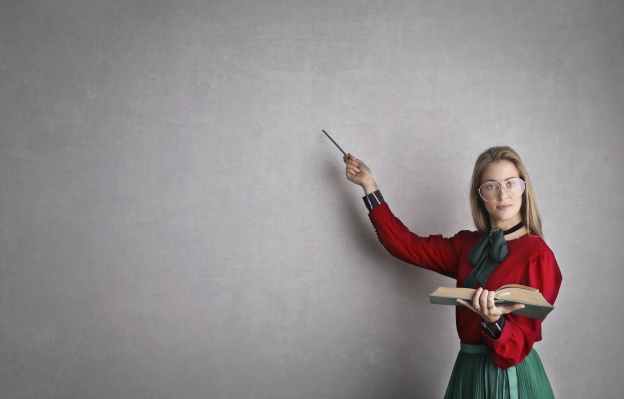
On this particular day, Levee and Bound arrived at the clearing together, though they didn’t look at all as if they belonged together. Levee, a thin, straight-lipped woman dressed like a schoolmarm, carried a ruler. Her hair was pulled back so tightly into a bun that her face looked just a bit stretched. No one can say I’m late, she pondered with pride, and with any luck, my exemplary responsibility will guilt the others into behaving themselves.

Bound was small in stature, the size of a boy ten or eleven, though clearly a grown man. He had short, black hair and wore brass knuckles on both hands. But one hardly noticed his appearance because he was always shouting, and all that uproarious noise was the main thing anyone remembered about him. He carried himself with the foreboding of a lit fuse nearing its explosive target, and a few strides into the clearing, he broke into a series of lunges and air-punches. Truth be told, the noise he generated on the outside was only a fraction of the roaring and explosions happening inside. Stupid. Unthinking. Can’t get their act together long enough to solve some problems, he thought, anticipating a tedious meeting. I can’t stand myself and I can’t stand them! Words stayed inside, as futility spilled out in growls.

Levee laid a legal pad and pencil on the stump and scrutinized the forest floor and canopy. Lost Boy circled the clearing, his large shoulders hunched over. No one had seen him arrive, and even he seemed a little unsure of his presence as he slunk in circles. I don’t think this is going to be okay. I can’t possibly speak in front of Levee and Bound. Nothing makes sense. What can I do. This was a statement, not a question, and his torso rocked forward and back with each repetition. What can I do. What can … What … His thoughts morphed into panic, disguised by his plodding feet.

A few moments passed as Found Girl flowed in her stone chair, Levee took stock with a critical eye, Bound threw punches, and Lost Boy bit his fingernails and wandered.

Fragrant—whom everyone called Fray—a woman of average stature with a fairy-like appearance and delightfully scented hair, entered through a cascade of willow branches on the east side of the clearing and stood beside Levee at the stump, where they waited for Broad. I’m lucky to belong here, thought Fray. This is a lovely group in a lovely place.

Broad soon arrived, looking especially round, his very large and expressive face—almost triangular in shape—resting directly on his shoulders. No one could say for sure if he had a neck, and no one wanted to get close enough to see, because Broad often broke into unrestrained displays of emotion, and his aura oozed despair in such a way that it seemed very likely to get all over whoever might come near. I’ll just stay here at the edge of the clearing. There’s too much energy at the stump, Broad decided. Too tired to stand, he melted onto a bed of thick moss near the base of a crooked evergreen.

The moment Broad arrived, Levee called the meeting to order with a few loud raps of her ruler on the stump. That is, she tried to call the meeting to order. This had no effect on Lost Boy, who continued his distracted circling, but it did throw Bound into a tizzy. “You two get over here!!” he shouted at Broad and Lost Boy. He kicked the stump as he repeated this command. Broad collapsed even further into a fat heap and cried.

At this point, Levee’s thin-lipped smile became so thin it almost disappeared. “We must stand around the stump and be quiet.” Her voice was coated with frustration and disdain, and she glared at Bound. Meanwhile, Fray fell in beside Lost Boy. “Come to the stump,” she invited in her always-pleasant voice. But Lost Boy didn’t reply, only continued in aimless circles, and Fray thought, Poor soul. If only he knew it’s okay to not be okay. She returned alone to the stump.

Levee, hell-bent on a productive meeting and desperate for order, strode over to Broad and dragged him toward the stump. This required no small amount of effort, and a few hairs popped out of her bun. After several exhausting moments, Broad was in a sad, fat heap, closer to the stump. Suddenly, Lost Boy noticed he was the only one still at large and would be Levee’s next target. Just as he moved to hide behind a tree at the edge of the clearing, Found Girl spoke.

This startled everyone, as they had forgotten she was there. Her voice, like her appearance, flowed, yet carried unmistakable strength. It drew Bound’s attention first; he immediately stopped kicking the stump and shouting. Before she finished a sentence, everyone in the clearing was focused on her, curiously enthralled by her flowing body and voice, their individual angst forgotten for a moment.

This is what she said. “Friends, each one of us belongs here. This is our clearing, our stump, our meeting. Levee may bring an agenda and take notes, but she is no more important—or in charge—than anyone else.” At this, Levee’s schoolmarm face relaxed somewhat, though her relief seemed tinged with doubt. I can’t imagine how Found Girl thinks she’s going to bring things to order.

Found Girl continued, “Lost Boy doesn’t have to speak his fears, and Bound doesn’t have to quiet his anger. Fray and Broad can attend to their own thoughts and feelings, which are their gifts in this meeting. We’re in this together. Look around at each other. Smell Fray’s fragrant hair. Admire Bound’s latest brass knuckles, and maybe look for Broad’s neck.” Everyone chuckled at this, except Lost Boy, who had commenced his circling.

Found Girl, having given everyone permission to be themselves, closed her captivating mouth and motioned to Levee. Then the meeting began.

Books I Read In 2024

I read 26 books last year. Let’s look at the boring category first: SELF HELP. (I won’t tell if you skip down the page)

Two of these books were suggested by friends, who read them with me. I’ve copied a favorite quote from each book.

“People who don’t know what they find satisfying generally struggle to know who they really are. Our identity and our passions are intimately connected.” (page 168)
The 4 Habits of Joy-Filled People, Marcus Warner and Chris M. Coursey, 179

“… if we are to stay connected with our soul, we will need to have the capacity to sometimes be dreadful, objectionable, or offensive.” (pages 64-65)
The Vital Spark: Reclaim Your Outlaw Energies and Find Your Feminine Fire, Lisa Marchiano, LCSW, 249

“Other people’s frustrations won’t kill you. Their opinions can’t take you out. You can indeed choose a new yes, or a continued yes. You can keep at the thing you love, even if it isn’t producing results yet. You can say yes to what you want to say yes to. … Are you just into it? That is reason enough.” (page 129)
Fierce, Free, and Full of Fire: The Guide to Being Glorious You, Jen Hatmaker, 221

“There is a season between deliverance and dominion that is called dependence.” (page 193)
She Is Free: Learning the Truth About the Lies That Hold You Captive, Andi Andrew, 203


FICTION. In 2023 I read only one work of fiction—I edited it for a friend. I determined to read more fiction in 2024, and I did! I enjoyed, but didn’t love, these reads. Maybe 2025 will be the year I find a fiction book to love.

The Innocents at Home: Children of the 1940’s, Mary Stone, 241

Facing the Dawn, Cynthia Ruchti, 310

Love, Jacaranda, Alex Flinn, 356

All Other Nights, Dara Horn, 363

One Corpse Too Many, Ellis Peters, 275

The Minister’s Restoration, George MacDonald, edited by Michael R. Phillips, 207


POETRY. I had the privilege of joining the book launch team for Marla Taviano’s book whole: poems on reclaiming the pieces of ourselves and creating something new (268 pp.). It’s a quick, fun read, and Marla’s authenticity creates space for a whole range of questions and “questionable thoughts” about Christianity/religion.

Made of Rivers by Emory Hall (68 pp.) is fabulous. It was recently re-released with thirty additional poems. Go buy it.

OR, if you can only buy one book of poetry today, you might consider All Along You Were Blooming: Thoughts for Boundless Living, by Morgan Harper Nichols (182 pp.). My dream as a writer is to create spaces with my words that allow folks to breathe, allow their souls to sit down in peace. This collection of poems did those exact things for me. It’s a wonderful read for a quiet hour on the weekend, or a way to rest your spirit when you climb in bed at night.


CREATIVITY AND WRITING. I’ve read some pretty amazing books by writers, about writing. Lots of people write about things they know about, and the books are good, but reading the words of a skilled writer is always more fun. Maybe I’m biased, but I think the best how-to books are about writing, because writers wrote them. Am I making any sense?

Julia Cameron’s book, The Artist’s Way: A Spiritual Path to Higher Creativity (235 pp.), would fall in the category of excellent-book-about-writing, written by an excellent writer. And if you like The Artist’s Way, she has perhaps a dozen more books with related content. Take a deep dive.

The Artist’s Rule: Nurturing Your Creative Soul With Monastic Wisdom, by Christine Valters Paintner (162 pp.), is an invitation to embrace the intersection of the spiritual and the creative—or, in her words, your inner monk and inner artist. I loved every page, had a lot of fun with the writing prompts, and tried some new things, like wabi-sabi photography.

Mark Yaconelli’s book, Between the Listening and the Telling: How Stories Can Save Us (183 pp.), is a compelling showcase for the power of story. It reignited my passion for storytelling and story-listening as community activities.


STORIES. All good. Of course the one about Gregory Boyle (G-dog) was a favorite, along with What My Bones Know. My daughter picked up The Invisible Thread at a used book fair. It’s the memoir of a young second-generation Japanese American who lived in a U.S. concentration camp during World War II. I read it because I knew nothing about the experience of Japanese Americans during the war, and to see if it was appropriate for an 11-year-old to read (in my opinion, it is).

G-Dog and the Homeboys: Father Greg Boyle and the Gangs of East Los Angeles, Celeste Fremon, 314

Happy Trails: The Story of Roy Rogers and Dale Evans, with Carlton Stowers, 207

I Know Why the Caged Bird Sings, Maya Angelou, 289

Surviving the White Gaze: A Memoir, Rebecca Carroll, 318

A Beautiful Mind: The Life of Mathematical Genius and Nobel Laureate John Nash, Sylvia Nasar, 390

What My Bones Know: A Memoir of Healing from Complex Trauma, Stephanie Foo, 321

The Invisible Thread, Yoshiko Uchida, 133


SOUL FOOD, my favorite! The books in the CREATIVITY AND WRITING category would fit here as well.

Eat, Pray, Love, by Elizabeth Gilbert (331 pp.)—it’s popular for a reason. The blend of delectable writing with deep insight and the permission to be human made it a special occasion each time I sat down to read. I celebrated these good feelings by taking the book to a coffee shop a few times, to revel in the experience.

Here’s a favorite passage from Somehow: Thoughts on Love, by Anne Lamott (191 pp.). I don’t know how I got by with reading only one Lamott book in 2024, and I plan to partake of at least a few this year.
“When we screw up … it is never the final word. The fact that this happens to all of us allows us to have a tenderness about the broken places. … hope is believing this one thing, that love is bigger than any grim, bleak shit anyone can throw at us. And I believe. Also, my experience is that grace bats last.” (pages 85-86)

And, without planning it, the first book I read in 2024 is last on the list: Running to the Mountain: A Midlife Adventure, by Jon Katz (242 pp). Here’s a quote.
“Spirituality is usually presented in terms of the Big Payoff—Merton finds faith sitting in a church one day. I’d expected something similarly dramatic. It took me weeks to grasp that this was going to be painstaking and meticulous work, hand-to-hand combat of the most intensely personal sort—with myself. Day by day, chore by chore, I’d know more in six months or a year—if I were lucky—than I did now.” (page 83)

And that concludes my reading for last year.
Julia, It’s either You or Me

Julia Cameron possesses the rare talent of crafting an instructional book that is a treat to read, an invitation to be seen, and a storehouse of insight and wisdom. But I’m not happy with her right now. With some friends, I’m going through her book, The Artist’s Way. And it’s fun—the reading, our group dynamic, the exercises. Under her tutelage I’m learning to date my inner artist, a practice designed to fill my creative well.

I’m not mad at Julia about these Artist Dates. Or about the fact that I seem to have less creative flow since starting The Artist’s Way coursework. It’s probably hormones or the time of year or the other things on my calendar. Or maybe I’m just too contented to write. I like most of what’s on my schedule, and since I don’t fight against myself all the time any more, the emotional atmosphere in my life is pretty calm. In any case, I can’t put Julia on the hook for my stagnant writing.

It’s Morning Pages I’m mad about—three pages of stream-of-consciousness writing every morning. Julia swears they will change your life. Morning Pages—along with Artist Dates—are Julia’s favorite tools for recovering creativity. They are “a loving witness to our growth process,” a form of meditation, a journey inside. “We find our own quiet center,” she writes, “the place where we hear the still, small voice that is at once our creator’s and our own.” I think I know exactly what she’s talking about. I’ve been journaling with God for decades. I found my quiet center. I love to sit with my Creator and a pen and see what happens, or to hash out on paper a nagging question, perplexing circumstance, or angry diatribe. On the page, in communion with the Spirit, I have found myself and have discovered with some surprise that I like myself.

Julia takes care to point out that many people have resistance to Morning Pages, but two months ago I just knew that would not be me. What could be better than starting the day with three pages of stream-of-consciousness writing? Well, after nearly two months of writing (almost) daily, I can think of at least three things: snuggling in bed with my warm husband a little longer, sitting with God and watching the sunrise, or spending time with whichever daughter awakens early.

As is often the case, the thing I thought would be hard (Artist Dates) slipped into my life like a new and delightful friend, and what I thought would be easy (Morning Pages) is causing considerable discomfort. I try to wrestle it into submission by reminding myself that it is a perfect fit for me. I totally look great in this outfit. But after weeks of early-morning writing in which I have discovered next to nothing about myself, except that I’m chafing at this requirement, I must admit Morning Pages are not a perfect fit. I don’t want to record random thoughts. I want to finish a thought. I don’t want to write fragments and ramblings. I don’t want to lose valuable insights in pages of jibber-jabber.

Besides, my “consciousness” seems to be a bit of a worrier. Following it around for three pages is more stressful than sitting in silence, practicing gratitude, or praying for friends. Perhaps those things are allowable for Morning Pages and I’m just getting this all wrong. But stream-of-conscious, to me, doesn’t sound like directed thoughts and meditations. And I’m not supposed to pause. Keep writing, bypass the left brain, or some crap like that.

I don’t like to admit it, but I don’t like being told what to do. The rule-follower in me really wants to cross every “t” and dot every “i,” so doing what I’m told can be excruciating. It takes a lot of energy to get things right. If you’re going to tell me what to do, you better know what you’re talking about and the payoff better be good, because I’m not self-actualized enough to put in a proper (balanced) amount of effort. And once I over-blow my efforts, I expect an equally overblown result. I’m not about to spend hours every week writing a bunch of gibberish because you, Julia, say it’s the best thing since sliced bread.

Take that.

I’m not very good at agency yet, so I make up for it by pushing back on everyone who wants something from me. I live in the tension of hoarding my time and emotions out of fear, and giving them too freely, also out of fear. This is not Julia’s fault. She has simply made a request and I can’t handle requests. Isn’t every request an obligation? And if it’s not—if this whole course is actually about helpful tools and creative recovery—then how do I know whether to force myself to do Morning Pages? Do I choose them because my resistance needs to be seen but not given charge? Or do I choose not to do them because I gave it an honest try and found I already have practices in place that work better for me? Is that prideful? Rebellious? Naive? How could I know more than Julia Cameron?

I’m stuck. And stuck makes me angry. And anger makes me want a “bad guy,” which in this case is either me or Julia. Who’s it gonna be?

Sigh.

There is no bad guy.

There is no right answer.

Morning Pages could be helpful today or next year or never. It could be unhelpful in winter or while I’m content in life, or forever. I hate that. How does ambiguity manage to be such heart-wrenching torture, and simultaneously an elegant freedom? I am free to choose. I can decide to write Morning Pages when I don’t feel like it. Or I can not write them at all. Or I can try one page, or evening pages, or weekend pages. Who decided to give me this much power?

Some say it’s God, the only One crazy enough to hand out freedom-of-choice like candy. The rest of us know that some amount of control is the only thing keeping us humans washing our hands before we eat, and stopping us from eating each other alive. But maybe I’ll go with God on this one. I don’t have to fight with Julia, or Morning Pages, or even with myself. I can decide. Then I can change my mind and try something else next week. There’s not much at stake here. Maybe the best part of Morning Pages is learning that life is not graded, but lived.

Potential

Potential

Blessed are You,
Lord our God,
King of the Universe,
for potential—
a door ajar,
a hint of what I can’t see.
What is there?

Blessed are You
for potential
to give and receive,
comfort and be comforted,
see and be seen—
relational miracles.

Blessed are You
for creative energy
to birth poems and essays,
make spring rolls and peanut sauce,
weave laughter through dinner and bedtime.

Blessed are You,
Lord our God,
King of the Universe, for this—
Potential means I don’t know.
Not knowing means I’m not in control.
Not controlling means I’m free to love.
And love makes even the impossible possible.
Potential.


Green fruit has potential to become ripe.
Ripe fruit is potent with flavor and satisfaction.
Empty things have potential to be filled with anything—even dust and spiders.
Full things contain possibilities for all kinds of creation.
Best of all, potential is NOT something I can DO.

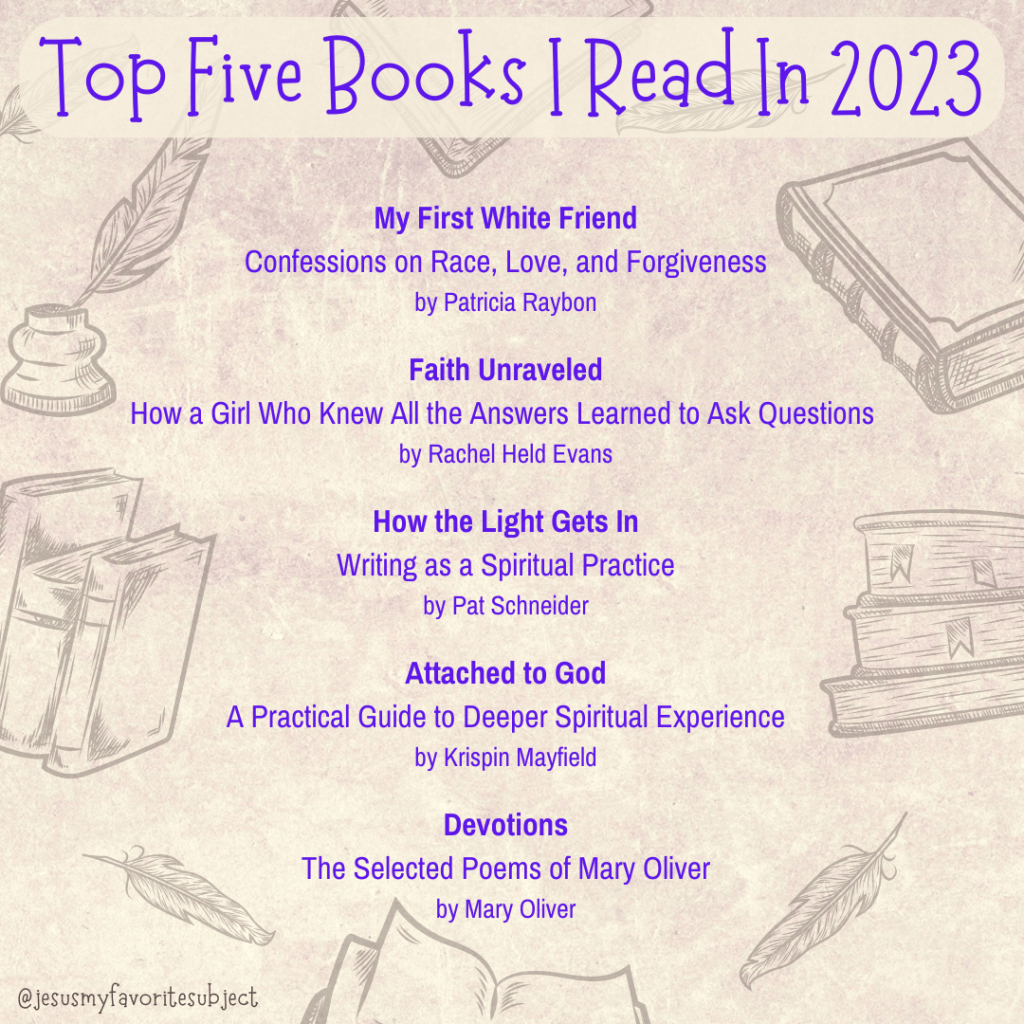
Books I Read in 2023

I read over 30 books in 2023. I’d like to think I choose what I read. But, as with many facets of life, the people I know—and whatever version of fate I ascribe to—play a large part. Last year I picked up nine books at a Writing For Your Life conference—none of which I would have read otherwise. Several were written by authors at the conference, others lay piled on a “free” table in the foyer, and another—Grace Notes—was a not-yet-published manuscript. The author and fellow conference attendee, Cheyenne Wilbur, agreed to let me try my copyediting skills on his book. Grace Notes was the only work of fiction I read last year. With no forethought or planning, I gravitated toward nonfiction.

In 2023 I read at least ten books recommended by friends and family—ranging from depression-era stories to books on writing. I selected books for a dozen reasons I know, and probably a score more subconscious reasons. I chose because of the author’s name—Richard Rohr, Rachel Held Evans, Anne Lamott; or because of the title—Intersexion: A Story of Faith, Identity, and Authenticity; or because I wanted to learn more about mysticism—The Big book of Christian Mysticism, and Wild Mercy. Some books, unread on my shelf since high school, had to be read or sent to the thrift store, making room for more recent acquisitions.


Eleven books by authors I know, or have connected with in some way, appear on my reading list. I treasure each of these connections, and find myself astonished by the quantity of people who write bravely, skillfully, and often while also attending to other full-time commitments.

A nurse and author of several books, Susan L. Schoenbeck, introduced herself to me on LinkedIn because of a mutual connection. Her experience—both personally and professionally—with near-death experiences piqued my interest and I purchased her self-published book Heaven and Angels.

My friend and cousin-in-law, Clair Gabriel, embraced her creative-writing skills and published a book on Amazon: Pregnancy, Birth, and Oh, Baby! It’s a quick and encouraging read, both important traits for a target audience of young mothers.

At the year’s end, I absorbed one last book, written by the former pastor of my childhood home church, Carl Wilkens. The book is titled I’m not leaving., with this singular statement on the cover: “Rwanda through the eyes of the only American to remain in the country through the 1994 genocide.” It was a thought-provoking read, ripe with unanswerable questions and the traits that empower a person to navigate such answerless queries and harrowing circumstances: love and connection.

Books by authors I met at the Writing For Your Life conference:

  • The Hundred Story Home: A Memoir About Finding Faith in Ourselves and Something Bigger, by Kathy Izard
  • Grace Notes, by John Cheyenne Wilbur
  • My First White Friend: Confessions on Race, Love, and Forgiveness, by Patricia Raybon
  • The Big Book of Christian Mysticism: The Essential Guide to Contemplative Spirituality, by Carl McColman
  • unbelieve: poems on the journey to becoming a heretic, by Marla Taviano

Books by authors in the Christian writing critique group I attend:

  • Surviving the Sand: My Family’s Struggle to Farm the Pasco Desert, by Helen Lingscheit Heavirland
  • Life Aboard a Sinking Ship: Mishaps and Mayhem on a Navy Tugboat, by Lee Yates as told to Blanche Yates
  • Building the Columbia River Highway: They Said It Couldn’t Be Done, by Peg Willis

Until last year, children’s books comprised nearly all my reading of poetry. Think Dr. Seuss and Shel Silverstein. When I started writing poems, I knew I needed to overcome my fear of poetry that isn’t illustrated and in large print. My sister helped by recommending several poets, and I read five books of poetry—including a compilation containing three of my poems, and the above-mentioned book by Marlia Taviano.

  • Swallow’s Nest: Poetry Journal, Fourth Annual Issue—December 2022, compiled by Linda L. Kruschke for Oregon Christian Writers
  • To Bless the Space Between Us: A Book of Blessings, by John O’Donohue
  • Stripped, by Cara Alwill Leyba
  • Devotions: The Selected Poems of Mary Oliver, by Mary Oliver

My reading last year included only one or two books from the self-help genre. I’d like to think this is because my mental and emotional health are improving. Or maybe I have that backward, and my mental and emotional health are improving because I’m not reading so many self-help books. Instead, I read more stories. There must be a technical term other than “story”—I’m sure “memoir” would apply to some—but to me these books are lovely because they are stories. The authors don’t tell me what to think. Rather, they invite me into their experiences. A good story is an offer of intimacy, a passageway to the inner workings of another human being and the wildness of their story. In addition to half a dozen of the above-listed books by authors I know, here are the stories I read last year.

  • Julie & Julia, by Julie Powell
  • Growing Up, by Russell Baker
  • Once Upon an Island: The Adventures of a Young Couple Who Did Buy Their Dream Island, by David Conover
  • I Went to the Woods: The Adventures of a Bird Photographer, by Ronald Austing
  • Faith Unraveled: How a Girl Who Knew All the Answers Learned to Ask Questions, by Rachel Held Evans
  • Intersexion: A Story of Faith, Identity, and Authenticity, by Cynthia Vacca Davis
  • The Face of Addiction: Stories of Loss and Recovery, by Joshua Lawson
  • Sealed: An Unexpected Journey Into the Heart of Grace, by Katie Langston
  • Love Warrior: A Memoir, by Glennon Doyle
  • Birding Against All Odds, by Joan Easton Lentz

Every one of the spiritual books I read felt like friendship. These books saw my heart and spoke both things I knew and things I didn’t yet know. They pushed me to try new things, think new thoughts, ask new questions. God and spirituality captivate me in a way nothing else does. I underline, write down page numbers, read aloud to my husband, and text paragraphs to friends. Although this happens with other books as well, it is spiritual books that most often invite me home, to a profound sense of belonging.

  • How the Light Gets In: Writing as a Spiritual Practice, by Pat Schneider
  • Attached to God: A Practical Guide to Deeper Spiritual Experience, by Krispin Mayfield
  • Small Victories: Spotting Improbable Moments of Grace, by Anne Lamott
  • The Tao of Pooh: The Principles of Taoism Demonstrated by Winnie the Pooh, by Benjamin Hoff
  • False Intimacy: Understanding the Struggle of Sexual Addiction, by Dr. Harry W. Schaumburg
  • Wild Mercy: Living the Fierce and Tender Wisdom of the Women Mystics, by Mirabai Starr
  • Forgive Everyone Everything, by Gregory Boyle, art by Fabian Debora
  • Seeking the Triune Image of God in You: A Glimpse Through a Keyhole, by Jeffrey D. Hill
  • Breathing Under Water: Spirituality and the Twelve Steps, by Richard Rohr

Re-reads. Finally, I read these three books a second time, because, in my humble opinion, they are just that good.

  • The Whole Language: The Power of Extravagant Tenderness, by Gregory Boyle
  • Bird by Bird: Some Instructions on Writing and Life, by Anne Lamott
  • Present Over Perfect: Leaving Behind Frantic for a Simple, More Soulful Way of Living, by Shauna Niequist

Thirty-seven books, and probably a few more I forgot to write down. It is a still-infant privilege, this copious access to written material. And yet, having grown up in America late in the 21st century, I can’t imagine anything else. Shelves of books are the backdrop to my office, my small groups, and my mental and emotional spaces. I am profoundly thankful for each author who puts their words into public spaces, and for the privilege of having time to pick up those words and hang out with them.

What did you read in 2023? Leave a comment and maybe I’ll add your recommendation to the list of books I want to read.

Morning Pages

Writing and prayer are, for me, inextricably linked. Pat Schneider said it well: “When I begin to write, I open myself and wait. And when I turn toward an inner spiritual awareness, I open myself and wait.”

In the course of living, I often disconnect from myself. I disconnect to stay operative, and it can be difficult to coax my spirit out of hiding. If I feel, will I still be able to function?

I’m reading two of Julia Cameron’s honest and encouraging books on the creative pursuit, and have been initiated to Morning Pages. Julia swears by them—three pages of longhand, stream-of-consciousness writing every morning, for the rest of your life. This practice puts you in touch with yourself, clears the racket in your head, lets you listen to the Spirit and to your own heart. “As we write,” Julia says, “we come know to ourselves, and increased tenderness to the self we are discovering is the reward.”

I’ve not made Morning Pages a daily habit, but when I do them, I find they deliver the promised effects.

My Morning Pages on June 2 were a ramble about ducklings and the kids’ last day of school. I wrote one page, then got scared: “How do I feel inside? Time to go shower …”

The next morning, it was time to come out of hiding.

June 3, 2023
I guess I’ll start today where I left off yesterday. With my heart. “Go ahead and come out, heart. This is a safe place.” Did some fear send my heart packing? When? How? It seems sudden that I have lost access to myself. But I know it can’t be. Am I running from heaviness? How does one keep a practical balance within one’s heart? Listen and feel, but not descend into the heaviness, never to rise? Maybe I’ve forgotten about my center. Is there really a still place in the middle of all this drama? A place to rest without shutting everything down or solving anything? “The present is safe,” Spirit says. My head is trying to protect my heart. My heart is trying to be small so I can get things done and look functional. But I am not lost in this stormy sea. The girls came downstairs so I moved upstairs. I sat down in my “prayer chair.” I turned my chair to look out a different window. I’m fantasizing about the marriage book I’m going to write. I’m listening to the ducklings and thinking they need their water refilled soon. I’m staring at nothing. I’m listening to the ceiling fan. I’m closing my eyes. I hear the mourning dove and think of the nest we had this spring. K is calling me from downstairs. Now she has come to ask if she can watch PJ Masks with her sister. She’s dressed only in underwear, and in their pretend game she has just hatched from an egg. She holds her hands under her chin in a chipmunk-like pose and speaks adorable gibberish, until I decipher “watch” and “PJ Masks.” It’s before 8am on a Saturday and I’d have to give special permission on Kayt’s iPad, so I say no. I’m starting to thaw here a little bit. I am safe with myself, my journal, God, Michael, and ultimately, with everyone and everything. K’s caterpillars are getting fat. I think God saved their lives. I guess (know) it’s safe to be me, and this day is very doable. Just show up, and then again.

Morning Pages are wonderful, rambling therapy. They are the healing experience of being seen. They are a permission slip to be human. Writing is a gentle and whimsical pathway to the inner self, which I once thought to access with a hammer and chisel, but which actually comes forward like a squirrel—shyly, with worried chirps and false starts. I must sit still. When the squirrel’s tiny paws rest on my fingertips, I feel a sense of wonder. I—brute that I am—receive the trust of another creature. So it is with my own spirit. I cannot use force to gain passage; I must sit quietly and observe with rapture that I am alive. And when I see myself alive, feel the pulse in my own fingertips, I know I will probably be okay.

~ Quotes are from Pat Schneider’s book, “How the Light Gets In,” and Julia Cameron’s book, “Write for Life.”