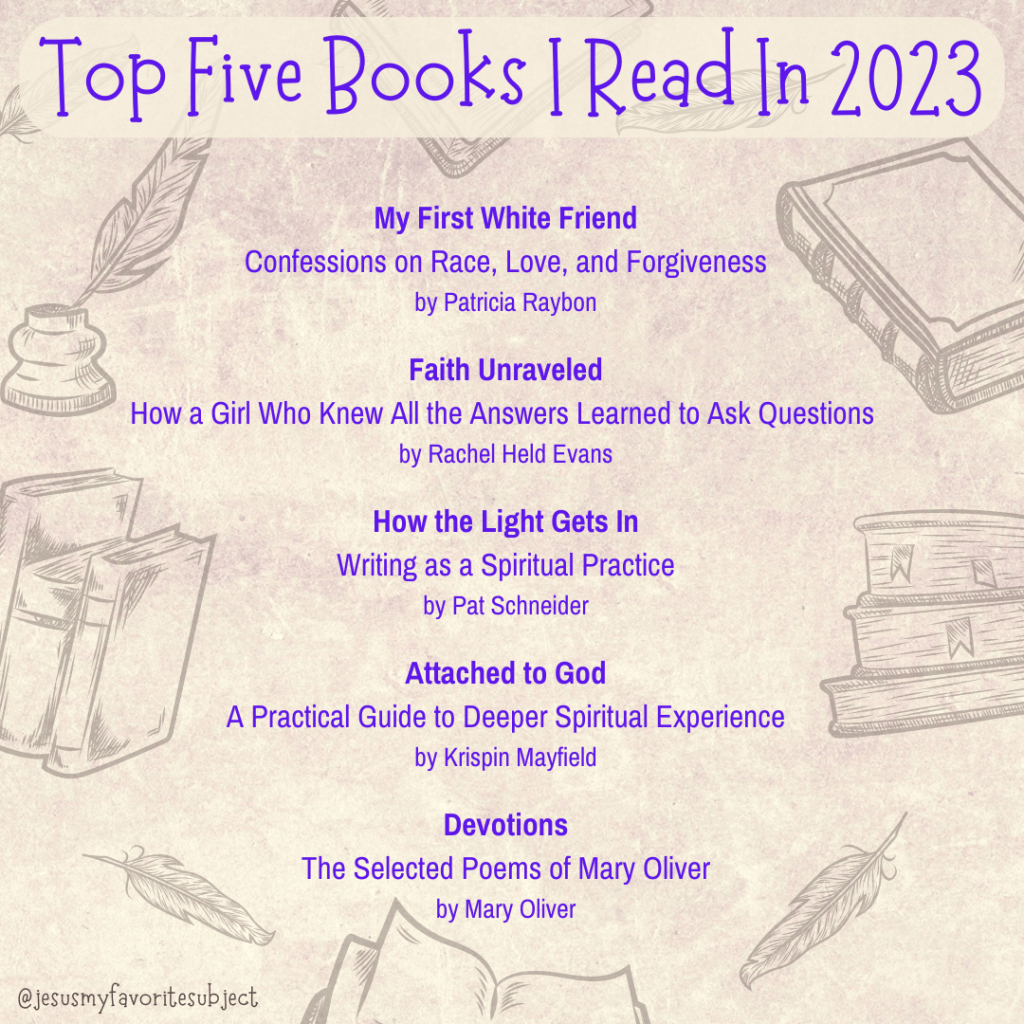
I read over 30 books in 2023. I’d like to think I choose what I read. But, as with many facets of life, the people I know—and whatever version of fate I ascribe to—play a large part. Last year I picked up nine books at a Writing For Your Life conference—none of which I would have read otherwise. Several were written by authors at the conference, others lay piled on a “free” table in the foyer, and another—Grace Notes—was a not-yet-published manuscript. The author and fellow conference attendee, Cheyenne Wilbur, agreed to let me try my copyediting skills on his book. Grace Notes was the only work of fiction I read last year. With no forethought or planning, I gravitated toward nonfiction.
In 2023 I read at least ten books recommended by friends and family—ranging from depression-era stories to books on writing. I selected books for a dozen reasons I know, and probably a score more subconscious reasons. I chose because of the author’s name—Richard Rohr, Rachel Held Evans, Anne Lamott; or because of the title—Intersexion: A Story of Faith, Identity, and Authenticity; or because I wanted to learn more about mysticism—The Big book of Christian Mysticism, and Wild Mercy. Some books, unread on my shelf since high school, had to be read or sent to the thrift store, making room for more recent acquisitions.
Eleven books by authors I know, or have connected with in some way, appear on my reading list. I treasure each of these connections, and find myself astonished by the quantity of people who write bravely, skillfully, and often while also attending to other full-time commitments.
A nurse and author of several books, Susan L. Schoenbeck, introduced herself to me on LinkedIn because of a mutual connection. Her experience—both personally and professionally—with near-death experiences piqued my interest and I purchased her self-published book Heaven and Angels.
My friend and cousin-in-law, Clair Gabriel, embraced her creative-writing skills and published a book on Amazon: Pregnancy, Birth, and Oh, Baby! It’s a quick and encouraging read, both important traits for a target audience of young mothers.
At the year’s end, I absorbed one last book, written by the former pastor of my childhood home church, Carl Wilkens. The book is titled I’m not leaving., with this singular statement on the cover: “Rwanda through the eyes of the only American to remain in the country through the 1994 genocide.” It was a thought-provoking read, ripe with unanswerable questions and the traits that empower a person to navigate such answerless queries and harrowing circumstances: love and connection.
Books by authors I met at the Writing For Your Life conference:
- The Hundred Story Home: A Memoir About Finding Faith in Ourselves and Something Bigger, by Kathy Izard
- Grace Notes, by John Cheyenne Wilbur
- My First White Friend: Confessions on Race, Love, and Forgiveness, by Patricia Raybon
- The Big Book of Christian Mysticism: The Essential Guide to Contemplative Spirituality, by Carl McColman
- unbelieve: poems on the journey to becoming a heretic, by Marla Taviano
Books by authors in the Christian writing critique group I attend:
- Surviving the Sand: My Family’s Struggle to Farm the Pasco Desert, by Helen Lingscheit Heavirland
- Life Aboard a Sinking Ship: Mishaps and Mayhem on a Navy Tugboat, by Lee Yates as told to Blanche Yates
- Building the Columbia River Highway: They Said It Couldn’t Be Done, by Peg Willis
Until last year, children’s books comprised nearly all my reading of poetry. Think Dr. Seuss and Shel Silverstein. When I started writing poems, I knew I needed to overcome my fear of poetry that isn’t illustrated and in large print. My sister helped by recommending several poets, and I read five books of poetry—including a compilation containing three of my poems, and the above-mentioned book by Marlia Taviano.
- Swallow’s Nest: Poetry Journal, Fourth Annual Issue—December 2022, compiled by Linda L. Kruschke for Oregon Christian Writers
- To Bless the Space Between Us: A Book of Blessings, by John O’Donohue
- Stripped, by Cara Alwill Leyba
- Devotions: The Selected Poems of Mary Oliver, by Mary Oliver
My reading last year included only one or two books from the self-help genre. I’d like to think this is because my mental and emotional health are improving. Or maybe I have that backward, and my mental and emotional health are improving because I’m not reading so many self-help books. Instead, I read more stories. There must be a technical term other than “story”—I’m sure “memoir” would apply to some—but to me these books are lovely because they are stories. The authors don’t tell me what to think. Rather, they invite me into their experiences. A good story is an offer of intimacy, a passageway to the inner workings of another human being and the wildness of their story. In addition to half a dozen of the above-listed books by authors I know, here are the stories I read last year.
- Julie & Julia, by Julie Powell
- Growing Up, by Russell Baker
- Once Upon an Island: The Adventures of a Young Couple Who Did Buy Their Dream Island, by David Conover
- I Went to the Woods: The Adventures of a Bird Photographer, by Ronald Austing
- Faith Unraveled: How a Girl Who Knew All the Answers Learned to Ask Questions, by Rachel Held Evans
- Intersexion: A Story of Faith, Identity, and Authenticity, by Cynthia Vacca Davis
- The Face of Addiction: Stories of Loss and Recovery, by Joshua Lawson
- Sealed: An Unexpected Journey Into the Heart of Grace, by Katie Langston
- Love Warrior: A Memoir, by Glennon Doyle
- Birding Against All Odds, by Joan Easton Lentz
Every one of the spiritual books I read felt like friendship. These books saw my heart and spoke both things I knew and things I didn’t yet know. They pushed me to try new things, think new thoughts, ask new questions. God and spirituality captivate me in a way nothing else does. I underline, write down page numbers, read aloud to my husband, and text paragraphs to friends. Although this happens with other books as well, it is spiritual books that most often invite me home, to a profound sense of belonging.
- How the Light Gets In: Writing as a Spiritual Practice, by Pat Schneider
- Attached to God: A Practical Guide to Deeper Spiritual Experience, by Krispin Mayfield
- Small Victories: Spotting Improbable Moments of Grace, by Anne Lamott
- The Tao of Pooh: The Principles of Taoism Demonstrated by Winnie the Pooh, by Benjamin Hoff
- False Intimacy: Understanding the Struggle of Sexual Addiction, by Dr. Harry W. Schaumburg
- Wild Mercy: Living the Fierce and Tender Wisdom of the Women Mystics, by Mirabai Starr
- Forgive Everyone Everything, by Gregory Boyle, art by Fabian Debora
- Seeking the Triune Image of God in You: A Glimpse Through a Keyhole, by Jeffrey D. Hill
- Breathing Under Water: Spirituality and the Twelve Steps, by Richard Rohr
Re-reads. Finally, I read these three books a second time, because, in my humble opinion, they are just that good.
- The Whole Language: The Power of Extravagant Tenderness, by Gregory Boyle
- Bird by Bird: Some Instructions on Writing and Life, by Anne Lamott
- Present Over Perfect: Leaving Behind Frantic for a Simple, More Soulful Way of Living, by Shauna Niequist
Thirty-seven books, and probably a few more I forgot to write down. It is a still-infant privilege, this copious access to written material. And yet, having grown up in America late in the 21st century, I can’t imagine anything else. Shelves of books are the backdrop to my office, my small groups, and my mental and emotional spaces. I am profoundly thankful for each author who puts their words into public spaces, and for the privilege of having time to pick up those words and hang out with them.
What did you read in 2023? Leave a comment and maybe I’ll add your recommendation to the list of books I want to read.


