Category Archives: Invitations

Come Wanderer

Come, come, whoever you are.
Wanderer, worshipper, lover of leaving.
It doesn’t matter.
Ours is not a caravan of despair.
Come, even if you have broken your vow
a hundred times.
Come, yet again, come, come.

-Rumi

“Come … wanderer,” God invites.

In what ways have I wandered?

The wilderness of parenting.

The jungle of marriage.

The labyrinth of religion.

Is wandering about being lost?

Or is it about looking for something new? Something about which I can’t say, “Oh, I knew that.”

Wandering leaves me wondering if I fit in, if I am still invited in.

You invite me in. “Come,” You say, “come wanderer.”

Yes, I am invited. Yes, I belong. Yes, there is a place for me, even—maybe especially—when I don’t fit in to the containers I used to fit in—the labeled Tupperware, the organized totes.

Now the pieces of me are less organized, but still You say, “Come,” and all of me comes even though I thought maybe the pieces were too scattered.

They are not. All of them respond to Your voice.

It is not my job to organize myself. Or to stop wandering. Everywhere I go, You meet me there.

If wandering has taught me anything, it is that You are everywhere.

“Come,” You say, and I am surprised to find You are standing right next to me. You are not calling from a great distance. “Come,” You say, “let us wander together. Show me something you’ve found here. And I’ll show you some things too.”

Wandering and loneliness are intertwined, and You and I, we are familiar with both.

“Come,” You say, and I know that You know this place, that You are no stranger to wilderness or jungle or labyrinth. These are Your kitchen, your garden, your cathedral.

“Come,” You say, and I know that I have always been home. For You are home to wanderers.

I Tried Yoga. What Next?

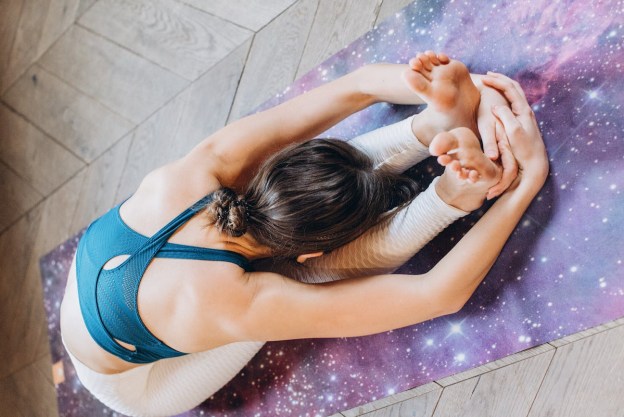
I sat on a yoga mat with the soles of my feet together in front of me, knees out to the sides. A feeling of connection and calm came over me. I had done this stretch many times and was surprised by the whole-body comfort. Rather than fighting against my body to force more flexibility, yoga taught me to work with my body. My bare feet pressed against each other, the stretch invited me to feel the muscles deep in my legs, and my spirit rested. I felt that I belonged to myself.

My exposure to yoga began in childhood, when my conservative Christian parents—who nevertheless had a habit of blazing their own way—bought a Bikram Choudhury yoga book. I loved watching my dad grunt his way into different poses—Eagle Pose, Tree Pose, Standing Bow Pulling Pose. My older sister and I would show off our youthful elasticity, easily getting into positions that our parents forced and contorted themselves into.

The Bikram’s Beginning Yoga Class book had funny cartoon illustrations, along with actual photographs of Bikram and his students—mostly leotard-clad, flat-bellied women. Bikram wore exceptionally small speedo-swimsuit-style briefs that left little to the imagination. The photos, taken during one of his Hatha Yoga classes in Beverly Hills in the 70’s, often show him steadying one of the willowy women, his face expressionless, a hand on her arm or leg.

In the 90’s, Christians—if I may generalize—spoke spitefully (or was it fearfully?) of “New Age” thinking. I’m not sure at what level I was aware that yoga made the naughty-new-age list, but the grunting and body-folding in our living room felt pretty safe to me. Any misgivings I may have had about yoga and its gateway-drug-to-eastern-religion qualities vanished sometime in my 20’s, and I accepted yoga as a healthy and legitimate practice. But until this year, I had never tried it as an adult. My time on a yoga mat typically involved sweating through lunges, burpees, and sit-ups, and those workouts were rare.

Last year, my friend Tiffaney started a yoga class with another young woman, in the fellowship room of a local church. It’s not called yoga class, because yoga is still associated with Eastern meditation, which allows evil spirits to inhabit you … or something. My sister, who is generally underwhelmed by the threat of evil spirits, has been doing yoga for years. She attended Tiffaney’s class, and around the time she mentioned it to me, Tiffaney invited me again.

So I came on a Thursday morning, late, and joined half a dozen barefoot women on yoga mats in the church basement. It didn’t take long to settle in to the quiet music and Tiffaney’s gentle voice, guiding me to breathe and stretch and count, hold and release. My body awakened, something like the expanding I feel when I step outside and take a deep breath after a rainy downpour. I felt invited to notice myself. I felt pleasure in the strength of my body, and deep release as I stretched muscle groups from head to toe. By the time I wiped down my mat at the end of class, I knew I’d be back.

Not long after my first yoga class, the group adjourned for summer. Around that time, I got a call from the local senior center, thanking me for a recent donation, and inviting me to join their yoga class. I arrived with some trepidation, expecting to be at least three decades younger than all the participants, but—in addition to the women in their 70’s and 80’s—a little girl probably three decades younger than me also attended.

“Hi,” I smiled. “I thought I was gonna be the youngest person here.” She smiled back politely but looked at me like I was about as easy to relate to as all the other strange old ladies. I laid my yoga mat down next to hers in the corner of the small, carpeted room, and a short, plump woman in her seventies began rolling her shoulders and inviting us to do the same—seven times forward, seven times back. As class progressed, I watched with respect as the circle of participants made their way through the stretches. Some were more flexible than me. Others adapted as needed for stiff joints or chronic pain. The little girl flailed and flopped in boredom, and I guessed she would have preferred her grandma took her somewhere other than yoga class.

Over the summer, I returned to the senior center whenever I had the time for Monday morning yoga. The teacher talked about opening my heart chakra, getting my synovial (joint) fluids moving, and keeping my arms against my head like ear muffs while stretching side to side. Rather than ending class with a Bible verse, she read a “thought of the day,” put her hands in prayer position, and said, “Namaste.” Five years ago that might have freaked me out, but after reading a couple of books on mysticism, and learning that “Namaste” is usually interpreted as, “the divine in me greets the divine in you,” I heartily embrace it.

There’s a wholeness to expansion and contraction. Rather than using my muscles only to hold body weight, dumbbells, or weird positions, I am invited to breathe deep and allow them to relax into the release of breath. There is safety in the guidance of a gentle voice. I don’t have to make decisions, or brace against a fitness pep talk. Rather, the teacher leads me in getting to know my body, feel my strength and my heaviness, and notice my capacity to loosen and lighten. This safety and wholeness is akin to what I feel with God, and I am delighted that it is built into my breath and my body.

Before I tried yoga, I thought it consisted of fancy stretching. Now yoga ranks among my top five bodily experiences. As I drove home from class at the senior center a couple weeks ago, I noticed that I sat taller, my muscles working together to hold me in a healthy posture. At the same time, I felt completely relaxed. Before yoga, I believed muscle tension and relaxation were mutually exclusive, but I have discovered they can coexist, and that opens a whole world of possibilities. Could a similar tension and relaxation also coexist in my spirit?

Since I’ve done yoga and remain uninhabited by evil spirits, next I’m planning to try meditation. Perhaps meditation is where the tension and peace in my spirit become friendly with each other. I aim to find out.

In the meantime, Namaste.

But Jesus Said

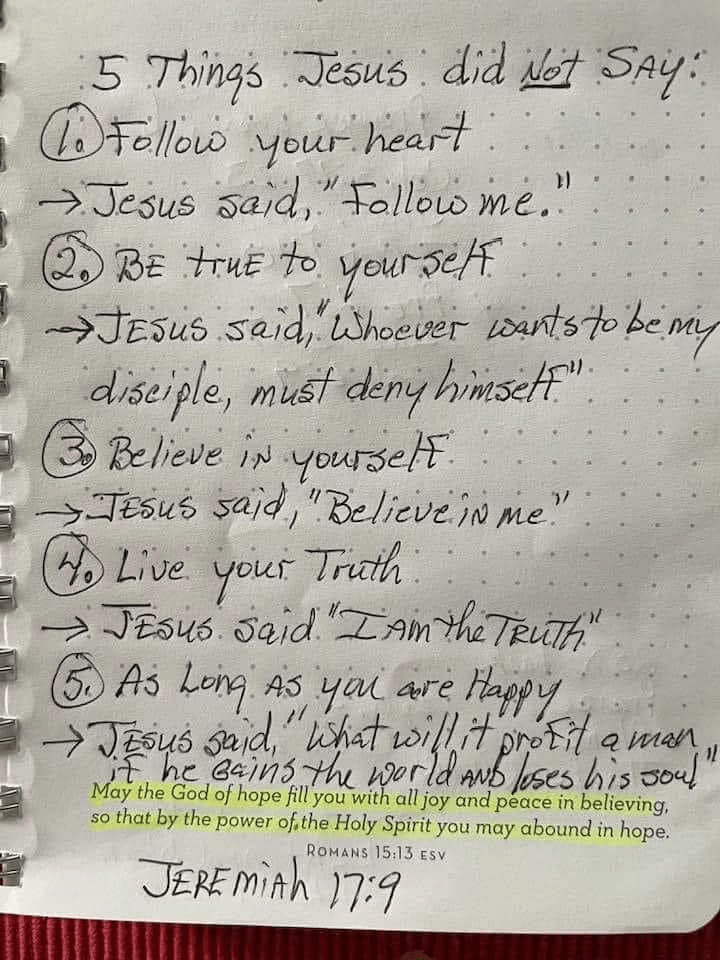
Last fall I (shockingly) found something on Facebook I don’t agree with. As I scrolled through the first dozen posts on my feed, this graphic appeared at least three times.

Obviously it resonated with many of my friends and family. But, when I read it, I felt small, mute, powerless. I felt called to misery as my spiritual inheritance. I felt afraid of myself.

Then I thought, two can play at this game. You throw Bible verses at me, I’ll throw some back at you. (Side note: I’m working on being less defensive.)

#1) Jesus didn’t say, “Follow your heart.”

No, but He made my heart, and He likes to spend time there. My heart is where the physical and the spiritual meet—like the exchange of oxygen in my lungs, passing from air to blood, life-giving mystery. If I try to separate from myself, I end up separating from God. He is the substance of which I am made.

Jesus said to His Father, “I do not pray for these alone, but also for those who will believe in Me through their word; that they all may be one, as You, Father, are in Me, and I in You; that they also may be one in Us.” (John 17:20-21a, NKJV, emphasis added)

#2) Jesus didn’t say, “Be true to yourself.”

No, but He did say, “Every kingdom divided against itself is brought to desolation, and every city or house divided against itself will not stand.” (Matthew 12:25b, NKJV)

#3) Jesus didn’t say, “Believe in yourself.”

No, but He did tell this parable: “Suppose a woman has ten silver coins and loses one. Doesn’t she light a lamp, sweep the house and search carefully until she finds it? And when she finds it, she calls her friends and neighbors together and says, ‘Rejoice with me; I have found my lost coin.’” (Luke 15:8-9, NIV)

This is a woman who believes in herself. She doesn’t blame the kids for losing her coin, or berate herself. She takes action. She lights a lamp, sweeps the house, and looks carefully until she finds the coin. When she finds it, she doesn’t breathe a sigh of relief that no one found out how irresponsible she was to lose it. On the contrary, it appears she’s okay with mistakes and disappointments. When she finds the coin, she calls her friends and neighbors to rejoice. She knows that she belongs and that her triumphs are worth celebrating—not because she has done something extraordinary, but because she has showed up for the ordinary.

#4) Jesus didn’t say, “Live your truth.”

No, but He did make me different from everyone else. JJ Heller sings, “Maybe the best thing I can be is me.” I’m not Jesus, or Paul, or Ruth. I’m not the foster-mom, or the guy who evangelizes with fresh-baked bread. I’m not the one who remembers everyone’s name and their mother-in-law’s name. My home isn’t a clean and peaceful space people flock to. But I do create safe spaces for people to talk and grapple and say life is shitty. I do text friends when I’m thinking of them, and sporadically send cards in the mail. I ask questions and deliver coffee and buy birthday gifts.

I write bravely, and sometimes the person who reads feels seen. My truth is the truth I know because I’ve lived it and it’s deep in my bones. It is these deepest parts of me that touch the divine.

Jesus said, “For God so loved the world that He gave His only begotten Son, that whoever believes in Him should not perish but have everlasting life. For God did not send His Son into the world to condemn the world, but that the world through Him might be saved.” (John 3:16-17, NKJV)

God didn’t come into the world to overshadow me or indict me, but to preserve and liberate me.

#5) Jesus didn’t say, “As long as you are happy…”

No, but He did say, “I have come that [my sheep] may have life, and that they may have it more abundantly. I am the good shepherd. The good shepherd gives His life for the sheep.” (John 10:10b-11, NKJV)

Jesus didn’t suggest that we sacrifice everything on the altar of happiness, but neither did He suggest that we pursue misery. He made us with taste buds and penises and clitorises, and He made a world bursting with taste and touch and life. He metes it out neither according to merit nor in submission to scarcity, but in wild abundance.

“Happy are the people whose God is the Lord!” (Psalm 144:15b, NKJV)

Toothpaste

Toothpaste

Blessed are You,
Lord our God,
Queen of the Universe,
for chocolate chips
melted into a couch cushion,
bandaids on the shower wall,
and toothpaste. so. much. toothpaste—
crusted onto the tube,
smeared on the bathroom counter,
cemented to sinks and walls.

Blessed are You
for Cheerios on the kitchen floor
crushed into powder,
coat wet and dirty
from a night in the back yard,
sandal forever lost
in the mud of Anthony Lake,
chip crumbs in the bunk bed.

Blessed are You,
Lord our God,
Queen of the Universe,
for candle wax dripped
down the cupboard door,
Q-tips cut into pieces,
gum saved on the dining table “for later.”

Two young humans dwell here
who create often and live large.
May they always have
permission to be messy and alive,
and enough money for toothpaste.

Prayer, Revised and Expanded

My journal takes me back in time. September 25, 2015. Thirty years old. Married ten years. Two daughters—Kyli two months past her first birthday, and Kayt a month shy of her third. That means on the day I wrote this prayer I had a one-year-old and a two-year-old. No surprise that “broken,” “scared,” “no match,” and “tired” feature in this heart-cry, penned during a rare stolen moment. My heart bled out through the ink of my pen. I turned to the page and to my heavenly parent, because together they were the safest place I knew.

April 17, 2024. Thirty-eight years old. Married 18 years. Kyli and Kayt are now 9 and 11. We’re deeply settled into the house we were in the process of purchasing in 2015. And I’m writing, which I now realize is not only a safe place for me, but also a creative passion.

Today I’ll respond to myself in this prayer. A spiritual journey is a both/and experience, dense with contrast and contradiction. And so today maybe I disagree with my thirty-year-old self, but my experience and beliefs then were as valid as my experience and beliefs now.

Truthfully, I haven’t been writing spiritual content much recently. I’m weary of cultural Christian ideas, the sin-and-salvation language, the beliefs that tied my hands behind my back. But set all that aside, and there is a friendship. Prayer is a celebration of friendship.


Good morning, Lord.

I am in a place I know You do not intend for me to be. I’m literally sick with worry. I can’t stop my head from spinning and my heart from panicking. Please speak truth to my heart and save me from myself.

You can be in this place. It’s okay to not be okay. You won’t feel this way forever. And yes, keep believing there are better things ahead. You are held.

I believe the solution is walking with You, but I can’t even do that. I am so broken, so scared, so selfish. Please do it for me, Lord. Take my heart, take my marriage, take my parenting, take my responsibilities at church and book group and other places, take the move to the new house, take meal planning and grocery shopping, take the lies that cripple me. Take my heart of stone and replace it with a heart of flesh.

What does it look like to “walk with God”? You are beautiful and your life is beautiful. You are worn out. Ask for help. Take medication. Drink coffee. Watch TV shows. Cry. Plan a day for yourself—that is not selfish. Your heart of flesh is already there. And this grieving might be just the thing to help you find it.

I confess my selfishness, my desire for control, my fears, my misbeliefs. They are sin and they do not honor You. Please take them from me. Please fight this fight for me. I am no match for sin, no match for the devil, no match for life.

Overwhelmed, flooded, depressed, alone, trapped. You feel these things deeply. You are stronger than you think, and not as strong as you think. You might have to let get of what you’re holding tight, and holder tighter to the things you’ve been letting go. Don’t know what that means? Don’t fret. God really does have your back, and She’s not the least bit disappointed.

I can do nothing … but isn’t that a good thing? For Your strength is made perfect in weakness [2 Corinthians 12:9]. Please hedge me behind and before and lay your hand upon me [Psalm 139:5]. Please take away my addiction to negative emotions. Teach me to rejoice in Your victory in my life, to give You the glory, to have a heart of thanksgiving.

These things you dream of will happen. You will learn to enjoy feeling happy, to like yourself, to feel gratitude and joy.

Lord, I am lonely. I am broken. I am too self-centered to see the beauty of You and the many good gifts You are showering on me daily. I surrender to You, Lord. Please save me from myself, Lord.

God will save you from yourself by introducing you to your true self. It’s okay to be lonely and broken. You are also brave and kind and capable.

I need time with You daily in prayer and in the Bible but I feel helpless to make that time. Please do it for me.

God loves to spend time with you. She hears you.

Thank You that You see me as I am and love me. I am so tired of myself. I am so grateful that You are not overwhelmed by my brokenness. Thank You that You use brokenness for Your glory. Give me a testimony that will draw others to You. Lord, if I need a mentor, please provide.

Keep speaking these truths. And when you’re too tired to speak them, the Spirit will speak them for you. You don’t need a testimony; you are a testimony. And you always will be.

I am terrified of the day ahead of me. Take this from me, Lord. Give me eyes of faith. Remind my heart to lay everything at Your feet and let You do the heavy lifting. I want to take Your yoke upon me and learn of You, and accept the rest You promise [Matthew 11:29]. I want to be Your servant and friend so that others will be drawn to You.

Oh dear one, these days are so long and so hard. I see you. You can do hard things. And God is teaching you to rest, even now.

Thank You for my brokenness, thank You for trials and difficult times. Thank You that You are enough and everything else is a cherry on top. I choose by the power of Your Spirit to abide in You. Please let me be a branch today. [John 15:4, 5]

Way to go! You are receiving with open hands. But you know, “everything else” is the stuff life is made of, and it’s okay to want it to feel lighter. You are a branch. You are a badass. Many good things are coming for you, and one day you will feel excited about what the day holds. In the meantime, go get some coffee.

Slugs

Slugs

Blessed are You,
Lord our God,
King of the Universe,
for spotted slugs,
fat and sticky,
slow and steady.

Blessed are You
for measured slither,
like slow-motion snakes,
leaving moisture on rocks,
strings of slime on sticks and leaves,
sensing with eyestalks—
reach forward, shrink back.

Blessed are You,
Lord our God,
King of the Universe,
for mantled slugs,
who live their adventures
one inch at a time,
knowing only what is
at the tips of their tiny tentacles—
a life of quiet trust.

Easter-Egg Life

As I practice both/and living, I learn to allow myself a mix of grace and hard work. Both/and living means, for me, a life that embraces paradox and nuance—different than black-and-white, either/or living.

It’s not unlike the Easter-egg hunt in our back yard last weekend. Several families gathered to spend a lazy afternoon enjoying haystacks (make-your-own taco salad), early spring sunshine, and Easter candy.

Our gathering was ripe with contrast:
Warm sun, cold wind
Hollow (plastic) eggs and solid (hard-boiled) eggs
Edible treasures and inedible treasures
Young and old (three generations of family)
Hiding and finding
Large eggs and small eggs
Textured eggs and smooth eggs
Relaxation and busyness
Eating and drinking (can’t do them at the same time)

Dozens of eggs peeked from grass clusters or perched in low branches. Most of them were easy to spot, but some hid deep in overgrown grass, or camouflaged with bushes and trees. Kids ran through the yard and collected the easy-to-find eggs, then dumped out the baskets to assess their treasures, popping candy into their mouths as they sorted the hollow, plastic eggs from the dyed, hard-boiled eggs. After they’d satisfactorily sorted their first take, they went out again, looking for the harder-to-find eggs. The second round yielded less results; nevertheless, each child’s collection of candy and coins, tiny animal toys and stickers, continued to grow.

My journey into paradox has involved opening the components of my life, like eggs collected in a basket, to find out they were filled with chocolate I couldn’t eat, money I couldn’t spend, and to-do lists I couldn’t finish. My basket stank. The hard-boiled eggs rotted, and the hollow eggs held no treasure. They were labeled—religion, self-help books, pulling myself up by my own bootstraps, always doing the right thing—but the contents disappointed. I thought I’d painstakingly collected resurrection power, or at least a lucky rabbit, but instead I had unearthed anxiety.

The hardest work in my life has been excavating the mountain between me and grace. My value has long been rooted in performance and productivity, and—far from what the church patriarchs predicted—it’s excruciating for me to be “lazy.” I have been incapable of resting my soul, unable to move in “the unforced rhythms of grace” (Matthew 11:29, MSG). A planned life and a protestant work ethic leave grace hanging to the side, like an awkward, unneeded appendage.

Late Easter afternoon, as we covered bowls of salsa and picked up trash, my daughter Kyli kept asking my help to find one more special egg. She knew it had $1 in it which would be hers to keep, along with the container—a beautiful, 3D-printed, shiny black egg that screwed open and shut, with mermaid-scale texture on the outside. I searched with her willingly at first, becoming more reluctant after each subsequent request. I had hidden the egg in question, but I couldn’t remember where, and I soon tired of looking.

It’s not that hard work or self-help books are inherently or predictably bad. It’s just that my basket lacked wholeness. I needed to collect eggs containing decadent chocolates meant to be eaten, money to spend, and lists of what I’d already done. I struggled to find those eggs. I saw them in other people’s baskets, but whenever I went collecting with my basket, I found more of the same eggs I’d already collected.

At length, one of Kyli’s uncles found the black egg under an apricot tree. Kyli squealed with joy, opened the egg to retrieve the dollar, then carefully added it to her egg collection. Soon she returned to our play-set, where the cousins were sending all manner of things down the slide—rocks, smaller cousins, broken plastic things. All was well in the world and she could focus on the fun at hand.

Like Kyli, I never did find the special “eggs” I was looking for. Someone else found them and handed them to me. Much to my surprise, the eggs I didn’t work for are some of my favorites. I used to think working hard mattered a lot, and productivity trumped enjoyment. I’m grateful to the authors, friends, and family who have lovingly placed “grace eggs” in my basket. I’ve learned to have fun.

It’s not that I won’t work hard; I do and I will. The difference is, as I putter and tumble and stride through my days, I like them. I like me. I like people and pets and all kinds of weather and books and food and friendship and I almost like it when my kids wake me up at night. At least, I’m pleased they trust me and know they don’t have to be alone when they’re scared or can’t go back to sleep. This, I think, is grace.

The Bible Is Bananas

A wise man once said there is a time for everything. I used to interpret that as a statement about seasons—one thing in one season, another thing in another season. But maybe it’s also a statement about concurrency, about different things at the same time. In stead of either/or, I find myself more often thinking both/and. I am both connected to people and separate from them. I am both anxious and at peace. The world is breathtakingly beautiful and excruciatingly broken. Family is an asset and a pain in the ass. Love is ultimate safety and ultimate risk. God is male and female and non-gender.

But now and then I wonder if I’m being too permissive. My conservative evangelical upbringing tells me there are definite wrongs and rights, and one typically excludes the other. The church also told me the Bible makes sense. Read it “right” and you can reconcile what is confusing, and even package it all up nicely in bullet points on illustrated pamphlets. So if I don’t believe in one right answer any more, do I still believe in the Bible?

I don’t open my Bible much these days, but today I do. I read Lamentations chapter 3, and find it to be a lovely example of both/and thinking. (Or an example of irreconcilable contradiction. Take your pick.) Lamentations 3 contains 66 verses of despair, hope, and vengeance, penned by the prophet Jeremiah. As I begin to read, I feel a growing sense of contrast between these verses and the scriptures I see stenciled on wall art at Hobby Lobby, or screen-printed on church youth group t-shirts. I certainly didn’t memorize these verses in Sabbath School.

v. 2 He has led me and made me walk in darkness and not in light.

v. 3 Surely He has turned His hand against me time and time again throughout the day.

v. 7 He has hedged me in so that I cannot get out; He has made my chain heavy.

v. 11 He has turned aside my ways and torn me in pieces; He has made me desolate.

v. 16 He has also broken my teeth with gravel, and covered me with ashes.

I’m not even gonna try to wrap those up with a nice bow. Not only are these sentiments a dark portrayal of God, they stand in open disagreement with texts elsewhere in the Bible. For example:

v. 2 He has led me and made me walk in darkness and not in light.
AND Your word is a lamp for my feet, a light on my path. Psalm 119:105

v. 3 Surely He has turned His hand against me time and time again throughout the day.
AND I will strengthen you and help you; I will uphold you with my righteous right hand. Isaiah 41:10b

v. 7 He has hedged me in so that I cannot get out; He has made my chain heavy.
AND “My yoke is easy and my burden is light.” Matthew 11:30

v. 8 Even when I cry and shout, He shuts out my prayer.
AND The righteous cry out, and the Lord hears, and delivers them out of all their troubles. Psalm 34:17

v. 9 He has blocked my ways with hewn stone; He has made my paths crooked.
AND I will go before you, and make the crooked places straight. Isaiah 45:2a

v. 16 He has also broken my teeth with gravel, and covered me with ashes.
AND The Spirit of the Lord God is upon Me, to give them beauty for ashes, the oil of joy for mourning, the garment of praise for the spirit of heaviness. Psalm 61:1a, 3b

v. 17 You have moved my soul far from peace; I have forgotten good.
AND “My peace I give to you.” John 14:27
AND He leads me beside the still waters. He restores my soul. Psalm 23:2b, 3a

As it turns out, I don’t need to look in other books of the Bible to find opposing sentiments. This one chapter of Lamentations contains a fullness of expression from one extreme to the other:

v. 11 He has turned aside my ways and torn me in pieces; He has made me desolate.
AND The Lord is good to those who wait for Him, to the soul who seeks Him. v. 25

v. 42 We have transgressed and rebelled; You have not pardoned.
AND Oh Lord, You have pleaded the case for my soul; You have redeemed my life. v. 58

v. 43 You have covered Yourself with anger and pursued us; You have slain and not pitied.
AND Through the Lord’s mercies we are not consumed, because His compassions fail not. They are new every morning; great is Your faithfulness. v. 22, 23 (Here’s the Hobby Lobby verse I was looking for!)

v. 44 You have covered Yourself with a cloud, that prayer should not pass through.
AND You drew near on the day I called on You, and said, “Do not fear!” v. 57

At this point I’m either thoroughly confused (I am), or my both/and thinking is expanding exponentially (it’s trying). The more I read, the more oddities I find. Is this a portrait of grief, not meant to make “sense”? Certainly an either/or mindset would require a diagnosis here, probably something along the lines of, “These are just feelings. Of course God doesn’t actually break our teeth, remove us from peace, or make our chains heavy. This passage is an upset person blowing off steam, exaggerating to express their angst.”

But couldn’t you say the same about the verses that extol God? What if the reality is that God turns His face away from us and punishes us, but sometimes we feel like He is listening to us and redeeming us?

Maybe it’s all of the above. We feel all kinds of feelings that aren’t about what God is actually doing or not doing. We also receive Her work in our life through our feelings. And maybe God is both punishing us and redeeming us. That’s hard for me to even write, as I have completely abandoned the idea of a God who punishes. But what if it’s both? And what if sometimes salvation happens in a sheep-and-goats sort of way, and other times in an all-shall-be-saved sort of way?

Jeremiah writes, “Is it not from the mouth of the Most High that woe and well-being proceed?” (v. 38) I love that it’s a question and not a statement. It’s an invitation to conversation, and invitation to keep wondering, keep talking, keep paying attention to what is there and what isn’t there.

Could it be comforting that the Bible is basically bananas? Imagine if everything matched up nicely and could be distilled to a handful of logical statements. No need for 66 books full of words that paint God (and Her creation) in every light imaginable. Let’s have one painting of God, at dusk, when the light is most complimentary and the air is calm. Let’s keep this one painting in a vault and burn all other paintings, and the people who paint them.

But no, the Bible will not allow this. Its vivid portraits of God and humans are all bound together. For my part, I’m done pretending the Holy Spirit is going to match it all up for me. Bring on the paradoxes, contradictions, violence and patriarchy, and the portrait of a God whose love is so inclusive and profligate it’s ridiculous. Both/and.


Special thanks to Marla Taviano (@marlataviano, @whitegirllearning) for the phrase “the Bible is basically bananas.” Go preorder her newest book of passionately beautiful deconstruction poetry, titled whole. (And while you’re at it, order her other books of poetry, unbelieve and jaded.)

Blessed or Lucky?

I possess the leisure of asking questions like, Am I blessed or lucky? This is a testament to my comfortable life, and my pedantic nature. It may also involve just a tiny bit of reputation management. I don’t want to say I’m lucky, as though I’ve left my destiny to a four-leafed clover. But I don’t want to say I’m blessed and be seen as a rare recipient of God’s favor.

I suppose I could dispense with both words and use something else altogether—maybe grateful. Still, there are connotations I don’t like. What if people think I’m grateful for ev-er-y-thing, or that I avoid talking about hard stuff because—you know—I’m just grateful. Why is it so damn hard to manage my reputation?

The church taught me not to say lucky—because luck’s got nothing to do with it. But as I near my 40th birthday, I’m fairly certain luck has everything to do with it. Luck means things happen to me because things happen. I can have bad luck or good luck, divorced from my character, my actions, and the circumstances preceding said luck.

In in a much less haphazard fashion, blessed seems to mean God is smiling down on me and providing extra special things, probably because of my good character. Or at least because I’m praying. You know the verse to that children’s song about the wise man and the foolish man—“the blessings come down as the prayers go up”? I take that to mean when I stop praying I’ll stop being blessed. Yes, the Lord makes the sun shine and the rain fall on the good and the evil (Matthew 5:45)… but surely draughts in California have something to do with legislation, and floods in Louisiana serve to tighten the Bible belt a notch or two.

The protestant work ethic suggests that accepting luck into my worldview will cause me to sit on my keister all day and wait for the garden to grow. As Mrs. Marcus complained in the comedy It’s a Mad Mad Mad Mad World, “This whole country is just full of people, who when these things happen they just say, ‘these things happen,’ and that’s why they happen!” This sentiment implies that if I worked harder I could be in control. Maybe if I prayed harder I’d have a more predictable life, good health until I die, financial security, children who stay “in the church,” and a permanent smile on my face. It’s laughable, really.

But isn’t every good gift from God? Is this a distribution problem? God’s blessings flow forth from Her heart of love, but the weather patterns dump them across the world haphazardly, piled up in some areas and entirely missing in others? In that case, blessed is really identical to lucky—I happened to be born in a wealthy country to parents who provided a stable home. I married a 22-year-old who happened to mature into an attentive and wise life partner. Like a video-game-player spawning into a game, I appeared here in a resource-rich environment. And I’m enjoying the benefits.

Everything I have is something a billion people don’t have—happy marriage, good health, both parents alive and still married, big house in a safe neighborhood, a comfortable wardrobe, not to mention the three meals I chew daily with well-cared-for teeth. It is tempting to wonder if God likes me better.

I’m not making much headway here. Thankfully, Elizabeth Gilbert leads me to the heart of the matter. In her book Eat, Pray, Love, she defines destiny as, “a play between divine grace and willful self-effort. Half of it you have no control over; half of it is absolutely in your hands, and your actions will show measurable consequence. Man is neither entirely a puppet of the gods, nor is he entirely the captain of his own destiny; he’s a little of both.”

There’s something underneath, a philosophy, a worldview. If I use the word luck to strip away all agency, lie down, and let life roll over me, I’ve become a puppet. If I use the word blessed to assign myself too much agency, I put God on puppet strings, and that can’t be good. But if I use either word to relax into the goodness of my life, the scales may tip from control to celebration. Celebration implies there is goodness worth noticing and lingering over, worth sharing with friends and family.

God blesses me.

Also, I’m just lucky.

Julia, It’s either You or Me

Julia Cameron possesses the rare talent of crafting an instructional book that is a treat to read, an invitation to be seen, and a storehouse of insight and wisdom. But I’m not happy with her right now. With some friends, I’m going through her book, The Artist’s Way. And it’s fun—the reading, our group dynamic, the exercises. Under her tutelage I’m learning to date my inner artist, a practice designed to fill my creative well.

I’m not mad at Julia about these Artist Dates. Or about the fact that I seem to have less creative flow since starting The Artist’s Way coursework. It’s probably hormones or the time of year or the other things on my calendar. Or maybe I’m just too contented to write. I like most of what’s on my schedule, and since I don’t fight against myself all the time any more, the emotional atmosphere in my life is pretty calm. In any case, I can’t put Julia on the hook for my stagnant writing.

It’s Morning Pages I’m mad about—three pages of stream-of-consciousness writing every morning. Julia swears they will change your life. Morning Pages—along with Artist Dates—are Julia’s favorite tools for recovering creativity. They are “a loving witness to our growth process,” a form of meditation, a journey inside. “We find our own quiet center,” she writes, “the place where we hear the still, small voice that is at once our creator’s and our own.” I think I know exactly what she’s talking about. I’ve been journaling with God for decades. I found my quiet center. I love to sit with my Creator and a pen and see what happens, or to hash out on paper a nagging question, perplexing circumstance, or angry diatribe. On the page, in communion with the Spirit, I have found myself and have discovered with some surprise that I like myself.

Julia takes care to point out that many people have resistance to Morning Pages, but two months ago I just knew that would not be me. What could be better than starting the day with three pages of stream-of-consciousness writing? Well, after nearly two months of writing (almost) daily, I can think of at least three things: snuggling in bed with my warm husband a little longer, sitting with God and watching the sunrise, or spending time with whichever daughter awakens early.

As is often the case, the thing I thought would be hard (Artist Dates) slipped into my life like a new and delightful friend, and what I thought would be easy (Morning Pages) is causing considerable discomfort. I try to wrestle it into submission by reminding myself that it is a perfect fit for me. I totally look great in this outfit. But after weeks of early-morning writing in which I have discovered next to nothing about myself, except that I’m chafing at this requirement, I must admit Morning Pages are not a perfect fit. I don’t want to record random thoughts. I want to finish a thought. I don’t want to write fragments and ramblings. I don’t want to lose valuable insights in pages of jibber-jabber.

Besides, my “consciousness” seems to be a bit of a worrier. Following it around for three pages is more stressful than sitting in silence, practicing gratitude, or praying for friends. Perhaps those things are allowable for Morning Pages and I’m just getting this all wrong. But stream-of-conscious, to me, doesn’t sound like directed thoughts and meditations. And I’m not supposed to pause. Keep writing, bypass the left brain, or some crap like that.

I don’t like to admit it, but I don’t like being told what to do. The rule-follower in me really wants to cross every “t” and dot every “i,” so doing what I’m told can be excruciating. It takes a lot of energy to get things right. If you’re going to tell me what to do, you better know what you’re talking about and the payoff better be good, because I’m not self-actualized enough to put in a proper (balanced) amount of effort. And once I over-blow my efforts, I expect an equally overblown result. I’m not about to spend hours every week writing a bunch of gibberish because you, Julia, say it’s the best thing since sliced bread.

Take that.

I’m not very good at agency yet, so I make up for it by pushing back on everyone who wants something from me. I live in the tension of hoarding my time and emotions out of fear, and giving them too freely, also out of fear. This is not Julia’s fault. She has simply made a request and I can’t handle requests. Isn’t every request an obligation? And if it’s not—if this whole course is actually about helpful tools and creative recovery—then how do I know whether to force myself to do Morning Pages? Do I choose them because my resistance needs to be seen but not given charge? Or do I choose not to do them because I gave it an honest try and found I already have practices in place that work better for me? Is that prideful? Rebellious? Naive? How could I know more than Julia Cameron?

I’m stuck. And stuck makes me angry. And anger makes me want a “bad guy,” which in this case is either me or Julia. Who’s it gonna be?

Sigh.

There is no bad guy.

There is no right answer.

Morning Pages could be helpful today or next year or never. It could be unhelpful in winter or while I’m content in life, or forever. I hate that. How does ambiguity manage to be such heart-wrenching torture, and simultaneously an elegant freedom? I am free to choose. I can decide to write Morning Pages when I don’t feel like it. Or I can not write them at all. Or I can try one page, or evening pages, or weekend pages. Who decided to give me this much power?

Some say it’s God, the only One crazy enough to hand out freedom-of-choice like candy. The rest of us know that some amount of control is the only thing keeping us humans washing our hands before we eat, and stopping us from eating each other alive. But maybe I’ll go with God on this one. I don’t have to fight with Julia, or Morning Pages, or even with myself. I can decide. Then I can change my mind and try something else next week. There’s not much at stake here. Maybe the best part of Morning Pages is learning that life is not graded, but lived.