Category Archives: Belonging

Simple Jesus

I want to like Jesus because the grown-ups in my life told me He is good, and they were right. 

I want to be innocently happy that God is good. 

I want to go back to painting “JESUS FREAK” in huge letters on a baggy cotton T-shirt, soaking up Sabbath School lessons with gusto, back to the credibility God had when I was 14.

Simple Jesus—does He still exist? Or can He at least be mysteriously complex and Kindergarten-simple at the same time? 

Is there a reality—no-strings-attached—in which Jesus just loves me and knows my name?

A few weeks ago I attended a spiritual retreat at Camp MiVoden, as a sponsor for the girls in the 7th/8th-grade class. During the worship services I remembered something, a feeling of belonging and certainty from my past. I knew some of the songs the praise band led, and I sang with my arms raised. No one expected anything—hardly anyone knew me—and the featured speaker said simple and good things, about who I am and who God is, and I cried, and I remembered a time when I belonged wholly, and sermons weren’t pocked with ideas that distract me from goodness and wholeness.

I want a plain friendship, one I don’t have to defend or explain, one in which I don’t need Jesus to make me look good, and Jesus doesn’t need me to make Him look good; Jesus with a reputation as simple as Mary who had a little lamb, not the notoriety of an activist. 

I don’t need answers for all the questions and discrepancies. I’m looking for that place where they are absent, where I don’t have to explain why I don’t believe in a punitive gospel, or why I’m part of a faith tradition (Christianity) that has inspired violence for thousands of years. I don’t want to explain why I use feminine pronouns for God, or why I say Adventism is my community but not my religion. I don’t want anyone to raise their eyebrows at me, nor me at them. I want to be in love—inside love. I want to feel safe because I am safe. 

Maybe what I really want to know is this: does a simple Jesus exist for adults too? Does He go for coffee with millennials—with me? Does He wear jeans and send 132 text messages every day? Does He understand carpools and playdates and a family calendar on the kitchen wall and how all the spoons are dirty if I miss one day running the dishwasher? Does He peruse my TBR shelf and ask me about my writing? Does He know I’m still a little girl inside, intimidated by the disciples who turn me away because I am small and simple?

Is Jesus here now, and does He remember me? Does He look through my photo albums and murmur memories? Has He been here for it all? Can we laugh together about singing “Sinnerman” and “We Are Soldiers”—the laugh of a shared memory—those lyrics humorous like the frizzy perms of the 80’s?* Is He still the cleft in the rock, the hiding place, the blessed assurance the hymns offered? 

What if we’ve shared a life more than a belief system, and our love is built on mutual adventure and admiration?

Maybe He has never needed me to pull Him apart and stitch Him back together, to understand how He is a triune being, or even to put our companionship into words. Perhaps I was mistaken in thinking that farther, bigger, and deeper are better. 

Jesus is here. In the essentials He hasn’t changed a bit. He’s still the great guy I knew in primary Sabbath School; the one who stood with me in the church baptistry, invisible yet deliciously simple; the father I wrote to in a dozen journals full of prayers; the soil from which I grow. Most of all, He’s still my friend.


*I sang these songs countless times. Although the lyrics of “Sinnerman” I sang were not as heinous as what I just found by googling it, I think it’s safe to say it’s inappropriate to mock sinners running from God (and what even is a “sinner”? Aren’t we all?). And don’t even get me started on “We Are Soldiers” and “I’m in the Lord’s Army.” Who decided it was a good idea for seven-year-olds to sing about blood-stained banners and artillery? So yes, I think Jesus and I can have a good laugh about it.

Run-on Marriage

Last week Michael and I celebrated 20 years of marriage. The run-on sentence below illustrates our run-on marriage. (And yes, we’re still crazy about each other, in addition to driving each other crazy.)

I cannot get in bed when the bedcovers are frumpy, drifting off the end of the bed, sideways, knowing that if I do lie down and tug on them I will get too much sheet, too little blanket, and the wrong corner of the comforter; but I do not make my bed in the morning—I make it right before I climb in bed at night, tugging with exaggerated exclamations as I dislodge cats, and my poor husband too, because there’s a tiny possibility that I idolize sleep and this bed is my altar and before I sacrifice my body the altar must be prepared as if for a temperamental god of linens, and I like to remind my husband that before I met him my sheets would stay tucked in and straight for months at a time, but since his feet hang over the end of the bed and he tosses and turns at night, I have to straighten the covers every single day, and I accomplish this with more violent energy and bitter comments than necessary, although one would think after 20 whole years I would have adjusted and calmed down about it—but he huffs and makes less-than-charitable remarks every time he drives, and he has been driving for twenty-five years, so I guess we are both going to have our snide remarks and adult tantrums and all shall be well. 

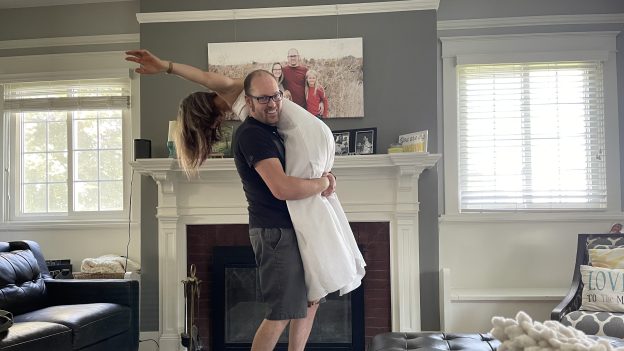
P.S. I usually use stock photos, but the photo for this post is of my husband and I earlier this month. I barely squeezed into my wedding dress, which I attempt every September as our anniversary rolls around.

Disrupt the System, Applaud Early

Applause: public approval or praise expressed by clapping hands together.

Some fifteen years ago, I stood while applauding after a Distinguished Faculty Lecture at my alma mater. Is it a standing ovation if only one person stands? I stood, exuberant about the depth of understanding and connection I experienced during the lecture. But as my peripheral vision told me that no one else stood, self-consciousness bubbled up. Why am I the only one deeply affected? Does everyone else already have a depth of experience such that the lecture was run-of-the-mill for them? My pulse quickened and I lowered into my seat, certain everyone must be giving me the side-eye, judging my way of being in the world.

Looking back, I am proud of that moment. I know now that many of us who speak or write or reveal ourselves in some way, need only one person to stand. Only one person to send a note letting us know our words created connection.

Late last July, I attended “heART on display,” an event featuring artwork by incarcerated or formerly incarcerated individuals. Cedar Rain Spirits, a distillery and BBQ in downtown Walla Walla, hosted the event, curated by Devon Player, whom I met through the Walla Walla Community Change Team. Outside the narrow storefront, a sandwich board on the sidewalk announced the event. Inside, people mingled, music blared, and art lined much of the two long walls that extended to the back of the venue.

For the next hour, I perused art, snacked on free hors d’oeuvres, asked a few questions, and flattened myself into tables and walls to avoid bumping into fellow guests. As I chose art to purchase—proceeds to benefit Running Waters Equity Fund and the Black Prisoners Caucus—Devon took the mic and introduced a guest speaker, Anthony Covert. We all quieted where we sat or stood, and turned to listen.

Anthony was sentenced to 432 months (36 years) in prison at the age of 18. He served 16 of those, and walked free on June 10, 2024. As he talked about sitting in prison, alone with himself, I stumbled into sudden affinity with him. We “outside” (unincarcerated) folks have so much available to distract ourselves; it is a rare and excruciating experience to be alone with ourselves. “ But when you’re sitting in that prison cell and all you got is those four walls—sometimes with a celly, sometimes not—you have to sit with yourself.” And, he says, you have to ask yourself questions, about how you came to be in this place, and what your purpose is now that you’re here. 

My own season of being alone with myself and asking hard questions transpired during stay-at-home momming. I recognized that singular agony of sitting with oneself, and the subsequent decision to engage with tricky, heavy questions. As an incarcerated, black young man, Anthony felt it in the isolation of prison. As a middle class, white mother of an infant and toddler, I felt it in the isolation of motherhood. Although our experiences differed, Anthony’s words connected intimately with my inner world as a stay-at-home mom. Because he exposed his pain, I felt seen in mine. Our stories held hands for a just a moment. 

I wanted to applaud, but other listeners were intent, soaking up the story, not ready to respond. Anthony continued, and when he shared the completion of a college degree, while incarcerated, with a 3.98 GPA, everyone applauded, including me. Later, when he talked about his clemency hearing and the unanimous vote to grant him clemency, we applauded again. It was then that I noticed my moments of connection were not the same as the moments of applause. Before Anthony’s clemency hearing, when anxiety was high, Anthony’s friend Demar told him, “Go in there and show them who you are.” That moment connected. That moment I wanted to clap or sigh, or give the man a hug. Show them who you are.

Why the dissonance between my moments of kinship with the speaker, and our collective moments of applause? Could it be that as a society we are quick to applaud measurable achievement, but not moments of quiet strength? What about times of agonizing surrender—to our brokenness, and simultaneously to our wholeness? 

Anthony described us on the “outside” as an invisible army that stands with those on the “inside.” Because our worlds are disconnected, there is a wall isolating our compassion and assistance from the insiders’ knowledge, and/or response. Knowing this, may we be courageous to continue engaging—despite the lack of testimonials, catchy postcards, and fundraising galas that feed the selfish side of our generosity. 

“ There’s no fixing the system. It is what it is,” Anthony said. “But what you can do is disrupt it in certain areas, right? To give people opportunities to come home.”

What if applause—public approval or praise—happened earlier in the story, and it served to recognize nothing more than our humanity, the intrinsic dignity of our existence? What if clapping said, “you got this,” more than, “you did something big and measurable”? Better yet, what if approval and praise showed up in the process and in the conclusion? What if it gave people opportunities to come home—to themselves, to their families, to their communities? I need this. I suspect we all do.

I want to applaud early—for my children, my spouse, my friends, my community. A healer is “someone who can see the movement toward wholeness in you more clearly than you can at any given moment,” wrote Rachel Naomi Remen. Let’s open our eyes to see. Put your hands together for humanity. 

Let’s applaud smallness. Clap for the courage it takes to engage with our own selves and our messy stories. Cheer at the thin places in our stories, where pain and intention form a bond and point us in a new direction. Celebrate wholeness even as it lingers in the wings. Disrupt the narrative in ways that invite belonging. 

Walk Repenting

“… the soft animal of my body …”

As I put the car in park, I leaned forward and squinted to read the blue letters on the bumper sticker of the car in front of me. “maybe the soft animal of my body wants to walk a thousand miles repenting”

I’d never heard a human body described as a soft animal before. Did I have a soft self, and did it want to repent?

It was Tuesday morning, Colville Street, a much needed coffee-and-writing date with myself. I turned off the engine, and hoping the woman in the red shirt exiting the store to my right was not the owner of the car, I snapped a photo of the bumper sticker. A silhouette of geese flying over cattails on the right side of the message added to the calm invitation I felt from those words. 

Not wanting to linger with my phone camera pointed at the back end of a stranger’s car, I made a quick detour into the building the red-shirted woman had just exited. Like a mini mall, a half dozen boutique clothing and food/wine shops occupied storefronts along a wide hallway. I noticed a sign for a soon-to-be bagel shop on the brown-paper-covered windows of a corner space. The slurpy sounds of a paint roller accompanied the smell of fresh paint.

The shop around the corner used to sell my favorite coffee smoothie—made with raw cashews, dates, and cocoa powder. They had closed some months ago, but I’d heard the new occupant of their space served the same smoothies. I walked in slowly and surveyed a freezer with everything from ice cream bars to frozen quarts of house-made soup. The deli fridge held a mouthwatering assortment of unique grab-and-go foods, such as spiced garbanzo beans. When I got to the cheeses, I noticed the front counter out of the corner of my eye, and above it the list of smoothies. No coffee smoothie. 

The bumper sticker I’d photographed still rolled around in my mind as I perused a couple shelves of dry goods, then stepped over to the counter. “Hi,” I spoke to the southern-California-pretty girl, feeling self-conscious in my workout clothes and messy half-ponytail. “This is my first time here since this store changed owners,” I offered awkwardly, “so I’m just checking it out.”

“Okay. Welcome.” She smiled.

“Do you have a coffee smoothie?”

“No. We’re working on it.” She gestured to a middle-aged woman with light brown hair, seated behind a laptop at the nearest round table. 

“I’m trying to get the consistency right,” the woman offered. I showed her the recipe I use at home for a coffee smoothie, and we chatted for a while. She told me about the plans she has with her business partner to open a sandwich shop in the small empty storefront next door. I wished her luck with the business ventures and returned the way I’d come, back to the sidewalk by my car. No police waited to take my phone away or arrest me for taking pictures of bumper stickers.

I grabbed my laptop, sweatshirt, journal and book from my car and headed toward my original destination for a weekday morning self-date—the coffee shop beside the mini-mall. 

I ordered a hot matcha latte, paid with a gift card, and chose a table in the corner. Then I settled in with my journal and returned to pondering the bumper sticker: maybe the soft animal of my body wants to walk a thousand miles repenting. Yes, my body seems to say, I want to do this. I ask my body, why?

Because pretense is not a way to spend a life.

Because I am sorry this world is not a comfortable place for a hundred families I know and billions I don’t know. 

I am sorry for the miscarriages and painful marriages, sorry for the systems that don’t see people, and the people who don’t see themselves, sorry I have loved control more than gentleness, sorry for the disease and dis-ease that never ask before they darken our doors.

I am sorry for the loss of hard-to-hear human stories to easy-to-apply inhumane labels, sorry that emotional and physical safety are a privilege and not a right, sorry for all the grief that is carried alone because we are scared to name our own grief and to witness the grief of others. 

I am sorry we look at teenagers and see youthful bodies and immature minds, but don’t see the loneliness or oppressive unanswered questions, sorry we look at children and see their food-smeared faces, hear their unfiltered words, but don’t see their whole souls—meant to awaken us to the wholeness that is their birthright and ours.

I am sorry there is no easy way out of addiction or a demeaning job or loneliness, sorry that pain is par for the course and I sometimes pretend it’s not, and sorry I forget that joy is also par for the course and I sometimes pretend otherwise.

I am sorry that plants are largely unheard and animals are prized or passed over, but rarely known, sorry I’m an unsafe stranger to some, and an unsafe friend to others, sorry for all the ways I have confirmed the loneliness in another person’s spirit.

I am sorry I swallow my food without giving thanks to the earth and the farmers and God.

So yeah, I could walk a thousand miles repenting, my soft body says. And I want to grasp other soft bodies and bring them with me, to walk together barefooted until our soft mass of bodies spreads repentance across every landscape, until we have repented our way home, which is not a place of individual belonging, but of collective belonging.

And then my body is done speaking. She relinquishes the pen back to my mind, and I see the paper I am writing on, the smooth blonde wood of the table underneath. I notice my cold ankles, the barista’s laughter, and a melancholy female voice singing through the shop speakers.

I notice the way my fingers wrinkle as I hold a blue pen with black ink, and see for the first time that the tiny screws on the metal logo attached to my purse are fake.

After a while, I notice that I am noticing, and I wonder—if fifteen minutes of quiet repentance awakens me this much, what might be born of a thousand miles?


Lunch time nears. I return to the shop with no coffee smoothie and purchase a cauliflower and garbanzo bean salad. While I eat, I think about repentance. Is repentance a list of sins and regrets before God? Is it turning a different direction, choosing a better way? Is it a walk, the bodily healing of circulation, the mental healing of gazing at the horizon, the spiritual healing of engaging with the landscape of humanity? My body says this might be the case. Perhaps it is all of these and more, an invitation to be awake, to be soft, to hold each other gently…for a thousand miles, if necessary.

Forty and (In)secure

Twenty One Pilots’s song, “Stressed Out,” laments the insecurities of adulthood, noting that fear is still present, and we still care what people think. I turned 40 this month, and yes, I’m still insecure. It’s different than high school. And the same. I want you to like me. I want to be well-dressed and well-spoken, and most importantly, perceived well.

I’m a grown-up—have been for quite some time—and I can tell you what maturity doesn’t mean. Being grown up doesn’t involve control and confidence; it doesn’t mean growing out of awkward traits and social habits; it doesn’t include a clean house and well-kept yard, or a passel of perfect grown-up girlfriends.

I’m less sure what being a grownup does mean. But I’ve noticed I’m softer than I used to be—more flexible, a teensy bit less judgmental, and I know more about cooking and cleaning than I did 20 years ago.

I know less about God, love, and relationships. It’s been said that the more you know, the more you know you don’t know anything. I can confirm this.

There’s a real sense of loss, not landing in adulthood firmly in control and certainty, an expert in the kitchen, the workplace, the bedroom. I get tired of being wrong, confused, ineffective. If knowledge comes from experience, I am an expert in exhaustion, stress, and leaving my cell phone in obscure places.

I know I’m sounding a tad morose. But there is a happy ending. There’s something left after losing control, and the appearance of control, and pretending to have control. What’s left is eyes to see a different life entirely—a life of watching the cat lick his fur, thinking of my three favorite moments from the day just before I fall asleep, fighting less with my kids and husband, knowing there will not be a seismic event when my to-do list is left undone.

And I know myself better. I know I love writing and small groups. I know I like a clean house, but not enough to put in the work. I know I’m scared of the interminable wants and needs of my children. Being quiet and alone—especially in nature—returns me to myself. Banana splits and blended mochas almost always sound good. I try the hardest to be self-sufficient when I’m at my weakest. Animals make me happy. Getting called “a writer” makes me stand a little taller. Synchronicity feels like opening a birthday present.

My birthday, which this year fell on the first Sunday in May, played out like a dream Mother’s Day. My husband cleaned the kitchen, top to bottom. He and the kids cooked breakfast and dinner, and took me out for lunch. I sorted through a large tote, five bags, and an unconstrained pile of children’s clothing I hauled up from the basement, and found most of it could be passed on. I went to the park and watched goslings and ducklings, heard the smack-smack of their webbed feet in shallow water, and marveled at their fluffy bodies. I took a nap. With my parents and sister, I ate fresh-made blackberry pie with “40” cut into the top crust. Michael gave me a gift certificate to have the house professionally cleaned (when the dust settles from our six-month construction project). Like I said, a dream day.

It’s worth noting I couldn’t have planned such a day. All was gift—the generosity of my husband, my children, my sister. Many times I have planned a birthday party for myself, with friends and presents and homemade cake. But for forty, this un-forced birthday felt fitting. The people who love me gave what they wanted to give. And I received. I basked. I rested. And yes, I sorted children’s clothing—one of those things I never can find time to do.

Maybe I’m ready to accept this life I have. Whether I die tomorrow or in another 40 years, I will die complicated—a mix of peace and insecurity, frustration and gratitude, mundane and miraculous. And not at all grown up.

Before the Meeting: A Story About Inner Voices

Once upon a time, in the midst of a large wood, there stood a smallish cluster of trees hiding a secret meeting place. From the outside, these trees appeared just as the rest of the forest. But underneath the canopy of intertwined branches that formed a roof over the meeting place, a mild summer climate prevailed. The temperature was always pleasantly warm, the leaves bright and shiny, the floor spongy and warm, but never damp. The light inside felt like sunlight, although it did not come from the sun and never changed with the seasons.

Near the center of this cozy clearing stood a tremendously broad tree stump, weathered and gray. There was enough room around the stump for seven or eight chairs, but the only seat was a large stone with a comfortable-looking, moss-lined depression, where Found Girl always sat. Although no one was ever quite certain if Found Girl really did sit, because it looked like she flowed, as if someone had plucked up a small section of a stream and fashioned it into something like a person. Her appendages were more suggestion than reality, and you could almost hear the gurgle of a creek when you came near. Despite her ambiguity of form, she had a most attractive face, with eyes that sparkled like sun glinting off stones in a mountain stream, and a mouth which gave order to her face and conveyed her gentle nature. The others came and went, but Found Girl always stayed on her stone chair, content and natural.

On this particular day, Levee and Bound arrived at the clearing together, though they didn’t look at all as if they belonged together. Levee, a thin, straight-lipped woman dressed like a schoolmarm, carried a ruler. Her hair was pulled back so tightly into a bun that her face looked just a bit stretched. No one can say I’m late, she pondered with pride, and with any luck, my exemplary responsibility will guilt the others into behaving themselves.

Bound was small in stature, the size of a boy ten or eleven, though clearly a grown man. He had short, black hair and wore brass knuckles on both hands. But one hardly noticed his appearance because he was always shouting, and all that uproarious noise was the main thing anyone remembered about him. He carried himself with the foreboding of a lit fuse nearing its explosive target, and a few strides into the clearing, he broke into a series of lunges and air-punches. Truth be told, the noise he generated on the outside was only a fraction of the roaring and explosions happening inside. Stupid. Unthinking. Can’t get their act together long enough to solve some problems, he thought, anticipating a tedious meeting. I can’t stand myself and I can’t stand them! Words stayed inside, as futility spilled out in growls.

Levee laid a legal pad and pencil on the stump and scrutinized the forest floor and canopy. Lost Boy circled the clearing, his large shoulders hunched over. No one had seen him arrive, and even he seemed a little unsure of his presence as he slunk in circles. I don’t think this is going to be okay. I can’t possibly speak in front of Levee and Bound. Nothing makes sense. What can I do. This was a statement, not a question, and his torso rocked forward and back with each repetition. What can I do. What can … What … His thoughts morphed into panic, disguised by his plodding feet.

A few moments passed as Found Girl flowed in her stone chair, Levee took stock with a critical eye, Bound threw punches, and Lost Boy bit his fingernails and wandered.

Fragrant—whom everyone called Fray—a woman of average stature with a fairy-like appearance and delightfully scented hair, entered through a cascade of willow branches on the east side of the clearing and stood beside Levee at the stump, where they waited for Broad. I’m lucky to belong here, thought Fray. This is a lovely group in a lovely place.

Broad soon arrived, looking especially round, his very large and expressive face—almost triangular in shape—resting directly on his shoulders. No one could say for sure if he had a neck, and no one wanted to get close enough to see, because Broad often broke into unrestrained displays of emotion, and his aura oozed despair in such a way that it seemed very likely to get all over whoever might come near. I’ll just stay here at the edge of the clearing. There’s too much energy at the stump, Broad decided. Too tired to stand, he melted onto a bed of thick moss near the base of a crooked evergreen.

The moment Broad arrived, Levee called the meeting to order with a few loud raps of her ruler on the stump. That is, she tried to call the meeting to order. This had no effect on Lost Boy, who continued his distracted circling, but it did throw Bound into a tizzy. “You two get over here!!” he shouted at Broad and Lost Boy. He kicked the stump as he repeated this command. Broad collapsed even further into a fat heap and cried.

At this point, Levee’s thin-lipped smile became so thin it almost disappeared. “We must stand around the stump and be quiet.” Her voice was coated with frustration and disdain, and she glared at Bound. Meanwhile, Fray fell in beside Lost Boy. “Come to the stump,” she invited in her always-pleasant voice. But Lost Boy didn’t reply, only continued in aimless circles, and Fray thought, Poor soul. If only he knew it’s okay to not be okay. She returned alone to the stump.

Levee, hell-bent on a productive meeting and desperate for order, strode over to Broad and dragged him toward the stump. This required no small amount of effort, and a few hairs popped out of her bun. After several exhausting moments, Broad was in a sad, fat heap, closer to the stump. Suddenly, Lost Boy noticed he was the only one still at large and would be Levee’s next target. Just as he moved to hide behind a tree at the edge of the clearing, Found Girl spoke.

This startled everyone, as they had forgotten she was there. Her voice, like her appearance, flowed, yet carried unmistakable strength. It drew Bound’s attention first; he immediately stopped kicking the stump and shouting. Before she finished a sentence, everyone in the clearing was focused on her, curiously enthralled by her flowing body and voice, their individual angst forgotten for a moment.

This is what she said. “Friends, each one of us belongs here. This is our clearing, our stump, our meeting. Levee may bring an agenda and take notes, but she is no more important—or in charge—than anyone else.” At this, Levee’s schoolmarm face relaxed somewhat, though her relief seemed tinged with doubt. I can’t imagine how Found Girl thinks she’s going to bring things to order.

Found Girl continued, “Lost Boy doesn’t have to speak his fears, and Bound doesn’t have to quiet his anger. Fray and Broad can attend to their own thoughts and feelings, which are their gifts in this meeting. We’re in this together. Look around at each other. Smell Fray’s fragrant hair. Admire Bound’s latest brass knuckles, and maybe look for Broad’s neck.” Everyone chuckled at this, except Lost Boy, who had commenced his circling.

Found Girl, having given everyone permission to be themselves, closed her captivating mouth and motioned to Levee. Then the meeting began.

Substance Use or Pain?

I know next to nothing about substance use. Other than tales of “the alcoholic” family members I never met, the “sinners” in the prodigal-returns books the church fed me, and the guy who beat the tar out of a piñata at his daughter’s birthday party, I live in a substance-use-free bubble. Although, I was offered a drink last week by two guys about my age who came upon me at a local park, where I had stationed myself to watch for beaver activity. I hoped to catch the crepuscular creatures near one end of their habitat, where they had recently felled a large tree.

It became apparent these two fellows had been drinking when they repeatedly complimented my purple outfit, introduced themselves, offered to move my chair for me, asked me to show them the beaver lodge, and kept up a constant stream of friendly banter. Sober people walk by silently and you’re lucky to get a nod.

“If you’re gonna take beer from a stranger, we’re the right people to take it from,” the talkative fellow offered. He went on to explain the virtues of the beer he had in the cooler bag over his shoulder, but it all went over my head. IPA and other alcohol-related terms are Greek to me.

As a child, I was taught to fear alcohol, with the admonition that because alcohol addiction runs in our family, I could become addicted with a single drink. Is there truth to that? I don’t know. Now that I’m an adult it seems beside the point.

Last November, I attended a community education event—“Hidden In Plain Sight,” or HIPS. This event multiplied my slight knowledge of substances by at least ten times. For example, I thought “doing pot” 40 years ago was essentially the same as “doing pot” today. I was wrong. But before I get to that … The whole experience hit me odd—attending a 1.5-hour community event in which I felt the main takeaway was “just say no” (although those words were not used). I thought people who didn’t rely on religious/moral reasons for abstinence just didn’t abstain. Or at the very least, didn’t tell others to abstain. But apparently, given data on brain development and facts about the effects of drugs and alcohol, a whole slough of people agree that—at least for kids and teens—“no” is the appropriate attitude toward substances. And this isn’t about illegal drugs; it’s about nicotine, marijuana, and alcohol.

When I talk to my kids about alcohol and drug use, I notice they are acutely—vehemently—aware that it is “bad”—so much so that it’s easy for them to assume a person who uses is not a “good” person. For that reason, my conversations with them, more often than not, focus on the aspect of numbing pain. I tell them people drink because it makes them feel better. It’s relief from anxiety, loneliness, trauma, and intense emotional pain. And isn’t every human being worthy of relief from pain?

I didn’t know what to expect going to the HIPS event—other than free pizza and a lesson on the paraphernalia of risky teen behavior. But when I left after the event I had a distinct feeling that something was missing—we didn’t talk about the pain these kids are trying to numb. Or the pain their parents are trying to numb. And parental influence means—like it or not—when we as parents use substances to numb our pain, it’s hard to tell our kids not to, and even harder for them to respect and respond to us.

In the state of Washington, where I live, it is legal for a parent to give alcohol to their child at any age, in their home1. And although it’s illegal to give tobacco or marijuana products to your own children, the data in our local community indicates that parents are supplying these items to their children in middle school and high school2—or at least turning a blind eye. Additionally, many websites that sell vapes and other nicotine products simply have a textbox to type in one’s age, making it easier to buy substances than it is to log into your bank account.

Products that were originally marketed as smoking cessation products, such as vapes,3 may deliver more nicotine to users than cigarettes, depending on the product and frequency of use. They’re also cheaper. A carton of cigarettes is $120, and the roughly-equivalent 7,000-puff rechargeable fume vape—which comes in more than a dozen flavors and fits easily in a closed hand—costs only $15. It also conveniently flies under the radar of the Clean Indoor Air Act, since the nicotine is delivered without a cloud of smoke. As you might imagine, these changes rewrite the landscape of nicotine use.

And alcohol is not exempt from the changing landscape. With a disposable water bottle, a wine cork, and a bike pump, a curious teen can vaporize alcohol, conveniently bypassing their digestive system and taking the full impact of a shot of hard liquor directly to their bloodstream.4

Now back to the changes around “doing pot”. Before the turn of the century, marijuana products delivered about 4% THC, or tetrahydrocannabinol, the psychoactive compound found in cannabis. In the 2010s, that number jumped to nearly 20% with the medicalization of marijuana. Today there are products containing up to 90% THC5. This ain’t your grandpa’s weed. Yet in Walla Walla County the Healthy Youth Survey in 2023 reported that 56% of 10th-grade respondents thought trying cannabis/marijuana held no risk or low risk, and 30% thought regular use had little or no risk.6 Are these students thinking of grandpa’s weed, or the expanding menu of available products? There’s rosin, crumble, distillate, bubble hash, dry sift, crystalline, and the list goes on.7

Youth who experiment with substance use are often unaware—now more than ever—of the actual amount of alcohol, nicotine, or THC they are taking in through various products or processes, resulting in an uptake of accidental overdoses.8 Parents seem to be checked out of their kids’ lives, and capitalism is taking advantage of the changing topography of products that deliver substances.

2023 Health Use Survey (askhys.net)
Walla Walla County data

20% of 10th graders reported using marijuana at least once in their life.

50.9% of 10th graders reported using alcohol at least once in their life.

16% of 8th graders had ridden, during the previous 30 days, in a vehicle driven by someone who had been drinking alcohol.

2.7% of 6th graders (my 12-year-old daughter’s grade) reported alcohol use in the past 30 days, as did 3.9% of 8th graders and 13.1% of 10th graders.

19.5% of 8th graders and 33.6% of 10th graders indicated it would be “sort of or very easy” to get marijuana.

In case you got lost in the grade numbers,
all of these statistics are for youth approximately 11-15 years of age.

Not long after attending the HIPS events, my husband Michael and I walked by a smoke shop as we were finishing a pizza-and-ice-cream date night. “Ooh,” I said spontaneously, “let’s go in!” Michael didn’t share my enthusiasm, but he followed me inside the shop. The young man behind the counter welcomed us in and asked if we were after anything particular. I volunteered that neither of us had ever had anything. “If there’s something you want to try, let me know,” he offered.

To the left, behind a long counter, packaged products lined the wall. To the right, blown-glass paraphernalia caught my eye. I didn’t know what any of it was called. “Pipe” and “bong” seemed like terms that probably applied to some of the stuff, but I wasn’t sure. It reminded me of visiting the glass-blowing shops in Oregon’s coastal towns. Rows of shelves showcased the beautiful colors and shapes, and at the back of the store two more large displays highlighted artful drug paraphernalia.

The shop also had knives, samurai swords, rings for body-piercings, incense, an impressive display of fancy cigars, sex paraphernalia, and—based on my newly-acquired knowledge—several items I assumed were for hiding drugs. Michael and I circled the store a few times, commenting quietly to each other. Wanting to be a good customer, I bought a small vaping device.

Just kidding. I bought a pair of cheap earrings.

“Drugs and alcohol” are not the static story I imagined. And my interpretations are one tiny perspective on an issue that is complex beyond any one person’s understanding. Advertising, social influences9, the complex science of the over-400 components of cannabis10, the biology of addiction, stigma, family structure, mental health, and countless other factors impact our youth and their decisions around substances.

Mental health professionals and others, including the renowned Brené Brown, say it isn’t possible to selectively numb emotion. If we numb pain, anxiety, and sadness, we also numb joy, contentment, and gratitude. How will a generation unable to feel things—let alone name those feelings—live whole lives, experience belonging, and effectively walk through the tragedy and triumph of life?

And how will they teach resilience to the next generation?

I am left with more questions than answers. Why did I know nothing of the breadth and depth of new and evolving products and packaging around substance use? Why did only about 20 people attend this HIPS event that was marketed across the Walla Walla Valley? Why does it seem like social workers and law enforcement are the only people looking at this data?

About 10% of 8th graders and 14% of 10th graders surveyed had considered suicide. Over a third indicated a struggle with depression.11 Why are our children in so much pain? And how are we offering relief?


Endnotes:
1 RCW 66.44.270, subsection (4), viewed here.
2 The Healthy Youth Survey fact sheet for Walla Walla County in 2023 reports that 29% of youth in 8th and 12th grades, and 27% of youth in 10th grade reported getting alcohol from home, with permission, in the past 30 days. Additionally, only 5% of youth drink alcohol if their parents think it’s wrong, while 28% drink if their parents don’t think it’s wrong. This data is from a fact sheet created here.
3 https://pmc.ncbi.nlm.nih.gov/articles/PMC10880776/
4 https://www.vumc.org/poison-control/toxicology-question-week/jan-29-2020-alcohol-vaping-friend-or-foe
3 https://medicine.yale.edu/news-article/not-your-grandmothers-marijuana-rising-thc-concentrations-in-cannabis-can-pose-devastating-health-risks/
6 This data is from a fact sheet created here.
7 https://vivosun.com/growing_guide/what-is-crumble-crystalline-sugar/
8 This was covered in the live presentation. I’m still looking for a data source to cite here.
9 https://www.cdc.gov/tobacco/e-cigarettes/why-youth-vape.html
10 https://pmc.ncbi.nlm.nih.gov/articles/PMC4188645/
11 This data is from a fact sheet created here.

What Version of Me Belongs?

I have chosen between attachment and authenticity a thousand times at least.

What do I mean by this?

I’ll loosely define attachment as a healthy sense of relational connection and belonging. And let’s think of authenticity as the ability to know ourselves and show up in the fullness of who we are, including the little quirks and details.

The choice between attachment and authenticity occurs when we must—or perceive we must—choose one of the two. For example, let’s say you’ve made a new acquaintance and you’re arriving at her house for the first time, with a plan to chat over a cup of tea. You might feel a little anxious, not knowing whether this will be awkward, and wondering about the future of your friendship. When you step in the door, your friend offers to take your coat. You’d rather leave it on until you warm up a bit, but instead you take it off and she whisks it away to a side room. Then she offers you scones, which are obviously hot from the oven and smell delicious. You accept and then notice there are raisins in them. You don’t like raisins. But rather than pick them out, you decide to eat them. In these moments, you are choosing attachment over authenticity. Sharing your preferences feels risky for the relationship, so you keep them to yourself.

Often, as in the above examples, we base our decision not on reality (you have no idea whether your friend would be offended by you picking out the raisins), but on a perception of what would best maintain your attachment—your relational connection—in the moment.

Let’s think about scenarios where the stakes are higher. A teen might have to choose between the authenticity of letting their parents know they’re transgender, or preserving attachment by not sharing that information. A pastor may have to choose between authentically and vulnerably requesting help for an addiction, or maintaining his position and his church relationships—his connection and belonging—because he knows he cannot have both. A person may choose to have sex with their partner because it’s easier to do what they don’t really want to do than it is to say the vulnerable truth and deal with the possible fallout of disconnection.

As children, and even as infants, when presented with a choice between authenticity and attachment, we choose attachment. Our survival depends on it. As we become adults, our circle of resources widens, and our options become more diverse. We don’t have to choose attachment over authenticity every time. Still, there is an element of risk to authenticity, and we weigh this consciously or subconsciously every day.

One of the most challenging environments to navigate this dynamic is religious circles—which in my case extend to my children’s private education, friends past and present, my readers, and even neighbors. Church seems a strange place to make a choice between belonging or being myself, yet I have felt it often there. Christians say, “Come as you are.” But I don’t think we meant it. Or, we mean it with a tag-on—“Come as you are, when you’re ready to change that to be like us.”

I have believed I can’t be me, because whatever improved version of me God has in mind is better than the current version of me—“sinful and selfish” me. Somehow being myself means heresy. I can’t be true to myself and to God at the same time. You know, something about “a house divided,” or how man’s thoughts are “evil continually.”

These days, I’m not sure I belong in church. But it doesn’t matter like it used to. I belong in myself, and that is sweet relief. I belong in the living room of God, who has become both mother and father to me. I am bonded spiritually, and it’s the safest place I’ve found yet to excavate and inhabit my authentic self.

God doesn’t ask Her children to choose between attachment and authenticity. Belonging is a foregone conclusion, and God’s favorite pastime might be holding your hand as you get acquainted with your authentic self. I think God emits joy-sparkles when He gets to witness you noticing yourself and connecting with the fun, complex, messed up, whole and holy person that you are.

Wherever attachment and authenticity occur together is sacred. These holy spaces may be inside us, in marriage or friendship, in nature or a good book. I’ve discovered that in settling into my own self, I can hold the paradox that I am okay and I am not okay. And it turns out God is way bigger than they said She was.


My understanding of these concepts leans heavily on Gabor Maté and Krispin Mayfield. Many thanks to them both for acquainting me with my own inner safety.


P.S. I posted an update today about trauma-informed writing groups. Check it out here.

Reasons for Self-Hatred

“Many unhealthy behaviors begin as necessary coping mechanisms.”

I hear various versions of this sentiment repeatedly from therapists and psychologists. What may be a harmful habit today, they say, served us well in a previous season of life. I get how this applies to people-pleasing, secret-keeping, anger-stuffing, and high-performing. I’m less sure how it applies to self-hatred which, at first, sounds universally useless to me.

But maybe it did begin somewhere useful. Maybe my self-hatred sprouted when I couldn’t stop big feelings during infancy and toddlerhood, feelings that overwhelmed both me and the people around me. Flooded with emotion and its unwieldy side effects, what could I do but show my disagreement with the outburst by hating myself?

I buried self-hatred under the more acceptable coping behaviors of performing and pleasing. But whenever I couldn’t perform and please—when I showed up in the world in a way I didn’t like—self-hatred jumped out of the trunk to take the steering wheel.

There were more scenarios than I realized, as self-hatred tried every position in the car, from back-seat driver to navigation system, snack hoarder to complainer. Further exploration reveals at least a dozen ways self-hatred has served me:

  • It keeps me small, and being small keeps me from being seen, because being seen is risky.
  • It beats “them” to it. If I can make myself feel bad sooner and more than you can make me feel bad, I’m not vulnerable to you.
  • An excuse to be sad. When I don’t know why I feel depressed, loathing myself makes it seem legitimate … OR maybe I’m sad because I hate myself. Either way, it’s a handy excuse.
  • A layer of protection between you and my pain, and between myself and my pain. During the years of parenting my preschool daughters, hating that I was exhausted, angry, and shut down seemed easier than admitting I felt lonely, empty, scared, and inadequate.
  • A way to belong. When my mom got frustrated with herself, she often said, “I’m such an idiot.” I could fit in at home by thinking and speaking poorly of myself. And the church taught me not to toot my own horn. Apparently it’s not spiritually sound to think well of myself (leave that to God, I guess?), so self-hatred is also a way to fit in spiritually.
  • Keeps me from being perceived as naive as Pollyanna.
  • Protects me from trying to do things I’ll fail at.
  • A way of responding to failure—it spares me the time and energy of taking responsibility. (ouch)
  • A shortcut. It’s faster to process, “I did that because I’m bad,” than it is to process, “I did that because I’m human and humans get depleted and defeated sometimes, and what is depleting or defeating me right now?”
  • A form of power. When I had infants, I “couldn’t” be angry with them. In order to feel some control (power) over my anger, I directed it toward myself.
  • A way to remain in “relationship” with the unwanted parts of myself, even though the relationship is toxic.
  • It proves my loyalty to certain ideals. It allows me to act outside of my standards without confusing myself or anyone else by condoning the behavior. So self-hatred proves I have morals (even if I don’t live them out).

This all sounds so ridiculous.

And familiar.

All of a sudden, it sounds like a lazy way out, but it makes so much sense, and I feel sad, but grateful that I can see it, and profoundly grateful that other options are available to me. I don’t need to dislike myself to belong with people, and certainly not to belong with God. So maybe I can give it a break.


Go ahead, sit down and make your own list. It might be time to break up with one of your coping mechanisms.

A Small Circle

It’s a few minutes before 10 AM on July 3 when I pull up in front of a quiet, fenced, red-brick home in downtown Walla Walla. The smell of warm brownies has kept me company across town, and I lift the shallow box containing towel-wrapped goodies and an assortment of papers from the passenger seat. Karen Carmen, founder of Hope Street, meets me at the front door and invites me inside with her usual friendliness and practicality.

I don’t realize it yet, but today marks exactly one year since I began my inquiry into trauma-informed writing groups. This will be my first time leading a group, and I focus my attention on setting out snacks and organizing papers. I have one hour with the five women seated around the living room, where small talk centers on a dead-mouse smell that mysteriously snuck into the house that morning. No one can tell quite where it’s coming from.

Alicia, who works here at Hope Street, passes out notebooks and pens. Then we begin with a writing prompt that will serve as personal introductions. “Finish these three sentences,” I instruct, “and then we’ll go around the circle and read what we’ve written. First sentence: I am… Second sentence: Once I bought… Third sentence: I wish…”

After a minute or two, the sounds of writing stop and we take turns reading our answers. “Once I bought…” sentences bring a few chuckles, and “I wish…” statements are trailed by affirming mmm’s and hmmm’s. Then I introduce the writing prompt that will take most of our time—a reflection on a moment with someone important to us. I set a timer on my phone for 15 minutes.

When there are two minutes left, I invite everyone to bring their writing to a conclusion, and hastily do the same with mine. I unwrap the brownies and we’re drawn in by the smell. We hold the sugary chocolate squares—and healthy apple slices—on napkins, and fall into conversation.

After our break, it’s time to read aloud what we’ve written. The women urge me to read first, so I do—I wrote about my grandma, and how she looked sitting on the back-porch swing at her home in Texas. Alicia reads next, and most of the women read aloud. They live here together, so they know each other. I am the stranger in the room and I’m honored by their trust.

We give each other feedback as I have instructed: positive comments on what you like, what stays with you, what you remember. I am surprised and delighted by the quality of writing. Each writer has used wonderfully descriptive words, and—even better—conveyed emotion. I am also surprised that we finish reading aloud and commenting on each other’s writing a few minutes before 11:00, which feels like a stroke of luck rather than a credit to my time management (running late is my cardio).

Already I like these women, and I’m thrilled when they compliment my writing and leadership and respond positively to my offer to come again. I plop my stuff back in the box, and Alicia walks me to the front door. I didn’t expect this to be so smooth, so fun, so… easy. Energized and feeling slightly inflated, I drive home, high on the joy of connection, the excitement of future possibilities, and the smell of brownies, which lingers in the warm car.


Eight hours later, I arrive at a tall brick building on the other side of downtown Walla Walla. Powerhouse Theatre is hosting a Red Badge Project reading—nearly three hours of veterans reading aloud their stories of war and life and healing. As I drove here, it dawned on me that one year ago today I attended this same event. It’s what first inspired me to spread the healing power of trauma-informed writing. I feel a moment of completeness as I settle into a seat near the front of the theater. I have returned to the place where my dream began. One small circle is complete.


I imagine that coming years will add circle upon circle, ripples of words and connection and healing. In the meantime, I continue to open my schedule, my brain, my emotions to a wider understanding of what trauma-informed means, a broader experience in writing, and a growing network of personal connections. In addition to leading the group at Hope Street and attending the Red Badge Project event, favorite moments of learning and connection in July include:

  • Attending a Trauma-Informed Community of Practice meeting, hosted by Becky Turner
  • Chatting with Matt Lopez at FVC Gallery, and enjoying the art displays and exquisite coffee
  • Talking to my aunt Pam on the phone about writing, healing, kids, and all the things
  • Participating in Janelle Hardy’s five-day, online “Stories From the Body Writing Challenge”
  • Attending ITIC’s “Unlocking Human Connection: The Power of Person-Centered Thinking,” training event with Robert Peaden
  • Visiting with Mindy Salyers of Counseltation about the possibility of a writing group with some of her clients (she is a therapist for elementary schools and high schools)
  • Meeting Warren Etheredge after the Red Badge Project reading. Warren emceed the program both last year and this year. He is a founding faculty member and writing coach for Red Badge.

Life may not be a box of chocolates, but whatever it serves up deserves to be written down, perhaps in the safety of a living room, around a plate of brownies.

One of the women at Hope Street used the words “laughter” and “loneliness” together in her writing—a pleasant alliteration, but an unlikely pairing. I noted the way it stood out to me, paused me. And that evening at Powerhouse Theatre, as a slightly-bent older man read from the podium, the very same words came out of his mouth, one after the other: laughter and loneliness. These two words carry human experience, the feeling in our spirit of connection or estrangement, belonging or realizing we are untethered. This is why I want to write with people—so we can notice our laughter and loneliness, we can read it—speak it—aloud, we can know we are not alone.


Today’s blog post is also the most recent journal entry on my Writing Groups page. Scroll down the page to read more about what got me into this quest to form trauma-informed writing groups.