Category Archives: both/and

Death Is Beautiful

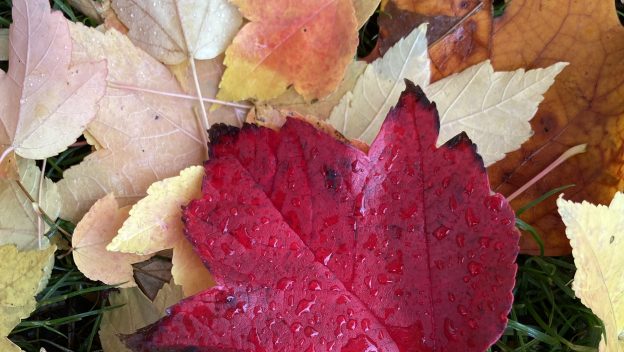
Death is beautiful. City streets and sidewalks are papered in it. Trees shout it with blazing reds and yellows—a rare season when the glow of sunset settles onto every country road and city block. And the individual deaths are as beautiful as the collective. If I dare use the worn-out snowflake analogy, each leaf is one-of-a-kind—the blend of colors, the shape and length of the stem, edges pointy or rounded, symmetry perfect or lopsided. Even the way it rides air currents to the ground is singular.

In the Celtic spiritual tradition, the phrase “thin places” describes those times when the veil thins between the now and the eternal, the ordinary and the extraordinary, and we see what is usually hidden. Death is one of those thin places.

Months before autumn, I walked a fog-covered beach on the Pacific Ocean, and death everywhere arrested me, stunned me, captivated me with its patterns and beauty. The oval-shaped outside of a small chiton shell—previously home to a creature that might have been the child of a limpet and a sea slug—was mossy green. But inside, surrounded by a wrinkly cream-colored girdle, an almost-neon aqua blue lit up the connected shell plates, and I stared in wonder. The shell of an urchin, now spineless, was covered with perfect rows of raised dots in muted tones of pink and green. The purple inside of a crab shell had patterns like light shining through water. Round jellyfish, symmetric from their thin edges to the white motif near their fat centers, lay stranded on the sand. A dead dragonfly, wings spread as if on display, had the bluest body, a peaceful gray-blue, but nothing dull about it.

My daughter picked up a crab shell which had been home to a couple dozen barnacles, and I imagined it in its heyday, scuttling through tide pools, unknowingly feeding the barnacles on its back, as well as itself. Uprooted seaweed formed circles and figure-eights. My daughters and I stomped on the seaweed air floats, trying to outdo each other with satisfying pops. One already-cracked float looked like Pac-Man, and another like a pelican’s head and neck. Shells, once symmetric, had broken into fragments and been polished smooth by the sand—pinks mottled like granite, colored ovals reminiscent of planetary rings, layered blues, and swaths of pearly iridescence. An art museum at my fingertips. 

As I contemplate the beauty of death, I can’t help but wonder what it will be like when someone I love dies. Will I feel the thinness between earth and heaven? Will there be beauty? Or will it be clinical, disturbing, exhausting, or—worst of all—sudden and too soon? I’ve never been with a person at death. I am curious—will there be a glimpse of what I have not seen before?

There is room for magic in morbidity. Although the leaves will turn brown, rot in the rain, and return to the soil, their week of splendor remains undiminished. Although every empty crab shell represents a death, and the waves and crunching feet will not leave them whole, they are no less exquisite. Although I will die, my passage from this life will squeeze the mortal and the immortal together for just a moment, creating a beautiful, painful, thin place.

Exposed by Proximity

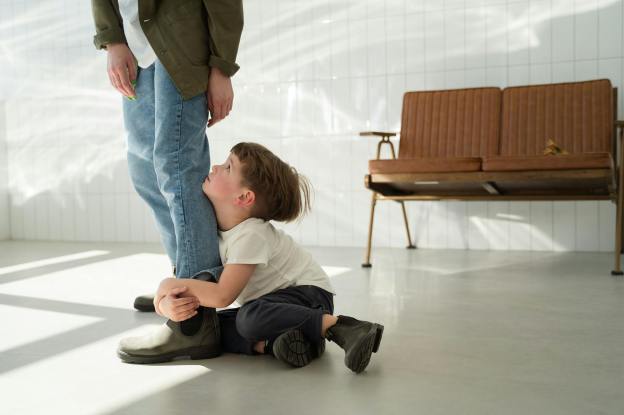
Children scare me. Even my own children. I do not like this, and admit it reluctantly. Children make noises at the wrong times, go where they shouldn’t in the blink of an eye, and express emotions with their bodies. In a word, they are unpredictable. 

The most likely culprit for my fear and discomfort is a desire to feel safe by being in control. This is also something I don’t want to admit. Isn’t it better to go with the flow? Not to mention that control is largely an illusion anyway. And Jesus not only loved children; He suggested we emulate them.

But that doesn’t help me with in-the-trenches moments with kids. I can’t ever find the one right answer I’m looking for. Should a kid have snacks or eat only at mealtimes? If I give someone else’s kid dessert, or put on a TV show, will that be the end of life as we know it? If two toddlers fight, and both hurt each other, do we call it even and move on, or should they be punished or lectured? How do I know in what moments to expect my children to toe the line, and in what moments to suspend expectations and get ice cream? And don’t even start on the pros and cons of vaccines. 

No matter the age of a child, my response to them could affect them for the rest of their lifetime. I am not okay with this. Will I be the one who offers grace or wisdom or a listening ear that gives permission for a child to like themselves? Or will I give advice at the wrong time, be lenient when the consequences are life threatening, or give peanut butter crackers to the kindergartner with a severe peanut allergy and get locked up for murder?

The stakes are too high. Somebody please lower them. Tell me I don’t have influence, I’m not culpable, my instincts can never go wrong. But no, once more I must make peace with uncertainty. I must receive the truth that I will both harm and help my children and other children. Sometimes I will hurt and another will heal. Sometimes I will heal what another has hurt. And some hurts won’t be healed. 

No matter the stakes, I am not superhuman. I will break what needs to be held together, and I will clamp down on what needs to be released. Damn, I hate that. 

Then again, maybe the children in my life are my greatest ally in accepting my humanness. I doubt the fear will go away. But maybe it could prompt a mantra: I am in this moment, with this child, and we are both getting to know ourselves. There’s something sacred under the scary feeling, a gift of mutual vulnerability that exists here where I am exposed.

Simple Jesus

I want to like Jesus because the grown-ups in my life told me He is good, and they were right. 

I want to be innocently happy that God is good. 

I want to go back to painting “JESUS FREAK” in huge letters on a baggy cotton T-shirt, soaking up Sabbath School lessons with gusto, back to the credibility God had when I was 14.

Simple Jesus—does He still exist? Or can He at least be mysteriously complex and Kindergarten-simple at the same time? 

Is there a reality—no-strings-attached—in which Jesus just loves me and knows my name?

A few weeks ago I attended a spiritual retreat at Camp MiVoden, as a sponsor for the girls in the 7th/8th-grade class. During the worship services I remembered something, a feeling of belonging and certainty from my past. I knew some of the songs the praise band led, and I sang with my arms raised. No one expected anything—hardly anyone knew me—and the featured speaker said simple and good things, about who I am and who God is, and I cried, and I remembered a time when I belonged wholly, and sermons weren’t pocked with ideas that distract me from goodness and wholeness.

I want a plain friendship, one I don’t have to defend or explain, one in which I don’t need Jesus to make me look good, and Jesus doesn’t need me to make Him look good; Jesus with a reputation as simple as Mary who had a little lamb, not the notoriety of an activist. 

I don’t need answers for all the questions and discrepancies. I’m looking for that place where they are absent, where I don’t have to explain why I don’t believe in a punitive gospel, or why I’m part of a faith tradition (Christianity) that has inspired violence for thousands of years. I don’t want to explain why I use feminine pronouns for God, or why I say Adventism is my community but not my religion. I don’t want anyone to raise their eyebrows at me, nor me at them. I want to be in love—inside love. I want to feel safe because I am safe. 

Maybe what I really want to know is this: does a simple Jesus exist for adults too? Does He go for coffee with millennials—with me? Does He wear jeans and send 132 text messages every day? Does He understand carpools and playdates and a family calendar on the kitchen wall and how all the spoons are dirty if I miss one day running the dishwasher? Does He peruse my TBR shelf and ask me about my writing? Does He know I’m still a little girl inside, intimidated by the disciples who turn me away because I am small and simple?

Is Jesus here now, and does He remember me? Does He look through my photo albums and murmur memories? Has He been here for it all? Can we laugh together about singing “Sinnerman” and “We Are Soldiers”—the laugh of a shared memory—those lyrics humorous like the frizzy perms of the 80’s?* Is He still the cleft in the rock, the hiding place, the blessed assurance the hymns offered? 

What if we’ve shared a life more than a belief system, and our love is built on mutual adventure and admiration?

Maybe He has never needed me to pull Him apart and stitch Him back together, to understand how He is a triune being, or even to put our companionship into words. Perhaps I was mistaken in thinking that farther, bigger, and deeper are better. 

Jesus is here. In the essentials He hasn’t changed a bit. He’s still the great guy I knew in primary Sabbath School; the one who stood with me in the church baptistry, invisible yet deliciously simple; the father I wrote to in a dozen journals full of prayers; the soil from which I grow. Most of all, He’s still my friend.


*I sang these songs countless times. Although the lyrics of “Sinnerman” I sang were not as heinous as what I just found by googling it, I think it’s safe to say it’s inappropriate to mock sinners running from God (and what even is a “sinner”? Aren’t we all?). And don’t even get me started on “We Are Soldiers” and “I’m in the Lord’s Army.” Who decided it was a good idea for seven-year-olds to sing about blood-stained banners and artillery? So yes, I think Jesus and I can have a good laugh about it.

Run-on Marriage

Last week Michael and I celebrated 20 years of marriage. The run-on sentence below illustrates our run-on marriage. (And yes, we’re still crazy about each other, in addition to driving each other crazy.)

I cannot get in bed when the bedcovers are frumpy, drifting off the end of the bed, sideways, knowing that if I do lie down and tug on them I will get too much sheet, too little blanket, and the wrong corner of the comforter; but I do not make my bed in the morning—I make it right before I climb in bed at night, tugging with exaggerated exclamations as I dislodge cats, and my poor husband too, because there’s a tiny possibility that I idolize sleep and this bed is my altar and before I sacrifice my body the altar must be prepared as if for a temperamental god of linens, and I like to remind my husband that before I met him my sheets would stay tucked in and straight for months at a time, but since his feet hang over the end of the bed and he tosses and turns at night, I have to straighten the covers every single day, and I accomplish this with more violent energy and bitter comments than necessary, although one would think after 20 whole years I would have adjusted and calmed down about it—but he huffs and makes less-than-charitable remarks every time he drives, and he has been driving for twenty-five years, so I guess we are both going to have our snide remarks and adult tantrums and all shall be well. 

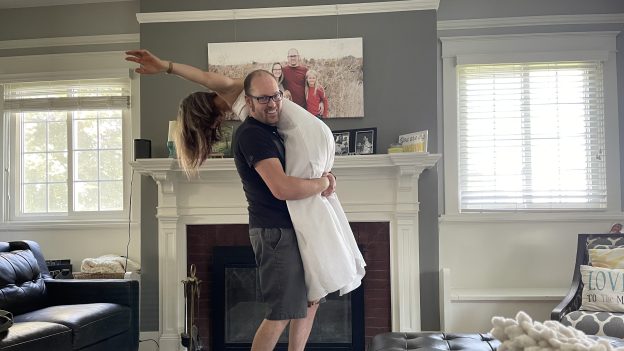
P.S. I usually use stock photos, but the photo for this post is of my husband and I earlier this month. I barely squeezed into my wedding dress, which I attempt every September as our anniversary rolls around.

A Mother’s Mundane Conundrum

“You’re just making me do it!” my daughter says with a surprising amount of conviction. “You just decided I have to do it.” She’s not wrong. Nothing will happen if she doesn’t clean her room. No one cares about it except me. I feel called out as an unnecessarily controlling parent, just as I do each time one of my daughters confronts me with these sentiments.

It seems I have arbitrarily decided most of the content of their lives. I require showers, food other than fruit and juice, feeding pets, getting out of the house for school—with clothes, lunch, piano books, shoes appropriate for PE, and a sweater. Would anything dire happen if all those things were left undone? No. One or both daughters could go to school late, in PJ’s, without a lunch, wearing the wrong shoes, and sweaterless. In fact, she could probably do that for a week before anything interesting or significant took place in response to her choices.

I dislike this feeling that I am the only reason she does most of what she does. And I don’t like it when she confronts me about it. I don’t know what to say. I agree with her. Most expectations really are arbitrary—for adults as well as kids.

There are plenty of things I could say that I don’t want to say. I could say, “Someday you’ll have a job,” but that has no meaning whatsoever to a nine-year-old. Or, “You have to learn to do things now so I’m not still reminding you when you’re thirty,” but is there any real danger of that? Or, “I’ll be embarrassed if you go to school in pajamas,” but do I really want to teach my kids to make decisions based on my embarrassment? Or, “Nasty things will start growing in your room if you don’t clean it,” —okay, maybe a month from now, so is that really motivation to tidy it up today? Or, “I’m your mom and I get to decide what you need,” except that I don’t think anyone should decide another person’s needs for them. You get the idea.

So here I am with nothing to say, a truthful human being looking me in the face, questioning my demands—and why are they demands? Perhaps because requests and suggestions haven’t worked, or because my emotions are now fueling this high-octane—but nevertheless mundane—occurance.

“You’re right,” I say. “I can’t actually make your body and your arms and legs do anything. But I can remind you there will be no screen time until chores are done. And if you don’t do chores today I might give you an extra cleaning job tomorrow.” This comes out sounding a tad desperate, and something like a threat—not exactly what I was going for. But you do what you have to do.

Motherhood seems to be a mix of desperation and compassion, empathy and threats, logic and insanity. Is that what childhood feels like too?

She whimpers. She complains it’s not fair. But eventually she trudges to her room and starts picking up clothes off the floor. My heart rate returns to normal as I breathe a sigh of relief. With any luck, I’ll have at least five minutes before this conversation repeats itself with my other daughter. Meanwhile, I whimper and complain internally as I return to a pyramid of dirty dishes. I guess we’re not wholly different.

Forty and (In)secure

Twenty One Pilots’s song, “Stressed Out,” laments the insecurities of adulthood, noting that fear is still present, and we still care what people think. I turned 40 this month, and yes, I’m still insecure. It’s different than high school. And the same. I want you to like me. I want to be well-dressed and well-spoken, and most importantly, perceived well.

I’m a grown-up—have been for quite some time—and I can tell you what maturity doesn’t mean. Being grown up doesn’t involve control and confidence; it doesn’t mean growing out of awkward traits and social habits; it doesn’t include a clean house and well-kept yard, or a passel of perfect grown-up girlfriends.

I’m less sure what being a grownup does mean. But I’ve noticed I’m softer than I used to be—more flexible, a teensy bit less judgmental, and I know more about cooking and cleaning than I did 20 years ago.

I know less about God, love, and relationships. It’s been said that the more you know, the more you know you don’t know anything. I can confirm this.

There’s a real sense of loss, not landing in adulthood firmly in control and certainty, an expert in the kitchen, the workplace, the bedroom. I get tired of being wrong, confused, ineffective. If knowledge comes from experience, I am an expert in exhaustion, stress, and leaving my cell phone in obscure places.

I know I’m sounding a tad morose. But there is a happy ending. There’s something left after losing control, and the appearance of control, and pretending to have control. What’s left is eyes to see a different life entirely—a life of watching the cat lick his fur, thinking of my three favorite moments from the day just before I fall asleep, fighting less with my kids and husband, knowing there will not be a seismic event when my to-do list is left undone.

And I know myself better. I know I love writing and small groups. I know I like a clean house, but not enough to put in the work. I know I’m scared of the interminable wants and needs of my children. Being quiet and alone—especially in nature—returns me to myself. Banana splits and blended mochas almost always sound good. I try the hardest to be self-sufficient when I’m at my weakest. Animals make me happy. Getting called “a writer” makes me stand a little taller. Synchronicity feels like opening a birthday present.

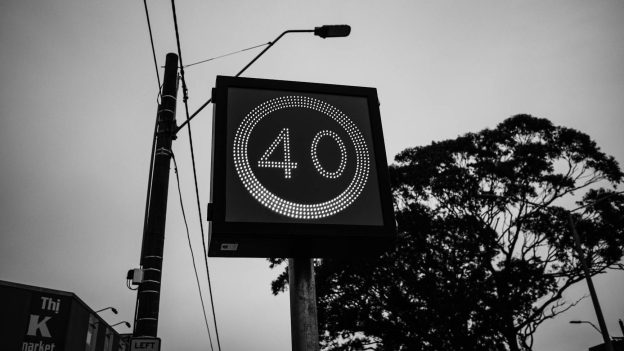
My birthday, which this year fell on the first Sunday in May, played out like a dream Mother’s Day. My husband cleaned the kitchen, top to bottom. He and the kids cooked breakfast and dinner, and took me out for lunch. I sorted through a large tote, five bags, and an unconstrained pile of children’s clothing I hauled up from the basement, and found most of it could be passed on. I went to the park and watched goslings and ducklings, heard the smack-smack of their webbed feet in shallow water, and marveled at their fluffy bodies. I took a nap. With my parents and sister, I ate fresh-made blackberry pie with “40” cut into the top crust. Michael gave me a gift certificate to have the house professionally cleaned (when the dust settles from our six-month construction project). Like I said, a dream day.

It’s worth noting I couldn’t have planned such a day. All was gift—the generosity of my husband, my children, my sister. Many times I have planned a birthday party for myself, with friends and presents and homemade cake. But for forty, this un-forced birthday felt fitting. The people who love me gave what they wanted to give. And I received. I basked. I rested. And yes, I sorted children’s clothing—one of those things I never can find time to do.

Maybe I’m ready to accept this life I have. Whether I die tomorrow or in another 40 years, I will die complicated—a mix of peace and insecurity, frustration and gratitude, mundane and miraculous. And not at all grown up.

Blessing My Small Self

Lord, wash me not of my imperfections, but of the ways I try to hide them.

Four-days-unwashed hair.

Running late, always running, always late.

Hoping no one finds out how infrequently I launder the bedsheets.

I never before thought of blessing these things. Now I see them in need of blessing, of integration.

The voices of emotion.

The voice of smallness.

The voice of vulnerability.

The voice of longing.

Christine Valters Paintner writes, “Sometimes we need to welcome our ‘small selves’—the poor, meek, humble parts of ourselves—to allow our big radiant selves to be in service to them … Perhaps there is something even more profound than all of the amazing things we are doing in the world. It is this simple unadorned self that is blessed. The smaller selves are blessed.” (The Artist’s Rule, pg. 87)

The wisdom of these smaller selves is the wisdom of being human, of being malleable, of being unpolished and beautiful.

I want to make peace with my shadow side, my imperfections. I feel in conflict with myself, like half of me is inside a fortress, and half of me is huddled against the outside walls—like all of me is afraid.

Interior freedom feels like being present with myself, like saying “not today” to crappy thoughts. It feels literally spacious, permission to take up more room with my body and breath. Is there room to make mistakes? I feel small when I think about making mistakes.

In Celtic spirituality, “thin places” refers to locations or times where the veil between the physical and spiritual realms seems thin, where a closer connection to the divine arrives, perhaps unexpected. It is possible that no one else wants my small self, but God does. He meets me in the moments when I am aware of a limitation, a failing, a smallness. Maybe these moments are another “thin place.”

I notice that my sense of self is rigid, even brittle. Can I reimagine myself? Fleshy, muscular, vulnerable, more cottage than castle, more field than fortress.

I am meadow. No meadow has walls. No meadow tries to look the same every day. A meadow doesn’t look at its thin patches with embarrassment.

My whole heart longs for grace and mercy. I want to mete out mercy, because it is the right thing to do. But I’m not sure mercy can be “meted.” It is given out not so much in measure as in waves. It is oceanic, much bigger than I realize.

I am meadow, and in meadows deer graze, butterflies drink, shy rabbits and tiny mice feel at home. “Welcome home to myself,” I say.

My big self sets the table for my small self, and together we dine in the meadow.

Dear God, I’m Annoyed

Dear God,

Do you receive enough letters every year to bury planet earth a mile deep in stamped and postmarked comments to the divine? Is there a team who helps you read them? Do you throw out letters that are too pious—or too irreverent? If a parcel comes to you “postage due”, do you pay the balance or return to sender? How many angels do you deploy every year in response to mail from earth? Do you keep statistics on what subjects are trending? Do letters from different parts of the earth have a distinct smell? Well, enough about that. I actually have a purpose for this letter.

I’m annoyed that using your name is so complicated. If I say I believe in you—whatever that means—I want to tell my story, not get coopted into someone else’s story. I’m scared of their assumptions and experiences. Does belief in God mean an agenda of fighting atheism? Evangelizing 3rd-world countries? Pro-life marches? Does belief in God mean you made the world, or that you died for our sins, or that you’re making some sort of “new heaven”?

Next time someone tells me they’re a Christian, does it mean they go to church but don’t pray? Or that they pray but don’t go to church? Does it mean they think you cause human pain, or relieve human pain, or both? Are you male or female? Do you live in humans or in heaven? How are you deciding when and how to make the earth new? Are you many, or one, or three-in-one? Is your love soft or hard? Do you ever feel afraid?

I guess my point is that, for my own comfort, I want you to be small. I don’t appreciate the need to explain what kind of Christian I am—if I say I’m a Christian—or that I have to explain what mysticism is if I say I’m a mystic, or that my swearing puts some people at ease and sets others on edge. And both responses to swearing feel somehow related to you—like we’re all basing our lives on you, whether we mean to or not, and we’re all uncomfortable with the fact that you remain shrouded in mystery. I’ve ceased to believe you have an agenda, but for some, an agenda is inherent in the word “Christian.”

Truthfully, I don’t want you to do anything about this. I just need to vent. Do you see how annoying the situation can be? The way you draw people together in a singular way and also divide folks violently? The way you bring us to peace with ourselves and offer us the most startling awareness of our love-less parts? Do you see how I experience you differently than the person next to me, and sometimes we admire each others’ representations of you, and sometimes despise them?

I find myself trying to assure some folks I’m not “that” right-wing Christian, and trying to assure other folks I’m not “that” far-left kind of Christian. I want people’s favor and I want yours and it’s all terribly messy and I blame you.

But, in conclusion, I admit it’s best for you to be slippery, mysterious, and surprising. Thank you for connecting with each of us in your own way without a thought of being consistent, following the rules, or managing outcomes. Your flagrant freedom in relationship to humans reminds me that I, too, have the freedom to look a little different to every person who knows me. Like you, we humans can be slippery, mysterious and surprising, and we need permission to embrace these traits in our relationships.

I’ll let you get back to that mountain of letters. And I don’t have the patience for snail-mail, so if you want to answer me, please send a text message.

Cordially,

Tobi

Two New Holes

Shortly after my May birthday last spring, I acquired two new holes in my body. I had my ears pierced.

One aspect of the conservative Christianity I grew up in is an aversion to body piercings. And tattoos, lipstick, and clothing that reveals feminine curves. When I left home as a I teen, I bought a padded bra, colored my hair with a box of dye from Walmart, and called it good for my rebellion. As a young adult I said I didn’t want to pierce my ears or get a tattoo because I have a low pain tolerance. Also, I faint for vaccinations, blood draws, and if I hit my knee or elbow too hard. (I fainted at the dentist once, and I fainted when I went to the college clinic to get a wart removed from my foot. The nurse sent me to Walmart to buy the kind of wart remover you paint on yourself.)

Why this sudden body piercing urge, you might ask, as I’m nearing the age of 40?

Last year, my nine-year-old daughter Kyli decided she wanted to get her ears pierced. “Why don’t you have your ears pierced, Mom?” she asked.

“I don’t know. I don’t like pain.”

“Well, if you really wanted them pierced you would do it,” she countered.

Point taken. So I thought about it. I hoped quiet reflection might reveal something profound, but my reasons were a grab-bag—it hurts, most of my friends don’t wear earrings, it feels weird to do it now that I’m middle-aged, it seems unnatural to poke a hole in my body (morality aside), my parents won’t like it, and so on. Like I said, random, blah, blah, blah.

So I decided to give it a shot, get my ears pierced with Kyli, and see if I like wearing earrings. Rather than take the lead because of lived experience—my usual role as mother—I had the same questions, concerns and curiosities as Kyli. We’d be figuring this one out together.

We waited for the school year to finish since the kids attend a Christian school that doesn’t allow earrings (or colored nail polish—go figure). Kyli wanted to get earrings the moment school let out, so we made appointments at Ulta Beauty for 1pm on May 31st—one hour after school dismissal on the last day of the school year. We snagged Kyli’s bestie, got a bite to eat, and drove to the salon. Inside, past the rows of creams and powders and scents, we found a plump young lady ready to pierce our ears.

I signed the thing they handed me—a waiver?—while Kyli picked out studs. Her bestie pinched her arm hard to show her how much it would hurt. The plump lady drew dots on Kyli’s earlobes, asked us to examine them and approve the placement, then inserted a stud in a white hand-gun. Punch!—right ear done. Kyli’s eyes were wide, a combination of curiosity and alarm, as she took in the experience and tried to categorize it. Painful? Scary? No big deal? Before she could settle an answer, punch!—left ear done.

For the next minute, Kyli’s hands hovered around her ears, her instinct to squeeze them through the discomfort, at odds with her determination not to touch. I watched, ready to comfort. But I wasn’t needed. Bestie dragged her around the store, applying makeup until Kyli’s face was caked with several shades of foundation and blush and her fears forgotten.

Meanwhile, I warned the employee holding the ear-piercing gun that I’m a fainter. Judging by her look of alarm, I guessed she didn’t have a lot of experience with people fainting—either that or she had a memorably bad experience. “I’ll know if I’m going to faint, and I’ll tell you,” I assured her. She proceeded to draw dots on my ears, punch, punch, voilà! Little silver hearts rested on my earlobes. During those thirty seconds, I felt the same wide-eyed, uncertain curiosity Kyli’s face had conveyed, but when it was all over, decided the pain wasn’t worth mentioning. We took pictures, documenting this mother-daughter experience trying something new together.

All summer we cleaned around our earrings, front and back—twice a day at first, then less often. We cleaned them after showers, after swimming, after getting dirty in the yard. We twisted them around in the holes as we had been instructed, and left them in 24/7.

At first, earrings were more unnerving than I expected. It felt wrong to intentionally punch a hole in my body and take special care of it to keep it that way. Usually when I cut through my skin and flesh, I tend it carefully to facilitate healing. This was different. Also, for the first month or two, I felt slightly anxious about having something attached to my body that I couldn’t take off. When I went to bed and took off my watch and glasses, I wanted to put the earrings on my nightstand too. I wanted to take them out so my body could be just my body. During the night, I tried different positions with my pillow to put the least pressure on my earlobes.

After the prescribed six weeks, I hesitated to remove my earrings since they still oozed or bled occasionally. Kyli, tired of waiting to wear a favorite pair of earrings, took out the original studs and sported cute, sparkly flowers for a day. This joyous occasion deteriorated when I couldn’t find the right hole to get the original studs back in her ear. I had erroneously thought a hole was a hole, but the tip of the earring took it’s own course through the fleshy part of Kyli’s earlobe and came out the back in a different place!

Blood, tears, and parental concern and confusion ensued. We survived this try-to-find-the-right-hole circus two or three times over the next week, and eventually Kyli’s left ear was so unhappy she let it heal shut. When school began again in August, she wore a tiny clear stud in her right ear—which still oozed and bled sometimes. She didn’t want to remove that one, but also refused to get her left ear pierced again. We were deadlocked in pirate mode.

The first pair of earrings I bought came from a rock-and-mineral shop in a falling-apart historic building we stumbled across during a bathroom break on a road trip. They’re tiger’s-eye stones. I nearly passed out when I first put them in, but after lying on the bathroom floor and breathing deeply for a minute—usually an effective method to maintain consciousness—I returned to normal.

At this point, I’ve probably had as much fun buying earrings as wearing them. For more than six months, I didn’t leave my earrings out any longer than an hour—the holes still appeared tenuous. Either the original studs or one of my half-dozen new pairs of earrings stayed in my ears at all times. At last, a month or two ago, I slept truly naked for the first time. It felt good as good as I imagined.

In a few months, it will be a year since we pierced our ears. During that time, Kyli’s right ear developed big scabs and pus came out when I cleaned it, over and over, so a few weeks ago she took out the clear stud. It’s healing now, and she’s done with earrings for the time being. Meanwhile, I’m growing into the fun of it. My sister gave me a beautiful pair of iridescent hummingbird earrings for Christmas. Michael gave me a pair of book earrings for Valentines Day—I’d been looking and found surprisingly few options, and these are adorable tiny blue books with real pages. I wore them to the library this week, and felt that same satisfaction I get when my bra and underwear match—a covert sense of matching.

So, friend, if you’re forty-ish and thinking about earrings, here’s what I’ve learned: It’s a small adventure, and hey, maybe that’s what makes it fun. These years lean low on adventure—outside of parenting. And come to think of it, this adventure was tangentially brought to me by parenting—two new holes, the result of a question from my daughter.

How about you—any new holes in your life? Or body?

What Version of Me Belongs?

I have chosen between attachment and authenticity a thousand times at least.

What do I mean by this?

I’ll loosely define attachment as a healthy sense of relational connection and belonging. And let’s think of authenticity as the ability to know ourselves and show up in the fullness of who we are, including the little quirks and details.

The choice between attachment and authenticity occurs when we must—or perceive we must—choose one of the two. For example, let’s say you’ve made a new acquaintance and you’re arriving at her house for the first time, with a plan to chat over a cup of tea. You might feel a little anxious, not knowing whether this will be awkward, and wondering about the future of your friendship. When you step in the door, your friend offers to take your coat. You’d rather leave it on until you warm up a bit, but instead you take it off and she whisks it away to a side room. Then she offers you scones, which are obviously hot from the oven and smell delicious. You accept and then notice there are raisins in them. You don’t like raisins. But rather than pick them out, you decide to eat them. In these moments, you are choosing attachment over authenticity. Sharing your preferences feels risky for the relationship, so you keep them to yourself.

Often, as in the above examples, we base our decision not on reality (you have no idea whether your friend would be offended by you picking out the raisins), but on a perception of what would best maintain your attachment—your relational connection—in the moment.

Let’s think about scenarios where the stakes are higher. A teen might have to choose between the authenticity of letting their parents know they’re transgender, or preserving attachment by not sharing that information. A pastor may have to choose between authentically and vulnerably requesting help for an addiction, or maintaining his position and his church relationships—his connection and belonging—because he knows he cannot have both. A person may choose to have sex with their partner because it’s easier to do what they don’t really want to do than it is to say the vulnerable truth and deal with the possible fallout of disconnection.

As children, and even as infants, when presented with a choice between authenticity and attachment, we choose attachment. Our survival depends on it. As we become adults, our circle of resources widens, and our options become more diverse. We don’t have to choose attachment over authenticity every time. Still, there is an element of risk to authenticity, and we weigh this consciously or subconsciously every day.

One of the most challenging environments to navigate this dynamic is religious circles—which in my case extend to my children’s private education, friends past and present, my readers, and even neighbors. Church seems a strange place to make a choice between belonging or being myself, yet I have felt it often there. Christians say, “Come as you are.” But I don’t think we meant it. Or, we mean it with a tag-on—“Come as you are, when you’re ready to change that to be like us.”

I have believed I can’t be me, because whatever improved version of me God has in mind is better than the current version of me—“sinful and selfish” me. Somehow being myself means heresy. I can’t be true to myself and to God at the same time. You know, something about “a house divided,” or how man’s thoughts are “evil continually.”

These days, I’m not sure I belong in church. But it doesn’t matter like it used to. I belong in myself, and that is sweet relief. I belong in the living room of God, who has become both mother and father to me. I am bonded spiritually, and it’s the safest place I’ve found yet to excavate and inhabit my authentic self.

God doesn’t ask Her children to choose between attachment and authenticity. Belonging is a foregone conclusion, and God’s favorite pastime might be holding your hand as you get acquainted with your authentic self. I think God emits joy-sparkles when He gets to witness you noticing yourself and connecting with the fun, complex, messed up, whole and holy person that you are.

Wherever attachment and authenticity occur together is sacred. These holy spaces may be inside us, in marriage or friendship, in nature or a good book. I’ve discovered that in settling into my own self, I can hold the paradox that I am okay and I am not okay. And it turns out God is way bigger than they said She was.


My understanding of these concepts leans heavily on Gabor Maté and Krispin Mayfield. Many thanks to them both for acquainting me with my own inner safety.


P.S. I posted an update today about trauma-informed writing groups. Check it out here.