Be Still, My Soul

“Be still, my soul, the Lord is on thy side.”*
Unexpected but much-needed words at 2 a.m., when the house is quiet but my soul is loud.

“Be still, my soul, the Lord is on thy side.”
A thousand memories of my father, the hymn-playing classical guitarist whose practicing accompanied my sleep most nights for my first 18 years. A hundred more memories of concerts in a hundred churches, Daddy’s black suit with the guitar-fretboard tie, my mother presiding over a table of music for sale—books, CDs, tapes. And record albums in the early memories. My sister and I sang duets. We wore matching dresses sewn by my mother each year, made from fabric chosen by my father.

“Be still, my soul, the Lord is on thy side.”
The deepest stillness of my soul is always at God’s invitation.

“Be still, my soul, the Lord is on thy side.”
Knowing I can rage against God, blame God, say “fuck” to God—this, too, is an element of the stillness of my soul.

“Be still, my soul, the Lord is on thy side.”
Words I need to hear now, and in five minutes, and five minutes after that, because my soul has amnesia when it comes to stillness.

“Be still, my soul, the Lord is on thy side.”
Comfort for the parts of me that fret about who is not on my side, who doesn’t understand me, who wants ill for me. Be still. The One on my side will never change Her mind.

“Be still, my soul, the Lord is on thy side.”
As the psalmist wrote, “Be still, and know that I am God.” (Psalm 46:10) If He is God, I am not. Sometimes I need to remember this. Be still. Be.

“Be still, my soul, the Lord is on thy side.”
It is safe to be me. Right now. Before I do the next thing.

“Be still, my soul, the Lord is on thy side.”
I am not alone, even in my ugliest moments. God’s holy presence holds me with tenderness. I am invited to hold myself with tenderness, too.

“Be still, my soul, the Lord is on thy side.”

I pull out my hymnal, play the song one-handed on the piano, wonder if I might fall in love with the rest of the lyrics. I don’t. All I need is that one line.

“Be still, my soul, the Lord is on thy side.”


*This is the first line of the hymn, “Be Still, My Soul.” Words by Kathrina von Schlegel, translated into English by Jane Borthwick. Sung to the tune of “Finlandia,” by the Finnish composer Jean Sibelius.

I Can’t Get Drunk

My friend E started drinking first, and together we made plans for my debut with alcohol. Piña coladas on my 40thbirthday. But then I decided to try a drink first with my husband—the primary witness to my life. The night was cold in every way. My turn to plan date night, and I reserved an “igloo” at Marcy’s downtown. These plastic domes appeared over several of their outdoor tables in late fall, purportedly to extend the viability of outdoor eating.

We drove to Marcy’s in silence, as we’d recently stopped speaking to each other unless absolutely necessary (a car ride did not qualify). It’s hard to say if silent date night indicated our stubbornness, a dark desire to marinate in our melancholy, or a hope that we might break things loose. If I’d had any ideas that alcohol might aid us, those hopes were soon dashed.

Our igloo struggled against the 30-degree weather, and I kept my coat on. A space heater ran full blast, and staff provided blankets. Too bad we didn’t feel like snuggling. Our waiter unzipped the igloo and stepped in, quickly zipped it behind him, and stood prepared to take our drink order. He provided a brief verbal tour of the alcoholic beverage options, none of which were warm. Unable to abide the thought of a cold drink, I asked if they had anything warm with alcohol. Yes, there were a few options. Having zero idea what most of the components were, I chose one that included coffee—something familiar. Michael ordered a cold mocktail.

As we waited for our drinks, I connected my phone to the provided bluetooth speaker and started our love-song playlist. The romantic songs did nothing to lift the chill, but they did slightly reduce the awkwardness of the silence between us. 

My drink came in a glass with a handle, piled high with whipped cream. First sip—tolerable. By the third sip I wished I’d ordered the same fruity mocktail as Michael. After that I kept trying tiny sips, but mostly ate the whipped cream off the top and felt bad for wasting money. Since I found nothing pleasurable in the flavor, I hoped to at least drink enough to feel something—a “buzz”?—or to get just a wee bit tipsy, or loose enough to throw myself at Michael when we got home and have makeup sex. But I couldn’t do it. The drink was just plain gross, and I didn’t care for the “warm” sensation as I swallowed. I tried to convince Michael he wanted to try it, but he most certainly did not.

Our pitiful meal came to end, we paid, unzipped our igloo, and returned home colder than we had arrived.

A month or two later, I sat on the couch at E’s house, working on a puzzle on her coffee table. Her husband offered me a glass of red wine as he poured some for each of them. “Don’t give her too much, she probably won’t drink it,” E said. It hit me just about the same as the drink at Marcy’s—gross with a side of unwanted “heat.” I would regale you with nuanced descriptions of flavor and texture, but my palate-related language is pedestrian at best.

In April I drove to Bellingham, Washington, for a soul-filling weekend with my OG ladies group. My friend Andi ordered me a shot of Baileys. “It’s really sweet. If you don’t like it you probably won’t like any alcohol.” It tasted like caramel mixed with isopropyl alcohol. She finished it for me.

Some weeks after my 40th birthday in May, and months after the frigid date at Marcy’s, E and I met downtown at a Mexican restaurant for piña coladas. Virgin piña coladas are one of my favorite drinks—in fact, we had them at our wedding reception. Not wanting to ruin the drink entirely, but still hoping for a new experience—relaxation, anger, stomach upset, anything really—I asked the waiter to cut the alcohol in half. E ordered chicken and scanned the restaurant for teetotalers who could jeopardize her career by reporting a drink to her religious employer.

Our piña coladas came. I took a small sip, then several long pulls at the straw, trying to determine how the flavor differed from a virgin drink. Not much. I drank the whole glass, but didn’t get any of those bodily changes I hoped for. Although it was my most successful drinking experiment yet in terms of volume, I decided I prefer virgin piña coladas.

Further attempts at drinking have failed to produce anything more exciting. My friend Gela and I had a lovely moms-afternoon-out at a cellar offering wine slushies—flavors in a row in large plastic tubs with turning paddles, just like gas station slushies. We sat on a fancy armless couch, and I drank my entire glass, but it wasn’t worth the $14. Until my drinking experiments, I’d had no idea alcohol sucked up even more money than designer coffee.

At the farmer’s market I tasted three (free!) wine samples, drinking barely enough for a semblance of politeness before I discreetly tossed most of the final serving away with the small plastic cup. 

Alcohol and I have not become friends. She is expensive and sharp. I remain curious, and may try a can of beer, hard cider at a local winery, or the mead my cousin makes, but I’ve given up on the possibility of actual enjoyment, and am unlikely to gag down enough of anything to get tipsy. For anyone who worried I’d become a raging alcoholic, I’m sorry to disappoint*. I’ve gained some fun experiences with friends, and lost the ability to say I’ve never had alcohol (well, other than in vanilla extract). I prefer a good mocktail to drinks with alcohol, but I like an Italian soda, blended mocha, or London fog even better. 

Honestly, I thought something about alcohol would appeal to me—after all, how can the masses be so enamored? So financially invested? I don’t understand drinking for pleasure, nor can I imagine swallowing enough to get drunk. I’ll drown my troubles with a good 12-hour night of sleep, followed by a morning nap, and an afternoon one too if it’s a sad Saturday, and leave the hop juice for someone else.


*This is not intended as a slight to my many friends and family who choose not to drink, nor do I intend to make light of the damage alcohol causes to individuals, families, and society. Rather, I am making fun of the over-moralized fear-based decision making that was for many years my reason for not drinking alcohol.

Tobi’s 2025 Book Awards

It’s that time where I look back over the books I read the previous year. I’m giving out five awards of my own making, followed by a list of five additional favorite reads. At the end of the post you’ll see the complete list of 27 books I finished, plus a few that I read parts of.

The Favorite New Author award goes to Rachel Naomi Remen. Her book, Kitchen Table Wisdom: Stories That Heal, surprised me with its depth. (Free printable quotes available here and here). I couldn’t quite put a finger on why I kept wanting to turn the pages and read more, but I did. Her stories are powerful in their simplicity, beautifully painting a picture of human healing and wholeness. I’m now halfway through another of her books, My Grandfather’s Blessings, and find it equally satisfying.

The Most Underlined Book award goes to Good Inside, by Dr. Becky Kennedy. Never has a complete stranger seemingly looked into my soul and given words to my experience in the way that Dr. Becky did, particularly in the first half of this book on parenting. I experienced it as a get-your-hands-dirty guide through story work, attachment, belonging, and how we communicate those things to our children. Her clarity of thought and wisdom are fitting of a person decades older. 

The Most Fun Read award goes to Big Magic, by Elizabeth Gilbert. Captivating, pithy, funny, challenging. (Free printable quotes available here and here). I cut out the excerpt on the back of the dust jacket and it hangs on the door of my office:

“Creativity is sacred,
and it is not sacred.
What we make matters enormously,
and it doesn’t matter at all.
We toil alone, and we are
accompanied by spirits.
We are terrified, and we are brave.
Art is a crushing chore and
a wonderful privilege.
The work wants to be made, and
it wants to be made through you.”

The Practical and Impactful award goes to Writing Alone and With Others, by Pat Schneider. This was my guidebook for leading creative writing groups, an incredibly rewarding endeavor that took flight in 2025.

The final award, Best Story, goes to The Boys in the Boat, by Daniel James Brown. Brown skillfully weaves together the stories of the men who made up the University of Washington rowing team that would win the 1936 Summer Olympics in Nazi Germany. It schooled me in rowing, the Great Depression, and Nazi Germany—a worthwhile education on all counts. Most of all, it’s a story of deep and lasting kinship. 

Five additional favorites:
The Tao of Pooh, by Benjamin Hoff, which I read for the second (or third?) time (Free printable quotes here)
The Yellow Leaves: A Miscellany, by Frederick Buechner
The Art of Memoir, by Mary Karr
Circle of Grace, a book of poetry by Jan Richardson
Grandma Gatewood’s Walk: The Inspiring Story of the Woman Who Saved the Appalachian Trail, by Ben Montgomery

I read for much the same reason that I go on coffee dates and volunteer in the community. I want to see and I want to be seen. And the more I see and am seen, the more I am aware of our interconnected universe, the more I am challenged to hold both joy and pain, and the more gentle I become. For my fellow readers, may you be fed and fueled by the words you read this year, and may you become fiercely kind.


COMPLETE 2025 BOOK LIST

STORIES

Puck Farkinsons: A Parkinson’s Memoir, Mike Justak, 91
14:19:22 audio book, The Boys in the Boat, Daniel James Brown
Grandma Gatewood’s Walk, Ben Montgomery, 268
Parkinson’s Humor, Beverly Ribaudo, 212
Four Against the Wilderness, Elmo Wortman, 210

FICTION

The Netanyahus: An Account of a Minor and Ultimately Even Negligible Episode in the History of a Very Famous Family, Joshua Cohen, 237
On The Brink, Michael E. Cafferky, 320

SPIRITUAL/CREATIVE

Help, Thanks, Wow: The Three Essential Prayers, Anne Lamott, 102
The Tao of Pooh, Benjamin Hoff, 158
Wake Up Laughing: A Spiritual Autobiography, Pat Schneider, 197
Writing Alone and With Others, Pat Schneider, 361
Etty Hillesum: Essential Writings, Selected with an Introduction by Annemarie S. Kidder, 157
Big Magic, Elizabeth Gilbert, 272
The Cloister Walk, Kathleen Norris, 382
The Yellow Leaves: A Miscellany, Frederick Buechner, 123
Invitations to Rest Right Where You Are, Alicia Worley Palacios, 125
Kitchen Table Wisdom: Stories That Heal, Rachel Naomi Remen, M.D., 333
Loving the Present: Sufism, Mindfulness, & Recovery from Addiction & Mental Illness, Sarah Huxtable Mohr, 152
Write for Life, Julia Cameron, 181
The Art of Memoir, Mary Karr, 218

POETRY

Given: Poems, Wendell Berry, 147
Circle of Grace, Jan Richardson, 180
Same, Hannah Rosenberg, 215
Prayer Poems From a Reluctant Disciple, Anthony Pfannenstiel, 73

OTHER

Gulp: Adventures on the Alimentary Canal, Mary Roach, 327
Good Inside, Dr. Becky Kennedy, 303
Trauma Stewardship: An Everyday Guide to Caring for Self While Caring for Others, Laura van Dernoot Lipsky with Connie Burk, 246

PARTIAL READS

The Second Brain: Your Gut Has a Mind of Its Own, Michael D. Gershon, M.D., read over 200 pages
How We Love: Discover Your Love Style, Enhance Your Marriage, Milan and Kay Yerkovich, read sections as assigned by our marriage counselor, probably about half the book
Mistress Pat, L.M. Montgomery, read less than two chapters

Death Is Beautiful

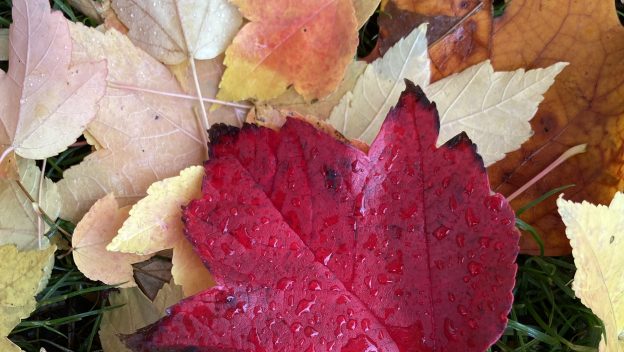
Death is beautiful. City streets and sidewalks are papered in it. Trees shout it with blazing reds and yellows—a rare season when the glow of sunset settles onto every country road and city block. And the individual deaths are as beautiful as the collective. If I dare use the worn-out snowflake analogy, each leaf is one-of-a-kind—the blend of colors, the shape and length of the stem, edges pointy or rounded, symmetry perfect or lopsided. Even the way it rides air currents to the ground is singular.

In the Celtic spiritual tradition, the phrase “thin places” describes those times when the veil thins between the now and the eternal, the ordinary and the extraordinary, and we see what is usually hidden. Death is one of those thin places.

Months before autumn, I walked a fog-covered beach on the Pacific Ocean, and death everywhere arrested me, stunned me, captivated me with its patterns and beauty. The oval-shaped outside of a small chiton shell—previously home to a creature that might have been the child of a limpet and a sea slug—was mossy green. But inside, surrounded by a wrinkly cream-colored girdle, an almost-neon aqua blue lit up the connected shell plates, and I stared in wonder. The shell of an urchin, now spineless, was covered with perfect rows of raised dots in muted tones of pink and green. The purple inside of a crab shell had patterns like light shining through water. Round jellyfish, symmetric from their thin edges to the white motif near their fat centers, lay stranded on the sand. A dead dragonfly, wings spread as if on display, had the bluest body, a peaceful gray-blue, but nothing dull about it.

My daughter picked up a crab shell which had been home to a couple dozen barnacles, and I imagined it in its heyday, scuttling through tide pools, unknowingly feeding the barnacles on its back, as well as itself. Uprooted seaweed formed circles and figure-eights. My daughters and I stomped on the seaweed air floats, trying to outdo each other with satisfying pops. One already-cracked float looked like Pac-Man, and another like a pelican’s head and neck. Shells, once symmetric, had broken into fragments and been polished smooth by the sand—pinks mottled like granite, colored ovals reminiscent of planetary rings, layered blues, and swaths of pearly iridescence. An art museum at my fingertips. 

As I contemplate the beauty of death, I can’t help but wonder what it will be like when someone I love dies. Will I feel the thinness between earth and heaven? Will there be beauty? Or will it be clinical, disturbing, exhausting, or—worst of all—sudden and too soon? I’ve never been with a person at death. I am curious—will there be a glimpse of what I have not seen before?

There is room for magic in morbidity. Although the leaves will turn brown, rot in the rain, and return to the soil, their week of splendor remains undiminished. Although every empty crab shell represents a death, and the waves and crunching feet will not leave them whole, they are no less exquisite. Although I will die, my passage from this life will squeeze the mortal and the immortal together for just a moment, creating a beautiful, painful, thin place.

Exposed by Proximity

Children scare me. Even my own children. I do not like this, and admit it reluctantly. Children make noises at the wrong times, go where they shouldn’t in the blink of an eye, and express emotions with their bodies. In a word, they are unpredictable. 

The most likely culprit for my fear and discomfort is a desire to feel safe by being in control. This is also something I don’t want to admit. Isn’t it better to go with the flow? Not to mention that control is largely an illusion anyway. And Jesus not only loved children; He suggested we emulate them.

But that doesn’t help me with in-the-trenches moments with kids. I can’t ever find the one right answer I’m looking for. Should a kid have snacks or eat only at mealtimes? If I give someone else’s kid dessert, or put on a TV show, will that be the end of life as we know it? If two toddlers fight, and both hurt each other, do we call it even and move on, or should they be punished or lectured? How do I know in what moments to expect my children to toe the line, and in what moments to suspend expectations and get ice cream? And don’t even start on the pros and cons of vaccines. 

No matter the age of a child, my response to them could affect them for the rest of their lifetime. I am not okay with this. Will I be the one who offers grace or wisdom or a listening ear that gives permission for a child to like themselves? Or will I give advice at the wrong time, be lenient when the consequences are life threatening, or give peanut butter crackers to the kindergartner with a severe peanut allergy and get locked up for murder?

The stakes are too high. Somebody please lower them. Tell me I don’t have influence, I’m not culpable, my instincts can never go wrong. But no, once more I must make peace with uncertainty. I must receive the truth that I will both harm and help my children and other children. Sometimes I will hurt and another will heal. Sometimes I will heal what another has hurt. And some hurts won’t be healed. 

No matter the stakes, I am not superhuman. I will break what needs to be held together, and I will clamp down on what needs to be released. Damn, I hate that. 

Then again, maybe the children in my life are my greatest ally in accepting my humanness. I doubt the fear will go away. But maybe it could prompt a mantra: I am in this moment, with this child, and we are both getting to know ourselves. There’s something sacred under the scary feeling, a gift of mutual vulnerability that exists here where I am exposed.

Simple Jesus

I want to like Jesus because the grown-ups in my life told me He is good, and they were right. 

I want to be innocently happy that God is good. 

I want to go back to painting “JESUS FREAK” in huge letters on a baggy cotton T-shirt, soaking up Sabbath School lessons with gusto, back to the credibility God had when I was 14.

Simple Jesus—does He still exist? Or can He at least be mysteriously complex and Kindergarten-simple at the same time? 

Is there a reality—no-strings-attached—in which Jesus just loves me and knows my name?

A few weeks ago I attended a spiritual retreat at Camp MiVoden, as a sponsor for the girls in the 7th/8th-grade class. During the worship services I remembered something, a feeling of belonging and certainty from my past. I knew some of the songs the praise band led, and I sang with my arms raised. No one expected anything—hardly anyone knew me—and the featured speaker said simple and good things, about who I am and who God is, and I cried, and I remembered a time when I belonged wholly, and sermons weren’t pocked with ideas that distract me from goodness and wholeness.

I want a plain friendship, one I don’t have to defend or explain, one in which I don’t need Jesus to make me look good, and Jesus doesn’t need me to make Him look good; Jesus with a reputation as simple as Mary who had a little lamb, not the notoriety of an activist. 

I don’t need answers for all the questions and discrepancies. I’m looking for that place where they are absent, where I don’t have to explain why I don’t believe in a punitive gospel, or why I’m part of a faith tradition (Christianity) that has inspired violence for thousands of years. I don’t want to explain why I use feminine pronouns for God, or why I say Adventism is my community but not my religion. I don’t want anyone to raise their eyebrows at me, nor me at them. I want to be in love—inside love. I want to feel safe because I am safe. 

Maybe what I really want to know is this: does a simple Jesus exist for adults too? Does He go for coffee with millennials—with me? Does He wear jeans and send 132 text messages every day? Does He understand carpools and playdates and a family calendar on the kitchen wall and how all the spoons are dirty if I miss one day running the dishwasher? Does He peruse my TBR shelf and ask me about my writing? Does He know I’m still a little girl inside, intimidated by the disciples who turn me away because I am small and simple?

Is Jesus here now, and does He remember me? Does He look through my photo albums and murmur memories? Has He been here for it all? Can we laugh together about singing “Sinnerman” and “We Are Soldiers”—the laugh of a shared memory—those lyrics humorous like the frizzy perms of the 80’s?* Is He still the cleft in the rock, the hiding place, the blessed assurance the hymns offered? 

What if we’ve shared a life more than a belief system, and our love is built on mutual adventure and admiration?

Maybe He has never needed me to pull Him apart and stitch Him back together, to understand how He is a triune being, or even to put our companionship into words. Perhaps I was mistaken in thinking that farther, bigger, and deeper are better. 

Jesus is here. In the essentials He hasn’t changed a bit. He’s still the great guy I knew in primary Sabbath School; the one who stood with me in the church baptistry, invisible yet deliciously simple; the father I wrote to in a dozen journals full of prayers; the soil from which I grow. Most of all, He’s still my friend.


*I sang these songs countless times. Although the lyrics of “Sinnerman” I sang were not as heinous as what I just found by googling it, I think it’s safe to say it’s inappropriate to mock sinners running from God (and what even is a “sinner”? Aren’t we all?). And don’t even get me started on “We Are Soldiers” and “I’m in the Lord’s Army.” Who decided it was a good idea for seven-year-olds to sing about blood-stained banners and artillery? So yes, I think Jesus and I can have a good laugh about it.

Ocean Infection

Tiny puff of sea spray
Between surf and horizon
A huge mammal exhales
“There’s a whale!”

Kayt drops her book
Michael appears from the kitchen
Wide window in the dining nook, our portal

We point and words punctuate—
“Whale right!” “Tail! Tail over there!”

But Kyli sees whale-less waters
Her disappointment thick and raw, until
The silhouette of a tail
Appears clear—magic.

She nearly levitates
Shouting with joy
Infecting us all—
Her cousin jumps wildly with her
We clap our hands
Voices high-pitched with excitement
Wonder sparking between us
As our eyes return to the blue
Searching for another breath in the water.

A Different Kind of Trust

I take into my body every day a substance I know almost nothing about, a refined form of an ancient plant—maybe a grass? Today the bouquet on my table consists of a dozen stems I gathered from the roadside a mile from home, at city limits where the speed limit increases from 35 to 50. This bouquet is the raw material for foods I eat daily, but I have harvested it for beauty and not for appetite. 


I’ve been learning about relationships since forever. As a teen I imbibed books by Joshua Harris and Elizabeth Elliot. I thrill a little every time I take a personality test. When my husband, Michael, and I went through pre-marital counseling together, we answered personality questions about ourselves and about each other, and our therapist came back with the results overlaid and a description of our relationship dynamics. I didn’t know that was possible! Unbounded delight and satisfaction. 


As I hold a stem from the bouquet, I find it rose-like in that it is beautiful, but it will hurt me if I handle its sharp edges carelessly. I’m not sure how one prepares it for consumption, but I think a severe beating is involved, to separate its parts. If I’m not mistaken, animals were traditionally employed to help with this task. But even this violent unmasking of the plant doesn’t render it edible—at least not to the standard of most palates. Additional breakdown, with stones or blades, nudges it closer to consumption. Even then, it doesn’t appear on dinner plates or in snack trays. It waits in the cupboard for a kitchen chemist to combine it with oil, water, yeast, sugar, and any number of other ingredients. The resulting gooey blob is then baked, fried, boiled—cooked in some way. Once cooked, the food may be spongy (in a good way) or crunchy, and bears no resemblance to the stalk I hold in my hand. 


I’m hungry to understand relationships, both because I’m intrigued, and because I do not want to leave my relationships to chance. Marriage tops the list of highly-scrutinized relationships, followed closely by the bonds I have with my kids, and with my parents. What’s happening when my husband gets super talkative? Does quietness mean completely different things for my two children? How have my mom and dad survived this long in the world with their seemingly brittle ideas about religion and diet, and not one single coffee date?


Although I don’t know how to plant, nurture, harvest, thresh or prepare grain, I do know that an established industry takes the plant through all those steps for me, and I ought not eat it otherwise. I owe this knowledge to my elementary school education, and the times my mother reprimanded me for eating raw flour—probably in the same era I sampled dry dog food. 


I am convinced I will not get relationships right by chance, by intuition, organically. Research, knowledge, and choice are required. I have used this knowledge to understand and to be understood; to shame myself and my spouse; to prove I’m right; to try new patterns and to defend old habits. Most of all, I use it to dispel mystery, because the mystery of love is uncomfortable; the bread of love is finicky—too dense or not dense enough, sometimes rising only to fall, tantalizing when it’s warm, less palatable cold. Does my reading and analysis save me from this roller-coaster ride? I think not. But it does help me feel less alone. 


As I drive from my small town to the next small town, I count fields of wheat. At least I think it’s wheat. Truth be told, I trust an industry I know little about, and a process I prefer not to attempt to replicate. On the baking aisle I can choose the brown bag or the blue-and-white one, non-GMO or organic, but I’m only pretending to understand. The way I know wheat best is on my tongue, in the form of bread, mixed with flavors like cheese and pickles, homemade raspberry jam, or peanut butter and applesauce. I don’t need to know all the details.


Could it be that the way I know relationship best is in the presence of a friend?—trying a new flavor of ice cream, laughing about how I only shaved one leg, crying about a pet passing heavenward. Maybe I don’t need to understand all the details in order to nourish and be nourished . . . in both food and friendship.

Tricky Trees

Blessed are You,
Lord our God,
King of the Universe,
for trees.

Trees don’t know about property lines
or sidewalks.
The neighbor’s tree
shades our driveway,
branches and roots
creep steadily,
and our trees reciprocate,
unabashedly leaning into sunlight
beyond the wire fence.

Blessed are You,
Lord our God,
King of the Universe,
for trees that shade the evil
and the good,
trees that don’t know to avoid power lines
or, for God’s sake, to fall away from houses,
but do know to protect a bird nest
cupping tiny, fragile eggs.