Sometimes I Feel Like a Black Hole

Often I have felt there is no cure for being me. I see my struggle—a desert stretching to the horizon. I feel like a black hole.

We’ve all had a friend who seems forever hungry for more attention and engagement. If we devoted every waking hour to their needs, they still would not be satisfied. I have felt that way about myself—like I will never get to the point where I am full and I can sit down with a sigh of contentment.

I suppose this is what some call the “God-shaped hole.” Since I’ve been a follower of Jesus my whole life, I thought didn’t have a God-shaped hole. Then I began to wonder. When I became still and thought about who I was, I cried. Evidence suggested that I did indeed have a hole, and it was not filled with God.

This was a disheartening realization, and a relief. Instead of assuming emptiness was all I could expect out of life, acknowledging the hole gave me hope—eventually. It took a while (years) to adjust to having a hole, but it was better than pretending I didn’t have one. I had put cones and yellow caution tape around that hole, keeping both myself and God out of it, not knowing my mess was inconsequential to God. I forgot that He willingly envelops me in Himself, and willingly lowers Himself into my frightening black depths.

“God meets our intensity of longing with intensity of longing,”* wrote Father Boyle. During this intensity I feel, this drivenness, this scrambling because I can never be satisfied—God moves toward me with equal intensity, with drivenness, with purpose, because He loves to satisfy me, and indeed He is satisfied with me. With Him there is contentment, enjoyment.

Do I still have a hole? Yes, but it’s not as scary and not as empty. It can be uncomfortable and unpredictable. Some days I still put up the orange cones and play it safe. But even on those days, I know that if I fall in, I’ll be okay. And most days I live life in that hole, because I’m not as scared of myself as I used to be, and it turns out that when I inhabit my own self and I hold hands with God, having a hole is not so bad.

*Gregory Boyle, The Whole Language: The Power of Extravagant Tenderness

Imperfect Reflection

Imperfect Reflection

Blessed are You,
Lord our God,
King of the Universe,
for reflections—
sunlight on white snow,
brightening my house in winter;
sky mirrored on water,
palette of grays and blues—so many blues;
or moon’s wavy, silver pathway
on breeze-wrinkled water.

Blessed are You
for my daughter, whimsical,
playing with her reflection in the window,
laughing because it looks like
she doesn’t have legs.

Blessed are You,
Lord our God,
King of the Universe,
for wide landscapes reflected on lakes,
and tiny reflections in roadside puddles.
Nature’s reflections are soft.
Rather than a glass mirror’s invitation to scrutiny,
they invite wonder, playfulness, tranquility.
Sometimes an imperfect reflection is better.

I’m Breaking Up With This Advice

“We have all failed, not only because we have sinned,
but because we have thought it wise to keep tabs at all.”

-Danielle Shroyer, as quoted in “Attached to God” by Krispin Mayfield, p. 135

I’m breaking up with this advice: “Stop and think.”

I have stopped to think and here I remain, thinking. It’s time for me to go and not think. I have lived my whole life under a microscope, evaluating everything. This is exhausting, cold, dehumanizing. It’s like looking in one of those concave mirrors that magnifies skin pores, obsessing over the health of each one. No wonder I’m weary.

The alternative is to zoom out a bit and smile. Zoomed out I see a face, a person, a life. God is inviting me to stop. evaluating. everything.

And I feel the freedom. “It is for freedom that Christ has set [me] free” (Galatians 5:1a, NIV). Imagine an unevaluated life. Just a life. Safe and free and homey. And maybe a little daring and vulnerable. I want to model this to my kids: an unevaluated life; a different way than school and work and self-help books, where everything is examined, measured, and labeled. “Bad.” “Good.” “Better.” “Best.” What if nothing was labeled? Imagine the chaos, the freedom, the delight. Imagine the curiosity, the seeing, the open hands receiving.

My calm and whole center where I know I’m okay seems to be growing. One morning I moved to it from a very distracted and unruly mind, and the calm felt bigger than it used to. In this holy center I don’t need to prove my worth or earn my keep. I am truly, deeply okay. In a strange way I feel perfect. The tension between where I am and where I ought to be doesn’t exist here. Imagine—a place where evaluation and measuring are a foreign concept. Breathing, smiling—these things come more easily.

If I can be free from scrutiny, how about everyone else? I feel a growing desire to stop evaluating others. I want to invite them to live freely, to zoom out and smile. See something beautiful here. Stop thinking for a minute—it’s revolutionary.

Molten God

Molten God

Blessed are You,
Lord our God,
King of the Universe,
for this planet
made of layers,
from fiery liquid center
to outer crust,
with animals and humans
like a cherry on top.

Blessed are You
for Your presence in all the layers,
from burning core
to ants harvesting crumbs
from a picnic at the surface.

Blessed are You,
Lord our God,
King of the Universe, for You:
my faithful, fiery center,
unaffected by crusty circumstances.
You are my depths,
each layer inseparable from the next.
You are molten love
in even the most frigid times.
I am grounded in You,
deep beyond my ability to pollute.
No matter how far I run,
I am the same distance from the core.
You are faithful center.

State of the Union

Marriage is inconvenient. I have to check with my husband, Michael, about lunching at a different-than-usual time. I can’t turn the bedroom light on in the mornings because he’s still asleep. If I want to be alone, I have to announce it and arrange for it (children are also culpable for this one). The bedclothes are always in disarray, the toilet a mess, and one word at the wrong time can tip us sideways for a day or three.

Michael has his own list of inconveniences, probably much longer than mine—if he took the time to write them down. But he doesn’t keep track much. I know marriage counseling was (mostly) fun for me, but inconvenient for him—more nerve-wracking and stressful than interesting or inspiring. He participated nonetheless, and we sorted some things out. We talked about allowing ourselves and each other to “just be.” In fact, we talked about this for years. I can’t say exactly when or how it moved from an idea to a reality, but I know that facing our most terrifying fears was a long stop on the way to freedom. Our marriage is buoyant now in a gracious and spacious way that allows for inconvenience. Relational blood pressure is down to a healthy range.

Our counselor had a Gottman Institute resource for everything, including a weekly marriage check-up titled “State of the Union Meeting.” The basic idea is to have a weekly, guided conversation about your marriage. The first bullet item on this handout is, “Start with what is going right in the relationship.” Next item, “Give one another five appreciations each.” Of course we disagreed on whether these were actually one item or two. Were we to start with what is going right by sharing appreciations? Or were we to make some general statements about what we felt was going right, followed by five specific appreciations? We haven’t settled that yet.


Last week I was sitting in my ugly, brown prayer-chair, when God asked me out of the blue, “What do you think is going well in our relationship?” I was surprised and delighted. The question itself, even unanswered, was joyful, even celebratory. I immediately thought of the Gottman worksheet, and began a list:

– There are deeper roots. I don’t have to hover over our relationship like it’s a new transplant.

– We like to be together, especially in stillness.

I paused—peaceful, grateful—and wrote, “I’m just so happy about the question, I can hardly think of answers.” But more answers came.

– We assume the best about each other.

– We at least interlock pinky fingers in the situations that seem to drive us apart.

– Our dialogue is not as one-sided as it used to be. We hear each other better and don’t miss the mark in our communication as much.

– I’m more willing to engage with what is, instead of what “should” be.

– I’m more aware of the fears I bring to the table.

– We don’t always try to make sense of each other or understand everything between us.

– We’re getting better at feeling, together.

Underneath the list I wrote, “I’m blown away. We actually have a better relationship than we used to. And it’s certainly not from trying hard.”

I used to do a lot of what I call “pre-work” in my relationship with God. When I sat down with Him, I’d fret and plan and beg and argue, read or study the Bible, and write long pages in my prayer journal. In most of this I avoided the real issues—albeit unintentionally. I wanted God to make me patient and happy, and show up in a predictable manner. Christian theology had taught me these were reasonable expectations in a relationship with God. But in all of this “work,” I avoided the real work. As I noted in my journal, growth in my relationship with God is “certainly not from trying hard.”

Dealing with the real issues—deep anger, fear, disappointment and depression—was hard, but all I had to do was show up. I didn’t try hard. I accepted hard. I allowed myself to feel a lot of hard things, and learn that I was not in control, and neither was God—at least not in the ways I wanted Him to be. I released my knotted “try hard” mentality and accepted that life is hard, and no amount of trying hard is going to fix that. To my surprise, I found God in the real work of accepting and walking through the stuff I didn’t want in my character or in my life. No holy avoidance or miraculous patience. Instead, a togetherness that gifted me a sense of belonging.

Here I am, healthier, mostly because God and I agree that it’s okay for me to be a mess, and for life and love to be, at times, a long list of inconveniences. I can “just be.” The state of our union is, “spacious enough for inconvenience.”

Friendship Is Holding and Being Held

Friendship Is Holding and Being Held

Blessed are You,
Lord our God,
King of the Universe,
for fragrant, fragile friendship.
I hold it reverently
and breathe in deeply.

Blessed are You for the wonder
of holding the attention,
the presence,
the story
of a friend,
and for the miracle
that she is willing to hold
my attention,
my presence,
my story.

Blessed are You,
Lord our God,
King of the Universe,
for friendship—like a pier—
sturdy place to walk together,
look on vast and unpredictable waters,
and to savor a bit of You in
a faithful human companion,
close enough to hold hands.

When I Grow Up I Want to Be Roy Kent From Ted Lasso

When I Grow Up I Want to Be Roy Kent From Ted Lasso

Journal entry, March 2023

I don’t feel on top of things, but I also don’t feel run over by things. I feel alive, real, and less scared.

Feeling on top of things is always about ego. Feeling run over by things is also about ego, but it feels like depression and stress.

I’d like to be like Roy Kent in the TV show Ted Lasso—fully present, wise, honest, and not connected to people because I’m nice, but because we’re connected. I think that’s called “secure attachment.”

Papa God, thank You for inviting me to this place and waiting—for years—while I hesitated outside the door. Thank You for sitting there outside with me, and for keeping the door open. Thank You, Spirit, for intimacy.

Journal entry, May 2023

I feel lost again. Depressed, I guess. I notice myself trying harder in some areas, and not trying at all in others. My mental space feels foggy and disconnected. I want to stay present, but being present feels like one more thing I “should” do that I’m terrible at. As I showered this morning, my mind was sluggish, but restless, like a tired housefly. I told God I feel out of practice at being present, and I don’t know what to do.

God told me the present is safe. It’s safe to be with myself in this moment. The moment I’m in is exempt from evaluation. I don’t have to carry a ruler—dual purposes of measuring and punishing. Instead, I receive the “we’ve got this” look from my Father.


Until my shower-talk with God, I didn’t realize I live mentally in the past or the future because it feels safer than the present. The past is over; I can fret about it all I want, and my judgement and worry give me a sense of control. The future is coming; maybe if I plan it just right my life will be better.

If I’m thinking about what’s next I reduce the pain of knowing I’m not showing up how I want to right now.

The present is wobbly. It slips away like kite string, pulling, whimsical. It doesn’t behave, doesn’t let me nail it down. Qué será será? Not on my watch.

This awareness I’m afraid of the present, and God’s assurance it is safe to be present—these are my invitation to relax. Like a massage, the words “present is safe” loosen the tightness underneath and free me to move and breath. And who knows, maybe if I receive this moment and accept safety in being present, I’ll have less to fret about in the past and the future. Maybe it’s all okay, even when it’s not okay.

Like Roy Kent, I can be angry and pessimistic if that’s what I experience in the present, and I can also be generous, compassionate, and honest. All of these are safe experiences for me, and receiving them open-handed is what steadies me for the next moment. I don’t need to worry. It is both safe and brave to be present, and I have a growing appetite for safety and bravery. Now is where I belong.

Brave Birds

Brave Birds

Blessed are You,
Lord our God,
King of the Universe,
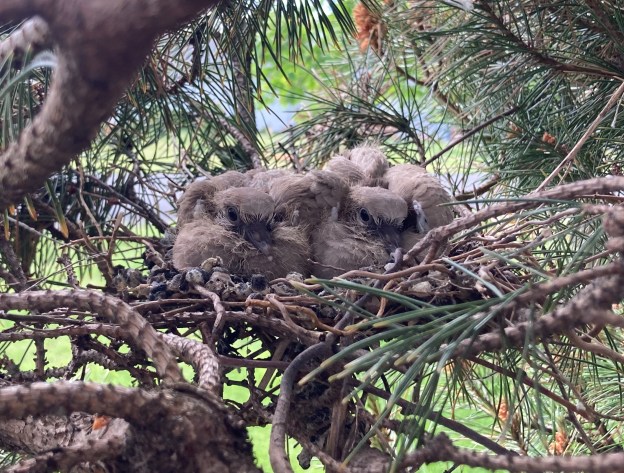
for the dove nest
hidden in the evergreen
by our front door.
Two white eggs
in a thin, flat bed of pine needles.
That nest looked too fragile
to hold anything.

Babies hatched—tiny,
bulbous, ugly—
but I said they were cute
and I meant it.

Blessed are You
for faithful mother and father,
sitting and sitting and sitting,
then feeding and feeding and feeding.
Babies are motionless,
so much so I worry they are dead.
But they grow.
I see mama come;
babies eagerly reach into her beak,
swallowing regurgitated seeds.

Blessed are You,
Lord our God,
King of the Universe,
for this brave bird family,
risking life in a tenuous world.
In two months—egg to independence—
they do what took me 18 years.
Squabs are now so fat they fill the nest.
When my own two babies—ages 8 and 10—
begin summer vacation,
the doves will be sporting full feathers,
cooing loudly, and finding their own dinner.
Their bravery, my invitation to life.

When I think of baby birds, I think of robins: a sturdy, deep nest full of wide-open beaks, voraciously devouring worms and bugs. This spring I’ve learned that mourning doves are sloppy nest builders, and they feed their babies crop milk and partially digested seeds. There’s a nest right outside our front door, and this front-row seat has grown in me a new awareness of the hundreds of different birds and nests and babies, near and far, all busy participating in the circle of life this Spring.

From Jesus Freak to Evangelism Phobia, Part Two

In this post—as in last week’s post—I use words like “Evangelism,” “Witnessing,” “Christianity,” and “Religion.” Each reader will have a different understanding of these words, both in denotation and connotation. Personally, I’m in the murky depths, somewhere between a conservative upbringing and an emerging mystical faith, still feeling around for a vocabulary that doesn’t cause pain.

***

“Aren’t you the one with a blog talking about Jesus?” Khalid asked.

I was at the home of my friends, Khalid and Tiffaney. They’d been to a concert earlier that week, which I avoided because of the musician’s evangelistic bent. “I don’t like evangelism,” I said, which prompted Khalid’s question about my blog.

“I certainly hope people don’t think I’m evangelizing!” I deflected the question.

It had not occurred to me that my blog (and my social handle @jesusmyfavoritesubject) could be viewed as evangelism. I have written over 100 blog posts, with the premise that talking about Jesus is one of my favorite things to do. What is that, if it’s not evangelism? Suddenly, I needed to answer this question.

I asked my husband if what I’m doing is evangelism. In his typical style, he looked up the word on his phone and found half a dozen definitions, all of which involved the concept of convincing another person. A Google search tells me that to convince is: to bring (as by argument) to belief, consent, or a course of action; persuade; cause (someone) to believe firmly in the truth of something. Combine this with the gospel of Jesus Christ, and you have evangelism: teaching or preaching about Jesus with the aim to bring about belief or action. Is that what I’m doing? I don’t want to answer.

A gray Jeep with a “Jesus Loves You” bumper sticker kept showing up on B Street last week. I passed it on my way home from school pick-up, and it got me all up in arms. Rather than joy at the sweet reminder of how loved I am, my response was irritation. People have all different conceptions of Jesus; the person displaying the sticker has no idea how many painful ideas he or she is promoting along with the positive ones. “Jesus Loves You” doesn’t see people, it talks at them. It doesn’t have any idea what tragedies or triumphs are on the reader’s mind, and it cannot weep or rejoice with them. The sticker is evangelism. I don’t like that I don’t like it … but I don’t like it.

One Friday afternoon, while chatting with my friend Celina at her dining room table, I brought up the question of whether I’m evangelizing. She asked, “If you’re not trying to convince when you write, what are you trying to do? What do you hope will happen when people read your blog?”

“I want people to feel seen,” I said. “I want them to be able to take a deep breath. I want them to know they’re okay.”

If God is in the picture, I hope people will see God seeing them.

On the eve of my recent 38th birthday, I spent a couple hours making a mental list of 38 people who have influenced me. It included coworkers, authors, family, and friends. Every influence was gentle; not one produced an about-face change in my life. They were quiet but strong: my boss—Jerry Mason—who believed in me, gave me responsibilities I would never have pursued on my own, and whose confidence in me was a steady presence in my life for over eight years; the authors—Gregory Boyle, Barbara Brown Taylor, Anne Lamott—who gave me permission to breathe, to try life open-handed; our mom tribe—half a dozen ladies who see me and allow me to see them. This is the kind of influence I hope for in writing.

I suppose I’m inviting people to be at home in themselves, rather than reject themselves to be at home in Christ. Krispin Mayfield, in his book Attached to God, writes about the Christian experience of sinfulness, and compares it to the pain of disconnection described in attachment theory.

It struck me that the theology I’d been given and the attachment literature I was reading seemed to be describing the exact same thing but offering different explanations. The theology taught that this awful feeling of ‘inner deformity’ was because of things we’ve done—lying to our parents, disrespecting teachers, sneaking extra candy. The psychology suggested that the terrible feeling came from what has been done to us. … (pg. 169)

When we have an insecure attachment, we feel awful inside not because of our sin but because of our unmet needs. It is the feelings of distance and separation that create the intense pain of shame. … (pg. 170)

“We think that if we can get a little bit better, a little less sinful, we will feel better about ourselves. In reality, true connection heals shame. (pg. 173)

True connection. That I might be willing to shout from the rooftops. I want to offer the things I thought I had because I was a Christian, but slowly and devastatingly found out I didn’t have: hope, peace, love, joy. These are almost synonymous with Christianity, but they evaded me for decades. So as I’ve found them, I’ve also found different language. When I share hope, I talk about how it’s okay to not be okay. When I share peace, I talk about disentangling from perfectionism. When I share love, I talk about expansiveness. When I share joy, I talk about coffee and friends.

I guess I’ve always wanted people to know they’re loved, and for a long time I thought telling them about Jesus was the best way to do that. But I was “the blind, leading the blind.” Religion created a structure in which I could feel my way around while my eyes were closed. But at some point I started bumping into sharp corners, and I didn’t feel safe any more. God suggested I sit still and open my eyes. In that terrifying posture of stillness, I learned to hold hands with myself, let myself be loved, and let life be both brutal and beautiful—“brutiful,” as Glennon Doyle would say. The structure of religion was an external protection. The beauty of loving and being loved is an internal strength. I’m learning to be strong rather than safe, and that’s what I want share. Is that evangelism? I still wonder about that.


Motherhood, My Invitation

Motherhood, My Invitation

Blessed are You,
Lord our God,
King of the Universe,
for motherhood—crucible,
mental health course—no way to opt out,
sleep—a mocking specter,
messes—everywhere, always;
but this too: my first real invitation to be kind
to the uglier parts of myself.

Blessed are You
for seeing me when I was unseen;
for holding my hand
when motherhood was a mirror.
I saw things I didn’t want to see,
didn’t want to be,
and became afraid of myself.

Blessed are You,
Lord our God,
King of the Universe,
for being my companion in the night,
a place to belong
when I didn’t belong in my own self.
You waited, waited for me to hear You,
hear You above the shame,
because You loving me when I hated myself
was the invitation to know my wholeness
and love myself, and in so doing,
to love my children, too.