Spiritual Hair

Spiritual Hair

Blessed are You,
Lord our God,
King of the Universe,
for hair—
a rainbow of textures,
a wisp or a thicket,
growing on heads
and peeking from armpits
and ears and noses.

Blessed are You for hair,
proof that You make stuff for fun—
red, brown, black, blonde, white,
ideal for play—
ponytail it, spike it, color it, braid it,
grow it, dreadlock it, cut it, gel it,
clip it, curl it, shave it, twirl it.

Blessed are You
for hair that needs care—
these strands on my head must be tended,
a combination of work and play,
same as the strands of my spirit,
woven for beauty,
made to be silly and serious,
often in need of untangling,
but beautiful in the wild,
salty-beach-air-jumbled moments.

Julia, It’s either You or Me

Julia Cameron possesses the rare talent of crafting an instructional book that is a treat to read, an invitation to be seen, and a storehouse of insight and wisdom. But I’m not happy with her right now. With some friends, I’m going through her book, The Artist’s Way. And it’s fun—the reading, our group dynamic, the exercises. Under her tutelage I’m learning to date my inner artist, a practice designed to fill my creative well.

I’m not mad at Julia about these Artist Dates. Or about the fact that I seem to have less creative flow since starting The Artist’s Way coursework. It’s probably hormones or the time of year or the other things on my calendar. Or maybe I’m just too contented to write. I like most of what’s on my schedule, and since I don’t fight against myself all the time any more, the emotional atmosphere in my life is pretty calm. In any case, I can’t put Julia on the hook for my stagnant writing.

It’s Morning Pages I’m mad about—three pages of stream-of-consciousness writing every morning. Julia swears they will change your life. Morning Pages—along with Artist Dates—are Julia’s favorite tools for recovering creativity. They are “a loving witness to our growth process,” a form of meditation, a journey inside. “We find our own quiet center,” she writes, “the place where we hear the still, small voice that is at once our creator’s and our own.” I think I know exactly what she’s talking about. I’ve been journaling with God for decades. I found my quiet center. I love to sit with my Creator and a pen and see what happens, or to hash out on paper a nagging question, perplexing circumstance, or angry diatribe. On the page, in communion with the Spirit, I have found myself and have discovered with some surprise that I like myself.

Julia takes care to point out that many people have resistance to Morning Pages, but two months ago I just knew that would not be me. What could be better than starting the day with three pages of stream-of-consciousness writing? Well, after nearly two months of writing (almost) daily, I can think of at least three things: snuggling in bed with my warm husband a little longer, sitting with God and watching the sunrise, or spending time with whichever daughter awakens early.

As is often the case, the thing I thought would be hard (Artist Dates) slipped into my life like a new and delightful friend, and what I thought would be easy (Morning Pages) is causing considerable discomfort. I try to wrestle it into submission by reminding myself that it is a perfect fit for me. I totally look great in this outfit. But after weeks of early-morning writing in which I have discovered next to nothing about myself, except that I’m chafing at this requirement, I must admit Morning Pages are not a perfect fit. I don’t want to record random thoughts. I want to finish a thought. I don’t want to write fragments and ramblings. I don’t want to lose valuable insights in pages of jibber-jabber.

Besides, my “consciousness” seems to be a bit of a worrier. Following it around for three pages is more stressful than sitting in silence, practicing gratitude, or praying for friends. Perhaps those things are allowable for Morning Pages and I’m just getting this all wrong. But stream-of-conscious, to me, doesn’t sound like directed thoughts and meditations. And I’m not supposed to pause. Keep writing, bypass the left brain, or some crap like that.

I don’t like to admit it, but I don’t like being told what to do. The rule-follower in me really wants to cross every “t” and dot every “i,” so doing what I’m told can be excruciating. It takes a lot of energy to get things right. If you’re going to tell me what to do, you better know what you’re talking about and the payoff better be good, because I’m not self-actualized enough to put in a proper (balanced) amount of effort. And once I over-blow my efforts, I expect an equally overblown result. I’m not about to spend hours every week writing a bunch of gibberish because you, Julia, say it’s the best thing since sliced bread.

Take that.

I’m not very good at agency yet, so I make up for it by pushing back on everyone who wants something from me. I live in the tension of hoarding my time and emotions out of fear, and giving them too freely, also out of fear. This is not Julia’s fault. She has simply made a request and I can’t handle requests. Isn’t every request an obligation? And if it’s not—if this whole course is actually about helpful tools and creative recovery—then how do I know whether to force myself to do Morning Pages? Do I choose them because my resistance needs to be seen but not given charge? Or do I choose not to do them because I gave it an honest try and found I already have practices in place that work better for me? Is that prideful? Rebellious? Naive? How could I know more than Julia Cameron?

I’m stuck. And stuck makes me angry. And anger makes me want a “bad guy,” which in this case is either me or Julia. Who’s it gonna be?

Sigh.

There is no bad guy.

There is no right answer.

Morning Pages could be helpful today or next year or never. It could be unhelpful in winter or while I’m content in life, or forever. I hate that. How does ambiguity manage to be such heart-wrenching torture, and simultaneously an elegant freedom? I am free to choose. I can decide to write Morning Pages when I don’t feel like it. Or I can not write them at all. Or I can try one page, or evening pages, or weekend pages. Who decided to give me this much power?

Some say it’s God, the only One crazy enough to hand out freedom-of-choice like candy. The rest of us know that some amount of control is the only thing keeping us humans washing our hands before we eat, and stopping us from eating each other alive. But maybe I’ll go with God on this one. I don’t have to fight with Julia, or Morning Pages, or even with myself. I can decide. Then I can change my mind and try something else next week. There’s not much at stake here. Maybe the best part of Morning Pages is learning that life is not graded, but lived.

Holy What?

Holy What?

Blessed are You,
Lord our God,
King of the Universe:
flame—do You warm cold bodies
or burn “wrong” people?
wind—do You play with our hair
or destroy our homes?
rock—do You stand firm beneath us
or avalanche upon us?

Blessed are You
beyond understanding
yet close as my skin,
a mystery, infinite, expanding,
yet fully present in the nose on my face.

Blessed are You,
Lord our God,
King of the Universe:
light, but creator of night,
the kind of wild that is safe for a child,
loving fire, burning desire,
bread and oil, seed and soil,
lawmaker and lawbreaker,
water-fountain of life.
I wonder about all this
(God isn’t supposed to be chaotic),
wonder if I should be worried,
until I remember we are holding hands,
fingers laced together,
and You don’t mind
if I close my eyes
for the scary parts.

Everything Is Well but Not Okay

On Sunday morning I lay in bed with my back against my husband’s chest, and the cat propped against me with her hindquarters on the bed and the rest of her body relaxed against my belly. As she purred, Michael and I groggily checked in with each other about last night’s sleep and the coming day’s hopes. In that moment I knew I was the luckiest woman in the world.

Also, too many people I know are in agony. It’s the usual culprits—death, divorce, disease. Add to that a whole lot of problems that haven’t been named or categorized. I know people who are feeling the brokenness in their minds and bodies, whether it has a name or not.

We’re veeerrryy close to the beginning of a remodel project that will add a master bath to our home. I can’t wait for the first day of real work, when the contractor comes in and lays that heavy duty cardboard down to protect the floors, and they start demolishing walls. I’m giddy with excitement about the next few weeks of packing up my bookshelves and moving things around to accommodate the remodel. Don’t ask me to explain this joy, but by golly I’m going to revel in it whether I can explain it or not.

I’ve been crying more lately, which is oddly comforting. I haven’t cried much the last year and a half since I’ve been taking anti-depressants. Whatever curbs my depression and anger also curbs tears, and I’ve missed crying. Last night I cried at the end of the Disney movie, Elemental. I teared up recently during a dolphin show at Sea Life Park. And this morning I cried when I shared a heavy heart with friends and their response came back immediate and full of love.

Yesterday I met with the school counselor at our local alternative high school. I’m slowly making connections in the community with the goal of learning about trauma-informed education and someday facilitating writing groups that empower incarcerated and underprivileged people to tell their stories. I want to give them room to be seen and heard. Writing is one path toward wholeness, and wholeness matters. Two books near the top of my TBR pile will help me with this—Between the Listening and the Telling, by Mike Yaconelli, and Writing Alone and With Others, by Pat Schneider. Just looking at those books gives me a tiny burst of energy, and if I let myself imagine a future in which I write with others toward healing, I break into a smile. Hand me the tools and let me get started!

If someone is living a better life than me, I don’t know who it is. Of course it wouldn’t take long to write down a dozen things that could be improved—but why bother? Today is my day to live, as me. I have what I need. I am enough. God is big and bigger and biggest.

When I feel the tension, I often return to these quotes, best when read together:

“Everything is so not okay.” -Anne Lamott*

“All shall be well, and all shall be well, and all manner of things shall be well.” -Julian of Norwich

Yes.

*Okay, the truth is I’m pretty sure I read this in an Anne Lamott book, but I can’t find it again. If you know, send me the book title and page number.

Cousins

Cousins

Blessed are You,
Lord our God,
King of the Universe,
for cousins—
like siblings
but without the drama,
similar to me in ways that are comfortable,
and familiar with the foibles
of the adults in my life.

Blessed are You
for sleepovers and Mad Libs,
tea parties and birthday parties,
visits to city parks and county fairs,
and standing in the concession line
at the pool, dripping wet,
to buy popsicles and pretzels.

Blessed are You,
Lord our God,
King of the Universe,
for older cousins who take
the burden of all the “firsts,”
and younger cousins who put up with
the older ones bossing them around.
You knew we’d need friends
who were actually relatives
but not our immediate family,
so You made cousins.

Big Joy

We returned a few days ago from vacation, and our upstairs cat, Phiona, seems particularly delighted to find me at my desk this morning. She jumps on my lap and leans into me. I put an arm around her and she settles down with loud purrs. I am charmed, as always, by her beauty and aliveness.

Other people’s cats—like other people’s kids—often look a little strange to me. I notice their proportions more than their personality, and nearly always conclude that my cat (or kid) is better. While I’m not proud of this, I’ve come to believe it’s a natural response to relationship. It is because I have a relationship with Phiona that I experience pleasure by looking at her, belonging when she flops across my feet for a nap, and joy when we play with the plastic bug my daughter tied to a piece of yarn.

“Joy is always relational,” write Marcus Warner and Chris Coursey in their book The 4 Habits of Joy-Filled People (p. 35). It’s a strong statement, but let’s play along and assume that joy is always relational. Put another way, joy comes from “knowing that someone is happy to see me” (p. 33). Is despair, then, the feeling that not a person in the world would be happy to see me? Is bitterness always relational too? Talk to a bitter person and you’ll get an earful about what they have or haven’t received at the hand of their dad, boss, roommate, kids, and church.

I wonder what joy looked liked for Jesus. Assuming He had an abundant supply from His relationship within the Trinity, would He also experience joy when people were happy to see Him? Imagine rounding the aisle at the grocery store, seeing Jesus, and spontaneously breaking into a joyful wave-and-smile. Does my joy produce joy in Him? It’s hard to imagine God coming away from an encounter with me feeling different than He felt before the encounter. And yet, if joy is always relational, then joy is the currency of divine-human interaction, and I’m inclined to believe this is not a one-way street.

Was Jesus’ greatest agony the (perceived) loss of all relationship on the cross? He asked his Father, “Why have You left me?” Stripped of relationship, what sustained Him? Dare I wonder if His relationship with Himself played a role? My inner critic says that question is sacrilegious. Relationship with self is so secular it’s scandalous. Love for us is what sustained Jesus.

But wasn’t that love for us something He found deep in His own self? Certainly He didn’t sacrifice Himself in loathing, as we are apt to do. He didn’t conclude that life wasn’t worth living. He must have valued life and held a deep regard—a love—for His own life, even as He parted with it. Perhaps it is in the safety of loving ones own self that a person finds strength to face death. After all, I will experience death alone, no matter how many people may be in the room. If I haven’t found peace in my own company, how can I receive death?

Sometimes I wonder what would happen to me if I existed only in relationship to God and to myself. How might I survive if war or disaster stripped human-to-human relationship from me? My guess is I would spend much of my time remembering the relationships of the past and desiring relationship in the future. It is human nature to visit a graveside and talk to a lost loved one, because even in the sorrow of death, we derive joy from that relationship.

I suppose it’s silly to spend time and energy considering lack of relationship, when the world I inhabit is drenched in relationship. And, truth be told, the joy of relationship finds expression in those who love themselves and those who don’t, those who fear death and those who don’t. Some folks are alone but not lonely, while others are lonely but not alone. It is in this complexity that God literally shows up everywhere. He’s not constrained to relationship with only those who love themselves, or only those who loathe themselves. His image is not confined to emanating from people who love well. His joy is not limited to those bathed in relationship.

There is no formula, and yes, even my response to this is divided—equal parts terror and comfort. I am outraged that “a” added to “b” doesn’t always equal “c,” but I am also relieved. I’m not hallucinating when I see exceptions, the edge cases that don’t fit my ideas of love and joy. I will be okay if I don’t follow the formula. In the meantime, I will cultivate joy by cultivating relationship. The scandalous promise of the upside-down kingdom is that as we exist in joyful relationship with God, we will find other people’s cats and kids looking a little less strange. The world of relationship will widen to include our enemies. We will be happy to see people, and they will know they are safe in relationship with us. That’s how I want to live.

Beach Body

Beach Body

Blessed are You,
Lord our God,
King of the Universe,
for bodies all over this beach,
like a bowl of mixed nuts
tossed in saltwater
and spread on the sand to dry.
How I am tempted to sort them
by shape and size and color.

Blessed are You for the confidence of jiggling white cheeks, divided by a teal thong,
for laissez-faire, leathered breasts who’ve seen more sun than most faces,
for awkward couples not sure how much of one another’s bare skin to touch,
and couples who’ve been walking barefoot in the foamy tide since before I was born.

Blessed are You,
Lord our God,
King of the Universe,
for every brave body,
here for sun and water and sand—
but also to be seen,
to remind me that every body is a “beach body.”
To paraphrase Jesus,
“The beach was made for bodies,
and not bodies for the beach.”
Every salty nut belongs.

From Pink Leather to Diversity

I cannot imagine the “Urgent need for Bibles” depicted on my social media feed and in letters from charities. I don’t know the hunger for Scripture that thousands have felt in prison, in remote villages, in countries hostile to Christianity. I have more Bibles than I want, and only need visit a book store or sit in a church pew to access even more.

Over the years, I’ve accumulated seven or eight Bibles, including a small pink New Testament with Psalms, a Seminars Unlimited Edition KJV (free for everyone who attended a Revelation Seminar series—hallmark of the Seventh-Day-Adventist Church), and the bright, almost-holographic NIV children’s Bible I earned by memorizing the books of the Bible. I’m still proud that I can recite the minor prophets in order.

During my high school years I bought a metal-covered NLT Bible with a magnetic clasp, and a Spanish/English NIV. In Senior Bible class, each student chose a new-to-us style or version of the Bible. I picked the Serendipity Bible, designed with questions and study helps in the margins for group discussion. Lover of small groups that I am, I thought—and still think—it’s brilliant. But I’ve hardly used it.

The only Bible I truly loved came to me in its pink leather cover on my ninth birthday. As I wrote in last week’s post, I read it all the way through that year, and over the next ten years it became like a fifth appendage. When I flip through it now, I find a quarter-sheet of paper with notes for a worship talk to the student body at my high school, and another with multiple-choice options, showing a checkmark beside the statement, “I rededicate my life to Christ today.”

I still get a feeling of companionship when I turn the pages of my pink Bible, but it’s connected to life before I moved away from home. I must have taken that Bible to church during my college years, but memories are vague. Did I have morning “quiet time”? I can’t remember. By the time I graduated from college, the focus of my small groups had moved away from Bible study and toward facilitating safe spaces for personal growth. The women in my life wanted to be heard, and so did I.

Two years after I graduated from college—and fifteen years after my parents gave me the pink Bible—my college-boyfriend-turned-husband gave me a burgundy NKJV Remnant Study Bible with my married name embossed on the front, in silver. Pink Bible retired to the Bible shelf, safe in a pleather case. But I never really moved in to my new Bible. Only a handful of verses are highlighted or underlined and no papers are tucked between the thin pages.

I can’t help but wonder if I loved the Bible as a book in its own right, or if I only loved that Bible. The pink Bible meant purpose, connection, expertise. Perhaps it filled the role of a cup of coffee or alcohol—to buffer social spaces. During my 20’s, as the years filled with grown-up responsibilities, the Bible settled down along with the rest of my life. The excitement of spiritual leadership, learning to drive, falling in love, and working a dozen different student jobs during my late teens and early 20’s turned into the predictability of a dual-income home. I rose at 5:40am for quiet time, and prayed through Stormie Omartian’s The Power of a Praying Wife at least twice. I read the Bible and journaled and expected life to continue in much the same way. The Bible was habit—was that all?

By the time I turned thirty, we’d added two babies to the family. Prayer journaling ceased during the years of babies and young children, and at the same time my confidence in God and Scripture took a beating. As I fought for sleep and struggled to maintain a shred of self-worth, my youthful confidence gave in to confusion, anger—and curiosity. I wrestled with God and mostly left the Bible out of it. An aching emptiness took hold of me, and the Bible’s companionship didn’t comfort. I read other books and prayed and went to counseling. Half a dozen agonizing years later I emerged with a different confidence and a different companion. My confidence resembled the flowing water of a mountain stream more than the steadfast rocks at its bottom. My new companion emerged as a sense of spiritual belonging and safety with myself and with the divine.

My “faith,” or whatever you want to name the relationship I have with myself and with the divine, is safe, flexible, curious, gentle. I have little interest in church doctrine, and equally slight interest in church pews. The occasional sermon I’m obliged to hear tends to raise my hackles. But I may be closer than I’ve ever been to possessing something I want to share. And it’s not a Bible study.

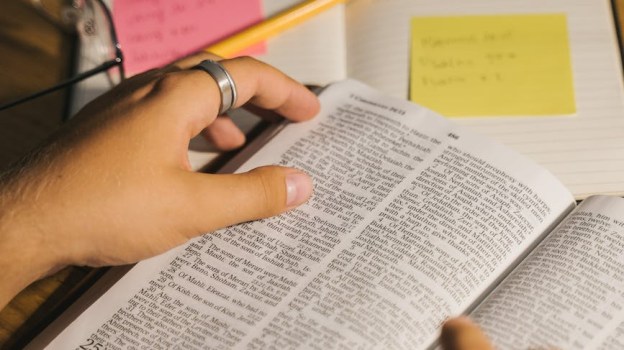
These days I’m timid with the Bible. When I want to find a verse, it’s faster to google a key phrase than open my Strong’s Exhaustive Concordance of the Bible, or—if I know the reference—I type it in BibleGateway and select the version I like best. My burgundy Bible sits on my writing desk more as a prop than a friend, and my pink Bible remains in the bookshelf.

Rachel Held Evans, in her book Faith Unraveled, takes readers along with her on the journey promised in the subtitle: How a Girl Who Knew All the Answers Learned to Ask Questions. Her Bible, like mine, absorbed a nontrivial portion of her time and energy as a teen. Unlike me, she started to ask questions, and learned that all questions do not have clean, three-point answers. Over time she found a different way to approach the Bible:

“As much as I struggle with the things I don’t like about the Bible—the apparent contradictions, the competing interpretations, the troubling passages—I’m beginning to think that God allows these tensions to exist for a reason. Perhaps our love for the Bible should be measured not by how valiantly we fight to convince others of our interpretations but by how diligently we work to preserve a diversity of opinion.”

Faith Unraveled, pg. 194

Diversity of opinion sounds terribly healthy. Am I that healthy? How comfortable am I, listening to another person share—from the Bible—a theological view different from mine? Will I allow them the certainty that irks me? On the other hand, am I able to hear doubts and questions without offering a solution? Can I experience spiritual intimacy with the people I disagree with, or only with those who have the same interpretations and “aha” moments that I do?

I’ve avoided the Bible for years now because when I pick it up and begin to read, I’m often thrown back into black-and-white thinking. Scripture is not a place of curiosity for me, but a textbook with answers. It’s hard to come back to a text I poured my life into as a teen, with a different view of myself and the world. We don’t fit together like we used to. But Rachel Held Evans gives me permission to try a more nuanced, messy relationship with my Bible. I haven’t picked it up yet, but I might. When I do, I want to look for diversity and contradiction, and practice making friends with the parts that are uncomfortable. I would like the Bible to be an irritating friend—by turns funny, exasperating, wise, sometimes a gentle companion and other times giver of good advice I’d rather not hear. I want it to remind me there are more questions than answers, and that what we write about God is as oddly erratic as what we write about humans. Maybe, in a year or ten, I will again be friends with a Bible. I don’t know what color the cover will be, but the inside won’t be black and white. It will be grey and rainbow.


Aunties

Aunties

Blessed are You,
Lord our God,
King of the Universe,
for my aunts,
who believe the best of me.
I still find it odd
that anyone thinks I’m smart
or capable, or decent,
but my aunts do
and for some reason
I trust them.

Blessed are you, aunties,
for unwavering kindness,
generous gift-giving,
craft supplies and gourmet meals,
giggles and connection,
honesty and creativity.
I never felt you had to invest in me
because I’m your niece.
I knew you wanted to.

Blessed are You,
Lord our God,
King of the Universe,
for the believing and belonging,
the handwritten cards and letters,
funny family stories,
warm welcomes, and celebrations.
You knew it would be hard for me to learn
that the best thing I can be is me,
so You created aunties.
Brave, they are, to be themselves,
and in so doing, to invite me to be myself.

Bible Sidekick

When I was eight years old, I signed a baptismal certificate, and Pastor Bryson baptized me into the Seventh-Day Adventist Church. I remember practicing how to hold his arm while he held the dry washcloth over my face, so I could go under without breathing in water.

Six months later, for my ninth birthday, my parents purchased a Bible from the Christian book store, where they had my name embossed on the cover. They let me choose the embossing color—rainbow shimmer—but they kept the Bible out of sight. I used to wish I had chosen plain silver embossing, to please the adults and to match my tastes as I grew older. But at eight-going-on-nine, I wanted rainbow shimmer.

I was allowed to invite one family to our home for my birthday celebration each year, and for my ninth birthday I invited Laura and Eric. They were the only people I knew in their early 20’s, and I admired them as only a nine-year-old can. Laura had dark brown hair with one curly spot in the back where her previously-straight hair grew back in a curl after a diving accident. She had a petite frame, and a lovely accent from spending a year in Latvia. Eric was tall, with long everything—legs, arms, torso—and a wide, impish-yet-innocent smile.

I don’t remember much about my ninth birthday. Pictures remind me that I dressed up in elegant old skirts from our dress-up stash. Laura and Eric gave me a miniature rose plant, and my parents gave me the Bible—a red letter edition NKJV with a pink, bonded-leather cover.

I read the Bible cover to cover that year. I read about creation and Abraham and Moses, the cut-up concubine, prostitution and murder, lying and rape, greed and gratuitous violence. I read about Ruth and Esther, the Song of Songs, and somehow made it through Lamentations and the major and minor prophets. I read the shocking story of Jesus’ beginnings and the shocking story of His death, and through the exhortations of the apostles, all the way to the “Amen” at the end of Revelation chapter 22, verse 21.

I don’t recall having any questions, registering any shock at the violence, or finding any difference between the God portrayed in the Old Testament and the God portrayed in the New Testament. It was the Bible. I assumed it was all okay to read, and unnecessary to question.

By the time I completed 8th grade, I could find any Scripture reference in 30 seconds or less. My pink Bible accompanied me for the livestream of Dwight Nelson’s Net ‘98 evangelistic series, and Mark Finley’s Net ‘99 evangelistic series, both projected on the big screen in my home church. I began a lifelong habit of morning prayer-journaling after Net ‘98, the year I turned 13. In the front of my Bible I glued a handwritten copy of Robert Frost’s poem, “The Road Not Taken,” and a variety of Bible “study helps” I never used. With The Marked Word study guide as my starting point, and armed with half a dozen pastel-colored gel pens, I underlined more than 30 chain studies.

After homeschooling basically forever, I attended Milo Adventist Academy (MAA) for 11th and 12th grades. Our family lived in the small southern-Oregon community where MAA occupies a slope beside the South Umpqua River, so as a high school student I attended the same church I’d been attending since I was born. As a student at MAA I served in almost every spiritual leadership position available. I was a group facilitator at a youth Bible conference, Spiritual Disciplines small-group leader, Junior Class Spiritual Vice President, and Student Association Spiritual Vice President. For a school talent show, I memorized and recited Psalm 139 and won a cash prize.

The summers I was 16 and 17 years old, I spent away from home, selling religious books and vegetarian cookbooks door to door with a Seventh-Day Adventist group called Oregon Youth Challenge. We led church services on weekends and Bible studies some weeknights, and my pink Bible and I took a tour of the SDA churches around Gresham, Oregon and Vancouver, Washington, while book sales helped fund my private school tuition.

Wherever I went, throughout my teen years that well-marked Bible was like a fifth appendage. When the youth leader said, “Hold up your swords!” my “sword” was always handy. I was well-prepared to fight with that sword, but I never did.

I don’t recall interacting with anyone who was interested in the Bible from a curious, unknowing space. Everyone I knew was either a “nominal Christian,” bumping along in apathy, or they were doing the same things I was, memorizing and marking Bible studies and verses that reinforced Adventist doctrine. Books I read and pastors I met told stories about meeting someone who was “hungry for the truth,” but I didn’t see or experience this firsthand.

Despite swallowing the Bible hook-line-and-sinker, even in high school I couldn’t imagine sharing the “plan of salvation,” telling someone they’re a sinner in need of saving. Although I soaked in Scripture and prayer, I didn’t feel any urgency to share my experience as a Christian. I sat squarely in the middle of an us-vs-them mindset, but the act of inviting a “them” to join “us” was far from my desire and far from my experience.

The Bible, I think, was something for me to be good at. I “knew” my Bible. I could find any verse in a few blinks of the eye, ask thoughtful questions (within accepted norms), and share my observations and opinions. I can’t imagine not having the Bible at that time in my life. I read it, marked it, loved it.

When I packed my room and drove eight hours to move into a college dormitory, I had no idea what was ahead for me and my Bible.


Read the next part of the story on February 7.