Here and There I Am

Here and There I Am

Blessed are You,
Lord our God,
King of the Universe,
for anticipation—
groom in shiny, toe-pinching shoes,
watching the sanctuary doorway.
Bread in the oven,
first crocus about to bloom,
waiting for grandma’s visit.

Blessed are You for memories—
wreaths on the necks of brown cows in Switzerland,
playing an evening game of soccer in Belize,
lighting bugs in Oklahoma,
backpacking through snow to natural hot springs,
holding purple shore crabs by Oregon tide pools.

Blessed are You for creating me to enjoy—
memories of the past,
scenery and scent of the present,
and the possibility of my future.
Your eternal nature allows me the pleasure
of what is already done,
what is now,
and what is yet to be,
for You are not contained in one reality,
and as Your child, neither am I.

Twenty Years in Love

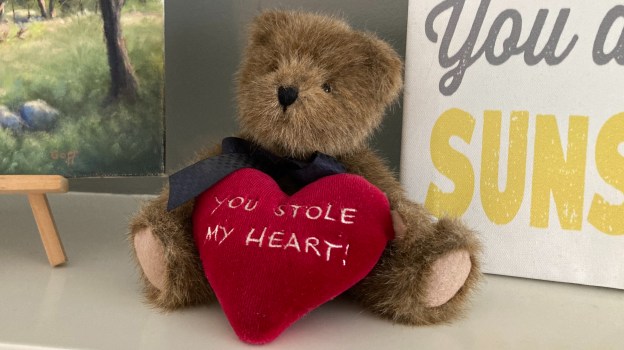
I remember only bits and pieces. A small, formal couch with burgundy upholstery and a rounded back. Our clothes still shedding cold air from the winter chill. Michael’s tan coat, puffy in a way that rounded his lean figure. The Boyd’s Bear he hid in that coat.

Michael was a junior in college, double-majoring in mathematics and computer science. I was a first-year student pursuing an associate degree in accounting. Michael lived at home; I lived in the dorm. I attended required worships and ate in the cafeteria; he didn’t attend evening worships and his mom still cooked his dinner most nights. Our paths didn’t cross.

Until mutual friends set us up on a blind date—a story for another time. He waited two or three months to ask me out again, to his sister’s New Year’s party. In the meantime, we got acquainted on Instant Messenger. At some point, I confessed my interest in him on a couch in the church youth room. Come to think of it, couches are kind of a thing for us. He asked me to be his girlfriend on a couch, and our first kiss was also on a couch. Anyway, after discovering our mutual interest in each other and going to the New Year’s party, what was next?

Could we formally-informally get to know each other? We decided we’d find times to meet on campus and talk—not formal dates, but an intentional time to get acquainted. At least that’s what I thought. I don’t remember who arrived at our meeting point first—third floor of Kretschmar Hall. Fancy, uncomfortable-looking furniture dressed up the wide space in the hall outside the president’s office. Administrators had gone home for the day and it was quiet.

I don’t remember what I was wearing or what I was thinking. Michael wore blue jeans, a t-shirt, and that tan coat. Maybe I remember the coat because of all the time we spent together that winter, or maybe I remember it because on this day Michael reached inside it and pulled out a teddy bear. “I’d be honored if you would be my girlfriend,” he said, holding it out to me. The teddy bear held a plush heart with an embroidered message, “You stole my heart.”

If I’d known then what I know now, I would’ve grabbed that bear, squeezed it tight against my heart and jumped onto Michael’s lap. Grinning a big yes, I’d have squeezed him, tucking my nose under his ear. But, as I didn’t know him yet, I didn’t give him an answer. I accepted the bear and told him I wanted to pray about it.

If we began dating, he would be my first boyfriend. I’d fastidiously avoided dating in high school—you know, I-kissed-dating-goodbye and all that purity culture stuff. I had been in college only a few months, and other than our blind date, had been on only one other date—and a couple times guys bought me a burger or ice cream. In other words, this was a big deal.

I don’t remember how long we talked, or how long I made him wait for my answer. I prayed about it during Tuesday evening worship in Heubach chapel, an intimate sanctuary across a breezeway from the imposing College Church. It was simple—write your student ID on the leader’s clipboard, pick a pew in the nearly-dark chapel, and sing, or listen to the singing.

So there I sat, near the back, in a sanctuary of song, asking God what She thought of me dating Michael. She didn’t have much to say. In fact, He said nothing. But I took the quiet peace in my heart as a green light. I’m guessing I didn’t waste much time letting Michael know my answer. I’m not exactly sure he asked me on the 21st, but we’ve been telling it that way for as long as I can remember, which makes today just a few a days past the twenty-year anniversary of our first yes.

I phoned my parents with the news and they developed a sudden, intense interest to come visit—an interest that had never occurred before and never occurred again. After all the parents met each other and nothing exploded, we launched into dating with a surprising amount of devotion, insecurity, and delight. Michael was my first and last boyfriend, and I feel for him, being the only one to iron out my wrinkles all these years.

Not that he didn’t have any wrinkles. The first time he took me to his house, he asked me to wait in the living room while he took a broom and dustpan to his room. I’m pretty sure that dustpan was brimming after a hasty sweep. Twenty years later we’re still ironing out each other’s wrinkles, but perhaps more importantly we’ve learned to live with wrinkles. Our foibles have just a bit of charm when we remember to laugh about them.

It’s strange after twenty years of togetherness and eighteen and a half years of marriage to revisit the moment on the couch, the simplicity, the significance. Nobody knows exactly what they’re signing up for with a yes to love. And I say yes again today with equally sparse knowledge about the next twenty years.

But this I know: Michael, I am honored to be your girlfriend, best friend, wife, parenting partner, and annoying roommate. Thank you for asking. Thank you for countless opportunities to say yes to love.

White Gift

White Gift

Blessed are You,
Lord our God,
King of the Universe,
for snow, brides,
egrets, rice.
White is bright,
reflecting light—
clouds,
the insides of radishes and potatoes,
coconut shreds,
vanilla ice cream.

Blessed are You for rabbits
who keep a white coat
without bleach or washing machine,
despite no hands to hold their juicy vegetables.
Me, I can’t keep a blouse white,
but kittens wear white boots
and gulls wear white all down their front,
and they make it look easy.

Blessed are You,
Lord our God,
King of the Universe—
though my stains are scarlet
they will be white as snow.
Though my wrongs are crimson
they’ll resemble finest wool.
White is not for me to toil over
but for You to give.

Cat-Size Heart

I invented a new drink today—cofftea. I steeped a bag of decaf chai, added about a half inch of bottled Starbucks caramel macchiato coffee, and a splash of low-sugar, sweet-cream-flavored creamer. It was perfect. Tea, as Ted Lasso said, tastes like hot brown water. Coffee is too strong and too caffeinated. Cofftea is just right.

I’m writing in the living room recliner, cofftea beside me, snow outside, listening to the heater combat the 19-degree weather while frozen rain pelts the house’s metal siding. Michael comes downstairs for home-office pleasantries, and our cat Phiona follows. She tangles herself in a long piece of tinsel-like gold streamer. She chews it while twisting about on the floor, then gets up and saunters slowly to a different part of the room. The tinsel is wrapped around her tail and trails after her, setting off a round of wild contortions. She leaps to the couch, paws churning on the leather, propels herself across the side table and under a chair, where she pauses before rushing to the middle of the room for another tussle with the tinsel. Michael takes the gold-tinsel streamer and he and Phiona pad back upstairs where she will likely settle down on her pillow at the window beside his desk.

When I was a kid, we had a no-pets-in-the-house rule, observed without exception for dogs, and occasionally broken for a supervised half-can of cat food or bowl of warm milk on the kitchen floor for kitty. There was also an exception for summertime jars filled with tadpoles in mud-puddle water, and the hamster who occupied a small aquarium in my bedroom. Ladybug was her name, and I’m sorry to say I grew tired of her biting and pooping and messing up her aquarium, and felt relieved when she died.

As an adult, I’ve dabbled in fish and rodents, decided I don’t have patience for a dog (or children, but it’s too late to return them), and have settled on cats as my pet of choice. Last spring we lost our 18-year-old cat, Phred, to a traffic accident, leaving us with geriatric Phrank, who hasn’t yet used up his nine lives. A few months later, in midsummer, we adopted a kitten—a birthday gift for our daughter Kyli, who named her Phiona. She is unceasingly gentle and relationally devoted (as much as possible for a cat). She keeps her claws retracted during play, and if she bites, she gives an apologetic lick. She is very chatty and will often respond with trills and meows when spoken to. Our family of four is under the spell of her charming face, maniacal antics, and friendly conversations.

I don’t mean to be judgy, but I think people who choose not to have pets still think happiness is a clean house and no vet bills. Yesterday Phiona chewed the cord for Kyli’s headphones in three pieces—two large and a small. A couple weeks ago one of Phiona’s eyes clouded over and we took her to Animal Clinic of Walla Walla to get it checked out. (Nothing was wrong.) The bigger she gets the more she eats and the more she potties, which means increasing cat food and litter costs. She scratches the couch and the mattresses, makes herself at home on the dining table, and wakes me every night between midnight and 1am for no apparent reason.

The petless people aren’t fools. I just think they have grinch-hearts that need to grow a few sizes (apologies to my petless parents and friends). I can only assume my own capacity to handle the inconvenience—and receive the love—of pets has room to grow, since I am not yet ready for the exuberance, mess, and affection of a dog. Maybe my heart is only mid-sized.

It’s no secret that introducing any living thing—plant or animal—into life carries a legal-pad list of complications. Plants need water and sun and god-knows-what-else, and they grow oddly out of proportion, drop leaves, forget to bloom, and either die under ideal conditions or thrive under heinous neglect. Yes, there are books on plant care, but there are also books on parenting, and we know how well that turns out. Oh, and my parents don’t go for indoor plants either—at least not living ones. I mean, who wants dirt in the house. Silk plants are a no-fuss, wash-in-the-bathtub-every-five-years type of happiness. Good luck finding any living foliage with that kind of low-maintenance guarantee.

Recently, I drove downtown via my usual route. Power poles and power lines compete with trees along the road. Why, I wondered, do we bring in a specialized truck to dig a hole and place a dead piece of wood in the ground to hold the lines, when strong, living trees are plentiful and perfectly located? Well, because trees are alive, and life is inconvenient. Trees grow taller and wider, swallow up wires, and attract wildlife. They’re unpredictable. And for power lines we need predictable.

Where am I on the continuum of power pole to dog-lover? How much life can I tolerate? I’d say a plant is less trouble than a cat, and a cat is less trouble than a spouse, and a spouse is (usually) less trouble than a child. Rules and stonewalling, tone of voice and expectations help corral my people into something I can perceive as manageable, but how much management is too much? How do I know when I’m opting for the less-alive version because it takes less maintenance, less money, less emotional involvement? As a wife, mother, and friend, do I optimize for dead traits, or living ones?

In 2023 I settled for a mid-size heart. Will 2024 be the year to grow another size? Don’t get any wild ideas—I’m not adopting a dog. But maybe I won’t assign chores when my kids get loud, and I’ll stop counting out the pieces of fruit each family member gets at breakfast. Maybe I’ll take bedtime noise and moldy lunchboxes in stride, and smile more when I get woken at night. I’m not going for superhuman here. Just a little more life, and a slightly bigger heart to pump blood so my extremities don’t go numb.

Potential

Potential

Blessed are You,
Lord our God,
King of the Universe,
for potential—
a door ajar,
a hint of what I can’t see.
What is there?

Blessed are You
for potential
to give and receive,
comfort and be comforted,
see and be seen—
relational miracles.

Blessed are You
for creative energy
to birth poems and essays,
make spring rolls and peanut sauce,
weave laughter through dinner and bedtime.

Blessed are You,
Lord our God,
King of the Universe, for this—
Potential means I don’t know.
Not knowing means I’m not in control.
Not controlling means I’m free to love.
And love makes even the impossible possible.
Potential.


Green fruit has potential to become ripe.
Ripe fruit is potent with flavor and satisfaction.
Empty things have potential to be filled with anything—even dust and spiders.
Full things contain possibilities for all kinds of creation.
Best of all, potential is NOT something I can DO.

What Is Kinship?

This morning I’m sitting in a favorite coffee shop as I write. Country music plays a little louder than I’d like from a speaker above, but quiet enough that I can overhear conversation. Two men in their seventies talk about therapy, travel plans, searching for a church that fits, and learning to support a recently-divorced family member. These men share themselves, hear each other, and speak encouragement. This, I think, is kinship.

I’m on a quest to learn about kinship. A google search provides this uninspiring two-word definition: blood relationship. But kinship can be so much bigger than that, a new way to see myself and others, a way that assumes value and connection. In kinship we are all on the same side of the line, rendering divides impotent. No “them,” only “us,” as Father Boyle would say. Only us.

Kinship has been slow-coming in my life. I grew up in a home where social time was considered a waste of time. If it wasn’t an event—like a birthday party or a hike to the lake—socializing didn’t happen. Although I’d like to blame my family and upbringing for my struggle to settle into friendship—I lived in a tiny community and was homeschooled through tenth grade—I’ve discovered my fears are not unique. Many women feel a lack of intimacy, and fear they don’t know how to participate in friendship. And, of course, each of us thinks other women have it figured out.

Every year I make a photo book commemorating our previous year. That may sound very organized, but it’s actually quite haphazard. Recently, I’ve been sorting through pictures from the last two years. As I put photos into categories and months—pets, school, March, November—a new category emerged: fun with girlfriends. These photo books will be the first to include a friendship photo spread—pictures of lunches out, movie nights, birthday coffee dates, pottery painting, and shopping fun. Looking at them, I feel connected, grateful, and not at all sure how it happened. I used to “do” friendship; now I enjoy friendship. I wish I could tell you five steps from lonely and anxious to connected and content, but, at least for me, it has been more mystical than methodical.

For most of my adult life I have compensated for lack of friendship by joining or creating small groups. A ladies group is my happy place. Crafts, Bible study, accountability, book-reading—it doesn’t matter. The structure provides a place for me to show up, participate in the mutual honoring of each other with our time, and complete the prescribed activity. Slowly I have ventured into one-on-one time with a handful of girlfriends, and casual activities together, like shopping. My circles of belonging widen.

The terror and the joy of intimacy with friends cannot be understated. Could one text or one misunderstanding upset it all and leave me in pain? Yes, it could. But in these relationships, do I feel seen, known, and safe? Do I invite these women into my home when I haven’t mopped the kitchen floor for three months, or done the dishes for three days? Yes, I do. Do I text them when I’m discouraged and take them coffee when I have a free morning? I do. Is it still scary, and do I have social anxiety? You bet.

Intimate relationships cannot be wrangled. It is a fools errand, seeking to avoid anxiety or relational fallout. Instead, I will allow anxiety and fear of intimacy to remind me that I am not impermeable. I am not above pain and misunderstanding. And this capacity for pain, this vulnerability, is what allows me life-giving connection, the joy of belonging, and the wonder of holding safe space for another person. This is the magic of being human.

Stories about men and women who stand in the gaps, go to the margins, hold hands with the desperate—these are my favorite. I want to be the hero in every story—the woman who taught homeless children, the man who endured exhausting legal battles to free wrongly-incarcerated men and women, the writer who teaches veterans to tell their stories, and the 22-year-old who adopted more than a dozen impoverished children.

At the same time, I don’t want to get anywhere near such unpredictable, messy situations. Can you imagine teaching at a homeless shelter, where traumatized children are in your classroom for 90 days or less? What about working long hours as a lawyer, toiling for years to see one ruling overturned, more years to find out it’s too late, the execution is scheduled. That may be charity, but it’s also insanity. How much could I handle?

There is tension between my relentless desire to love, and the ever-present awareness and fear of my limitations. I don’t know what’s coming for me in life, but I know I want to rise to the occasion and choose real love over false safety. I’m grateful for the thousands who have done this before me, proving it is possible and powerful. I watch the nonprofits in my hometown of Walla Walla, Washington, as they construct shelters for homeless, hold hands with the formerly incarcerated, provide dental services, food and clothing, love and dignity. I want to be part of that.

Children’s Home Society,* a local charity that works tirelessly to keep families together through in-home visits and a score of other services, has discovered the power of kinship—linking arms with the marginalized and misunderstood. Each year at their fundraising luncheon, one of their clients gives a keynote presentation, a story of their move from the thinness of broken family, addiction, and poverty, to a wholeness they didn’t know was possible. These people, unlike many of the donors in the room, haven’t been able to keep their lives “together” and show the polished side to society. But for that very reason, their stories are potent with hope. Every person in the room feels the energy of kinship. Hearts beat faster. Smiles appear. Applause is loud and long. Every one of us loves stories of redemption, and kinship is the catalyst for redemption.

Jesus born in a barn is kinship. He grew up to touch the untouchables, teach the stubborn, and include the rejected. He forever found beauty in ashes, wholeness in tragedy, and life in death. He defied categories, sweeping them into a circle and inviting them to hold hands, mix together like a delicious, forbidden stew. With a twinkle in His eye, He invites me into spaces where the ground is dry and barren. He invites me to bring kinship—the first drop of rain.


*Children’s Home Society is in the process of re-branding as Akin. I love this short-and-sweet name that includes the concept of kinship—the earth-shaking power of standing at the margins and holding hands.

At Home in the Dark

At Home in the Dark

Blessed are You,
Lord our God,
King of the Universe,
for making it clear
that life is not about improving
myself
or anyone else.

Blessed are You
for not bettering me
so much as standing with me,
proving by Your presence
that nothing is needed
except love.

Blessed are You,
Lord our God,
King of the Universe,
for Your love unflinching,
beyond logic and practicality,
beyond physical and emotional limits.
You leaned lovingly into death
and took up Your life again in love,
demonstrating that love
is at home in the dark
and in the light—
improbable,
unstoppable,
enough.

Books I Read in 2023

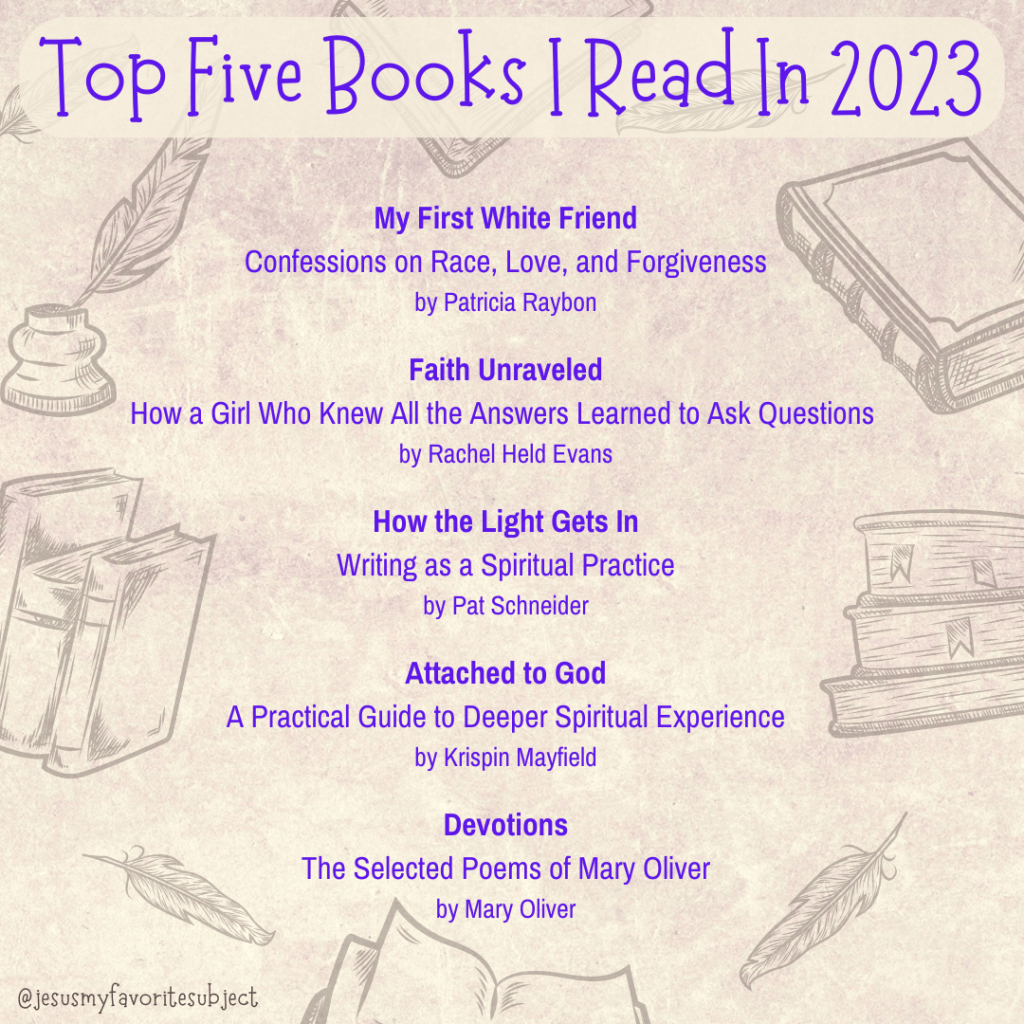
I read over 30 books in 2023. I’d like to think I choose what I read. But, as with many facets of life, the people I know—and whatever version of fate I ascribe to—play a large part. Last year I picked up nine books at a Writing For Your Life conference—none of which I would have read otherwise. Several were written by authors at the conference, others lay piled on a “free” table in the foyer, and another—Grace Notes—was a not-yet-published manuscript. The author and fellow conference attendee, Cheyenne Wilbur, agreed to let me try my copyediting skills on his book. Grace Notes was the only work of fiction I read last year. With no forethought or planning, I gravitated toward nonfiction.

In 2023 I read at least ten books recommended by friends and family—ranging from depression-era stories to books on writing. I selected books for a dozen reasons I know, and probably a score more subconscious reasons. I chose because of the author’s name—Richard Rohr, Rachel Held Evans, Anne Lamott; or because of the title—Intersexion: A Story of Faith, Identity, and Authenticity; or because I wanted to learn more about mysticism—The Big book of Christian Mysticism, and Wild Mercy. Some books, unread on my shelf since high school, had to be read or sent to the thrift store, making room for more recent acquisitions.


Eleven books by authors I know, or have connected with in some way, appear on my reading list. I treasure each of these connections, and find myself astonished by the quantity of people who write bravely, skillfully, and often while also attending to other full-time commitments.

A nurse and author of several books, Susan L. Schoenbeck, introduced herself to me on LinkedIn because of a mutual connection. Her experience—both personally and professionally—with near-death experiences piqued my interest and I purchased her self-published book Heaven and Angels.

My friend and cousin-in-law, Clair Gabriel, embraced her creative-writing skills and published a book on Amazon: Pregnancy, Birth, and Oh, Baby! It’s a quick and encouraging read, both important traits for a target audience of young mothers.

At the year’s end, I absorbed one last book, written by the former pastor of my childhood home church, Carl Wilkens. The book is titled I’m not leaving., with this singular statement on the cover: “Rwanda through the eyes of the only American to remain in the country through the 1994 genocide.” It was a thought-provoking read, ripe with unanswerable questions and the traits that empower a person to navigate such answerless queries and harrowing circumstances: love and connection.

Books by authors I met at the Writing For Your Life conference:

  • The Hundred Story Home: A Memoir About Finding Faith in Ourselves and Something Bigger, by Kathy Izard
  • Grace Notes, by John Cheyenne Wilbur
  • My First White Friend: Confessions on Race, Love, and Forgiveness, by Patricia Raybon
  • The Big Book of Christian Mysticism: The Essential Guide to Contemplative Spirituality, by Carl McColman
  • unbelieve: poems on the journey to becoming a heretic, by Marla Taviano

Books by authors in the Christian writing critique group I attend:

  • Surviving the Sand: My Family’s Struggle to Farm the Pasco Desert, by Helen Lingscheit Heavirland
  • Life Aboard a Sinking Ship: Mishaps and Mayhem on a Navy Tugboat, by Lee Yates as told to Blanche Yates
  • Building the Columbia River Highway: They Said It Couldn’t Be Done, by Peg Willis

Until last year, children’s books comprised nearly all my reading of poetry. Think Dr. Seuss and Shel Silverstein. When I started writing poems, I knew I needed to overcome my fear of poetry that isn’t illustrated and in large print. My sister helped by recommending several poets, and I read five books of poetry—including a compilation containing three of my poems, and the above-mentioned book by Marlia Taviano.

  • Swallow’s Nest: Poetry Journal, Fourth Annual Issue—December 2022, compiled by Linda L. Kruschke for Oregon Christian Writers
  • To Bless the Space Between Us: A Book of Blessings, by John O’Donohue
  • Stripped, by Cara Alwill Leyba
  • Devotions: The Selected Poems of Mary Oliver, by Mary Oliver

My reading last year included only one or two books from the self-help genre. I’d like to think this is because my mental and emotional health are improving. Or maybe I have that backward, and my mental and emotional health are improving because I’m not reading so many self-help books. Instead, I read more stories. There must be a technical term other than “story”—I’m sure “memoir” would apply to some—but to me these books are lovely because they are stories. The authors don’t tell me what to think. Rather, they invite me into their experiences. A good story is an offer of intimacy, a passageway to the inner workings of another human being and the wildness of their story. In addition to half a dozen of the above-listed books by authors I know, here are the stories I read last year.

  • Julie & Julia, by Julie Powell
  • Growing Up, by Russell Baker
  • Once Upon an Island: The Adventures of a Young Couple Who Did Buy Their Dream Island, by David Conover
  • I Went to the Woods: The Adventures of a Bird Photographer, by Ronald Austing
  • Faith Unraveled: How a Girl Who Knew All the Answers Learned to Ask Questions, by Rachel Held Evans
  • Intersexion: A Story of Faith, Identity, and Authenticity, by Cynthia Vacca Davis
  • The Face of Addiction: Stories of Loss and Recovery, by Joshua Lawson
  • Sealed: An Unexpected Journey Into the Heart of Grace, by Katie Langston
  • Love Warrior: A Memoir, by Glennon Doyle
  • Birding Against All Odds, by Joan Easton Lentz

Every one of the spiritual books I read felt like friendship. These books saw my heart and spoke both things I knew and things I didn’t yet know. They pushed me to try new things, think new thoughts, ask new questions. God and spirituality captivate me in a way nothing else does. I underline, write down page numbers, read aloud to my husband, and text paragraphs to friends. Although this happens with other books as well, it is spiritual books that most often invite me home, to a profound sense of belonging.

  • How the Light Gets In: Writing as a Spiritual Practice, by Pat Schneider
  • Attached to God: A Practical Guide to Deeper Spiritual Experience, by Krispin Mayfield
  • Small Victories: Spotting Improbable Moments of Grace, by Anne Lamott
  • The Tao of Pooh: The Principles of Taoism Demonstrated by Winnie the Pooh, by Benjamin Hoff
  • False Intimacy: Understanding the Struggle of Sexual Addiction, by Dr. Harry W. Schaumburg
  • Wild Mercy: Living the Fierce and Tender Wisdom of the Women Mystics, by Mirabai Starr
  • Forgive Everyone Everything, by Gregory Boyle, art by Fabian Debora
  • Seeking the Triune Image of God in You: A Glimpse Through a Keyhole, by Jeffrey D. Hill
  • Breathing Under Water: Spirituality and the Twelve Steps, by Richard Rohr

Re-reads. Finally, I read these three books a second time, because, in my humble opinion, they are just that good.

  • The Whole Language: The Power of Extravagant Tenderness, by Gregory Boyle
  • Bird by Bird: Some Instructions on Writing and Life, by Anne Lamott
  • Present Over Perfect: Leaving Behind Frantic for a Simple, More Soulful Way of Living, by Shauna Niequist

Thirty-seven books, and probably a few more I forgot to write down. It is a still-infant privilege, this copious access to written material. And yet, having grown up in America late in the 21st century, I can’t imagine anything else. Shelves of books are the backdrop to my office, my small groups, and my mental and emotional spaces. I am profoundly thankful for each author who puts their words into public spaces, and for the privilege of having time to pick up those words and hang out with them.

What did you read in 2023? Leave a comment and maybe I’ll add your recommendation to the list of books I want to read.

New Love, or Old?

Are babies new,
Or just recycled?
Does baptism make
A person new?
The Bible says
God’s mercies are
New every morning.
What is a
New mercy like?
How’s it different
From old mercy?
What is better—
New love, or
Old, wrinkled love?

Today, they say, begins
A new year.
It doesn’t feel
New to me.
My kids are older
And I’m older
And the world is older
And this feels
More like a “keep going” than
A “start fresh.”
But that’s okay.
I don’t need
To be a baby again.
With age comes
Wisdom, and it is the adding of
All my years
That tells me I can
Do this year.
I’ve done 38 years before,
And I know
I don’t need new resolutions
As much as
I need old love.

Now What?

In a few days, 2024 will unfurl. I’m curious what the year will be like, for one reason I never expected: joy. I’m happy, content, grateful. After years of feeling heavy, taking life seriously, and forming relationships around mutual brokenness, happy is a little scary. My inner child tells me cheerful is good, but not happy. Happy is too … emotional. Cheerful is a choice. Happy is a feeling. God forbid I feel anything.

Boldness rises. I will step away from the heavy hand of survival to the wide open spaces of abundance. I will feel joy. And I will enjoy that joy. I will laugh and smile and say I’m doing great. It will be scary, but worth it.

Scary, because I’ve primarily related to God as therapist for so long. What will we do together if we’re not bonding over my anger, fear, and dislike of myself and my life?

Scary, because I’ve thrived on connecting with friends through a shared journey of personal growth. When I don’t have a problem to employ as a means to vulnerability, how will I connect deeply?

Scary, because I’ve believed that happy is irritating and naive. If I love my life, what will people think of me? What will I write about?

Yes, I’m afraid.

I’m also excited, tantalized by the potential of a tea-sipping life—warm, slow, fragrant. I’ve been dodging bullets and putting out fires, sleeping to avoid the chaos in my mind. What will it be like to enjoy wakefulness?

Here’s to 2023 for being ripe with friendship and love, catalysts for joy.

And here’s to 2024 for its potential to be well-lived rather than well-controlled.