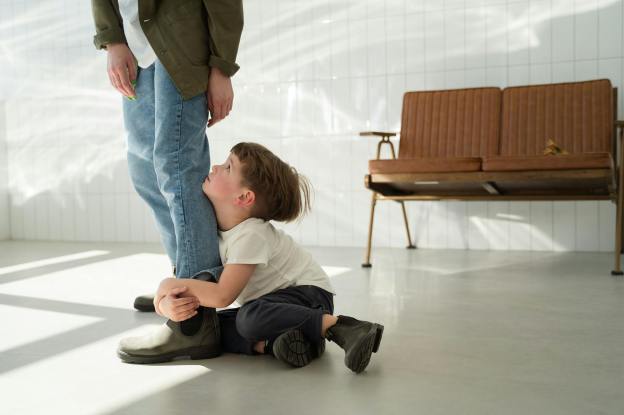
Children scare me. Even my own children. I do not like this, and admit it reluctantly. Children make noises at the wrong times, go where they shouldn’t in the blink of an eye, and express emotions with their bodies. In a word, they are unpredictable.
The most likely culprit for my fear and discomfort is a desire to feel safe by being in control. This is also something I don’t want to admit. Isn’t it better to go with the flow? Not to mention that control is largely an illusion anyway. And Jesus not only loved children; He suggested we emulate them.
But that doesn’t help me with in-the-trenches moments with kids. I can’t ever find the one right answer I’m looking for. Should a kid have snacks or eat only at mealtimes? If I give someone else’s kid dessert, or put on a TV show, will that be the end of life as we know it? If two toddlers fight, and both hurt each other, do we call it even and move on, or should they be punished or lectured? How do I know in what moments to expect my children to toe the line, and in what moments to suspend expectations and get ice cream? And don’t even start on the pros and cons of vaccines.
No matter the age of a child, my response to them could affect them for the rest of their lifetime. I am not okay with this. Will I be the one who offers grace or wisdom or a listening ear that gives permission for a child to like themselves? Or will I give advice at the wrong time, be lenient when the consequences are life threatening, or give peanut butter crackers to the kindergartner with a severe peanut allergy and get locked up for murder?
The stakes are too high. Somebody please lower them. Tell me I don’t have influence, I’m not culpable, my instincts can never go wrong. But no, once more I must make peace with uncertainty. I must receive the truth that I will both harm and help my children and other children. Sometimes I will hurt and another will heal. Sometimes I will heal what another has hurt. And some hurts won’t be healed.
No matter the stakes, I am not superhuman. I will break what needs to be held together, and I will clamp down on what needs to be released. Damn, I hate that.
Then again, maybe the children in my life are my greatest ally in accepting my humanness. I doubt the fear will go away. But maybe it could prompt a mantra: I am in this moment, with this child, and we are both getting to know ourselves. There’s something sacred under the scary feeling, a gift of mutual vulnerability that exists here where I am exposed.
I’m angry with housework. I know anger is a waste of energy, but still I seethe and sigh. The kitchen counters and bedroom floors lie to me. “Clean us,” they say. “Just 20 minutes a day and you’ll have a tidy, happy home.” So I clean them. Only to find the bread bag stuck to the shelf in the fridge where something spilled two months ago, and the kids’ latest glue-paper-glitter project all over the dining room table and floor. “You’ll never catch up,” hiss the fridge and dining room. “You thought you could have a clean house, but you could clean 20 hours a week and your house would still look like this.” This isn’t fair. I’m darned if I do, and darned if I don’t.
After two weeks of cleaning more than usual, I have escaped to a coffee shop this morning because I can no longer stand my dirty house. I feel more than a little silly. After 11 years of mothering and 18 years of wife-ing, how am I at square one in housekeeping? The kids are in school full time, and I don’t work full time. Surely this is the golden age of housekeeping, the time of life where I wash the dishes and tidy the kitchen after supper, put away a pair of shoes, and straighten couch pillows on my way upstairs to put the kids to bed. Maybe I wash the windows every season, and clean grout in the bathroom. An insane little laugh escapes. What a crock, that picture, that dream.
Life is a mess. I’m angry my house doesn’t get a special exemption. Why does it have to be messy too? May I please control this one thing? I beg the Universe. It responds with cracker crumbs on the couch and cat hair in the corners.
What do I hope to find here at the coffee shop? It’s a cold morning, temperates in the 30’s for the first time this fall. I’m seated in a red vinyl chair with my laptop, and I’m the only customer under 60 years old, other than a little girl, maybe three years old, here with her grandparents. She never stops moving. She’s up on her chair, then down, now playing with a stuffed animal, now taking her grandma by the hand to look for the stuffed animal, which she has hidden. “Where did he go? Let’s keep looking,” she speaks in a strong, sweet, toddler voice. “Can we go to the park on the way home?” she asks. “It’s too cold,” says Grandpa. Why are adults always so practical?
Grandma strokes little-girl curls while Grandpa dresses the stuffed animal. Now they are getting ready to leave and the sweet sentences turn in to squeaky No!’s as Grandpa scoops the little one and takes her outside. How does this couple who must be 70 years old have the energy and patience to play hide-and-seek in a coffee shop and listen to endless chatter? How do they find the desire to follow around this busy little girl? Is it because they are grandparents and this ball of energy comes one hour at time? Or have they learned something about life that I have yet to learn, something I could apply to housekeeping?
No answers float to me through coffee-scented air. My feet are cold and I wish I had worn warmer shoes. Two men at a table near my seat are planning the HVAC and electricity for a home. One of them has a southern accent. The other has a shaved head and carries a man-purse that matches his gray-green coat. Their conversation is friendly, and turns to dog-fur trimming.
Movement outside the window alerts me to the flight of a heron above the business strip. Its steady, quiet flight calms me. I pause and sip my hot mocha. Maybe everything is okay, even though everything is not okay. I will go back to my messy house and I will not have a solution. No schedule, no discipline, and no amount of bribing or shouting at my children will produce a clean house. We do live there, after all. No one lives here at the coffee shop. Most folks have come to visit with someone they like, love, or work with. It’s nice to visit in a clean place, with a ready-made hot drink.
But I don’t want to live here. I want to live at home, with my favorite, messy people. I want my girls to be creative, even if it means scissors all over the house and cut up cotton swabs on the bathroom counter. I want my family to eat well, even if it means dirty counters and sticky floors and an overstuffed fridge. I want to provide clean clothes, even if it means piles of unfolded laundry on the couch, mixed with popcorn remnants from movie night. I want to clean dried water spots off the wall beside the bathroom sink, even though no one will notice. I want to have two cats and a rabbit, even though the house would be easier to clean without them.
I want all this, but I’m scared. If this season of life is the ideal situation for keeping a clean house, and every room is a mess, does the dream have to die? I can’t blame this dirty house on full-time work, or full-time parenting. There’s nothing left. I just don’t keep a clean house. I have friends with social lives, kids, and clean houses. But that is not my lot. Some friends have spouses who like things clean and tidy, and participate in daily routines that promote cleanliness. Mine doesn’t.
I will kill this dream before it kills me. I cannot argue with it any more. I will not abide its mocking, and I will not let it speak to me from stained toilet bowls and dusty windowsills. I may curse when my slippers stick to the kitchen floor, but I will also chuckle. I will find my way to a healthy relationship with my messy house because I want this for myself and for my family.
The average customer age in the coffee shop has gone down. A handsome man maybe a decade older than me asks if he can sit in the red vinyl chair on the other side of the table from mine. Three casually dressed men in athletic shoes assemble at the counter to order, while another group of four young guys enters the shop. Now there are a dozen male patrons and only three of us ladies. I wonder, what is it like to be on the lookout for new relationships with men? Is this coffee shop a good place to strike up a conversation? Does a different type do it here than the type who do it at bars? It occurs to me this is one area in which I am content. My husband is a ten and I have no interest in hooking up with anyone else. In fact, although Michael isn’t bothered enough by our untidy home to do much cleaning, he has taken to making the bed in the morning, for me. I love that. I love him. And damn, how lucky I am to be stressed about my house and not my marriage.
I guess I have found something here at the coffee shop. I have recaptured a modicum of gratitude. I have remembered that I am not a victim. I have received the calm of the Great Blue Heron, and the pleasure of writing in a clean space that is not my responsibility.
Two women in their forties are at the counter now, and three ladies with coiffed hair come in behind them. Gender balance is restored in the coffee shop, and goodwill is restored in me.
Blessed are You, Lord our God, King of the Universe, for raindrops, pesky on glasses, risky on a white t-shirt, frisky as they land with a splash in roadside puddles.
Blessed are You for the wideness of meaning in a raindrop: hope—the end of drought, fear—a tropical storm, irritation—picnic at the park, boredom—long and rainy spring.
Blessed are You, Lord our God, King of the Universe, for the elegance of raindrops, their tidy round wetness highlighting beauty as they pause on blades of grass, bluebird feathers, rose petals, pine needles, or dangle from the tiniest twig. How do they hold on without fingers?
“Life is a journey,” we say. I want a rest stop. I want to stay at a posh hotel for, I don’t know, a couple of years. But in a rash moment I decided healing is a priority. Discomfort is part and parcel with healing, so I carry on. I receive the affirmation of my friends and of my own spirit and I keep taking steps.
My current discomfort comes from the fluctuations and changes of intimacy in marriage. I feel like I’m on a chain and I don’t know when it’s gonna get jerked. It seems we oscillate between politeness and passion, and both extremes are uncomfortable. The truth is I’m really scared to be me. Around all the actual dynamics and realities of our relationship is a cloud of fear. My thoughts are fearful, terrified. Though I’m acting peaceful, some inward part of me is frozen, and if it gets poked it will likely either fight or flee.
What if this fear is not me, not true to who I am? What if it doesn’t belong here and I can send it away?
What if being me is never a mistake? There can be fallout, but it doesn’t mean I ought not to have been me. I am not the mistake. I make mistakes, but I am not a mistake. I’m gonna agree with Papa God and Jesus and Holy Spirit on this one.
“A feeling is just a feeling,” I say, quoting Josh Straub. What is under this fear? What is my internal space without the fear?
I journal the fears. I allow myself to explore them and feel them and write them down. Then I do the same with healing messages. Sometimes it helps to call them “lies” and “truths.”
Lie: I am not and cannot be enough. Truth: I am enough.
Lie: I am not worthy of connection or belonging. Truth: I am worthy of connection and belonging.
Lie: Vulnerability may cause permanent damage to my sense of self. Truth: No matter how someone reaches out to me or responds to me, they cannot touch my identity of wholeness. Vulnerability involves sharing my inner world, but it does not involve putting my value up for negotiation.
Lie: Rejection says something about who I am. Truth: Rejection is a normal human dynamic, a part of processing experiences in a shared space, and grappling with fears. Rejection does not tell me the truth about who I am or about who the other person is.
Lie: Being different means someone is wrong. Truth: Being different probably means we’re both right, both have something to contribute. We bring our flat realities and together make a 3D reality.
Lie: I should be able to avoid hurting someone if I try hard enough. Truth: I cannot avoid hurting other people. Hurting someone does not declare that I am a hurtful person. It means that my movement in the world interacted with another person’s movement in the world in a way that was painful—similar to accidentally stepping on someone’s toe, or elbowing your kid in the head while unloading the dishwasher.
Lie: I am not a safe person. Truth: I am a safe person when I am a real person. Being me is the greatest gift I can give.
Lie: I can unwittingly ruin a relationship. Truth: I can unwittingly cause pain, but I cannot unwittingly ruin a relationship. Relationships are bigger than the stimulus of pain. Relationships always hold the potential for repair and shared understanding, connection and healing. Even when there is a rift in a relationship, the relationship continues to hold that potential.
And so it seems I am a lot less dangerous and powerful than I thought I was. The success or failure of each relationship I’m in—including my marriage—is not mine to carry. I am me, and that is good. I will keep showing up because relationships are life, and I was made to live.
“Rest first.” This is God’s favorite thing to say to me. It’s incredibly irritating. I am terrible at resting, compelled to be a productive and functional human being. But God is provokingly persistent.
“Rest first.”
But I’m too messy to rest.
“Rest first.”
But there’s work to be done.
“Rest first.”
But people need me.
“Rest first.”
But I don’t deserve to rest.
“Rest first.”
But rest makes me feel restless.
“Rest first.”
But what if I get tired and sleep too long?
“Rest first.”
But what if I’m missing something? What if right now is the moment I need to grab what You have for me and hold on tight?
“Rest first.”
At this point I’m out of excuses, so I sit slumped down with arms crossed, pouting.
I have fought God tooth and nail on His invitation to rest first, and His corresponding refusal to “fix” me before I can rest.
In my defense, it’s impossible to rest when I don’t feel safe in my own skin. My journal bears witness to this ongoing struggle.
August 1 - What am I afraid of? Myself. And I think I’m afraid of admitting I’m afraid of myself, because it took me a long time to write that down, and I’m feeling really vulnerable.
September 22 - I wanted to be alone today, but it occurs to me that perhaps I wanted to get away even from myself, and this is hard (read “impossible”) to do. If I’m scared of me, anxiety is inescapable. Even if I get away from people and distract myself with busyness, in the end I’m still with myself.
I have been plagued with fear that I am a liability in life. Every time I fail, or don’t show up how I want to, it seems my fear is confirmed, and I am, in fact, a liability. Fighting this battle, against what I perceive as my own nature, sucks away time and energy like a board meeting. I struggle against my own self, day in and day out. I am a liability. I must protect myself and the people around me from this truth by performing well. Every. Single. Time.
But fighting and performing inevitably fails. I suppose the redeeming feature of failure is that eventually I become willing to consider what God is saying; consider thinking differently; consider rest.
I am allowed to be a mess.
I am allowed to skip out on some work.
I am allowed to take a break from meeting people’s needs.
I am allowed to rest.
I am worthy of rest.
I am not going to miss out on anything.
In her book Braving the Wilderness, Brené Brown uses the phrase, “Strong back. Soft front.” For me, this is a depiction of what it means to have an identity in Christ. I was created by God; I am inhabited by God; I am destined for perfect union with God. This is my strong back. I am not waiting to find out who I am today—to define myself by success or failure. I know who I am.
And today my soft front is three things: 1) love for people—especially my family, 2) grace for myself, and 3) holding things loosely—especially tiredness, fear, sadness, confusion, and loneliness in my marriage. These things are transient, but God and love and grace aren’t going anywhere.
I am able to have a soft front only when I have a strong back. If I have no back, I rely on an exoskeleton of performance to hold me together. But when I have a backbone of awareness that I am loved and righteous, I become soft and able to rest; and after rest, to embrace the person in front of me.
This freedom pokes its way into my consciousness through friendship, quiet time, reading. I write down moments of grace-full thinking and return to them:
“I am beautiful without adding or taking away anything, just like the lilies of the field. I am clothed by God, and my clothing is not distinguishable from me, just like a violet. I am clothed in dignity.”
“I am not a liability.”
“I am learning how to hold myself, receive comfort from God, and receive comfort from people. This is a valuable skill. I have survived without it, but I will thrive with it.”
“I have permission to enjoy my own company. I get to decide how I treat myself.”
Some time ago I wrote reminders to myself on a notecard, including: “I believe God is trustworthy,” and “I believe my husband is trustworthy.” With some trepidation I recently added, “I believe I am trustworthy.” After a lifetime of being told that sinful humans can’t be trusted, believing I am trustworthy may be what returns me to myself. I can be trusted to make decisions, manage my emotions, spend my time. In other words, I can be trusted to be in charge of myself. I am not on trial with God or anyone else, so all of these decisions are simply opportunities to learn. I can be curious about myself—about life—and I can be compassionate with myself.
Earlier this year I really got my panties in a wad, worrying that I wasn’t receiving what God had for me. After months of struggling I admitted things weren’t looking too good and set up an appointment with my counselor, Beth. When I told her I was worried and distracted by wanting God to fix me, and fearful I wasn’t letting Him do what He wanted to do, Beth said, “But you do know how to listen to the Holy Spirit and trust Him.”
After my long struggle I felt it would be necessary to claw my way back to peace and trust. But Beth said it’s just a tweak, a chiropractic adjustment, and I am back in trust with God. And so I journal again, choosing to trust God, and in so doing, to trust myself.
“God with the Welcoming Lap, I leave behind my perfectionist, outcomes-based thinking, and I return to trust. I am fully capable of responding to Your Spirit.”
In Zach Williams’ song, “Fear Is a Liar,” this line arrests me: “…you could be the one that grace could never change.” Despite (or maybe because of) being a lifelong Bible-believing Christian, I fear I could be the one who can get it wrong, miss out, not respond how or when I’m supposed to. This lie has felt so close to truth.
There’s a whole conversation about whether it’s hard to be “saved” or hard to be “lost,” which I’m not going to get into. I will say that believing it’s hard to be saved is a death sentence for a perfectionist. What helps me unclench is knowing “It is finished.” God already did the thing that rescued me. I can go with what He did, instead of what I’m doing. I can agree with Him, instead of my wretched feelings. He says I am righteous. Full stop.
And so I pray: “I leave behind my stubborn fear that I am the one grace could never change. I am capable of trusting You. I am not a helpless victim. I am able to hear You, trust You, and choose You. I am not in need of the right formula, or the right circumstances, or the future version of me that is better than this one. You created me with the ability to choose and to trust. ‘Being good’ was completed by Jesus, and there is nothing left for me to perform.”
Oh, sweet rest, how I longed to fall into your soft pillows, pull up a thick blanket, and be still. And here I am finally, with both feet tucked in, glasses off, curled up around my pillow, almost laughing with joy before I sink into peaceful stillness. Rest.
As I described in Is It Really Safe?, Part 1, I have been in a funk. It’s a tropical storm of emotions, fueled by the lie that my value is based on my performance. It’s not the first time this lie has pounced on me in my weakness, and I am certain it will not be the last. I find some comfort knowing that God sees me and loves me. He invites me to be as I am, to be known by Him, to take a deep breath with the knowing: it’s ok to not be ok. As I continue to battle the monster and alternately fight and give up as each day goes by, God keeps inviting me into His goodness.
Invited To Be Sought
Unsurprisingly, my funk takes a toll on my marriage. It’s exhausting to live with a depressed person, and it’s exhausting to be depressed. With my husband I feel compelled to take the path of least resistance. I don’t have much energy for intimacy (emotional, physical, or otherwise), but neither do I have the energy for a big breach or fight and then repairing. So I’m walking on eggshells, somewhere in between (if that’s even possible). As I write about this in my prayer journal, God says, “I’ll help you walk on eggshells.”
Uh… Wait, what did You just say? I am stunned into silence. This is not what I expected. When I find my voice I say God can’t possibly mean that. Doesn’t He have a solution? Isn’t there something I ought to be doing differently? Slowly I internalize that He does, in fact, mean what He said. He affirms my struggle and joins me in it. Perhaps this isn’t as bizarre as it seemed to me at first. After all, didn’t He save us humans by becoming one of us? This is central to the way He operates. He seeks me, He finds me, and He stays with me. Oh God, Your companionship would mean the world to me.
Two weeks after the “God, what did You just say?” conversation, bedtime with the kids crashed and burned. It was late. Nothing went well. It ended with my five year old crying herself to sleep in the guest room and me in time out downstairs. As I sat in the recliner crying and staring out at the trees, I was again reassured of God’s companionship. No advice, no fixing. Instead, a quiet spirit.
The lessons of love are freeing: I am invited to be. This invitation stands even when I am seen – no masks, no filters, no protection. God wants to be my companion, exactly where I am. Even when where I am is unhealthy and un-beautiful and unpleasant. Even when it is lonely and sad and frustrating. He will be here. With me. Emmanuel: God with us.
I am invited to be sought, and to be found. And when God finds me, hiding under a blanket of shame, red-handed from my latest sin, deeply mired in my mistakes, He stays there with me. Oh precious gift! My failings do not sentence me to solitary confinement. This God-Man Jesus knows what it is like to be human, and He stands with me, sits with me, struggles with me. I always thought God didn’t really get it. Yes, he was tempted, but He didn’t sin (Hebrews 4:15). So how could He possibly understand what it feels like to fail: to find myself again and again on the other side of a choice I wish I’d made differently; to treat the people I love the most with aggression, disdain, selfishness. He doesn’t know what it feels like to suck at life.
But I think I was wrong. Paul says, “God made him who had no sin to be sin for us” (2 Corinthians 5:21a). Sin separates. Jesus cried, “My God, my God, why have you forsaken me?” (Matthew 27:46). The only reason He could have felt forsaken is if He became sin for us and experienced the feelings of separation and despair that plague every human. He does indeed know how heavy it is. How lonely it is. How desperate. And this is what He does: He seeks me. He finds me. He shares with me this ugly knowing of sin and separation, and He doesn’t run. He stays.
Invited To Enjoy
In his book Come to the Cradle Michael Card observes that children are occupied with playful imitation of what they see adults doing. He asks, “Could my work become playful imitation of what I see my Father doing?” I mull this over. It is so different from how I think about life, it is a foreign thought. Card goes on to say, “The point of work is to finish. The point of play is to not finish…” Again I pause, unsure what to do with this observation.
Finished is safe. Unfinished is negligent. Given my point of view I suppose it’s not surprising that I excel at finishing. I am so determined to finish that I even try to finish my children. Do the tasks, learn the skill, become mature.
I am realizing that often the way I think about my life is unhealthy and counterproductive. So I approach God one morning with a question, and we have this conversation: How do You think about my life? How do You want me to think about it? “Life is to be held loosely. Even people who are deeply sad or troubled can enjoy life. You have more capacity for enjoyment than you think. Keep slowing down. The answer is not more.” Are you sure? Because I feel like I’m hardly doing anything. “Think about the gift analogy. I have called you to play, not work. There is so much to enjoy in your life, but we must take this slow, because you will be tempted to turn enjoyment into work.” I sigh. You know me so well. Why do I always think of martyrs and people in concentration camps when I think about goodness/happiness/enjoyment? “You are still living in fear. That’s ok. You won’t always.” Ok. Will You help me enjoy something today? “Of course I will. I love to help you! This will be fun!” Ok. (Pause) Do You really feel that way? “Yes, I do.” You’re trying to speak life over me, aren’t You? I’m sorry I make it so hard. “It’s not hard, because I love you with my whole big self. I don’t think you know how much patience I have.” No, I suppose I don’t. Ok Lord, go head and make me alive. (Pause). Are you sure it’s not hard? Because I feel like a tough case / lost cause / disaster. *Laughter* (is anything too hard for God?)
I find it very odd that God wants me to enjoy life. It’s not a new concept, but in all honesty, I always hear it through the lens of “doing the right thing” and it sounds like work: there are so many wonderful things in life we ought always to be joyful. Ugh. I guess there’s something wrong with me.
God enters into my misconceptions and fears and invites me to enjoy, to hold life loosely. I am so accustomed to holding life with an iron grip that I’m not even sure where to start. I have the “scarcity mindset” Brené Brown describes in her book, The Gifts of Imperfection: “We’re afraid to lose what we love the most, and we hate that there are no guarantees. We think not being grateful and not feeling joy will make it hurt less. We think if we can beat vulnerability to the punch by imaging loss, we’ll suffer less.” This is a lie I have believed. I protect myself behind the safety of pessimism/realism, hard work, and control. Enjoying is scary because it’s vulnerable. Brown continues, “If we’re not practicing gratitude and allowing ourselves to know joy, we are missing out on the two things that will actually sustain us during the inevitable hard times.” Hmm.
Why is it that I don’t want to enjoy what I have now, because I don’t know what I’ll have tomorrow? I don’t want to drink in abundance when I can imagine a future without abundance. It’s like I want a guarantee of a long and happy life, or I won’t engage. I want to know that if I do things right everything will turn out well, or that if I trust Jesus I will experience safety in all things: relationships, finances, health, my faith community, and the list goes on. Not knowing sets me on edge. Being set on edge is the opposite of enjoyment. So here I am trying to perform an impossible balancing act while holding onto – well – nothing, with an iron grip.
And here God is, inviting me to loosen my grip and to enjoy. To play. To have fun. To be grateful. To slow down. I feel like God is laying out a lavish banquet before me, but I have not yet partaken. I’m still looking at it. When I fill up a plate and start eating, perhaps I’ll write another blog post about enjoyment.
For now, I am grateful that I need not hold tighter or try harder. I can be still and know that God is seeing me, seeking me, celebrating me, and being the companion my soul longs for most deeply.





 My Favorite Subject