Tag Archives: love

Simple Jesus

I want to like Jesus because the grown-ups in my life told me He is good, and they were right. 

I want to be innocently happy that God is good. 

I want to go back to painting “JESUS FREAK” in huge letters on a baggy cotton T-shirt, soaking up Sabbath School lessons with gusto, back to the credibility God had when I was 14.

Simple Jesus—does He still exist? Or can He at least be mysteriously complex and Kindergarten-simple at the same time? 

Is there a reality—no-strings-attached—in which Jesus just loves me and knows my name?

A few weeks ago I attended a spiritual retreat at Camp MiVoden, as a sponsor for the girls in the 7th/8th-grade class. During the worship services I remembered something, a feeling of belonging and certainty from my past. I knew some of the songs the praise band led, and I sang with my arms raised. No one expected anything—hardly anyone knew me—and the featured speaker said simple and good things, about who I am and who God is, and I cried, and I remembered a time when I belonged wholly, and sermons weren’t pocked with ideas that distract me from goodness and wholeness.

I want a plain friendship, one I don’t have to defend or explain, one in which I don’t need Jesus to make me look good, and Jesus doesn’t need me to make Him look good; Jesus with a reputation as simple as Mary who had a little lamb, not the notoriety of an activist. 

I don’t need answers for all the questions and discrepancies. I’m looking for that place where they are absent, where I don’t have to explain why I don’t believe in a punitive gospel, or why I’m part of a faith tradition (Christianity) that has inspired violence for thousands of years. I don’t want to explain why I use feminine pronouns for God, or why I say Adventism is my community but not my religion. I don’t want anyone to raise their eyebrows at me, nor me at them. I want to be in love—inside love. I want to feel safe because I am safe. 

Maybe what I really want to know is this: does a simple Jesus exist for adults too? Does He go for coffee with millennials—with me? Does He wear jeans and send 132 text messages every day? Does He understand carpools and playdates and a family calendar on the kitchen wall and how all the spoons are dirty if I miss one day running the dishwasher? Does He peruse my TBR shelf and ask me about my writing? Does He know I’m still a little girl inside, intimidated by the disciples who turn me away because I am small and simple?

Is Jesus here now, and does He remember me? Does He look through my photo albums and murmur memories? Has He been here for it all? Can we laugh together about singing “Sinnerman” and “We Are Soldiers”—the laugh of a shared memory—those lyrics humorous like the frizzy perms of the 80’s?* Is He still the cleft in the rock, the hiding place, the blessed assurance the hymns offered? 

What if we’ve shared a life more than a belief system, and our love is built on mutual adventure and admiration?

Maybe He has never needed me to pull Him apart and stitch Him back together, to understand how He is a triune being, or even to put our companionship into words. Perhaps I was mistaken in thinking that farther, bigger, and deeper are better. 

Jesus is here. In the essentials He hasn’t changed a bit. He’s still the great guy I knew in primary Sabbath School; the one who stood with me in the church baptistry, invisible yet deliciously simple; the father I wrote to in a dozen journals full of prayers; the soil from which I grow. Most of all, He’s still my friend.


*I sang these songs countless times. Although the lyrics of “Sinnerman” I sang were not as heinous as what I just found by googling it, I think it’s safe to say it’s inappropriate to mock sinners running from God (and what even is a “sinner”? Aren’t we all?). And don’t even get me started on “We Are Soldiers” and “I’m in the Lord’s Army.” Who decided it was a good idea for seven-year-olds to sing about blood-stained banners and artillery? So yes, I think Jesus and I can have a good laugh about it.
Run-on Marriage

Last week Michael and I celebrated 20 years of marriage. The run-on sentence below illustrates our run-on marriage. (And yes, we’re still crazy about each other, in addition to driving each other crazy.)

I cannot get in bed when the bedcovers are frumpy, drifting off the end of the bed, sideways, knowing that if I do lie down and tug on them I will get too much sheet, too little blanket, and the wrong corner of the comforter; but I do not make my bed in the morning—I make it right before I climb in bed at night, tugging with exaggerated exclamations as I dislodge cats, and my poor husband too, because there’s a tiny possibility that I idolize sleep and this bed is my altar and before I sacrifice my body the altar must be prepared as if for a temperamental god of linens, and I like to remind my husband that before I met him my sheets would stay tucked in and straight for months at a time, but since his feet hang over the end of the bed and he tosses and turns at night, I have to straighten the covers every single day, and I accomplish this with more violent energy and bitter comments than necessary, although one would think after 20 whole years I would have adjusted and calmed down about it—but he huffs and makes less-than-charitable remarks every time he drives, and he has been driving for twenty-five years, so I guess we are both going to have our snide remarks and adult tantrums and all shall be well. 

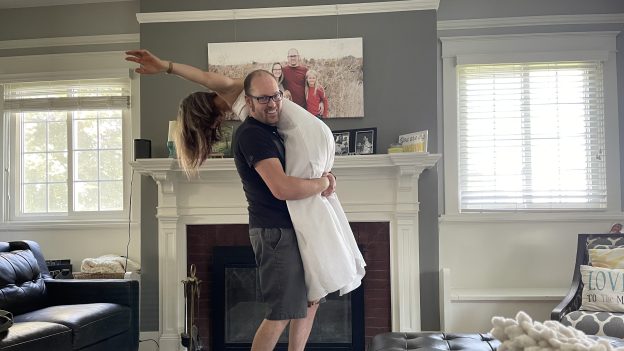
P.S. I usually use stock photos, but the photo for this post is of my husband and I earlier this month. I barely squeezed into my wedding dress, which I attempt every September as our anniversary rolls around.

Mothers Are Stalkers

Every mother is a stalker—stealthy as a fox, or loud and proud as a heckler. 

She may try on other hats—friend, playmate, shopping buddy, or cook. But she will always return to the well-worn stalker cap. 

No one knows exactly why. Perhaps all those years of sleep deprivation affected her brain. Or maybe her partner has become boring and she needs to trail someone interesting. Or her dream of being a paparazzo never panned out and she’s done repressing her hunger for juicy stories.

Could it be revenge—on her own mother, or on her child—for needing her when she didn’t want to be needed? Is it fear, masquerading as care? Control masquerading as curiosity? Perhaps sheer boredom is the culprit. 

Or it could be force of habit—one that began while watching an infant’s chest rise and fall, then following a toddler through play structures, teaching a child how to use a toothbrush, then how to handle a kitchen knife. A long stint as chauffeur cements the habit, and by the time a kid has wheels of their own, stalking is like a nervous mother-twitch that can’t be medicated.

Whatever the case, mothers are stalkers, and children are their prey. They follow, but never shoot. They scribble notes and report to their partner in bed at night. They buy new camo when the old is detected, and they keep on stalking even when the tap-tap of their walkers is a dead giveaway.

And, depending on your religious beliefs, upon death they have the best of all—that birds-eye view they always wanted, the ability to hover without being detected, and maybe even a direct line to put in a few suggestions to God about how their child’s life should go.

The Red Circle

A perfect dark-red, circular spot on the beige carpet. I reached down and touched it, first with a finger and then my thumb, pressing lightly. Sure enough, something wet and red thinly coated my fingers. It had to be blood. But where did it come from?

“There’s blood on the carpet,” I announced to my mother. We had just spent 40 minutes getting her from the dining table to the couch—a distance of about 12 feet. She was certain I couldn’t help her stand up, that my dad had to be there for her to move. My parents recently relocated, and dad was at the old house cleaning out the garage. They would sign closing documents that afternoon for the sale of the house. I came to be with my mother, whose mobility and cognitive ability had declined rapidly over the past few months.

Back at the dining table, I’d held out my arms to help her stand, but she made no attempt to respond. I moved the walker in front of her and held it steady so she could pull herself up, but still she didn’t move. Then she wanted to get down to the floor and crawl. She instructed me to bring some towels to soften the floor. I spread a thick blanket, doubled over, between her dining chair and the edge of the living room carpet. She leaned forward and tried to rest a hand on the floor, but lost her nerve. At her insistence, we called my dad. He said yes, I could move her. Again, I held out my arms—no response. I brought the walker over—she tried holding it in different ways but never got to the standing-up part. She tried again to get to the floor with similar results—her hesitant hand reached low.

I kept offering to help her stand, as that seemed to me the best option, but she said she didn’t want to hurt me. She is several inches taller than me, but only a few pounds heavier. I had helped her stand and walk many times before. Perhaps her reticence resulted from a recent fall, although I wasn’t there at the time of her fall. She asked who else could help her and named an acquaintance who had visited a couple days before. When she determined that I was, indeed, the only available person to move her, she asked for my dad again and cried. An hour earlier she had announced, “This afternoon I’m scheduled to have a nervous breakdown.” I was beginning to agree.

My mother insisted that she could not stand up with her feet on the smooth floor of the dining room, but only on the carpet. In response, I grabbed the front legs of the wooden chair she occupied and pulled it to the edge of the carpet. Now we had less than six feet to go. I held out my arms again, instructing her to hold onto my biceps as I held her elbows. I planted my knees against her right leg and pulled her up—sort of. She doesn’t straighten up all the way when she stands. I put my arm around her back to keep her from sinking back down, and pulled the walker in front of her.

A one-inch scooch, a six-inch step, a rapid little shuffle. She leaned forward on her toes, her center of gravity moving precariously in front of her as her heels came off the floor. I lifted her foot so she could move it forward. Then again the other foot. Then a step on her own. Then a one-inch scooch. Somehow she got her back turned to the couch and sank down onto the cushions. However, she wanted to lie, and would need to be closer to one end of the couch to make room for her legs to stretch out. Rather than attempt convincing her to stand again, I grabbed her blue jeans on each side of her hips and heaved her slowly across the couch. I lifted her feet onto the couch, then blue-jean-heaved her a little more until her hips rested perpendicular to the back of the couch. A large array of pillows served as a back rest. I spread a fluffy white blanket over her.

“I haven’t brushed my teeth in three days.” She seemed worried about looking well-kept for the house signing, although I had no idea how long it really had been since she last brushed. I poked around in the bathroom drawers and cupboards until I found floss, toothpaste, and toothbrush. She couldn’t floss. I tore off a piece of waxed floss, wound the ends around my fingers, and started with the teeth that were easiest to reach. After flossing most of her teeth, I handed her the toothbrush, which she had instructed me to wet, but not apply toothpaste. She proceeded with brushing on her own. When she finished, she asked me to take a picture of her shiny clean smile and text it to my dad.

It was at this point I noticed the red spot on the carpet. What could have produced a clean drop of blood? My mother suggested I check her knee, which I did—but given that she had jeans on, it couldn’t have dripped blood unless she had a gushing wound that soaked her pants in blood. We checked her elbows too—had she bumped into something and not realized it? No, no signs of blood on my mother. “I’m on my period,” I confessed, “but I don’t understand how I could have dripped blood on the floor like that.” As we discussed the possibilities, she concluded that my menstrual bleeding was the mostly likely culprit.

I wetted a paper towel in the kitchen and went to work on the red spot. Much to my relief, it came out of the carpet with minimal scrubbing. I had no interest in staining carpet at my parents’ house—the very same parents who kept cream-colored carpet in near-perfect condition for 20 years while farming and raising two kids. I knew better than to soil it.

As I turned, my mother noticed blood on my shorts. Another piece of the puzzle. I hastened to the restroom and found that indeed there was blood on my shorts. They were loose, pink-purple shorts made of sweat-pant material. As I cleaned them the best I could without actually taking them off and washing them, I realized what must have happened. When I sat on the edge of the couch to floss my mom’s teeth, I must have leaned into such a position that my underwear and pad weren’t fully in place. Hence, a few drops of blood had fallen onto my shorts, and from there one of them dripped to the carpet.

I have this idea that at 40 years of age, period “accidents” should be a thing of the past. It’s not like I’m new at this bleeding-out-of-my-vagina thing. But there I was, cleaning blood from various surfaces. My mother was unconcerned, a conversational ally as we pieced together what had happened. How strange that in the afternoon’s events, simply standing up would be infinitely more stressful than blood on the carpet.

Oddly, when it was all over, I primarily felt gratitude. It’s awkward to be a fully functional person around a not-fully-functional person. It feels weird that I can floss my teeth and walk where I want to, and my mother can’t. I’m never quite certain what to offer in terms of help, and since her mobility and cognitive ability are a little different each time I visit—sometimes more and sometimes less—it’s a moment-by-moment game. Not the kind of game I’m good at.

This blood on the floor was a gift. An opportunity for me to be vulnerable, to need help solving a problem, to have an awkward dysfunction of sorts. It allowed our roles to feel just a bit more “normal” for a few minutes—she the mother, I the child. I miss that.

A Mother’s Mundane Conundrum

“You’re just making me do it!” my daughter says with a surprising amount of conviction. “You just decided I have to do it.” She’s not wrong. Nothing will happen if she doesn’t clean her room. No one cares about it except me. I feel called out as an unnecessarily controlling parent, just as I do each time one of my daughters confronts me with these sentiments.

It seems I have arbitrarily decided most of the content of their lives. I require showers, food other than fruit and juice, feeding pets, getting out of the house for school—with clothes, lunch, piano books, shoes appropriate for PE, and a sweater. Would anything dire happen if all those things were left undone? No. One or both daughters could go to school late, in PJ’s, without a lunch, wearing the wrong shoes, and sweaterless. In fact, she could probably do that for a week before anything interesting or significant took place in response to her choices.

I dislike this feeling that I am the only reason she does most of what she does. And I don’t like it when she confronts me about it. I don’t know what to say. I agree with her. Most expectations really are arbitrary—for adults as well as kids.

There are plenty of things I could say that I don’t want to say. I could say, “Someday you’ll have a job,” but that has no meaning whatsoever to a nine-year-old. Or, “You have to learn to do things now so I’m not still reminding you when you’re thirty,” but is there any real danger of that? Or, “I’ll be embarrassed if you go to school in pajamas,” but do I really want to teach my kids to make decisions based on my embarrassment? Or, “Nasty things will start growing in your room if you don’t clean it,” —okay, maybe a month from now, so is that really motivation to tidy it up today? Or, “I’m your mom and I get to decide what you need,” except that I don’t think anyone should decide another person’s needs for them. You get the idea.

So here I am with nothing to say, a truthful human being looking me in the face, questioning my demands—and why are they demands? Perhaps because requests and suggestions haven’t worked, or because my emotions are now fueling this high-octane—but nevertheless mundane—occurance.

“You’re right,” I say. “I can’t actually make your body and your arms and legs do anything. But I can remind you there will be no screen time until chores are done. And if you don’t do chores today I might give you an extra cleaning job tomorrow.” This comes out sounding a tad desperate, and something like a threat—not exactly what I was going for. But you do what you have to do.

Motherhood seems to be a mix of desperation and compassion, empathy and threats, logic and insanity. Is that what childhood feels like too?

She whimpers. She complains it’s not fair. But eventually she trudges to her room and starts picking up clothes off the floor. My heart rate returns to normal as I breathe a sigh of relief. With any luck, I’ll have at least five minutes before this conversation repeats itself with my other daughter. Meanwhile, I whimper and complain internally as I return to a pyramid of dirty dishes. I guess we’re not wholly different.

Damn Hospital Corridors and Mothers

I’m dabbling in fiction again, which of course is influenced by my actual life, wherein my mother’s health is failing. This piece came from a writing prompt to begin with, “The hospital corridor was dimly lit…”

The hospital corridor was dimly lit, but only because the fluorescent lights on one side of the ceiling emitted partial light, accompanied by a buzzing sound. I wished someone would turn the lights off. One o’clock a.m. was never meant to be lit at all. Sinking to the floor, I checked the exact time on my watch, 1:17.

My mother slept. She’d been sleeping much of the day and night for some five years. Sleeping suited her phlegmatic personality and neurodegenerative disease. Sleeping was familiar.

But tonight, sleep could wander into death at any moment. And so we kept vigil—my brother and I—taking turns at her bedside, watching the face of each nurse who came in to check her vital signs. Did their expression show any hint of surprise or concern? Anything to indicate an imminent ending?

I’d never been this close to death before, and my feelings warred with my philosophies. It’s one thing to say death is natural, a passage as much as an ending, a new experience just like every other milestone in life. But there’s something heavy about a last milestone.

As I stared at the wall, unseeing, questions caught traction in my mind. This grief, is it about loss of the mother I have, or loss of the mother I wish I had? Or is it fear of what will happen to my brother and me when Mom isn’t here? Or am I feeling anger that I have to be here, to witness this, to hold it and see it and feel it and live it—that this dying person not only consumes my time when I’m at the hospital, but consumes my emotions and thoughts when I’m driving, eating, washing dishes? Who gave her permission to be woven into me in this way?

And what does the unweaving look like? Is it a severing, like a guillotine? Is it a careful unstitching, or an impassioned disassembly, tossing parts and pieces here and there? Or will my dead mother remain inside me, and will I like her better that way? What memories will make me smile? How much time will it take for me to internalize a narrative that holds us both gently?—a narrative that’s peaceful, not buzzing and half-lit like this damn hallway.

Forty and (In)secure

Twenty One Pilots’s song, “Stressed Out,” laments the insecurities of adulthood, noting that fear is still present, and we still care what people think. I turned 40 this month, and yes, I’m still insecure. It’s different than high school. And the same. I want you to like me. I want to be well-dressed and well-spoken, and most importantly, perceived well.

I’m a grown-up—have been for quite some time—and I can tell you what maturity doesn’t mean. Being grown up doesn’t involve control and confidence; it doesn’t mean growing out of awkward traits and social habits; it doesn’t include a clean house and well-kept yard, or a passel of perfect grown-up girlfriends.

I’m less sure what being a grownup does mean. But I’ve noticed I’m softer than I used to be—more flexible, a teensy bit less judgmental, and I know more about cooking and cleaning than I did 20 years ago.

I know less about God, love, and relationships. It’s been said that the more you know, the more you know you don’t know anything. I can confirm this.

There’s a real sense of loss, not landing in adulthood firmly in control and certainty, an expert in the kitchen, the workplace, the bedroom. I get tired of being wrong, confused, ineffective. If knowledge comes from experience, I am an expert in exhaustion, stress, and leaving my cell phone in obscure places.

I know I’m sounding a tad morose. But there is a happy ending. There’s something left after losing control, and the appearance of control, and pretending to have control. What’s left is eyes to see a different life entirely—a life of watching the cat lick his fur, thinking of my three favorite moments from the day just before I fall asleep, fighting less with my kids and husband, knowing there will not be a seismic event when my to-do list is left undone.

And I know myself better. I know I love writing and small groups. I know I like a clean house, but not enough to put in the work. I know I’m scared of the interminable wants and needs of my children. Being quiet and alone—especially in nature—returns me to myself. Banana splits and blended mochas almost always sound good. I try the hardest to be self-sufficient when I’m at my weakest. Animals make me happy. Getting called “a writer” makes me stand a little taller. Synchronicity feels like opening a birthday present.

My birthday, which this year fell on the first Sunday in May, played out like a dream Mother’s Day. My husband cleaned the kitchen, top to bottom. He and the kids cooked breakfast and dinner, and took me out for lunch. I sorted through a large tote, five bags, and an unconstrained pile of children’s clothing I hauled up from the basement, and found most of it could be passed on. I went to the park and watched goslings and ducklings, heard the smack-smack of their webbed feet in shallow water, and marveled at their fluffy bodies. I took a nap. With my parents and sister, I ate fresh-made blackberry pie with “40” cut into the top crust. Michael gave me a gift certificate to have the house professionally cleaned (when the dust settles from our six-month construction project). Like I said, a dream day.

It’s worth noting I couldn’t have planned such a day. All was gift—the generosity of my husband, my children, my sister. Many times I have planned a birthday party for myself, with friends and presents and homemade cake. But for forty, this un-forced birthday felt fitting. The people who love me gave what they wanted to give. And I received. I basked. I rested. And yes, I sorted children’s clothing—one of those things I never can find time to do.

Maybe I’m ready to accept this life I have. Whether I die tomorrow or in another 40 years, I will die complicated—a mix of peace and insecurity, frustration and gratitude, mundane and miraculous. And not at all grown up.

Reasons for Self-Hatred

“Many unhealthy behaviors begin as necessary coping mechanisms.”

I hear various versions of this sentiment repeatedly from therapists and psychologists. What may be a harmful habit today, they say, served us well in a previous season of life. I get how this applies to people-pleasing, secret-keeping, anger-stuffing, and high-performing. I’m less sure how it applies to self-hatred which, at first, sounds universally useless to me.

But maybe it did begin somewhere useful. Maybe my self-hatred sprouted when I couldn’t stop big feelings during infancy and toddlerhood, feelings that overwhelmed both me and the people around me. Flooded with emotion and its unwieldy side effects, what could I do but show my disagreement with the outburst by hating myself?

I buried self-hatred under the more acceptable coping behaviors of performing and pleasing. But whenever I couldn’t perform and please—when I showed up in the world in a way I didn’t like—self-hatred jumped out of the trunk to take the steering wheel.

There were more scenarios than I realized, as self-hatred tried every position in the car, from back-seat driver to navigation system, snack hoarder to complainer. Further exploration reveals at least a dozen ways self-hatred has served me:

  • It keeps me small, and being small keeps me from being seen, because being seen is risky.
  • It beats “them” to it. If I can make myself feel bad sooner and more than you can make me feel bad, I’m not vulnerable to you.
  • An excuse to be sad. When I don’t know why I feel depressed, loathing myself makes it seem legitimate … OR maybe I’m sad because I hate myself. Either way, it’s a handy excuse.
  • A layer of protection between you and my pain, and between myself and my pain. During the years of parenting my preschool daughters, hating that I was exhausted, angry, and shut down seemed easier than admitting I felt lonely, empty, scared, and inadequate.
  • A way to belong. When my mom got frustrated with herself, she often said, “I’m such an idiot.” I could fit in at home by thinking and speaking poorly of myself. And the church taught me not to toot my own horn. Apparently it’s not spiritually sound to think well of myself (leave that to God, I guess?), so self-hatred is also a way to fit in spiritually.
  • Keeps me from being perceived as naive as Pollyanna.
  • Protects me from trying to do things I’ll fail at.
  • A way of responding to failure—it spares me the time and energy of taking responsibility. (ouch)
  • A shortcut. It’s faster to process, “I did that because I’m bad,” than it is to process, “I did that because I’m human and humans get depleted and defeated sometimes, and what is depleting or defeating me right now?”
  • A form of power. When I had infants, I “couldn’t” be angry with them. In order to feel some control (power) over my anger, I directed it toward myself.
  • A way to remain in “relationship” with the unwanted parts of myself, even though the relationship is toxic.
  • It proves my loyalty to certain ideals. It allows me to act outside of my standards without confusing myself or anyone else by condoning the behavior. So self-hatred proves I have morals (even if I don’t live them out).

This all sounds so ridiculous.

And familiar.

All of a sudden, it sounds like a lazy way out, but it makes so much sense, and I feel sad, but grateful that I can see it, and profoundly grateful that other options are available to me. I don’t need to dislike myself to belong with people, and certainly not to belong with God. So maybe I can give it a break.


Go ahead, sit down and make your own list. It might be time to break up with one of your coping mechanisms.

We Woke Up

It’s not (technically) spring yet,
but the first warm days arrived this weekend,
and northerners weary with winter
woke up.

We trimmed shrubs and pulled weeds,
started lawn mowers and plunged trowels into the warming earth.
We went to parks all over town
with our kids and dogs and blankets and guitars,
and we sang and walked and let the sun massage vitamin D and peace into our faces.
We picked daffodils,
chose outdoor seating at coffee shops,
and skipped church.
Even the odd ones who don’t care for sunshine came stiffly out,
and antique cars shook off dust for the first drive of the year.

Love is in the air—turkeys strutting, people kissing, dogs sniffing, squirrels flirting.
The earth is pulsing alive and we feel the anticipation—
joy radiates from crocus blossoms and forsythia.
Hope again surprises us with its quiet turn from black-and-white to color—
paintbrush poised to anoint fields and forests and gardens with life.

As we bask in today
we take a collective deep breath; we’re okay.
The sun and soil are alive; all will be well.

Twenty Years in Love

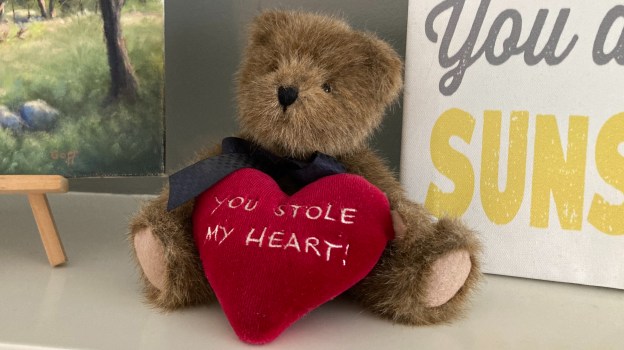
I remember only bits and pieces. A small, formal couch with burgundy upholstery and a rounded back. Our clothes still shedding cold air from the winter chill. Michael’s tan coat, puffy in a way that rounded his lean figure. The Boyd’s Bear he hid in that coat.

Michael was a junior in college, double-majoring in mathematics and computer science. I was a first-year student pursuing an associate degree in accounting. Michael lived at home; I lived in the dorm. I attended required worships and ate in the cafeteria; he didn’t attend evening worships and his mom still cooked his dinner most nights. Our paths didn’t cross.

Until mutual friends set us up on a blind date—a story for another time. He waited two or three months to ask me out again, to his sister’s New Year’s party. In the meantime, we got acquainted on Instant Messenger. At some point, I confessed my interest in him on a couch in the church youth room. Come to think of it, couches are kind of a thing for us. He asked me to be his girlfriend on a couch, and our first kiss was also on a couch. Anyway, after discovering our mutual interest in each other and going to the New Year’s party, what was next?

Could we formally-informally get to know each other? We decided we’d find times to meet on campus and talk—not formal dates, but an intentional time to get acquainted. At least that’s what I thought. I don’t remember who arrived at our meeting point first—third floor of Kretschmar Hall. Fancy, uncomfortable-looking furniture dressed up the wide space in the hall outside the president’s office. Administrators had gone home for the day and it was quiet.

I don’t remember what I was wearing or what I was thinking. Michael wore blue jeans, a t-shirt, and that tan coat. Maybe I remember the coat because of all the time we spent together that winter, or maybe I remember it because on this day Michael reached inside it and pulled out a teddy bear. “I’d be honored if you would be my girlfriend,” he said, holding it out to me. The teddy bear held a plush heart with an embroidered message, “You stole my heart.”

If I’d known then what I know now, I would’ve grabbed that bear, squeezed it tight against my heart and jumped onto Michael’s lap. Grinning a big yes, I’d have squeezed him, tucking my nose under his ear. But, as I didn’t know him yet, I didn’t give him an answer. I accepted the bear and told him I wanted to pray about it.

If we began dating, he would be my first boyfriend. I’d fastidiously avoided dating in high school—you know, I-kissed-dating-goodbye and all that purity culture stuff. I had been in college only a few months, and other than our blind date, had been on only one other date—and a couple times guys bought me a burger or ice cream. In other words, this was a big deal.

I don’t remember how long we talked, or how long I made him wait for my answer. I prayed about it during Tuesday evening worship in Heubach chapel, an intimate sanctuary across a breezeway from the imposing College Church. It was simple—write your student ID on the leader’s clipboard, pick a pew in the nearly-dark chapel, and sing, or listen to the singing.

So there I sat, near the back, in a sanctuary of song, asking God what She thought of me dating Michael. She didn’t have much to say. In fact, He said nothing. But I took the quiet peace in my heart as a green light. I’m guessing I didn’t waste much time letting Michael know my answer. I’m not exactly sure he asked me on the 21st, but we’ve been telling it that way for as long as I can remember, which makes today just a few a days past the twenty-year anniversary of our first yes.

I phoned my parents with the news and they developed a sudden, intense interest to come visit—an interest that had never occurred before and never occurred again. After all the parents met each other and nothing exploded, we launched into dating with a surprising amount of devotion, insecurity, and delight. Michael was my first and last boyfriend, and I feel for him, being the only one to iron out my wrinkles all these years.

Not that he didn’t have any wrinkles. The first time he took me to his house, he asked me to wait in the living room while he took a broom and dustpan to his room. I’m pretty sure that dustpan was brimming after a hasty sweep. Twenty years later we’re still ironing out each other’s wrinkles, but perhaps more importantly we’ve learned to live with wrinkles. Our foibles have just a bit of charm when we remember to laugh about them.

It’s strange after twenty years of togetherness and eighteen and a half years of marriage to revisit the moment on the couch, the simplicity, the significance. Nobody knows exactly what they’re signing up for with a yes to love. And I say yes again today with equally sparse knowledge about the next twenty years.

But this I know: Michael, I am honored to be your girlfriend, best friend, wife, parenting partner, and annoying roommate. Thank you for asking. Thank you for countless opportunities to say yes to love.