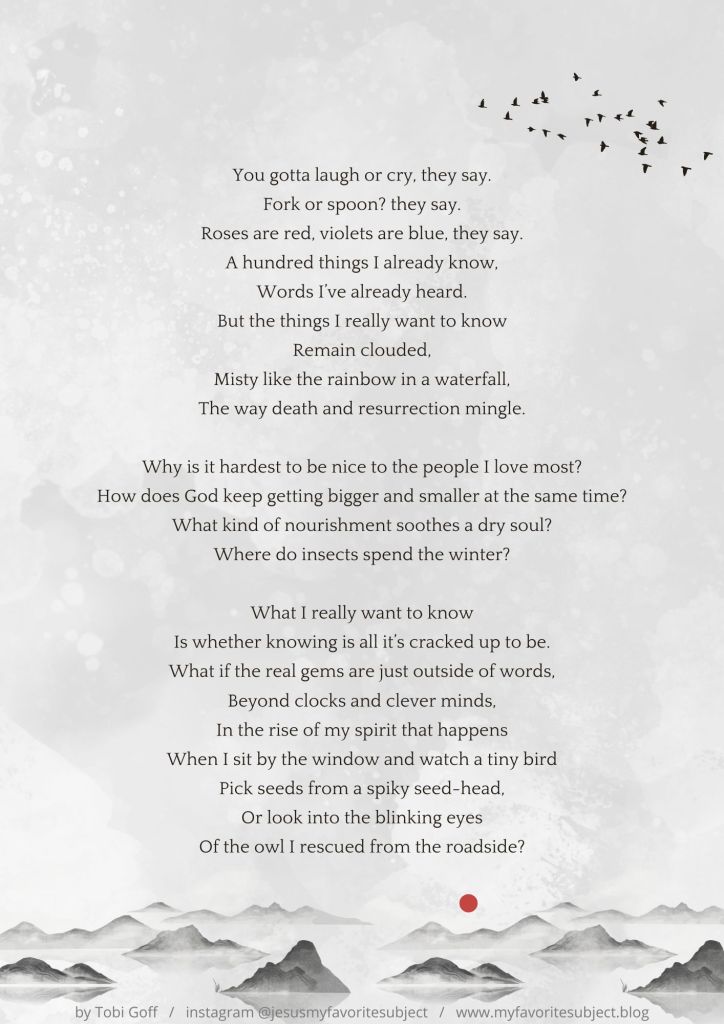

“Be still, my soul, the Lord is on thy side.”*
Unexpected but much-needed words at 2 a.m., when the house is quiet but my soul is loud.
“Be still, my soul, the Lord is on thy side.”
A thousand memories of my father, the hymn-playing classical guitarist whose practicing accompanied my sleep most nights for my first 18 years. A hundred more memories of concerts in a hundred churches, Daddy’s black suit with the guitar-fretboard tie, my mother presiding over a table of music for sale—books, CDs, tapes. And record albums in the early memories. My sister and I sang duets. We wore matching dresses sewn by my mother each year, made from fabric chosen by my father.
“Be still, my soul, the Lord is on thy side.”
The deepest stillness of my soul is always at God’s invitation.
“Be still, my soul, the Lord is on thy side.”
Knowing I can rage against God, blame God, say “fuck” to God—this, too, is an element of the stillness of my soul.
“Be still, my soul, the Lord is on thy side.”
Words I need to hear now, and in five minutes, and five minutes after that, because my soul has amnesia when it comes to stillness.
“Be still, my soul, the Lord is on thy side.”
Comfort for the parts of me that fret about who is not on my side, who doesn’t understand me, who wants ill for me. Be still. The One on my side will never change Her mind.
“Be still, my soul, the Lord is on thy side.”
As the psalmist wrote, “Be still, and know that I am God.” (Psalm 46:10) If He is God, I am not. Sometimes I need to remember this. Be still. Be.
“Be still, my soul, the Lord is on thy side.”
It is safe to be me. Right now. Before I do the next thing.
“Be still, my soul, the Lord is on thy side.”
I am not alone, even in my ugliest moments. God’s holy presence holds me with tenderness. I am invited to hold myself with tenderness, too.
“Be still, my soul, the Lord is on thy side.”
I pull out my hymnal, play the song one-handed on the piano, wonder if I might fall in love with the rest of the lyrics. I don’t. All I need is that one line.
“Be still, my soul, the Lord is on thy side.”
*This is the first line of the hymn, “Be Still, My Soul.” Words by Kathrina von Schlegel, translated into English by Jane Borthwick. Sung to the tune of “Finlandia,” by the Finnish composer Jean Sibelius.

Blessed are You,
Lord our God,
King of the Universe,
for evening.
Trees slip into black pajamas
as color drains from the sky,
pooling at the edges,
vivid feather boas draping the sun.
Blessed are You
for slowness of twilight,
a dissolving that escapes notice
until I get distracted,
and looking back to the sky,
find it changed.
Blessed are You,
Lord our God,
King of the Universe,
for those things that spark alive
even as I dim.
Owls and mice open their eyes,
stars twinkle, dew forms,
and streams gurgle night music.
My ears attune as my eyes rest,
kissed to sleep by the softness of twilight.
What pulls at me today, daring to suggest my calm and holy center is not where I belong? Emotions roll like a ball in one of those handheld mazes, frozen in place as I s-l-o-w-l-y tip the maze, then a lightning-quick roll to the far corner before I can steady my hand.
So, what is pulling today?
Fear of disappointing my husband.
Heaviness from the impenetrable docket of housekeeping chores.
Despair over how my daughters have been treating each other.
Anxiety that I am a split second away from disappointing myself or someone else.
Terror because I am not in control of my inner world, or my outer world.
Is speeding up is the answer? More lists, more timekeeping, more discipline? No, because speed propels me out of my center, into the fears and despair.
The call is to slow down. Slowness requires trust—of myself, God, the people around me. Trust of time and the universe. What precedes trust? Willingness to accept a variety of outcomes, and to receive that I am well-loved in all of them.
Beginning at the end of myself, I find my way back to the beginning, receive the wideness of love, prevalent as air. As I breathe in love, I trust the intrinsic goodness of myself and others. I give up trust in outcomes and good behavior.
I choose slowness as an embodied reflection of my still and holy center. This is different than the stubborn slowness I use to distance myself from the needs of others, or the sullen slowness meant to display my tired and long-suffering soul.
With a playful but firm finger to my fretting lips, God intervenes. My churning heart stills once again in the embrace of grace and abundance. I am called to “unforced rhythms of grace,” where the daily cadence of faithfulness takes place within the finished song of grace.
~Scripture quote in the final paragraph is from Matthew 11:28-30 MSG: “Are you tired? Worn out? Burned out on religion? Come to me. Get away with me and you’ll recover your life. I’ll show you how to take a real rest. Walk with me and work with me—watch how I do it. Learn the unforced rhythms of grace. I won’t lay anything heavy or ill-fitting on you. Keep company with me and you’ll learn to live freely and lightly.”

Writing and prayer are, for me, inextricably linked. Pat Schneider said it well: “When I begin to write, I open myself and wait. And when I turn toward an inner spiritual awareness, I open myself and wait.”
In the course of living, I often disconnect from myself. I disconnect to stay operative, and it can be difficult to coax my spirit out of hiding. If I feel, will I still be able to function?
I’m reading two of Julia Cameron’s honest and encouraging books on the creative pursuit, and have been initiated to Morning Pages. Julia swears by them—three pages of longhand, stream-of-consciousness writing every morning, for the rest of your life. This practice puts you in touch with yourself, clears the racket in your head, lets you listen to the Spirit and to your own heart. “As we write,” Julia says, “we come know to ourselves, and increased tenderness to the self we are discovering is the reward.”
I’ve not made Morning Pages a daily habit, but when I do them, I find they deliver the promised effects.
My Morning Pages on June 2 were a ramble about ducklings and the kids’ last day of school. I wrote one page, then got scared: “How do I feel inside? Time to go shower …”
The next morning, it was time to come out of hiding.
June 3, 2023
I guess I’ll start today where I left off yesterday. With my heart. “Go ahead and come out, heart. This is a safe place.” Did some fear send my heart packing? When? How? It seems sudden that I have lost access to myself. But I know it can’t be. Am I running from heaviness? How does one keep a practical balance within one’s heart? Listen and feel, but not descend into the heaviness, never to rise? Maybe I’ve forgotten about my center. Is there really a still place in the middle of all this drama? A place to rest without shutting everything down or solving anything? “The present is safe,” Spirit says. My head is trying to protect my heart. My heart is trying to be small so I can get things done and look functional. But I am not lost in this stormy sea. The girls came downstairs so I moved upstairs. I sat down in my “prayer chair.” I turned my chair to look out a different window. I’m fantasizing about the marriage book I’m going to write. I’m listening to the ducklings and thinking they need their water refilled soon. I’m staring at nothing. I’m listening to the ceiling fan. I’m closing my eyes. I hear the mourning dove and think of the nest we had this spring. K is calling me from downstairs. Now she has come to ask if she can watch PJ Masks with her sister. She’s dressed only in underwear, and in their pretend game she has just hatched from an egg. She holds her hands under her chin in a chipmunk-like pose and speaks adorable gibberish, until I decipher “watch” and “PJ Masks.” It’s before 8am on a Saturday and I’d have to give special permission on Kayt’s iPad, so I say no. I’m starting to thaw here a little bit. I am safe with myself, my journal, God, Michael, and ultimately, with everyone and everything. K’s caterpillars are getting fat. I think God saved their lives. I guess (know) it’s safe to be me, and this day is very doable. Just show up, and then again.
Morning Pages are wonderful, rambling therapy. They are the healing experience of being seen. They are a permission slip to be human. Writing is a gentle and whimsical pathway to the inner self, which I once thought to access with a hammer and chisel, but which actually comes forward like a squirrel—shyly, with worried chirps and false starts. I must sit still. When the squirrel’s tiny paws rest on my fingertips, I feel a sense of wonder. I—brute that I am—receive the trust of another creature. So it is with my own spirit. I cannot use force to gain passage; I must sit quietly and observe with rapture that I am alive. And when I see myself alive, feel the pulse in my own fingertips, I know I will probably be okay.
~ Quotes are from Pat Schneider’s book, “How the Light Gets In,” and Julia Cameron’s book, “Write for Life.”

Blessed are You,
Lord our God,
King of the Universe,
for darkness—
daily invitation to rest—
to be quiet in ink-dark night
or a night moonlit and star-twinkled.
Blessed are You
for spirit rest,
my insides sitting down,
breathing deep,
inhaling Life.
Blessed are You,
Lord our God,
King of the Universe,
for the authority of rest
to dethrone “right” and “wrong,”
straining and struggling,
worth by performance,
and value by others’ opinions of me.
Blessed are You
for this sacred act of resistance,
this radical move to stop moving,
this subversive whisper
suggesting that rest is a nap—
but also more—
a knowing
that what is most important
is already done.
“It is finished.”

June 20, 2022
God, I am so tired of thinking I am bigger than You, and my ability to mess things up is bigger than You. That is a lie and I am choking in its grip. Please show me how big You are. Please, uproot the lie. Show me how small I am. I cling to Your feet. I don’t need You to be what I think You are. Lord, please make me willing to be inhabited by Your Spirit and to release control. The story of Jacob’s wrestle in the night comes to mind. (see Genesis 32:24-30)
I’m asking for a miracle. I’m asking because I know that thinking I’m bigger than You is a fabrication. A sleight of hand. Please take me out from under the spell. Show me how the trick works so that I am no longer captured by it. Take me back to the garden, to the lie, and reverse the damage. You have crushed the serpent’s head, and along with it crushed the lie that You are holding out on me; that You have limited me and excluded me from Your fullness. “The kingdom of heaven is at hand,” You say.
I’m so sorry that we wanted “to know good and evil.” I am drawn to that tree, that struggle. You remind me of another tree, another struggle, “On a hill far away.” Lord, I receive Your death in me. I receive the silence of the tomb. It’s a long silence, really. The silence of a world in awe at what they have seen. A silence void of struggle, void of taunting, certainly void of trying. It is the moment of silence after a stunning victory before the crowd comes to life and erupts with noise and elation.
The tomb is a quiet place, a place of mystery, a place we respectfully allow darkness and silence. A place where stillness is not a practice, but the truest reality. I lie dead. I have gone from confused delirium to perfect, unruffled peace. Every muscle that was trying so hard to hold me together has now relaxed. Resurrection is not on my mind, because nothing is on my mind. That’s the beauty of being dead. The rushing is suddenly and decisively irrelevant. Not even snoring disturbs this silence. A dead person doesn’t sin, doesn’t worry, doesn’t know anything.
Lord here I am, passed out in the tomb with You, knowing nothing. I can do nothing. My senses have stopped signaling my brain. There is no input, no output. Only silence and stillness. Even breathing has ceased. I am in a holy place of waiting, a sleep of death that will feel the same whether it is one minute or one hundred years. This is the only way to wait without fretting—in death. Death is also where decay occurs—the return of life to the soil, from which new life will arise. Dust I am. This is how I know silence. Death silences the endless chatter, and it is God’s gift to me, though my heart still beats.
“I am crucified with Christ; therefore I no longer live.” (Galatians 2:20) It seems I have tried to be born again without dying. I have wanted to skip over death to resurrection, not realizing how I long for death. Quiet. No expectations. I might have known that in God’s hands even death is a gift. As I permit myself to engage with death, I find treasure: grace, humor, peace.
Nobody expects anything of a dead person. I am gloriously, peacefully dead. Dead people aren’t really good at anything, except maybe lying still. I suppose if their eyelids were open they could win any staring contest.
Also, the band name “Grateful Dead” has taken on a whole new meaning.
The nice thing about being the dead person is that there is no sense of loss. I cannot grieve, because I cannot do anything. I need not try to be still, nor try to move. I need not expect perfection, nor hope for predictability. I cannot hold onto life. It is behind me and beyond me and it animates me only when I am not in this passageway of death.
Trust. Humility. These things I have longed for are here in the tomb.
Perhaps Jesus called death “sleep” because He knew it was the only way for humans to Rest In Peace. Death is not a fitful slumber. It is the child who has fallen asleep in his mother’s arms in a waiting room, every muscle relaxed, dead to the passage of time and to the noise of a coffee machine and crying children and ringing phones.
Like Barbara Brown Tayler, I love the question, “What is saving you right now?” Death is saving me right now. Today I am in the grave. Neither crucifixion nor resurrection are on my mind. Maybe “grave circumstances” aren’t so bad. “Grave” and “grace” are closer than I thought. My tired heart has stopped beating and it lies still in the mystery of death.
Only Jesus. Always Jesus. Beautifully Jesus. Safely Jesus. I will Rest In Peace with You, the only one who can lay down Your life and take it up again.

God says, “Be still, and know that I am God!” (Psalm 46:10a NLT). I wonder how “they” decide where to place exclamation points in scripture. This one startles me, like maybe God just shouted a little bit. It’s like He knows it takes an act of nature to shake me out of performing and perfecting.
Learning to be still with Jesus is an ongoing pursuit for me. For years my habitual quiet time in the morning was infused with a hurry/produce mentality. I focused my time around memorizing a chapter of the Bible or reading one chapter of a book each day. I would journal all my angst, problems, and frustration over my lack of control. Ever so slowly I have learned to be still in God’s presence. Learning to be without an agenda has often resulted in tears. For most of my life I didn’t know what it was like to be seen and loved. As I came to experience Jesus, I cried many tears: tears of joy over being loved for no reason, and tears of grief over releasing who I was striving to be.
After a long season of either crying or feeling “blank” in my quiet times, I began to listen. I got really honest. I learned to take inventory of my heart. The thing about sitting with Jesus is that He doesn’t meet me where I wish I was; He meets me where I actually am.
I remember the day I was sitting in my “prayer chair” looking into the expansive greenness of a large tree near the window. I was thinking about trusting God, and realized that I could not pray, “I trust You today.” I didn’t trust God. I had no idea what He would ask me to do and I had no intention of handing Him my life to do with as He pleased. This was hard to admit. It’s kind of awkward when you’ve been a Christian for 30 years and realize you still think you’re a better god than God.
But I can’t manage trust the way I manage brushing my teeth. It doesn’t happen because I write it on my schedule. It happens when I get to know someone who’s trustworthy.
My honest reflection landed me here: I want to want to trust God. That’s two levels away from actually trusting, but it was a start: the beginning of “starting over” getting to know God. A year or two later a day came where I felt that God just might manage my day better than I could. Trust. Built on honesty, hard questions, arguments, and the discovery that God is emotional safety on steroids. Often I didn’t know my own heart, but Jesus brought it to the surface so we could engage with it together. At first this took a long time, but gradually it happened faster.
Other things flowed into my quiet time as well. I began to enjoy praying for all kinds of people: family, friends, acquaintances, classmates, neighbors, strangers. I began to catch myself when I started to rant and have a pity party, and instead make a choice to say what I was thankful for, or to praise God for who He is, or to revisit a promise or a truth He had previously given me. Quiet time became a daily opportunity to be seen and loved, no matter what state I was in.
Then, because God is absurdly good to me (I am His favorite child), this practice of stillness filtered into other parts of my day. I began to experience more emotional safety in relationships, and I watched the clock less when spending time with people. God invited me to do daily tasks one at a time, relieving my exhausting mental multitasking. I began to seek stillness and allow tears or rest instead of pushing myself harder when tired. Fruits of the Spirit like patience—for which I had cajoled God for years—began to show up.
One week last fall was ridiculously busy. I was harvesting and processing garden produce, preparing for my daughter’s birthday, and putting together a chapel talk for my kids’ school, in addition to writing several hours more than usual. The kids got sent home from school one day because of a power outage, and I felt behind all week. As I watched myself go through the week I noticed unusual behaviors: I didn’t demand that my family be as busy as me. I didn’t get up early, stay up late, or skip meals to keep being productive. I didn’t make long lists and then freak out when I only finished half. I took short naps. I took time to be still in the mornings and evenings. I often engaged in the task I was doing without rehearsing the next five tasks in my mind. I was flexible when timelines or events changed.
I didn’t even know that was possible.
I have a sneaking suspicion that God knew.
It was still a tough week, but there was a taste of grace. I was impatient sometimes. I complained about all I had to do. At times, I stilled my body but my mind and spirit didn’t follow suit. Yet there was a breeze of grace that has not often been present. There was a tendency to stop when I felt anxious or tired, instead of going faster. There was an acceptance of the times when stillness was a physical choice but mental rest didn’t follow.
One afternoon I started a fire in the outdoor fire pit, with great hopes of enjoying a deep breath in my spirit. I sat down with a blanket and a book. I started a poem about my tangled feelings. But I ended up more anxious than I began. Sometimes that’s how it goes.
I bumble along, and God persistently shows up. I am humbled, and grateful to the point of tears, for all the moments that were redeemed by His grace that long week. The times when I helped my children instead of demanding they go faster. The times I snuggled with my husband instead of doing one more thing. Participating with my daughter in baking and party preparations. Time spent with friends. These were all gifts from a persistent God who shows me the beauty of stillness despite my adamance that going fast and doing more is a noble agenda which He ought to adopt with me.
Stillness is an act of trust. Stillness is changing my life.

God has a knack for suggesting stillness when it sounds like the worst possible idea. Imagine the Israelites leaving behind hundreds of years of slavery in Egypt, and suddenly seeing the Egyptian army coming after them as they approach the Red Sea. Terrified, they declare they would rather go back to be slaves than die. Sounds logical to me. But Moses says, “Don’t be afraid. Just stand still and watch the Lord rescue you today. The Egyptians you see today will never be seen again. The Lord himself will fight for you. Just stay calm.” (Exodus 14:13,14 NLT) “Just stay calm”? Really, God? You’re just going to say that? Of all the times to stand still, this seems like the worst.
On some level I can relate to the Israelites, being trapped between slavery and salvation. My brokenness—from which God has already delivered me in Christ—pursues and traps me. Fear and anxiety rush in and I am ready to run back to my slavery: impatience, control, and being right. I would rather perform than be set free. I am afraid of myself and the cavernous ugliness I have seen inside. When things are not turning out how I want, it sounds much safer to reach for control than to sit between the enemy and an unknown outcome. But sometimes that is exactly what I am invited to do. And sometimes watching and waiting is the catalyst for victory.
Last winter our marriage stepped off solid ground onto a suspension bridge. There was a bit of wobbling and a few moments where we held our breath. After one of many difficult conversations, I was left looking down at the chasm below and wondering if that’s where we were going to end up. As I prayed, I had a strong impression that I was to watch and wait—that God was on the move but I needed to be still. So I was. By God’s grace I didn’t dwell on painful words or unanswerable questions. I waited. When fear rolled in with a choking sensation and suggested that I fight or flee, I prayed aloud, reminding God what He had asked of me and asking for His help to continue watching and waiting. After several days I saw God’s handiwork, in the form of a handwritten letter from my husband. God fought the battle for me as I watched and waited.
When God is involved, stillness can be productive. Look at the moment of stillness in this story of Jesus going to Nain:
Now it happened… that [Jesus] went into a city called Nain… and when He came near the gate of the city, behold, a dead man was being carried out, the only son of his mother; and she was a widow. And a large crowd from the city was with her. When the Lord saw her, He had compassion on her and said to her, “Do not weep.” Then He came and touched the open coffin, and those who carried him stood still. And He said, “Young man, I say to you, arise.” So he who was dead sat up and began to speak. And He presented him to his mother. (Luke 7:11-15, NKJV)
Did you catch it? The pallbearers stand still.
When something is dead—whether it be a dream, an opportunity, a relationship—we take the next logical step and bury it. And rightly so, for dead things left in the open begin to stink. But Jesus may be audacious enough to stop us on the way to the hole in the ground. I want to get the ordeal over with. But if I pay attention to Jesus, He may simply be asking me to pause.
I realize when I look at these stories that it can be ill-advised to be logical with Jesus. He may ask me sometimes to stop and be still when I am taking what is the undeniably obvious next step. Am I willing to still myself and see what He is going to do?
There are times to take action, yes. There are also times to stand still. Permit me one more Bible story: Judah’s king, Jehoshaphat, is terrified by the approach of not one, but three armies. He fasts and prays, and orders his whole kingdom to do the same. In response, God’s Spirit comes upon a guy named Jahaziel, and this is what he says: “‘Listen, all you people of Judah and Jerusalem! Listen, King Jehoshaphat! This is what the Lord says: Do not be afraid! Don’t be discouraged by this mighty army, for the battle is not yours, but God’s… you will not even need to fight. Take your positions; then stand still and watch the Lord’s victory’” (2 Chronicles 20:15-17b, NLT, emphasis added). Sure enough, the enemies coming against Judah in battle kill each other, and Jehoshaphat’s army just watches.
Isn’t that crazy?
Is it possible that sometimes I miss what God is saying because I’m only listening for actions I can take? Maybe I give God multiple-choice, but His answer isn’t on the list. Doing nothing seems counterintuitive to problem solving.
If we are parents, sometimes we have to tell our kids to wait: for cookies to cool, for glue to dry, for the day of the party to arrive. By the same token, we may be asked by Daddy God to wait when it seems obvious what the next step ought to be. The antidote for white-knuckled waiting—or rushing in headlong—is the slow building of trust, creating a safe space for stillness. As God shows His heart to us, we let His love soak deep into our bones so that we may trust Him, crazy though He may be.
blank
A couple things to check out: 1) this freeing song about stillness, by Hillary Scott. 2) my new Facebook page @jesusmyfavoritesubject. Love ya’ll. Thanks for reading.

Here’s what irritates me the most about Jesus: He is never in a hurry. Of course I don’t like to be hurried. But life is fast and full and I want people to jump when I say jump. God is not on board with this plan. This would have been me living with Jesus: “Twenty minutes until Sabbath, Jesus!” “It’s meal time.” “Jesus, You’ve been preaching for three hours.” I would have been the disciple reminding Jesus that the people were hungry and needed to go home (see Matthew 14:15). And, when He stopped to talk with a random lady on his way to a dying girl, I might have burst a blood vessel. (see Luke 8:41-49)
As a child I was taught to keep moving and be productive. In my teens constant productivity made me somewhat of an oddity. I took summer courses in addition to working full time; I multitasked during movies; and I often carried a book with me to occupy myself should things start to drag. My first recollection of anyone pushing back on this trait was when I began dating. When I met my first (and last) boyfriend, Michael, I was taking a full university class load and working three part-time campus jobs totaling about 30 hours a week. Very soon after we began dating, Michael encouraged me to quit one of my jobs, which I did. He often challenged my hurried and productive lifestyle simply because he didn’t live that way. For example, I always walked fast; he couldn’t stand walking fast. Over time he taught me to “stroll,” as he liked to call it. This drove me nuts!
Often I have found slowing down produces anxiety in me. When I slow down I must face who I am. This can be debilitating. The truth is hard to swallow: I am not who I want to be and change is costly. Constant activity shields me from the awareness that I am scrambling for safety I don’t have—the kind of quiet safety that anchors my spirit. Hustling and productivity provide an escape. Being productive is a deeply ingrained habit, rewarded by my family of origin and my country’s culture. Slowing down requires engaging in the difficult process of renovating my beliefs about myself. While I may find all this terrifying, God is ready to roll up His sleeves and get to work.
If learning to be still began when I started dating Michael, it has now occupied half my life. I spent a decade learning to slow physically: to enjoy a relaxing stroll, to watch a movie and let it be the only activity, to sit and watch the birds. For the most part I have eased into this over time and am finding it comfortable.
Mental stillness has come at a much greater price. My first few years as a stay-at-home mom I managed to “perform” in my new role, as I had in all previous roles. I kept my babies fed and washed and responded to their cries. I cooked and cleaned and went to mommy groups. But shortly after my girls turned one and three years old, I began to struggle mentally and emotionally. The stillness of being home all day was a place of reflection in which all I could see were distortions and shadows. Compassion and hope were blotted out by fear of who I was and fear of getting things wrong. I would cry whenever someone said I was a good mom, because I desired it with every fiber of my being yet felt estranged from it. I pushed myself through each day because I felt if I stopped I would never get up again. I thought if I admitted I was lonely, discouraged and afraid, I would be swallowed up by those feelings.
I have often said the worst possible scenario for my mental health is to be alone in my own mind. Here I was, at home all day with these little people who no longer exhausted me to the point of survival mode, and I found that living with myself was the most painful thing I had ever endured. As a companion to myself, I was critical, short-tempered and punitive. I was so hard on myself that I lived in constant fear and decision-paralysis. God forbid I make a “wrong” choice about how to handle the hundred-and-one decisions I made about my children every day. I was, as they say, my own worst enemy. I was unable to cheer myself on, and instead found every reason to point out how I was not meeting expectations. I had never learned to be kind to myself. I could not let the waters still, to see my beautiful reflection clearly. I was quick to throw stones—to rend the image—because I identified with my brokenness more than my beauty.
One evening after a particularly difficult bedtime with my girls, I retreated to the recliner prepared to rehearse my awfulness and parade my ugliness before myself. Maybe enough shame would help me get my shit together (I’m not sure why I still believe that when it has yet to “work”). But God had other ideas. I felt Him embracing me, and I knew He was there not to talk about how to do better next time, but to hold me because He knew how much it hurt this time. I don’t understand why God is like this, but slowly I am learning to follow His lead. I am learning to embrace myself when I cause pain. And if I can embrace myself when I cause pain, then I can embrace others when they cause pain. I can invite them into this stillness, in which God’s holy presence holds all of us with tenderness. Stillness becomes a place of expanding kindness.
For six years now God has been loosening my corset little by little, teaching me to take up space, to breathe, until the corset is almost forgotten, and I am even invited to be plump and to enjoy it. I can be kind to myself. And when I am, it’s not so bad to be alone and still.
 My Favorite Subject