Category Archives: Relationship

Simple Jesus

I want to like Jesus because the grown-ups in my life told me He is good, and they were right. 

I want to be innocently happy that God is good. 

I want to go back to painting “JESUS FREAK” in huge letters on a baggy cotton T-shirt, soaking up Sabbath School lessons with gusto, back to the credibility God had when I was 14.

Simple Jesus—does He still exist? Or can He at least be mysteriously complex and Kindergarten-simple at the same time? 

Is there a reality—no-strings-attached—in which Jesus just loves me and knows my name?

A few weeks ago I attended a spiritual retreat at Camp MiVoden, as a sponsor for the girls in the 7th/8th-grade class. During the worship services I remembered something, a feeling of belonging and certainty from my past. I knew some of the songs the praise band led, and I sang with my arms raised. No one expected anything—hardly anyone knew me—and the featured speaker said simple and good things, about who I am and who God is, and I cried, and I remembered a time when I belonged wholly, and sermons weren’t pocked with ideas that distract me from goodness and wholeness.

I want a plain friendship, one I don’t have to defend or explain, one in which I don’t need Jesus to make me look good, and Jesus doesn’t need me to make Him look good; Jesus with a reputation as simple as Mary who had a little lamb, not the notoriety of an activist. 

I don’t need answers for all the questions and discrepancies. I’m looking for that place where they are absent, where I don’t have to explain why I don’t believe in a punitive gospel, or why I’m part of a faith tradition (Christianity) that has inspired violence for thousands of years. I don’t want to explain why I use feminine pronouns for God, or why I say Adventism is my community but not my religion. I don’t want anyone to raise their eyebrows at me, nor me at them. I want to be in love—inside love. I want to feel safe because I am safe. 

Maybe what I really want to know is this: does a simple Jesus exist for adults too? Does He go for coffee with millennials—with me? Does He wear jeans and send 132 text messages every day? Does He understand carpools and playdates and a family calendar on the kitchen wall and how all the spoons are dirty if I miss one day running the dishwasher? Does He peruse my TBR shelf and ask me about my writing? Does He know I’m still a little girl inside, intimidated by the disciples who turn me away because I am small and simple?

Is Jesus here now, and does He remember me? Does He look through my photo albums and murmur memories? Has He been here for it all? Can we laugh together about singing “Sinnerman” and “We Are Soldiers”—the laugh of a shared memory—those lyrics humorous like the frizzy perms of the 80’s?* Is He still the cleft in the rock, the hiding place, the blessed assurance the hymns offered? 

What if we’ve shared a life more than a belief system, and our love is built on mutual adventure and admiration?

Maybe He has never needed me to pull Him apart and stitch Him back together, to understand how He is a triune being, or even to put our companionship into words. Perhaps I was mistaken in thinking that farther, bigger, and deeper are better. 

Jesus is here. In the essentials He hasn’t changed a bit. He’s still the great guy I knew in primary Sabbath School; the one who stood with me in the church baptistry, invisible yet deliciously simple; the father I wrote to in a dozen journals full of prayers; the soil from which I grow. Most of all, He’s still my friend.


*I sang these songs countless times. Although the lyrics of “Sinnerman” I sang were not as heinous as what I just found by googling it, I think it’s safe to say it’s inappropriate to mock sinners running from God (and what even is a “sinner”? Aren’t we all?). And don’t even get me started on “We Are Soldiers” and “I’m in the Lord’s Army.” Who decided it was a good idea for seven-year-olds to sing about blood-stained banners and artillery? So yes, I think Jesus and I can have a good laugh about it.

A Different Kind of Trust

I take into my body every day a substance I know almost nothing about, a refined form of an ancient plant—maybe a grass? Today the bouquet on my table consists of a dozen stems I gathered from the roadside a mile from home, at city limits where the speed limit increases from 35 to 50. This bouquet is the raw material for foods I eat daily, but I have harvested it for beauty and not for appetite. 


I’ve been learning about relationships since forever. As a teen I imbibed books by Joshua Harris and Elizabeth Elliot. I thrill a little every time I take a personality test. When my husband, Michael, and I went through pre-marital counseling together, we answered personality questions about ourselves and about each other, and our therapist came back with the results overlaid and a description of our relationship dynamics. I didn’t know that was possible! Unbounded delight and satisfaction. 


As I hold a stem from the bouquet, I find it rose-like in that it is beautiful, but it will hurt me if I handle its sharp edges carelessly. I’m not sure how one prepares it for consumption, but I think a severe beating is involved, to separate its parts. If I’m not mistaken, animals were traditionally employed to help with this task. But even this violent unmasking of the plant doesn’t render it edible—at least not to the standard of most palates. Additional breakdown, with stones or blades, nudges it closer to consumption. Even then, it doesn’t appear on dinner plates or in snack trays. It waits in the cupboard for a kitchen chemist to combine it with oil, water, yeast, sugar, and any number of other ingredients. The resulting gooey blob is then baked, fried, boiled—cooked in some way. Once cooked, the food may be spongy (in a good way) or crunchy, and bears no resemblance to the stalk I hold in my hand. 


I’m hungry to understand relationships, both because I’m intrigued, and because I do not want to leave my relationships to chance. Marriage tops the list of highly-scrutinized relationships, followed closely by the bonds I have with my kids, and with my parents. What’s happening when my husband gets super talkative? Does quietness mean completely different things for my two children? How have my mom and dad survived this long in the world with their seemingly brittle ideas about religion and diet, and not one single coffee date?


Although I don’t know how to plant, nurture, harvest, thresh or prepare grain, I do know that an established industry takes the plant through all those steps for me, and I ought not eat it otherwise. I owe this knowledge to my elementary school education, and the times my mother reprimanded me for eating raw flour—probably in the same era I sampled dry dog food. 


I am convinced I will not get relationships right by chance, by intuition, organically. Research, knowledge, and choice are required. I have used this knowledge to understand and to be understood; to shame myself and my spouse; to prove I’m right; to try new patterns and to defend old habits. Most of all, I use it to dispel mystery, because the mystery of love is uncomfortable; the bread of love is finicky—too dense or not dense enough, sometimes rising only to fall, tantalizing when it’s warm, less palatable cold. Does my reading and analysis save me from this roller-coaster ride? I think not. But it does help me feel less alone. 


As I drive from my small town to the next small town, I count fields of wheat. At least I think it’s wheat. Truth be told, I trust an industry I know little about, and a process I prefer not to attempt to replicate. On the baking aisle I can choose the brown bag or the blue-and-white one, non-GMO or organic, but I’m only pretending to understand. The way I know wheat best is on my tongue, in the form of bread, mixed with flavors like cheese and pickles, homemade raspberry jam, or peanut butter and applesauce. I don’t need to know all the details.


Could it be that the way I know relationship best is in the presence of a friend?—trying a new flavor of ice cream, laughing about how I only shaved one leg, crying about a pet passing heavenward. Maybe I don’t need to understand all the details in order to nourish and be nourished . . . in both food and friendship.

Run-on Marriage

Last week Michael and I celebrated 20 years of marriage. The run-on sentence below illustrates our run-on marriage. (And yes, we’re still crazy about each other, in addition to driving each other crazy.)

I cannot get in bed when the bedcovers are frumpy, drifting off the end of the bed, sideways, knowing that if I do lie down and tug on them I will get too much sheet, too little blanket, and the wrong corner of the comforter; but I do not make my bed in the morning—I make it right before I climb in bed at night, tugging with exaggerated exclamations as I dislodge cats, and my poor husband too, because there’s a tiny possibility that I idolize sleep and this bed is my altar and before I sacrifice my body the altar must be prepared as if for a temperamental god of linens, and I like to remind my husband that before I met him my sheets would stay tucked in and straight for months at a time, but since his feet hang over the end of the bed and he tosses and turns at night, I have to straighten the covers every single day, and I accomplish this with more violent energy and bitter comments than necessary, although one would think after 20 whole years I would have adjusted and calmed down about it—but he huffs and makes less-than-charitable remarks every time he drives, and he has been driving for twenty-five years, so I guess we are both going to have our snide remarks and adult tantrums and all shall be well. 

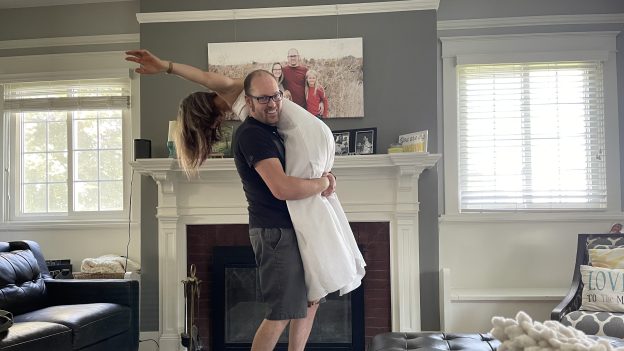
P.S. I usually use stock photos, but the photo for this post is of my husband and I earlier this month. I barely squeezed into my wedding dress, which I attempt every September as our anniversary rolls around.

Walk Repenting

“… the soft animal of my body …”

As I put the car in park, I leaned forward and squinted to read the blue letters on the bumper sticker of the car in front of me. “maybe the soft animal of my body wants to walk a thousand miles repenting”

I’d never heard a human body described as a soft animal before. Did I have a soft self, and did it want to repent?

It was Tuesday morning, Colville Street, a much needed coffee-and-writing date with myself. I turned off the engine, and hoping the woman in the red shirt exiting the store to my right was not the owner of the car, I snapped a photo of the bumper sticker. A silhouette of geese flying over cattails on the right side of the message added to the calm invitation I felt from those words. 

Not wanting to linger with my phone camera pointed at the back end of a stranger’s car, I made a quick detour into the building the red-shirted woman had just exited. Like a mini mall, a half dozen boutique clothing and food/wine shops occupied storefronts along a wide hallway. I noticed a sign for a soon-to-be bagel shop on the brown-paper-covered windows of a corner space. The slurpy sounds of a paint roller accompanied the smell of fresh paint.

The shop around the corner used to sell my favorite coffee smoothie—made with raw cashews, dates, and cocoa powder. They had closed some months ago, but I’d heard the new occupant of their space served the same smoothies. I walked in slowly and surveyed a freezer with everything from ice cream bars to frozen quarts of house-made soup. The deli fridge held a mouthwatering assortment of unique grab-and-go foods, such as spiced garbanzo beans. When I got to the cheeses, I noticed the front counter out of the corner of my eye, and above it the list of smoothies. No coffee smoothie. 

The bumper sticker I’d photographed still rolled around in my mind as I perused a couple shelves of dry goods, then stepped over to the counter. “Hi,” I spoke to the southern-California-pretty girl, feeling self-conscious in my workout clothes and messy half-ponytail. “This is my first time here since this store changed owners,” I offered awkwardly, “so I’m just checking it out.”

“Okay. Welcome.” She smiled.

“Do you have a coffee smoothie?”

“No. We’re working on it.” She gestured to a middle-aged woman with light brown hair, seated behind a laptop at the nearest round table. 

“I’m trying to get the consistency right,” the woman offered. I showed her the recipe I use at home for a coffee smoothie, and we chatted for a while. She told me about the plans she has with her business partner to open a sandwich shop in the small empty storefront next door. I wished her luck with the business ventures and returned the way I’d come, back to the sidewalk by my car. No police waited to take my phone away or arrest me for taking pictures of bumper stickers.

I grabbed my laptop, sweatshirt, journal and book from my car and headed toward my original destination for a weekday morning self-date—the coffee shop beside the mini-mall. 

I ordered a hot matcha latte, paid with a gift card, and chose a table in the corner. Then I settled in with my journal and returned to pondering the bumper sticker: maybe the soft animal of my body wants to walk a thousand miles repenting. Yes, my body seems to say, I want to do this. I ask my body, why?

Because pretense is not a way to spend a life.

Because I am sorry this world is not a comfortable place for a hundred families I know and billions I don’t know. 

I am sorry for the miscarriages and painful marriages, sorry for the systems that don’t see people, and the people who don’t see themselves, sorry I have loved control more than gentleness, sorry for the disease and dis-ease that never ask before they darken our doors.

I am sorry for the loss of hard-to-hear human stories to easy-to-apply inhumane labels, sorry that emotional and physical safety are a privilege and not a right, sorry for all the grief that is carried alone because we are scared to name our own grief and to witness the grief of others. 

I am sorry we look at teenagers and see youthful bodies and immature minds, but don’t see the loneliness or oppressive unanswered questions, sorry we look at children and see their food-smeared faces, hear their unfiltered words, but don’t see their whole souls—meant to awaken us to the wholeness that is their birthright and ours.

I am sorry there is no easy way out of addiction or a demeaning job or loneliness, sorry that pain is par for the course and I sometimes pretend it’s not, and sorry I forget that joy is also par for the course and I sometimes pretend otherwise.

I am sorry that plants are largely unheard and animals are prized or passed over, but rarely known, sorry I’m an unsafe stranger to some, and an unsafe friend to others, sorry for all the ways I have confirmed the loneliness in another person’s spirit.

I am sorry I swallow my food without giving thanks to the earth and the farmers and God.

So yeah, I could walk a thousand miles repenting, my soft body says. And I want to grasp other soft bodies and bring them with me, to walk together barefooted until our soft mass of bodies spreads repentance across every landscape, until we have repented our way home, which is not a place of individual belonging, but of collective belonging.

And then my body is done speaking. She relinquishes the pen back to my mind, and I see the paper I am writing on, the smooth blonde wood of the table underneath. I notice my cold ankles, the barista’s laughter, and a melancholy female voice singing through the shop speakers.

I notice the way my fingers wrinkle as I hold a blue pen with black ink, and see for the first time that the tiny screws on the metal logo attached to my purse are fake.

After a while, I notice that I am noticing, and I wonder—if fifteen minutes of quiet repentance awakens me this much, what might be born of a thousand miles?


Lunch time nears. I return to the shop with no coffee smoothie and purchase a cauliflower and garbanzo bean salad. While I eat, I think about repentance. Is repentance a list of sins and regrets before God? Is it turning a different direction, choosing a better way? Is it a walk, the bodily healing of circulation, the mental healing of gazing at the horizon, the spiritual healing of engaging with the landscape of humanity? My body says this might be the case. Perhaps it is all of these and more, an invitation to be awake, to be soft, to hold each other gently…for a thousand miles, if necessary.

The Red Circle

A perfect dark-red, circular spot on the beige carpet. I reached down and touched it, first with a finger and then my thumb, pressing lightly. Sure enough, something wet and red thinly coated my fingers. It had to be blood. But where did it come from?

“There’s blood on the carpet,” I announced to my mother. We had just spent 40 minutes getting her from the dining table to the couch—a distance of about 12 feet. She was certain I couldn’t help her stand up, that my dad had to be there for her to move. My parents recently relocated, and dad was at the old house cleaning out the garage. They would sign closing documents that afternoon for the sale of the house. I came to be with my mother, whose mobility and cognitive ability had declined rapidly over the past few months.

Back at the dining table, I’d held out my arms to help her stand, but she made no attempt to respond. I moved the walker in front of her and held it steady so she could pull herself up, but still she didn’t move. Then she wanted to get down to the floor and crawl. She instructed me to bring some towels to soften the floor. I spread a thick blanket, doubled over, between her dining chair and the edge of the living room carpet. She leaned forward and tried to rest a hand on the floor, but lost her nerve. At her insistence, we called my dad. He said yes, I could move her. Again, I held out my arms—no response. I brought the walker over—she tried holding it in different ways but never got to the standing-up part. She tried again to get to the floor with similar results—her hesitant hand reached low.

I kept offering to help her stand, as that seemed to me the best option, but she said she didn’t want to hurt me. She is several inches taller than me, but only a few pounds heavier. I had helped her stand and walk many times before. Perhaps her reticence resulted from a recent fall, although I wasn’t there at the time of her fall. She asked who else could help her and named an acquaintance who had visited a couple days before. When she determined that I was, indeed, the only available person to move her, she asked for my dad again and cried. An hour earlier she had announced, “This afternoon I’m scheduled to have a nervous breakdown.” I was beginning to agree.

My mother insisted that she could not stand up with her feet on the smooth floor of the dining room, but only on the carpet. In response, I grabbed the front legs of the wooden chair she occupied and pulled it to the edge of the carpet. Now we had less than six feet to go. I held out my arms again, instructing her to hold onto my biceps as I held her elbows. I planted my knees against her right leg and pulled her up—sort of. She doesn’t straighten up all the way when she stands. I put my arm around her back to keep her from sinking back down, and pulled the walker in front of her.

A one-inch scooch, a six-inch step, a rapid little shuffle. She leaned forward on her toes, her center of gravity moving precariously in front of her as her heels came off the floor. I lifted her foot so she could move it forward. Then again the other foot. Then a step on her own. Then a one-inch scooch. Somehow she got her back turned to the couch and sank down onto the cushions. However, she wanted to lie, and would need to be closer to one end of the couch to make room for her legs to stretch out. Rather than attempt convincing her to stand again, I grabbed her blue jeans on each side of her hips and heaved her slowly across the couch. I lifted her feet onto the couch, then blue-jean-heaved her a little more until her hips rested perpendicular to the back of the couch. A large array of pillows served as a back rest. I spread a fluffy white blanket over her.

“I haven’t brushed my teeth in three days.” She seemed worried about looking well-kept for the house signing, although I had no idea how long it really had been since she last brushed. I poked around in the bathroom drawers and cupboards until I found floss, toothpaste, and toothbrush. She couldn’t floss. I tore off a piece of waxed floss, wound the ends around my fingers, and started with the teeth that were easiest to reach. After flossing most of her teeth, I handed her the toothbrush, which she had instructed me to wet, but not apply toothpaste. She proceeded with brushing on her own. When she finished, she asked me to take a picture of her shiny clean smile and text it to my dad.

It was at this point I noticed the red spot on the carpet. What could have produced a clean drop of blood? My mother suggested I check her knee, which I did—but given that she had jeans on, it couldn’t have dripped blood unless she had a gushing wound that soaked her pants in blood. We checked her elbows too—had she bumped into something and not realized it? No, no signs of blood on my mother. “I’m on my period,” I confessed, “but I don’t understand how I could have dripped blood on the floor like that.” As we discussed the possibilities, she concluded that my menstrual bleeding was the mostly likely culprit.

I wetted a paper towel in the kitchen and went to work on the red spot. Much to my relief, it came out of the carpet with minimal scrubbing. I had no interest in staining carpet at my parents’ house—the very same parents who kept cream-colored carpet in near-perfect condition for 20 years while farming and raising two kids. I knew better than to soil it.

As I turned, my mother noticed blood on my shorts. Another piece of the puzzle. I hastened to the restroom and found that indeed there was blood on my shorts. They were loose, pink-purple shorts made of sweat-pant material. As I cleaned them the best I could without actually taking them off and washing them, I realized what must have happened. When I sat on the edge of the couch to floss my mom’s teeth, I must have leaned into such a position that my underwear and pad weren’t fully in place. Hence, a few drops of blood had fallen onto my shorts, and from there one of them dripped to the carpet.

I have this idea that at 40 years of age, period “accidents” should be a thing of the past. It’s not like I’m new at this bleeding-out-of-my-vagina thing. But there I was, cleaning blood from various surfaces. My mother was unconcerned, a conversational ally as we pieced together what had happened. How strange that in the afternoon’s events, simply standing up would be infinitely more stressful than blood on the carpet.

Oddly, when it was all over, I primarily felt gratitude. It’s awkward to be a fully functional person around a not-fully-functional person. It feels weird that I can floss my teeth and walk where I want to, and my mother can’t. I’m never quite certain what to offer in terms of help, and since her mobility and cognitive ability are a little different each time I visit—sometimes more and sometimes less—it’s a moment-by-moment game. Not the kind of game I’m good at.

This blood on the floor was a gift. An opportunity for me to be vulnerable, to need help solving a problem, to have an awkward dysfunction of sorts. It allowed our roles to feel just a bit more “normal” for a few minutes—she the mother, I the child. I miss that.

Weird but Not Worried

Weird but Not Worried

Blessed are You
Lord Jesus,
King of the Universe,
for sending Your disciples to preach—
even Judas—
before they grasped
what You were all about.

Blessed are You
for letting thousands of people
get hungry on a hillside,
for letting demons
run a fortune of bacon
over a cliff to drown,
for letting a woman use her hair
as a washcloth, on You.

Blessed are You
Lord Jesus,
King of the Universe,
for never being much of one to worry
about Your next meal
or Your fickle followers
or that you sounded crazy
or preached too long.
You saw the person in front of You
like they’d never been seen before
and didn’t worry about the rest.

A Mother’s Mundane Conundrum

“You’re just making me do it!” my daughter says with a surprising amount of conviction. “You just decided I have to do it.” She’s not wrong. Nothing will happen if she doesn’t clean her room. No one cares about it except me. I feel called out as an unnecessarily controlling parent, just as I do each time one of my daughters confronts me with these sentiments.

It seems I have arbitrarily decided most of the content of their lives. I require showers, food other than fruit and juice, feeding pets, getting out of the house for school—with clothes, lunch, piano books, shoes appropriate for PE, and a sweater. Would anything dire happen if all those things were left undone? No. One or both daughters could go to school late, in PJ’s, without a lunch, wearing the wrong shoes, and sweaterless. In fact, she could probably do that for a week before anything interesting or significant took place in response to her choices.

I dislike this feeling that I am the only reason she does most of what she does. And I don’t like it when she confronts me about it. I don’t know what to say. I agree with her. Most expectations really are arbitrary—for adults as well as kids.

There are plenty of things I could say that I don’t want to say. I could say, “Someday you’ll have a job,” but that has no meaning whatsoever to a nine-year-old. Or, “You have to learn to do things now so I’m not still reminding you when you’re thirty,” but is there any real danger of that? Or, “I’ll be embarrassed if you go to school in pajamas,” but do I really want to teach my kids to make decisions based on my embarrassment? Or, “Nasty things will start growing in your room if you don’t clean it,” —okay, maybe a month from now, so is that really motivation to tidy it up today? Or, “I’m your mom and I get to decide what you need,” except that I don’t think anyone should decide another person’s needs for them. You get the idea.

So here I am with nothing to say, a truthful human being looking me in the face, questioning my demands—and why are they demands? Perhaps because requests and suggestions haven’t worked, or because my emotions are now fueling this high-octane—but nevertheless mundane—occurance.

“You’re right,” I say. “I can’t actually make your body and your arms and legs do anything. But I can remind you there will be no screen time until chores are done. And if you don’t do chores today I might give you an extra cleaning job tomorrow.” This comes out sounding a tad desperate, and something like a threat—not exactly what I was going for. But you do what you have to do.

Motherhood seems to be a mix of desperation and compassion, empathy and threats, logic and insanity. Is that what childhood feels like too?

She whimpers. She complains it’s not fair. But eventually she trudges to her room and starts picking up clothes off the floor. My heart rate returns to normal as I breathe a sigh of relief. With any luck, I’ll have at least five minutes before this conversation repeats itself with my other daughter. Meanwhile, I whimper and complain internally as I return to a pyramid of dirty dishes. I guess we’re not wholly different.

Damn Hospital Corridors and Mothers

I’m dabbling in fiction again, which of course is influenced by my actual life, wherein my mother’s health is failing. This piece came from a writing prompt to begin with, “The hospital corridor was dimly lit…”

The hospital corridor was dimly lit, but only because the fluorescent lights on one side of the ceiling emitted partial light, accompanied by a buzzing sound. I wished someone would turn the lights off. One o’clock a.m. was never meant to be lit at all. Sinking to the floor, I checked the exact time on my watch, 1:17.

My mother slept. She’d been sleeping much of the day and night for some five years. Sleeping suited her phlegmatic personality and neurodegenerative disease. Sleeping was familiar.

But tonight, sleep could wander into death at any moment. And so we kept vigil—my brother and I—taking turns at her bedside, watching the face of each nurse who came in to check her vital signs. Did their expression show any hint of surprise or concern? Anything to indicate an imminent ending?

I’d never been this close to death before, and my feelings warred with my philosophies. It’s one thing to say death is natural, a passage as much as an ending, a new experience just like every other milestone in life. But there’s something heavy about a last milestone.

As I stared at the wall, unseeing, questions caught traction in my mind. This grief, is it about loss of the mother I have, or loss of the mother I wish I had? Or is it fear of what will happen to my brother and me when Mom isn’t here? Or am I feeling anger that I have to be here, to witness this, to hold it and see it and feel it and live it—that this dying person not only consumes my time when I’m at the hospital, but consumes my emotions and thoughts when I’m driving, eating, washing dishes? Who gave her permission to be woven into me in this way?

And what does the unweaving look like? Is it a severing, like a guillotine? Is it a careful unstitching, or an impassioned disassembly, tossing parts and pieces here and there? Or will my dead mother remain inside me, and will I like her better that way? What memories will make me smile? How much time will it take for me to internalize a narrative that holds us both gently?—a narrative that’s peaceful, not buzzing and half-lit like this damn hallway.

How to Be a Mother

Breathe. And not just
during the contractions.
You must be well-oxygenated
to care for another human being.

Give up. And not just
once. Keep at it.
You must release your grasp
before your muscles cramp.

Laugh. And not just
when it’s funny.
You must include sadness and shock
and exhaustion in your mirth.

Tell the truth. And not just
to yourself.
You must tell the other moms,
and listen to their tellings.

Accept your new self. And not just
the nurturing and brave parts.
You must accept the anger,
the desperation, the invisibility.

And remember to breathe.

What Version of Me Belongs?

I have chosen between attachment and authenticity a thousand times at least.

What do I mean by this?

I’ll loosely define attachment as a healthy sense of relational connection and belonging. And let’s think of authenticity as the ability to know ourselves and show up in the fullness of who we are, including the little quirks and details.

The choice between attachment and authenticity occurs when we must—or perceive we must—choose one of the two. For example, let’s say you’ve made a new acquaintance and you’re arriving at her house for the first time, with a plan to chat over a cup of tea. You might feel a little anxious, not knowing whether this will be awkward, and wondering about the future of your friendship. When you step in the door, your friend offers to take your coat. You’d rather leave it on until you warm up a bit, but instead you take it off and she whisks it away to a side room. Then she offers you scones, which are obviously hot from the oven and smell delicious. You accept and then notice there are raisins in them. You don’t like raisins. But rather than pick them out, you decide to eat them. In these moments, you are choosing attachment over authenticity. Sharing your preferences feels risky for the relationship, so you keep them to yourself.

Often, as in the above examples, we base our decision not on reality (you have no idea whether your friend would be offended by you picking out the raisins), but on a perception of what would best maintain your attachment—your relational connection—in the moment.

Let’s think about scenarios where the stakes are higher. A teen might have to choose between the authenticity of letting their parents know they’re transgender, or preserving attachment by not sharing that information. A pastor may have to choose between authentically and vulnerably requesting help for an addiction, or maintaining his position and his church relationships—his connection and belonging—because he knows he cannot have both. A person may choose to have sex with their partner because it’s easier to do what they don’t really want to do than it is to say the vulnerable truth and deal with the possible fallout of disconnection.

As children, and even as infants, when presented with a choice between authenticity and attachment, we choose attachment. Our survival depends on it. As we become adults, our circle of resources widens, and our options become more diverse. We don’t have to choose attachment over authenticity every time. Still, there is an element of risk to authenticity, and we weigh this consciously or subconsciously every day.

One of the most challenging environments to navigate this dynamic is religious circles—which in my case extend to my children’s private education, friends past and present, my readers, and even neighbors. Church seems a strange place to make a choice between belonging or being myself, yet I have felt it often there. Christians say, “Come as you are.” But I don’t think we meant it. Or, we mean it with a tag-on—“Come as you are, when you’re ready to change that to be like us.”

I have believed I can’t be me, because whatever improved version of me God has in mind is better than the current version of me—“sinful and selfish” me. Somehow being myself means heresy. I can’t be true to myself and to God at the same time. You know, something about “a house divided,” or how man’s thoughts are “evil continually.”

These days, I’m not sure I belong in church. But it doesn’t matter like it used to. I belong in myself, and that is sweet relief. I belong in the living room of God, who has become both mother and father to me. I am bonded spiritually, and it’s the safest place I’ve found yet to excavate and inhabit my authentic self.

God doesn’t ask Her children to choose between attachment and authenticity. Belonging is a foregone conclusion, and God’s favorite pastime might be holding your hand as you get acquainted with your authentic self. I think God emits joy-sparkles when He gets to witness you noticing yourself and connecting with the fun, complex, messed up, whole and holy person that you are.

Wherever attachment and authenticity occur together is sacred. These holy spaces may be inside us, in marriage or friendship, in nature or a good book. I’ve discovered that in settling into my own self, I can hold the paradox that I am okay and I am not okay. And it turns out God is way bigger than they said She was.


My understanding of these concepts leans heavily on Gabor Maté and Krispin Mayfield. Many thanks to them both for acquainting me with my own inner safety.


P.S. I posted an update today about trauma-informed writing groups. Check it out here.