Category Archives: Personal Stories and Memories

Ocean Infection

Tiny puff of sea spray
Between surf and horizon
A huge mammal exhales
“There’s a whale!”

Kayt drops her book
Michael appears from the kitchen
Wide window in the dining nook, our portal

We point and words punctuate—
“Whale right!” “Tail! Tail over there!”

But Kyli sees whale-less waters
Her disappointment thick and raw, until
The silhouette of a tail
Appears clear—magic.

She nearly levitates
Shouting with joy
Infecting us all—
Her cousin jumps wildly with her
We clap our hands
Voices high-pitched with excitement
Wonder sparking between us
As our eyes return to the blue
Searching for another breath in the water.

Run-on Marriage

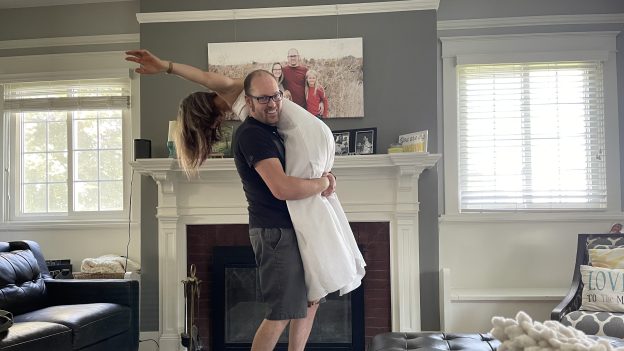
Last week Michael and I celebrated 20 years of marriage. The run-on sentence below illustrates our run-on marriage. (And yes, we’re still crazy about each other, in addition to driving each other crazy.)

I cannot get in bed when the bedcovers are frumpy, drifting off the end of the bed, sideways, knowing that if I do lie down and tug on them I will get too much sheet, too little blanket, and the wrong corner of the comforter; but I do not make my bed in the morning—I make it right before I climb in bed at night, tugging with exaggerated exclamations as I dislodge cats, and my poor husband too, because there’s a tiny possibility that I idolize sleep and this bed is my altar and before I sacrifice my body the altar must be prepared as if for a temperamental god of linens, and I like to remind my husband that before I met him my sheets would stay tucked in and straight for months at a time, but since his feet hang over the end of the bed and he tosses and turns at night, I have to straighten the covers every single day, and I accomplish this with more violent energy and bitter comments than necessary, although one would think after 20 whole years I would have adjusted and calmed down about it—but he huffs and makes less-than-charitable remarks every time he drives, and he has been driving for twenty-five years, so I guess we are both going to have our snide remarks and adult tantrums and all shall be well. 

P.S. I usually use stock photos, but the photo for this post is of my husband and I earlier this month. I barely squeezed into my wedding dress, which I attempt every September as our anniversary rolls around.

Disrupt the System, Applaud Early

Applause: public approval or praise expressed by clapping hands together.

Some fifteen years ago, I stood while applauding after a Distinguished Faculty Lecture at my alma mater. Is it a standing ovation if only one person stands? I stood, exuberant about the depth of understanding and connection I experienced during the lecture. But as my peripheral vision told me that no one else stood, self-consciousness bubbled up. Why am I the only one deeply affected? Does everyone else already have a depth of experience such that the lecture was run-of-the-mill for them? My pulse quickened and I lowered into my seat, certain everyone must be giving me the side-eye, judging my way of being in the world.

Looking back, I am proud of that moment. I know now that many of us who speak or write or reveal ourselves in some way, need only one person to stand. Only one person to send a note letting us know our words created connection.

Late last July, I attended “heART on display,” an event featuring artwork by incarcerated or formerly incarcerated individuals. Cedar Rain Spirits, a distillery and BBQ in downtown Walla Walla, hosted the event, curated by Devon Player, whom I met through the Walla Walla Community Change Team. Outside the narrow storefront, a sandwich board on the sidewalk announced the event. Inside, people mingled, music blared, and art lined much of the two long walls that extended to the back of the venue.

For the next hour, I perused art, snacked on free hors d’oeuvres, asked a few questions, and flattened myself into tables and walls to avoid bumping into fellow guests. As I chose art to purchase—proceeds to benefit Running Waters Equity Fund and the Black Prisoners Caucus—Devon took the mic and introduced a guest speaker, Anthony Covert. We all quieted where we sat or stood, and turned to listen.

Anthony was sentenced to 432 months (36 years) in prison at the age of 18. He served 16 of those, and walked free on June 10, 2024. As he talked about sitting in prison, alone with himself, I stumbled into sudden affinity with him. We “outside” (unincarcerated) folks have so much available to distract ourselves; it is a rare and excruciating experience to be alone with ourselves. “ But when you’re sitting in that prison cell and all you got is those four walls—sometimes with a celly, sometimes not—you have to sit with yourself.” And, he says, you have to ask yourself questions, about how you came to be in this place, and what your purpose is now that you’re here. 

My own season of being alone with myself and asking hard questions transpired during stay-at-home momming. I recognized that singular agony of sitting with oneself, and the subsequent decision to engage with tricky, heavy questions. As an incarcerated, black young man, Anthony felt it in the isolation of prison. As a middle class, white mother of an infant and toddler, I felt it in the isolation of motherhood. Although our experiences differed, Anthony’s words connected intimately with my inner world as a stay-at-home mom. Because he exposed his pain, I felt seen in mine. Our stories held hands for a just a moment. 

I wanted to applaud, but other listeners were intent, soaking up the story, not ready to respond. Anthony continued, and when he shared the completion of a college degree, while incarcerated, with a 3.98 GPA, everyone applauded, including me. Later, when he talked about his clemency hearing and the unanimous vote to grant him clemency, we applauded again. It was then that I noticed my moments of connection were not the same as the moments of applause. Before Anthony’s clemency hearing, when anxiety was high, Anthony’s friend Demar told him, “Go in there and show them who you are.” That moment connected. That moment I wanted to clap or sigh, or give the man a hug. Show them who you are.

Why the dissonance between my moments of kinship with the speaker, and our collective moments of applause? Could it be that as a society we are quick to applaud measurable achievement, but not moments of quiet strength? What about times of agonizing surrender—to our brokenness, and simultaneously to our wholeness? 

Anthony described us on the “outside” as an invisible army that stands with those on the “inside.” Because our worlds are disconnected, there is a wall isolating our compassion and assistance from the insiders’ knowledge, and/or response. Knowing this, may we be courageous to continue engaging—despite the lack of testimonials, catchy postcards, and fundraising galas that feed the selfish side of our generosity. 

“ There’s no fixing the system. It is what it is,” Anthony said. “But what you can do is disrupt it in certain areas, right? To give people opportunities to come home.”

What if applause—public approval or praise—happened earlier in the story, and it served to recognize nothing more than our humanity, the intrinsic dignity of our existence? What if clapping said, “you got this,” more than, “you did something big and measurable”? Better yet, what if approval and praise showed up in the process and in the conclusion? What if it gave people opportunities to come home—to themselves, to their families, to their communities? I need this. I suspect we all do.

I want to applaud early—for my children, my spouse, my friends, my community. A healer is “someone who can see the movement toward wholeness in you more clearly than you can at any given moment,” wrote Rachel Naomi Remen. Let’s open our eyes to see. Put your hands together for humanity. 

Let’s applaud smallness. Clap for the courage it takes to engage with our own selves and our messy stories. Cheer at the thin places in our stories, where pain and intention form a bond and point us in a new direction. Celebrate wholeness even as it lingers in the wings. Disrupt the narrative in ways that invite belonging. 

Walk Repenting

“… the soft animal of my body …”

As I put the car in park, I leaned forward and squinted to read the blue letters on the bumper sticker of the car in front of me. “maybe the soft animal of my body wants to walk a thousand miles repenting”

I’d never heard a human body described as a soft animal before. Did I have a soft self, and did it want to repent?

It was Tuesday morning, Colville Street, a much needed coffee-and-writing date with myself. I turned off the engine, and hoping the woman in the red shirt exiting the store to my right was not the owner of the car, I snapped a photo of the bumper sticker. A silhouette of geese flying over cattails on the right side of the message added to the calm invitation I felt from those words. 

Not wanting to linger with my phone camera pointed at the back end of a stranger’s car, I made a quick detour into the building the red-shirted woman had just exited. Like a mini mall, a half dozen boutique clothing and food/wine shops occupied storefronts along a wide hallway. I noticed a sign for a soon-to-be bagel shop on the brown-paper-covered windows of a corner space. The slurpy sounds of a paint roller accompanied the smell of fresh paint.

The shop around the corner used to sell my favorite coffee smoothie—made with raw cashews, dates, and cocoa powder. They had closed some months ago, but I’d heard the new occupant of their space served the same smoothies. I walked in slowly and surveyed a freezer with everything from ice cream bars to frozen quarts of house-made soup. The deli fridge held a mouthwatering assortment of unique grab-and-go foods, such as spiced garbanzo beans. When I got to the cheeses, I noticed the front counter out of the corner of my eye, and above it the list of smoothies. No coffee smoothie. 

The bumper sticker I’d photographed still rolled around in my mind as I perused a couple shelves of dry goods, then stepped over to the counter. “Hi,” I spoke to the southern-California-pretty girl, feeling self-conscious in my workout clothes and messy half-ponytail. “This is my first time here since this store changed owners,” I offered awkwardly, “so I’m just checking it out.”

“Okay. Welcome.” She smiled.

“Do you have a coffee smoothie?”

“No. We’re working on it.” She gestured to a middle-aged woman with light brown hair, seated behind a laptop at the nearest round table. 

“I’m trying to get the consistency right,” the woman offered. I showed her the recipe I use at home for a coffee smoothie, and we chatted for a while. She told me about the plans she has with her business partner to open a sandwich shop in the small empty storefront next door. I wished her luck with the business ventures and returned the way I’d come, back to the sidewalk by my car. No police waited to take my phone away or arrest me for taking pictures of bumper stickers.

I grabbed my laptop, sweatshirt, journal and book from my car and headed toward my original destination for a weekday morning self-date—the coffee shop beside the mini-mall. 

I ordered a hot matcha latte, paid with a gift card, and chose a table in the corner. Then I settled in with my journal and returned to pondering the bumper sticker: maybe the soft animal of my body wants to walk a thousand miles repenting. Yes, my body seems to say, I want to do this. I ask my body, why?

Because pretense is not a way to spend a life.

Because I am sorry this world is not a comfortable place for a hundred families I know and billions I don’t know. 

I am sorry for the miscarriages and painful marriages, sorry for the systems that don’t see people, and the people who don’t see themselves, sorry I have loved control more than gentleness, sorry for the disease and dis-ease that never ask before they darken our doors.

I am sorry for the loss of hard-to-hear human stories to easy-to-apply inhumane labels, sorry that emotional and physical safety are a privilege and not a right, sorry for all the grief that is carried alone because we are scared to name our own grief and to witness the grief of others. 

I am sorry we look at teenagers and see youthful bodies and immature minds, but don’t see the loneliness or oppressive unanswered questions, sorry we look at children and see their food-smeared faces, hear their unfiltered words, but don’t see their whole souls—meant to awaken us to the wholeness that is their birthright and ours.

I am sorry there is no easy way out of addiction or a demeaning job or loneliness, sorry that pain is par for the course and I sometimes pretend it’s not, and sorry I forget that joy is also par for the course and I sometimes pretend otherwise.

I am sorry that plants are largely unheard and animals are prized or passed over, but rarely known, sorry I’m an unsafe stranger to some, and an unsafe friend to others, sorry for all the ways I have confirmed the loneliness in another person’s spirit.

I am sorry I swallow my food without giving thanks to the earth and the farmers and God.

So yeah, I could walk a thousand miles repenting, my soft body says. And I want to grasp other soft bodies and bring them with me, to walk together barefooted until our soft mass of bodies spreads repentance across every landscape, until we have repented our way home, which is not a place of individual belonging, but of collective belonging.

And then my body is done speaking. She relinquishes the pen back to my mind, and I see the paper I am writing on, the smooth blonde wood of the table underneath. I notice my cold ankles, the barista’s laughter, and a melancholy female voice singing through the shop speakers.

I notice the way my fingers wrinkle as I hold a blue pen with black ink, and see for the first time that the tiny screws on the metal logo attached to my purse are fake.

After a while, I notice that I am noticing, and I wonder—if fifteen minutes of quiet repentance awakens me this much, what might be born of a thousand miles?


Lunch time nears. I return to the shop with no coffee smoothie and purchase a cauliflower and garbanzo bean salad. While I eat, I think about repentance. Is repentance a list of sins and regrets before God? Is it turning a different direction, choosing a better way? Is it a walk, the bodily healing of circulation, the mental healing of gazing at the horizon, the spiritual healing of engaging with the landscape of humanity? My body says this might be the case. Perhaps it is all of these and more, an invitation to be awake, to be soft, to hold each other gently…for a thousand miles, if necessary.

The Red Circle

A perfect dark-red, circular spot on the beige carpet. I reached down and touched it, first with a finger and then my thumb, pressing lightly. Sure enough, something wet and red thinly coated my fingers. It had to be blood. But where did it come from?

“There’s blood on the carpet,” I announced to my mother. We had just spent 40 minutes getting her from the dining table to the couch—a distance of about 12 feet. She was certain I couldn’t help her stand up, that my dad had to be there for her to move. My parents recently relocated, and dad was at the old house cleaning out the garage. They would sign closing documents that afternoon for the sale of the house. I came to be with my mother, whose mobility and cognitive ability had declined rapidly over the past few months.

Back at the dining table, I’d held out my arms to help her stand, but she made no attempt to respond. I moved the walker in front of her and held it steady so she could pull herself up, but still she didn’t move. Then she wanted to get down to the floor and crawl. She instructed me to bring some towels to soften the floor. I spread a thick blanket, doubled over, between her dining chair and the edge of the living room carpet. She leaned forward and tried to rest a hand on the floor, but lost her nerve. At her insistence, we called my dad. He said yes, I could move her. Again, I held out my arms—no response. I brought the walker over—she tried holding it in different ways but never got to the standing-up part. She tried again to get to the floor with similar results—her hesitant hand reached low.

I kept offering to help her stand, as that seemed to me the best option, but she said she didn’t want to hurt me. She is several inches taller than me, but only a few pounds heavier. I had helped her stand and walk many times before. Perhaps her reticence resulted from a recent fall, although I wasn’t there at the time of her fall. She asked who else could help her and named an acquaintance who had visited a couple days before. When she determined that I was, indeed, the only available person to move her, she asked for my dad again and cried. An hour earlier she had announced, “This afternoon I’m scheduled to have a nervous breakdown.” I was beginning to agree.

My mother insisted that she could not stand up with her feet on the smooth floor of the dining room, but only on the carpet. In response, I grabbed the front legs of the wooden chair she occupied and pulled it to the edge of the carpet. Now we had less than six feet to go. I held out my arms again, instructing her to hold onto my biceps as I held her elbows. I planted my knees against her right leg and pulled her up—sort of. She doesn’t straighten up all the way when she stands. I put my arm around her back to keep her from sinking back down, and pulled the walker in front of her.

A one-inch scooch, a six-inch step, a rapid little shuffle. She leaned forward on her toes, her center of gravity moving precariously in front of her as her heels came off the floor. I lifted her foot so she could move it forward. Then again the other foot. Then a step on her own. Then a one-inch scooch. Somehow she got her back turned to the couch and sank down onto the cushions. However, she wanted to lie, and would need to be closer to one end of the couch to make room for her legs to stretch out. Rather than attempt convincing her to stand again, I grabbed her blue jeans on each side of her hips and heaved her slowly across the couch. I lifted her feet onto the couch, then blue-jean-heaved her a little more until her hips rested perpendicular to the back of the couch. A large array of pillows served as a back rest. I spread a fluffy white blanket over her.

“I haven’t brushed my teeth in three days.” She seemed worried about looking well-kept for the house signing, although I had no idea how long it really had been since she last brushed. I poked around in the bathroom drawers and cupboards until I found floss, toothpaste, and toothbrush. She couldn’t floss. I tore off a piece of waxed floss, wound the ends around my fingers, and started with the teeth that were easiest to reach. After flossing most of her teeth, I handed her the toothbrush, which she had instructed me to wet, but not apply toothpaste. She proceeded with brushing on her own. When she finished, she asked me to take a picture of her shiny clean smile and text it to my dad.

It was at this point I noticed the red spot on the carpet. What could have produced a clean drop of blood? My mother suggested I check her knee, which I did—but given that she had jeans on, it couldn’t have dripped blood unless she had a gushing wound that soaked her pants in blood. We checked her elbows too—had she bumped into something and not realized it? No, no signs of blood on my mother. “I’m on my period,” I confessed, “but I don’t understand how I could have dripped blood on the floor like that.” As we discussed the possibilities, she concluded that my menstrual bleeding was the mostly likely culprit.

I wetted a paper towel in the kitchen and went to work on the red spot. Much to my relief, it came out of the carpet with minimal scrubbing. I had no interest in staining carpet at my parents’ house—the very same parents who kept cream-colored carpet in near-perfect condition for 20 years while farming and raising two kids. I knew better than to soil it.

As I turned, my mother noticed blood on my shorts. Another piece of the puzzle. I hastened to the restroom and found that indeed there was blood on my shorts. They were loose, pink-purple shorts made of sweat-pant material. As I cleaned them the best I could without actually taking them off and washing them, I realized what must have happened. When I sat on the edge of the couch to floss my mom’s teeth, I must have leaned into such a position that my underwear and pad weren’t fully in place. Hence, a few drops of blood had fallen onto my shorts, and from there one of them dripped to the carpet.

I have this idea that at 40 years of age, period “accidents” should be a thing of the past. It’s not like I’m new at this bleeding-out-of-my-vagina thing. But there I was, cleaning blood from various surfaces. My mother was unconcerned, a conversational ally as we pieced together what had happened. How strange that in the afternoon’s events, simply standing up would be infinitely more stressful than blood on the carpet.

Oddly, when it was all over, I primarily felt gratitude. It’s awkward to be a fully functional person around a not-fully-functional person. It feels weird that I can floss my teeth and walk where I want to, and my mother can’t. I’m never quite certain what to offer in terms of help, and since her mobility and cognitive ability are a little different each time I visit—sometimes more and sometimes less—it’s a moment-by-moment game. Not the kind of game I’m good at.

This blood on the floor was a gift. An opportunity for me to be vulnerable, to need help solving a problem, to have an awkward dysfunction of sorts. It allowed our roles to feel just a bit more “normal” for a few minutes—she the mother, I the child. I miss that.

Forty and (In)secure

Twenty One Pilots’s song, “Stressed Out,” laments the insecurities of adulthood, noting that fear is still present, and we still care what people think. I turned 40 this month, and yes, I’m still insecure. It’s different than high school. And the same. I want you to like me. I want to be well-dressed and well-spoken, and most importantly, perceived well.

I’m a grown-up—have been for quite some time—and I can tell you what maturity doesn’t mean. Being grown up doesn’t involve control and confidence; it doesn’t mean growing out of awkward traits and social habits; it doesn’t include a clean house and well-kept yard, or a passel of perfect grown-up girlfriends.

I’m less sure what being a grownup does mean. But I’ve noticed I’m softer than I used to be—more flexible, a teensy bit less judgmental, and I know more about cooking and cleaning than I did 20 years ago.

I know less about God, love, and relationships. It’s been said that the more you know, the more you know you don’t know anything. I can confirm this.

There’s a real sense of loss, not landing in adulthood firmly in control and certainty, an expert in the kitchen, the workplace, the bedroom. I get tired of being wrong, confused, ineffective. If knowledge comes from experience, I am an expert in exhaustion, stress, and leaving my cell phone in obscure places.

I know I’m sounding a tad morose. But there is a happy ending. There’s something left after losing control, and the appearance of control, and pretending to have control. What’s left is eyes to see a different life entirely—a life of watching the cat lick his fur, thinking of my three favorite moments from the day just before I fall asleep, fighting less with my kids and husband, knowing there will not be a seismic event when my to-do list is left undone.

And I know myself better. I know I love writing and small groups. I know I like a clean house, but not enough to put in the work. I know I’m scared of the interminable wants and needs of my children. Being quiet and alone—especially in nature—returns me to myself. Banana splits and blended mochas almost always sound good. I try the hardest to be self-sufficient when I’m at my weakest. Animals make me happy. Getting called “a writer” makes me stand a little taller. Synchronicity feels like opening a birthday present.

My birthday, which this year fell on the first Sunday in May, played out like a dream Mother’s Day. My husband cleaned the kitchen, top to bottom. He and the kids cooked breakfast and dinner, and took me out for lunch. I sorted through a large tote, five bags, and an unconstrained pile of children’s clothing I hauled up from the basement, and found most of it could be passed on. I went to the park and watched goslings and ducklings, heard the smack-smack of their webbed feet in shallow water, and marveled at their fluffy bodies. I took a nap. With my parents and sister, I ate fresh-made blackberry pie with “40” cut into the top crust. Michael gave me a gift certificate to have the house professionally cleaned (when the dust settles from our six-month construction project). Like I said, a dream day.

It’s worth noting I couldn’t have planned such a day. All was gift—the generosity of my husband, my children, my sister. Many times I have planned a birthday party for myself, with friends and presents and homemade cake. But for forty, this un-forced birthday felt fitting. The people who love me gave what they wanted to give. And I received. I basked. I rested. And yes, I sorted children’s clothing—one of those things I never can find time to do.

Maybe I’m ready to accept this life I have. Whether I die tomorrow or in another 40 years, I will die complicated—a mix of peace and insecurity, frustration and gratitude, mundane and miraculous. And not at all grown up.

Substance Use or Pain?

I know next to nothing about substance use. Other than tales of “the alcoholic” family members I never met, the “sinners” in the prodigal-returns books the church fed me, and the guy who beat the tar out of a piñata at his daughter’s birthday party, I live in a substance-use-free bubble. Although, I was offered a drink last week by two guys about my age who came upon me at a local park, where I had stationed myself to watch for beaver activity. I hoped to catch the crepuscular creatures near one end of their habitat, where they had recently felled a large tree.

It became apparent these two fellows had been drinking when they repeatedly complimented my purple outfit, introduced themselves, offered to move my chair for me, asked me to show them the beaver lodge, and kept up a constant stream of friendly banter. Sober people walk by silently and you’re lucky to get a nod.

“If you’re gonna take beer from a stranger, we’re the right people to take it from,” the talkative fellow offered. He went on to explain the virtues of the beer he had in the cooler bag over his shoulder, but it all went over my head. IPA and other alcohol-related terms are Greek to me.

As a child, I was taught to fear alcohol, with the admonition that because alcohol addiction runs in our family, I could become addicted with a single drink. Is there truth to that? I don’t know. Now that I’m an adult it seems beside the point.

Last November, I attended a community education event—“Hidden In Plain Sight,” or HIPS. This event multiplied my slight knowledge of substances by at least ten times. For example, I thought “doing pot” 40 years ago was essentially the same as “doing pot” today. I was wrong. But before I get to that … The whole experience hit me odd—attending a 1.5-hour community event in which I felt the main takeaway was “just say no” (although those words were not used). I thought people who didn’t rely on religious/moral reasons for abstinence just didn’t abstain. Or at the very least, didn’t tell others to abstain. But apparently, given data on brain development and facts about the effects of drugs and alcohol, a whole slough of people agree that—at least for kids and teens—“no” is the appropriate attitude toward substances. And this isn’t about illegal drugs; it’s about nicotine, marijuana, and alcohol.

When I talk to my kids about alcohol and drug use, I notice they are acutely—vehemently—aware that it is “bad”—so much so that it’s easy for them to assume a person who uses is not a “good” person. For that reason, my conversations with them, more often than not, focus on the aspect of numbing pain. I tell them people drink because it makes them feel better. It’s relief from anxiety, loneliness, trauma, and intense emotional pain. And isn’t every human being worthy of relief from pain?

I didn’t know what to expect going to the HIPS event—other than free pizza and a lesson on the paraphernalia of risky teen behavior. But when I left after the event I had a distinct feeling that something was missing—we didn’t talk about the pain these kids are trying to numb. Or the pain their parents are trying to numb. And parental influence means—like it or not—when we as parents use substances to numb our pain, it’s hard to tell our kids not to, and even harder for them to respect and respond to us.

In the state of Washington, where I live, it is legal for a parent to give alcohol to their child at any age, in their home1. And although it’s illegal to give tobacco or marijuana products to your own children, the data in our local community indicates that parents are supplying these items to their children in middle school and high school2—or at least turning a blind eye. Additionally, many websites that sell vapes and other nicotine products simply have a textbox to type in one’s age, making it easier to buy substances than it is to log into your bank account.

Products that were originally marketed as smoking cessation products, such as vapes,3 may deliver more nicotine to users than cigarettes, depending on the product and frequency of use. They’re also cheaper. A carton of cigarettes is $120, and the roughly-equivalent 7,000-puff rechargeable fume vape—which comes in more than a dozen flavors and fits easily in a closed hand—costs only $15. It also conveniently flies under the radar of the Clean Indoor Air Act, since the nicotine is delivered without a cloud of smoke. As you might imagine, these changes rewrite the landscape of nicotine use.

And alcohol is not exempt from the changing landscape. With a disposable water bottle, a wine cork, and a bike pump, a curious teen can vaporize alcohol, conveniently bypassing their digestive system and taking the full impact of a shot of hard liquor directly to their bloodstream.4

Now back to the changes around “doing pot”. Before the turn of the century, marijuana products delivered about 4% THC, or tetrahydrocannabinol, the psychoactive compound found in cannabis. In the 2010s, that number jumped to nearly 20% with the medicalization of marijuana. Today there are products containing up to 90% THC5. This ain’t your grandpa’s weed. Yet in Walla Walla County the Healthy Youth Survey in 2023 reported that 56% of 10th-grade respondents thought trying cannabis/marijuana held no risk or low risk, and 30% thought regular use had little or no risk.6 Are these students thinking of grandpa’s weed, or the expanding menu of available products? There’s rosin, crumble, distillate, bubble hash, dry sift, crystalline, and the list goes on.7

Youth who experiment with substance use are often unaware—now more than ever—of the actual amount of alcohol, nicotine, or THC they are taking in through various products or processes, resulting in an uptake of accidental overdoses.8 Parents seem to be checked out of their kids’ lives, and capitalism is taking advantage of the changing topography of products that deliver substances.

2023 Health Use Survey (askhys.net)
Walla Walla County data

20% of 10th graders reported using marijuana at least once in their life.

50.9% of 10th graders reported using alcohol at least once in their life.

16% of 8th graders had ridden, during the previous 30 days, in a vehicle driven by someone who had been drinking alcohol.

2.7% of 6th graders (my 12-year-old daughter’s grade) reported alcohol use in the past 30 days, as did 3.9% of 8th graders and 13.1% of 10th graders.

19.5% of 8th graders and 33.6% of 10th graders indicated it would be “sort of or very easy” to get marijuana.

In case you got lost in the grade numbers,
all of these statistics are for youth approximately 11-15 years of age.

Not long after attending the HIPS events, my husband Michael and I walked by a smoke shop as we were finishing a pizza-and-ice-cream date night. “Ooh,” I said spontaneously, “let’s go in!” Michael didn’t share my enthusiasm, but he followed me inside the shop. The young man behind the counter welcomed us in and asked if we were after anything particular. I volunteered that neither of us had ever had anything. “If there’s something you want to try, let me know,” he offered.

To the left, behind a long counter, packaged products lined the wall. To the right, blown-glass paraphernalia caught my eye. I didn’t know what any of it was called. “Pipe” and “bong” seemed like terms that probably applied to some of the stuff, but I wasn’t sure. It reminded me of visiting the glass-blowing shops in Oregon’s coastal towns. Rows of shelves showcased the beautiful colors and shapes, and at the back of the store two more large displays highlighted artful drug paraphernalia.

The shop also had knives, samurai swords, rings for body-piercings, incense, an impressive display of fancy cigars, sex paraphernalia, and—based on my newly-acquired knowledge—several items I assumed were for hiding drugs. Michael and I circled the store a few times, commenting quietly to each other. Wanting to be a good customer, I bought a small vaping device.

Just kidding. I bought a pair of cheap earrings.

“Drugs and alcohol” are not the static story I imagined. And my interpretations are one tiny perspective on an issue that is complex beyond any one person’s understanding. Advertising, social influences9, the complex science of the over-400 components of cannabis10, the biology of addiction, stigma, family structure, mental health, and countless other factors impact our youth and their decisions around substances.

Mental health professionals and others, including the renowned Brené Brown, say it isn’t possible to selectively numb emotion. If we numb pain, anxiety, and sadness, we also numb joy, contentment, and gratitude. How will a generation unable to feel things—let alone name those feelings—live whole lives, experience belonging, and effectively walk through the tragedy and triumph of life?

And how will they teach resilience to the next generation?

I am left with more questions than answers. Why did I know nothing of the breadth and depth of new and evolving products and packaging around substance use? Why did only about 20 people attend this HIPS event that was marketed across the Walla Walla Valley? Why does it seem like social workers and law enforcement are the only people looking at this data?

About 10% of 8th graders and 14% of 10th graders surveyed had considered suicide. Over a third indicated a struggle with depression.11 Why are our children in so much pain? And how are we offering relief?


Endnotes:
1 RCW 66.44.270, subsection (4), viewed here.
2 The Healthy Youth Survey fact sheet for Walla Walla County in 2023 reports that 29% of youth in 8th and 12th grades, and 27% of youth in 10th grade reported getting alcohol from home, with permission, in the past 30 days. Additionally, only 5% of youth drink alcohol if their parents think it’s wrong, while 28% drink if their parents don’t think it’s wrong. This data is from a fact sheet created here.
3 https://pmc.ncbi.nlm.nih.gov/articles/PMC10880776/
4 https://www.vumc.org/poison-control/toxicology-question-week/jan-29-2020-alcohol-vaping-friend-or-foe
3 https://medicine.yale.edu/news-article/not-your-grandmothers-marijuana-rising-thc-concentrations-in-cannabis-can-pose-devastating-health-risks/
6 This data is from a fact sheet created here.
7 https://vivosun.com/growing_guide/what-is-crumble-crystalline-sugar/
8 This was covered in the live presentation. I’m still looking for a data source to cite here.
9 https://www.cdc.gov/tobacco/e-cigarettes/why-youth-vape.html
10 https://pmc.ncbi.nlm.nih.gov/articles/PMC4188645/
11 This data is from a fact sheet created here.

Two New Holes

Shortly after my May birthday last spring, I acquired two new holes in my body. I had my ears pierced.

One aspect of the conservative Christianity I grew up in is an aversion to body piercings. And tattoos, lipstick, and clothing that reveals feminine curves. When I left home as a I teen, I bought a padded bra, colored my hair with a box of dye from Walmart, and called it good for my rebellion. As a young adult I said I didn’t want to pierce my ears or get a tattoo because I have a low pain tolerance. Also, I faint for vaccinations, blood draws, and if I hit my knee or elbow too hard. (I fainted at the dentist once, and I fainted when I went to the college clinic to get a wart removed from my foot. The nurse sent me to Walmart to buy the kind of wart remover you paint on yourself.)

Why this sudden body piercing urge, you might ask, as I’m nearing the age of 40?

Last year, my nine-year-old daughter Kyli decided she wanted to get her ears pierced. “Why don’t you have your ears pierced, Mom?” she asked.

“I don’t know. I don’t like pain.”

“Well, if you really wanted them pierced you would do it,” she countered.

Point taken. So I thought about it. I hoped quiet reflection might reveal something profound, but my reasons were a grab-bag—it hurts, most of my friends don’t wear earrings, it feels weird to do it now that I’m middle-aged, it seems unnatural to poke a hole in my body (morality aside), my parents won’t like it, and so on. Like I said, random, blah, blah, blah.

So I decided to give it a shot, get my ears pierced with Kyli, and see if I like wearing earrings. Rather than take the lead because of lived experience—my usual role as mother—I had the same questions, concerns and curiosities as Kyli. We’d be figuring this one out together.

We waited for the school year to finish since the kids attend a Christian school that doesn’t allow earrings (or colored nail polish—go figure). Kyli wanted to get earrings the moment school let out, so we made appointments at Ulta Beauty for 1pm on May 31st—one hour after school dismissal on the last day of the school year. We snagged Kyli’s bestie, got a bite to eat, and drove to the salon. Inside, past the rows of creams and powders and scents, we found a plump young lady ready to pierce our ears.

I signed the thing they handed me—a waiver?—while Kyli picked out studs. Her bestie pinched her arm hard to show her how much it would hurt. The plump lady drew dots on Kyli’s earlobes, asked us to examine them and approve the placement, then inserted a stud in a white hand-gun. Punch!—right ear done. Kyli’s eyes were wide, a combination of curiosity and alarm, as she took in the experience and tried to categorize it. Painful? Scary? No big deal? Before she could settle an answer, punch!—left ear done.

For the next minute, Kyli’s hands hovered around her ears, her instinct to squeeze them through the discomfort, at odds with her determination not to touch. I watched, ready to comfort. But I wasn’t needed. Bestie dragged her around the store, applying makeup until Kyli’s face was caked with several shades of foundation and blush and her fears forgotten.

Meanwhile, I warned the employee holding the ear-piercing gun that I’m a fainter. Judging by her look of alarm, I guessed she didn’t have a lot of experience with people fainting—either that or she had a memorably bad experience. “I’ll know if I’m going to faint, and I’ll tell you,” I assured her. She proceeded to draw dots on my ears, punch, punch, voilà! Little silver hearts rested on my earlobes. During those thirty seconds, I felt the same wide-eyed, uncertain curiosity Kyli’s face had conveyed, but when it was all over, decided the pain wasn’t worth mentioning. We took pictures, documenting this mother-daughter experience trying something new together.

All summer we cleaned around our earrings, front and back—twice a day at first, then less often. We cleaned them after showers, after swimming, after getting dirty in the yard. We twisted them around in the holes as we had been instructed, and left them in 24/7.

At first, earrings were more unnerving than I expected. It felt wrong to intentionally punch a hole in my body and take special care of it to keep it that way. Usually when I cut through my skin and flesh, I tend it carefully to facilitate healing. This was different. Also, for the first month or two, I felt slightly anxious about having something attached to my body that I couldn’t take off. When I went to bed and took off my watch and glasses, I wanted to put the earrings on my nightstand too. I wanted to take them out so my body could be just my body. During the night, I tried different positions with my pillow to put the least pressure on my earlobes.

After the prescribed six weeks, I hesitated to remove my earrings since they still oozed or bled occasionally. Kyli, tired of waiting to wear a favorite pair of earrings, took out the original studs and sported cute, sparkly flowers for a day. This joyous occasion deteriorated when I couldn’t find the right hole to get the original studs back in her ear. I had erroneously thought a hole was a hole, but the tip of the earring took it’s own course through the fleshy part of Kyli’s earlobe and came out the back in a different place!

Blood, tears, and parental concern and confusion ensued. We survived this try-to-find-the-right-hole circus two or three times over the next week, and eventually Kyli’s left ear was so unhappy she let it heal shut. When school began again in August, she wore a tiny clear stud in her right ear—which still oozed and bled sometimes. She didn’t want to remove that one, but also refused to get her left ear pierced again. We were deadlocked in pirate mode.

The first pair of earrings I bought came from a rock-and-mineral shop in a falling-apart historic building we stumbled across during a bathroom break on a road trip. They’re tiger’s-eye stones. I nearly passed out when I first put them in, but after lying on the bathroom floor and breathing deeply for a minute—usually an effective method to maintain consciousness—I returned to normal.

At this point, I’ve probably had as much fun buying earrings as wearing them. For more than six months, I didn’t leave my earrings out any longer than an hour—the holes still appeared tenuous. Either the original studs or one of my half-dozen new pairs of earrings stayed in my ears at all times. At last, a month or two ago, I slept truly naked for the first time. It felt good as good as I imagined.

In a few months, it will be a year since we pierced our ears. During that time, Kyli’s right ear developed big scabs and pus came out when I cleaned it, over and over, so a few weeks ago she took out the clear stud. It’s healing now, and she’s done with earrings for the time being. Meanwhile, I’m growing into the fun of it. My sister gave me a beautiful pair of iridescent hummingbird earrings for Christmas. Michael gave me a pair of book earrings for Valentines Day—I’d been looking and found surprisingly few options, and these are adorable tiny blue books with real pages. I wore them to the library this week, and felt that same satisfaction I get when my bra and underwear match—a covert sense of matching.

So, friend, if you’re forty-ish and thinking about earrings, here’s what I’ve learned: It’s a small adventure, and hey, maybe that’s what makes it fun. These years lean low on adventure—outside of parenting. And come to think of it, this adventure was tangentially brought to me by parenting—two new holes, the result of a question from my daughter.

How about you—any new holes in your life? Or body?

In Five or Six Hours the House Will Be Quiet

I’m not okay. This is how I know it’s time to write.

I’m sitting in the kids’ room by the fire I lit for them—my attempt to dote on them since they stayed home from school today.

Sore throat again this morning—it has been almost daily for weeks with my younger daughter, Kyli. The older one, Kayt, said probably nothing is wrong with her but she doesn’t want to go to school. Middle school “friendship” has been sucking the life out of her. I can’t help but wonder if her chronic exhaustion and headaches are as much social as they are physical.

I shone a flashlight down two throats this morning. Kyli’s looked red, and Kayt’s had a weird white blob that dr. google says is a tonsil stone. Never heard of those before.

By the time I sit down to write, it’s midafternoon. Homework time downstairs has devolved. My stomach clenches in response to unharmonious sounds, insufficiently diminished by their travel up the stairs to my ears.

Now Kayt has come upstairs to whine and writhe. Technically she came up to say Kyli is bugging her and won’t stop. Since I made clear arrangements for Kyli to come upstairs if they weren’t enjoying sitting together, I feel a gallon of frustration and a drop of empathy. So I tell her to send Kyli upstairs, and that’s why she’s begging, moaning, and asking unanswerable questions in a nails-on-chalkboard tone of voice. She has a weird thing about not being alone.

At 7:15 this morning, when I usually would have been seeing the girls off to the bus, instead I set up appointments at the urgent care center. This change in schedule involved calling the bus driver and texting, let’s see,—their teacher, my yoga instructor, my husband, and several people I had plans with later in the day.

Did I mention the power outage? Just got yet another automated call from the power company. I have an outage that should be restored by 4:30pm, says the message. The power has already been back on for half an hour, and it’s currently 3:30. Not to mention just a few minutes ago I received an automated call informing me that the outage was caused by wildlife (read “squirrel”), and my power had been restored.

I think I’ve received five automated calls, including one that announced an outage had been reported in my area and a truck had been dispatched. Yes, I’m aware. I reported the outage when an explosive BANG and corresponding flash of light outside the dining room window resulted in all powered devices in our home going blank.

My husband is in Denver for work.

My sister is home with a sick kid as well.

My younger daughter made a “fun cutting station” on the floor in her room, where folks can experience the satisfaction of cutting various materials—like blue yarn (now in pieces all over the floor), tiny foam squares, a rubber armband (okay, that actually is super satisfying), and a plastic packing sleeve.

On the kitchen counter downstairs is a bowl of homemade slime that looks like a hot-pink pile of animal intestines. The dining table is covered with rubber stamps and paper, ink pads and embossing supplies, dirty dishes, purple slime, saltines, and homework.

Finally. I breathe. Here’s a moment of peace. Kyli is taking a break from homework, so I allow Kayt to study upstairs with me.

Kyli is quietly making a creature out of air-dry clay (a substance which already covers a significant portion of the bathroom counter due to a previous creative session this morning).

I don’t like the multiplying messes.

Sibling snarkyness nauseates me.

Most of my day has born no resemblance to the Wednesday I thought would unfold when I opened my eyes this morning.

But I ran on the treadmill and took a shower this morning, and in an unplanned burst of self-care I even dried and straightened my hair, and put in earrings. I’m sitting here by the fire, cat on the hearth, journaling. I did a marvelous breathing meditation from The Artist’s Rule, and I laughed with my girls.

After our visit to urgent care, we went to school and picked up homework (the current quarter ends in two days and there is a small state of panic about grades). Then we filled the car with gas for “real low cheap”* at the station near the school, stopped at Walmart for grocery pickup, and came home for the whole slime-making, lunch-eating, power-outage bonanza, followed by the Sibling Homework Crisis of 2024.

So I’m not okay.

But also I am.

Because it’s okay to not be okay.

And I’m grateful my kids don’t have strep, and … this just in: Kyli is cutting a stick of gum into pieces, holding the scissors above her mouth so each piece drops in … back to gratitude—for the fire warming my feet, for furry and purry kitties, for a relatively small pile of dishes in the kitchen sink. I haven’t yelled at my kids, and I have listened to them. I’m going out with girlfriends this evening.

And—bless Mother God—in five or six hours we’ll (fingers crossed) be tucked in bed and the house will. be. quiet.

*If you want to acquaint yourself with the phrase “real low cheap,” watch this.