Category Archives: Personal Stories and Memories

Substance Use or Pain?

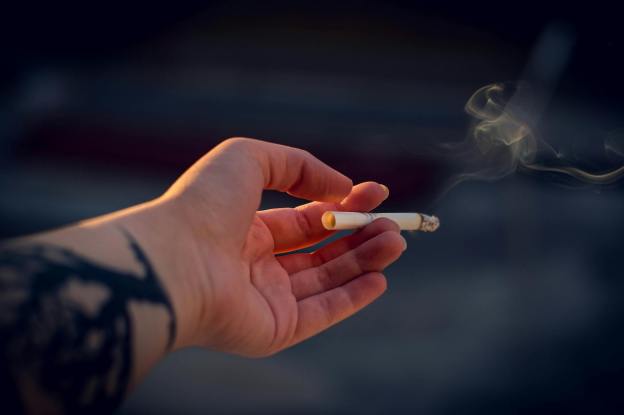
I know next to nothing about substance use. Other than tales of “the alcoholic” family members I never met, the “sinners” in the prodigal-returns books the church fed me, and the guy who beat the tar out of a piñata at his daughter’s birthday party, I live in a substance-use-free bubble. Although, I was offered a drink last week by two guys about my age who came upon me at a local park, where I had stationed myself to watch for beaver activity. I hoped to catch the crepuscular creatures near one end of their habitat, where they had recently felled a large tree.

It became apparent these two fellows had been drinking when they repeatedly complimented my purple outfit, introduced themselves, offered to move my chair for me, asked me to show them the beaver lodge, and kept up a constant stream of friendly banter. Sober people walk by silently and you’re lucky to get a nod.

“If you’re gonna take beer from a stranger, we’re the right people to take it from,” the talkative fellow offered. He went on to explain the virtues of the beer he had in the cooler bag over his shoulder, but it all went over my head. IPA and other alcohol-related terms are Greek to me.

As a child, I was taught to fear alcohol, with the admonition that because alcohol addiction runs in our family, I could become addicted with a single drink. Is there truth to that? I don’t know. Now that I’m an adult it seems beside the point.

Last November, I attended a community education event—“Hidden In Plain Sight,” or HIPS. This event multiplied my slight knowledge of substances by at least ten times. For example, I thought “doing pot” 40 years ago was essentially the same as “doing pot” today. I was wrong. But before I get to that … The whole experience hit me odd—attending a 1.5-hour community event in which I felt the main takeaway was “just say no” (although those words were not used). I thought people who didn’t rely on religious/moral reasons for abstinence just didn’t abstain. Or at the very least, didn’t tell others to abstain. But apparently, given data on brain development and facts about the effects of drugs and alcohol, a whole slough of people agree that—at least for kids and teens—“no” is the appropriate attitude toward substances. And this isn’t about illegal drugs; it’s about nicotine, marijuana, and alcohol.

When I talk to my kids about alcohol and drug use, I notice they are acutely—vehemently—aware that it is “bad”—so much so that it’s easy for them to assume a person who uses is not a “good” person. For that reason, my conversations with them, more often than not, focus on the aspect of numbing pain. I tell them people drink because it makes them feel better. It’s relief from anxiety, loneliness, trauma, and intense emotional pain. And isn’t every human being worthy of relief from pain?

I didn’t know what to expect going to the HIPS event—other than free pizza and a lesson on the paraphernalia of risky teen behavior. But when I left after the event I had a distinct feeling that something was missing—we didn’t talk about the pain these kids are trying to numb. Or the pain their parents are trying to numb. And parental influence means—like it or not—when we as parents use substances to numb our pain, it’s hard to tell our kids not to, and even harder for them to respect and respond to us.

In the state of Washington, where I live, it is legal for a parent to give alcohol to their child at any age, in their home1. And although it’s illegal to give tobacco or marijuana products to your own children, the data in our local community indicates that parents are supplying these items to their children in middle school and high school2—or at least turning a blind eye. Additionally, many websites that sell vapes and other nicotine products simply have a textbox to type in one’s age, making it easier to buy substances than it is to log into your bank account.

Products that were originally marketed as smoking cessation products, such as vapes,3 may deliver more nicotine to users than cigarettes, depending on the product and frequency of use. They’re also cheaper. A carton of cigarettes is $120, and the roughly-equivalent 7,000-puff rechargeable fume vape—which comes in more than a dozen flavors and fits easily in a closed hand—costs only $15. It also conveniently flies under the radar of the Clean Indoor Air Act, since the nicotine is delivered without a cloud of smoke. As you might imagine, these changes rewrite the landscape of nicotine use.

And alcohol is not exempt from the changing landscape. With a disposable water bottle, a wine cork, and a bike pump, a curious teen can vaporize alcohol, conveniently bypassing their digestive system and taking the full impact of a shot of hard liquor directly to their bloodstream.4

Now back to the changes around “doing pot”. Before the turn of the century, marijuana products delivered about 4% THC, or tetrahydrocannabinol, the psychoactive compound found in cannabis. In the 2010s, that number jumped to nearly 20% with the medicalization of marijuana. Today there are products containing up to 90% THC5. This ain’t your grandpa’s weed. Yet in Walla Walla County the Healthy Youth Survey in 2023 reported that 56% of 10th-grade respondents thought trying cannabis/marijuana held no risk or low risk, and 30% thought regular use had little or no risk.6 Are these students thinking of grandpa’s weed, or the expanding menu of available products? There’s rosin, crumble, distillate, bubble hash, dry sift, crystalline, and the list goes on.7

Youth who experiment with substance use are often unaware—now more than ever—of the actual amount of alcohol, nicotine, or THC they are taking in through various products or processes, resulting in an uptake of accidental overdoses.8 Parents seem to be checked out of their kids’ lives, and capitalism is taking advantage of the changing topography of products that deliver substances.

2023 Health Use Survey (askhys.net)
Walla Walla County data

20% of 10th graders reported using marijuana at least once in their life.

50.9% of 10th graders reported using alcohol at least once in their life.

16% of 8th graders had ridden, during the previous 30 days, in a vehicle driven by someone who had been drinking alcohol.

2.7% of 6th graders (my 12-year-old daughter’s grade) reported alcohol use in the past 30 days, as did 3.9% of 8th graders and 13.1% of 10th graders.

19.5% of 8th graders and 33.6% of 10th graders indicated it would be “sort of or very easy” to get marijuana.

In case you got lost in the grade numbers,
all of these statistics are for youth approximately 11-15 years of age.

Not long after attending the HIPS events, my husband Michael and I walked by a smoke shop as we were finishing a pizza-and-ice-cream date night. “Ooh,” I said spontaneously, “let’s go in!” Michael didn’t share my enthusiasm, but he followed me inside the shop. The young man behind the counter welcomed us in and asked if we were after anything particular. I volunteered that neither of us had ever had anything. “If there’s something you want to try, let me know,” he offered.

To the left, behind a long counter, packaged products lined the wall. To the right, blown-glass paraphernalia caught my eye. I didn’t know what any of it was called. “Pipe” and “bong” seemed like terms that probably applied to some of the stuff, but I wasn’t sure. It reminded me of visiting the glass-blowing shops in Oregon’s coastal towns. Rows of shelves showcased the beautiful colors and shapes, and at the back of the store two more large displays highlighted artful drug paraphernalia.

The shop also had knives, samurai swords, rings for body-piercings, incense, an impressive display of fancy cigars, sex paraphernalia, and—based on my newly-acquired knowledge—several items I assumed were for hiding drugs. Michael and I circled the store a few times, commenting quietly to each other. Wanting to be a good customer, I bought a small vaping device.

Just kidding. I bought a pair of cheap earrings.

“Drugs and alcohol” are not the static story I imagined. And my interpretations are one tiny perspective on an issue that is complex beyond any one person’s understanding. Advertising, social influences9, the complex science of the over-400 components of cannabis10, the biology of addiction, stigma, family structure, mental health, and countless other factors impact our youth and their decisions around substances.

Mental health professionals and others, including the renowned Brené Brown, say it isn’t possible to selectively numb emotion. If we numb pain, anxiety, and sadness, we also numb joy, contentment, and gratitude. How will a generation unable to feel things—let alone name those feelings—live whole lives, experience belonging, and effectively walk through the tragedy and triumph of life?

And how will they teach resilience to the next generation?

I am left with more questions than answers. Why did I know nothing of the breadth and depth of new and evolving products and packaging around substance use? Why did only about 20 people attend this HIPS event that was marketed across the Walla Walla Valley? Why does it seem like social workers and law enforcement are the only people looking at this data?

About 10% of 8th graders and 14% of 10th graders surveyed had considered suicide. Over a third indicated a struggle with depression.11 Why are our children in so much pain? And how are we offering relief?


Endnotes:
1 RCW 66.44.270, subsection (4), viewed here.
2 The Healthy Youth Survey fact sheet for Walla Walla County in 2023 reports that 29% of youth in 8th and 12th grades, and 27% of youth in 10th grade reported getting alcohol from home, with permission, in the past 30 days. Additionally, only 5% of youth drink alcohol if their parents think it’s wrong, while 28% drink if their parents don’t think it’s wrong. This data is from a fact sheet created here.
3 https://pmc.ncbi.nlm.nih.gov/articles/PMC10880776/
4 https://www.vumc.org/poison-control/toxicology-question-week/jan-29-2020-alcohol-vaping-friend-or-foe
3 https://medicine.yale.edu/news-article/not-your-grandmothers-marijuana-rising-thc-concentrations-in-cannabis-can-pose-devastating-health-risks/
6 This data is from a fact sheet created here.
7 https://vivosun.com/growing_guide/what-is-crumble-crystalline-sugar/
8 This was covered in the live presentation. I’m still looking for a data source to cite here.
9 https://www.cdc.gov/tobacco/e-cigarettes/why-youth-vape.html
10 https://pmc.ncbi.nlm.nih.gov/articles/PMC4188645/
11 This data is from a fact sheet created here.

Two New Holes

Shortly after my May birthday last spring, I acquired two new holes in my body. I had my ears pierced.

One aspect of the conservative Christianity I grew up in is an aversion to body piercings. And tattoos, lipstick, and clothing that reveals feminine curves. When I left home as a I teen, I bought a padded bra, colored my hair with a box of dye from Walmart, and called it good for my rebellion. As a young adult I said I didn’t want to pierce my ears or get a tattoo because I have a low pain tolerance. Also, I faint for vaccinations, blood draws, and if I hit my knee or elbow too hard. (I fainted at the dentist once, and I fainted when I went to the college clinic to get a wart removed from my foot. The nurse sent me to Walmart to buy the kind of wart remover you paint on yourself.)

Why this sudden body piercing urge, you might ask, as I’m nearing the age of 40?

Last year, my nine-year-old daughter Kyli decided she wanted to get her ears pierced. “Why don’t you have your ears pierced, Mom?” she asked.

“I don’t know. I don’t like pain.”

“Well, if you really wanted them pierced you would do it,” she countered.

Point taken. So I thought about it. I hoped quiet reflection might reveal something profound, but my reasons were a grab-bag—it hurts, most of my friends don’t wear earrings, it feels weird to do it now that I’m middle-aged, it seems unnatural to poke a hole in my body (morality aside), my parents won’t like it, and so on. Like I said, random, blah, blah, blah.

So I decided to give it a shot, get my ears pierced with Kyli, and see if I like wearing earrings. Rather than take the lead because of lived experience—my usual role as mother—I had the same questions, concerns and curiosities as Kyli. We’d be figuring this one out together.

We waited for the school year to finish since the kids attend a Christian school that doesn’t allow earrings (or colored nail polish—go figure). Kyli wanted to get earrings the moment school let out, so we made appointments at Ulta Beauty for 1pm on May 31st—one hour after school dismissal on the last day of the school year. We snagged Kyli’s bestie, got a bite to eat, and drove to the salon. Inside, past the rows of creams and powders and scents, we found a plump young lady ready to pierce our ears.

I signed the thing they handed me—a waiver?—while Kyli picked out studs. Her bestie pinched her arm hard to show her how much it would hurt. The plump lady drew dots on Kyli’s earlobes, asked us to examine them and approve the placement, then inserted a stud in a white hand-gun. Punch!—right ear done. Kyli’s eyes were wide, a combination of curiosity and alarm, as she took in the experience and tried to categorize it. Painful? Scary? No big deal? Before she could settle an answer, punch!—left ear done.

For the next minute, Kyli’s hands hovered around her ears, her instinct to squeeze them through the discomfort, at odds with her determination not to touch. I watched, ready to comfort. But I wasn’t needed. Bestie dragged her around the store, applying makeup until Kyli’s face was caked with several shades of foundation and blush and her fears forgotten.

Meanwhile, I warned the employee holding the ear-piercing gun that I’m a fainter. Judging by her look of alarm, I guessed she didn’t have a lot of experience with people fainting—either that or she had a memorably bad experience. “I’ll know if I’m going to faint, and I’ll tell you,” I assured her. She proceeded to draw dots on my ears, punch, punch, voilà! Little silver hearts rested on my earlobes. During those thirty seconds, I felt the same wide-eyed, uncertain curiosity Kyli’s face had conveyed, but when it was all over, decided the pain wasn’t worth mentioning. We took pictures, documenting this mother-daughter experience trying something new together.

All summer we cleaned around our earrings, front and back—twice a day at first, then less often. We cleaned them after showers, after swimming, after getting dirty in the yard. We twisted them around in the holes as we had been instructed, and left them in 24/7.

At first, earrings were more unnerving than I expected. It felt wrong to intentionally punch a hole in my body and take special care of it to keep it that way. Usually when I cut through my skin and flesh, I tend it carefully to facilitate healing. This was different. Also, for the first month or two, I felt slightly anxious about having something attached to my body that I couldn’t take off. When I went to bed and took off my watch and glasses, I wanted to put the earrings on my nightstand too. I wanted to take them out so my body could be just my body. During the night, I tried different positions with my pillow to put the least pressure on my earlobes.

After the prescribed six weeks, I hesitated to remove my earrings since they still oozed or bled occasionally. Kyli, tired of waiting to wear a favorite pair of earrings, took out the original studs and sported cute, sparkly flowers for a day. This joyous occasion deteriorated when I couldn’t find the right hole to get the original studs back in her ear. I had erroneously thought a hole was a hole, but the tip of the earring took it’s own course through the fleshy part of Kyli’s earlobe and came out the back in a different place!

Blood, tears, and parental concern and confusion ensued. We survived this try-to-find-the-right-hole circus two or three times over the next week, and eventually Kyli’s left ear was so unhappy she let it heal shut. When school began again in August, she wore a tiny clear stud in her right ear—which still oozed and bled sometimes. She didn’t want to remove that one, but also refused to get her left ear pierced again. We were deadlocked in pirate mode.

The first pair of earrings I bought came from a rock-and-mineral shop in a falling-apart historic building we stumbled across during a bathroom break on a road trip. They’re tiger’s-eye stones. I nearly passed out when I first put them in, but after lying on the bathroom floor and breathing deeply for a minute—usually an effective method to maintain consciousness—I returned to normal.

At this point, I’ve probably had as much fun buying earrings as wearing them. For more than six months, I didn’t leave my earrings out any longer than an hour—the holes still appeared tenuous. Either the original studs or one of my half-dozen new pairs of earrings stayed in my ears at all times. At last, a month or two ago, I slept truly naked for the first time. It felt good as good as I imagined.

In a few months, it will be a year since we pierced our ears. During that time, Kyli’s right ear developed big scabs and pus came out when I cleaned it, over and over, so a few weeks ago she took out the clear stud. It’s healing now, and she’s done with earrings for the time being. Meanwhile, I’m growing into the fun of it. My sister gave me a beautiful pair of iridescent hummingbird earrings for Christmas. Michael gave me a pair of book earrings for Valentines Day—I’d been looking and found surprisingly few options, and these are adorable tiny blue books with real pages. I wore them to the library this week, and felt that same satisfaction I get when my bra and underwear match—a covert sense of matching.

So, friend, if you’re forty-ish and thinking about earrings, here’s what I’ve learned: It’s a small adventure, and hey, maybe that’s what makes it fun. These years lean low on adventure—outside of parenting. And come to think of it, this adventure was tangentially brought to me by parenting—two new holes, the result of a question from my daughter.

How about you—any new holes in your life? Or body?

In Five or Six Hours the House Will Be Quiet

I’m not okay. This is how I know it’s time to write.

I’m sitting in the kids’ room by the fire I lit for them—my attempt to dote on them since they stayed home from school today.

Sore throat again this morning—it has been almost daily for weeks with my younger daughter, Kyli. The older one, Kayt, said probably nothing is wrong with her but she doesn’t want to go to school. Middle school “friendship” has been sucking the life out of her. I can’t help but wonder if her chronic exhaustion and headaches are as much social as they are physical.

I shone a flashlight down two throats this morning. Kyli’s looked red, and Kayt’s had a weird white blob that dr. google says is a tonsil stone. Never heard of those before.

By the time I sit down to write, it’s midafternoon. Homework time downstairs has devolved. My stomach clenches in response to unharmonious sounds, insufficiently diminished by their travel up the stairs to my ears.

Now Kayt has come upstairs to whine and writhe. Technically she came up to say Kyli is bugging her and won’t stop. Since I made clear arrangements for Kyli to come upstairs if they weren’t enjoying sitting together, I feel a gallon of frustration and a drop of empathy. So I tell her to send Kyli upstairs, and that’s why she’s begging, moaning, and asking unanswerable questions in a nails-on-chalkboard tone of voice. She has a weird thing about not being alone.

At 7:15 this morning, when I usually would have been seeing the girls off to the bus, instead I set up appointments at the urgent care center. This change in schedule involved calling the bus driver and texting, let’s see,—their teacher, my yoga instructor, my husband, and several people I had plans with later in the day.

Did I mention the power outage? Just got yet another automated call from the power company. I have an outage that should be restored by 4:30pm, says the message. The power has already been back on for half an hour, and it’s currently 3:30. Not to mention just a few minutes ago I received an automated call informing me that the outage was caused by wildlife (read “squirrel”), and my power had been restored.

I think I’ve received five automated calls, including one that announced an outage had been reported in my area and a truck had been dispatched. Yes, I’m aware. I reported the outage when an explosive BANG and corresponding flash of light outside the dining room window resulted in all powered devices in our home going blank.

My husband is in Denver for work.

My sister is home with a sick kid as well.

My younger daughter made a “fun cutting station” on the floor in her room, where folks can experience the satisfaction of cutting various materials—like blue yarn (now in pieces all over the floor), tiny foam squares, a rubber armband (okay, that actually is super satisfying), and a plastic packing sleeve.

On the kitchen counter downstairs is a bowl of homemade slime that looks like a hot-pink pile of animal intestines. The dining table is covered with rubber stamps and paper, ink pads and embossing supplies, dirty dishes, purple slime, saltines, and homework.

Finally. I breathe. Here’s a moment of peace. Kyli is taking a break from homework, so I allow Kayt to study upstairs with me.

Kyli is quietly making a creature out of air-dry clay (a substance which already covers a significant portion of the bathroom counter due to a previous creative session this morning).

I don’t like the multiplying messes.

Sibling snarkyness nauseates me.

Most of my day has born no resemblance to the Wednesday I thought would unfold when I opened my eyes this morning.

But I ran on the treadmill and took a shower this morning, and in an unplanned burst of self-care I even dried and straightened my hair, and put in earrings. I’m sitting here by the fire, cat on the hearth, journaling. I did a marvelous breathing meditation from The Artist’s Rule, and I laughed with my girls.

After our visit to urgent care, we went to school and picked up homework (the current quarter ends in two days and there is a small state of panic about grades). Then we filled the car with gas for “real low cheap”* at the station near the school, stopped at Walmart for grocery pickup, and came home for the whole slime-making, lunch-eating, power-outage bonanza, followed by the Sibling Homework Crisis of 2024.

So I’m not okay.

But also I am.

Because it’s okay to not be okay.

And I’m grateful my kids don’t have strep, and … this just in: Kyli is cutting a stick of gum into pieces, holding the scissors above her mouth so each piece drops in … back to gratitude—for the fire warming my feet, for furry and purry kitties, for a relatively small pile of dishes in the kitchen sink. I haven’t yelled at my kids, and I have listened to them. I’m going out with girlfriends this evening.

And—bless Mother God—in five or six hours we’ll (fingers crossed) be tucked in bed and the house will. be. quiet.

*If you want to acquaint yourself with the phrase “real low cheap,” watch this.

Small-Town Anniversary

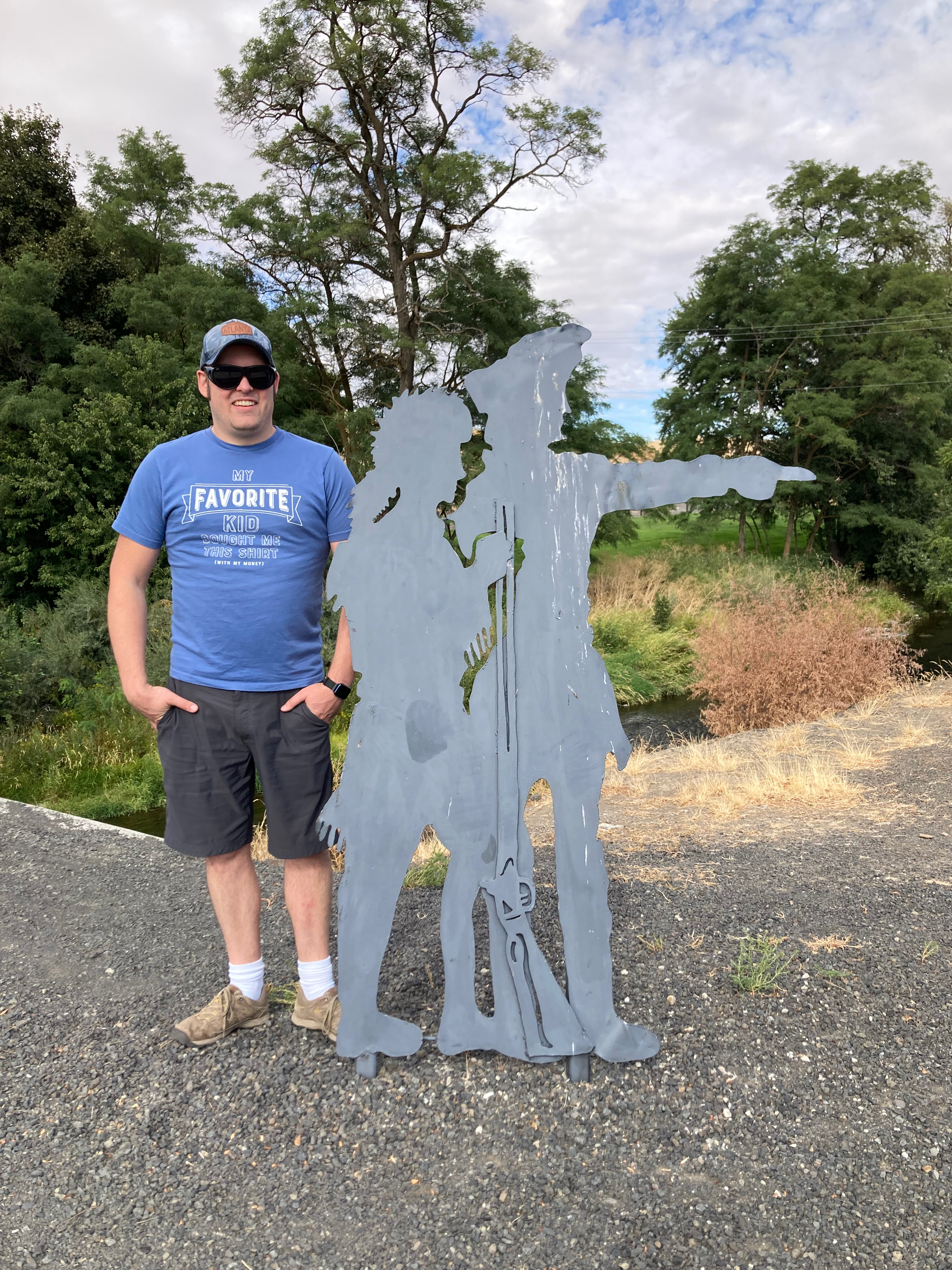
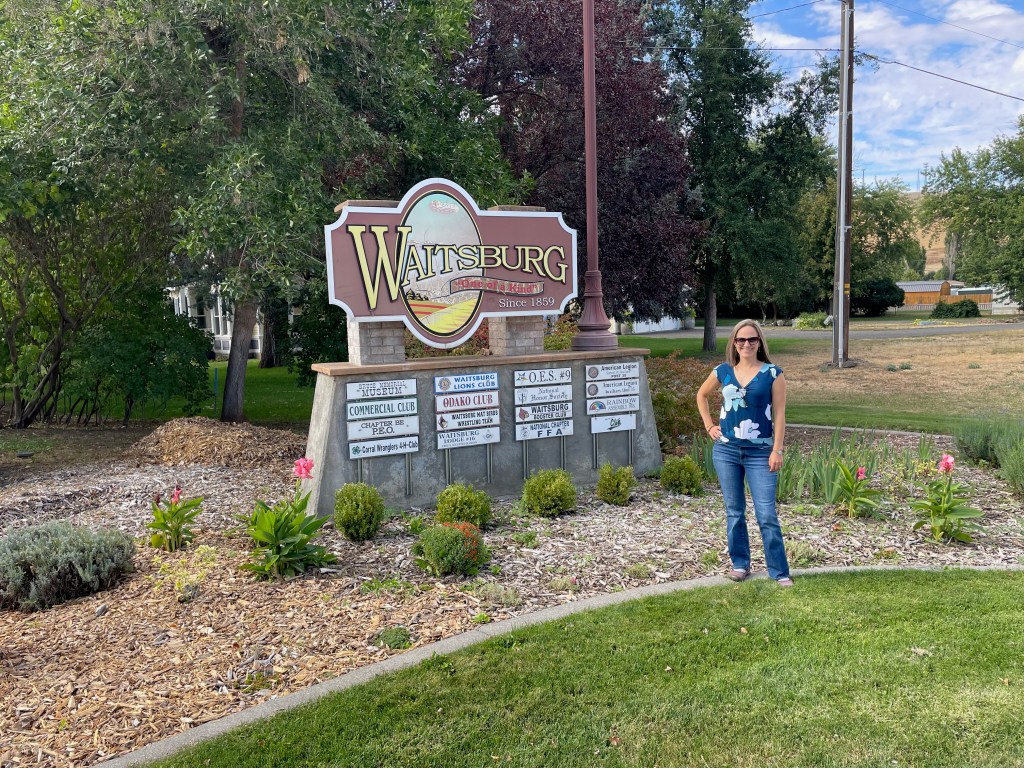
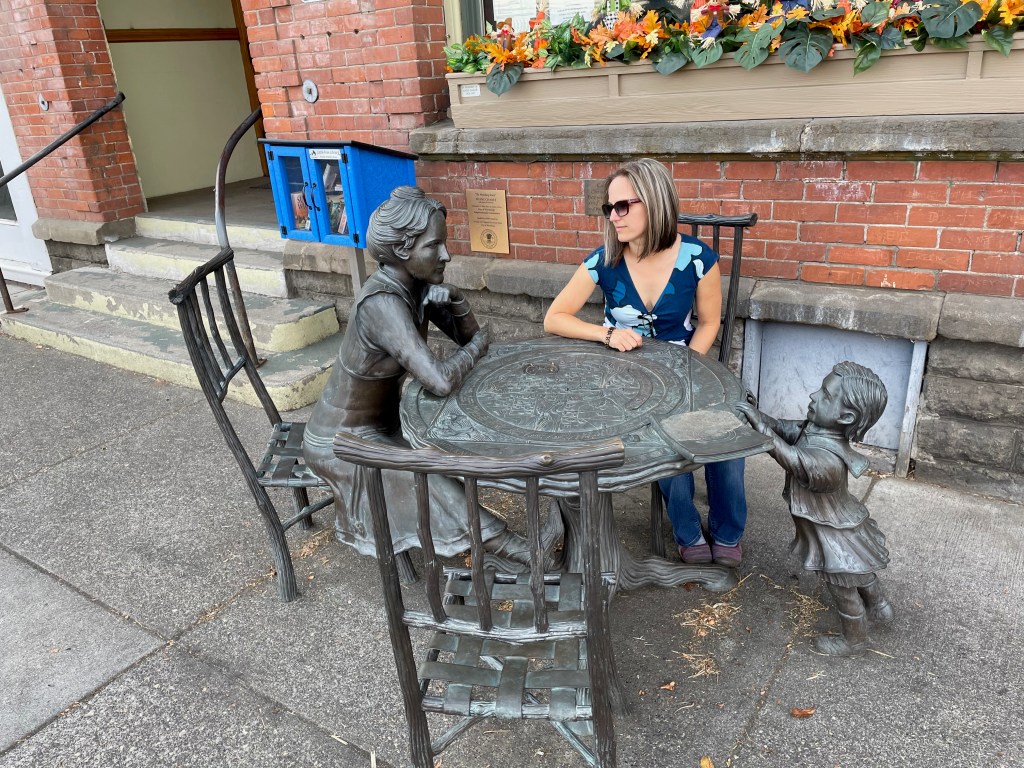
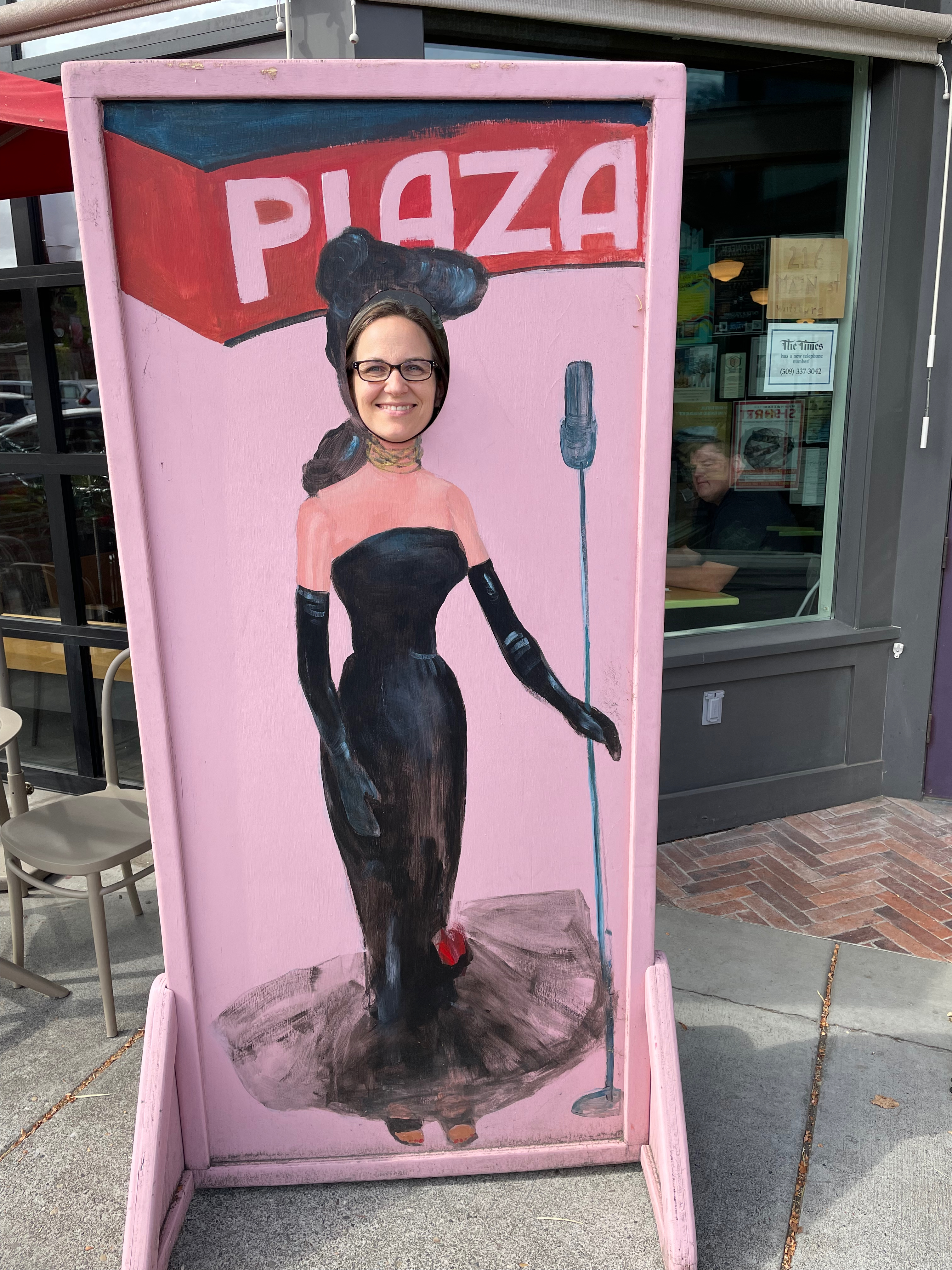
Last weekend Michael and I celebrated 19 years of marriage, with a getaway to Waitsburg, WA. For those who aren’t from around here, Waitsburg is a 25-minute drive from our home in Walla Walla, and it boasts a population of about 1,200. Despite its small size (or maybe because of it), Waitsburg treated us like royalty.

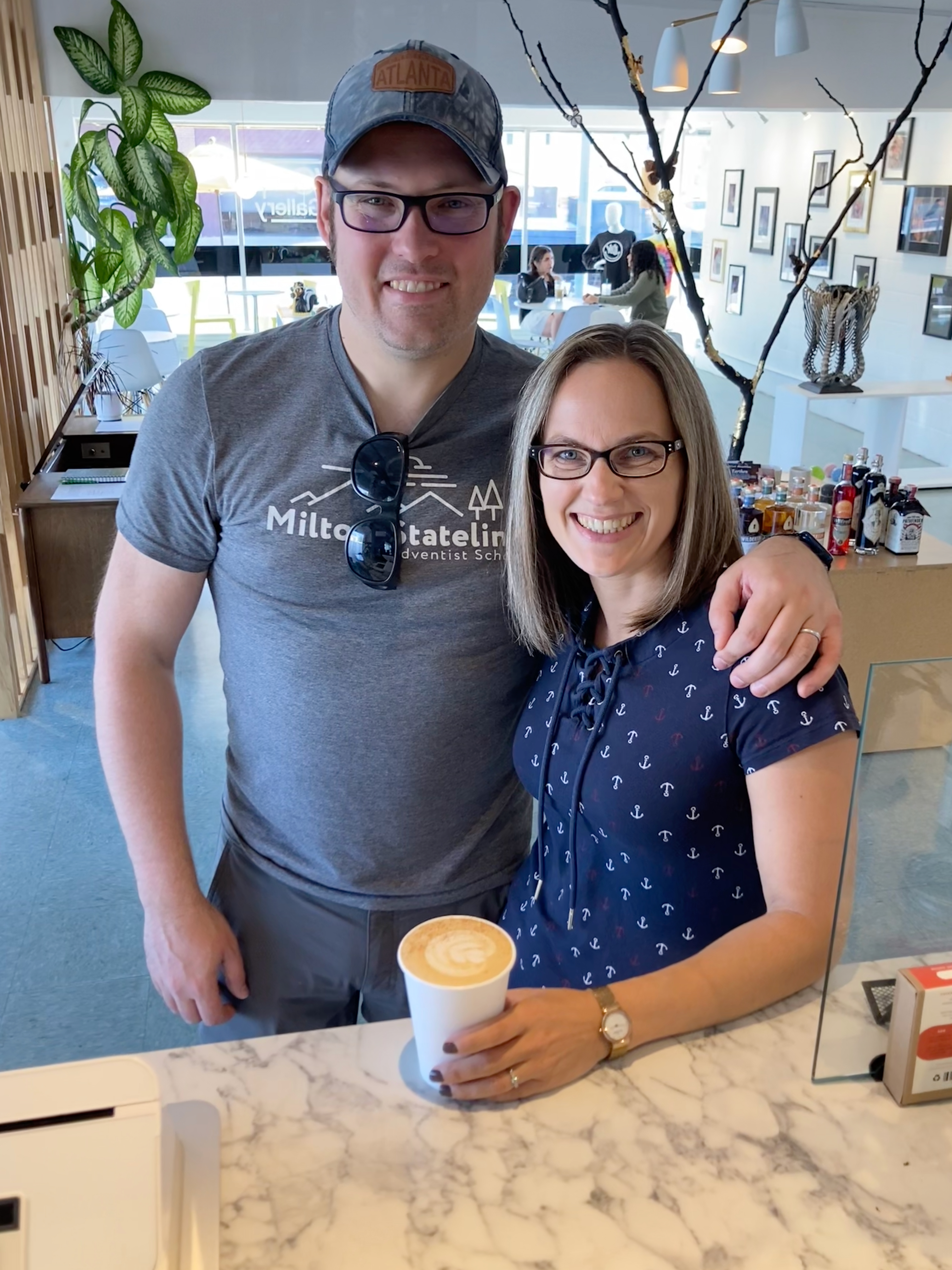
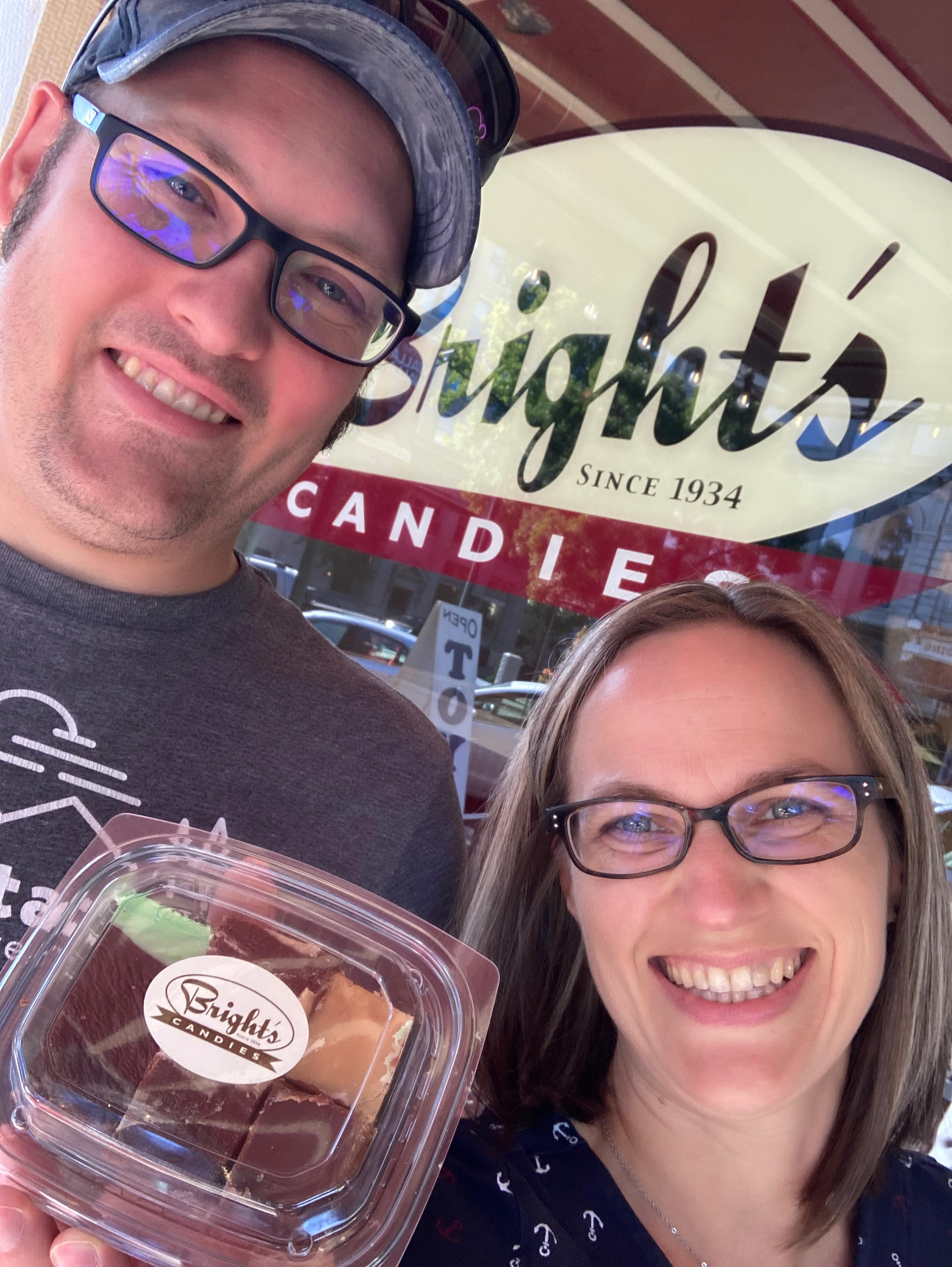
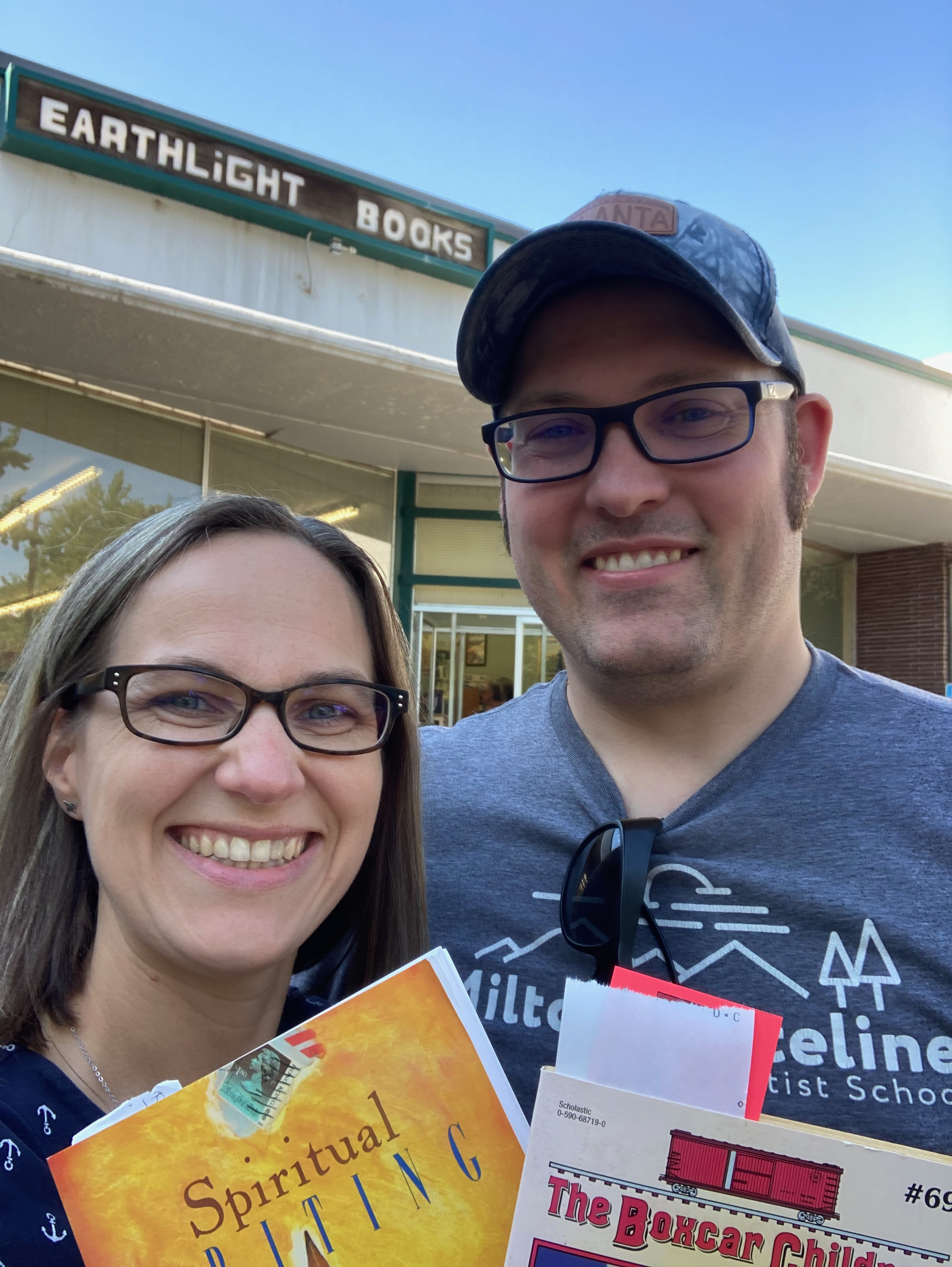
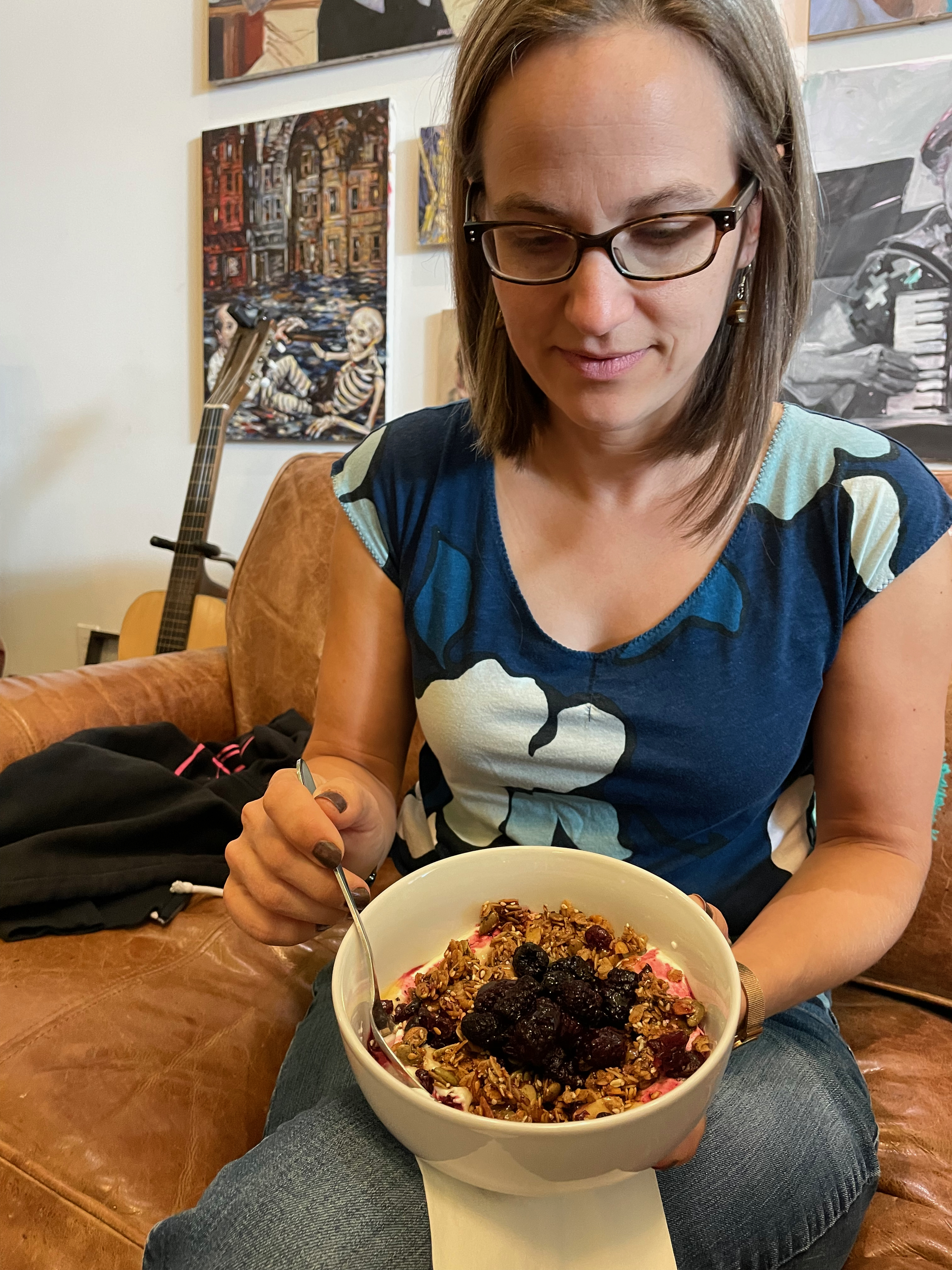
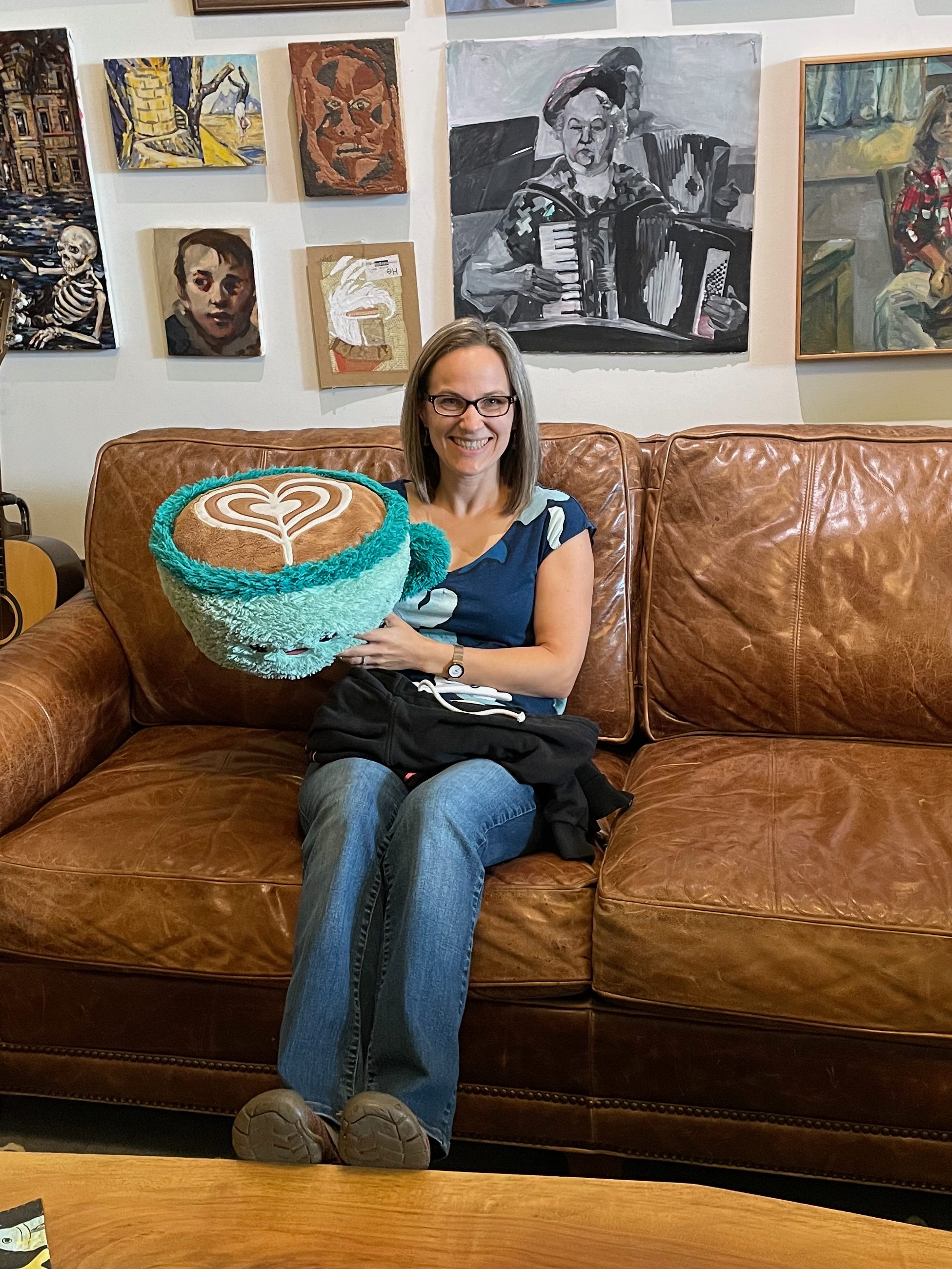
We dropped the kids at their great-grandma’s house Friday afternoon, and since it would be a couple of hours before we could check in to our hotel, we bummed around Walla Walla for a while. We stopped at FVC Gallery to try their new pumpkin chai. Then we poked around the stacks and shelves at Earthlight Books. After that, a walk to Bright’s Candies in the warm afternoon sun brought us close to our check-in time and we drove to Waitsburg. The farmland and sky showed off as we passed the time talking about serious stuff like other people’s relationships.

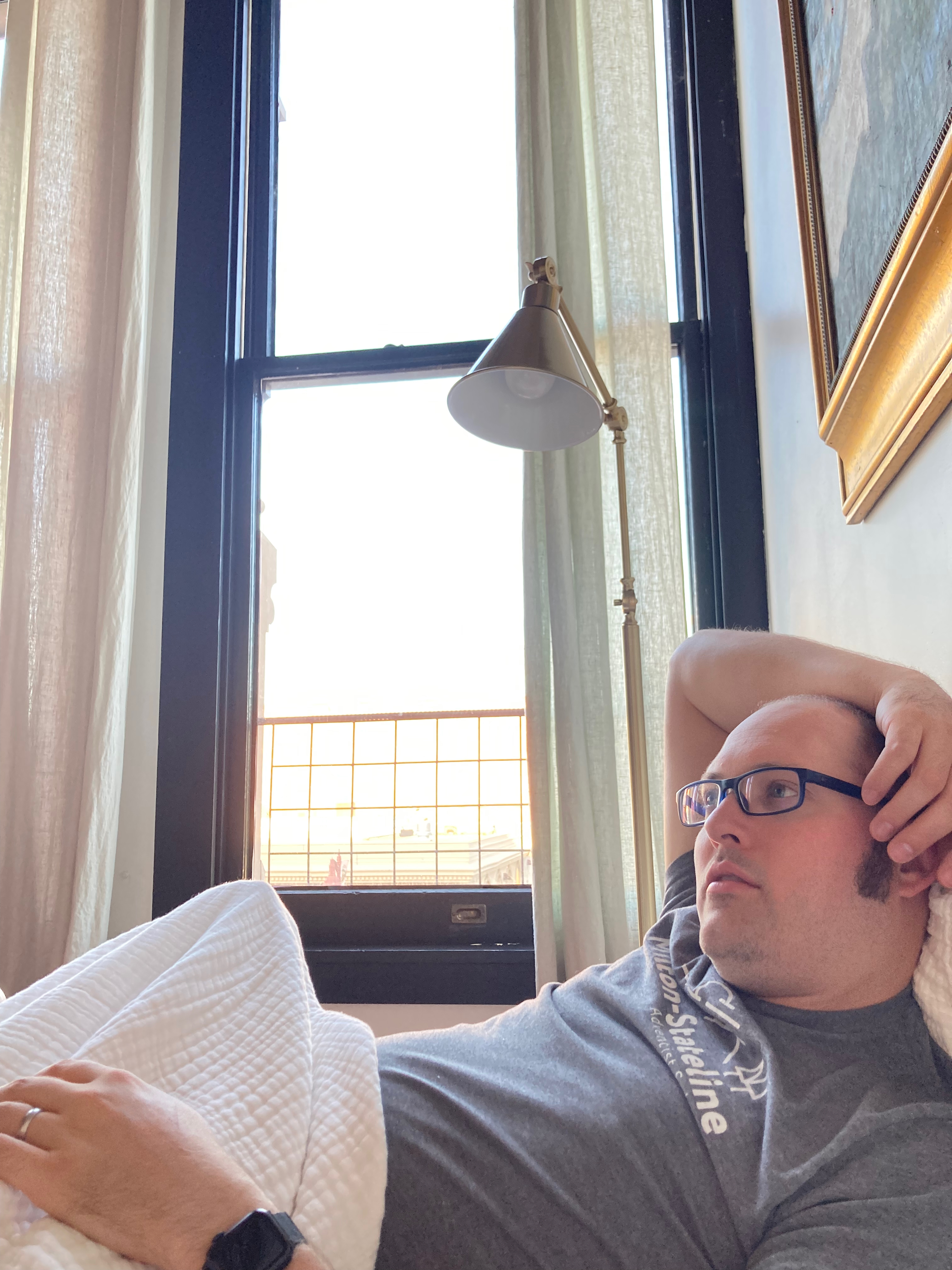
Our room in the the Royal Block had tall ceilings, and gorgeous windows facing Main Street. The king bed occupied a loft over the large custom shower.

We lounged in our room, then checked out the local grocery store and convenience store (there’s one of each). Although we didn’t find the plant-based meat we were looking for to go with our croissant sandwiches, I found pineapple juice concentrate. (That may not sound exciting, but the two grocery stores I shop at weekly have been out for months. I like to keep it around for smoothies (especially piña colada smoothies), so we made plans to come back and buy some later.)

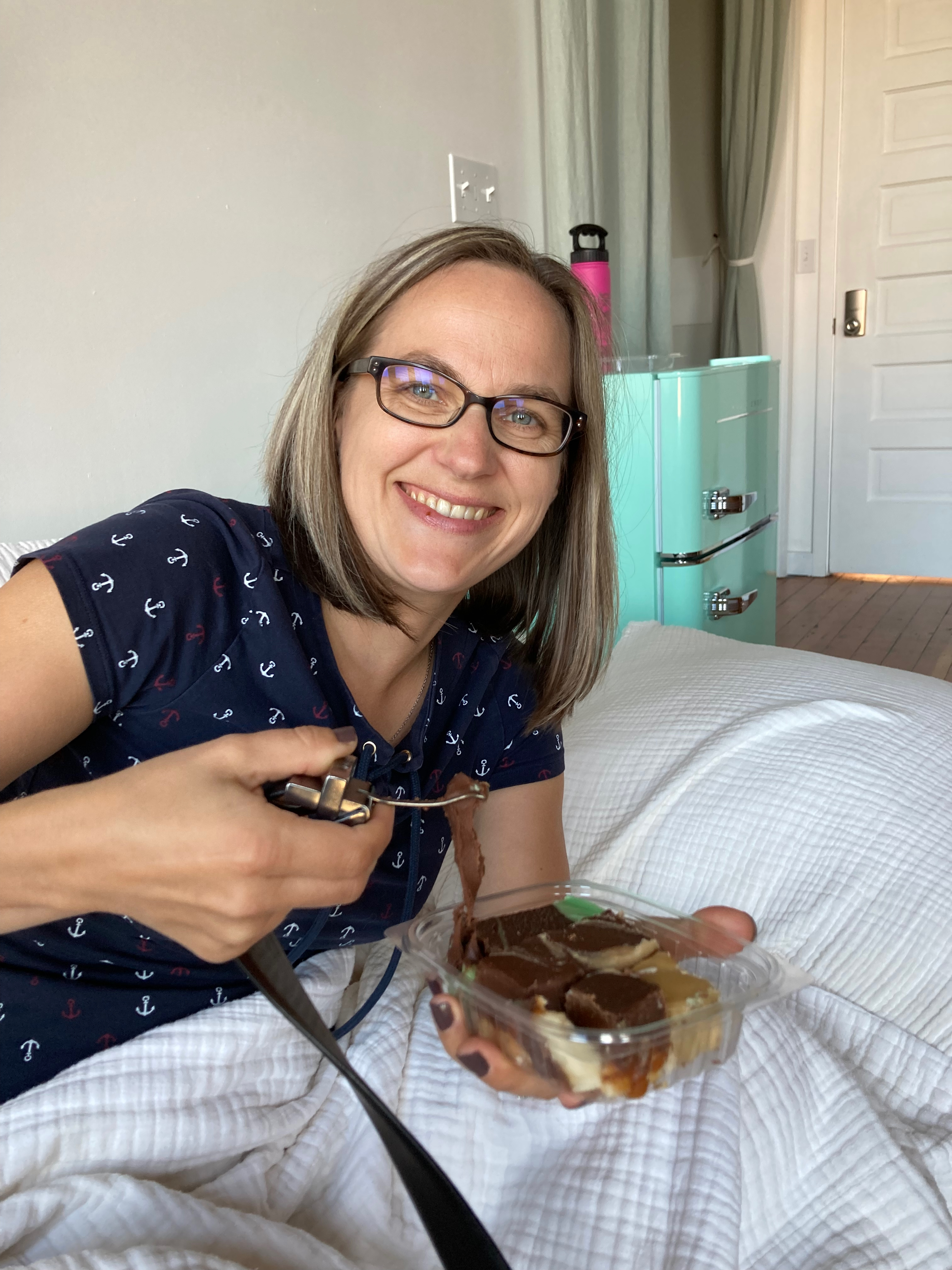
After dinner we opened the fudge from Bright’s Candies. We had no utensils, plastic or otherwise, so we used the prong on Michael’s belt buckle to slice our fudge. Yum.

In the evening, we wandered down to the bar that occupies a portion of the Royal Block’s first floor, and ended up deep in conversation with the owners, Joe and Tiina. Tiina made us a cup of tea and kept our water glasses full, while Joe regaled us with stories of the owls that lived in the building when they first bought it, and how they lived in a tent because of how much water dripped down inside any time it rained. They’re passionate about community and beauty, and are delightful conversationalists. We must have talked for an hour before turning in for the night.

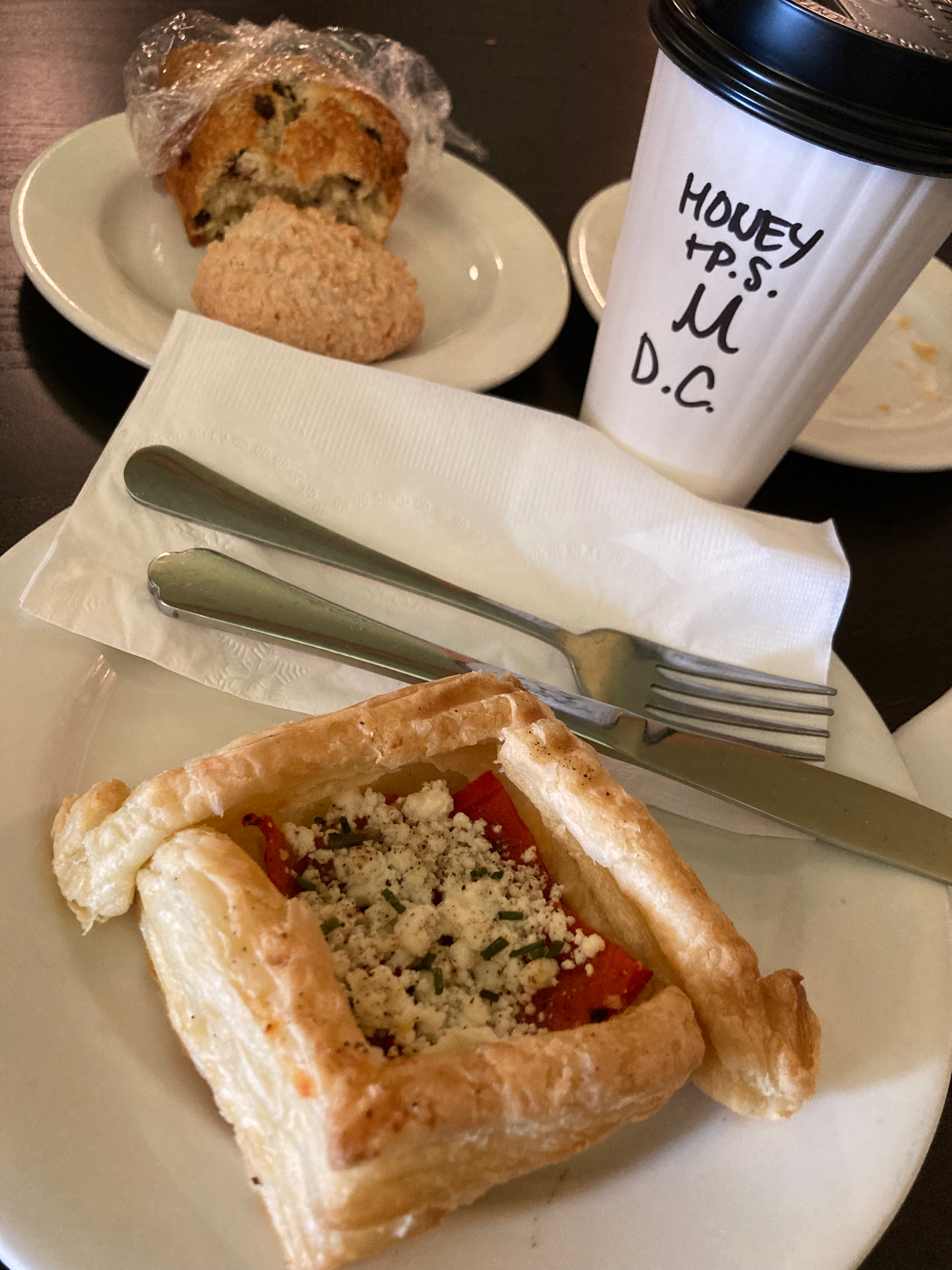
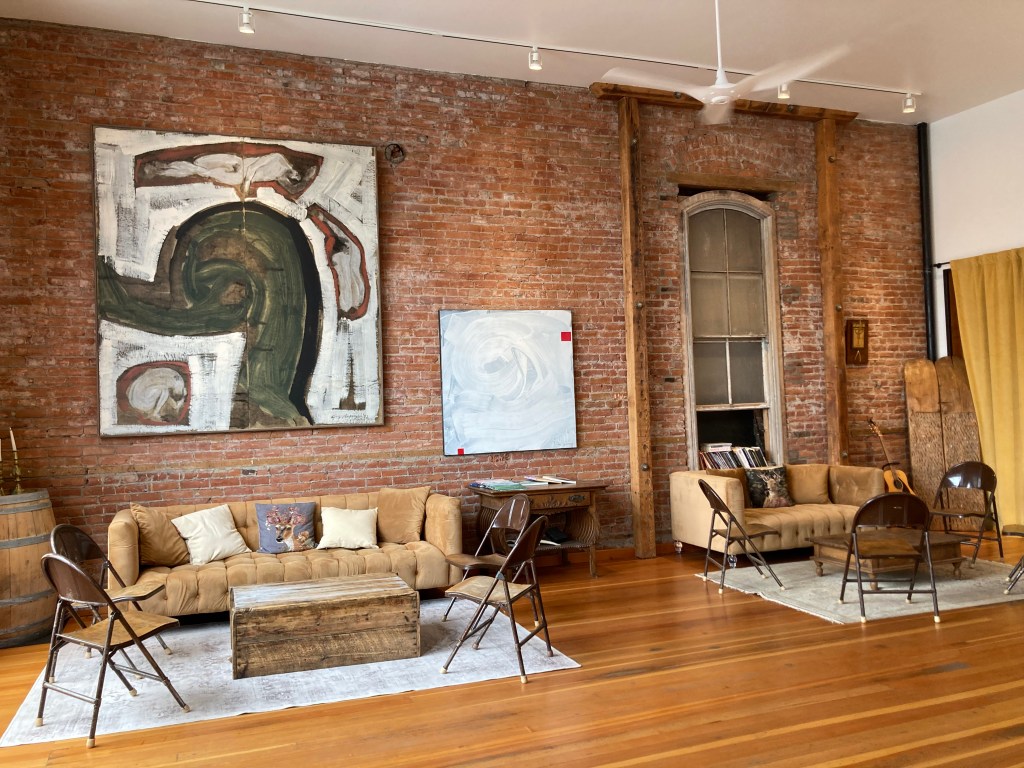
Saturday morning we quietly exited the Royal Block and walked next door to Ten Ton Coffee, where eclectic art, comfortable seating, and good food occupied us. Michael read “King Jack and the Dragon” to me while we waited for our food. (The story was new to us, and I highly recommend it for preschoolers and their parents.)

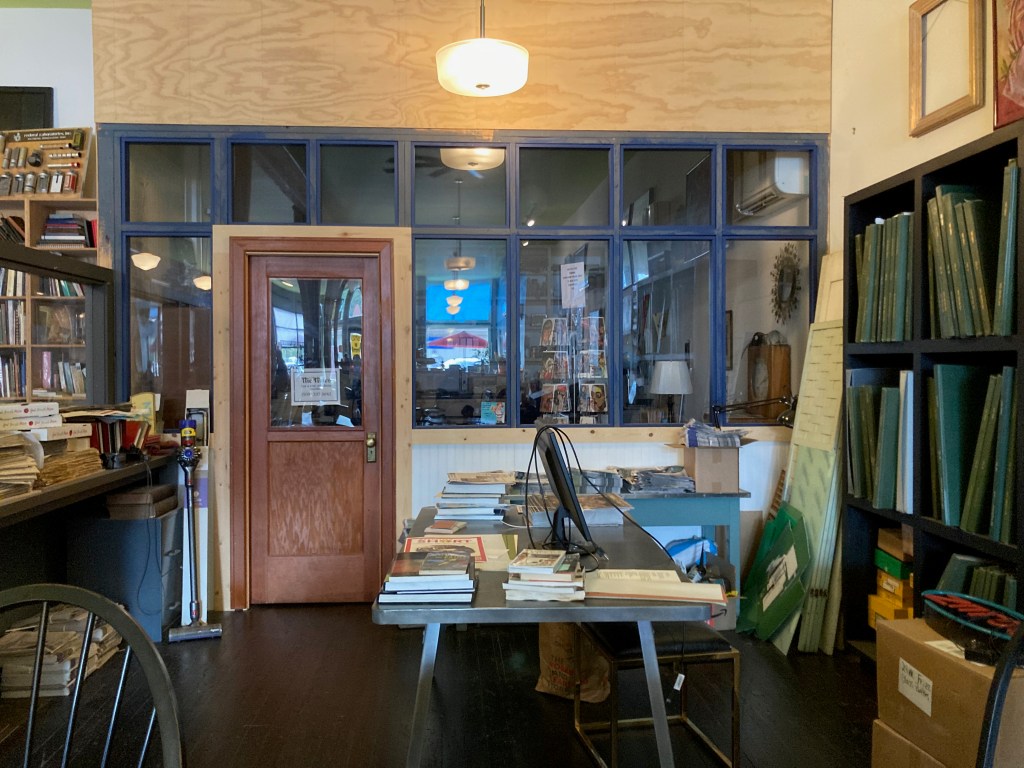
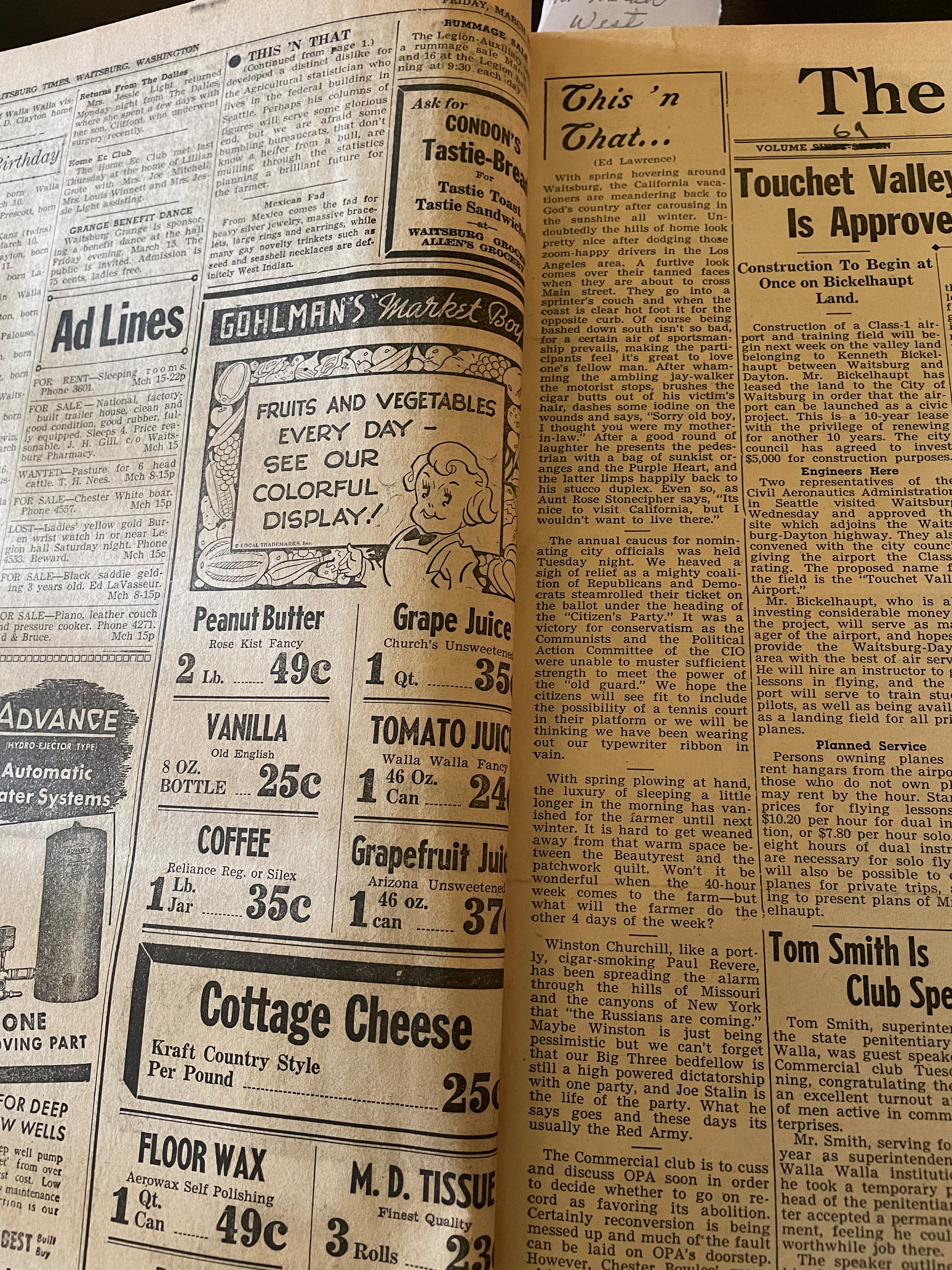
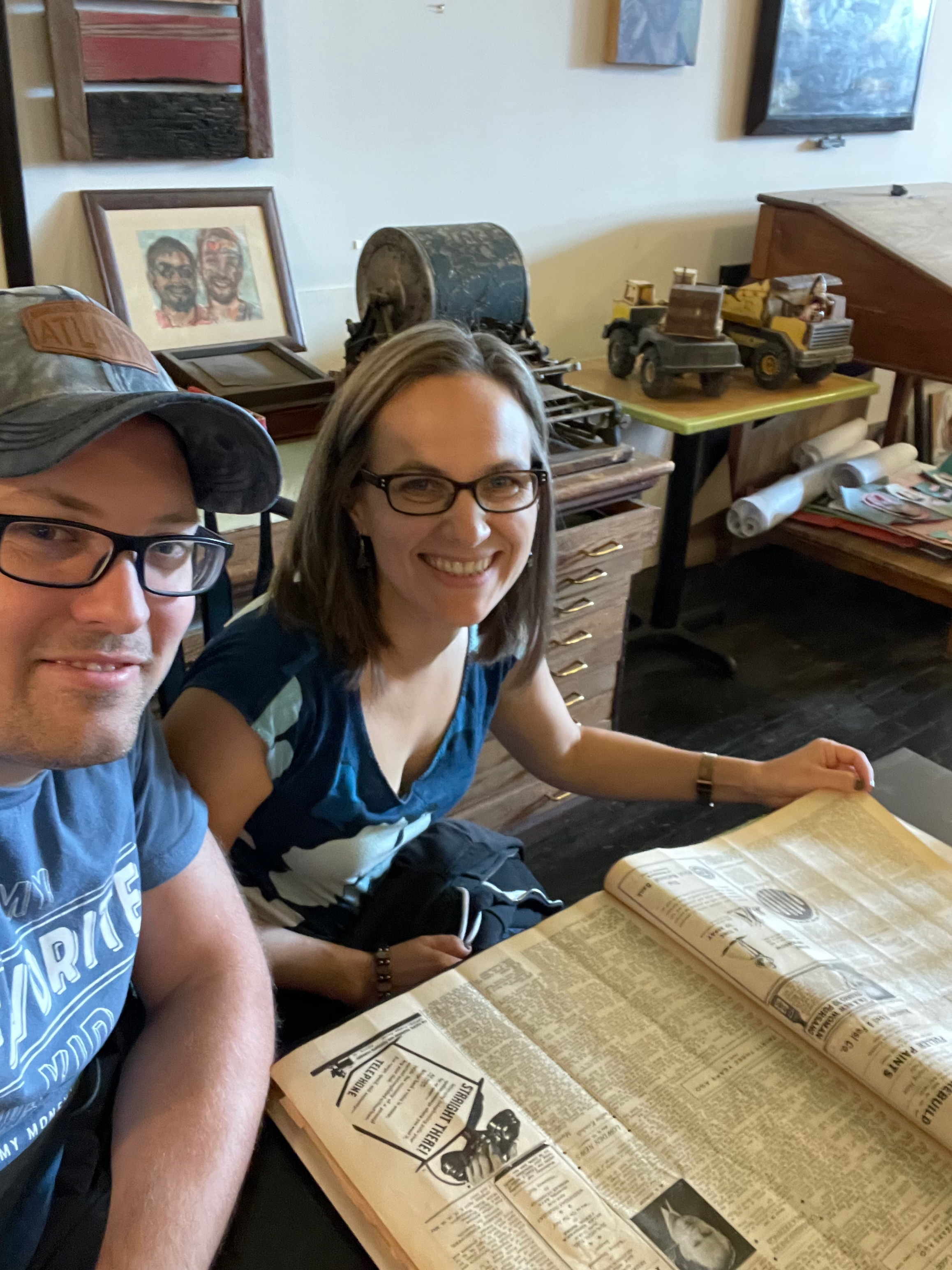
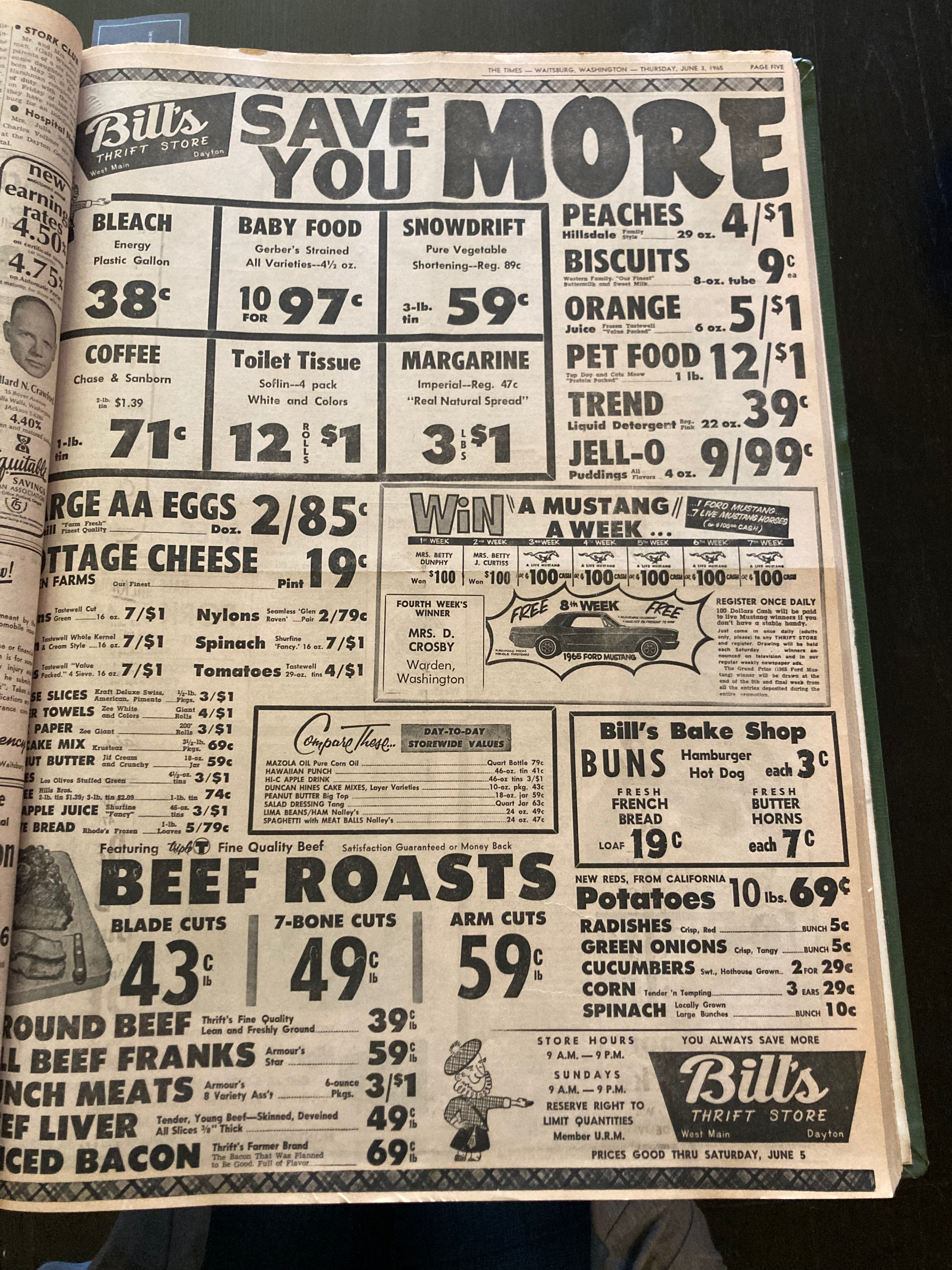
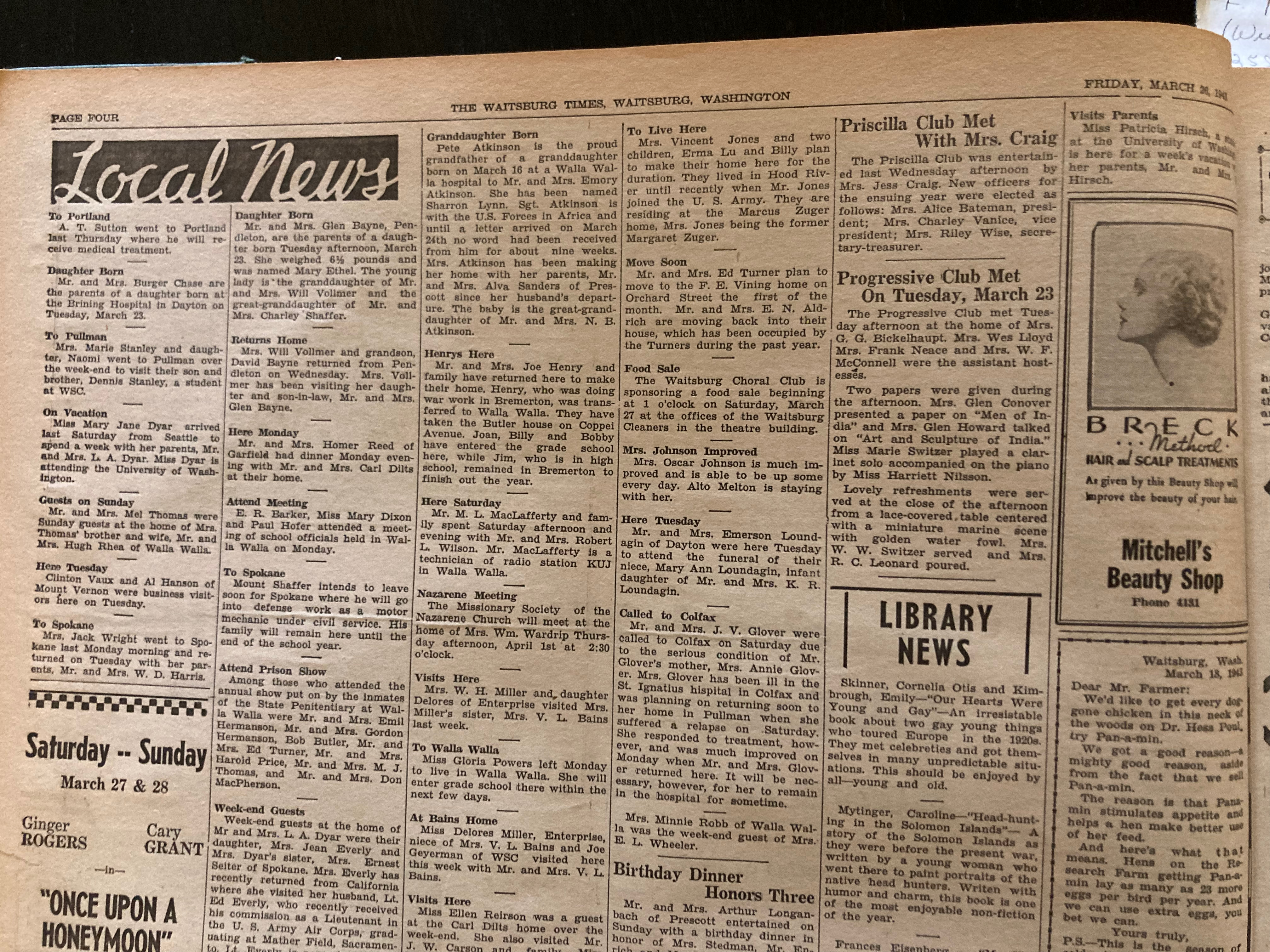
After eating, we checked out The Times office in the back of the coffee shop. The woman who currently owns the paper struck up a conversation. We talked about coffee, art, the local white supremacists, and The Times, which has been in print nearly 150 years – since 1878. She invited us to peruse the archives, housed in large volumes with green covers, shown on the right in the picture below.

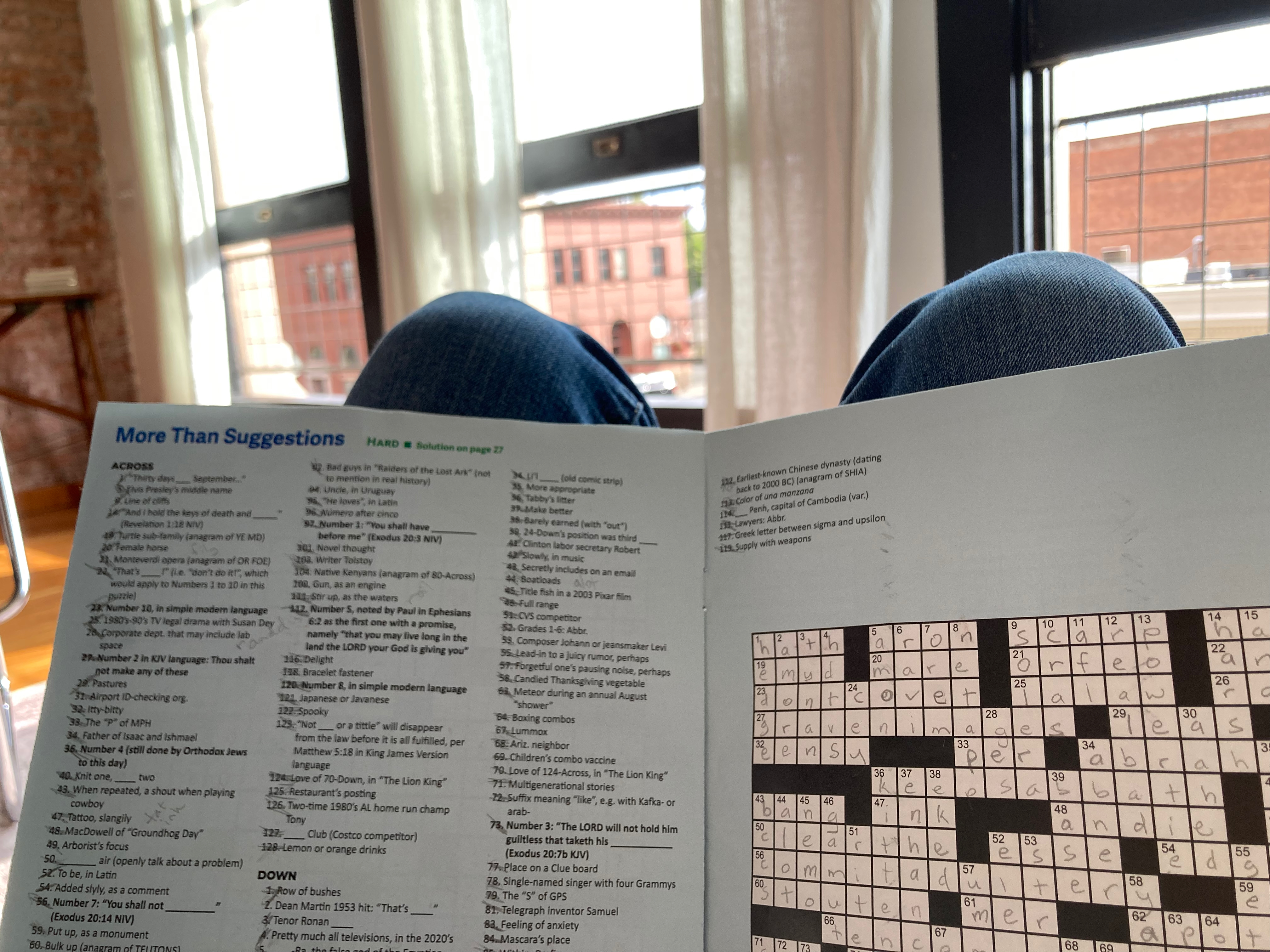
Having no plans for the day turned out to be great fun. We read newspapers from the 40’s and 60’s, and when we tired of that we went back to our room and did a crossword puzzle.

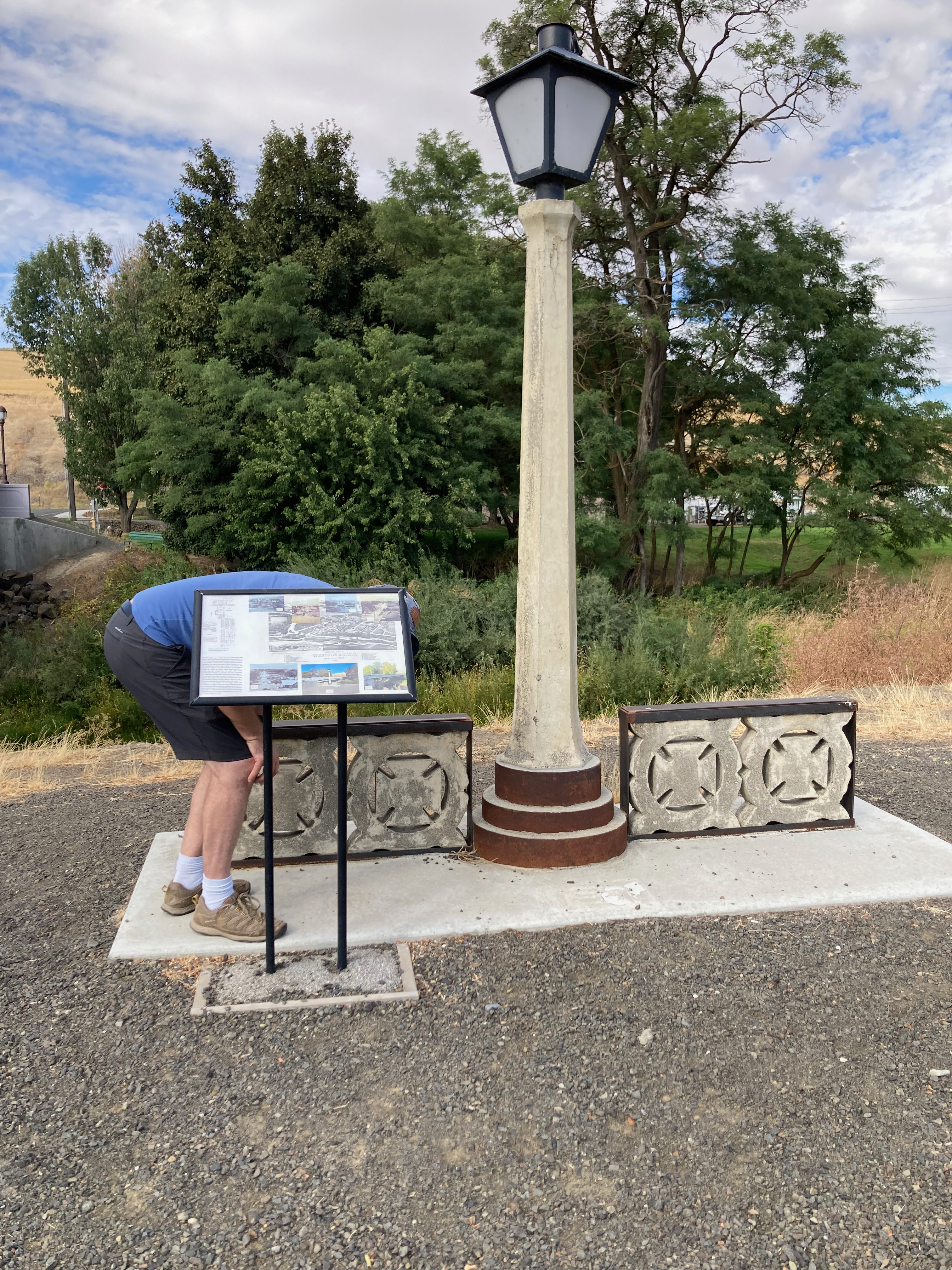
Lunchtime found us at Whiskey Canyon, a half-mile walk to the other end of town. The food was good, but a healthy population of house flies detracted from the ambience. We took the long way back to our hotel, stopping to see the sights and take too many pictures.

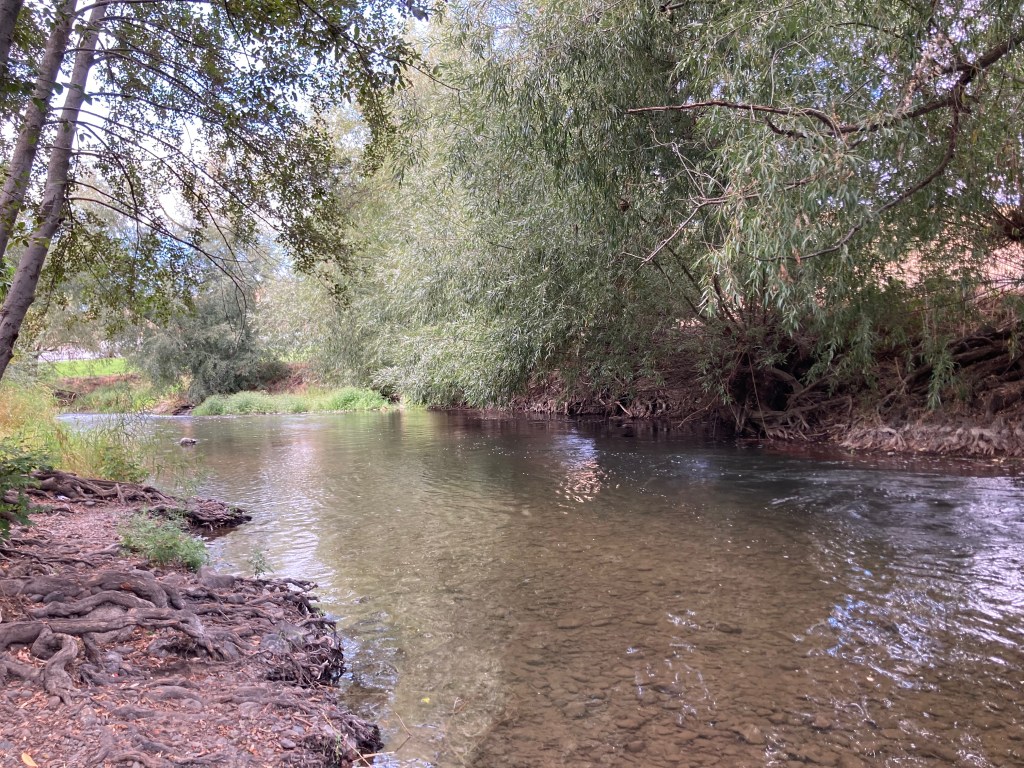
The city park in Waitsburg borders the Touchet River, and if you’re willing to scramble down a short dirt embankment, you can stand at the water’s edge and listen to the peaceful sounds of water flowing and branches swaying.

While I took a picture of the library, Michael snapped one of the former City Hall (the portion of the building with darker brick), which is currently for sale. Both Joe and Tiina at the Royal Block, and the woman who owns The Times, suggested that we buy the place (we brainstormed possible business plans over lunch because, why not?). We snuck in the building to admire the beautiful old architecture, complete with a dripping sink in a dilapidated bathroom, and office doors painted with signage for the lawyers who used to occupy them.

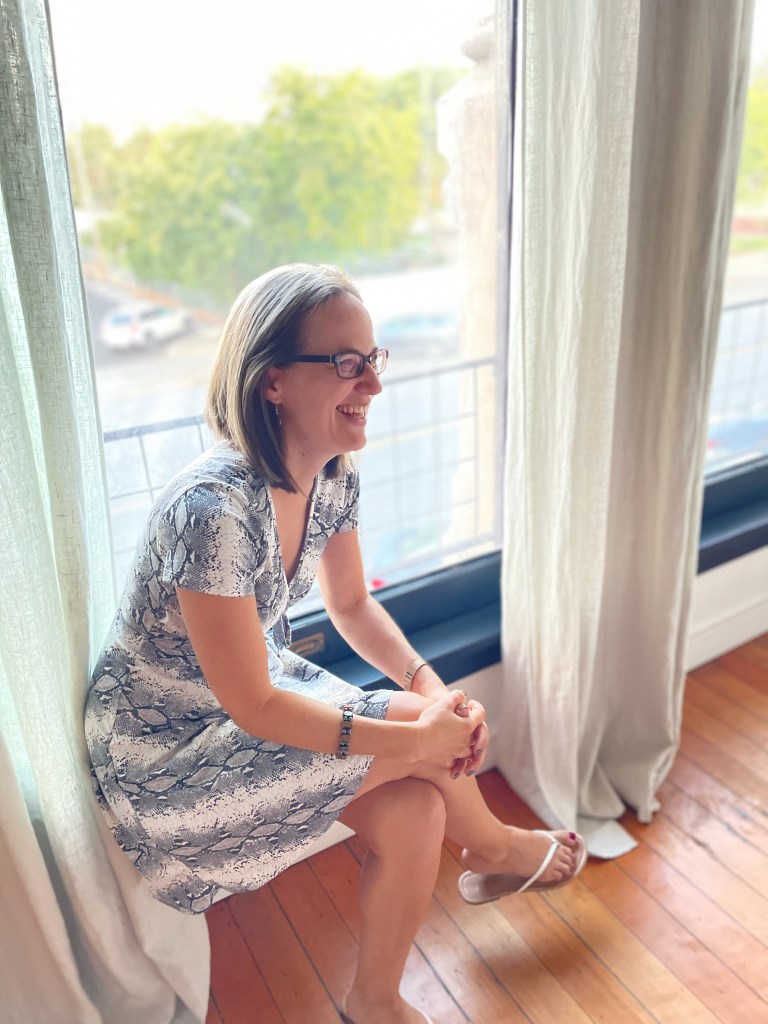
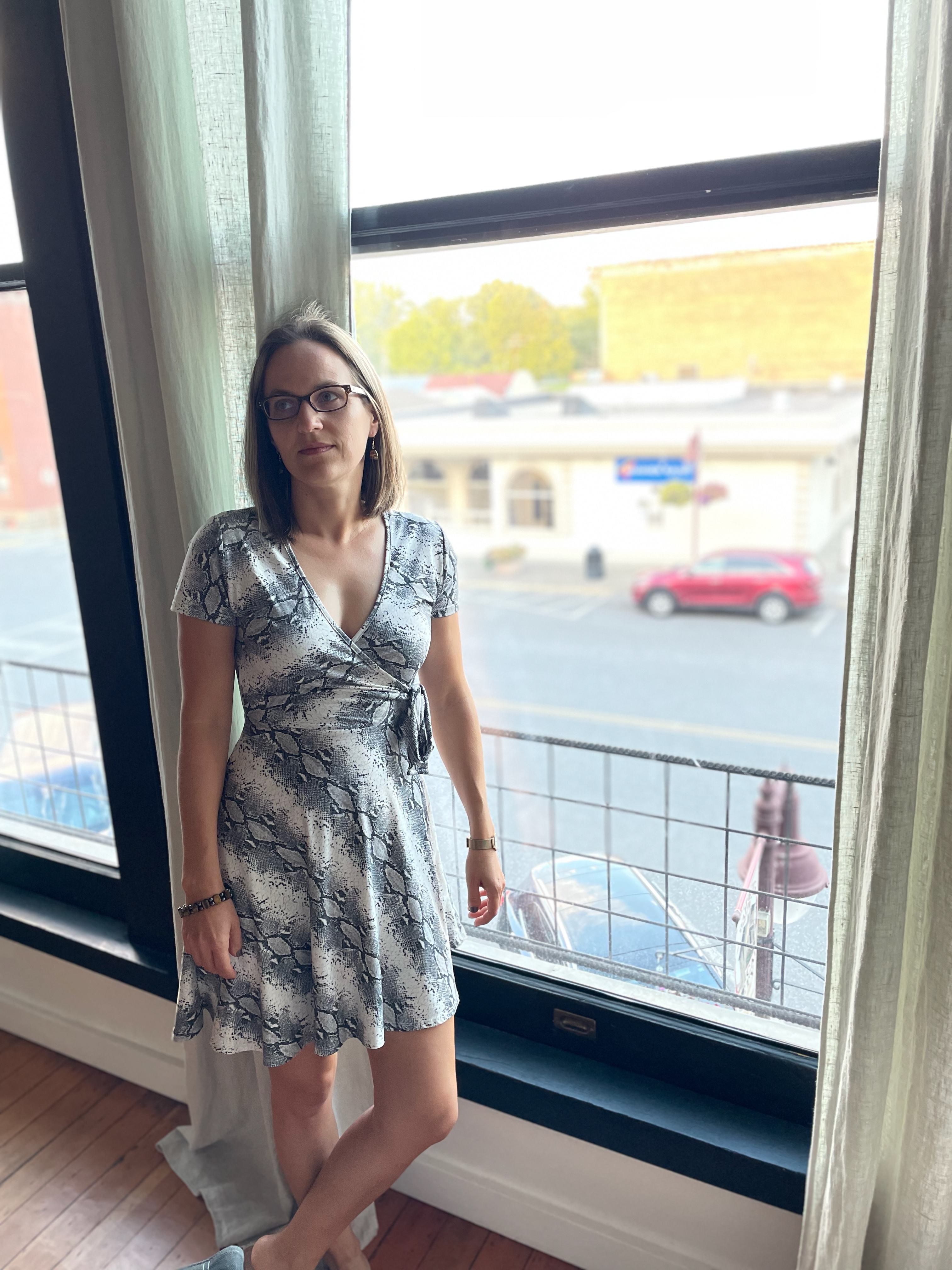
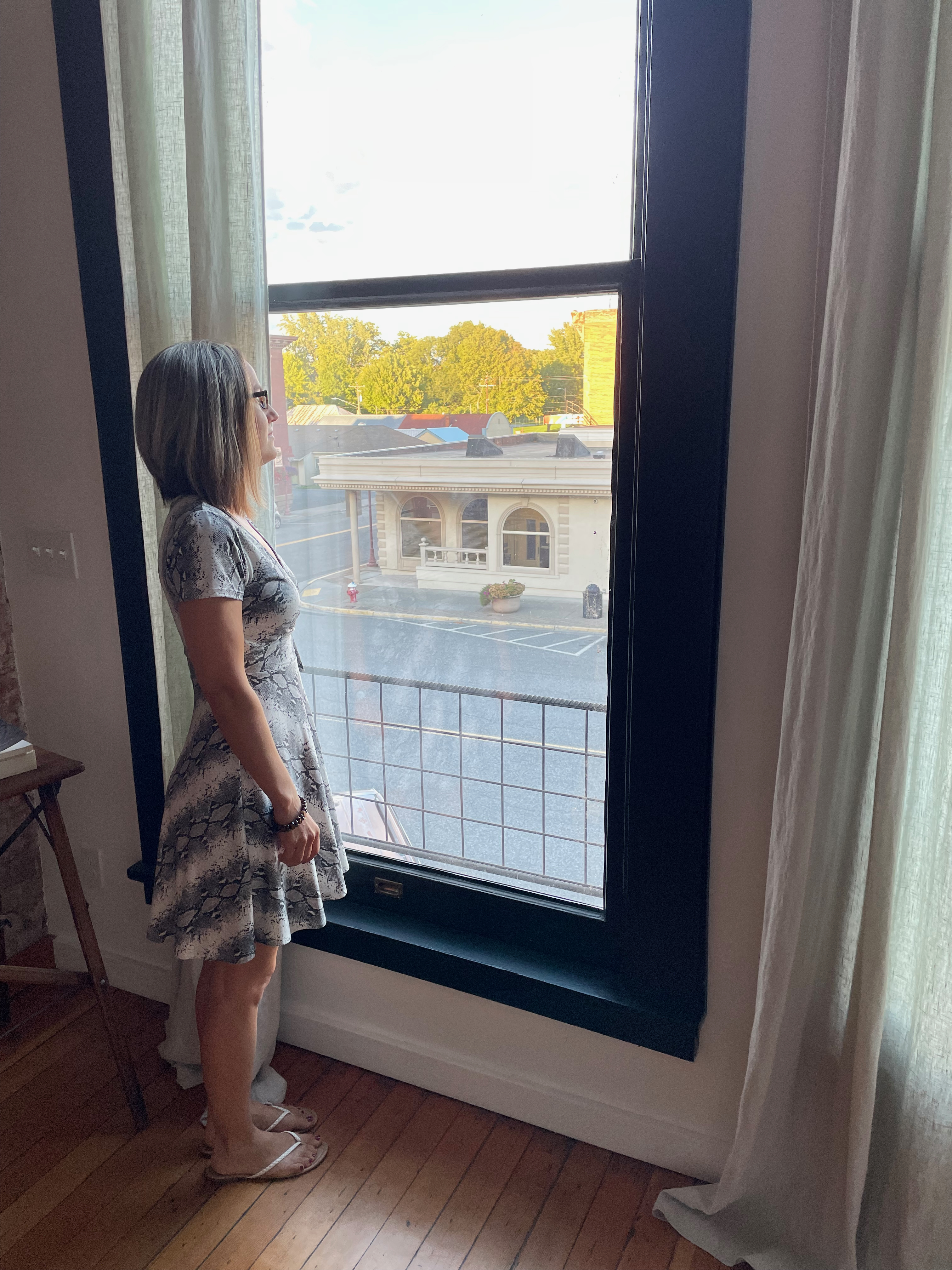
We dressed up for dinner and I asked Michael to take pictures of me in front of the lovely windows. We laughed over my awkward poses and the bank sign outside that clearly added to the romance.

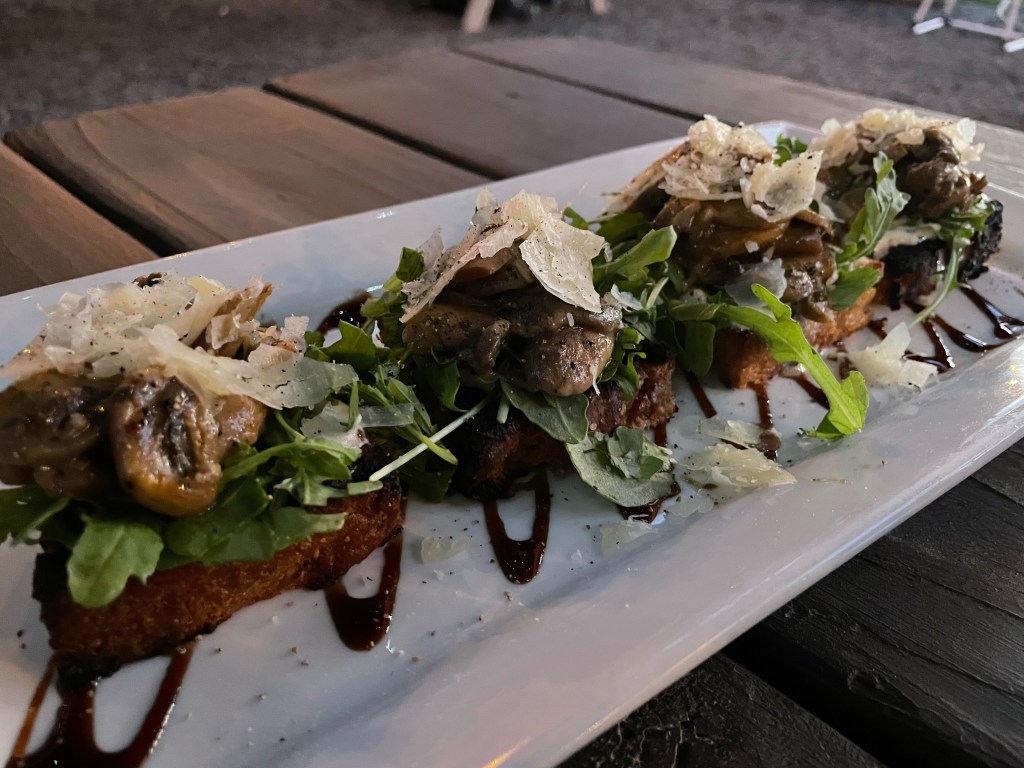
Our flip-flops (yes, flip-flops can be dress-up clothes) smacked loudly on the wood stairs as we walked down to the main floor, where Tongue and Groove, a local band, played live. Joe and Tiina took orders and chatted with customers. We’d been told that Joe bakes on Saturday, so we ordered bread, an adorable baby loaf that came with housemade dipping sauce – oil and vinegar, herbs, and fresh sliced garlic.

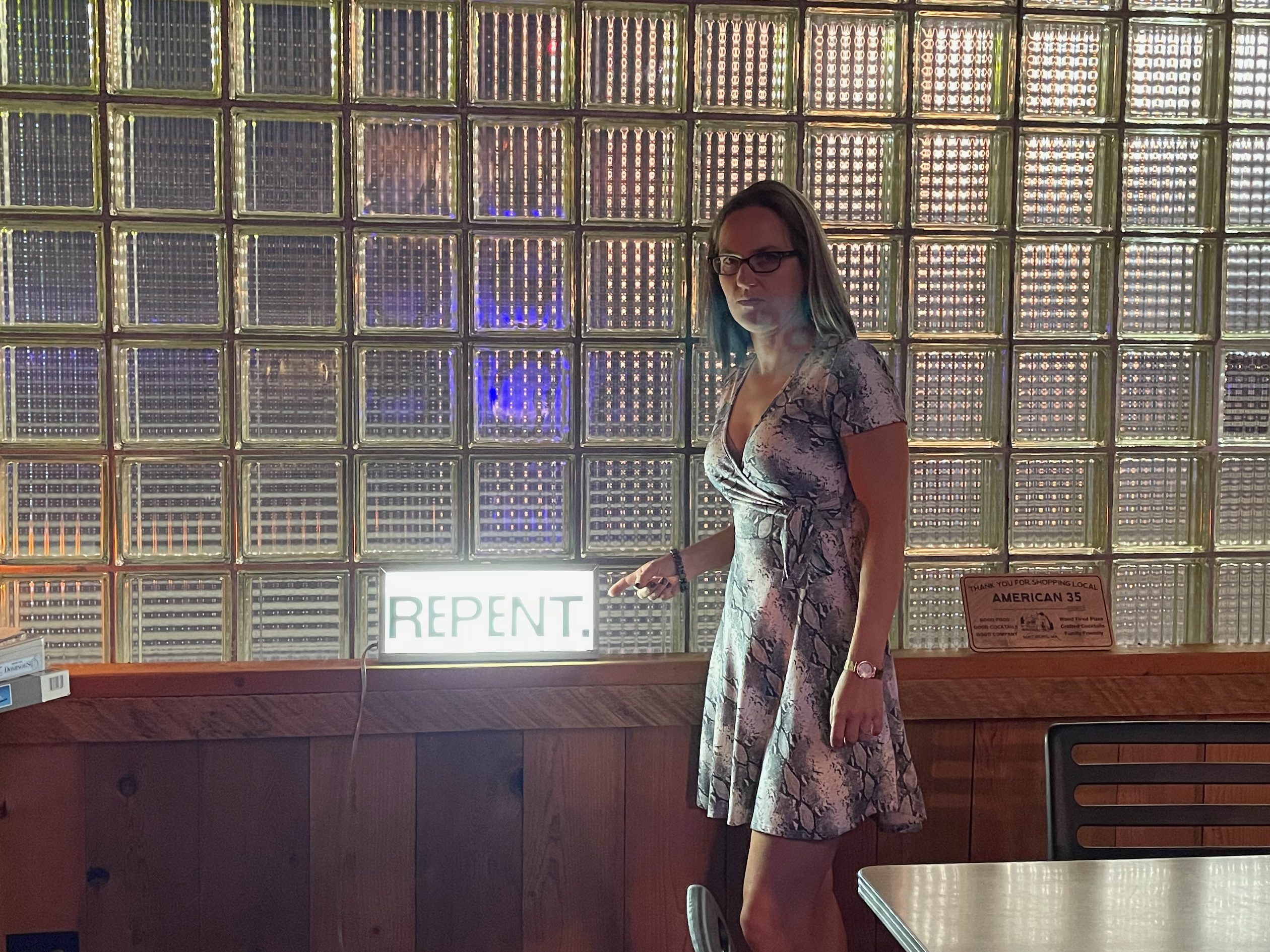
As the sun sank low and the air cooled, we walked down the block to American 35, where we enjoyed dinner outdoors under a lighted umbrella, and tried to make friends with two wary cats. We finished up with a corn-hole game, then took a picture inside by the “Repent” sign.

Sunday morning we repeated the performance at Ten Ton Coffee, complete with newspaper readings like this 80-year-old entry in the “Local News” section:

To Pullman. Mrs. Marie Stanley and daughter, Naomi went to Pullman over the week-end to visit their son and brother, Dennis Stanley, a student at WSC.

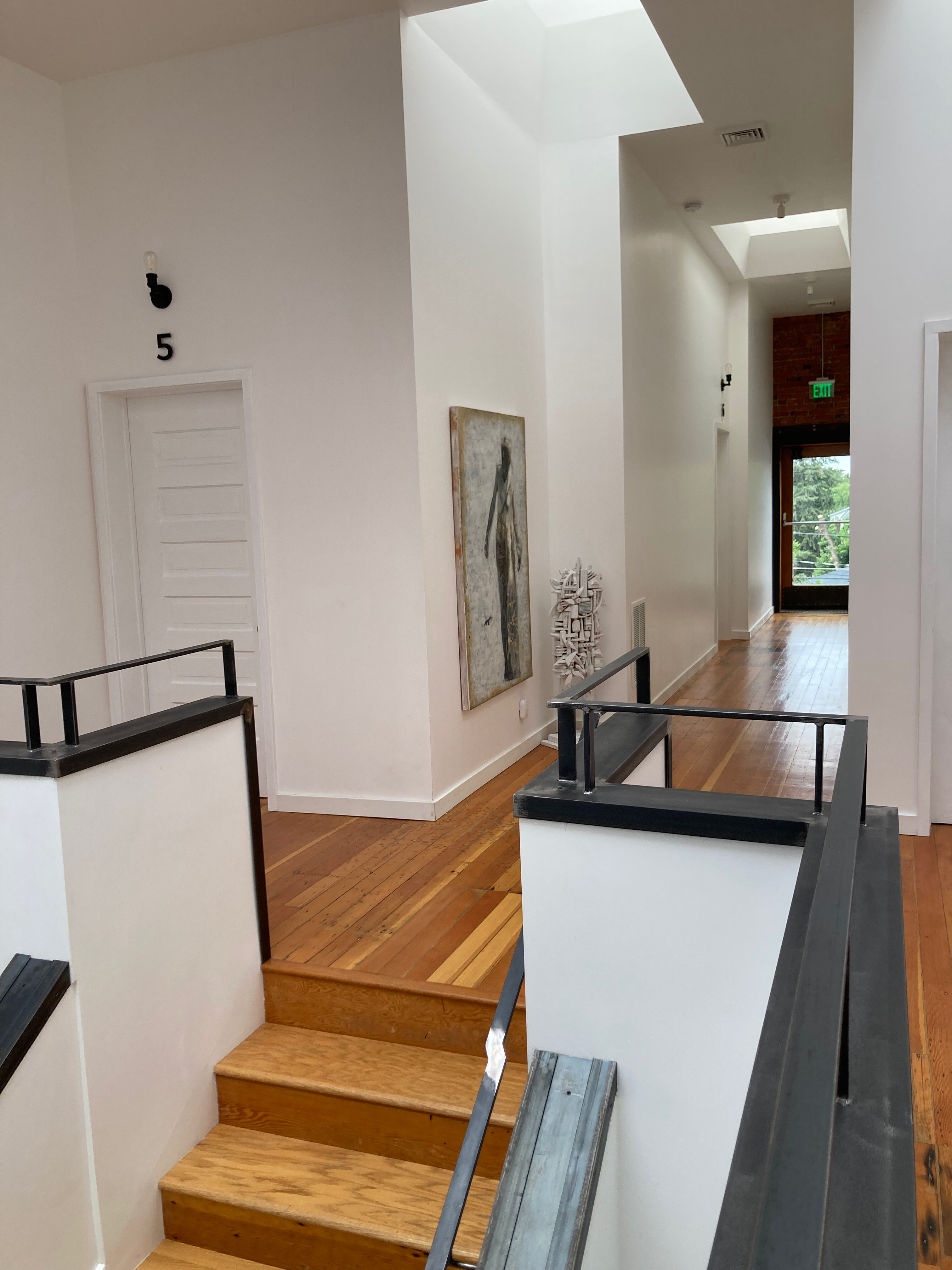
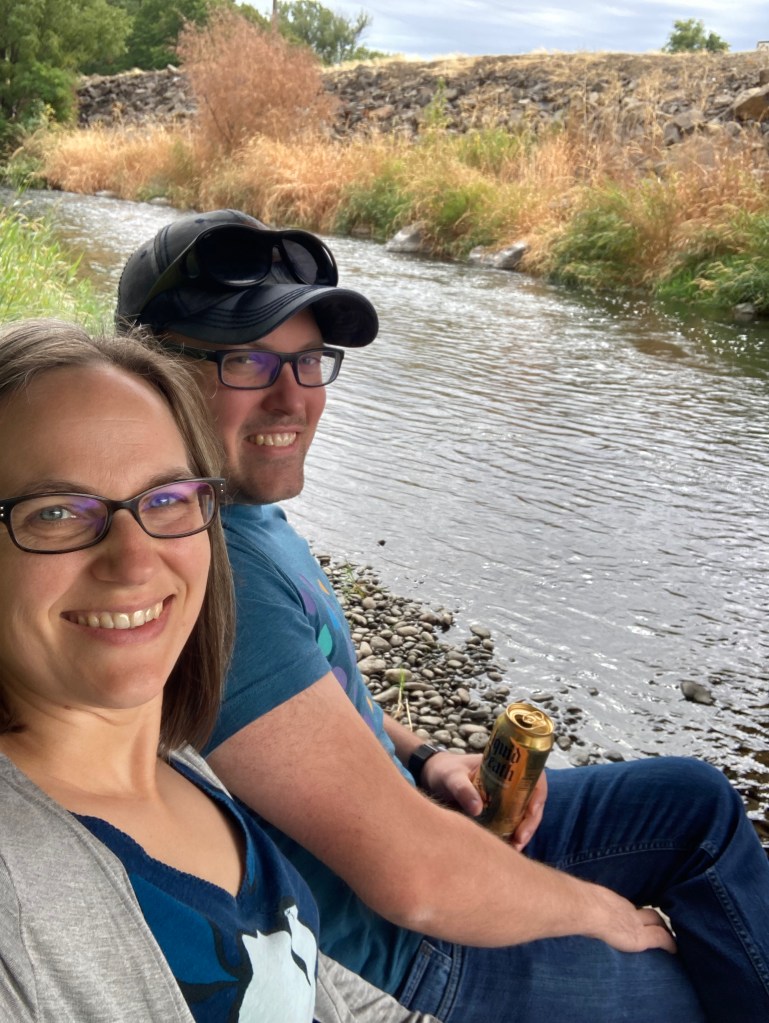
Before leaving town we snapped a picture of the lobby in the Royal Block, sat beside the river, and bought pineapple juice concentrate.

Final thoughts on Waitsburg: go visit. We talked for more than thirty minutes each with three different business owners. That’s a first. In addition to the businesses I already mentioned, also take time to stop by Simply Sawdust, where I forgot to take pictures.

Final thoughts on marriage: we’re enjoying a peaceful season – an overnight success, 19 years in the making, you might say. We’ve grown both tougher and more tender. We’ve made it through the sleepless years of parenting. We’ve settled into ourselves and into each other. It feels good. Quiet. Homey. Like a small town.


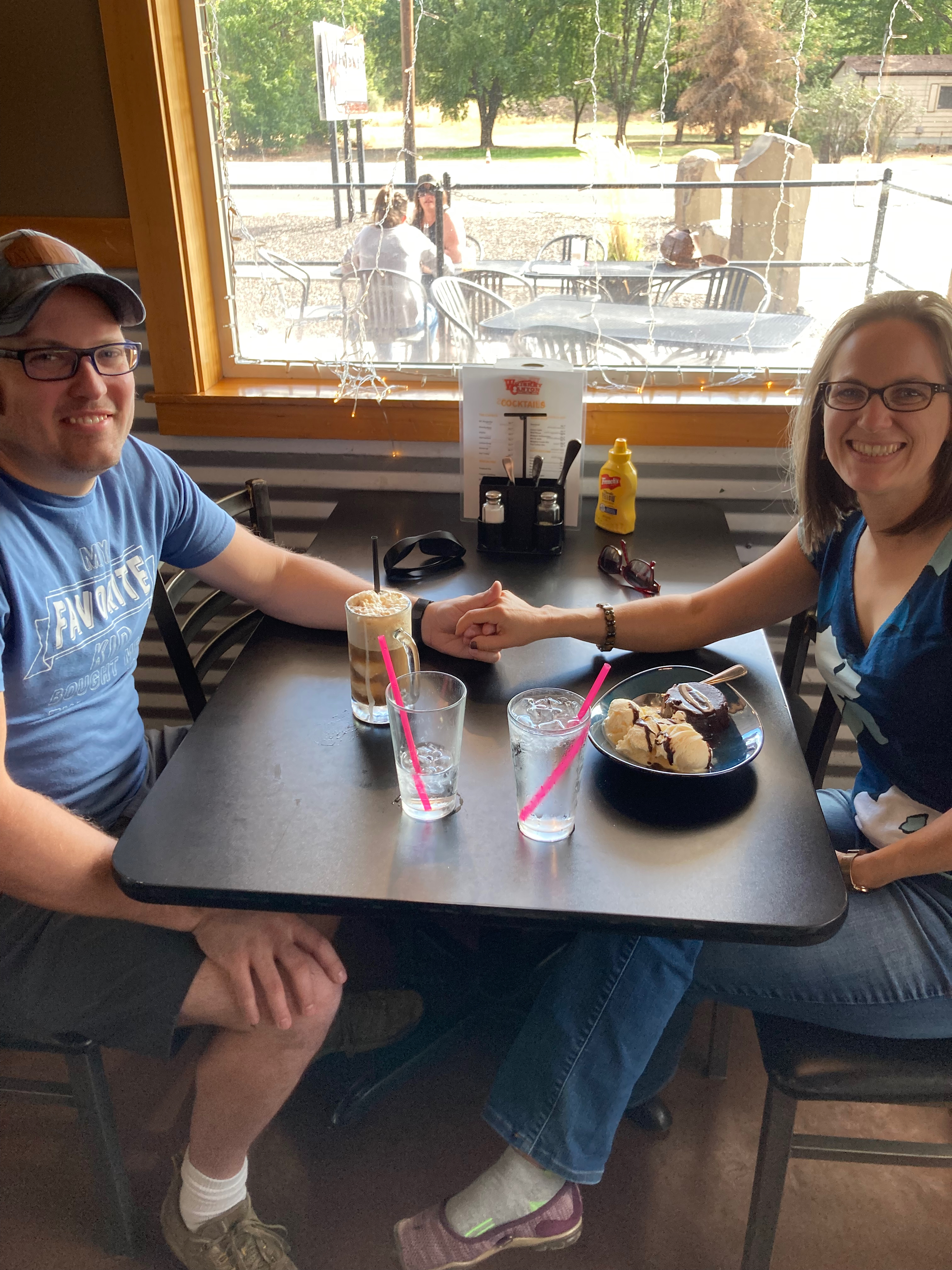
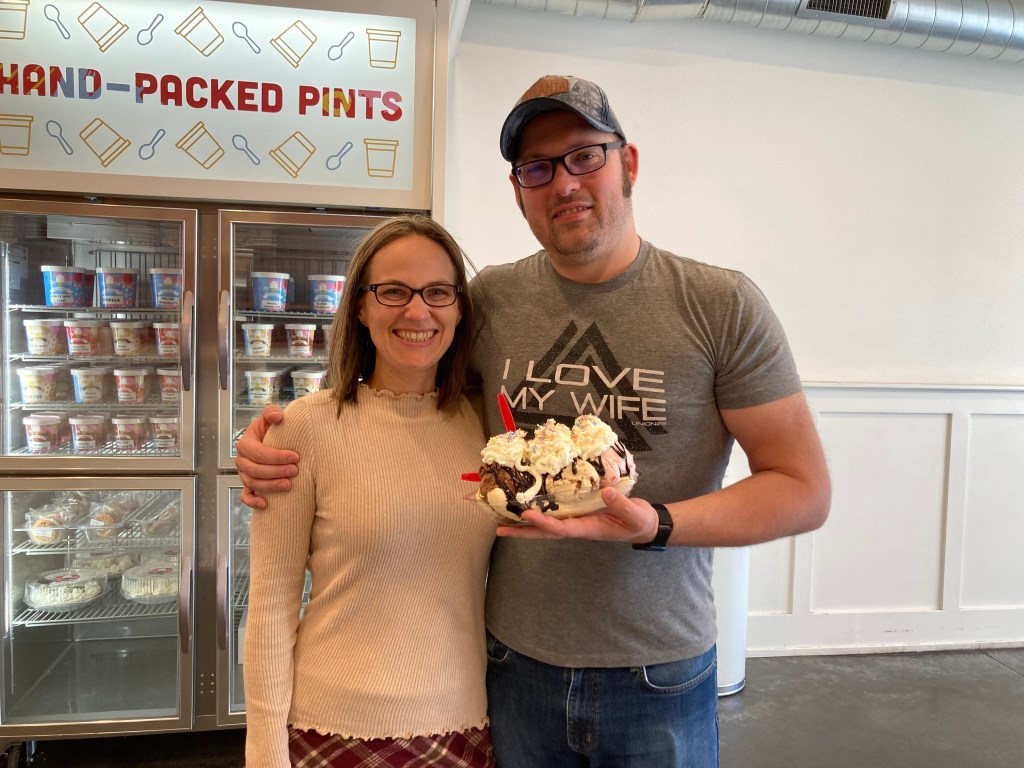
Bonus Picture: Michael and I at Pine Cone Creamery yesterday, celebrating on the actual day of our anniversary.

I Tried Yoga. What Next?

I sat on a yoga mat with the soles of my feet together in front of me, knees out to the sides. A feeling of connection and calm came over me. I had done this stretch many times and was surprised by the whole-body comfort. Rather than fighting against my body to force more flexibility, yoga taught me to work with my body. My bare feet pressed against each other, the stretch invited me to feel the muscles deep in my legs, and my spirit rested. I felt that I belonged to myself.

My exposure to yoga began in childhood, when my conservative Christian parents—who nevertheless had a habit of blazing their own way—bought a Bikram Choudhury yoga book. I loved watching my dad grunt his way into different poses—Eagle Pose, Tree Pose, Standing Bow Pulling Pose. My older sister and I would show off our youthful elasticity, easily getting into positions that our parents forced and contorted themselves into.

The Bikram’s Beginning Yoga Class book had funny cartoon illustrations, along with actual photographs of Bikram and his students—mostly leotard-clad, flat-bellied women. Bikram wore exceptionally small speedo-swimsuit-style briefs that left little to the imagination. The photos, taken during one of his Hatha Yoga classes in Beverly Hills in the 70’s, often show him steadying one of the willowy women, his face expressionless, a hand on her arm or leg.

In the 90’s, Christians—if I may generalize—spoke spitefully (or was it fearfully?) of “New Age” thinking. I’m not sure at what level I was aware that yoga made the naughty-new-age list, but the grunting and body-folding in our living room felt pretty safe to me. Any misgivings I may have had about yoga and its gateway-drug-to-eastern-religion qualities vanished sometime in my 20’s, and I accepted yoga as a healthy and legitimate practice. But until this year, I had never tried it as an adult. My time on a yoga mat typically involved sweating through lunges, burpees, and sit-ups, and those workouts were rare.

Last year, my friend Tiffaney started a yoga class with another young woman, in the fellowship room of a local church. It’s not called yoga class, because yoga is still associated with Eastern meditation, which allows evil spirits to inhabit you … or something. My sister, who is generally underwhelmed by the threat of evil spirits, has been doing yoga for years. She attended Tiffaney’s class, and around the time she mentioned it to me, Tiffaney invited me again.

So I came on a Thursday morning, late, and joined half a dozen barefoot women on yoga mats in the church basement. It didn’t take long to settle in to the quiet music and Tiffaney’s gentle voice, guiding me to breathe and stretch and count, hold and release. My body awakened, something like the expanding I feel when I step outside and take a deep breath after a rainy downpour. I felt invited to notice myself. I felt pleasure in the strength of my body, and deep release as I stretched muscle groups from head to toe. By the time I wiped down my mat at the end of class, I knew I’d be back.

Not long after my first yoga class, the group adjourned for summer. Around that time, I got a call from the local senior center, thanking me for a recent donation, and inviting me to join their yoga class. I arrived with some trepidation, expecting to be at least three decades younger than all the participants, but—in addition to the women in their 70’s and 80’s—a little girl probably three decades younger than me also attended.

“Hi,” I smiled. “I thought I was gonna be the youngest person here.” She smiled back politely but looked at me like I was about as easy to relate to as all the other strange old ladies. I laid my yoga mat down next to hers in the corner of the small, carpeted room, and a short, plump woman in her seventies began rolling her shoulders and inviting us to do the same—seven times forward, seven times back. As class progressed, I watched with respect as the circle of participants made their way through the stretches. Some were more flexible than me. Others adapted as needed for stiff joints or chronic pain. The little girl flailed and flopped in boredom, and I guessed she would have preferred her grandma took her somewhere other than yoga class.

Over the summer, I returned to the senior center whenever I had the time for Monday morning yoga. The teacher talked about opening my heart chakra, getting my synovial (joint) fluids moving, and keeping my arms against my head like ear muffs while stretching side to side. Rather than ending class with a Bible verse, she read a “thought of the day,” put her hands in prayer position, and said, “Namaste.” Five years ago that might have freaked me out, but after reading a couple of books on mysticism, and learning that “Namaste” is usually interpreted as, “the divine in me greets the divine in you,” I heartily embrace it.

There’s a wholeness to expansion and contraction. Rather than using my muscles only to hold body weight, dumbbells, or weird positions, I am invited to breathe deep and allow them to relax into the release of breath. There is safety in the guidance of a gentle voice. I don’t have to make decisions, or brace against a fitness pep talk. Rather, the teacher leads me in getting to know my body, feel my strength and my heaviness, and notice my capacity to loosen and lighten. This safety and wholeness is akin to what I feel with God, and I am delighted that it is built into my breath and my body.

Before I tried yoga, I thought it consisted of fancy stretching. Now yoga ranks among my top five bodily experiences. As I drove home from class at the senior center a couple weeks ago, I noticed that I sat taller, my muscles working together to hold me in a healthy posture. At the same time, I felt completely relaxed. Before yoga, I believed muscle tension and relaxation were mutually exclusive, but I have discovered they can coexist, and that opens a whole world of possibilities. Could a similar tension and relaxation also coexist in my spirit?

Since I’ve done yoga and remain uninhabited by evil spirits, next I’m planning to try meditation. Perhaps meditation is where the tension and peace in my spirit become friendly with each other. I aim to find out.

In the meantime, Namaste.

Martina and “Reckless”

This summer I’m bingeing country artist Martina McBride. She’ll be right here in Walla Walla for our county fair at the end of August and I. Can’t. Help. Myself. Michael and I have tickets on “Floor A”—the center of the arena, between the bandstand and the stage. I’m gonna belt every song I know, and I’m hoping I know every song. Hence, the bingeing—time to explore her music, especially any hits I don’t know, and hopefully find new favorites. But first I return to the song that connected me with Martina 25 years ago.

Remember the CD mail-order marketing of the late ‘90s? For me, a teen reaching a few timid fingers out of my homeschooled-on-a-farm cocoon, an offer of a dozen free compact discs was too good to pass up.

The ‘90s and early 2000s were my puritan years—no dating, no secular music. I lived those moral convictions with great gusto. My collection of CDs, which by high school graduation filled two disc storage albums, consisted almost entirely of Contemporary Christian music (Michael W. Smith, every Jaci Valasquez album, Kathy Troccoli), along with a compilation of Elvis Presley’s gospel songs, and a few “pagan” discs from my musician father—Peter, Paul and Mary; Roger Miller; Cat Stevens. The Cat Stevens album included “Two Fine People,” with a scandalous lyric about breast kissing—that was a new thought.

The summer after my 15th birthday I worked at a small orchard in a neighboring town, thinning and picking peaches and nectarines. The self-assigned orchard crew leader, a tough woman named Dawn, kept the portable stereo in the orchard tuned to country radio, shifting it down the rows as we moved our ladders and picked only ripe fruit—the best I’ve ever tasted. By the end of that summer I knew most of the country hits of the year 2000. That same summer, my sister worked as a lifeguard at the city pool in the next one-horse-town down the line from where I picked fruit. Country music was the backdrop there, too, and we both finished out high school with the stereos in our matching white Chevy Corsicas tuned to the country station.

On the radio I heard Martina McBride sing “There You Are,” a slow song full of metaphor about the omnipresence of a lover. I immediately adopted it as a Christian song about the ever-presence of God. This adoption allowed it into my stringent collection of music. I wanted to buy the album with that song, but didn’t know which album to buy. It took me a couple of tries, and that is how I came to possess Martina McBride’s albums Evolution and Emotion—the latter includes the song “There You Are.”

Popular music, along with all Disney movies, and most fiction books, were absent from my childhood home. As a Junior in high school—the first year I didn’t homeschool—I became best friends with Terah, who listened to popular music. I picked up a song here and there. She gave me the Shrek soundtrack and introduced me to Billy Gillman, who sang country that was pop enough she could handle it. At first I felt a bit sneaky adding those Martina McBride albums to my Christian-curated collection, but my loyalty was sealed when I read online that Martina sidelined her touring so her children could have a normal upbringing, with her in it. I mean, doesn’t that speak for her music?
Evolution and Emotion are cherished albums 25 years later, and Martina continues to be my favorite country artist, although I haven’t kept up with her later releases. Her Christmas albums play in our house every December, and I learned the chords for “This Uncivil War” so I could sing and play it on my guitar.

In preparation for the concert at the county fair, I’ve been listening to all 14 of Martina’s albums. There’s some good classic country stuff in there, like the song about crying on the shoulder of the road. Her first three albums lean toward “whiny country” (or, if you prefer, “classic country”) and I’m finding I don’t enjoy them as much as her country-pop sound. But one album, released 17 years after Emotion, quickly became a new favorite from beginning to end. I can sing parts of every song now. And—once again—the song that captivated me most, reminds me of God. The album is Reckless, and the title song is about, well, being reckless, rushing headlong into everything. The rash person in the song makes a rash statement about her lover, new words for my standing conviction that God is crazy: “For loving me the way you do / I know I’m reckless / But you must be reckless, too.”

I don’t suppose God is reckless in a traditional sense (“reckless” is generally defined as a lack of concern for consequences), careless about the consequences of His decisions—given all that omniscience and “outside of time” stuff. But, unlike humans, perhaps God doesn’t make decisions based on consequences. Maybe He doesn’t even base decisions on “outcomes”—the sophisticated version of consequences. What if it’s all about creativity, the making of us; and presence, seeing us? What if it’s about doing a whole lot of reckless things for people who will never return the favor, the affection?

I’m looking forward to a reunion on August 28—a return to age 15 and nectarines, to the memory of CD clubs and having my own car (a Garth Brooks CD was in the player when I bought the car), and a do-over of the time I missed hearing Martina at the 2019 Ventura County Fair. I’m looking forward to singing in a sea of strangers, watching the moon rise above the stage, everything sounding muted on the way home. And I’m looking forward to celebrating the God who loves me through my puritan phases, arrogance, anger, and disbelief. He has sent love notes to me in country music, TV shows, and irreverent books. He has taken me on dates to therapy offices, quiet campgrounds, and Bible studies. I know I’m reckless (believe me, perfectionism is its own version of recklessness), but He must be reckless, too.

Prayer, Revised and Expanded

My journal takes me back in time. September 25, 2015. Thirty years old. Married ten years. Two daughters—Kyli two months past her first birthday, and Kayt a month shy of her third. That means on the day I wrote this prayer I had a one-year-old and a two-year-old. No surprise that “broken,” “scared,” “no match,” and “tired” feature in this heart-cry, penned during a rare stolen moment. My heart bled out through the ink of my pen. I turned to the page and to my heavenly parent, because together they were the safest place I knew.

April 17, 2024. Thirty-eight years old. Married 18 years. Kyli and Kayt are now 9 and 11. We’re deeply settled into the house we were in the process of purchasing in 2015. And I’m writing, which I now realize is not only a safe place for me, but also a creative passion.

Today I’ll respond to myself in this prayer. A spiritual journey is a both/and experience, dense with contrast and contradiction. And so today maybe I disagree with my thirty-year-old self, but my experience and beliefs then were as valid as my experience and beliefs now.

Truthfully, I haven’t been writing spiritual content much recently. I’m weary of cultural Christian ideas, the sin-and-salvation language, the beliefs that tied my hands behind my back. But set all that aside, and there is a friendship. Prayer is a celebration of friendship.


Good morning, Lord.

I am in a place I know You do not intend for me to be. I’m literally sick with worry. I can’t stop my head from spinning and my heart from panicking. Please speak truth to my heart and save me from myself.

You can be in this place. It’s okay to not be okay. You won’t feel this way forever. And yes, keep believing there are better things ahead. You are held.

I believe the solution is walking with You, but I can’t even do that. I am so broken, so scared, so selfish. Please do it for me, Lord. Take my heart, take my marriage, take my parenting, take my responsibilities at church and book group and other places, take the move to the new house, take meal planning and grocery shopping, take the lies that cripple me. Take my heart of stone and replace it with a heart of flesh.

What does it look like to “walk with God”? You are beautiful and your life is beautiful. You are worn out. Ask for help. Take medication. Drink coffee. Watch TV shows. Cry. Plan a day for yourself—that is not selfish. Your heart of flesh is already there. And this grieving might be just the thing to help you find it.

I confess my selfishness, my desire for control, my fears, my misbeliefs. They are sin and they do not honor You. Please take them from me. Please fight this fight for me. I am no match for sin, no match for the devil, no match for life.

Overwhelmed, flooded, depressed, alone, trapped. You feel these things deeply. You are stronger than you think, and not as strong as you think. You might have to let get of what you’re holding tight, and holder tighter to the things you’ve been letting go. Don’t know what that means? Don’t fret. God really does have your back, and She’s not the least bit disappointed.

I can do nothing … but isn’t that a good thing? For Your strength is made perfect in weakness [2 Corinthians 12:9]. Please hedge me behind and before and lay your hand upon me [Psalm 139:5]. Please take away my addiction to negative emotions. Teach me to rejoice in Your victory in my life, to give You the glory, to have a heart of thanksgiving.

These things you dream of will happen. You will learn to enjoy feeling happy, to like yourself, to feel gratitude and joy.

Lord, I am lonely. I am broken. I am too self-centered to see the beauty of You and the many good gifts You are showering on me daily. I surrender to You, Lord. Please save me from myself, Lord.

God will save you from yourself by introducing you to your true self. It’s okay to be lonely and broken. You are also brave and kind and capable.

I need time with You daily in prayer and in the Bible but I feel helpless to make that time. Please do it for me.

God loves to spend time with you. She hears you.

Thank You that You see me as I am and love me. I am so tired of myself. I am so grateful that You are not overwhelmed by my brokenness. Thank You that You use brokenness for Your glory. Give me a testimony that will draw others to You. Lord, if I need a mentor, please provide.

Keep speaking these truths. And when you’re too tired to speak them, the Spirit will speak them for you. You don’t need a testimony; you are a testimony. And you always will be.

I am terrified of the day ahead of me. Take this from me, Lord. Give me eyes of faith. Remind my heart to lay everything at Your feet and let You do the heavy lifting. I want to take Your yoke upon me and learn of You, and accept the rest You promise [Matthew 11:29]. I want to be Your servant and friend so that others will be drawn to You.

Oh dear one, these days are so long and so hard. I see you. You can do hard things. And God is teaching you to rest, even now.

Thank You for my brokenness, thank You for trials and difficult times. Thank You that You are enough and everything else is a cherry on top. I choose by the power of Your Spirit to abide in You. Please let me be a branch today. [John 15:4, 5]

Way to go! You are receiving with open hands. But you know, “everything else” is the stuff life is made of, and it’s okay to want it to feel lighter. You are a branch. You are a badass. Many good things are coming for you, and one day you will feel excited about what the day holds. In the meantime, go get some coffee.

Easter-Egg Life

As I practice both/and living, I learn to allow myself a mix of grace and hard work. Both/and living means, for me, a life that embraces paradox and nuance—different than black-and-white, either/or living.

It’s not unlike the Easter-egg hunt in our back yard last weekend. Several families gathered to spend a lazy afternoon enjoying haystacks (make-your-own taco salad), early spring sunshine, and Easter candy.

Our gathering was ripe with contrast:
Warm sun, cold wind
Hollow (plastic) eggs and solid (hard-boiled) eggs
Edible treasures and inedible treasures
Young and old (three generations of family)
Hiding and finding
Large eggs and small eggs
Textured eggs and smooth eggs
Relaxation and busyness
Eating and drinking (can’t do them at the same time)

Dozens of eggs peeked from grass clusters or perched in low branches. Most of them were easy to spot, but some hid deep in overgrown grass, or camouflaged with bushes and trees. Kids ran through the yard and collected the easy-to-find eggs, then dumped out the baskets to assess their treasures, popping candy into their mouths as they sorted the hollow, plastic eggs from the dyed, hard-boiled eggs. After they’d satisfactorily sorted their first take, they went out again, looking for the harder-to-find eggs. The second round yielded less results; nevertheless, each child’s collection of candy and coins, tiny animal toys and stickers, continued to grow.

My journey into paradox has involved opening the components of my life, like eggs collected in a basket, to find out they were filled with chocolate I couldn’t eat, money I couldn’t spend, and to-do lists I couldn’t finish. My basket stank. The hard-boiled eggs rotted, and the hollow eggs held no treasure. They were labeled—religion, self-help books, pulling myself up by my own bootstraps, always doing the right thing—but the contents disappointed. I thought I’d painstakingly collected resurrection power, or at least a lucky rabbit, but instead I had unearthed anxiety.
The hardest work in my life has been excavating the mountain between me and grace. My value has long been rooted in performance and productivity, and—far from what the church patriarchs predicted—it’s excruciating for me to be “lazy.” I have been incapable of resting my soul, unable to move in “the unforced rhythms of grace” (Matthew 11:29, MSG). A planned life and a protestant work ethic leave grace hanging to the side, like an awkward, unneeded appendage.
Late Easter afternoon, as we covered bowls of salsa and picked up trash, my daughter Kyli kept asking my help to find one more special egg. She knew it had $1 in it which would be hers to keep, along with the container—a beautiful, 3D-printed, shiny black egg that screwed open and shut, with mermaid-scale texture on the outside. I searched with her willingly at first, becoming more reluctant after each subsequent request. I had hidden the egg in question, but I couldn’t remember where, and I soon tired of looking.

It’s not that hard work or self-help books are inherently or predictably bad. It’s just that my basket lacked wholeness. I needed to collect eggs containing decadent chocolates meant to be eaten, money to spend, and lists of what I’d already done. I struggled to find those eggs. I saw them in other people’s baskets, but whenever I went collecting with my basket, I found more of the same eggs I’d already collected.

At length, one of Kyli’s uncles found the black egg under an apricot tree. Kyli squealed with joy, opened the egg to retrieve the dollar, then carefully added it to her egg collection. Soon she returned to our play-set, where the cousins were sending all manner of things down the slide—rocks, smaller cousins, broken plastic things. All was well in the world and she could focus on the fun at hand.

Like Kyli, I never did find the special “eggs” I was looking for. Someone else found them and handed them to me. Much to my surprise, the eggs I didn’t work for are some of my favorites. I used to think working hard mattered a lot, and productivity trumped enjoyment. I’m grateful to the authors, friends, and family who have lovingly placed “grace eggs” in my basket. I’ve learned to have fun.

It’s not that I won’t work hard; I do and I will. The difference is, as I putter and tumble and stride through my days, I like them. I like me. I like people and pets and all kinds of weather and books and food and friendship and I almost like it when my kids wake me up at night. At least, I’m pleased they trust me and know they don’t have to be alone when they’re scared or can’t go back to sleep. This, I think, is grace.

Gained in Translation

“Thanks to you I have the goal of being someone good in this world.” So concludes the final letter from Alejandro*, and his words stop me.

I’ve been told I have influence—or rather, warned that I have influence. Better use it for good, they say. Watch yourself. Or, as the church-school song goes, “Oh be careful little tongue what you say… for the Father up above is looking down in love…” And I have been careful, which mostly feels like fear, anxiety, and judgement.

I’ve been told I have influence—but Alejandro’s words shocked me. It hadn’t occurred to me that I could inspire anyone to want to be good, and certainly not someone I’d never met in person.


In 2009, I was a few years married and worked full time at the Christian college from which I had recently graduated. That spring the student association hosted a concert by the Christian rock band, Superchick. It took place in the big dome at a neighboring college. While true fans moshed it up, I wished for earplugs from my seat on the bleachers. Somewhere in the course of the evening, the band made an appeal for child sponsors, and in the post-concert din and jostling, we managed to buy a CD and sponsor a child—Alejandro, from Bolivia.

For 14 years we exchanged letters with Alejandro, as he grew from a preschooler to a working man and graduated from Compassion International’s child sponsorship program at age 20. Early letters were written by Alejandro’s brother or his tutor. A letter in 2011 included this endearing anecdote: “It was a happy week for my family too because my brother was born and my mom was delicate so we couldn’t do anything for her birthday. She is better now and we are going to buy a cake for her. Alejandro helps me to wash the dishes because my mom is still delicate.” -signed by older brother Emilio.

Over the years we prayed for each other and shared favorite foods and the antics of our pets. One letter informed us that Alejandro’s pet goose had laid five eggs and was taking good care of them, and included an update on turkeys that had hatched some months before: “My mom likes them very much, she feeds them every moment.” Occasionally we’d make an extra monetary gift through the Compassion project, and a few months later we’d receive a picture showing what Alejandro bought with the money—clothing and shoes, “rubber dinosaurs,” a dresser for his clothes.

At first our letters traveled snail-mail between Bolivia and Washington state. Later, online letter-writing became available, but still it was a slow correspondence. I worried about asking the same questions or sharing the same information because I forgot what we covered in previous letters. I probably did forget things and repeat myself, but Alejandro responded to every letter with only the kindest words, and patiently answered our questions.

In 2023, Alejandro aged out of Compassion International’s sponsorship program and we each wrote a letter of farewell. His letter begins, “My dear friends Michael, Tobi, Kyli and Kayt, let me greet you, I am so grateful for all the time you were my friends and I was blessed with your sponsorship. Truly God touched your lives and through you He touched mine and my family’s. I am so grateful. You were really an unconditional support for so long, words would not be enough to show you how much I love and appreciate you.”

I am immediately touched, and simultaneously aware that these kind words register on a grand scale almost foreign to my daily narrative—God reaching through me to touch another, the elusive desire of every God-lover. “Unconditional” is not a word I would use to describe myself, but there it is. I choose to receive it.

Alejandro goes on to describe how the Compassion project helped him and his family, concluding “but above all, I received the word of God in my life, I was able to know Jesus, and I was able to understand that my life was better if I held His hand.” One sentence, profound gospel. My life was better if I held His hand.

Alejandro requested our continued prayers for guidance and for his family, and promised to pray for us: “I will pray that God will always bless you, that God will grant you the desires of your heart, that God will guide you well in everything you do, that God will keep you from all evil, and that you will now be able to continue blessing more lives as you did with me during all this time.”

Then he concluded, “Now, with a happy heart, for having completed the Compassion program, but also a little sad because I will no longer be in touch with you, I really feel you as part of my family, I will always have you in my heart my dear friends. Thanks to you I have the goal of being someone good in this world. God bless you always, your friend forever, Alejandro.”

It has been said some things are lost in translation, but, if anything, I’d say translation lent this final letter a beautiful simplicity. Alejandro’s translated words rank among the best prose I’ve read. They are high praise yet totally devoid of flattery. His gentle and grateful heart reminds me who I am—a daughter of God who does’t have to worry or hustle. I am blessed and I am a blessing—this is the sum of my existence. Alejandro, thanks to you I have the goal of being someone good in this world. I want to live up to your estimation of me. God bless you always.


*Not his real name.