Category Archives: Personal Stories and Memories

Small-Town Anniversary

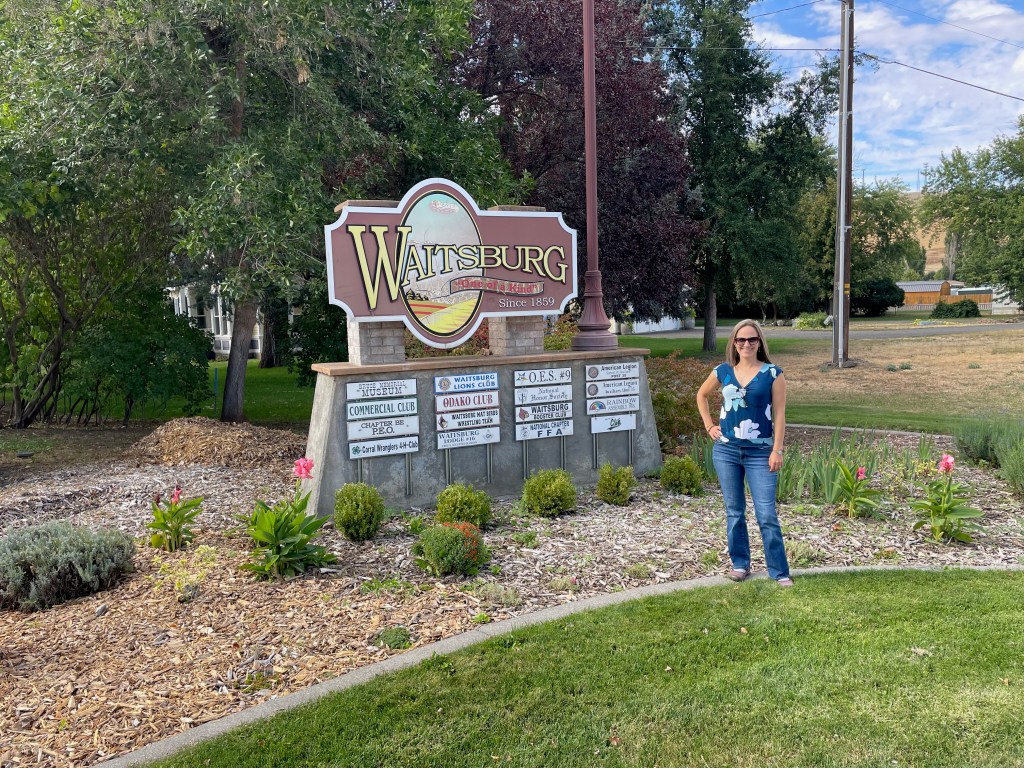
Last weekend Michael and I celebrated 19 years of marriage, with a getaway to Waitsburg, WA. For those who aren’t from around here, Waitsburg is a 25-minute drive from our home in Walla Walla, and it boasts a population of about 1,200. Despite its small size (or maybe because of it), Waitsburg treated us like royalty.

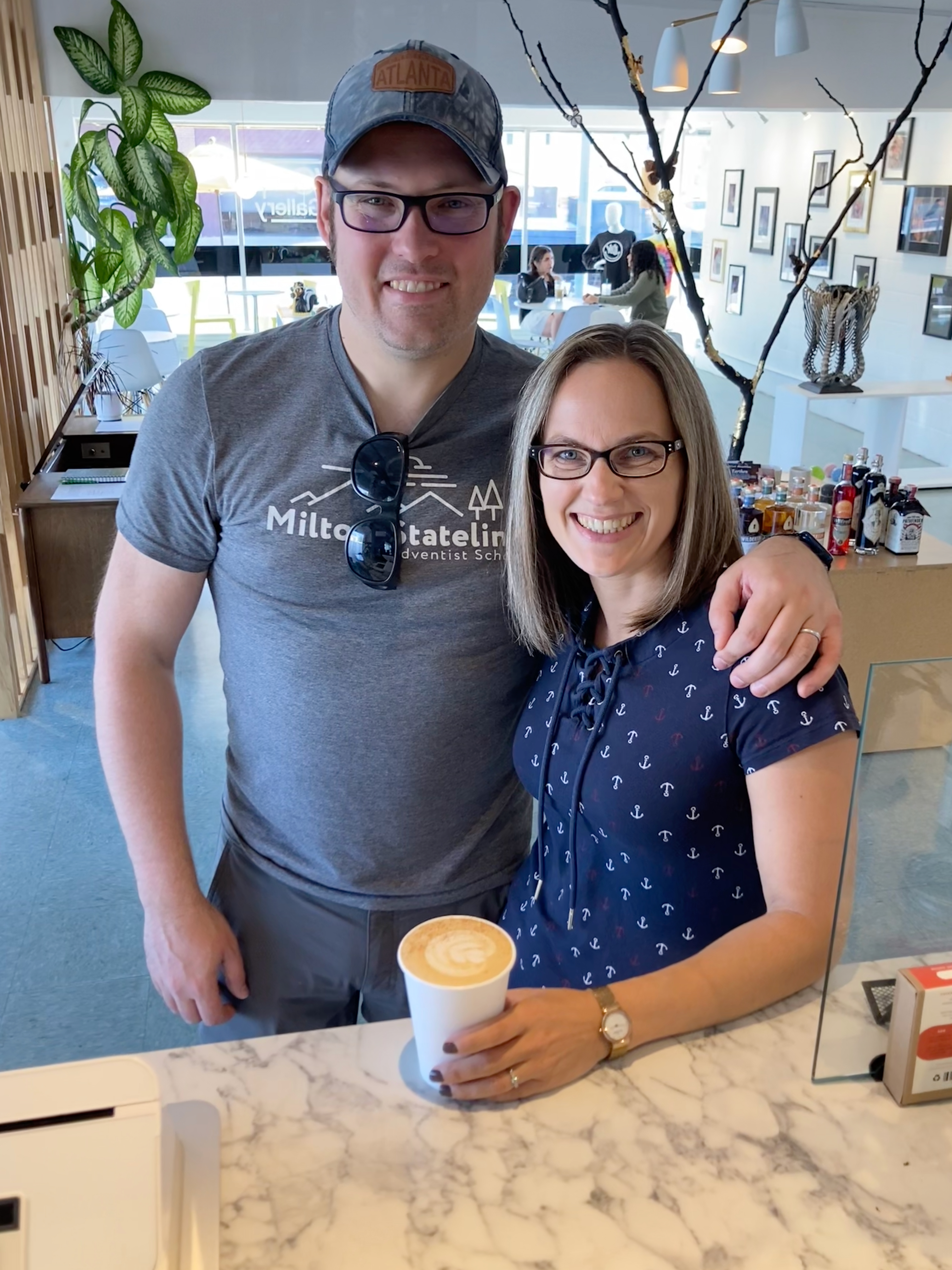
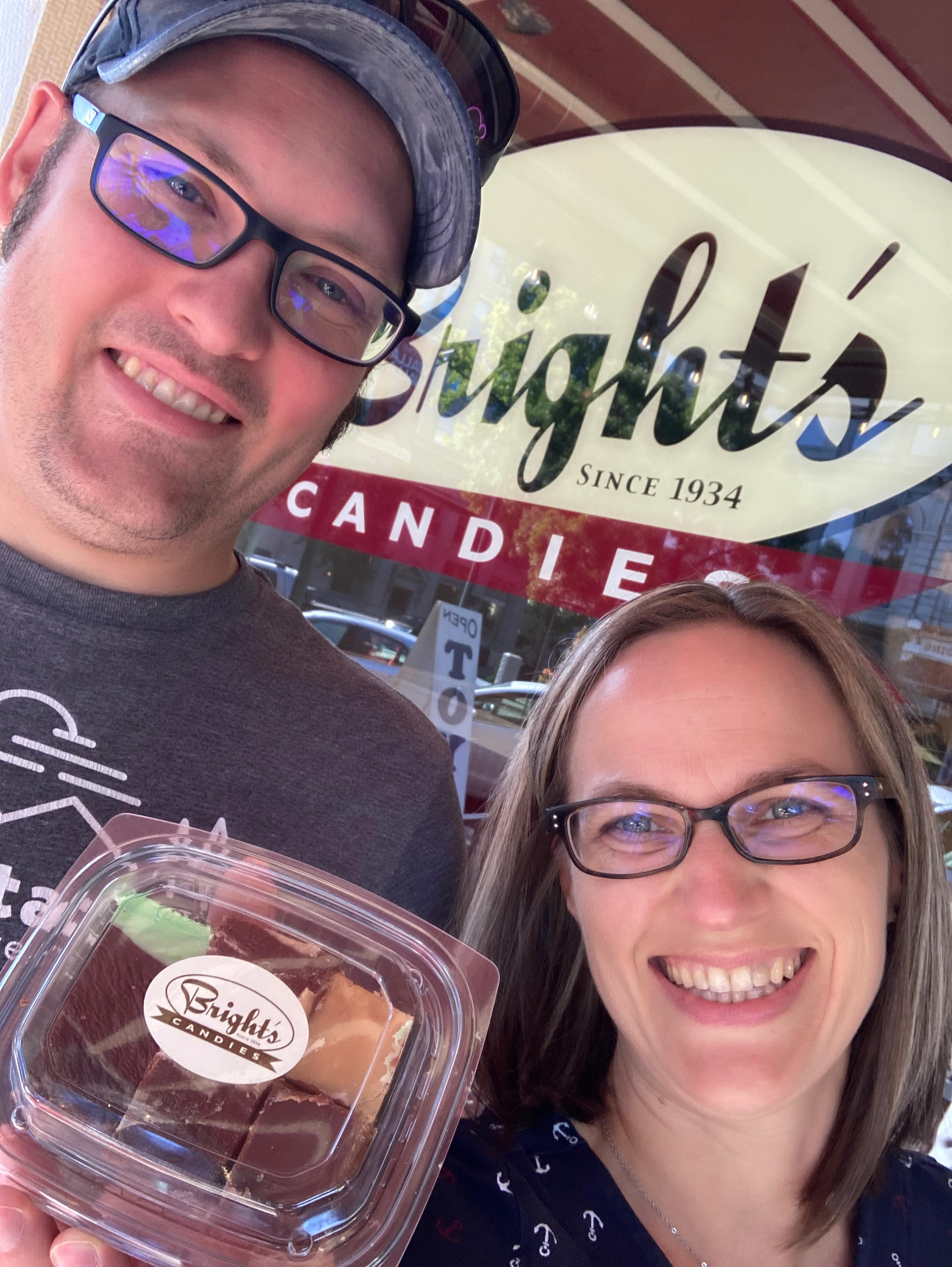
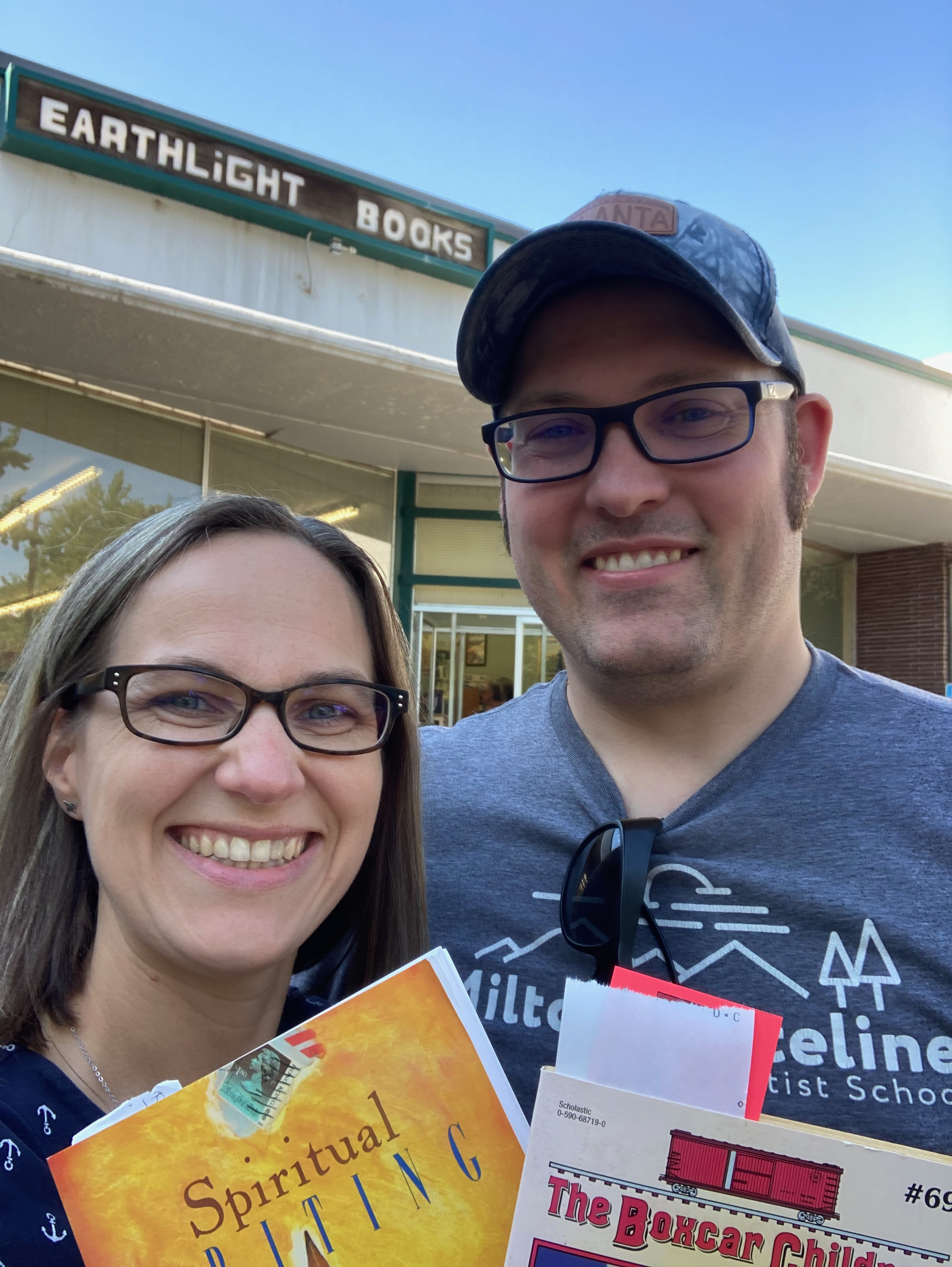
We dropped the kids at their great-grandma’s house Friday afternoon, and since it would be a couple of hours before we could check in to our hotel, we bummed around Walla Walla for a while. We stopped at FVC Gallery to try their new pumpkin chai. Then we poked around the stacks and shelves at Earthlight Books. After that, a walk to Bright’s Candies in the warm afternoon sun brought us close to our check-in time and we drove to Waitsburg. The farmland and sky showed off as we passed the time talking about serious stuff like other people’s relationships.

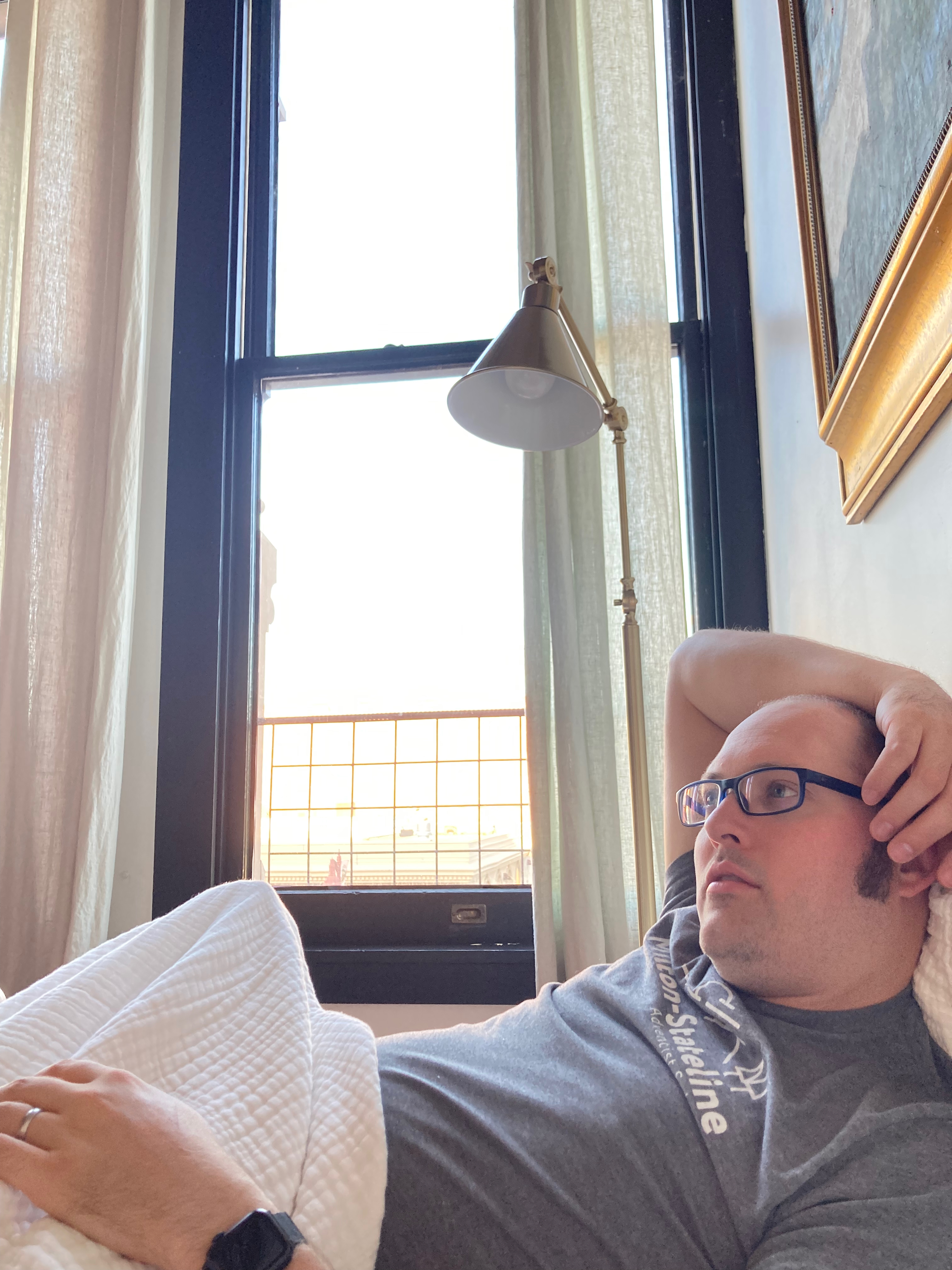
Our room in the the Royal Block had tall ceilings, and gorgeous windows facing Main Street. The king bed occupied a loft over the large custom shower.

We lounged in our room, then checked out the local grocery store and convenience store (there’s one of each). Although we didn’t find the plant-based meat we were looking for to go with our croissant sandwiches, I found pineapple juice concentrate. (That may not sound exciting, but the two grocery stores I shop at weekly have been out for months. I like to keep it around for smoothies (especially piña colada smoothies), so we made plans to come back and buy some later.)

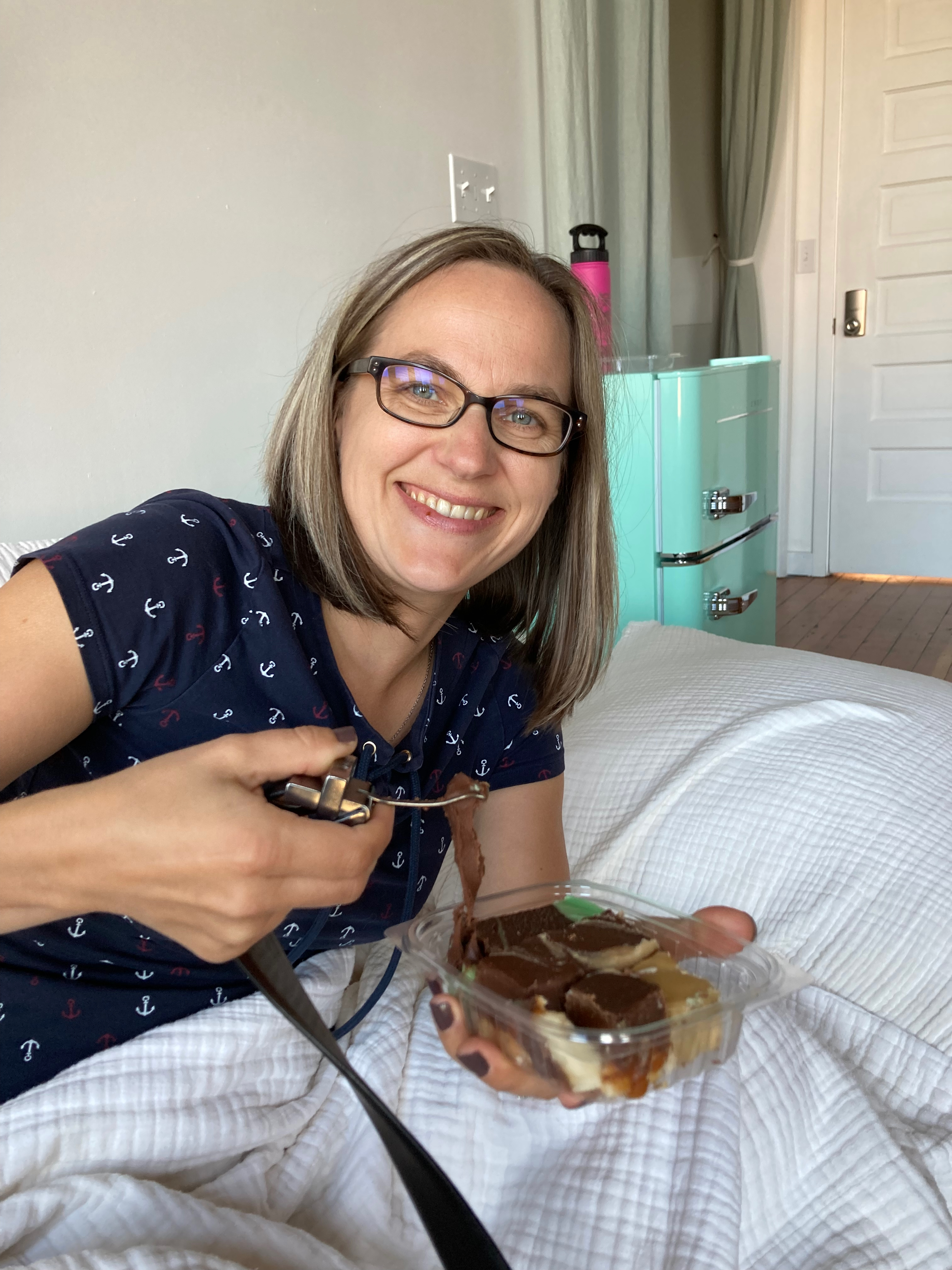
After dinner we opened the fudge from Bright’s Candies. We had no utensils, plastic or otherwise, so we used the prong on Michael’s belt buckle to slice our fudge. Yum.

In the evening, we wandered down to the bar that occupies a portion of the Royal Block’s first floor, and ended up deep in conversation with the owners, Joe and Tiina. Tiina made us a cup of tea and kept our water glasses full, while Joe regaled us with stories of the owls that lived in the building when they first bought it, and how they lived in a tent because of how much water dripped down inside any time it rained. They’re passionate about community and beauty, and are delightful conversationalists. We must have talked for an hour before turning in for the night.

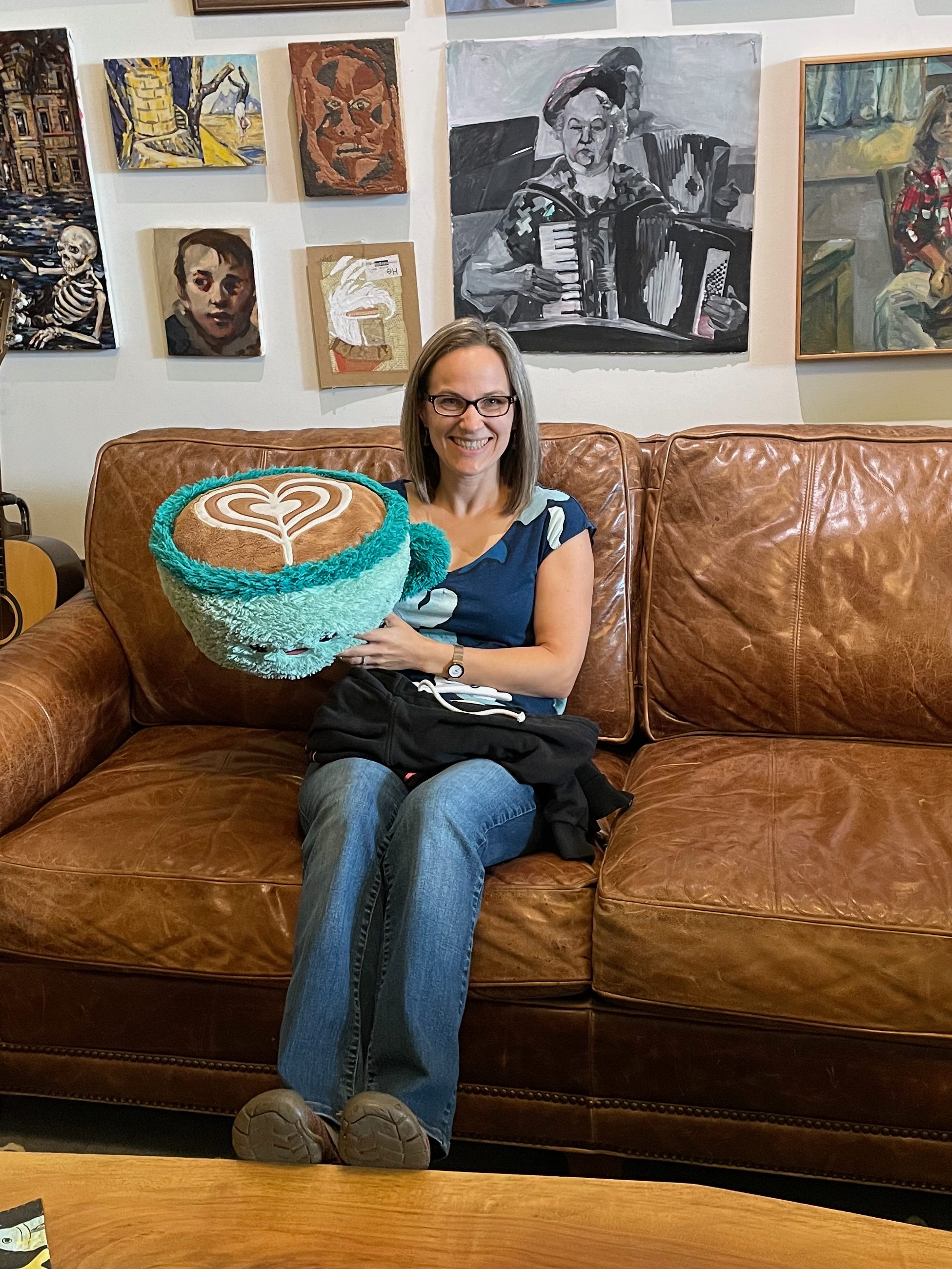
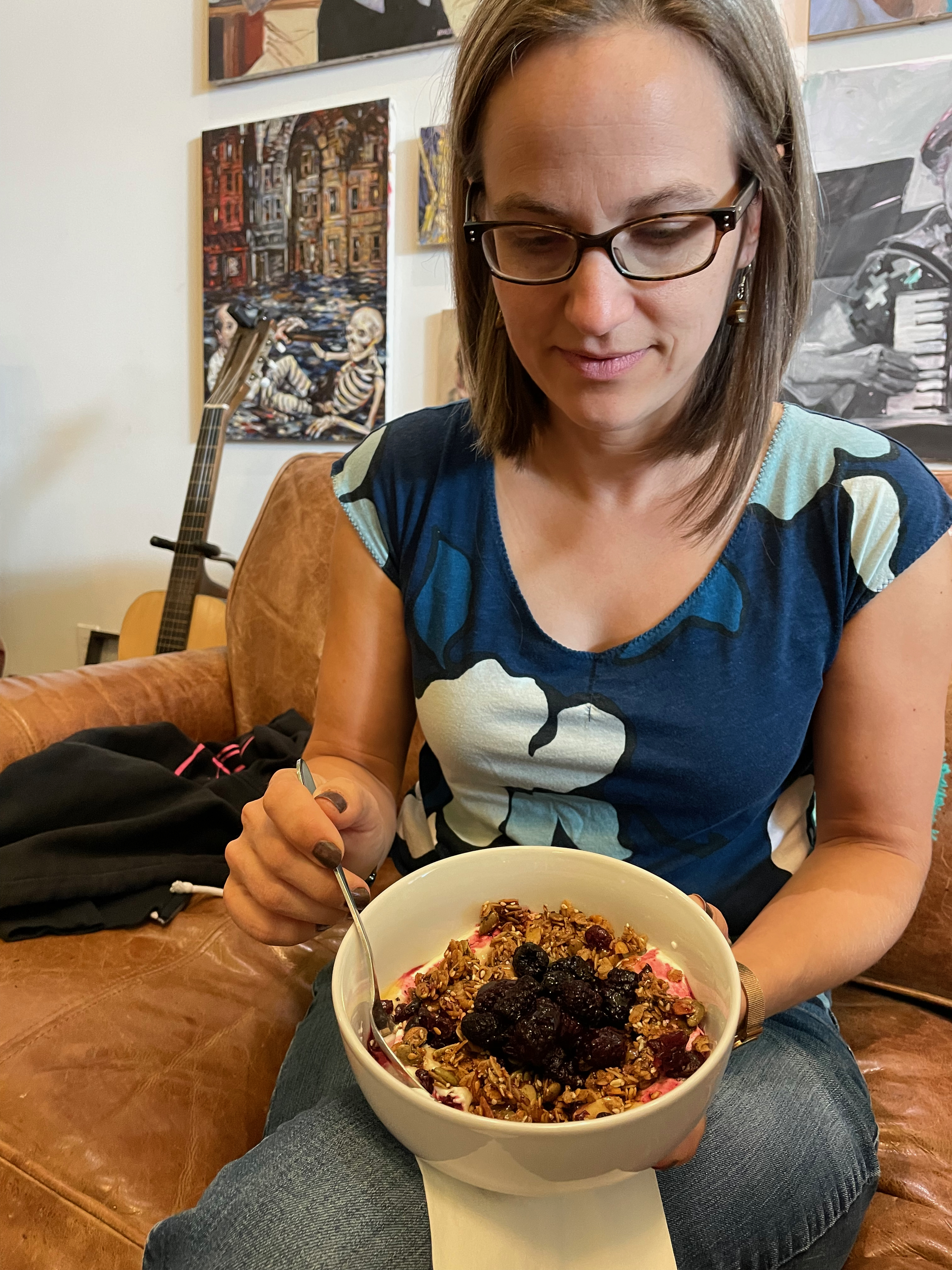
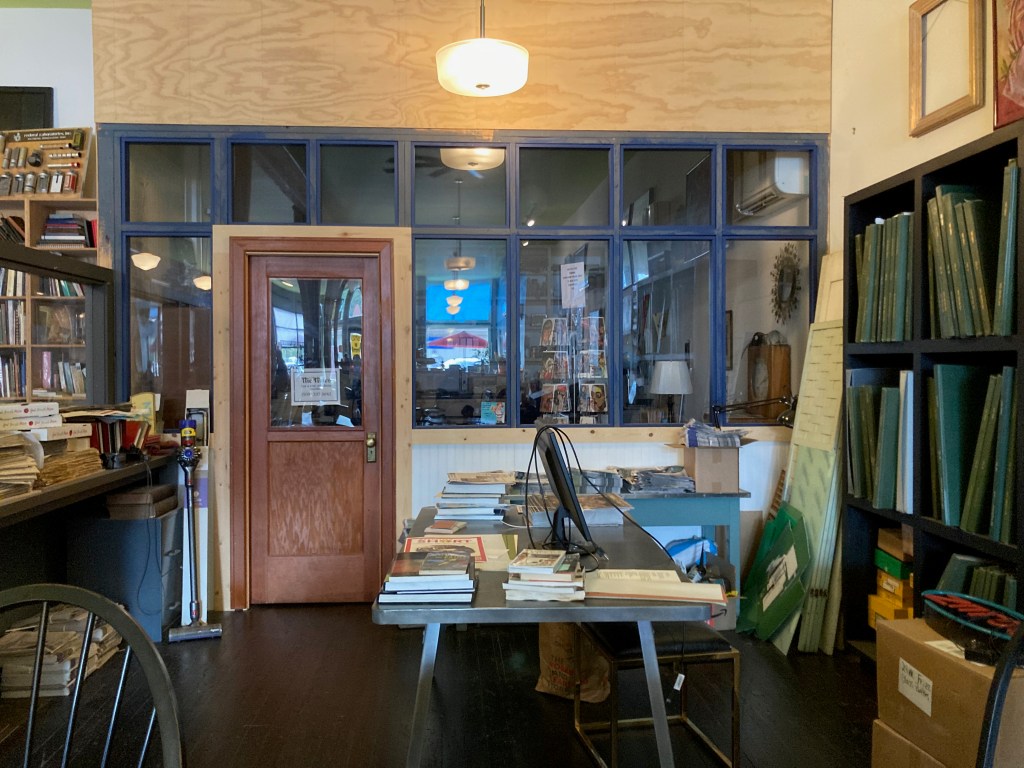
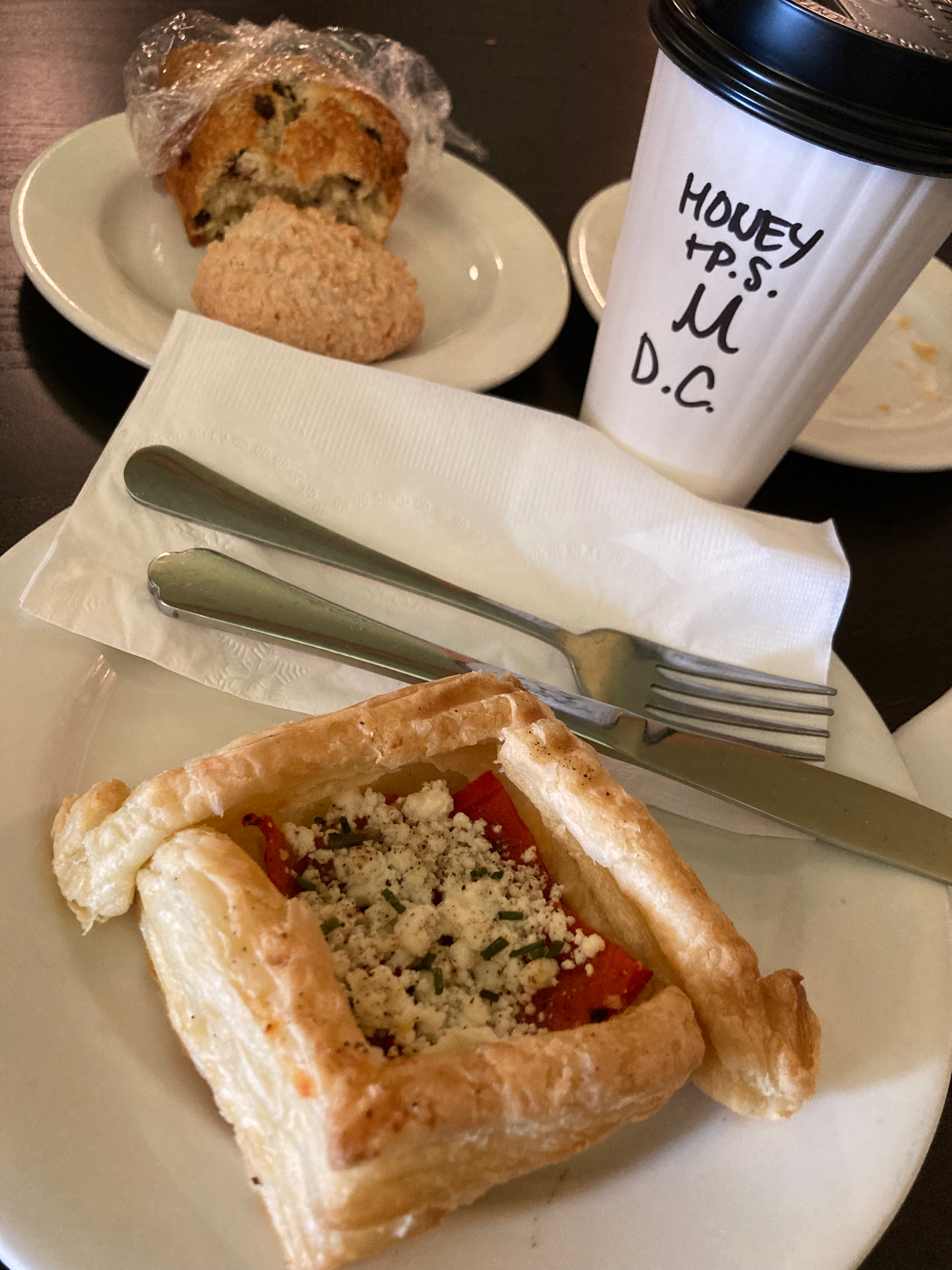
Saturday morning we quietly exited the Royal Block and walked next door to Ten Ton Coffee, where eclectic art, comfortable seating, and good food occupied us. Michael read “King Jack and the Dragon” to me while we waited for our food. (The story was new to us, and I highly recommend it for preschoolers and their parents.)

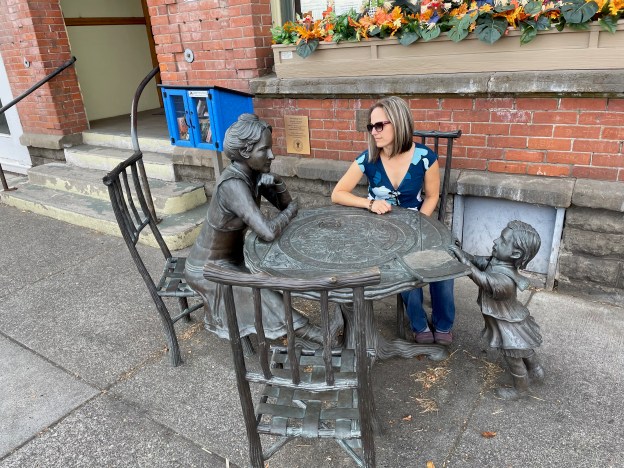
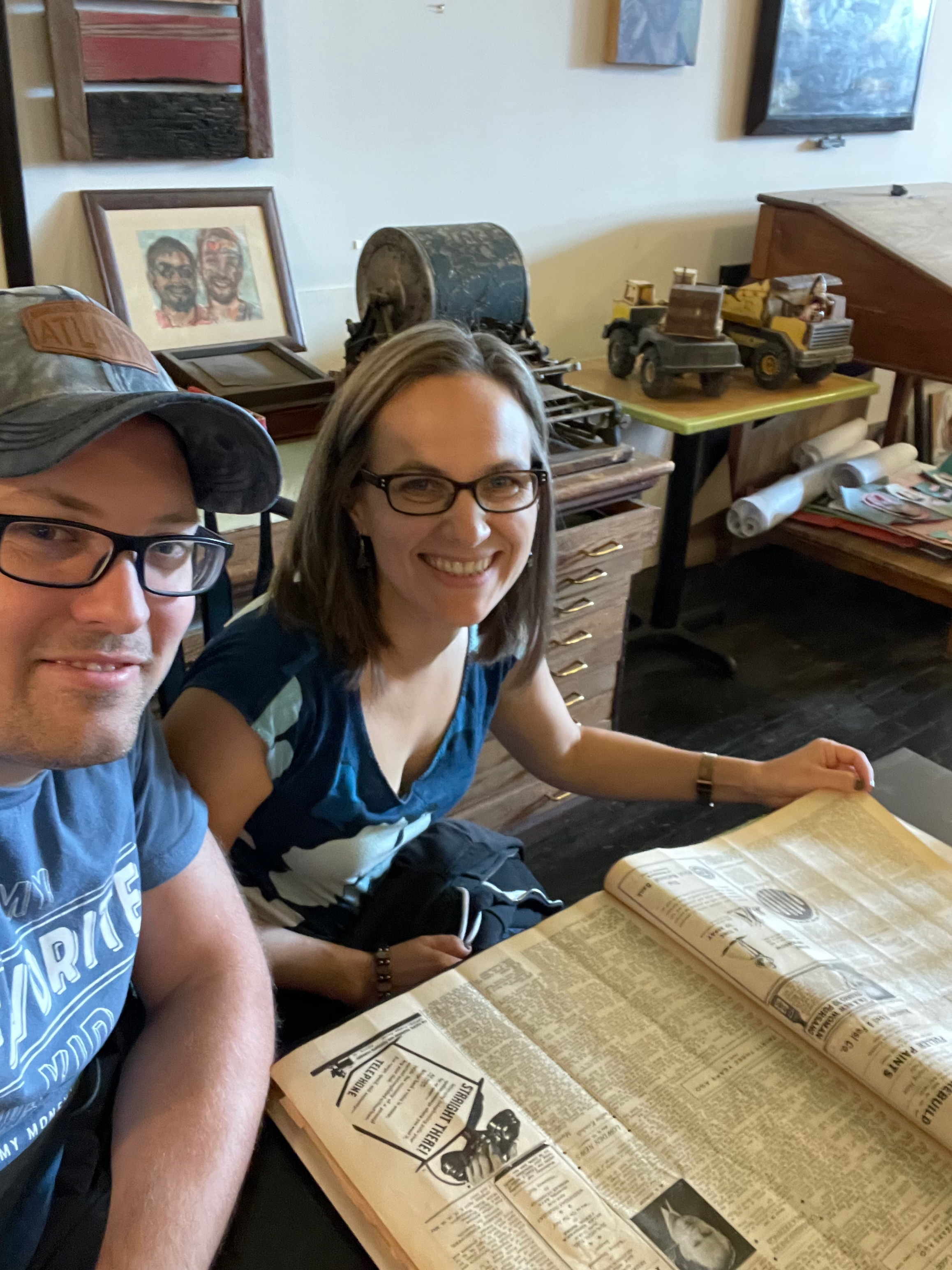
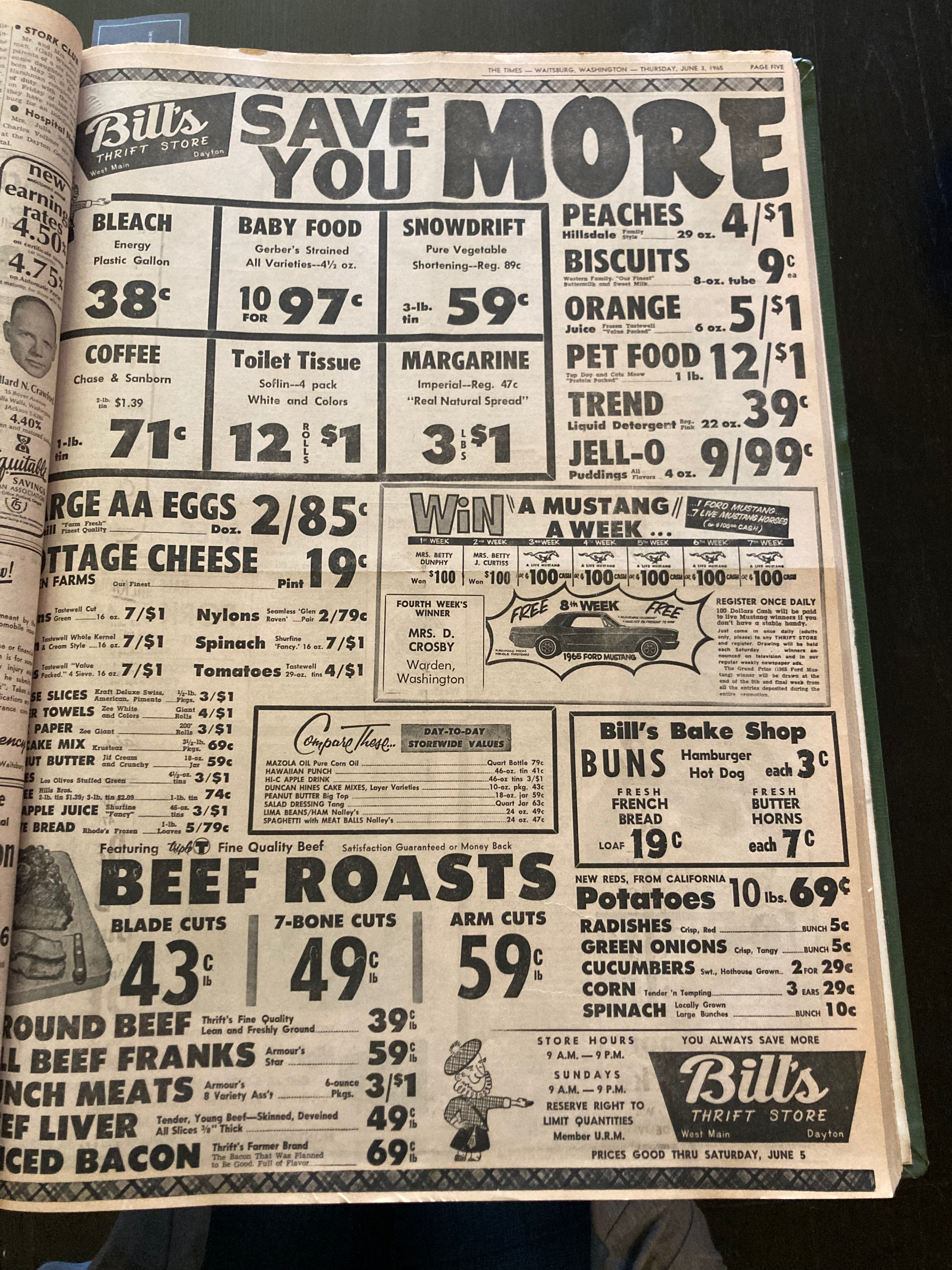
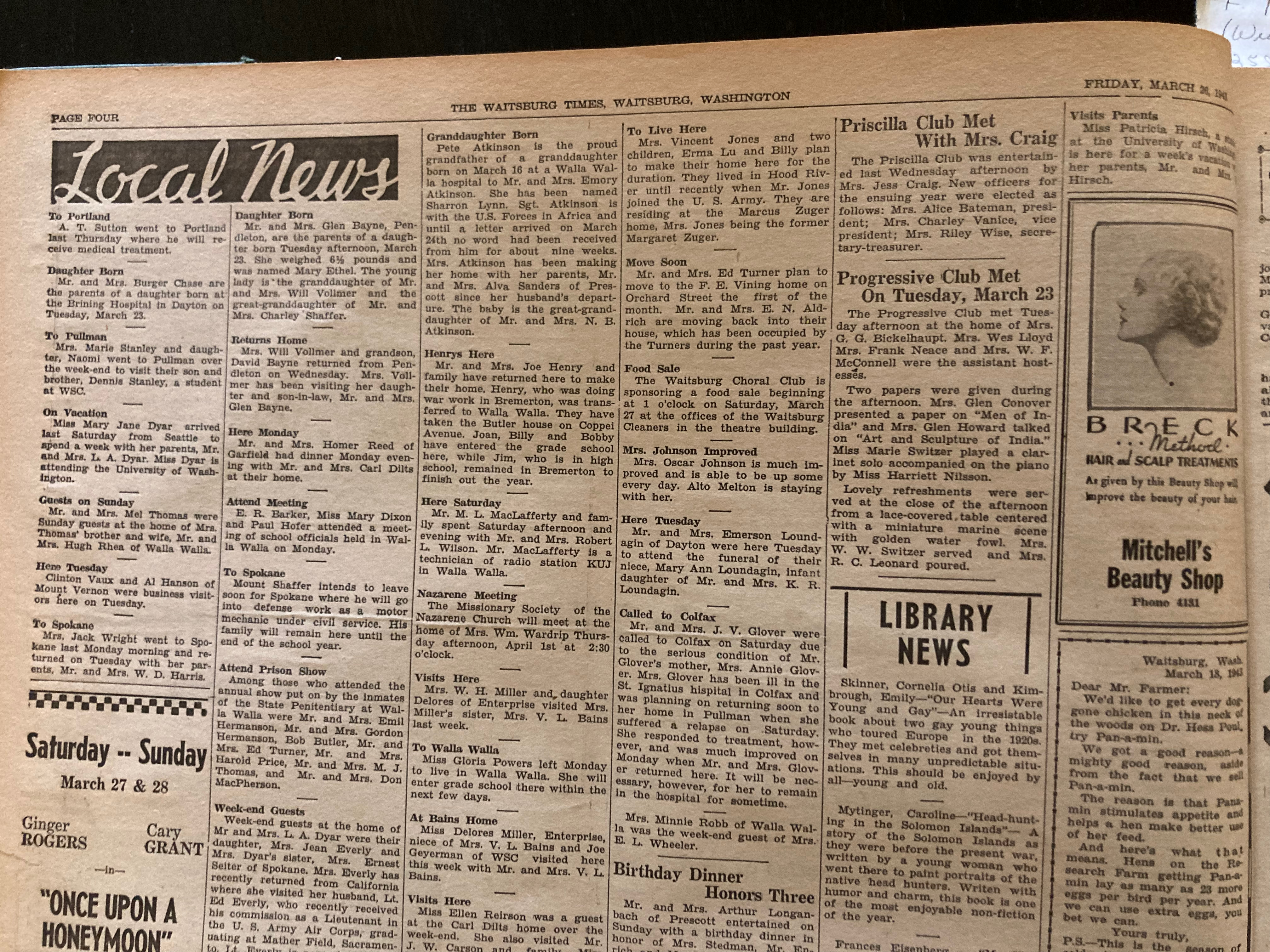
After eating, we checked out The Times office in the back of the coffee shop. The woman who currently owns the paper struck up a conversation. We talked about coffee, art, the local white supremacists, and The Times, which has been in print nearly 150 years – since 1878. She invited us to peruse the archives, housed in large volumes with green covers, shown on the right in the picture below.

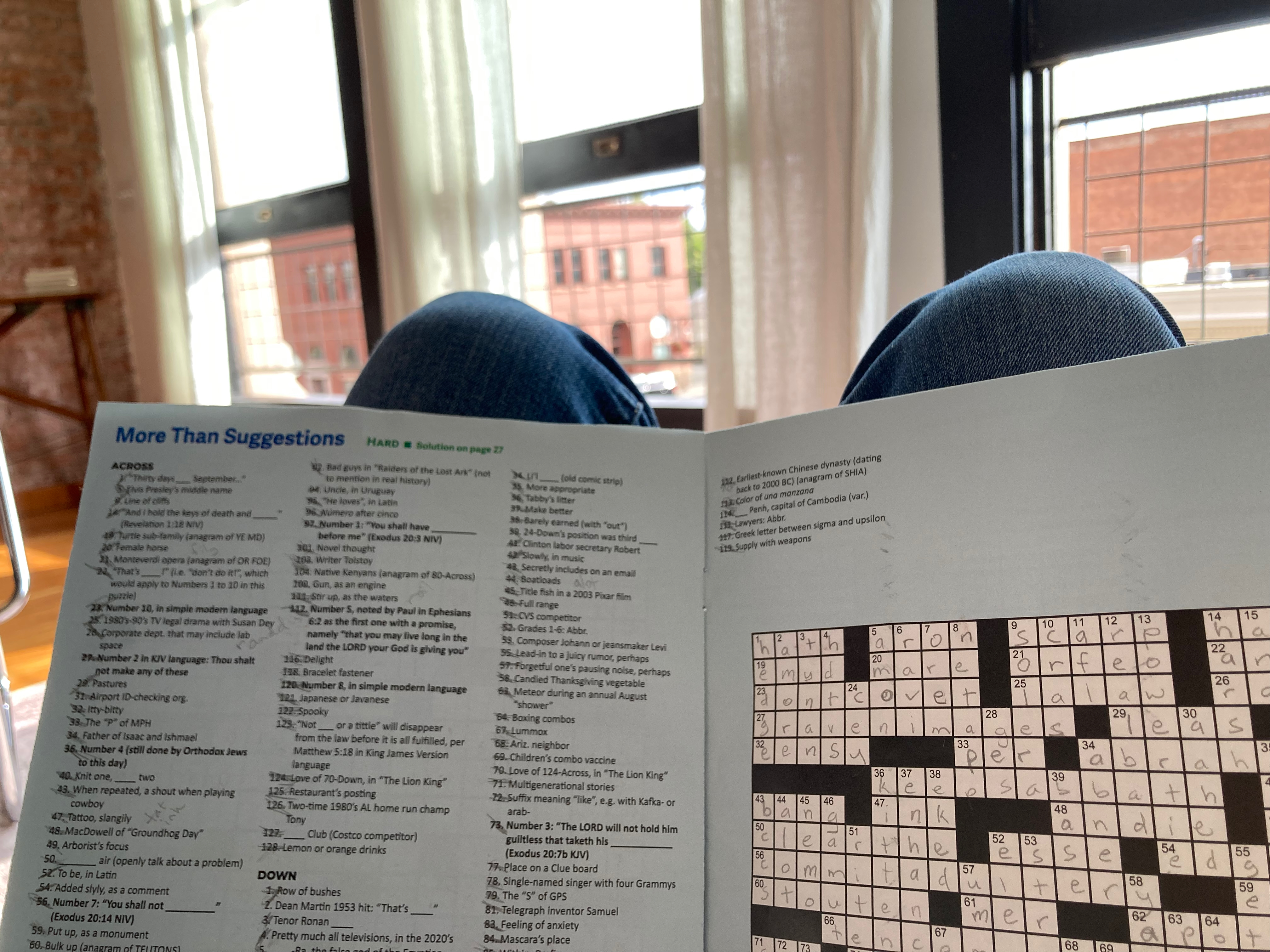
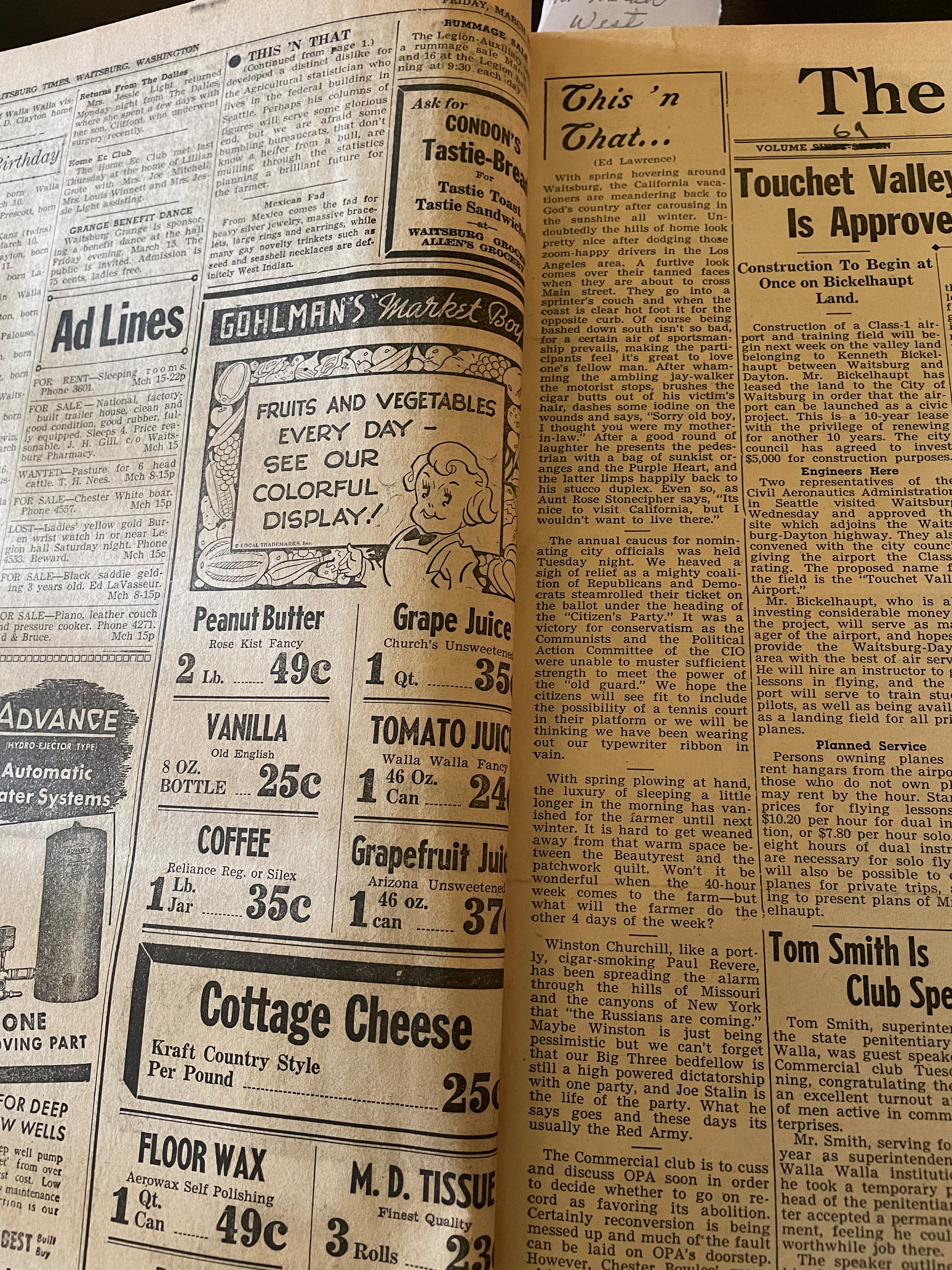
Having no plans for the day turned out to be great fun. We read newspapers from the 40’s and 60’s, and when we tired of that we went back to our room and did a crossword puzzle.

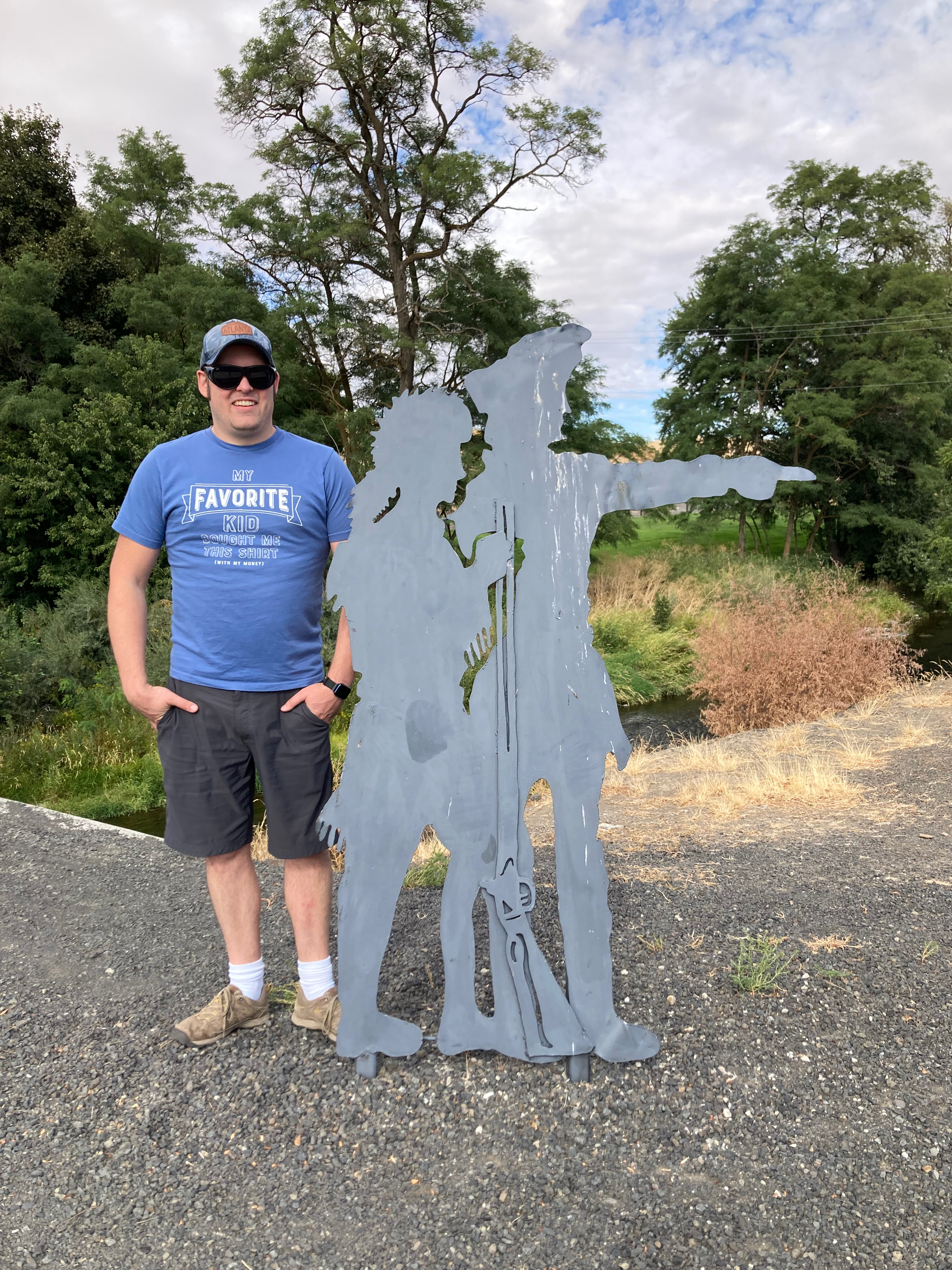
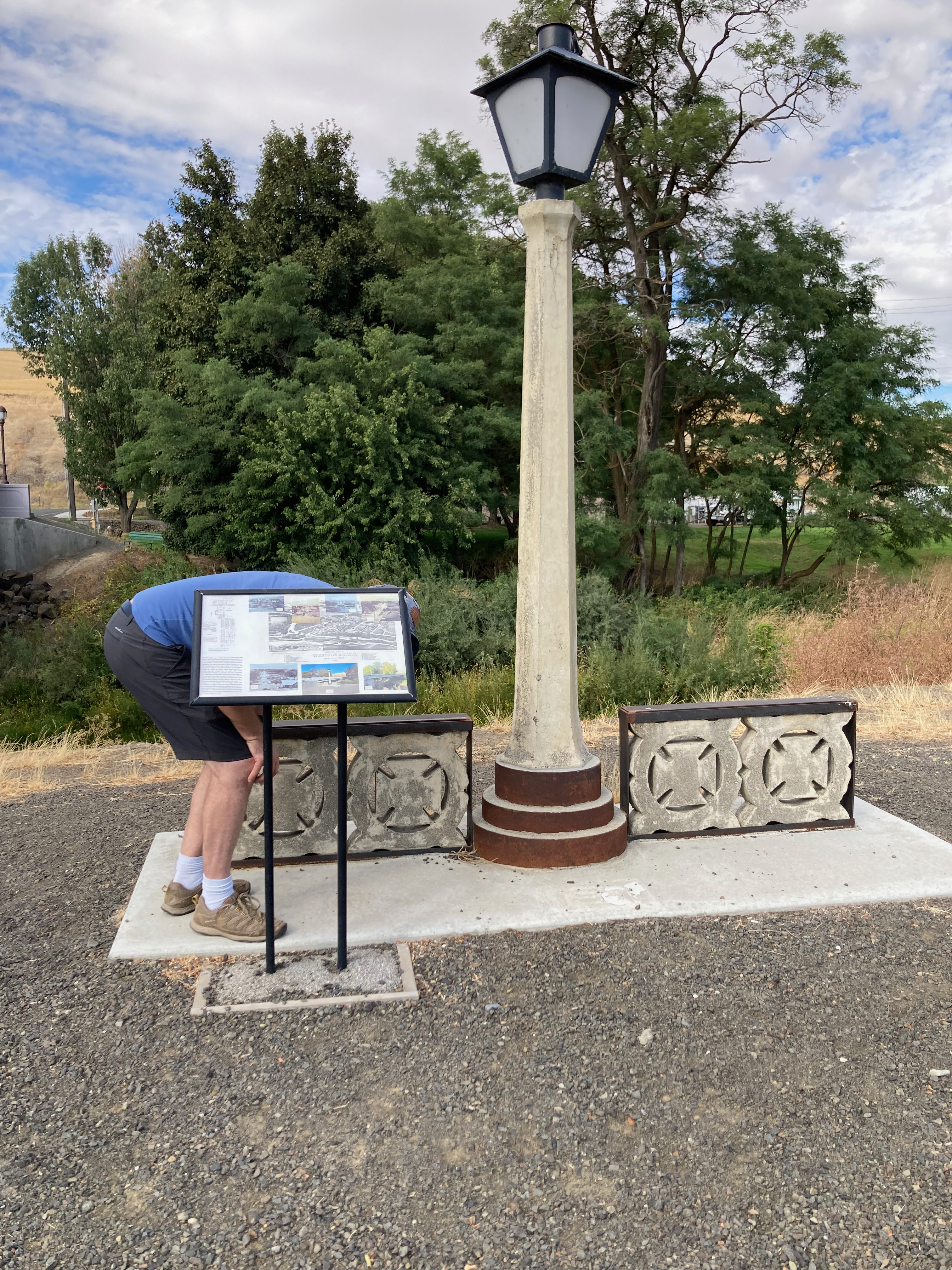
Lunchtime found us at Whiskey Canyon, a half-mile walk to the other end of town. The food was good, but a healthy population of house flies detracted from the ambience. We took the long way back to our hotel, stopping to see the sights and take too many pictures.

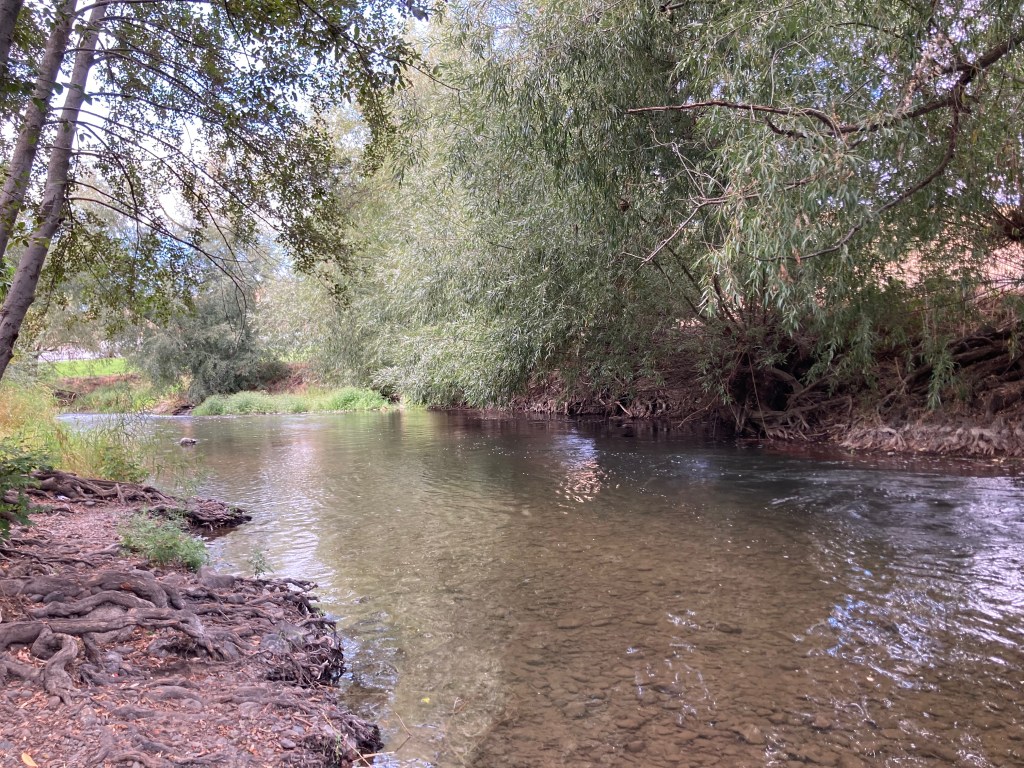
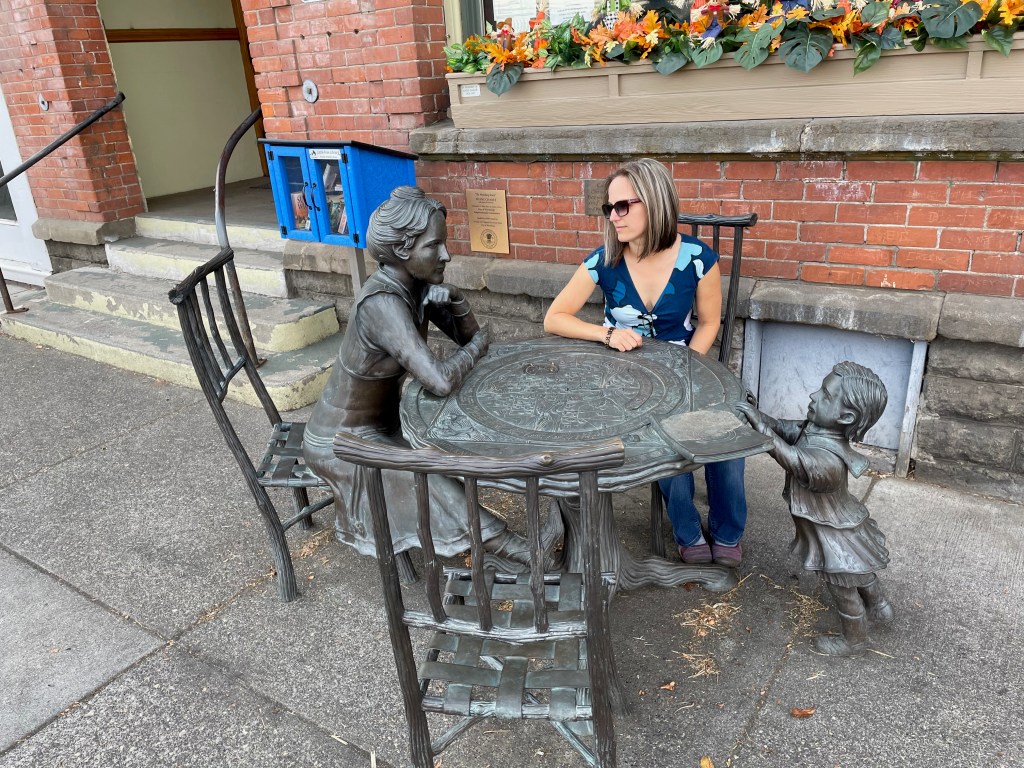
The city park in Waitsburg borders the Touchet River, and if you’re willing to scramble down a short dirt embankment, you can stand at the water’s edge and listen to the peaceful sounds of water flowing and branches swaying.

While I took a picture of the library, Michael snapped one of the former City Hall (the portion of the building with darker brick), which is currently for sale. Both Joe and Tiina at the Royal Block, and the woman who owns The Times, suggested that we buy the place (we brainstormed possible business plans over lunch because, why not?). We snuck in the building to admire the beautiful old architecture, complete with a dripping sink in a dilapidated bathroom, and office doors painted with signage for the lawyers who used to occupy them.

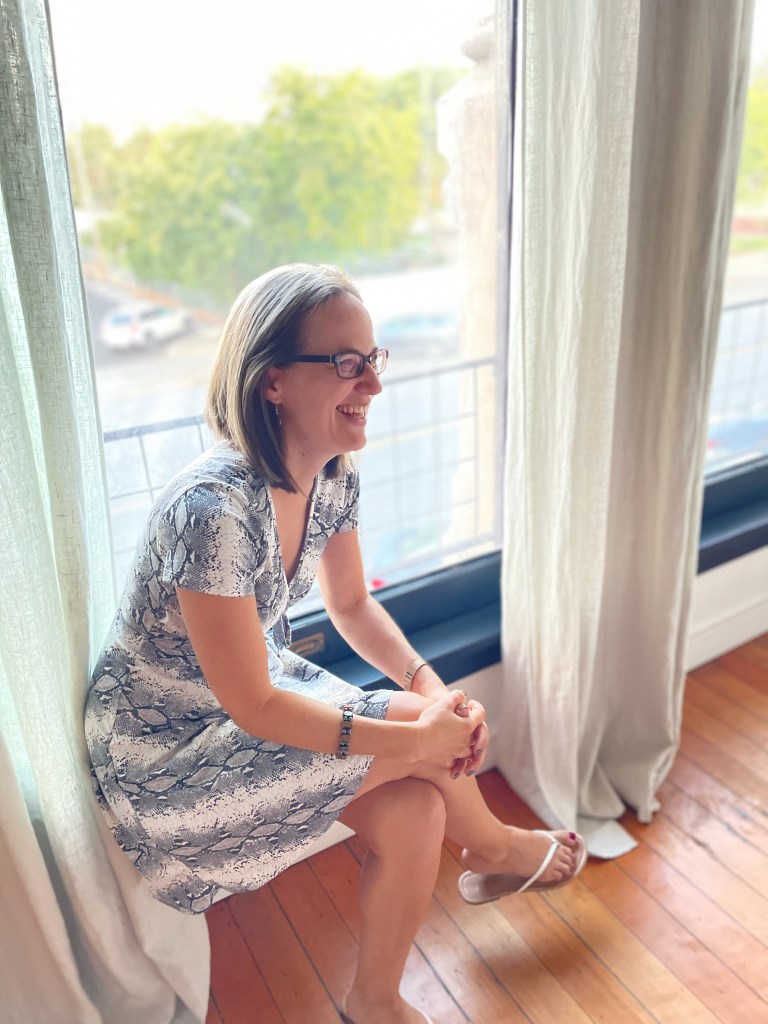
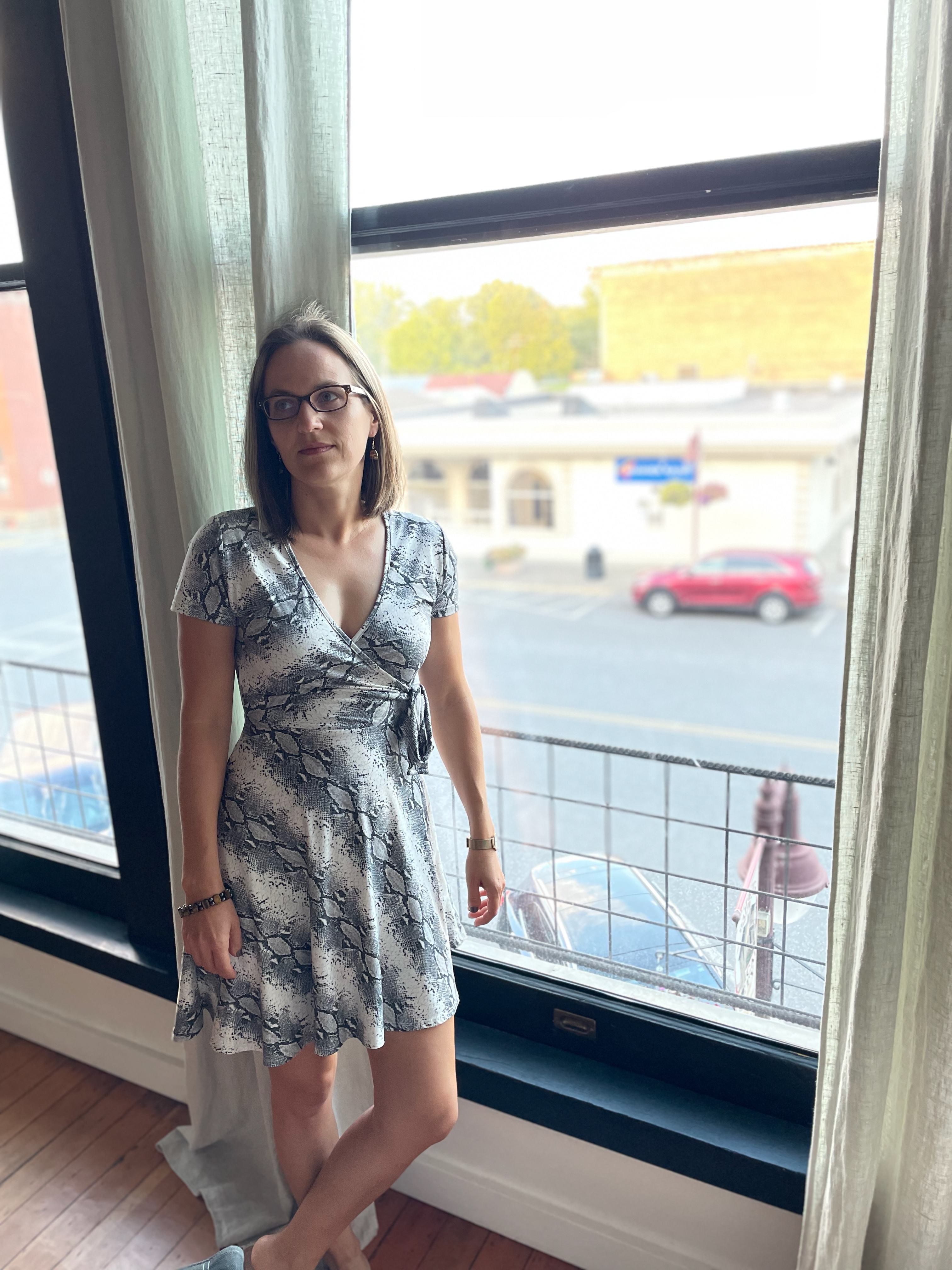
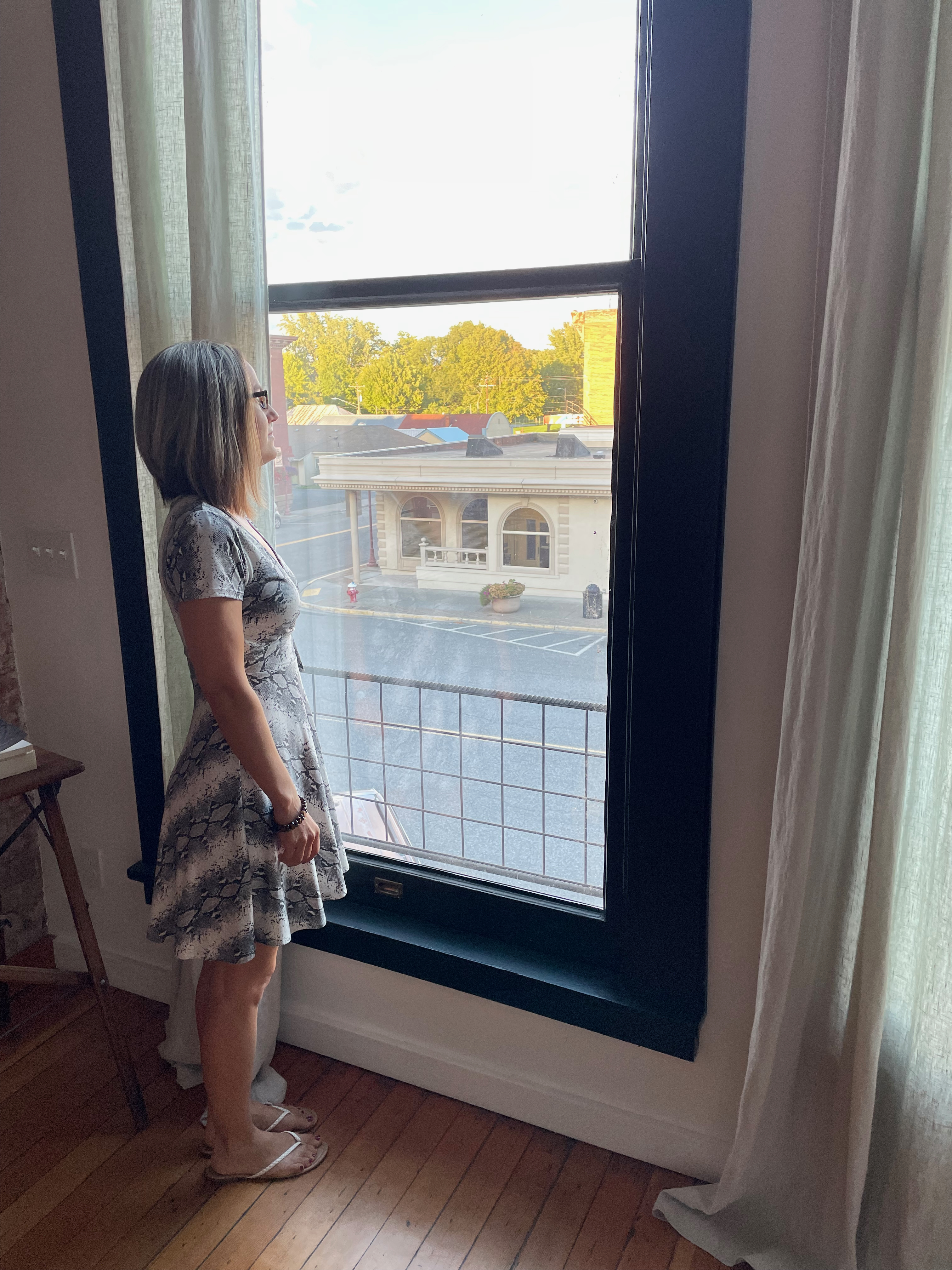
We dressed up for dinner and I asked Michael to take pictures of me in front of the lovely windows. We laughed over my awkward poses and the bank sign outside that clearly added to the romance.

Our flip-flops (yes, flip-flops can be dress-up clothes) smacked loudly on the wood stairs as we walked down to the main floor, where Tongue and Groove, a local band, played live. Joe and Tiina took orders and chatted with customers. We’d been told that Joe bakes on Saturday, so we ordered bread, an adorable baby loaf that came with housemade dipping sauce – oil and vinegar, herbs, and fresh sliced garlic.

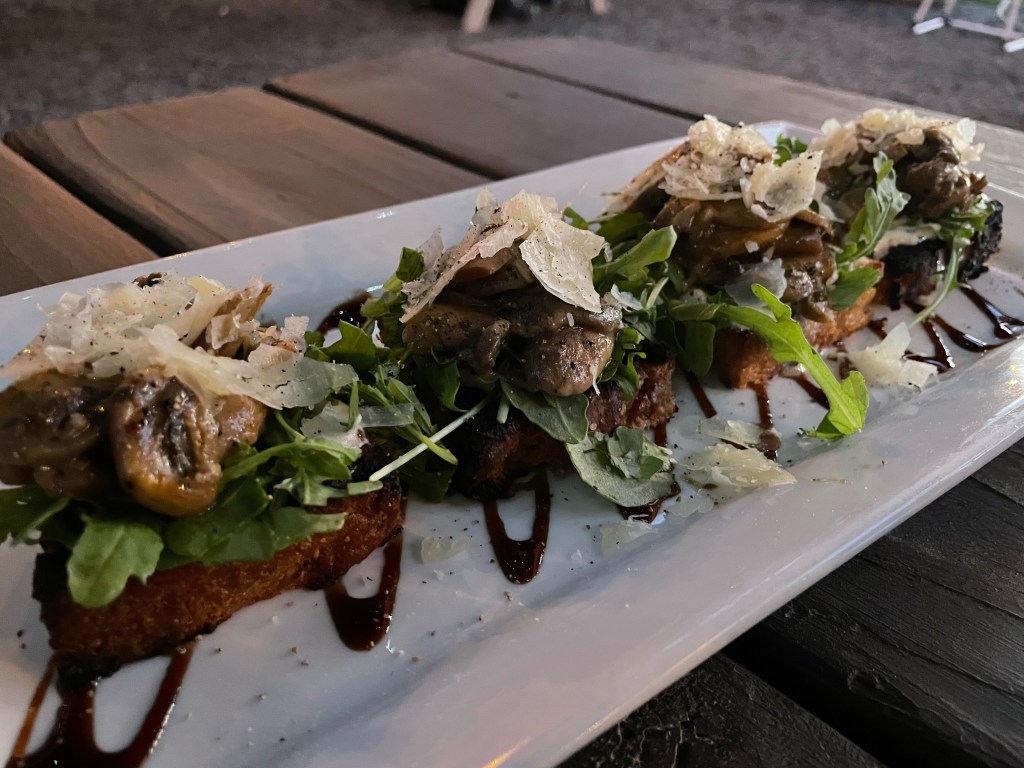
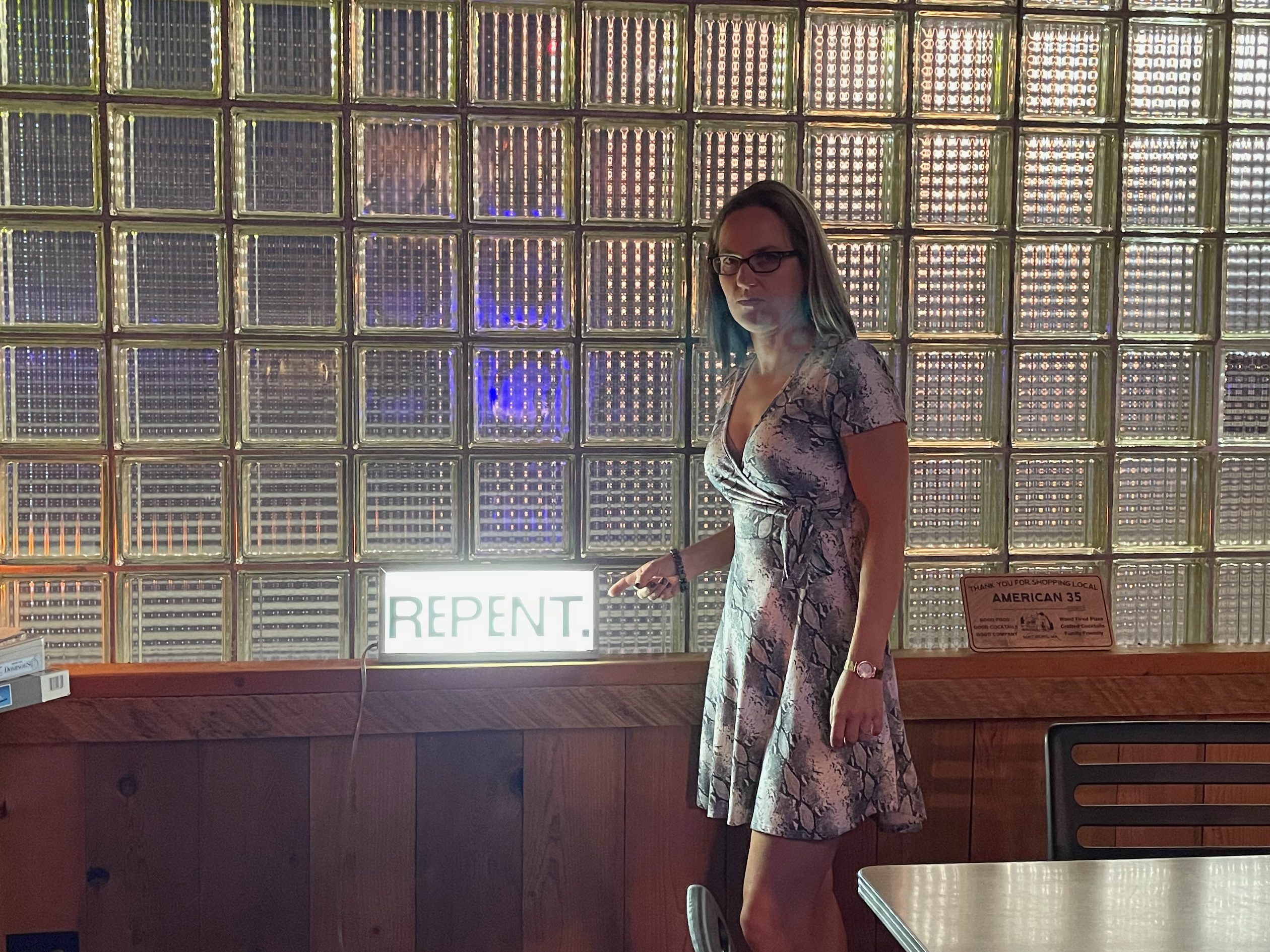
As the sun sank low and the air cooled, we walked down the block to American 35, where we enjoyed dinner outdoors under a lighted umbrella, and tried to make friends with two wary cats. We finished up with a corn-hole game, then took a picture inside by the “Repent” sign.

Sunday morning we repeated the performance at Ten Ton Coffee, complete with newspaper readings like this 80-year-old entry in the “Local News” section:

To Pullman. Mrs. Marie Stanley and daughter, Naomi went to Pullman over the week-end to visit their son and brother, Dennis Stanley, a student at WSC.

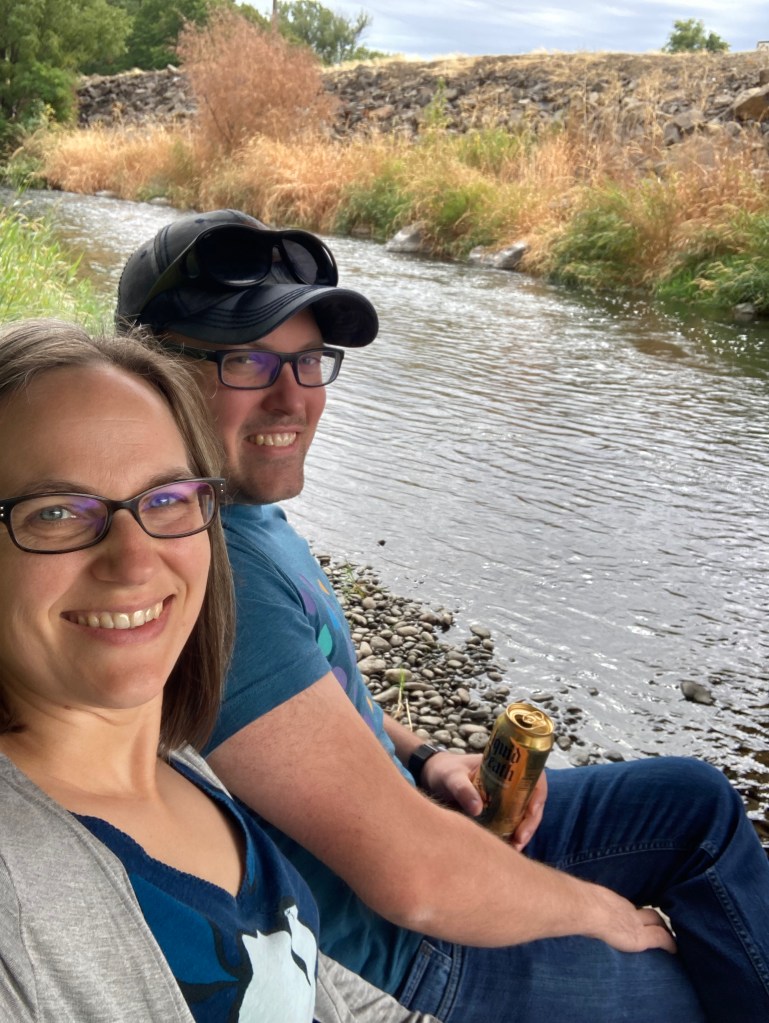
Before leaving town we snapped a picture of the lobby in the Royal Block, sat beside the river, and bought pineapple juice concentrate.

Final thoughts on Waitsburg: go visit. We talked for more than thirty minutes each with three different business owners. That’s a first. In addition to the businesses I already mentioned, also take time to stop by Simply Sawdust, where I forgot to take pictures.

Final thoughts on marriage: we’re enjoying a peaceful season – an overnight success, 19 years in the making, you might say. We’ve grown both tougher and more tender. We’ve made it through the sleepless years of parenting. We’ve settled into ourselves and into each other. It feels good. Quiet. Homey. Like a small town.


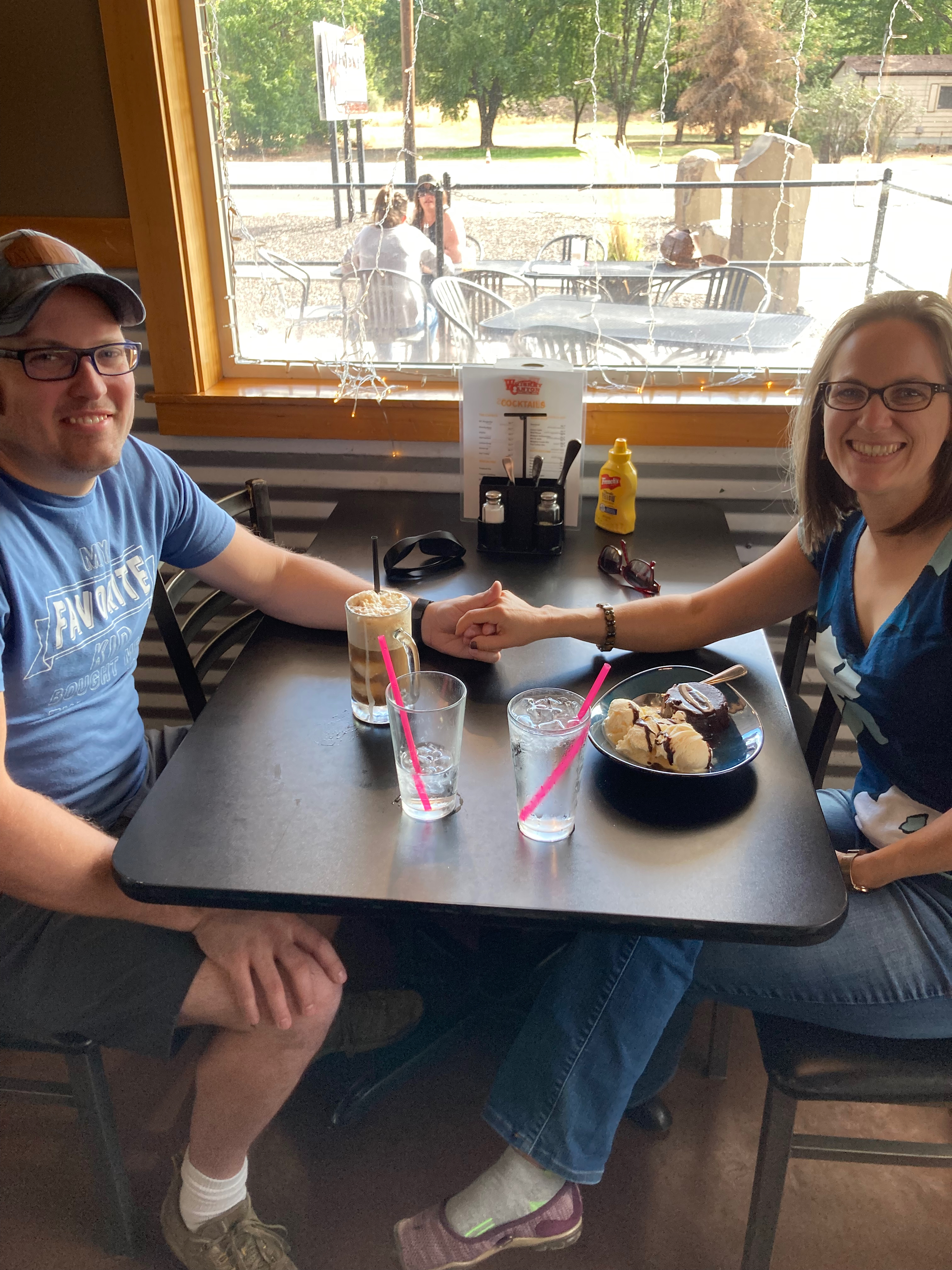
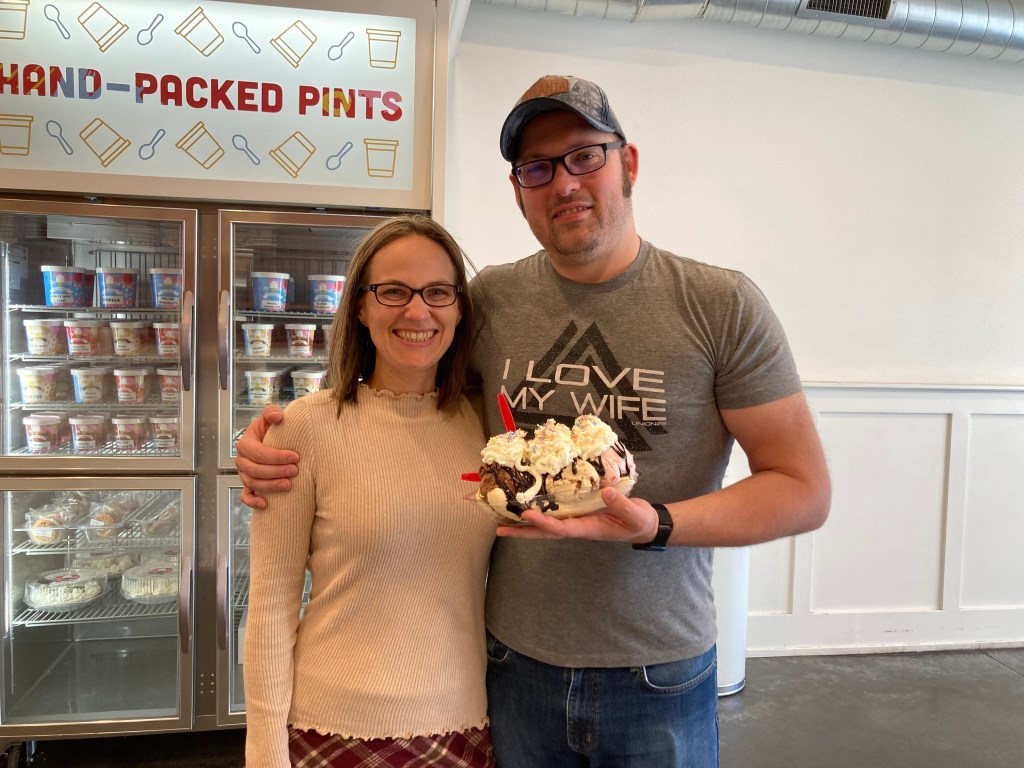
Bonus Picture: Michael and I at Pine Cone Creamery yesterday, celebrating on the actual day of our anniversary.

I Tried Yoga. What Next?

I sat on a yoga mat with the soles of my feet together in front of me, knees out to the sides. A feeling of connection and calm came over me. I had done this stretch many times and was surprised by the whole-body comfort. Rather than fighting against my body to force more flexibility, yoga taught me to work with my body. My bare feet pressed against each other, the stretch invited me to feel the muscles deep in my legs, and my spirit rested. I felt that I belonged to myself.

My exposure to yoga began in childhood, when my conservative Christian parents—who nevertheless had a habit of blazing their own way—bought a Bikram Choudhury yoga book. I loved watching my dad grunt his way into different poses—Eagle Pose, Tree Pose, Standing Bow Pulling Pose. My older sister and I would show off our youthful elasticity, easily getting into positions that our parents forced and contorted themselves into.

The Bikram’s Beginning Yoga Class book had funny cartoon illustrations, along with actual photographs of Bikram and his students—mostly leotard-clad, flat-bellied women. Bikram wore exceptionally small speedo-swimsuit-style briefs that left little to the imagination. The photos, taken during one of his Hatha Yoga classes in Beverly Hills in the 70’s, often show him steadying one of the willowy women, his face expressionless, a hand on her arm or leg.

In the 90’s, Christians—if I may generalize—spoke spitefully (or was it fearfully?) of “New Age” thinking. I’m not sure at what level I was aware that yoga made the naughty-new-age list, but the grunting and body-folding in our living room felt pretty safe to me. Any misgivings I may have had about yoga and its gateway-drug-to-eastern-religion qualities vanished sometime in my 20’s, and I accepted yoga as a healthy and legitimate practice. But until this year, I had never tried it as an adult. My time on a yoga mat typically involved sweating through lunges, burpees, and sit-ups, and those workouts were rare.

Last year, my friend Tiffaney started a yoga class with another young woman, in the fellowship room of a local church. It’s not called yoga class, because yoga is still associated with Eastern meditation, which allows evil spirits to inhabit you … or something. My sister, who is generally underwhelmed by the threat of evil spirits, has been doing yoga for years. She attended Tiffaney’s class, and around the time she mentioned it to me, Tiffaney invited me again.

So I came on a Thursday morning, late, and joined half a dozen barefoot women on yoga mats in the church basement. It didn’t take long to settle in to the quiet music and Tiffaney’s gentle voice, guiding me to breathe and stretch and count, hold and release. My body awakened, something like the expanding I feel when I step outside and take a deep breath after a rainy downpour. I felt invited to notice myself. I felt pleasure in the strength of my body, and deep release as I stretched muscle groups from head to toe. By the time I wiped down my mat at the end of class, I knew I’d be back.

Not long after my first yoga class, the group adjourned for summer. Around that time, I got a call from the local senior center, thanking me for a recent donation, and inviting me to join their yoga class. I arrived with some trepidation, expecting to be at least three decades younger than all the participants, but—in addition to the women in their 70’s and 80’s—a little girl probably three decades younger than me also attended.

“Hi,” I smiled. “I thought I was gonna be the youngest person here.” She smiled back politely but looked at me like I was about as easy to relate to as all the other strange old ladies. I laid my yoga mat down next to hers in the corner of the small, carpeted room, and a short, plump woman in her seventies began rolling her shoulders and inviting us to do the same—seven times forward, seven times back. As class progressed, I watched with respect as the circle of participants made their way through the stretches. Some were more flexible than me. Others adapted as needed for stiff joints or chronic pain. The little girl flailed and flopped in boredom, and I guessed she would have preferred her grandma took her somewhere other than yoga class.

Over the summer, I returned to the senior center whenever I had the time for Monday morning yoga. The teacher talked about opening my heart chakra, getting my synovial (joint) fluids moving, and keeping my arms against my head like ear muffs while stretching side to side. Rather than ending class with a Bible verse, she read a “thought of the day,” put her hands in prayer position, and said, “Namaste.” Five years ago that might have freaked me out, but after reading a couple of books on mysticism, and learning that “Namaste” is usually interpreted as, “the divine in me greets the divine in you,” I heartily embrace it.

There’s a wholeness to expansion and contraction. Rather than using my muscles only to hold body weight, dumbbells, or weird positions, I am invited to breathe deep and allow them to relax into the release of breath. There is safety in the guidance of a gentle voice. I don’t have to make decisions, or brace against a fitness pep talk. Rather, the teacher leads me in getting to know my body, feel my strength and my heaviness, and notice my capacity to loosen and lighten. This safety and wholeness is akin to what I feel with God, and I am delighted that it is built into my breath and my body.

Before I tried yoga, I thought it consisted of fancy stretching. Now yoga ranks among my top five bodily experiences. As I drove home from class at the senior center a couple weeks ago, I noticed that I sat taller, my muscles working together to hold me in a healthy posture. At the same time, I felt completely relaxed. Before yoga, I believed muscle tension and relaxation were mutually exclusive, but I have discovered they can coexist, and that opens a whole world of possibilities. Could a similar tension and relaxation also coexist in my spirit?

Since I’ve done yoga and remain uninhabited by evil spirits, next I’m planning to try meditation. Perhaps meditation is where the tension and peace in my spirit become friendly with each other. I aim to find out.

In the meantime, Namaste.

Martina and “Reckless”

This summer I’m bingeing country artist Martina McBride. She’ll be right here in Walla Walla for our county fair at the end of August and I. Can’t. Help. Myself. Michael and I have tickets on “Floor A”—the center of the arena, between the bandstand and the stage. I’m gonna belt every song I know, and I’m hoping I know every song. Hence, the bingeing—time to explore her music, especially any hits I don’t know, and hopefully find new favorites. But first I return to the song that connected me with Martina 25 years ago.

Remember the CD mail-order marketing of the late ‘90s? For me, a teen reaching a few timid fingers out of my homeschooled-on-a-farm cocoon, an offer of a dozen free compact discs was too good to pass up.

The ‘90s and early 2000s were my puritan years—no dating, no secular music. I lived those moral convictions with great gusto. My collection of CDs, which by high school graduation filled two disc storage albums, consisted almost entirely of Contemporary Christian music (Michael W. Smith, every Jaci Valasquez album, Kathy Troccoli), along with a compilation of Elvis Presley’s gospel songs, and a few “pagan” discs from my musician father—Peter, Paul and Mary; Roger Miller; Cat Stevens. The Cat Stevens album included “Two Fine People,” with a scandalous lyric about breast kissing—that was a new thought.

The summer after my 15th birthday I worked at a small orchard in a neighboring town, thinning and picking peaches and nectarines. The self-assigned orchard crew leader, a tough woman named Dawn, kept the portable stereo in the orchard tuned to country radio, shifting it down the rows as we moved our ladders and picked only ripe fruit—the best I’ve ever tasted. By the end of that summer I knew most of the country hits of the year 2000. That same summer, my sister worked as a lifeguard at the city pool in the next one-horse-town down the line from where I picked fruit. Country music was the backdrop there, too, and we both finished out high school with the stereos in our matching white Chevy Corsicas tuned to the country station.

On the radio I heard Martina McBride sing “There You Are,” a slow song full of metaphor about the omnipresence of a lover. I immediately adopted it as a Christian song about the ever-presence of God. This adoption allowed it into my stringent collection of music. I wanted to buy the album with that song, but didn’t know which album to buy. It took me a couple of tries, and that is how I came to possess Martina McBride’s albums Evolution and Emotion—the latter includes the song “There You Are.”

Popular music, along with all Disney movies, and most fiction books, were absent from my childhood home. As a Junior in high school—the first year I didn’t homeschool—I became best friends with Terah, who listened to popular music. I picked up a song here and there. She gave me the Shrek soundtrack and introduced me to Billy Gillman, who sang country that was pop enough she could handle it. At first I felt a bit sneaky adding those Martina McBride albums to my Christian-curated collection, but my loyalty was sealed when I read online that Martina sidelined her touring so her children could have a normal upbringing, with her in it. I mean, doesn’t that speak for her music?

Evolution and Emotion are cherished albums 25 years later, and Martina continues to be my favorite country artist, although I haven’t kept up with her later releases. Her Christmas albums play in our house every December, and I learned the chords for “This Uncivil War” so I could sing and play it on my guitar.

In preparation for the concert at the county fair, I’ve been listening to all 14 of Martina’s albums. There’s some good classic country stuff in there, like the song about crying on the shoulder of the road. Her first three albums lean toward “whiny country” (or, if you prefer, “classic country”) and I’m finding I don’t enjoy them as much as her country-pop sound. But one album, released 17 years after Emotion, quickly became a new favorite from beginning to end. I can sing parts of every song now. And—once again—the song that captivated me most, reminds me of God. The album is Reckless, and the title song is about, well, being reckless, rushing headlong into everything. The rash person in the song makes a rash statement about her lover, new words for my standing conviction that God is crazy: “For loving me the way you do / I know I’m reckless / But you must be reckless, too.”

I don’t suppose God is reckless in a traditional sense (“reckless” is generally defined as a lack of concern for consequences), careless about the consequences of His decisions—given all that omniscience and “outside of time” stuff. But, unlike humans, perhaps God doesn’t make decisions based on consequences. Maybe He doesn’t even base decisions on “outcomes”—the sophisticated version of consequences. What if it’s all about creativity, the making of us; and presence, seeing us? What if it’s about doing a whole lot of reckless things for people who will never return the favor, the affection?

I’m looking forward to a reunion on August 28—a return to age 15 and nectarines, to the memory of CD clubs and having my own car (a Garth Brooks CD was in the player when I bought the car), and a do-over of the time I missed hearing Martina at the 2019 Ventura County Fair. I’m looking forward to singing in a sea of strangers, watching the moon rise above the stage, everything sounding muted on the way home. And I’m looking forward to celebrating the God who loves me through my puritan phases, arrogance, anger, and disbelief. He has sent love notes to me in country music, TV shows, and irreverent books. He has taken me on dates to therapy offices, quiet campgrounds, and Bible studies. I know I’m reckless (believe me, perfectionism is its own version of recklessness), but He must be reckless, too.

Prayer, Revised and Expanded

My journal takes me back in time. September 25, 2015. Thirty years old. Married ten years. Two daughters—Kyli two months past her first birthday, and Kayt a month shy of her third. That means on the day I wrote this prayer I had a one-year-old and a two-year-old. No surprise that “broken,” “scared,” “no match,” and “tired” feature in this heart-cry, penned during a rare stolen moment. My heart bled out through the ink of my pen. I turned to the page and to my heavenly parent, because together they were the safest place I knew.

April 17, 2024. Thirty-eight years old. Married 18 years. Kyli and Kayt are now 9 and 11. We’re deeply settled into the house we were in the process of purchasing in 2015. And I’m writing, which I now realize is not only a safe place for me, but also a creative passion.

Today I’ll respond to myself in this prayer. A spiritual journey is a both/and experience, dense with contrast and contradiction. And so today maybe I disagree with my thirty-year-old self, but my experience and beliefs then were as valid as my experience and beliefs now.

Truthfully, I haven’t been writing spiritual content much recently. I’m weary of cultural Christian ideas, the sin-and-salvation language, the beliefs that tied my hands behind my back. But set all that aside, and there is a friendship. Prayer is a celebration of friendship.


Good morning, Lord.

I am in a place I know You do not intend for me to be. I’m literally sick with worry. I can’t stop my head from spinning and my heart from panicking. Please speak truth to my heart and save me from myself.

You can be in this place. It’s okay to not be okay. You won’t feel this way forever. And yes, keep believing there are better things ahead. You are held.

I believe the solution is walking with You, but I can’t even do that. I am so broken, so scared, so selfish. Please do it for me, Lord. Take my heart, take my marriage, take my parenting, take my responsibilities at church and book group and other places, take the move to the new house, take meal planning and grocery shopping, take the lies that cripple me. Take my heart of stone and replace it with a heart of flesh.

What does it look like to “walk with God”? You are beautiful and your life is beautiful. You are worn out. Ask for help. Take medication. Drink coffee. Watch TV shows. Cry. Plan a day for yourself—that is not selfish. Your heart of flesh is already there. And this grieving might be just the thing to help you find it.

I confess my selfishness, my desire for control, my fears, my misbeliefs. They are sin and they do not honor You. Please take them from me. Please fight this fight for me. I am no match for sin, no match for the devil, no match for life.

Overwhelmed, flooded, depressed, alone, trapped. You feel these things deeply. You are stronger than you think, and not as strong as you think. You might have to let get of what you’re holding tight, and holder tighter to the things you’ve been letting go. Don’t know what that means? Don’t fret. God really does have your back, and She’s not the least bit disappointed.

I can do nothing … but isn’t that a good thing? For Your strength is made perfect in weakness [2 Corinthians 12:9]. Please hedge me behind and before and lay your hand upon me [Psalm 139:5]. Please take away my addiction to negative emotions. Teach me to rejoice in Your victory in my life, to give You the glory, to have a heart of thanksgiving.

These things you dream of will happen. You will learn to enjoy feeling happy, to like yourself, to feel gratitude and joy.

Lord, I am lonely. I am broken. I am too self-centered to see the beauty of You and the many good gifts You are showering on me daily. I surrender to You, Lord. Please save me from myself, Lord.

God will save you from yourself by introducing you to your true self. It’s okay to be lonely and broken. You are also brave and kind and capable.

I need time with You daily in prayer and in the Bible but I feel helpless to make that time. Please do it for me.

God loves to spend time with you. She hears you.

Thank You that You see me as I am and love me. I am so tired of myself. I am so grateful that You are not overwhelmed by my brokenness. Thank You that You use brokenness for Your glory. Give me a testimony that will draw others to You. Lord, if I need a mentor, please provide.

Keep speaking these truths. And when you’re too tired to speak them, the Spirit will speak them for you. You don’t need a testimony; you are a testimony. And you always will be.

I am terrified of the day ahead of me. Take this from me, Lord. Give me eyes of faith. Remind my heart to lay everything at Your feet and let You do the heavy lifting. I want to take Your yoke upon me and learn of You, and accept the rest You promise [Matthew 11:29]. I want to be Your servant and friend so that others will be drawn to You.

Oh dear one, these days are so long and so hard. I see you. You can do hard things. And God is teaching you to rest, even now.

Thank You for my brokenness, thank You for trials and difficult times. Thank You that You are enough and everything else is a cherry on top. I choose by the power of Your Spirit to abide in You. Please let me be a branch today. [John 15:4, 5]

Way to go! You are receiving with open hands. But you know, “everything else” is the stuff life is made of, and it’s okay to want it to feel lighter. You are a branch. You are a badass. Many good things are coming for you, and one day you will feel excited about what the day holds. In the meantime, go get some coffee.

Easter-Egg Life

As I practice both/and living, I learn to allow myself a mix of grace and hard work. Both/and living means, for me, a life that embraces paradox and nuance—different than black-and-white, either/or living.

It’s not unlike the Easter-egg hunt in our back yard last weekend. Several families gathered to spend a lazy afternoon enjoying haystacks (make-your-own taco salad), early spring sunshine, and Easter candy.

Our gathering was ripe with contrast:
Warm sun, cold wind
Hollow (plastic) eggs and solid (hard-boiled) eggs
Edible treasures and inedible treasures
Young and old (three generations of family)
Hiding and finding
Large eggs and small eggs
Textured eggs and smooth eggs
Relaxation and busyness
Eating and drinking (can’t do them at the same time)

Dozens of eggs peeked from grass clusters or perched in low branches. Most of them were easy to spot, but some hid deep in overgrown grass, or camouflaged with bushes and trees. Kids ran through the yard and collected the easy-to-find eggs, then dumped out the baskets to assess their treasures, popping candy into their mouths as they sorted the hollow, plastic eggs from the dyed, hard-boiled eggs. After they’d satisfactorily sorted their first take, they went out again, looking for the harder-to-find eggs. The second round yielded less results; nevertheless, each child’s collection of candy and coins, tiny animal toys and stickers, continued to grow.

My journey into paradox has involved opening the components of my life, like eggs collected in a basket, to find out they were filled with chocolate I couldn’t eat, money I couldn’t spend, and to-do lists I couldn’t finish. My basket stank. The hard-boiled eggs rotted, and the hollow eggs held no treasure. They were labeled—religion, self-help books, pulling myself up by my own bootstraps, always doing the right thing—but the contents disappointed. I thought I’d painstakingly collected resurrection power, or at least a lucky rabbit, but instead I had unearthed anxiety.

The hardest work in my life has been excavating the mountain between me and grace. My value has long been rooted in performance and productivity, and—far from what the church patriarchs predicted—it’s excruciating for me to be “lazy.” I have been incapable of resting my soul, unable to move in “the unforced rhythms of grace” (Matthew 11:29, MSG). A planned life and a protestant work ethic leave grace hanging to the side, like an awkward, unneeded appendage.

Late Easter afternoon, as we covered bowls of salsa and picked up trash, my daughter Kyli kept asking my help to find one more special egg. She knew it had $1 in it which would be hers to keep, along with the container—a beautiful, 3D-printed, shiny black egg that screwed open and shut, with mermaid-scale texture on the outside. I searched with her willingly at first, becoming more reluctant after each subsequent request. I had hidden the egg in question, but I couldn’t remember where, and I soon tired of looking.

It’s not that hard work or self-help books are inherently or predictably bad. It’s just that my basket lacked wholeness. I needed to collect eggs containing decadent chocolates meant to be eaten, money to spend, and lists of what I’d already done. I struggled to find those eggs. I saw them in other people’s baskets, but whenever I went collecting with my basket, I found more of the same eggs I’d already collected.

At length, one of Kyli’s uncles found the black egg under an apricot tree. Kyli squealed with joy, opened the egg to retrieve the dollar, then carefully added it to her egg collection. Soon she returned to our play-set, where the cousins were sending all manner of things down the slide—rocks, smaller cousins, broken plastic things. All was well in the world and she could focus on the fun at hand.

Like Kyli, I never did find the special “eggs” I was looking for. Someone else found them and handed them to me. Much to my surprise, the eggs I didn’t work for are some of my favorites. I used to think working hard mattered a lot, and productivity trumped enjoyment. I’m grateful to the authors, friends, and family who have lovingly placed “grace eggs” in my basket. I’ve learned to have fun.

It’s not that I won’t work hard; I do and I will. The difference is, as I putter and tumble and stride through my days, I like them. I like me. I like people and pets and all kinds of weather and books and food and friendship and I almost like it when my kids wake me up at night. At least, I’m pleased they trust me and know they don’t have to be alone when they’re scared or can’t go back to sleep. This, I think, is grace.

Gained in Translation

“Thanks to you I have the goal of being someone good in this world.” So concludes the final letter from Alejandro*, and his words stop me.

I’ve been told I have influence—or rather, warned that I have influence. Better use it for good, they say. Watch yourself. Or, as the church-school song goes, “Oh be careful little tongue what you say… for the Father up above is looking down in love…” And I have been careful, which mostly feels like fear, anxiety, and judgement.

I’ve been told I have influence—but Alejandro’s words shocked me. It hadn’t occurred to me that I could inspire anyone to want to be good, and certainly not someone I’d never met in person.


In 2009, I was a few years married and worked full time at the Christian college from which I had recently graduated. That spring the student association hosted a concert by the Christian rock band, Superchick. It took place in the big dome at a neighboring college. While true fans moshed it up, I wished for earplugs from my seat on the bleachers. Somewhere in the course of the evening, the band made an appeal for child sponsors, and in the post-concert din and jostling, we managed to buy a CD and sponsor a child—Alejandro, from Bolivia.

For 14 years we exchanged letters with Alejandro, as he grew from a preschooler to a working man and graduated from Compassion International’s child sponsorship program at age 20. Early letters were written by Alejandro’s brother or his tutor. A letter in 2011 included this endearing anecdote: “It was a happy week for my family too because my brother was born and my mom was delicate so we couldn’t do anything for her birthday. She is better now and we are going to buy a cake for her. Alejandro helps me to wash the dishes because my mom is still delicate.” -signed by older brother Emilio.

Over the years we prayed for each other and shared favorite foods and the antics of our pets. One letter informed us that Alejandro’s pet goose had laid five eggs and was taking good care of them, and included an update on turkeys that had hatched some months before: “My mom likes them very much, she feeds them every moment.” Occasionally we’d make an extra monetary gift through the Compassion project, and a few months later we’d receive a picture showing what Alejandro bought with the money—clothing and shoes, “rubber dinosaurs,” a dresser for his clothes.

At first our letters traveled snail-mail between Bolivia and Washington state. Later, online letter-writing became available, but still it was a slow correspondence. I worried about asking the same questions or sharing the same information because I forgot what we covered in previous letters. I probably did forget things and repeat myself, but Alejandro responded to every letter with only the kindest words, and patiently answered our questions.

In 2023, Alejandro aged out of Compassion International’s sponsorship program and we each wrote a letter of farewell. His letter begins, “My dear friends Michael, Tobi, Kyli and Kayt, let me greet you, I am so grateful for all the time you were my friends and I was blessed with your sponsorship. Truly God touched your lives and through you He touched mine and my family’s. I am so grateful. You were really an unconditional support for so long, words would not be enough to show you how much I love and appreciate you.”

I am immediately touched, and simultaneously aware that these kind words register on a grand scale almost foreign to my daily narrative—God reaching through me to touch another, the elusive desire of every God-lover. “Unconditional” is not a word I would use to describe myself, but there it is. I choose to receive it.
Alejandro goes on to describe how the Compassion project helped him and his family, concluding “but above all, I received the word of God in my life, I was able to know Jesus, and I was able to understand that my life was better if I held His hand.” One sentence, profound gospel. My life was better if I held His hand.

Alejandro requested our continued prayers for guidance and for his family, and promised to pray for us: “I will pray that God will always bless you, that God will grant you the desires of your heart, that God will guide you well in everything you do, that God will keep you from all evil, and that you will now be able to continue blessing more lives as you did with me during all this time.”

Then he concluded, “Now, with a happy heart, for having completed the Compassion program, but also a little sad because I will no longer be in touch with you, I really feel you as part of my family, I will always have you in my heart my dear friends. Thanks to you I have the goal of being someone good in this world. God bless you always, your friend forever, Alejandro.”

It has been said some things are lost in translation, but, if anything, I’d say translation lent this final letter a beautiful simplicity. Alejandro’s translated words rank among the best prose I’ve read. They are high praise yet totally devoid of flattery. His gentle and grateful heart reminds me who I am—a daughter of God who does’t have to worry or hustle. I am blessed and I am a blessing—this is the sum of my existence. Alejandro, thanks to you I have the goal of being someone good in this world. I want to live up to your estimation of me. God bless you always.


*Not his real name.

Julia, It’s either You or Me

Julia Cameron possesses the rare talent of crafting an instructional book that is a treat to read, an invitation to be seen, and a storehouse of insight and wisdom. But I’m not happy with her right now. With some friends, I’m going through her book, The Artist’s Way. And it’s fun—the reading, our group dynamic, the exercises. Under her tutelage I’m learning to date my inner artist, a practice designed to fill my creative well.

I’m not mad at Julia about these Artist Dates. Or about the fact that I seem to have less creative flow since starting The Artist’s Way coursework. It’s probably hormones or the time of year or the other things on my calendar. Or maybe I’m just too contented to write. I like most of what’s on my schedule, and since I don’t fight against myself all the time any more, the emotional atmosphere in my life is pretty calm. In any case, I can’t put Julia on the hook for my stagnant writing.

It’s Morning Pages I’m mad about—three pages of stream-of-consciousness writing every morning. Julia swears they will change your life. Morning Pages—along with Artist Dates—are Julia’s favorite tools for recovering creativity. They are “a loving witness to our growth process,” a form of meditation, a journey inside. “We find our own quiet center,” she writes, “the place where we hear the still, small voice that is at once our creator’s and our own.” I think I know exactly what she’s talking about. I’ve been journaling with God for decades. I found my quiet center. I love to sit with my Creator and a pen and see what happens, or to hash out on paper a nagging question, perplexing circumstance, or angry diatribe. On the page, in communion with the Spirit, I have found myself and have discovered with some surprise that I like myself.

Julia takes care to point out that many people have resistance to Morning Pages, but two months ago I just knew that would not be me. What could be better than starting the day with three pages of stream-of-consciousness writing? Well, after nearly two months of writing (almost) daily, I can think of at least three things: snuggling in bed with my warm husband a little longer, sitting with God and watching the sunrise, or spending time with whichever daughter awakens early.

As is often the case, the thing I thought would be hard (Artist Dates) slipped into my life like a new and delightful friend, and what I thought would be easy (Morning Pages) is causing considerable discomfort. I try to wrestle it into submission by reminding myself that it is a perfect fit for me. I totally look great in this outfit. But after weeks of early-morning writing in which I have discovered next to nothing about myself, except that I’m chafing at this requirement, I must admit Morning Pages are not a perfect fit. I don’t want to record random thoughts. I want to finish a thought. I don’t want to write fragments and ramblings. I don’t want to lose valuable insights in pages of jibber-jabber.

Besides, my “consciousness” seems to be a bit of a worrier. Following it around for three pages is more stressful than sitting in silence, practicing gratitude, or praying for friends. Perhaps those things are allowable for Morning Pages and I’m just getting this all wrong. But stream-of-conscious, to me, doesn’t sound like directed thoughts and meditations. And I’m not supposed to pause. Keep writing, bypass the left brain, or some crap like that.

I don’t like to admit it, but I don’t like being told what to do. The rule-follower in me really wants to cross every “t” and dot every “i,” so doing what I’m told can be excruciating. It takes a lot of energy to get things right. If you’re going to tell me what to do, you better know what you’re talking about and the payoff better be good, because I’m not self-actualized enough to put in a proper (balanced) amount of effort. And once I over-blow my efforts, I expect an equally overblown result. I’m not about to spend hours every week writing a bunch of gibberish because you, Julia, say it’s the best thing since sliced bread.

Take that.

I’m not very good at agency yet, so I make up for it by pushing back on everyone who wants something from me. I live in the tension of hoarding my time and emotions out of fear, and giving them too freely, also out of fear. This is not Julia’s fault. She has simply made a request and I can’t handle requests. Isn’t every request an obligation? And if it’s not—if this whole course is actually about helpful tools and creative recovery—then how do I know whether to force myself to do Morning Pages? Do I choose them because my resistance needs to be seen but not given charge? Or do I choose not to do them because I gave it an honest try and found I already have practices in place that work better for me? Is that prideful? Rebellious? Naive? How could I know more than Julia Cameron?

I’m stuck. And stuck makes me angry. And anger makes me want a “bad guy,” which in this case is either me or Julia. Who’s it gonna be?

Sigh.

There is no bad guy.

There is no right answer.

Morning Pages could be helpful today or next year or never. It could be unhelpful in winter or while I’m content in life, or forever. I hate that. How does ambiguity manage to be such heart-wrenching torture, and simultaneously an elegant freedom? I am free to choose. I can decide to write Morning Pages when I don’t feel like it. Or I can not write them at all. Or I can try one page, or evening pages, or weekend pages. Who decided to give me this much power?

Some say it’s God, the only One crazy enough to hand out freedom-of-choice like candy. The rest of us know that some amount of control is the only thing keeping us humans washing our hands before we eat, and stopping us from eating each other alive. But maybe I’ll go with God on this one. I don’t have to fight with Julia, or Morning Pages, or even with myself. I can decide. Then I can change my mind and try something else next week. There’s not much at stake here. Maybe the best part of Morning Pages is learning that life is not graded, but lived.

Everything Is Well but Not Okay

On Sunday morning I lay in bed with my back against my husband’s chest, and the cat propped against me with her hindquarters on the bed and the rest of her body relaxed against my belly. As she purred, Michael and I groggily checked in with each other about last night’s sleep and the coming day’s hopes. In that moment I knew I was the luckiest woman in the world.

Also, too many people I know are in agony. It’s the usual culprits—death, divorce, disease. Add to that a whole lot of problems that haven’t been named or categorized. I know people who are feeling the brokenness in their minds and bodies, whether it has a name or not.

We’re veeerrryy close to the beginning of a remodel project that will add a master bath to our home. I can’t wait for the first day of real work, when the contractor comes in and lays that heavy duty cardboard down to protect the floors, and they start demolishing walls. I’m giddy with excitement about the next few weeks of packing up my bookshelves and moving things around to accommodate the remodel. Don’t ask me to explain this joy, but by golly I’m going to revel in it whether I can explain it or not.

I’ve been crying more lately, which is oddly comforting. I haven’t cried much the last year and a half since I’ve been taking anti-depressants. Whatever curbs my depression and anger also curbs tears, and I’ve missed crying. Last night I cried at the end of the Disney movie, Elemental. I teared up recently during a dolphin show at Sea Life Park. And this morning I cried when I shared a heavy heart with friends and their response came back immediate and full of love.

Yesterday I met with the school counselor at our local alternative high school. I’m slowly making connections in the community with the goal of learning about trauma-informed education and someday facilitating writing groups that empower incarcerated and underprivileged people to tell their stories. I want to give them room to be seen and heard. Writing is one path toward wholeness, and wholeness matters. Two books near the top of my TBR pile will help me with this—Between the Listening and the Telling, by Mike Yaconelli, and Writing Alone and With Others, by Pat Schneider. Just looking at those books gives me a tiny burst of energy, and if I let myself imagine a future in which I write with others toward healing, I break into a smile. Hand me the tools and let me get started!

If someone is living a better life than me, I don’t know who it is. Of course it wouldn’t take long to write down a dozen things that could be improved—but why bother? Today is my day to live, as me. I have what I need. I am enough. God is big and bigger and biggest.

When I feel the tension, I often return to these quotes, best when read together:

“Everything is so not okay.” -Anne Lamott*

“All shall be well, and all shall be well, and all manner of things shall be well.” -Julian of Norwich

Yes.

*Okay, the truth is I’m pretty sure I read this in an Anne Lamott book, but I can’t find it again. If you know, send me the book title and page number.

From Pink Leather to Diversity

I cannot imagine the “Urgent need for Bibles” depicted on my social media feed and in letters from charities. I don’t know the hunger for Scripture that thousands have felt in prison, in remote villages, in countries hostile to Christianity. I have more Bibles than I want, and only need visit a book store or sit in a church pew to access even more.

Over the years, I’ve accumulated seven or eight Bibles, including a small pink New Testament with Psalms, a Seminars Unlimited Edition KJV (free for everyone who attended a Revelation Seminar series—hallmark of the Seventh-Day-Adventist Church), and the bright, almost-holographic NIV children’s Bible I earned by memorizing the books of the Bible. I’m still proud that I can recite the minor prophets in order.

During my high school years I bought a metal-covered NLT Bible with a magnetic clasp, and a Spanish/English NIV. In Senior Bible class, each student chose a new-to-us style or version of the Bible. I picked the Serendipity Bible, designed with questions and study helps in the margins for group discussion. Lover of small groups that I am, I thought—and still think—it’s brilliant. But I’ve hardly used it.

The only Bible I truly loved came to me in its pink leather cover on my ninth birthday. As I wrote in last week’s post, I read it all the way through that year, and over the next ten years it became like a fifth appendage. When I flip through it now, I find a quarter-sheet of paper with notes for a worship talk to the student body at my high school, and another with multiple-choice options, showing a checkmark beside the statement, “I rededicate my life to Christ today.”

I still get a feeling of companionship when I turn the pages of my pink Bible, but it’s connected to life before I moved away from home. I must have taken that Bible to church during my college years, but memories are vague. Did I have morning “quiet time”? I can’t remember. By the time I graduated from college, the focus of my small groups had moved away from Bible study and toward facilitating safe spaces for personal growth. The women in my life wanted to be heard, and so did I.

Two years after I graduated from college—and fifteen years after my parents gave me the pink Bible—my college-boyfriend-turned-husband gave me a burgundy NKJV Remnant Study Bible with my married name embossed on the front, in silver. Pink Bible retired to the Bible shelf, safe in a pleather case. But I never really moved in to my new Bible. Only a handful of verses are highlighted or underlined and no papers are tucked between the thin pages.

I can’t help but wonder if I loved the Bible as a book in its own right, or if I only loved that Bible. The pink Bible meant purpose, connection, expertise. Perhaps it filled the role of a cup of coffee or alcohol—to buffer social spaces. During my 20’s, as the years filled with grown-up responsibilities, the Bible settled down along with the rest of my life. The excitement of spiritual leadership, learning to drive, falling in love, and working a dozen different student jobs during my late teens and early 20’s turned into the predictability of a dual-income home. I rose at 5:40am for quiet time, and prayed through Stormie Omartian’s The Power of a Praying Wife at least twice. I read the Bible and journaled and expected life to continue in much the same way. The Bible was habit—was that all?

By the time I turned thirty, we’d added two babies to the family. Prayer journaling ceased during the years of babies and young children, and at the same time my confidence in God and Scripture took a beating. As I fought for sleep and struggled to maintain a shred of self-worth, my youthful confidence gave in to confusion, anger—and curiosity. I wrestled with God and mostly left the Bible out of it. An aching emptiness took hold of me, and the Bible’s companionship didn’t comfort. I read other books and prayed and went to counseling. Half a dozen agonizing years later I emerged with a different confidence and a different companion. My confidence resembled the flowing water of a mountain stream more than the steadfast rocks at its bottom. My new companion emerged as a sense of spiritual belonging and safety with myself and with the divine.

My “faith,” or whatever you want to name the relationship I have with myself and with the divine, is safe, flexible, curious, gentle. I have little interest in church doctrine, and equally slight interest in church pews. The occasional sermon I’m obliged to hear tends to raise my hackles. But I may be closer than I’ve ever been to possessing something I want to share. And it’s not a Bible study.

These days I’m timid with the Bible. When I want to find a verse, it’s faster to google a key phrase than open my Strong’s Exhaustive Concordance of the Bible, or—if I know the reference—I type it in BibleGateway and select the version I like best. My burgundy Bible sits on my writing desk more as a prop than a friend, and my pink Bible remains in the bookshelf.

Rachel Held Evans, in her book Faith Unraveled, takes readers along with her on the journey promised in the subtitle: How a Girl Who Knew All the Answers Learned to Ask Questions. Her Bible, like mine, absorbed a nontrivial portion of her time and energy as a teen. Unlike me, she started to ask questions, and learned that all questions do not have clean, three-point answers. Over time she found a different way to approach the Bible:

“As much as I struggle with the things I don’t like about the Bible—the apparent contradictions, the competing interpretations, the troubling passages—I’m beginning to think that God allows these tensions to exist for a reason. Perhaps our love for the Bible should be measured not by how valiantly we fight to convince others of our interpretations but by how diligently we work to preserve a diversity of opinion.”

Faith Unraveled, pg. 194

Diversity of opinion sounds terribly healthy. Am I that healthy? How comfortable am I, listening to another person share—from the Bible—a theological view different from mine? Will I allow them the certainty that irks me? On the other hand, am I able to hear doubts and questions without offering a solution? Can I experience spiritual intimacy with the people I disagree with, or only with those who have the same interpretations and “aha” moments that I do?

I’ve avoided the Bible for years now because when I pick it up and begin to read, I’m often thrown back into black-and-white thinking. Scripture is not a place of curiosity for me, but a textbook with answers. It’s hard to come back to a text I poured my life into as a teen, with a different view of myself and the world. We don’t fit together like we used to. But Rachel Held Evans gives me permission to try a more nuanced, messy relationship with my Bible. I haven’t picked it up yet, but I might. When I do, I want to look for diversity and contradiction, and practice making friends with the parts that are uncomfortable. I would like the Bible to be an irritating friend—by turns funny, exasperating, wise, sometimes a gentle companion and other times giver of good advice I’d rather not hear. I want it to remind me there are more questions than answers, and that what we write about God is as oddly erratic as what we write about humans. Maybe, in a year or ten, I will again be friends with a Bible. I don’t know what color the cover will be, but the inside won’t be black and white. It will be grey and rainbow.

Bible Sidekick

When I was eight years old, I signed a baptismal certificate, and Pastor Bryson baptized me into the Seventh-Day Adventist Church. I remember practicing how to hold his arm while he held the dry washcloth over my face, so I could go under without breathing in water.

Six months later, for my ninth birthday, my parents purchased a Bible from the Christian book store, where they had my name embossed on the cover. They let me choose the embossing color—rainbow shimmer—but they kept the Bible out of sight. I used to wish I had chosen plain silver embossing, to please the adults and to match my tastes as I grew older. But at eight-going-on-nine, I wanted rainbow shimmer.

I was allowed to invite one family to our home for my birthday celebration each year, and for my ninth birthday I invited Laura and Eric. They were the only people I knew in their early 20’s, and I admired them as only a nine-year-old can. Laura had dark brown hair with one curly spot in the back where her previously-straight hair grew back in a curl after a diving accident. She had a petite frame, and a lovely accent from spending a year in Latvia. Eric was tall, with long everything—legs, arms, torso—and a wide, impish-yet-innocent smile.

I don’t remember much about my ninth birthday. Pictures remind me that I dressed up in elegant old skirts from our dress-up stash. Laura and Eric gave me a miniature rose plant, and my parents gave me the Bible—a red letter edition NKJV with a pink, bonded-leather cover.

I read the Bible cover to cover that year. I read about creation and Abraham and Moses, the cut-up concubine, prostitution and murder, lying and rape, greed and gratuitous violence. I read about Ruth and Esther, the Song of Songs, and somehow made it through Lamentations and the major and minor prophets. I read the shocking story of Jesus’ beginnings and the shocking story of His death, and through the exhortations of the apostles, all the way to the “Amen” at the end of Revelation chapter 22, verse 21.

I don’t recall having any questions, registering any shock at the violence, or finding any difference between the God portrayed in the Old Testament and the God portrayed in the New Testament. It was the Bible. I assumed it was all okay to read, and unnecessary to question.

By the time I completed 8th grade, I could find any Scripture reference in 30 seconds or less. My pink Bible accompanied me for the livestream of Dwight Nelson’s Net ‘98 evangelistic series, and Mark Finley’s Net ‘99 evangelistic series, both projected on the big screen in my home church. I began a lifelong habit of morning prayer-journaling after Net ‘98, the year I turned 13. In the front of my Bible I glued a handwritten copy of Robert Frost’s poem, “The Road Not Taken,” and a variety of Bible “study helps” I never used. With The Marked Word study guide as my starting point, and armed with half a dozen pastel-colored gel pens, I underlined more than 30 chain studies.

After homeschooling basically forever, I attended Milo Adventist Academy (MAA) for 11th and 12th grades. Our family lived in the small southern-Oregon community where MAA occupies a slope beside the South Umpqua River, so as a high school student I attended the same church I’d been attending since I was born. As a student at MAA I served in almost every spiritual leadership position available. I was a group facilitator at a youth Bible conference, Spiritual Disciplines small-group leader, Junior Class Spiritual Vice President, and Student Association Spiritual Vice President. For a school talent show, I memorized and recited Psalm 139 and won a cash prize.

The summers I was 16 and 17 years old, I spent away from home, selling religious books and vegetarian cookbooks door to door with a Seventh-Day Adventist group called Oregon Youth Challenge. We led church services on weekends and Bible studies some weeknights, and my pink Bible and I took a tour of the SDA churches around Gresham, Oregon and Vancouver, Washington, while book sales helped fund my private school tuition.

Wherever I went, throughout my teen years that well-marked Bible was like a fifth appendage. When the youth leader said, “Hold up your swords!” my “sword” was always handy. I was well-prepared to fight with that sword, but I never did.

I don’t recall interacting with anyone who was interested in the Bible from a curious, unknowing space. Everyone I knew was either a “nominal Christian,” bumping along in apathy, or they were doing the same things I was, memorizing and marking Bible studies and verses that reinforced Adventist doctrine. Books I read and pastors I met told stories about meeting someone who was “hungry for the truth,” but I didn’t see or experience this firsthand.

Despite swallowing the Bible hook-line-and-sinker, even in high school I couldn’t imagine sharing the “plan of salvation,” telling someone they’re a sinner in need of saving. Although I soaked in Scripture and prayer, I didn’t feel any urgency to share my experience as a Christian. I sat squarely in the middle of an us-vs-them mindset, but the act of inviting a “them” to join “us” was far from my desire and far from my experience.

The Bible, I think, was something for me to be good at. I “knew” my Bible. I could find any verse in a few blinks of the eye, ask thoughtful questions (within accepted norms), and share my observations and opinions. I can’t imagine not having the Bible at that time in my life. I read it, marked it, loved it.

When I packed my room and drove eight hours to move into a college dormitory, I had no idea what was ahead for me and my Bible.


Read the next part of the story on February 7.