I attended church every Sabbath (Saturday, in my faith tradition) for the first thirty years of my life. That’s 1,560 Saturdays. Allowing for a few skips, I’ll round down to 1,500. I participated in at least a few hundred of those, either up front or behind the scenes, most often in music—song service, choir, special music, offertory. I served as deaconess and Sabbath School Superintendent, provided children’s story, directed and participated in skits, coordinated VBS (Vacation Bible School), collected offering, counted offering, served on the floral committee . . . You get the idea. Church held an unquestioned space in my life.
Fast forward ten years, to a Sabbath in early spring. I drive to the far side of the small town where I live and meet my sister at Mill Creek Channel. We’ve only just begun walking the paved trail when I spot a mother mallard riding the creek, which is high and moving fast. Cement dividers at regular intervals create mini waterfalls. A single duckling follows Mother Mallard, and I wonder aloud if its siblings drowned from similar rough rides. In the froth where the water drops, the duckling disappears for a moment, then pops up like cork.
Five minutes later we cut off the path, toward a patch of trees where we’ll find what we’ve come to see. For much of the winter I’ve been coming here on weekends, and in spaces that were bare last time I visited, green plants have proliferated. A few steps into the greenery, a tree trunk bears a light-colored, concave mark a couple feet above ground, where a beaver has gnawed off an almost-heart-shaped patch of bark and wood. Walking past this, we step over and around tender new trees and bushes, and baby horsetail plants that look like bottle brushes.
Evidence of beavers is everywhere—small trees felled by a characteristic hourglass-shaped chewing pattern, wood chips, logs stripped of bark, and at the stream, multiple stick-and-mud dams upon which tall grasses grow. Coming up from the stream bank, we hoist ourselves over a large, smooth log and walk to the edge of this semi-open space, where the brush becomes thick and prickly. A ground-level tunnel through the underbrush indicates one of the beavers’ paths. A few feet in front of the tunnel opening is a tree I’ve been photographing, perhaps 18 inches in diameter and so tall I don’t venture a guess at its height. Where the beavers have chewed into the tree, only a thin portion of the trunk remains. I had hoped to track their progress in felling the tree—at what point it would succumb to gravity?—but I am disappointed to see that here, and elsewhere in the clearing, it appears the beavers are no longer active. The only change is the color of wood chips on the ground, from bright and fresh two months ago, to a dark gray. Have the beavers been captured and moved elsewhere?
I will come again and look, but for now we weave our way out of the spring undergrowth and return to the paved walkway. Here we part ways, as my sister returns to the parking lot and I continue along Mill Creek Channel. A handful of minutes later, I cross the creek on a corrugated metal bridge. The rushing water, visible under the bridge, makes me feel unsteady on my feet. Reaching the other side, I walk to a bench maybe twenty yards away and it and sit down.
Although I know the water is flowing “down,” some wavelets appear to flow “up,” jumping and curving in a seemingly reversed fashion. At my feet, wild grasses with freshly-minted purple and green seed-heads wobble and sway in a light wind. Under the water, longer grasses, submerged when the creek rose with rainwater, flow long and smooth. The air smells fresh, almost like a waterfall, and I breathe in slowly. Walkers, alone or in groups of two or three, all accompanied by one or more dogs, pass behind me, but I scarcely hear them over the loud and steady surge of the water. An occasional birdsong breaks through.
The sky is blended blue and white, and the sun on my back comes and goes as clouds shapeshift and bend to the wind. All this hospitality, my soul soaks it in. My back and shoulders relax. Sitting here, I recall decades of Sabbaths in church. If I still attended church, that’s where I’d be right now. I don’t miss it. Why?
How could I belong to something for 30 years and feel no sense of loss? Or maybe the sense of loss has faded away with time. I did miss traditional church when we transitioned to leading a house church. House church was different—in ways I loved, and ways I didn’t love. When we stepped away from house church after six years, I didn’t know what was next. Traditional church felt weird; staying home felt weird.
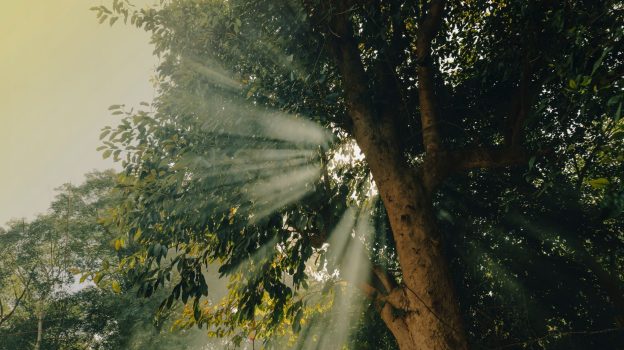
Today, I think I might know what’s next. This. Mother Nature. Or, if you prefer, God’s presence in the outdoors, in the rhythm of water, the sound of birds, the antennae on an insect smaller than my fingertip, patterns in tree bark and in the sky. I need this mothering, a learning of beauty, impermanence, sound and silence. Here I find endless discovery saturated with companionship.
On many Sabbaths last winter I took a walk on another nature path not far from our home, either alone or with one or more of kids/husband. The secluded trails enchanted me with their secret stream and vines with berries, bright red and white. I watched a flock of starlings shapeshift in the sky above a meadow. I sat in the grasses at the base of a naked deciduous tree and paid attention—to the slug on my shoe, the cold and sunny sky. I felt my feet on the earth, and marveled at an enormous wild apple tree. And each time my car crunched out of the gravel parking lot, I was kinder, more hopeful, more grounded. These were lessons learned not in words but in silence. Not through instruction but curious awareness. I found complexity, not perfection. Death mixed with life. The way living things trust the land, and the land trusts living things.
As I sit by Mill Creek, I think about all this and wonder if church is my Father, and nature my Mother. I spent 30 years in my Father’s house; will I spend another 30 in my Mother’s house? I have explored ad nauseam the ways God is my father. But I’ve only just begun to learn how God is my mother.
Mothers are complicated. I want to release my expectations—based on my experience with my own mother, based on what the Bible or churches say about God as mother—and I want to experience it, to accumulate stories of my Mother and I, to come up against the edges of her that nudge me where I don’t like to be nudged, to soak in the warmth of her voluminous embrace. I suspect Mother God will at times disappoint me, and I will try her with my stubborn certainties. I also suspect that, like my Father, she is both safe and wild.
I rise and follow the path along this side of the creek, taking pictures of farmhouses flanked with bright green meadows, and closeups of pink blossoms on trees. I am startled by a bird flying rapidly toward me, an osprey. He or she carries a stick some two feet long, and passes directly overhead. I turn to keep the bird in sight, and it lands across the creek on a nesting platform where a nest is taking shape.
A few days later, I pull books off my shelf, looking for descriptions of masculine and feminine traits—not physical traits, but the ways of being that lie within those terms. Will I find evidence that church leans masculine and nature leans feminine? Are Mother God and Mother Nature one and the same?
In Mirabai Starr’s book, Wild Mercy, I find these descriptions:
Feminine: An aggregate of qualities such as mercy, loving-kindness, wildness, inclusiveness, radical truth telling and tendencies such as nurturing, subversive, relational, community building, heart centered, honoring of embodied experience, comfortable with ambiguity.
Divine Masculine: The sublime aspects of the masculine spiritual paradigm, an inclination toward detachment [objective, impartial, unemotional] and transcendence, intellectual clarity and religious rigor, purification and perfection.
(Bracketed words are mine)
Wildness. Nurturing. Honoring of embodied experience. Comfortable with ambiguity. These I find in nature. I soak in them and I am still thirsty; my capacity to hold more remains undiminished. I dip into Mother Nature again and again, and I come home to myself every time.
Last summer, when my sister was sorting through old family papers, she texted me a picture of a sheet of lined, yellow paper, torn from a mini legal pad. “TOBI June 89 (4 yrs)” is printed at the top in my mom’s writing, and below that, four quotes from my four-year-old self:
“Do you think God needed a ladder to get the sky up there?”
“Is Jesus going to be comin’ ‘round the mountain when he comes?”
“God isn’t a he, God is a she!!”
“Do you think God made our feet first so we could stand while he made the rest of us?”
Three questions and a statement, as only a four-year-old can say them.
After years of grappling with whether it would be offensive to use feminine pronouns to refer to the divine, and with my recent curiosity about Mother God, the statement grabbed me. It seemed my four-your-old self had shown up to give me permission to fall in love with an (obviously!) female God.
In my early thirties I sought help through mental health therapy. I brought my list of goals to the first session, but only later would I come to understand that essentially what I wanted was the ability to live with myself comfortably. My Christian therapist tasked me with writing out internal messages I’d inherited from my dad, and then writing what God might say instead. I cherish the many pages of writing which came out of that exercise, and the ripple effect of healthier thought patterns that affirm my value and wholeness. And I wonder if it is time to do the same exercise for mothers—my earthly mother and my divine Mother. What is my mother’s legacy inside me, and how is God’s mothering different? What are Mother Nature’s messages to me?
And what will be the ripple effect this time? Mirabai Starr writes, “… I believe in the healing energy of the feminine as a fire that can melt the frozen heart of the world, the artistry that will mend the tattered web of interconnection.” This I want to receive, and this I want to regift to my children and my community. Let me be a melter of frozen hearts, mender of tattered connections.
I sit on my porch, tea in hand. Tall, green-leafed bushes grow outside the deck railing, and trees canopy the lawn and driveway, such that nearly my entire view is green. (Later, I ask Google the meaning of the color green, and the AI overview tells me green has a calming effect that slows metabolism and promotes physical and emotional wellbeing. Green also symbolizes renewal.) An inordinate amount of rustling arises as squirrels and birds nose and scratch their way through old autumn leaves beside the gravel drive, searching for tiny treasures in exoskeletons. The new, green leaves of the canopy move continually, and I am amazed by their responsiveness to mere whispers of air. A squirrel sleeps on a tree branch—the same branch I can see from an upstairs window, where I often watch squirrels sleeping or bathing, like a cat. Sleeping squirrels, dancing leaves, the color green—these are “the artistry that will mend the tattered web of interconnection.” These are my Divine Mother.

